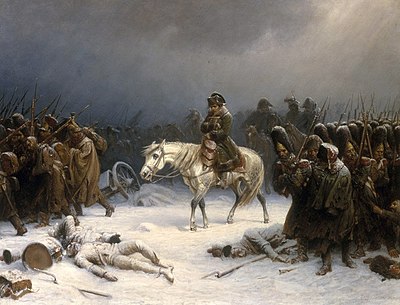
Napoleon's Retreat From Moscow by Adolf NorthernMartin van Creveld, a professor at Hebrew University in Jerusalem, is considered one of the world’s most eminent experts on military history and strategy.
David Seaton's News Links
Martin van Creveld is considered the world's foremost strategic thinker. Nobody has a franker or more cruel reading of the situation the United States faces (the hole it has dug for itself) in the Middle East.
Nobody can accuse van Creveld of "wishful thinking". He is an Israeli and lives in Israel. This gives his views added credibility as he and his loved ones will have to live with the consequences of Bush's idiocy which van Creveld has famously said is, "the most foolish war since Emperor Augustus in 9b.c. sent his legions into Germany and lost them.”
All I can add to the 'master's voice' is my intuition that once this situation becomes clear to one and all... and that could be any moment now, there will be a tipping point when all the different world crisis will begin to collide with each other, much like the classic silent comedy sequence of the "Keystone Cops" running out of the police station. What van Creveld describes is the starting gun for chaos and as the chaos theory makes clear, chaos is chaotic and by definition its surfit of variables makes it next to impossible to predict outcomes. Like the weather the situation in Iraq can only be made sense of in retrospect. DS
Martin van Creveld is considered the world's foremost strategic thinker. Nobody has a franker or more cruel reading of the situation the United States faces (the hole it has dug for itself) in the Middle East.
Nobody can accuse van Creveld of "wishful thinking". He is an Israeli and lives in Israel. This gives his views added credibility as he and his loved ones will have to live with the consequences of Bush's idiocy which van Creveld has famously said is, "the most foolish war since Emperor Augustus in 9b.c. sent his legions into Germany and lost them.”
All I can add to the 'master's voice' is my intuition that once this situation becomes clear to one and all... and that could be any moment now, there will be a tipping point when all the different world crisis will begin to collide with each other, much like the classic silent comedy sequence of the "Keystone Cops" running out of the police station. What van Creveld describes is the starting gun for chaos and as the chaos theory makes clear, chaos is chaotic and by definition its surfit of variables makes it next to impossible to predict outcomes. Like the weather the situation in Iraq can only be made sense of in retrospect. DS
Martin van Creveld: The Fall:
Consequences of US Withdrawal From Iraq - New Perspectives Quarterly
Abstract: Withdrawing 140,000 soldiers with all their equipment is a very complex operation. In 1945 and 1973, the US simply evacuated its troops, leaving most of its equipment to its West European and South Vietnamese protégés respectively. This time, however, things are different. So precious is modern defense equipment that not even the largest power on earth can afford to abandon large quantities of it; in this respect, the model is the First Gulf War, not Vietnam or World War II. Second, whatever equipment is left in Iraq is very likely to fall into the hands of America’s enemies. Thus the Pentagon will have no choice but to evacuate millions of tons of war materiel the way it came—in other words, back at least as far as Kuwait. Doing so will be time-consuming and enormously expensive. Inevitably, it will also involve casualties as the road-bound convoys making their way south are shot up and bombed. The Iraq that the American forces leave behind them has been devastated. Its infrastructure has been wrecked; the oil industry, which used to account for 90 percent of its income, is in ruins. A recent estimate puts human losses at 150,000 dead. Worst of all, a government that can master the situation is not in sight.(...) A reunited Iraq will take a long time to rise, if it ever does. A fragmented Iraq will greatly strengthen, indeed has already greatly strengthened, the position of Iran. Iran will surely play a major role in determining Iraq’s future, but just in what direction it will make its influence felt and how great its impact is going to be nobody knows. One thing, though, is absolutely certain. To make sure some future American president does not get it into his or her head to attack Iran as Iraq was attacked (essentially, for no reason at all), the Iranians are going to press ahead as fast as they can in building nuclear weapons. A powerful Iran presents a threat to the world’s oil supplies and should therefore worry Washington. To deter Iran, US forces will have to stay in the region for the indefinite future (...) Some countries in the Middle East ought to be even more worried about Iran than the US. While turning to the latter for protection, several of them will almost certainly take a second look into the possibility of starting their own nuclear programs. Each time a country proliferates, its neighbors will ask whether they, too, need to do the same. In time, Saudi Arabia, Turkey, Egypt and Syria may all end up with nuclear arsenals. How this will affect the regional balance of power is impossible to say. A government-less Iraq that is in a state of chronic civil war will present an ideal breeding ground for terrorists of every sort. Presumably, most terrorists will merely want to participate in, and profit from, the civil war itself, but some will no doubt have wider objectives in mind. Most will probably operate within Iraq, but some will almost certainly take on the regimes of neighboring Arab countries, such as Jordan and Kuwait. Some may reach Lebanon, others Israel. Others still will try to extend their activities into the West. Another Bin Laden, setting up his headquarters somewhere in Iraq and directing his operations from there, is a distinct possibility. Before 2003, many people looked at the US as a colossus that was bestriding the earth. Whatever else, the war has left the US with its international position weakened; Secretary of State Condoleezza Rice may bark, but she can hardly bite. So shattered and demoralized are the armed forces that they can only fill their ranks by taking in 41-year-old grandmothers. READ IT ALL
Consequences of US Withdrawal From Iraq - New Perspectives Quarterly
Abstract: Withdrawing 140,000 soldiers with all their equipment is a very complex operation. In 1945 and 1973, the US simply evacuated its troops, leaving most of its equipment to its West European and South Vietnamese protégés respectively. This time, however, things are different. So precious is modern defense equipment that not even the largest power on earth can afford to abandon large quantities of it; in this respect, the model is the First Gulf War, not Vietnam or World War II. Second, whatever equipment is left in Iraq is very likely to fall into the hands of America’s enemies. Thus the Pentagon will have no choice but to evacuate millions of tons of war materiel the way it came—in other words, back at least as far as Kuwait. Doing so will be time-consuming and enormously expensive. Inevitably, it will also involve casualties as the road-bound convoys making their way south are shot up and bombed. The Iraq that the American forces leave behind them has been devastated. Its infrastructure has been wrecked; the oil industry, which used to account for 90 percent of its income, is in ruins. A recent estimate puts human losses at 150,000 dead. Worst of all, a government that can master the situation is not in sight.(...) A reunited Iraq will take a long time to rise, if it ever does. A fragmented Iraq will greatly strengthen, indeed has already greatly strengthened, the position of Iran. Iran will surely play a major role in determining Iraq’s future, but just in what direction it will make its influence felt and how great its impact is going to be nobody knows. One thing, though, is absolutely certain. To make sure some future American president does not get it into his or her head to attack Iran as Iraq was attacked (essentially, for no reason at all), the Iranians are going to press ahead as fast as they can in building nuclear weapons. A powerful Iran presents a threat to the world’s oil supplies and should therefore worry Washington. To deter Iran, US forces will have to stay in the region for the indefinite future (...) Some countries in the Middle East ought to be even more worried about Iran than the US. While turning to the latter for protection, several of them will almost certainly take a second look into the possibility of starting their own nuclear programs. Each time a country proliferates, its neighbors will ask whether they, too, need to do the same. In time, Saudi Arabia, Turkey, Egypt and Syria may all end up with nuclear arsenals. How this will affect the regional balance of power is impossible to say. A government-less Iraq that is in a state of chronic civil war will present an ideal breeding ground for terrorists of every sort. Presumably, most terrorists will merely want to participate in, and profit from, the civil war itself, but some will no doubt have wider objectives in mind. Most will probably operate within Iraq, but some will almost certainly take on the regimes of neighboring Arab countries, such as Jordan and Kuwait. Some may reach Lebanon, others Israel. Others still will try to extend their activities into the West. Another Bin Laden, setting up his headquarters somewhere in Iraq and directing his operations from there, is a distinct possibility. Before 2003, many people looked at the US as a colossus that was bestriding the earth. Whatever else, the war has left the US with its international position weakened; Secretary of State Condoleezza Rice may bark, but she can hardly bite. So shattered and demoralized are the armed forces that they can only fill their ranks by taking in 41-year-old grandmothers. READ IT ALL

