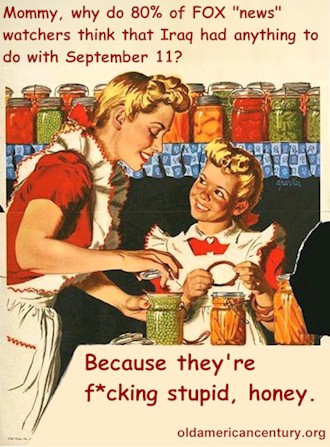

"The problem is not just the things we do not know (consider the one in five American adults who, according to the National Science Foundation, thinks the sun revolves around the Earth); it's the alarming number of Americans who have smugly concluded that they do not need to know such things in the first place. Call this anti-rationalism -- a syndrome that is particularly dangerous to our public institutions and discourse."David Seaton's News Links
Susan Jacoby - Washington Post
America is literally like no other country in the world. To understand how original it is you only have to compare it to Australia and Canada. In fact one of the best ways of coming to grips with the American psyche is to begin by comparing these three, white settler, ex-British colonies.
America is extraordinarily original, therefore "exceptional", but not exactly like most Americans think. In fact "American Exceptionalism" is a doctrine which maintains that Americans, because of their innate "goodness", are destined to fulfill a special destiny.
Here is a sample of this mentality in a recent statement of Colin Powell's, which many see as an indirect endorsement of Barack Obama:
"I am going to be looking for the candidate that seems to me to be leading a party that is fully in sync with the candidate and a party that will also reflect America's goodness and America's vision."Now there any number of positive adjectives that I could apply to "my fellow Americans": energetic, creative, hard working, ingenious, enthusiastic, etcetera, but "good"?
General Powell is talking about a people who enslaved his ancestors, ethnically cleansed the Native-Americans, dropped atomic bombs on the helpless civilian populations of Hiroshima and Nagasaki and uselessly killed about a million Vietnamese in a historically short space of time. Good? Certainly, any lucid historian would have to say about America what the British used to say about certain ladies, "she's no better than she ought to be".
So, I am not "proud" to be an American, simply, I AM an American. I love America because I love myself, not vice versa. I accept and cherish her gifts to me and assume her karma reverently. America is my idiosyncrasy, my mother tongue and a sortilege of skandas to schlep though the samsara. Never, in my whole life, often surrounded by people who detest what the United States represents, have I ever said -- with that smile of a fox eating shit off a wire brush -- that I am a Canadian... In the words of a great American, "I yam what I yam". I just don't want to live there, f'ya knowwhaddahmean.
After I lived away from America some time, I began to have enough distance to "see oursels as ithers see us" and realize how unique, eccentric, idiosyncratic and even a bit sinister America really is. However, like Susan Jacoby, whose text I quote today, lately I have begun to notice that America has passed originality to become simply weird. A country that produced Emerson, William James, Walt Whitman, Henry Ford and Thomas Alva Edison has become a universal byword for stupidity.
'Twasn't always so. Jacoby writes:
People accustomed to hearing their president explain complicated policy choices by snapping "I'm the decider" may find it almost impossible to imagine the pains that Franklin D. Roosevelt took, in the grim months after Pearl Harbor, to explain why U.S. armed forces were suffering one defeat after another in the Pacific. In February 1942, Roosevelt urged "Americans to spread out a map during his radio "fireside chat" so that they might better understand the geography of battle. In stores throughout the country, maps sold out; about 80 percent of American adults tuned in to hear the president. FDR had told his speechwriters that he was certain that if Americans understood the immensity of the distances over which supplies had to travel to the armed forces, "they can take any kind of bad news right on the chin." This is a portrait not only of a different presidency and president but also of a different country and citizenry, one that lacked access to satellite-enhanced Google maps but was far more receptive to learning and complexity than today's public. According to a 2006 survey by National Geographic-Roper, nearly half of Americans between ages 18 and 24 do not think it necessary to know the location of other countries in which important news is being made.If we go farther back we can find masses of citizens, many frontiersmen, who way back in 1858 were able to follow the complex arguments of the Lincoln-Douglas debates. So obviously this isn't something genetic. Americans are being deliberately turned into idiots, because only idiots would act as America does today. What has happened? Who in America wants Americans to be so stupid? Why?
It is far beyond my modest abilities to forge a truly American, grand, paranoid, conspiracy theory of all of this. But I would humbly direct the attention of those sufficiently endowed in these matters to explore the confluence of interests between America's over bloated military spending, its suicidally self-defeating foreign policy and the enormous media conglomerates: news-sports-Hollywood, that create America's mental wallpaper, the texture of its stupidity. The answer is certainly there. DS
Susan Jacoby: The Dumbing Of America - Washington Post
Abstract: "The mind of this country, taught to aim at low objects, eats upon itself." Ralph Waldo Emerson offered that observation in 1837, but his words echo with painful prescience in today's very different United States. Americans are in serious intellectual trouble -- in danger of losing our hard-won cultural capital to a virulent mixture of anti-intellectualism, anti-rationalism and low expectations. This is the last subject that any candidate would dare raise on the long and winding road to the White House. It is almost impossible to talk about the manner in which public ignorance contributes to grave national problems without being labeled an "elitist," one of the most powerful pejoratives that can be applied to anyone aspiring to high office.(...) Dumbness, to paraphrase the late senator Daniel Patrick Moynihan, has been steadily defined downward for several decades, by a combination of heretofore irresistible forces. These include the triumph of video culture over print culture (and by video, I mean every form of digital media, as well as older electronic ones); a disjunction between Americans' rising level of formal education and their shaky grasp of basic geography, science and history; and the fusion of anti-rationalism with anti-intellectualism.(...) It is not surprising, for example, that less has been heard from the presidential candidates about the Iraq war in the later stages of the primary campaign than in the earlier ones, simply because there have been fewer video reports of violence in Iraq. Candidates, like voters, emphasize the latest news, not necessarily the most important news. No wonder negative political ads work. "With text, it is even easy to keep track of differing levels of authority behind different pieces of information," the cultural critic Caleb Crain noted recently in the New Yorker. "A comparison of two video reports, on the other hand, is cumbersome. Forced to choose between conflicting stories on television, the viewer falls back on hunches, or on what he believed before he started watching." As video consumers become progressively more impatient with the process of acquiring information through written language, all politicians find themselves under great pressure to deliver their messages as quickly as possible -- and quickness today is much quicker than it used to be.(...) The problem is not just the things we do not know (consider the one in five American adults who, according to the National Science Foundation, thinks the sun revolves around the Earth); it's the alarming number of Americans who have smugly concluded that they do not need to know such things in the first place. Call this anti-rationalism -- a syndrome that is particularly dangerous to our public institutions and discourse. Not knowing a foreign language or the location of an important country is a manifestation of ignorance; denying that such knowledge matters is pure anti-rationalism. The toxic brew of anti-rationalism and ignorance hurts discussions of U.S. public policy on topics from health care to taxation. There is no quick cure for this epidemic of arrogant anti-rationalism and anti-intellectualism; rote efforts to raise standardized test scores by stuffing students with specific answers to specific questions on specific tests will not do the job. Moreover, the people who exemplify the problem are usually oblivious to it. ("Hardly anyone believes himself to be against thought and culture," Hofstadter noted.) It is past time for a serious national discussion about whether, as a nation, we truly value intellect and rationality. READ IT ALL


