Showing posts with label civil rights. Show all posts

Tuesday, January 01, 2013

New Year's Re(v)olutions

Obama in Rosa Park's seat
POTUS sits in Rosa Park's seat
"It would be a good idea"
Mahatma Gandhi, when asked his opinion of western civilization.
Putting content into fine words would be the greatest of revolutions, now and always. 
Cynics today might be forgiven for thinking that the words of Jesus are often only used as a cover for serial child abuse, but who could doubt that if only all those with four grandparent that called themselves Christians, practiced only the following Christian precepts: to love their neighbors as themselves, to do unto others as they would have others do unto them, to never cast the first stone and then  forgive others their trespasses, then most of the world that even today considers itself civilized would instantly be like heaven on earth. However hypocritical Christians abound and we are as we are.
I cannot imagine that anybody would call Jesus himself a hypocrite, he certainly walked the walk, no space between his words and his actions, however hypocrites can often say memorable things too.
An example: perhaps the greatest hypocrite in America's history, Thomas Jefferson, a brutal slave owner, a sexual exploiter of his slaves, wrote the most powerful words in the American canon, words that rival the Bible in their grandeur and echo: Jefferson wrote that line, "All men are created equal"...
Despite Jefferson's hypocrisy, citizens trying to fill those words with some meaning brought about a revolution in my lifetime.
How hypocritical were Jefferson's words in America's mouth?
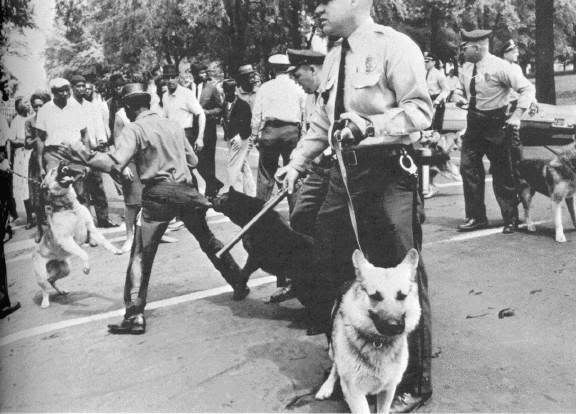
An example. In the segregated South, during World War Two, during America's war against fascism, African-American GIs, wearing the uniform of the United States army, often found themselves riding in the back of public buses while German POW trustees rode up front with the local white people.
How is that for hypocrisy?
The Civil Rights movement changed that. Today, with all the endless caveats you can apply, a black man is the president of the United States. He is the Chief of State of the most powerful country in the world, sitting in the White House, the tenant of a building where during most of America's history the only black people ever seen there were butlers and waiters.
People got lynched, went to jail, marched and sang for the photo that tops this post. J. Edgar Hoover would spin in his grave if he saw it. There are people still spinning when they see it.
So, if enough people make their minds up to change, to change themselves, then to change the world, then change is doable.
I would say that during the coming year, the next set of fine noble, words that need to be reconsecrated, refurbished and refilled with meaning are Abraham Lincoln's from his Gettysburg Address:
"Government of the people, by the people, for the people, shall not perish from the earth".
To do that the Citizen's United verdict needs to be overturned and campaign financing needs to be regulated. Any meaningful change begins there.
The goal is clear, now the question is, who is going to bell the cat?
Happy New Year!
DS


Sunday, June 12, 2011

Movements without "leaders"

David Seaton's News Links
The other day, a top American political consultant, Matthew Dowd, was visiting Madrid and was interviewed by the local "newspaper of reference", El PaĆ­s. When he was asked his opinion about Spain's "15th of May" citizen's movement, AKA, "The Spanish Revolution" or "Los Indignados", he dismissed them saying, "If they want to influence the system they must work from within, supporting a leader." In so saying, I think this consummate insider has revealed one of the keys to a political system which today seems much more in tune with lobbies and special interest groups than with the lives and concerns of its citizens and voters: a "caste apart"... precisely what los indignados are indignant about.
Are political leaders a solution?

A true political movement is about agreed goals, not about "leaders". Look at the American Civil Rights movement, a true citizen's movement if there ever was one. Martin Luther King was its voice, but the energy behind his voice was the energy of thousands of "Rosa Parks": black people, who had it very clear in their minds that they had had enough. Men and women, even children, who simply were not about to take any more shit.

Without those thousands upon thousands of "Rosa Parks", marchers and martyrs, and their firm decision not to back down even one step, Martin Luther King would have been no more than another fine example of the African-American community's legendary, evangelical pulpit artistry. The nobility of the movement he gave voice to washes away any controversies over personal frailties he may have had and enshrines him in American history. In short, Rosa Parks "created" Martin Luther King and Martin Luther King Day and not vice-versa. 

Therefore a clear cause, with clear objectives, is the heart of a powerful movement: objectives which elicit the commitment of those who join it, and that combination of objectives and massive commitment calls forth clear "leadership" as needed. In short a healthy mass political movement is created first by the "followers" not by the "leaders".

Starting with the leader and then looking around for some objectives and then looking for followers is simply manipulative, no different really than selling any other product. You could even say that in a "leader-originated" movement, the leader's role is to take the "movement" out of the movement. Certainly there could be no greater contrast than between the Civil Rights Movement and the  marketing operation, cast as a "movement", that took Barack Obama to the White House. Contrast MLK's, "If man hasn’t discovered something that he will die for, he isn’t fit to live." with Obama's lawyerly, "change (you can believe in) ".

The proof of this is that, what should have been the crowning moment of the Civil Rights struggle, putting an African-American into the White House, after all the froth and self-congratulation, is turning out to be next to meaningless by any objective measure.

So Matthew Dowd is wrong. There is a surfeit of "leaders" today, politics is crawling with them, what are needed are people: masses of committed people, people who come together with clear objectives to change things and just like Rosa Parks, wont take no for an answer.

It would make me happy to think that anything as spontaneous and potentially fertile as Spain's "indignados" could spring to life in the USA... that would change not only the USA, it would change the entire world.

We live in hope. DS

Thursday, January 24, 2008

William Pfaff: The Coup d'Etat against Bush


David Seaton's News Links
I can't think of a more important topic than this. This is not the rant of some blogger in pajamas. William Pfaff is one of the most respected political commentators writing today in the English language.

Careful readers will notice a thick forest of nuances in everything he says here. DS


William Pfaff: The Coup d'Etat against Bush
Abstract: The conspicuous irrelevance of George W. Bush’s tour of the Middle East to any of the real forces and interests of the region, as well as the spooky irrelevance of nearly everything he said there about the alleged menace of Iran, Israel-Palestine peace, his fancied notions of Iraq’s democratic development, and even about oil prices and the American economy, embarrassed his Arab hosts as well as the American officials and press accompanying him. The tour – his farewell to the Middle East? -- lent weight to the judgement many abroad have already reached, that he no longer governs the United States, and indeed does not even understand its present foreign relationships. It is widely felt that what amounts to a coup d’etat has taken place in the United States, removing George Bush, without his even recognizing this (or at least admitting that it has occurred) from control over the principal issues of war and peace. This coup has taken the form of what amounts to a mutiny of the professional foreign policy services of the U.S. government, acquiesced in by the new Secretary of Defense, the service chiefs, and Director of Central Intelligence Bush has himself appointed.(...) The pathetic and pusillanimous refusal of recent American Congresses – and we are not simply speaking about the Congress now in office, but of practically every Congress since the beginning of the cold war – to fulfill their constitutional responsibilities with respect to the declaration and financing of wars, has now generated its own rebuke from within the executive branch of government. Leaders in the executive branch are unwilling to act on presidential orders that do not carry with them the constitutionally mandated authority of the representative branch of government.(...) I am perhaps taking a romantic and unjustified view of what has happened. I hope not. I believe that only grave malfeasance in government and unconstitutional conduct justify an executive ‘coup d’etat’ – however ‘postmodern’ the form that it assumes, and however elevated its motives. However I would suggest that the present election campaign demonstrates that powerful forces in the Washington political and foreign policy communities, reinforced by financial and industrial interests, are committed to suppressing all challenge to policies that already have altered the political character of the United States. The American form of government itself needs to be defended. READ IT ALL

Thursday, January 10, 2008

Health is a "civil right"

"What European countries definitely haven’t done is dismantle their strong social safety nets. Universal health care is a given. So are a variety of programs that support families in trouble, helping protect Europeans from the extreme poverty all too common in this country.(...) the next time a politician tries to scare you with the European bogeyman, bear this in mind: Europe’s economy is actually doing O.K. these days, despite a level of taxing and spending beyond the wildest ambitions of American progressives."
Paul Krugman - NYT
David Seaton's News Links
Health is a civil right, like the right to life or the right to vote.

I live in Europe, where we have socialized medicine. This means that the major hospitals are owned by the state. During at least half the day most doctors, even eminent specialists, are state employees. Medicines, even the most expensive, are heavily subsidized or totally free. Here the suffering of poor people in America without medical care, or the anxiety of the American middle class worrying about losing their jobs and thus losing their coverage is unthinkable. I read the "plans" the different American political "leaders" have to solve this suffering and humiliation and they remind me of the cynical and patronizing "separate but equal" justifications of the Jim Crow south.

The more I explore this painful and festering sore of scores of millions of Americans of all colors without adequate medical care, the more I am reminded of the political climate before the civil rights battles of the 50s and 60s. What seems totally missing, however, is the Martin Luther King or the Malcolm X to give it shape and words. Polar bears and glaciers have their Al Gore, but who is to lead a citizen's revolt against pain, sickness, humiliation and death?

You could say that the idea of some 40,000,000 Americans many of them of color, condemned to death and disease is even worse than the injustice of segregation, but the comparison is one of hope. The civil rights movement's successes means that even within the American system profound change is possible when enough people stand up and say, "this far, no farther." It can be done, it's been done before.

For someone who has no memory of what America was like before the civil rights movement, let me explain as quickly and brutally as I can what America would be like today if that movement had never existed:

  • Colin Powell would be a retired army sergeant.
  • Barack Obama's mother would be a pariah.
  • Barack Obama would be somebody's butler.
  • Clarance Thomas would be working in somebody's yard.
  • Condoleezza Rice would be teaching in a segregated grammar school.
  • Oprah Winfrey would be cleaning some white lady's house.
That America is so different today, that the lives of the above mentioned have turned out so differently, was not engineered by benevolent politicians, it was a conquest of the American people in the streets. It was all about marches, sit ins and riots. It cost pain, blood, jail time and lives. Cities burned and soldier's patrolled the streets, men were lynched. It was a movement. The politicians came trailing after making laws to recognize the facts created on the ground.

The result is that the America of today is barely recognizable to someone born into the America that was before. This means that things can be changed by people who won't accept "no" for an answer.

But make no mistake, this battle could be even harder and crueler. The battle against prejudice and discrimination was only really about customs and habits, it was fought in the context of the cold war where the Soviet Union used the plight of black people in the USA to its advantage in Europe and the Third World. Law makers knew that social inertia was the only real obstacle to dramatically improving America's self-image and its image around the world as a champion of freedom. It was simply good for business. For America's rich and the powerful little was really changed by allowing African-Americans full civil rights.

The battle for the right to health, however is about money, lots of money: higher taxes for the rich, much higher... like in Sweden. And the limits beyond which the wealthy of America will not go
in defense of their money, has yet to be discovered.

The money invested in the ideology necessary to fight socialized medicine in America is also limitless. This ideological task force that the oligarchy has deployed has even made the very words "
socialized medicine" taboo. Thus the successful system of countries like Britain, Canada, France and Germany is made to sound like something inefficient and subversive.

Politicians require huge amounts of money to get elected and those who sign the big checks don't want to pay the taxes necessary to pay for a health system similar to Europe's. I don't think anything meaningful will ever occur led by the men and women who owe their existence to our present system of campaign financing.

To get something like this done only a movement will suffice and I doubt if even a million uninsured children marching on Washington would be enough to melt the hearts of those weaned on a diet of Ayn Rand. It might take a general strike, the shutting down of America's huge transport system for a few days,
to bring it off.

This more than any other is work for grassroots activists and organizers: free health care for all is the true catalyst for change in the USA. Those who begin to organize this from the ground up are today's equivalent of the Freedom Riders that opened up the American south and ennobled an entire generation. DS

Paul Krugman: The Comeback Continent - NYT
Abstract: Why should Americans care about Europe’s economy? Well, for one thing, it’s big. The G.D.P. of the European Union is roughly comparable to that of the United States; the euro is almost as important a global currency as the dollar; and the governance of the world financial system is, for practical purposes, equally shared by the European Central Bank and the Federal Reserve. But there’s another thing: it’s important to get the facts about Europe’s economy right because the alleged woes of that economy play an important role in American political discourse, usually as an excuse for the insecurities and injustices of our own society. For example, does Hillary Clinton have a plan to cover the millions of Americans who lack health insurance? “She takes her inspiration from European bureaucracies,” sneers Mitt Romney. Or are top U.S. executives grossly overpaid? According to a Times report, Michael Jensen, a professor emeritus at Harvard’s Graduate School of Business whose theories helped pave the way for gigantic paychecks, considers executive excess “an acceptable price to pay for an American economy that he believes has outstripped Japan and Europe in growth and prosperity.” In fact, however, tales of a moribund Europe are greatly exaggerated.(...) Since 2000, employment has actually grown a bit faster in Europe than in the United States — and since Europe has a lower rate of population growth, this has translated into a substantial rise in the percentage of working-age Europeans with jobs, even as America’s employment-population ratio has declined. In particular, in the prime working years, from 25 to 54, the big gap between European and U.S. employment rates that existed a decade ago has been largely eliminated. If you think Europe is a place where lots of able-bodied adults just sit at home collecting welfare checks, think again. Meanwhile, Europe’s Internet lag is a thing of the past. The dial-up Internet of the 1990s was dominated by the United States. But as dial-up has given way to broadband, Europe has more than kept up. The number of broadband connections per 100 people in the 15 countries that were members of the European Union before it was enlarged in 2004, is slightly higher than in the U.S. — and Europe’s connections are both substantially faster and substantially cheaper than ours. I don’t want to exaggerate the good news. Europe continues to have many economic problems. But who doesn’t? The fact is that Europe’s economy looks a lot better now — both in absolute terms and compared with our economy — than it did a decade ago. What’s behind Europe’s comeback? It’s a complicated story, probably involving a combination of deregulation (which has expanded job opportunities) and smart regulation. One of the keys to Europe’s broadband success is that unlike U.S. regulators, many European governments have promoted competition, preventing phone and cable companies from monopolizing broadband access. What European countries definitely haven’t done is dismantle their strong social safety nets. Universal health care is a given. So are a variety of programs that support families in trouble, helping protect Europeans from the extreme poverty all too common in this country. All of this costs money — even though European countries spend far less on health care than we do — and European taxes are very high by U.S. standards.(...) According to the anti-government ideology that dominates much U.S. political discussion, low taxes and a weak social safety net are essential to prosperity. Try to make the lives of Americans even slightly more secure, we’re told, and the economy will shrivel up — the same way it supposedly has in Europe. But the next time a politician tries to scare you with the European bogeyman, bear this in mind: Europe’s economy is actually doing O.K. these days, despite a level of taxing and spending beyond the wildest ambitions of American progressives. READ IT ALL