 David Seaton's News LinksA Spanish friend of ours that runs a very important NGO has just come back from Beijing, where she hadn't visited since 1995. In those days, as she tells it, Beijing was millions of identically dressed people on bicycles and deep fried grasshopper stands on every corner. Today, she says that Beijing makes the isle of Manhattan look like Trenton New Jersey. What has been done in a little over ten years is breathtaking.
I think by now it's obvious that someday China is going to surpass the United States. There are too many of them, they work too hard, they are too smart and there are too many of them... I already said that.
Still, the USA has one advantage that will probably keep it afloat much longer than it deserves. The secret is in the photo above, taken in a KFC in Beijing.
What is that secret?
People like to pretend they are Americans.
China is without any question one of the world's greatest cultures with massive contributions to humanity's treasures in thought, word and deed over thousands of years. However, no matter how much you admire and love their culture, unless you are of 100% Han Chinese descent, it is impossible to imagine yourself being Chinese. Statistically, of course, there is a fairly good chance that you are Chinese already, but if you aren't, there is no way in the world you can become Chinese. You are either Chinese or you aren't.
But, thanks to America's amazing ability to mythify even its most banal idiosyncrasies, millions upon millions of humans all over the world imagine themselves to be Americans several hours a week and have been doing so since the invention of moving pictures. This is usually known as America's "colonization of the world's subconscious".
You don't even have to speak English to participate. Films are dubbed. I remember, when learning the language, that I soon got used to hearing John Wayne speaking Spanish on the screen, but I collapsed in laughter the first time I heard him speak Italian. John Wayne? Italiano? ¡No, hombre, no!
The Chinese man in the picture, happy in his cowboy hat, is our Pyramid of Giza, our Great Wall. DS
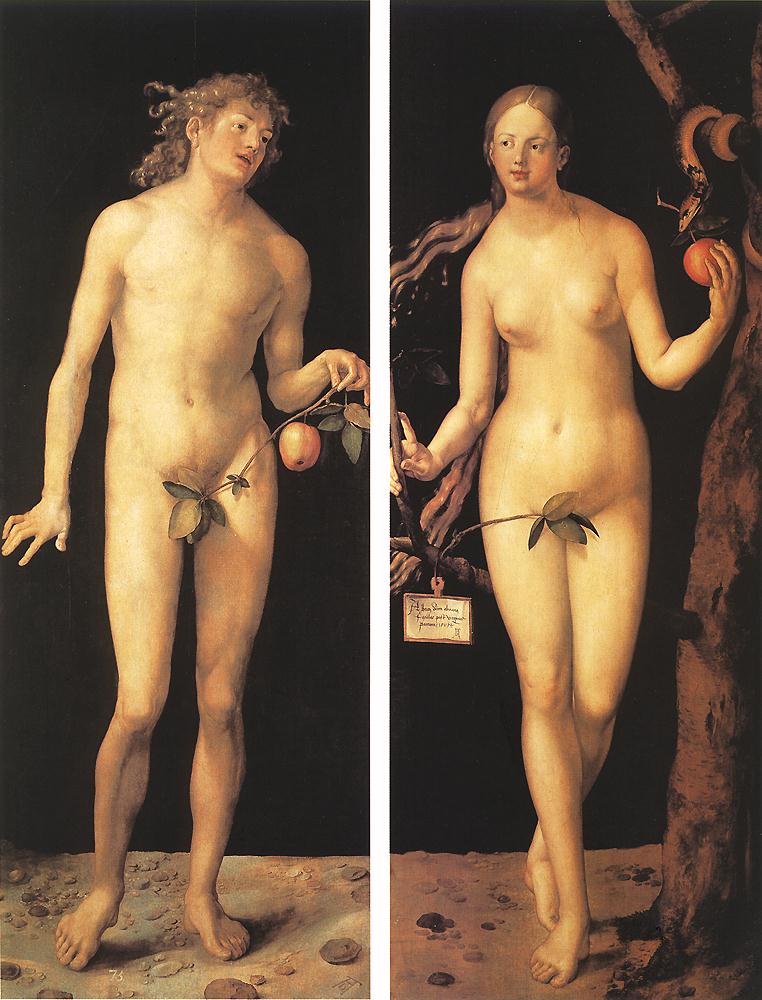 Mom and Pop - Albrecht Durer - 1507
A very wise man once said that there are only two kinds of people in the world: those that think that there are only two kinds of people in the world and those who don't.
The other day I posted an article by Gabriel Rachman from the Financial Times, dissecting neocon-über-guru Bernard Lewis's view of Islam.
Rachman said something very basic that I'd like to underline. The tell-tale danger sign in Mr Lewis's argument is that he constantly refers to Muslims in Europe as "they" - an undifferentiated mass. (...) Once you start thinking of the more than 15m Muslims living in Europe as a single, hostile bloc, you close the door to understanding and open the door to racism.
This readiness to quickly divide the world into "us" and "them": this need to stimulate tribalism, is at the heart of right wing populism and the only difference between right wing populism and fascism is the degree of organized violence that they finally produce.
If you observe humanity closely it is hard to apply the word "them" to any mass of it. Perhaps only creatures from outer space could really be "them"... Humanity is "us". This is not to underestimate or obviate the cultural differences that exist. They exist because our species is unique in having memory, unique in its ability to accumulate and tell stories about itself. And also unique in living under the shadow of death, which other species ignore until it is upon them. Geography, climate, memory, language and death are the origins of culture.
Under our important cultural differences we have a species that that is defined by living in society with its fellows. Different cultures facing different geography and climate have devised different strategies to make that possible, but all cultures have been faced with the same problem of integrating large groups of "us" into something manageable and productive enough to survive.
Most if not all of these strategies for social survival place value on such concepts as truth and peace and what the Chinese philosopher Mencius called, "human heartedness" or "innate goodness". His famous example (hat to Wikipedia) is called "The Four Beginnings" (benevolence, righteousness, respect and the capacity to distinguish right from wrong).. To show innate goodness, Mencius used the example of a child falling down a well. Witnesses of this event immediately feel:
- Alarm and distress, not to gain friendship with the child's parents, nor to seek the praise of their neighbors and friends, nor because they dislike the reputation [of lack of humanity if they did not rescue the child]...
- The feeling of commiseration is the beginning of humanity; the feeling of shame and dislike is the beginning of righteousness; the feeling of deference and compliance is the beginning of propriety; and the feeling of right and wrong is the beginning of wisdom.
- Men have these Four Beginnings just as they have their four limbs. Having these Four Beginnings, but saying that they cannot develop them is to destroy themselves.
These values make it possible for human beings to live together, to eat, to breed and to buy and to sell... and to realize their humanity.
Mencius's Four Beginnings could probably be a practical starting point for a constructive dialog, leading to peaceful coexistence, between any groups of human beings who have ever inhabited this planet. The challenge today with globalization and the phenomenon of mass immigration is to simultaneously respect that climate, geography, memory and death have made us all "different" while our common humanness has made us all "the same". DS
 David Seaton's News Links
