 David Seaton's News Links
I was perusing The Guardian the other morning looking for articles about the G-20 for a press dossier, when I stumbled On this about the American actor, writer and director Tyler Perry:
Why is the man ranked by the business magazine Forbes as the third top-earning black artist in America, with a personal income of $125m (£87m) a year, also described by Forbes as the "best kept secret in movie-making"? Why is he a virtual unknown outside America, while even within the US, he is regularly panned by critics or, worse, utterly ignored by them? Why, in return, has he turned his back on mainstream Hollywood, shunning the big studios, refusing to screen his films for critics, barely marketing them to wider audiences?Why indeed?
Here are Perry's numbers from Entertainment Weekly:
Number of Tyler Perry Films: 7Living outside the states, Tyler Perry was completely off my radar, but I get the impression that he could also be completely off the radar of almost any white person actually living inside the United States today.
Number of Films That Have Opened at No. 1 or No. 2: 6
Combined Domestic Gross: $356 mil
It seems that he is literally worshiped by working class African-Americans, but is a bit of an embarrassment for upwardly mobile members of that community.
Todd Boyd, an expert on race and popular culture at the University of Southern California, draws a connection between the stereotypes of black people perpetrated by Hollywood in the days of legal segregation and Perry's caricatures. "Black people were portrayed as slow and dumb; they scratched when they didn't itch, laughed when they weren't funny. They were buffoonish. "Tyler Perry has taken a number of those stereotypes and owned them - reinterpreting them for a new era. The difference is they used to be perpetrated by white Hollywood studio bosses. Now we have an African-American getting rich off them."Of course the difference is that nowadays black people are doing the laughing, not white people, and black people are making Perry rich, not white people. Perry proves that African-Americans enjoy seeing themselves stereotyped by an African-American in ways that would not be acceptable in white hands. That is probably the biggest and certainly the most crucially important difference between Tyler Perry and say, Freeman Gosden and Charles Correll.
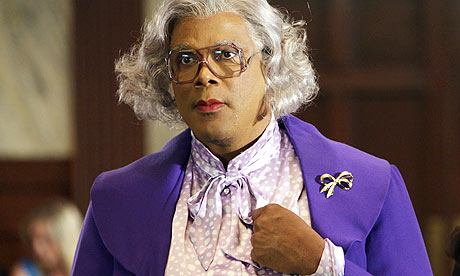
I watched some very crude, but very fresh and very funny Perry/Madea videos on Youtube and the first thing that came to my mind was that Perry's Madea was doing "Moms Mabley" with a pistol. Moms Mabley was a legendary comedienne, doyenne of the "chitlin circuit", the theaters and night clubs like Harlem's Apollo that catered exclusively to African-American audiences.
So much of America's exportable culture, its image, especially it's music, language, sports and fashion, or practically anything joyous it sends to the world, is of African-American origin and there have always been an enormous number of hugely talented black performers that were unknown to white audiences. This was principally due of course to segregation, but even in those days white cognoscenti were constantly visiting the circuit eager to steal the routines and techniques of its stars like Bojangles Robinson, getting rich from it while the black artists often made very little themselves by comparison. The examples are countless
Again, what sets Tyler Perry apart today is the money he is making... and his independence.
For me the most interesting thing about Tyler Perry beyond his highlighting America's enduring racial-cultural divide is how through extremely viral marketing techniques he has managed to maintain total control of his work. There is no doubt in my mind that he is the most totally in control auteur in American cinema, perhaps in American cinema's history.
I also enjoy what many critics, both black and white, criticize, even detest about Perry's work, which is its crude, homemade, almost amateurish quality.
In the era of huge super productions filled with super heroes, superstars, special effects and 3D animation, it is wonderful to see films about ordinary people with ordinary problems; films with the production values of a high school play, giving a box-office drubbing to deracinated, polystyrene films with budgets that would dwarf the GDP of a small country.
Another very interesting facet of Perry's work is that his films begin as plays that go on tour all over the country, so that all the material has been amply tested in front of live audiences - his audience - before any camera ever rolls. As far as I know this hasn't happened since the days of the Marx Brothers, who also liked to test their new material with live audiences to see what worked and what didn't before they began to film.
Perry's whole approach to his audience reminds me of the "slow food" movement: maximum respect for the ingredients and maximum respect for those who consume them.
What makes me sad is that despite Obamania, the cultural divide between Americans is still so great that only five percent of the audience for such genuinely American films is white. DS