Thursday, June 17, 2010

Oil, Obama and tea... tea everywhere and not a drop to drink

Ruccola
As one should expect from a natural phenomenon, failure is fractal—observable at every scale. The same pattern of maladaptive strategy leading to untimely demise constantly replays itself at the level of viruses and bacteria, and all the way to individual plants and animals, populations, societies, countries and civilizations. Dimitri Orlov

Bogus and misdirected as the Tea Party movement is, in one respect it has an authenticity that the left lacks: it is angry and it's prepared to translate that anger into action. It is marching, recruiting, unseating, replacing. We talk, they act.  George Monbiot - Guardian
David Seaton's News Links
Globalization allows or forces all people to ask themselves, "what benefit do I derive from the state I pay taxes to?"

When we see that the only real power in the world belongs to the "markets", we all wonder what need our particular nation state fulfills that wouldn't be better served by a soccer team.

I repeat, that this is a question that stares everyone in the face today, both left and right, but only the far right seems to be addressing it, all backwards, but addressing it.

As Monbiot says, the Tea Party
(...) voices the resentments of those who sense that they have been shut out of American life. Yet it campaigns for policies that threaten to exclude them further. The Contract from America for which Tea Party members voted demands that the US adopt a single-rate tax system, repeal Obama's healthcare legislation and sustain George Bush's reductions in income tax, capital gains tax and inheritance tax. The beneficiaries of these policies are corporations and the ultra-wealthy. Those who will be hurt by them are angrily converging on state capitals to demand that they are implemented.
So obviously they are thick as a brick, but they are a living example of people who are on their feet, getting well organized around what they believe in and taking it to the streets and the political campaigns.

This a movement. Misguided, manipulated, wrong headed, whatever, but as Woody Allen said, 90 percent of success is just showing up.

So the only ones showing up are the ultra-right.

Let's not put too fine a point on the word ultra-right, let's just loosely define it as some sort of ad-hoc mix of xenophobic, chauvinistic, populist-militaristic idiocy whereby globalization's walking wounded blame their troubles on a variable geometry combination of Islam, homosexuality, abortion, elitism and ruccola, instead of the financial industry (for example).

But funny enough though,  for incipient fascistoids they don't seem to be yearning for some Duce, Caudillo, Fuhrer or The One to lead them passively to the promised land. They are not cutting anybody any slack: pragmatism, charisma and "stories" don't seem to make much of a dent in them, its all program, program and God help the politician that deviates from their orthodoxy.

Why can't the left seem to show such initiative?

George Monbiot has put his finger right on a major problem for the American left or for the left in most developed countries for that matter: the left has become the default wimp option.

This certainly is not a law of nature, they hardly ever came more alpha than Joe Hill,  Che Guevara or Lenin, but in the USA, and most of the rest of the developed world, the left has somehow come to be vaguely represented by ruccola, white wine and librarians. Who knows, perhaps it's something they put in the water or feed to the beef cattle.

But maybe, just maybe the worm is turning, Katrina vanden Heuvel the editor and publisher of the Nation, one of America's leading progressive voices, wrote the following in the Washington Post:
Now, with resistance imperiling the Obama's change agenda, there is an understanding that it is time for progressives to mobilize independently once more. It doesn't matter whether you think Obama has done the best that he can or that he has compromised too easily. What's important is to alter the balance of power. And that means recruiting and mobilizing to unleash new energy into the debate. (...) The tension between Obama and the progressive movement isn't a threat to the president. Rather, it may be needed to save him.
Well, I'm of the opinion that if it will have to threaten him, and threaten him much more than the corporate "constituencies" do in order to "save" him.

Because this is really more about saving his proposed or
implied agenda than it is about saving him.

It's about wanting to save what people were wanting to want before they got what they got. DS

Wednesday, June 09, 2010

Helen Thomas touched the sore point

"Jews know that they can land on their feet in any corner of the world. The real test for us is to make Israel such an attractive place--cutting edge in science, education, culture, quality of life--that even American Jewish young people want to come here. If we cannot do this, even those who were born here will consciously decide to go to other places. This is a real problem." Ehud Barak

A recent survey by the Jerusalem-based Menachem Begin Heritage Center found that 59% of Israelis had approached or intended to approach a foreign embassy to ask for citizenship and a passport.(...) Insofar as Israel is very much a part of the global economy, it is no longer unusual for Israelis to commute to work in Europe and even the United States. A European or American passport renders the commute that much easier. A second-generation Israeli of Polish extraction might want a Polish passport so she can study and work freely throughout the E.U. for a few years. And an Israeli doing business in the Arab world would definitely need a second passport. And then there’s this: Despite the aspirations of Zionism to create a safe haven for the world’s Jews, Israel is hardly the safest place in the world. Can we blame Israeli parents for wanting their children to have another option, an insurance policy, just in case Mahmoud Ahmadinejad makes good on his threats? The Forward

Israel fears the new Turkey, Syria and Iran as much as it fears Russian support for it. A new Middle East is being born - and there seems to be only one place for Israel: isolation.
Pepe Escobar - Asia Times
David Seaton's News Links
Helen Thomas the ancient mother superior of White House correspondents was immolated in a firestorm of her own making when she suggested that Israelis get out of the Middle East and return to Poland, Germany and America. I'm sure that one of the reasons the reaction to her off the cuff remarks was so violent was that she touched a nerve. Because as you can see from the quotes of Ehud Barack and The Forward above, quite a few Israelis are prepared and equipped to do just what she said.

Scientists, computer and aerospace engineers and the other practitioners of  the "cutting edge" technologies that make up the backbone of Israel's new information-society prosperity are in great demand in Europe and the USA and can find jobs in those countries at the drop of a hat and all they need to continue working can probably fit onto the hard disk of a laptop computer. Transferring them and their technology from one place to another would only take a matter of days. Overwhelmingly this elite is of European or American origin.

In short, if things got too rough, if the tension built up beyond a certain point the crème de la crème of Israel could be gone in a week... with nice jobs, nice homes and good schools for their children waiting for them wherever they went.

Now, of course, not all Israelis are from Poland, Germany and America, in fact over half of the Jews of Israel are "Mizrahim" or "Oriental" Jews, originally from places like Yemen, Morocco, Iraq, Algeria, Iran, etc. To cut to the chase, they are the poorest people of Israel, the least educated, with the fewest marketable skills, whose countries of origin wouldn't welcome them back, even if there were any jobs to be had in those places.

So even if a full scale war never finally broke out, if the tension became too nerve wracking, too constant, went on too long, Israel could experience a crippling brain drain and  gradually more elite Ashkenazim would take Helen Thomas's advice and then the vast majority of Jews left in Israel would be the less educated oriental Jews or the fundamentalist Ashkenazi Haredim who don't even do military service. Israel would quickly be converted into a poor Middle Eastern country bordering Lebanon, Syria, Jordan and Egypt.

The Turks know this and the Israelis know they know it.

My reading of the flotilla crisis is that the Turks are playing mind games with the Israelis in order to dictate the terms for peace in the Middle East.

The Turks are uniquely equipped to do this.

Turkey is a Muslim country, but they have been living peacefully with a large and flourishing Sephardi, Jewish community for 500 years (no "Christian" country can make that statement). The Jews know the Turks very well, and perhaps more importantly the Turks know the Jews well too.

The Turks are one of the oldest and historically most active warrior cultures in the world, who once ruled an immense empire... (we drink coffee thanks to their siege of Vienna in 1683... Cervantes lost the use of his left hand fighting the Turks in the battle of Lepanto). They were in the Korean war and their reputation for sheer stoic toughness and cruel ferocity in battle remained undimmed. They have one of the most powerful armies in the world today.

Nobody in their right mind would want to go to war with Turkey.

My reading is that the Turks, being who they are, and having lived side by side with the Jews for centuries, are much less impressed by Israel's military prowess than the rest of us. They probably think that inside every Moshe Dayan there is a Woody Allen trying to get out and they are playing on the Israeli's "inner Woody Allen".

The Turks have completely changed the game and since they can raise and lower the tension at will, they can and will play on the Israeli's frayed nervous system like a bağlama.

In short, they are "psyching out" the Israelis. They have found the Israeli's spot and are playing on it... the resultant hysteria is proof of this strategy's effectiveness.

If Turkey has decided to become the "play maker" of the Middle East then the eastern Mediterranean and the ME are going to get very complicated for the Israelis and the tension that they will have to endure in dozens of incidents like the flotilla massacre, any one of which could set off a war they might end up losing will be too much for those Israelis whose skills are marketable in Europe or the USA. They will begin to move out.

Unless the Israelis let the Turks dictate the terms of Palestinian statehood, that is probably what will happen.

In the end, Helen Thomas, whose remarks were taken as antisemitic, may simply have predicted the future. DS

Monday, June 07, 2010

Israel: cold Turkey

"Ah" says Mr. Kissinger, "If only the Bible had been written in Uganda. Everyone would be better off." Saul Bellow- "To Jerusalem and Back: a personal account"
David Seaton's News Links
It came to me when rolling this flotilla crisis thing around in my mind, that what we are witnessing at this moment is a rebirth of the old non-aligned nations group, but without the Soviet Union and with Russia as non-aligned too. 

During the Cold War, the United States attacked the non-aligned movement as a tool of Soviet imperialism, but without the Manichean ideological framework of the Cold War, we are simply talking about countries that are grouping together in variable geometry to protect themselves from becoming American vassals.

Turkey is earning its non-aligned cred in this crisis, it is doing to the USA what Tito did to the USSR. If you look at Turkey's geographical and historical position you can see what opportunities await them. They are set to become an extremely powerful geopolitical broker. Turkey's stepping forward to claim a leadership role that everything: location, history and present power entitles them to, changes the whole balance of power in the region. Right now the Turks are mending fences with the Greeks and the Armenians, with Syria, Iraq and Iran, They are a major trading partner with Russia and as founding members of NATO, have troops in Afghanistan. This is very positive for the region as a whole. Positive also for the USA, which is literally aching to devote more of its dwindling power to addressing its innumerable problems at home.  

But not positive for Netanyahu's Israel. Not one bit.

What doesn't fit into the non-aligned script for the Middle East or the Mediterranean, for that matter, is Israel. Jerusalem is beginning to create the same problems for the USA and Europe that N. Korea creates for China and the rest of Asia (enormous pain in the tuchas); with the huge difference that the North Koreans don't have a lobby in Beijing that makes the Chinese Communist Party sit up and beg.

There are two major problems Israel presents at this point, as I see it:
  1. It destabilizes the ME, which is a very important place, not only because of the oil, but because it lies between Europe and Asia and within it lies Mecca, the heart and soul of Islam.   Today's communications connects Mecca and the idea of Mecca instantly with the nervous system of a lot of other strategic and sensitive places all over Asia and Africa. The Internet has made Mohamed's dream of the Umma a reality and this means that what happens to the Palestinians in Gaza and the West Bank instantly complicates otherwise unrelated situations all over the world.   If Israel were located in Africa, as Kissinger would have preferred, and having problems with oil-rich Nigeria, I'm sure we could all live with that... we cannot live with an endless world war with Islam.
  2. Israel has way too much power over the US political system and this power is much too blatant and increasingly employed as a blunt instrument. This makes the USA look weak and ineffectual: the tail wags the dog. Allies and enemies both get the impression that anything the USA does or says must first be vetted by Jerusalem. Bad for brand America. Bad for American Jewish people too, as Philip Weiss, M.J. Rosenberg and J-Street are pointing out daily. A serious backlash against the lobby could rend America's social fabric beyond repair.
In my opinion Turkey's moving into its natural role in the Middle East and the Eastern Mediterranean makes this a whole new ballgame. Israel's position is more precarious now than at any time since the Six Day War. This time the danger is political more than military. It has not one ally in the region where it lives and totally depends on a distant power with grave domestic difficulties that require its entire attention.

The danger in coming months is that Israel may "do a Samson" and pull the roof down on all our heads by striking out in all directions in a desperate attempt to totally rearrange a dynamic that is radically unfavorable to them. DS

Tuesday, June 01, 2010

Israel's massive flotilla cock-up


(...) I call on the Government of Israel to open the crossings to allow unfettered access for aid to Gaza, and address the serious concerns about the deterioration in the humanitarian and economic situation and about the effect on a generation of young Palestinians‪." William Hague - UK Foreign Secretary statement on Gaza Flotilla
Mossad Chief Meir Dagan said on Tuesday that Israel is progressively becoming a burden on the United States. "Israel is gradually turning from an asset to the United States to a burden," said Dagan, speaking before the Knesset's Foreign Affairs and Defense Committee. Dagan said that the U.S. government has recently examined the possibility of coercing a settlement on Israel and the Palestinians, but retreated from the idea after realizing it would not lead to a peace agreement. Haaretz
David Seaton's News Links
If we look at the thing sensu strictu, the ship of a NATO country has been boarded on the high seas by the armed forces of a non-member of NATO and when the occupants of the ship exercised their right of self-defense and tried to repel the boarding party, they were massacred.... This is piracy plain and simple.

In theory the members of NATO should invoke Article Five "an attack on one member is an attack on all the members" and declare war on Israel. Of course that isn't going to happen, but the reasons it isn't going to happen show NATO to be something of a joke. You may remember that the USA fought a war with Great Britain in 1812 over the principal of freedom of the seas. The "Law of the Sea" is the basis of international law.

Aside from all questions of international law, what stands out is how badly done it was. The Israel of Entebbe days seems to have vanished with the hardy kibbutz culture that created it. Bad concept, bad planning, bad execution... like the Cast Lead attack on Gaza, like the last invasion of Lebanon. The enemies of Israel and even its friends are beginning to think Israel can't cut the mustard anymore. That perception is more dangerous for Israel than any Iranian atomic bomb.

If there is anything but simple incompetence and pathological stupidity involved, if there is a "deep game" here, than all I can think of is that this barbaric boutade  is a ploy to humiliate Barack Obama and degrade his attempts to effect some sort of reconciliation between the USA and the Muslim world.

However, you know that finally Obama's response will be mealymouthed, and although there is much criticism of Israel all over the alternative media in the USA, you wont hear any strong criticism of Israel from him, or the US Congress or the mainstream American media either... then the world will know who is boss. That could be the bottom line: Israel still controls the American political-media space.

As of now the Israeli PR response is the classic, "The whole world are hypocrites, Israel is terribly misunderstood, your eye punched my fist", when the problem for Israel is that, daily, Israel is better understood than ever before and the mechanisms that give Israel impunity are clearer every day too. As the head of Mossad says, Israel is getting to be a burden and not an asset for the USA. The question is how long can you keep a lead balloon airborne?

What Israel and friends of Israel should be concerned about is that the number of people in the "west" who are thoroughly sick of Israel is growing exponentially. The problem is that the people now in power in Israel believe that everyone who isn't Jewish, if you only scratch the surface, is a default antisemite anyway and it is naive to try to conform to their hypocritical rules of conduct.

Of course, in the end, this is a self-fulfilling prophecy.

Finally, people will have had enough and no matter how much military might or political leverage is employed, universally adverse opinion reaches a tipping point. At that moment things begin to move very quickly and no amount of hasbara will hide the simple reality of an apartheid rogue state, armed with atomic weapons, that has managed to unman the American political class.

In the Gaza flotilla incident we are looking at a "dress rehearsal" of that tipping point... it is now only a matter of time. DS

Sunday, May 30, 2010

The asymmetrical revolution - part II

Just suck it up

David Seaton's News Links
There is an idea prevalent among many commentators that the "markets" are something immutable, some God-given law of nature, like the law of gravity. This is part of the "end of history", pensée unique, business. In fact the markets are just human social constructions like any other... that is to say they are political. What human beings have arranged, human beings can rearrange.

Admittedly the human animal can continue to flourish in conditions where any other self-respecting mammal would stop breeding and go extinct, but even so, if you oppress them enough, they turn and bite. That is what is about to happen shortly, certainly in countries with long traditions of taking things to the streets.

The welfare state is not socialism, but rather something created to stem the rise of socialism. The whole skimmed milk, social democracy business was concocted in the first place by the middle class (Bismark created the pension system, Roosevelt created Social Security, remember) to protect itself from violent revolutionary movements.

The reason we even had the recent subprime mortgage crisis in the first place was because a political decision had been made to make home owning possible for the savings-less working poor through easy credit -- by giving away money -- because the real incomes of everyone but the rich had either stagnated or had been in decline for decades.

Home ownership is considered socially stabilizing, the entry point to the prudent middle class. Politically it was thought positive to get  poor people (NINJAs) into houses they thought they owned, even if they really didn't and could never have afforded, if the lenders had been using traditional credit evaluation procedures.

Thus a fiction of prosperity was created through politics. The increasing inequality and impoverishment of the lower middle class and working class, brought on by decades of Friedman-Reagan-Thatcher-ism was papered over by easy credit and now the money is being shut off. Changing metaphors, root canal work begins after the anesthetic wears off.

So making endless cash available was a political decision to defuse social tension, but now it has been decided that politics must bow to the markets... we are expected to believe that the markets will decide the fate of nations, will decimate health care, education, pensions... and everybody is just going to resign themselves to that and say "Amen". People who believe this should take their eyes off the Bloomberg screen for a moment and read some history.

We have finally come to a major debt crisis because it has never been politically possible in democracy to ask people to resign themselves to poverty. It still isn't. They tend to rebel, especially when they see that those who are telling them to "live within their means" are drawing huge salaries and bonuses. Any ruler should know that if there is nothing left in the larder to throw to the "wolves", they will break inside and feed at will.

What is being cooked now is a huge social conflict... like 1968, but this time without the background of full employment; less festive, more "bread and butter", more widespread and more violent.

Hopefully democracy itself will survive this. DS

Thursday, May 27, 2010

The Korean mess

"As we have learnt again and again in this long period of turmoil, the impossible can become inevitable without even passing through improbable." Anatole Kaletsky - The Times

David Seaton's News Links
We seem to be immersed in a period of cumulative disasters, rather similar to the astrological idea of the inauspicious conjunction of certain planets.

This is not how the "age of Aquarius" was supposed to turn out!

This feeling that everything is happening at once colors my reading of the Korean story. Certainly the world's tinder is very dry and any spark could set the whole thing alight. Sarajevo was such an unlikely place to start the Great War, wasn't it? Sometimes, events do pile up in a sinisterly random way, which is where the astrological metaphor of the inauspicious alignment of the planets has at least a poetically descriptive value.

There is this wonderful Spanish saying to describe such a situation, "there already were too many of us and then grandmother had a baby". As if we didn't have enough to worry about, suddenly North Korea looks like starting a war.

The first thing you notice when looking at this unexpected affair is that it couldn't have come at a worse time.

Perhaps that is the key to it all.

I really don't think anybody, not even the Chinese, has much of an idea of what North Korea is up to. The whole "selling point" of North Korea is its mystery. That is their major card in any conflict: nobody understands them.

The USA is bogged down in two inconclusive wars and the Washington neocons and Israel are pressuring them to start another one with Iran. The world economy seems to be entering into multiple organ dysfunction syndrome, as Angela Merkel becomes the "incredible shrinking German chancellor" ...a war with North Korea right now could have sensational knock-on effects.

Although we assume they would be defeated in short order, I understand that North Korea has enough concentrated artillery to destroy Seoul and decimate the token American forces in South Korea. Probably the American ground forces are too overstretched in Iraq and Afghanistan to react conventionally and this might lead to the use of atomic weapons. Certainly even a minor war ending in a mushroom cloud could be enough to sink the world's leaking economy.

This knowledge that they hold the world's economy in their hands is probably what is causing North Korea to take these chances.

North Korea observes the Greek bailout and suddenly wants to take sirtaki lessons.

No country is more precarious than North Korea and if it collapsed, China would have huge problems with refugees, South Korea would have to somehow absorb the dysfunctional north like West Germany did with the East... and the German Democratic Republic was Switzerland compared to North Korea. it would suck all the life out of the south's vibrant economy. Asia would be in turmoil for quite some time.

Just as a sailor uses the wind to navigate, but doesn't create the wind, anybody, who has grown up reading Sun Tzu and Lenin, might see opportunities in the chaotic world situation. I think that we live in a world which is overly exposed to random events, that nobody is really "in charge" and to quote another wonderful Spanish saying, "troubled waters make for good fishing".  Perhaps, the fact that so many disasters are happening at once and leaders are so distracted by the specter of financial collapse has led the the North Koreans to think they may be able to win something in this confusion.

So my guess is that the North Koreans want money, food, relaxation of sanctions, you name it. However they might miscalculate, or any of the other players could too.

Of course all these calculations of mine could be way off. There is always a chance that the North Korean leaders are simply bat-guano crazy. That doubt is their secret weapon. DS

Wednesday, May 26, 2010

The asymmetrical revolution


Sexual intercourse began
In nineteen sixty-three
(which was rather late for me) -
Between the end of the Chatterley ban
And the Beatles' first LP.
Annus Mirabilis - Philip Larkin
David Seaton's News Links
As the English poet, Philip Larkin proclaimed, sexual intercourse "began" in the 1960s. Of course it really didn't or humanity wouldn't exist, but Larkin is a poet and there is "poetic" truth in what he says. The availability of reliable contraception  -- controlled by women -- meant that for the first time, one of the most traditional progressive utopias, "free love" was a practical reality and the intercourse part of sexual intercourse could take on its full meaning.

Larkin mentions the end of the ban on D.H. Lawrence's book "Lady Chatterley's Lover", with its graphic sex scenes and liberal use of the most descriptive Anglo-Saxon. Taboos came crashing down. The Greenwich Village "Stonewall riots", marked the beginning of the gay rights movement.

The 60s was a decade which also saw the civil rights movement in the USA: people of color took their place in the sun. People became freer then. Anyone who came to consciousness in the 1950s knows that we are freer now than we were then. Freer than we ever have been before.

It was also a time of great prosperity in the western democracies, with full employment, good wages and in most western countries, liberal social nets.

Freer from worry, plenty of work, plenty of money in their pockets, plenty to spend it on, freer to speak, freer to love... we are still living on the fading glow from that period.

But today things are looking rather grim.

The money is being taken away, the social net is going in the same direction.

What happens when free people who have been led to think that they have a right to be happy, who thought that the system they support gives them that possibility, begin to see that this system cannot or will not continue to provide the means to be happy?

That is going to be the question that defines the coming years. DS

Saturday, May 22, 2010

Rashad D. Chamberlain gets to the heart of American foreign policy


David Seaton's News Links
Through a mutual friend in Facebook,  I came across this video by Rashad D. Chamberlain of Chicago, Illinois. I am impressed by how Mr. Chamberlain has been able to get to the very essence of American foreign policy in only a few, well chosen, colorful, words.

Synthesis like this is what is needed in the midst of today's think-tank fog, and I felt I must share it with all my News Links readers, who I am sure will heartily agree with its arguments. DS

Wednesday, May 19, 2010

Looking on the bright side of life

"When you're chewing on life's gristle
Don't grumble, give a whistle"
Eric Idle

David Seaton's News Links
Things are looking pretty dismal at the moment. The economic situation is the worst in my lifetime, and I was born at the end of WWII.

Even before our Friedmanite economy showed us its athlete's feet of clay, we could see that fossil fuels were a finite source and that their continued use might make it difficult for our species to survive. The nightmare oil spill in the Gulf reminds us of that inconvenient truth, while we watch the gyrations of the world economy.

And if the economy does pick up again, the Chinese and the Indians imitating the American Way of Life with its phenomenal waste of fossil fuel energy could lead to God knows what kind of terminal ecological collapse.

Of course the problem is that to sustain itself our economy must grow constantly, like a bicycle that will fall over if it ever stops. The fact is that we may "running out of road", reaching some sort of limit, a sort of musical chairs, where the few chairs left have already been taken by the rich while the great mass of the world's population mills around with nowhere to sit and little to eat after the music stops.

It would seem obvious to me that if we are not going to see the world entirely degenerated into some Hobbesian dystopia, we are going to have to create and run a very tightly organized, strictly regulated and equitable order of society. If the trends we see today continue, I believe that will be inevitable, so fast becoming inevitable, that even a person like me, in their mid 60s, might live to see it.

The question, will be how to preserve the republican trinity, "Liberty, Equality, Fraternity" in such a tightly ordered society.

These three things often don't go together or are mixed in very weighted proportions.

Lets look at Germany before the collapse of Communism:

In East Germany, for example, you had a very sinister secret police and steady repression of all dissent. You had very few consumer goods and no freedom to travel. However, you also had total job security, a good free school system (Angela Merkel is a product of that system) and subsidized housing and free health care.

That system was defeated because Western Germany had strong labor unions, good free schools and health and subsidies... and also freedom of speech, assembly, travel and abundant consumer goods... No contest. Obviously West Germany's "Social Market Society" came closer to "Liberty, Equality, Fraternity" than "Real Existing Socialism" did.

However in the future we will probably find ourselves stripping out the abundant consumer goods from the mix and certainly mass tourism to the four corners of the earth will be a fairy tale that today's children will tell their grandchildren about.

If we are going to be moving toward a world of limited energy use, zero growth sustainability, less possibility to travel and fewer consumer goods and so forth, about the best we could hope for would be East Germany without the Stasi and with free speech, assembly and habeas corpus.

Right now the dynamic of our system seems to be to "Friedmanize" the world and break down social democracy wherever it is found, impoverish people and make their lives precarious.

This sort of society where the majority is impoverished, while a minority becomes amazingly rich, has been proven to only work with a military dictatorship and police state repression... and even then hunger and precariousness cannot go on beyond a certain point without engendering revolutionary movements.

Certainly if you increase the percentage of the poor and precarious beyond a certain level the word "freedom" begins to take on different nuances: freedom from what? freedom to do what? That is when some version of Equality, Fraternity, without Liberty, a version of East Germany "uncut" might seem very attractive to many desperately poor and insecure people.

If any young person is looking for something useful to do with their lives, helping to organize and build a world where free people live in brotherhood, sharing out the world's limited resources equitably, would certainly fill the bill. DS

Sunday, May 16, 2010

Rafting down shit creek under "Matthew's Rules"

Matthew's Rules:
"For whosoever hath, to him shall be given, and he shall have more abundance: but whosoever hath not, from him shall be taken away even that he hath." Matthew 3:12

"Them that's got shall get/Them that's not shall lose/So the Bible said and it still is news." Billie Holiday

David Seaton's News Links
I'm always on the lookout for the right metaphor, the one that sums something up with one image, and "rafting" came to me as one that describes the economic, soon to be social, crisis we are all living through right now.

Rafting isn't like sailing a boat, where, taking into account the direction of the wind and ocean currents, you chart a a course and sail to it with the possibility of changing your mind and sailing back. In rafting, once you are in the river there is no turning back; all you can do is hold on tight and try to keep your boat from hitting rocks, or turning over. This can be exciting when led by an expert guide who makes the descent several times a week or even several times a day, but no fun at all when the river's depth, speed, approaching rocks or waterfalls are unknown.

That is the case of the crisis we are living through now, nobody really understands what is going on or what is waiting around the bend.

Matthew's Rules:

We may not know where we are going, but we do know where we have been. A tiny group of men and women (almost all of them men, really) have created a speculative bubble and burst it, and those who created the mess made enormous fortunes blowing the bubble up, made enormous fortunes betting against their own bubble, received enormous bailouts of taxpayer's money when the bubble burst and are making enormous fortunes while you read this. And all of this is something which is creating untold pain and hardship for most of the world's population and may be the beginning of a historical period as dark as the 1930s.

Here is how William Pfaff puts things into perspective:
A feature of modern capitalism, in which the United States seems currently the leader, is that the country where corporations are effectively headquartered have impoverished schools, rotting, rusting infrastructure, and third world social and health facilities, while billions are paid to corporate and banking executives. This is a moral scandal even though economic elites promoting the dominant economic theory prevailing until now in the leading free-market countries have identified morality as a source of market distortion and economic inefficiencies. Self-admittedly profligate Greece did not invent the world crisis, nor did Portugal, Spain nor Italy. The guilt lies with the United States, source of modern intellectual global leadership and exemplar of democracy. It did not even have a serious reason. Americans did it to make money gambling with other people’s money.
That's pretty cold stuff, but, as usual, Pfaff has nailed it. The frivolity of the whole thing adds insult to injury.

Perhaps the only bright spot in the whole mess is that the crisis has finally eviscerated what the French call neo-liberal "pensée unique", the intellectual structure of this particular chapter of capitalism, which Pfaff calls, "the Ronald Reagan, Alan Greenspan, Ayn Rand, School of Chicago fantasy".

With the Soviet Union's brand of "real existent socialism" and Milton Friedman's version of "real existent capitalism" both now in smoking ruins, maybe some serious new thinking may arise.

What is obvious, at least to me, is that things like human rights and financial regulation have to be packaged together so tightly that no daylight appears between them. I don't think this is going to happen in China, I'm sorry to say that I don't think it is going to happen in the USA, in any foreseeable future, either.

The historically unique crisis that is transpiring around the euro, may have the seeds of this human rights and multinational regulation model, that is surely the only path forward if globalization is going to be anything but a raft to hell. DS

Thursday, May 13, 2010

Milton Friedman's "Full Monty" makes its European tour (soon in theaters near your home)

Deep down, the crisis is yet another manifestation of what I call “the political trilemma of the world economy”: economic globalization, political democracy, and the nation-state are mutually irreconcilable. We can have at most two at one time. Democracy is compatible with national sovereignty only if we restrict globalization. If we push for globalization while retaining the nation-state, we must jettison democracy. And if we want democracy along with globalization, we must shove the nation-state aside and strive for greater international governance.  Professor Dani Rodrik, Harvard University
David Seaton's News Links
"Economic globalization, political democracy, and the nation-state are mutually irreconcilable." You might say it louder, but it would be difficult to say it more clearly. Here, in one sentence, Dani Rodrik has encapsulated the cross currents that are creating the turbulence we are living through today.

If you mull over the entire quote at the top of the page you can see that of all the "trilemma", democracy has the roughest row to hoe.

Right now now the IMF style austerity programs are beginning in Greece, Spain and Portugal, with severe cuts in public spending, pensions and other entitlements, labor rights reform.  Next will be Italy and the United Kingdom. But, carrying the debt it carries, even the United States can expect to see it "playing soon in a theater near your home".

This is perhaps the first time that the IMF's full Monty has ever been performed on  rich and a powerfuldemocracy... not just one, but several simultaneously. The financial disaster brought on by irresponsible, if not criminal, speculators, who are making millions at this very minute, is now going to be paid for by widows and orphans (literally).

As Naomi Klein points out in her groundbreaking book, "The Shock Doctrine", extreme Friedmanism normally is executed (choice of word) by people like Indonesia's Suharto, Brazil's military dictatorship of the 1960s, Pinochet or the Argentinian junta. This could be taken as a working illustration of Rodrik's "trilemma".

Now some of the most developed and democratic and historically creative countries in the world are going to experience the Shock Doctrine in full.

I find it simple to predict that many people in these countries are going to rebel and that the new technologies are going to empower that protest, and that the sort of protests seen in Seattle, instead of being confined to activists, will begin to mobilize the same masses of ordinary folks that filled the streets of Europe's cities before the invasion of Iraq. Will democracy survive? Will globalization? Will the nation state? Very dramatic questions, but as theater people would say, it reads better than it plays.

What all this reminds me of is the fall of the Berlin Wall and the collapse of "real existing socialism". The same feeling of exploring terra incognita.

I wrote this awhile back:
When the USSR went down, most observers read it ideologically, that we in the west had "won". Our merit had caused it all to happen. This was probably a big mistake. Perhaps that collapse did little more than reveal that a huge, powerful, system, one that had industrialized an enormous, backward country and made it into a scientific, political and military superpower, one that had defeated Nazi Germany almost single handed in WWII, a power like that could just simply collapse mysteriously. Just up and die. Just like that. The United States, instead of taking a victory lap, might have been more prudent to murmur then, "there but for the grace of God go I" and gotten busy looking to its own vulnerabilities instead of crowing and preening, because it appears that good ol' Grace is seeing somebody else these days.
What is really happening? It's hard to say, but Rodrik and Naomi Klein have the neatest explanations of this supremely confusing moment that I have seen. DS

Monday, May 10, 2010

Forever Young: The key to the Tea Party movement


Forever young
"We may be prisoners of deep and poorly understood changes to the world economic system." Robert J. Samuelson - Newsweek

"(M)any companies will do whatever necessary to squeeze out added profits. And that will spell disaster – giant oil spills, terrible coal-mine disasters, and Wall Street meltdowns – unless the nation has tough regulations backed up by significant penalties, including jail terms for executives found guilty of recklessness, and vigilant enforcement." Robert Reich

It is hardly a new insight that much of the environmental movement is a Trojan Horse for socialist assumptions and ambitions (the British like to call environmentalists “watermelons”—green on the outside, red on the inside). Jonah Goldberg - Commentary

"Since the beginning of the modern period, expanding markets and communications networks had an explosive force, with individualising and liberating impacts on individual citizens; but each such opening was followed by a reorganisation of the old relations of solidarity within an expanded institutional framework. Time and again, a sufficient equilibrium between the market and politics was achieved to ensure that the network of social relations between citizens of a political community was not damaged beyond repair. According to this rhythm, the current phase of financial-market-driven globalisation should also be followed by a strengthening not only of the European Union but of the international community. Today, we need institutions capable of acting on a global scale." Jürgen Habermas - Financial Times
David Seaton's News Links
When I am subjected to an information overload, I occasionally experience some sort of intuitive flash connected to images, a sudden understanding/epiphany/gestalt.

The Greek crisis combined with the chaos of the volcanic ash episode and the hideous, Gulf of Mexico oil spill, followed close on by the mysterious Dow Jones electronic trading collapse the other day on Wall Street, set off such a eureka moment for me.

Suddenly the Tea Party movement revealed itself in a poetic metaphor to me in a way that put them into a different perspective. Something that although just as grotesque, is at the same time touchingly human in its vulnerability.

It came to me that the Tea Party movement with their confused and confusing agenda, the open carrying of fire arms in Starbucks, the birthers, the militias, the "Last Days" crowd, the Limbaughs, the Becks, and all the assorted, foxy, incoherent mishegoss that goes with them is one and the same thing as collagen lip injections, faces paralyzed with botox or toupees and comb overs: a self-deceiving escape from the inevitable. Fooling the mirror perhaps, but nobody else, certainly not Father Time or the Grim Reaper or the great undercurrents of events. This escapism from the simplest of realities is one of the hallmarks of our era.

The Tea Baggers, like the botox zombies, are just whistling past the graveyard.

Everything we are living right now, from global warming to the juking and jiving of the financial system, from exploding population in poor countries, to aging populations in the rich ones, is crying out for more regulation, more control, more transparency and more taxes to pay for it. This is either going to happen or our world is going to disintegrate into a devil's stew of famine, pollution, explosively intolerable inequality and endless war... not necessarily in that order.

The world of the future will be a world of control or it wont be.

The world of the future will be a world of iron rules and regulations and with all the privacy of a nudist camp, or it will be a nightmare beyond our powers to imagine.

This process is as inevitable as aging leading to dying.

People do some some weird stuff when staring down the one that the Spanish call "the bald lady"... death.

Just as an aging woman who has had her lips blown up like Donald Duck fools herself into thinking she is still desirable, someone who walks into Starbucks with a pitiful little pistol on his hip fools himself into thinking he has power over his life and future. He sips his latte made from coffee grown in an impoverished third-world narco-state and sits there worrying about a dark skinned "socialist" coming and taking his little gun away.

The word "socialism" is thrown about with so much abandon. The word is used as an automatic disqualification, something both strange and sinister, touched with the "Mark of the Beast".

However, the world we are fast approaching would be fortunate if it were somehow connected to Liberty, Equality and Fraternity, somehow an expression of international solidarity. Because the alternative, at best, would be a global version of a huge Indian slum, a human ant's nest crossed by open sewers, filled with hunger, anger and disease or living skeletons listlessly wasting away in starved apathy: the world's misery huddled at the feet of a few gated communities, heavily guarded by... Predator drones. DS

Wednesday, May 05, 2010

Down by Gulf, oil my blues


"A man's true homeland is his childhood" Rainer Maria Rilke
"Oil-covered birds on fire. Another name for dinner."  Rush Limbaugh
David Seaton's News Links
The Gulf of Mexico is in the news again and just like in Katrina days I feel all messed up by what I'm hearing and seeing.

A while back I wrote here about Biloxi Mississippi, down near where all the oil is spilling. Feeling lazy, I'll just plagiarize myself and fill it out a bit.

Although I come from the Middle West, in a very special way the Gulf of Mexico is the only place I ever felt at home

When I was just learning to talk my parent's marriage was breaking up. This was in the days before "no fault" divorce, so to get a divorce my mom had to "abandon" the home. She took me with her and we lived for a couple of years in the old Tivoli hotel in Biloxi Mississippi, long since closed, whose ruins are still some sort of "historical" landmark down there.

This all happened at the end of the 1940s and Biloxi Mississippi at that time was a charming place, in its final days as the "American Riviera" and not the tacky nightmare it has long since become. All of that schlock was blown away by Katrina, I understand, but I'm sure it will be even worse when reconstructed.

Anyway, neighboring Keesler air force base was a tiny thing then and there were no casinos and all that goes with them either, just warm breezes off the Gulf of Mexico, Forrest Gumpy shrimp and oyster boats and soft-voiced people, young and old, white and black, who loved small children and sweetly and patiently took endless pains with them... nothing like Chicago.

My late mother in those days was  a young divorcee and a drop-dead redhead, so I didn't see much of her  either by day or by night and I spent most of my time in the ample laps of the African-American ladies who actually ran the hotel. They made a huge fuss over me, in a way that nobody up north, even my own family, ever would again, and I still remember the warm sound of their laughter and the high pitched, slow cadence of their speech and the smooth, warm touch of their skin. Looking back, I have often thought that those were by far the happiest days of my childhood.

Unlike Chicago, older children in Mississippi, like the adults, were also kind and patient with small children and let them tag along. I had one friend, who must have been eight or nine years old, a veritable ancient for a toddler like me, whose daddy owned a couple of oyster boats and  we had the run of the boats when they were tied up at the wharf. On discovering that I liked oysters, he would sit me down next to a barrel full of them  freshly caught and with a special knife, skillfully shuck oysters for me and feed them to me on the half shell. I could easily eat what today would be about a hundred euros worth at a sitting and to this day I have found it hard to ever pay for them.

I'm sure that, if my friend is still alive, he has been retired for several years by now and I wonder if he has sons who are oyster men too and is wondering how they are going to feed their families with the oil spill having shut all the fishing down.  DS

Sunday, May 02, 2010

"Insanity: doing the same thing over and over again and expecting different results. " - Albert Einstein

The 2010 Sunday Times Rich List, published today, reveals that the 1,000 richest people in the country increased their wealth by £77 billion last year, bringing their total wealth to £335.5 billion — equal to more than one-third of the national debt. The number of billionaires has risen from 43 to 53, with nine seeing their wealth rise by £1 billion or more during the past 12 months. Philip Beresford, compiler of the list, said: “The rich have come through the recession with flying colours. The stock market is up, the hedge funds are coining it. The rich are doing very nicely. “The rest of the country is going to have to face public spending cuts, but it has little effect on the rich because they don’t consume public services.” Sunday Times
David Seaton's News Links
If I were a hard core Marxist-Leninist of the old school, one of those stone washed and sun dried, grizzled, lucid, implacable types, free from all my petit bourgeois sentiments, I would be licking my chops right now. Because boy, oh boy, do we have a lineup of "objective conditions" and baby, baby, baby, have we ever entered into contradiction!

Somebody should keep a close watch on Lenin's mummy in Red Square, Moscow these days, cause I expect him to be up and doing a "dancing baby" number at any moment.

This is classic stuff.

Again one feels the ghost of Karl and Friedrich breathing down our necks... they would see all this as inevitable. The inescapable creation of advanced capitalism. And, strangely enough, many reading that phrase would still smile in contempt and commiseration.

Since the end of the cold war, we seem to have come to believe that the law of gravity has been suspended, that Bismark created the modern pension system and found the money to pay for it, because the "Iron Chancellor"  was either:
  1. Just a tender, warmhearted, sentimental old Prussian Junker, or
  2. He was a closet pinko.
Since the end of the Cold War many appear to be under the impression that Roosevelt's New Deal and the European welfare state had their origins in a orgy of brotherly love. Or that Marxist-Leninism or Anarcho-Syndicalism were created in the Silicon Valley garage spirit of "if we build it they'll come".

Sorry folks there was no such, "Field of Dreams".

All of the above developed in answer to an objective reality of intolerable immiseration, which our system now seems bent on recreating without stopping for a moment in their imbecilic greed and ignorance to think that they might also be recreating an enemy that may devour them and all that supports them, just like its predecessor nearly did.

What made our system work rather well for a few decades was that the Blankfeins and Fulds, the Thatchers, Reagans and the Friedmans of our world were once afraid, as was Bismark, of a "spectre" that "haunted Europe" and now is being called from the dead by the necromancers of the IMF to haunt the entire world.

This is not to say that some of the more lucid of the good and the great have not caught the odor of a brewing revolt in the breeze.
The American people fear they are losing their place and authority in the daily, unwinding drama of American history. They feel increasingly alienated from their government. And alienation, again, is often followed by deep animosity, and animosity by the breaking up of things. Peggy Noonan - WSJ
But, it is not just the American people, it is people almost everywhere, this crisis is a world crisis and the villains of the story are just as clearly drawn as the villains in a fairy tale by the Brothers Grimm. The system has been caught with its fly open all over the world. People everywhere are enraged simultaneously.

The British quote at the top of this post could work as well in the USA and suitably translated, probably in any other advanced country in the world. A lot of people, everywhere are demanding solutions, fairness, justice.

The classic answer of the good and the great to this kind of worldwide trend toward reform or even drastic change that might cost them money is to stimulate nationalism, xenophobia and racism. Divide and conquer.

This is simple reason behind the flowering of the Limbaughs the Becks, the Palins, the birthers, the militias and the Tea Parties, all of them under the tender nurturing of Rupert Murdoch, to whom all of this sort of poisoning of public opinion is as second nature as hitting a golf ball or shagging a cocktail waitress is to Tiger Woods. 

Will Murdoch and his ilk succeed?

Perhaps not.

Up to you, really. DS

Thursday, April 29, 2010

My plan for solving Arizona AND the Middle East simultaneously

Birds of a feather flock together

David Seaton's News Links
My plan for bringing peace to the Middle East is quite simple.

Most observers including most Israelis and an overwhelming majority of American Jews are in favor of the "Two State Solution": this would entail the creation of a sovereign, viable and contiguous Palestinian state whose boundaries would be the the 1967 frontiers with some "adjustments".

The principal obstacle to a Two State Solution are the Jewish "settlers" on the land which would comprise the bulk of the Palestinian state;  land which the settlers refer to as "Judea and Samaria" and which they view as an essential piece of "Eretz Yisrael Ha-Shlema" or "greater Israel".

It is said that any attempt to remove them by force from their settlements in order to create a sovereign, viable and contiguous Palestinian state might very well tear Israel apart by causing a mutiny in the Israel Defense Force, 30% of whose officers are said to be religious conservatives who support the settler movement.

Now it appears that many if not most of these settlers are American citizens. This is the key to my plan.

The Seaton Middle East Peace Plan

We take the amount of money the United States of America spends on Israel in direct aid one year, which in 2008, the last year I have figures for, totaled some 2,423.8 billion dollars. The exact quantity is not important at this stage, suffice to say we are talking about a lot of money. The USA has spent an estimated 103,614.67 billion dollars on Israel since 1948, making it the largest recipient of US aid since WWII.

I repeat, we take the amount of money the United States of America spends on Israel in direct aid for one year and we divide it, tax free, among the settlers, every man, woman and child equally. I'm hopeless with numbers so I'm hoping that some of my readers could do the math on this one. But, for sure it would make the settlers rich for life. Since many settlers have a lot of children, some families could become very rich.

Now this huge amount of money comes with strings attached. In order to receive it the settlers must move to Arizona, where public land will be allotted to them for resettlement. There they can establish some sort of "Eretz Yarizona".

From what I am reading in the press about Arizona these days this would be a perfect match and aside from their Brooklyn accents the settlers would surely feel right at home immediately. They could even continue to pack their guns.

Ok, it's a lot of money, but it would be cheap at the price. The settlers are the major obstacle to peace in the Middle East, the lack of which is costing the USA much more.

Neat, huh? DS

Wednesday, April 28, 2010

When will this Mr. Smith ever go to Washington?


Mr. Smith

David Seaton's News Links
I read and read and sometimes I come across something truly important that turns me upside down and inside out, which I want to share with as many people as I can.

This week playing under the rules of Serendip, I happened upon an article in The New Statesman by the Indian Nobel prize winner  Amartya Sen that, as the geezers of my generation were want to say, "blew my mind".

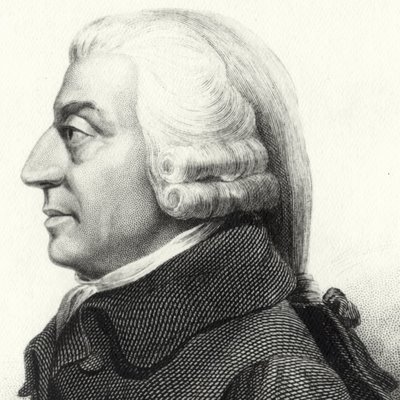
All my life I have had right wing people ramming Adam Smith down my throat as the philosopher's stone of laissez faire and  the impersonal, inhuman, invisible, hand and then out of nowhere, here comes an economist and a human being of the class of Amartya Sen and reveals an entirely new view of Mr. Smith. This is like discovering an unknown play by Shakespeare,  one which puts everything else he ever wrote into a new light.

In his article in The New Statesman that Doctor Sen entitles, "The Economist Manifesto", he presents Smith's first book, "The Theory of Moral Sentiments", which is the missing link that provides the ethical, philosophical, psychological, and methodological underpinnings to Smith's later works, including "The Wealth of Nations". In it Adam Smith reveals himself to be the closest thing to a modern Social Democrat imaginable. Let me quote Amartya Sen at length:
Smith saw the task of political economy as the pursuit of "two distinct objects": "first, to provide a plentiful revenue or subsistence for the people, or more properly to enable them to provide such a revenue or subsistence for themselves; and second, to supply the state or commonwealth with a revenue sufficient for the public services". He defended such public services as free education and poverty relief, while demanding greater freedom for the in­digent who receives support than the rather punitive Poor Laws of his day permitted. Beyond his attention to the components and responsibilities of a well-functioning market system (such as the role of accountability and trust), he was deeply concerned about the inequality and poverty that might remain in an otherwise successful market economy. Even in dealing with regulations that restrain the markets, Smith additionally acknowledged the importance of interventions on behalf of the poor and the underdogs of society. At one stage, he gives a formula of disarming simplicity: "When the regulation, therefore, is in favour of the workmen, it is always just and equitable; but it is sometimes otherwise when in favour of the masters." Smith was both a proponent of a plural institutional structure and a champion of social values that transcend the profit motive, in principle as well as in actual reach.

Smith's personal sentiments are also relevant here. He argued that our "first perceptions" of right and wrong "cannot be the object of reason, but of immediate sense and feeling". Even though our first perceptions may change in response to critical examination (as Smith also noted), these perceptions can still give us interesting clues about our inclinations and emotional predispositions.

One of the striking features of Smith's personality is his inclination to be as inclusive as possible, not only locally but also globally. He does acknowledge that we may have special obligations to our neighbours, but the reach of our concern must ultimately transcend that confinement. To this I want to add the understanding that Smith's ethical inclusiveness is matched by a strong inclination to see people everywhere as being essentially similar. There is something quite remarkable in the ease with which Smith rides over barriers of class, gender, race and nationality to see human beings with a presumed equality of potential, and without any innate difference in talents and abilities.

He emphasised the class-related neglect of human talents through the lack of education and the unimaginative nature of the work that many members of the working classes are forced to do by economic circumstances. Class divisions, Smith argued, reflect this inequality of opportunity, rather than indicating differences of inborn talents and abilities.
Please, do yourselves the favor of reading the whole article. No one could teach this class better than Amartya Sen.

So there you have it: Adam Smith, the man we all thought had established the ultimate justifications for selfishness, was in fact a believer in liberty, equality and fraternity.

Just as I think that progressives should spout the Bible and not leave that amazing power-text as the sole property of the right, so too, this little known text of Adam Smith should leaven their arguments.

So much of the problem of American progressive politics is to reclaim the language. I have always believed that the muddying of American English is a deliberate affair and the muddier it gets the more difficult it is to even think certain things. For example in every language in the world, including the Queen's English, "red" is the color of the left. But, only a relatively short time ago, it suddenly became the word to describe conservative. So we have gone from the "red scares" and "Red China" of my youth, to the "red states" of today. Does anybody know who did this first? This is just one flagrant example, but the muddying of the language is endless.

Confucius was asked what would be the first thing he would do if he were made emperor and he said he would "clarify terms". That is what is needed, new words for old things.

The present economic crisis, brought on by speculators who have made fortunes destroying the lives of middle and working class families, is a "teaching opportunity" if ever there was one. Watching the likes of "Fabulous Fabrice" or Lloyd Blankfein as they go about doing "God's work", is a unique possibility for masses of people to learn how the world really works and to work up an appetite to change it.

But we always come up against language.

It is really difficult to talk about class conflict in American English because all the traditional words like, "class struggle", "contradiction" etc, are taboo or sound foreign to American ears. This is as if a doctor would have to use awkward euphemisms when making a diagnosis. Imagine a gynecologist writing, "the patient reports experiencing severe discomfort whenever a dime is inserted in her pay phone." Communication would suffer. The march of science would be arrested.

Like Confucius we have to reclaim the language.

Any real change has to come from people who feel oppressed and victimized, not just those who look upon their misfortunes with benign sympathy.

Probably the most significant thing that could happen in American politics would be the rebirth of the language of progressive politics among the working poor. This crisis is a unique chance to cut through the fog and double talk and get to central questions.

This is where texts like Adam Smith's and the Bible come in. The left simply must loosen its connection with Ruccola and communicate. DS

Wednesday, April 21, 2010

"Eyjafjallajökull": Icelandic for "write if you get work and hang by your thumbs"

 What's his name erupts

David Seaton's News Links
"Old Unpronounceable", a minor volcano, blew its top in Iceland and the world's transport system practically collapsed.

Compared to the intricate embroidery of  Wall Street's goniffery that brought the world's economic system to collapse, Eyjafjallajökull is a simple thing.

Many people are comparing the two crisis because they clearly illustrate how fragile our world system has become since the stolid days of the Cold War.

I think I would like to re-baptize "globalization" as "for the want of a nail-ization", which I have taken from an ancient poem which goes like this:
For want of a nail the shoe was lost.
For want of a shoe the horse was lost.
For want of a horse the rider was lost.
For want of a rider the battle was lost.
For want of a battle the kingdom was lost.
And all for the want of a horseshoe nail.
Our lives have become a sped up film of lost nails, horses, riders and kingdoms. The entire world's exposure to the cupidity of far off thieves and the violence of obscure volcanoes is grotesque.

We are doing it all wrong, we've got it all bassackwards. Both the timeless random, brutal, magnificence of Eyjafjallajökull and the obscene greed of Goldman Sachs are useful warnings that we must look for new ways of doing things.

What chaos theory mavens call the "butterfly effect", something that used to be a rather amusing idea with which to tease our neurons, has become the central mechanism of our lives.

Simplifying this system, making it more robust, stepping back and making a cool evaluation of what we really need and what we should be willing to go through to achieve it should be the major serious conversation of our societies. We must bend every effort to discovering the art or even perhaps the science of what the French call "le petit bonheur", the "small happiness", the accumulated pleasure taken in the smallest things, which, as far as life has taught me up till now, is the philosopher's stone of the alchemy of savoir vivre.

As a small example: our new and absurdly cheap communications systems, such as IP to IP telephone and video conferencing, make much of today's business travel absurd.

Air travel, which used to be quite a pleasant experience, has become a purgatorial ordeal of humiliated, belt-less and shoeless penitents staggering fatigued, waterless and electronically naked on their way to the next pea in the pod hotel.

If is possible for an American suburbanite to commute to a nearby office and pilot a drone with which to kill people in Afghanistan and then be back home in time to play a little catch in the backyard with his son before dinner, I ask myself if is it absolutely vital to send another American half way around the world just to negotiate a sale?

Why should the business of business be more killing than the business of killing? DS

Saturday, April 17, 2010

Human beings: get them while they are cheap


Commodities, derided for decades as unimportant, have become scarce resources, to be guarded and managed with the utmost care. Conversely human labor and skill, on the basis of which the glories of human civilization were built, is entering into a state of gigantic glut.  Martin Hutchinson - Prudent Bear
David Seaton's News Links
The quote at the top of this is the world's political bottom line.

Today this glut of human beings includes highly skilled, trained and educated human beings, not just the hewers of wood and drawers of water that have always made up Marx's "reserve army of labor".

I should quickly add that the author of the quote is anything but a Marxist.

Martin Hutchinson is a former international merchant banker, with a first class Honors degree from Trinity College in Cambridge and a Master of Business Administration from Harvard Business School. He writes a weekly column called "The Bear's Lair" in a web called Prudent Bear. I read him regularly because, in my opinion, he writes well and he has interesting and provocative ideas. He is a very classical economist: very conservative in the old, pre-Reagan use of the word.

Let me quote him at more length:
Overall, rapid economic development has thrust commodities from a position of glut into a position of relative scarcity. Conversely, the emergence of modern telecoms, the globalization of markets and the increasing wealth and education levels of billions in China, India and elsewhere, has transferred human labor, even skilled human labor, from a position of relative scarcity into a position of glut. That’s not surprising – when the number of full participants in the global economy quadruples from 700 million to 3 billion over a period of less than 20 years, those participants are likely to face an over-supply problem. It’s also not unusual – as Thomas Malthus would have told you in 1798, the periods when human labor is worth more than bare subsistence have historically been few and far between.
( ...) In summary, in today’s world, commodities have become scarce and labor has become commoditized, unless fenced in by artificial restraints. With the global supply of commodities finite, this problem can only worsen if population is allowed to continue growing. A world with 10 billion people, all able to compete on an equal basis in a globalized labor market and desiring commodity-intensive modern mechanical marvels, would be a world of ever-increasing scarcity and impoverishment, besides its adverse environmental effects. Hence population reduction programs, aiming to reduce global population to a level at which labor once more becomes more valuable than commodities, should be given the highest priority at a global level. Otherwise, with the labor supply unlimited and the skills supply nearly so, and commodities supply relatively restricted, the only wealthy people will be those who own mines or oil wells.
I find it interesting that there seems to be a clear convergence between the view of the future of a very classic conservative economist and a classic Marxist reading of of it. Both see the "increasing immiseration of the proletariat" and the only real difference that I can see between them is that the Marxist would believe and hope that this will lead to a revolution and the classic conservative, at some point, probably fears that it will.

Certainly this is a different message than the one given by globalization's cheerleaders like Thomas Friedman, or intellectually more respectable folk such as Keynesians Paul Krugman, and Robert Reich.

I cannot imagine any of the aforementioned having such a sweepingly pessimistic view of where the world is heading as Hutchinson does. They might see grave dangers in global warming, but probably they would see new, "green" industries as solving climate change and unemployment too. I have to admit that I find myself more in tune with Hutchinson on this.

Keynes, who is probably the one chiefly responsible for an American boomer like me having had a prosperous childhood in the 50s and 60s, was a self-confessed bourgeois, someone who wanted to save capitalism and his upper-middle class place in it by tinkering with the system, not scrapping it. His tinkering worked very well for my generation, certainly much better than the Friedman to Thatcher to Reagan to Greenspan to ruin, that we have just been living through.

Since I am not an economist, since I am someone who, without a pocket calculator, is helpless when confronted with even the simplest arithmetic... you might ask... I should ask myself... On what exactly to I base this preference?

The way I get there without crunching any numbers is through an effort of imagination, seeing the world as a shrinking whole, without economic frontiers with everyone jammed together, where prices can be instantly compared, where anything that can be digitized, ideas, numbers, words, images, films, blueprints, intellectual property of almost any sort which can be copied endlessly for next to no money and increasingly melts into something like air. Air which is something that I'm sure they would have always liked to charge for, make into a commodity, but have never found a way to.

A world of staggering complexity and speed, without past or future, only an overpoweringly universal, pressing, simultaneous present.

In this world there wanders a creature who for most of his hundred million years of existence was a drop in the ocean of nature, a being who  throughout most of his saga wandered naked in the company of small groups of relatives and friends, merely reaching out his hands to reap nature's generosity. A gregarious, sensitive, labile creature of intense empathy and interest in his fellow's doings, whose ability to speak empowered cooperation in hunting and accumulating knowledge and memories, who for most of his species' existence has owned nothing that he couldn't carry in his two hands.

This is the creature that confronts today's world of artifice and oppression.

We have to look at humanity as a continuum starting from Lucy the Australopithecus afarensis right up to today to see the blinding truth of Rousseau's dictum, "Man was born free, and he is everywhere in chains."

I agree with Hutchinson's bleak view essentially because I think that humanity is going to have a its nature as an animal. Like those performing dogs you see in the circus: wearing a hat and glasses and tottering along on its back legs, dreaming of a fire plug. DS