Showing posts with label global warming. Show all posts

Saturday, April 19, 2014

The "butterfly effect" revisited

Moth by night
In chaos theory, the butterfly effect is the sensitive dependency on initial conditions in which a small change at one place in a deterministic nonlinear system can result in large differences in a later state. The name of the effect, coined by Edward Lorenz, is derived from the theoretical example of a hurricane's formation being contingent on whether or not a distant butterfly had flapped its wings several weeks earlier. Wikipedia
I remember that the "butterfly effect" was much in vogue in the late 1990s and was often quoted by the chaos theoreticians that were instrumental in designing the risk modeling that ruled finance up till 2008 and signally failed to predict the implosion of the financial system.

I think that today it would be more appropriate to talk about the "moth effect".

Moths are not as conventionally "pretty" as butterflies, but are often stunningly beautiful in a rather sinister way; and yes they flap their wings too and they often arrive in large numbers and eat their way through closets full of wool or gardens full of geraniums. 

Unlike the butterfly, the moth is seen as a plague and a pest... you don't go to the store to buy "butterflyballs", do you?

And then, rather poetically: on balmy, breathless, summer nights, moths often commit suicide en masse in the flickering flames of dinner candles, driven by their love, need and obsession with light... 

The romantic, sinister, light-driven and pestilent moth: a fitting symbol of our time.

The greatest clusters of metaphorical, wing flapping, wool chewing, suicidal moths that I detect today seem to me to be long term products of our economic system, such as the doomsday effect of global warming and the Oozlum bird effects of the advances in Artificial Intelligence. 

Global warming is the long term effect of the industrial revolution and its spread to the entire globe, but so is Artificial Intelligence.
One can imagine such technology outsmarting financial markets, out-inventing human researchers, out-manipulating human leaders, and developing weapons we cannot even understand. Whereas the short-term impact of AI depends on who controls it, the long-term impact depends on whether it can be controlled at all.  Stephen Hawking and friends - Huffington Post
But long before it comes to all that, in the near future AI will be putting nearly everyone (except maybe the people who clip the toenails and give blowjobs to elderly billionaires) out of work.

AI is the result of the geometrically accelerating drive for technological innovation, which we are told is wonderful and which will solve all our problems, but which in fact is not really a search for the greatest good for the greatest number, but on the contrary, generally driven by the intense dog eat dog competition of our economic system, where to avoid being eliminated, management and shareholders are constantly looking for greater efficiencies in cutting costs and getting more productivity with fewer people, even if this reduces the number of potential consumers. The now classic metaphor for this is Kodak, which once had 140,000 employees being replaced by Instagram, which had 13 employees when Facebook bought it.

Ironically, this pressure to innovate may finally be what fatally destabilizes our system. DS

Wednesday, February 22, 2012

The Darkest Hour Is Just Before Dawn

David Seaton's News Links
Between the civil war in Syria, for that is what it is, and the threat of an Israeli attack on Iran, which would set the region -- at the very least -- ablaze, and probably start off a chain of events that could tip the whole world into full-scale depression, we have plenty to worry about... things that could pull our attention decisively away from the saga of Jeremy Lin.
At the bottom of what most of us worriers worry about is the economic crisis. In a nutshell we are looking at the result of an increasingly "friction-less" world market.
Perhaps the core problem is that we are a consumer economy and our consumption, from designer tee-shirts  to the iPad and the iPhone, depends almost entirely on the slave wages and slave working conditions of millions upon millions of Chinese workers, who, without old age pensions and healthcare, save all their money and so do not consume what we produce. Our money goes there and it doesn't come back and our own workers are impoverished by this phenomenon and thus also consume less and less.
And if we managed to solve this problem and the Chinese workers earned enough to consume like we do, we the "breathing class" would suffocate in the ensuing pollution and if the enriched Chinese chose to eat cereal-fed, animal protein on the scale we do, mass starvation in the third (or not so third) world would result... without entering into the feedlot methane gas and water pollution issues that enough steers, swine and chickens to supply a billion Chinese with a diet like ours would produce.
The sheer contradiction and intractability enclosed in the scenario described means that inevitably our entire system is in question and our priorities must adjust to this new reality and adjust they will, even if it takes great wars and massive civil disturbance to bring the adjustments about.
In every established hierarchy, those who most benefit from the statu quo naturally write the rules and laws that best suit their interests and also do their best to create an intellectual and political climate that makes any real questioning of that situation "unthinkable".
Nobody describes this paradox better than the Slovenian philosophe à tout faire, Slavoj Zizek does:
In such a constellation, the very idea of a radical social transformation may appear as an impossible dream—yet the term ‘impossible’ should make us stop and think. Today, possible and impossible are distributed in a strange way, both simultaneously exploding into excess. On the one hand, in the domains of personal freedoms and scientific technology, we are told that ‘nothing is impossible’: we can enjoy sex in all its perverse versions, entire archives of music, films and tv series are available to download, space travel is available to everyone (at a price). There is the prospect of enhancing our physical and psychic abilities, of manipulating our basic properties through interventions into the genome; even the tech-gnostic dream of achieving immortality by transforming our identity into software that can be downloaded into one or another set of hardware.  On the other hand, in the domain of socio-economic relations, our era perceives itself as the age of maturity in which humanity has abandoned the old millenarian utopian dreams and accepted the constraints of reality—read: capitalist socio-economic reality—with all its impossibilities. The commandment you cannot is its mot d’ordre: you cannot engage in large collective acts, which necessarily end in totalitarian terror; you cannot cling to the old welfare state, it makes you non-competitive and leads to economic crisis; you cannot isolate yourself from the global market, without falling prey to the spectre of North Korean juche.
Zizek concludes: "Today we do not know what we have to do, but we have to act now, because the consequence of non-action could be disastrous."
The disruption of existing relationships of power and authority, that the inevitable changes the situation will increasingly demand, goes a long way to explaining the polarization of much of politics today; especially where the world's power is still predominately brokered, the USA. And it is no surprise that the sound and the fury is mostly coming from the right, those who represent those who have much to lose if today's existing relationships of power and authority should ever change.
So that is the real bottom line: we have the privilege of living in a time of profound changes... a time of fear and a time of hope. As to hope, hopefully the metaphor that titles this post is apt, and the darkest hour does come just before dawn. DS

Thursday, November 10, 2011

The bright side of life - revisited

“When you’re chewing on life’s gristle
Don’t grumble, give a whistle”
Eric Idle
I am in the process of reworking a lot of my material, looking to see if I could ever make a book out of it all, trying to see what, if any, threads of thought might hold it all together. This is a rough draft of some of the reworkings. Thank you for your patience. DS

David Seaton's News Links
Things are looking pretty dismal at the moment. The economic situation is the worst in my lifetime, and I was born at the end of WWII.  The bad news comes fast and furious. When I am subjected to an information overload, I occasionally experience some sort of intuitive flash connected to images, a sudden understanding/epiphany/gestalt.

The other day the Tea Party movement revealed itself to me in a poetic metaphor that put them into a different perspective. Something that although just as grotesque, is at the same time touchingly human in its vulnerability.

It came to me that the Tea Party movement with their confused and confusing agenda, the open carrying of fire arms in Starbucks, the birthers, the militias, the “Last Days” crowd, the Limbaughs, the Becks, and all the assorted, foxy, incoherent mishegoss that goes with them is one and the same thing as collagen lip injections, faces paralyzed with botox or toupees and comb overs: a self-deceiving escape from the inevitable. Fooling the mirror perhaps, but nobody else, certainly not Father Time or the Grim Reaper or the great undercurrents of events. This escapism from the simplest of realities is one of the hallmarks of our era.

The Tea Baggers, like the botox zombies, are just whistling past the graveyard.
Everything we are living right now, from global warming to the juking and jiving of the financial system, from exploding population in poor countries, to aging populations in the rich ones, is crying out for more regulation, more control, more transparency and more taxes to pay for it. This is either going to happen or our world is going to disintegrate into a devil’s stew of famine, pollution, explosively intolerable inequality and endless war… not necessarily in that order.
The world of the future will be a world of control or it wont be.

The world of the future will be a world of iron rules and regulations and with all the privacy of a nudist camp, or it will be a nightmare beyond our powers to imagine.

This process is as inevitable as aging leading to dying.

People do some some weird stuff when staring down the one that the Spanish call “the bald lady”… death.

Just as an aging woman who has had her lips blown up like Donald Duck fools herself into thinking she is still desirable, someone who walks into Starbucks with a pitiful little pistol on his hip fools himself into thinking he has power over his life and future. He sips his latte made from coffee grown in an impoverished third-world narco-state and sits there worrying about a dark skinned “socialist” coming and taking his little gun away.

The word “socialism” is thrown about with so much abandon. The word is used as an automatic disqualification, something both strange and sinister, touched with the “Mark of the Beast”.

However, the world we are fast approaching would be fortunate if it were somehow connected to Liberty, Equality and Fraternity, somehow an expression of international solidarity. Because the alternative, at best, would be a global version of a huge Indian slum, a human ant’s nest crossed by open sewers, filled with hunger, anger and disease or living skeletons listlessly wasting away in starved apathy: the world’s misery huddled at the feet of a few gated communities, heavily guarded by… Predator drones.

Even before our Friedmanite economy showed us its athlete’s feet of clay, we could see that fossil fuels were a finite source and that their continued use might make it difficult for our species to survive.

And if the economy does pick up again, the Chinese and the Indians imitating the American Way of Life with its phenomenal waste of fossil fuel energy could lead to God knows what kind of terminal ecological collapse.

Of course the problem is that to sustain itself our economy must grow constantly, like a bicycle that will fall over if it ever stops. The fact is that we may “running out of road”, reaching some sort of limit, a sort of musical chairs, where the few chairs left have already been taken by the rich while the great mass of the world’s population mills around with nowhere to sit and little to eat after the music stops.

It would seem obvious to me that if we are not going to see the world entirely degenerated into some Hobbesian dystopia, we are going to have to create and run a very tightly organized, strictly regulated and equitable order of society. If the trends we see today continue, I believe that will be inevitable, so fast becoming inevitable, that even a person like me, in their mid 60s, might live to see it.

The question, will be how to preserve the republican trinity, “Liberty, Equality, Fraternity” in such a tightly ordered society.

These three things often don’t go together or are mixed in very weighted proportions.

Lets look at Germany before the collapse of Communism:

In East Germany, for example, you had a very sinister secret police and steady repression of all dissent. You had very few consumer goods and no freedom to travel. However, you also had total job security, a good free school system (Angela Merkel is a product of that system) and subsidized housing and free health care.

That system was defeated because Western Germany had strong labor unions, good free schools and health and subsidies… and also freedom of speech, assembly, travel and abundant consumer goods… No contest. Obviously West Germany’s “Social Market Society” came closer to “Liberty, Equality, Fraternity” than “Real Existing Socialism” did.

However in the future, because of the need to husband fossil fuels and other natural resources, we will probably find ourselves stripping out the abundant consumer goods from the mix and certainly mass tourism to the four corners of the earth, with its frivolous burning of ever scarcer oil, will be a fairy tale that today’s children will tell their grandchildren about.

If we are going to be moving toward a world of limited energy use, zero growth sustainability, less possibility to travel and fewer consumer goods and so forth, about the best we could hope for would be East Germany without the Stasi and with free speech, assembly and habeas corpus.

Right now the dynamic of our system seems to be to “Friedmanize” the world and break down social democracy wherever it is found, impoverish people and make their lives precarious.

This sort of society where the majority is impoverished, while a minority becomes amazingly rich, has been proven to only work with a military dictatorship and police state repression… and even then hunger and precariousness cannot go on beyond a certain point without engendering revolutionary movements.

Admittedly the human animal can continue to flourish in conditions where any other self-respecting mammal would stop breeding and go extinct, but even so, if you oppress them enough, they turn and bite.

Certainly if you increase the percentage of the poor and precarious beyond a certain level the word “freedom” begins to take on different nuances: freedom from what? freedom to do what? That is when some version of Equality, Fraternity, without Liberty, a version of East Germany “uncut” might seem very attractive to many desperately poor and insecure people.

If any young person is looking for something useful to do with their lives, helping to organize and build a world where free people live in brotherhood, sharing out the world’s limited resources equitably, would certainly fill the bill. DS

Monday, February 21, 2011

Globalization and its discontents: a new paradigm


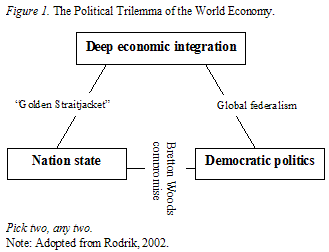
I have an "impossibility theorem" for the global economy (...). It says that democracy, national sovereignty and global economic integration are mutually incompatible: we can combine any two of the three, but never have all three simultaneously and in full.  Dani Rodrik - Kennedy School Harvard
David Seaton's News Links
In the Middle East -- and who knows where else next -- the masses are on the march and the mystery and the mystique of revolution unfolds once again.

There is a mixture of things, like a chemical formula, that leads to revolutions, here is a sample of  the mixture that is brewing up in the Middle East right now:
  • Generally people are tired of being intimidated and resentful at being tortured and oppressed. 
  • Then, thanks to modern medical advances and the lowering of infant mortality, there are huge numbers of young people and very few jobs for them.
  • Thanks to advances in education, many of these young people are vastly overqualified for any jobs they might ever manage to get: the revolutionary leaven of dissatisfied intellectuals is well known. 
  •  Add food inflation, which brings the sans culotte into the street.
  • Remember that the rising price of oil brought on by these disturbances adds exponentially to that food inflation.
      Everybody has their own spin on Egypt's revolution and the word "freedom" is being thrown about a lot as if it were an end in itself instead of simply being a means, a precondition of action. Who is free? Free to do what? Free from whom? The question might be better expressed as: now that they are free, what are they going to express with that freedom?

      Of course the American media inventively associates "freedom" with "free market capitalism" and as we saw in the previous post on the BBC video, "The Century of Self", this was an idea that cost American business a huge amount of money and time to sell to its first victims, the American people, and is not that deeply rooted in countries that were heavily exploited former colonies at the mercy for centuries of foreign interests and not their own..  I think that many commentators are neglecting the anti-imperialist angle in all of this: once free from the local "foreign client" dictator, the desire all these countries have for national independence and sovereignty and how that contradicts with America's brand of multinational corporate globalization.

      Again, most commentators read the role of Islam in this struggle for freedom from foreign tutelage in a shallow manner. If American dominated globalization is seen as a dissolvent of this new freedom to "be themselves", then what ideology is robust enough to be indigestible by globalization. What set of ideas and customs can bullet proof these newly free societies from what the Chinese call "America's candy bullets"? Obviously Islam is well suited for that role, both nationally and internationally.
      Sheik Qaradawi, a popular television cleric whose program reaches an audience of tens of millions worldwide, addressed a rapt audience of more than a million Egyptians gathered in Tahrir Square to celebrate the uprising and honor those who died. On Friday, he struck themes of democracy and pluralism, long hallmarks of his writing and preaching. He began his sermon by saying that he was discarding the customary opening “Oh Muslims,” in favor of “Oh Muslims and Copts,” referring to Egypt’s Coptic Christian minority. He praised Muslims and Christians for standing together in Egypt’s revolution and even lauded the Coptic Christian “martyrs” who once fought the Romans and Byzantines. “I invite you to bow down in prayer together,” he said. He urged the military officers governing Egypt to deliver on their promises of turning over power to “a civil government” founded on principles of pluralism, democracy and freedom. And he called on the army to immediately release all political prisoners and rid the cabinet of its dominance by officials of the old Mubarak government.“We demand from the Egyptian Army to free us from the government that was appointed by Mubarak,” Sheik Qaradawi declared. “We want a new government without any of these faces whom people can no longer stand.” And he urged the young people who led the uprising to continue their revolution. “Protect it,” he said. “Don’t you dare let anyone steal it from you.”(...)  Scholars who have studied his work say Sheik Qaradawi has long argued that Islamic law supports the idea of a pluralistic, multiparty, civil democracy. But he has made exceptions for violence against Israel or the American forces in Iraq. “You call it violence; I call it resistance,” said Prof. Emad Shahin of the University of Notre Dame, an Egyptian scholar who has studied Sheik Qaradawi’s work and was in Tahrir Square for his speech Friday. New York Times
      And speaking of the Chinese and what  they call, "America's candy bullets". Quite a few people seem to think that China is a loser in all this business because it isn't a liberal democracy on the western model.  They miss a very important point: China does not interfere in the internal affairs of other countries and does not lecture them on "values" or export revolution. America is guilty of all these sins and is an inveterate and unrepentant sinner. For any former colony of the west, be it a democracy or a dictatorship, China is a more comfortable business partner than the USA. I think China is finally going to be one of the biggest winners of the upheaval in the Middle East.

      The United States has two principal objectives in the Middle East: to control the world's access to its oil reserves and to give political and military cover to the state of Israel, for reasons of purely domestic, American politics.

      As to the role of the Israel Lobby in Washington, truly the joker in the deck, they have their work cut out for them, Americans may soon find themselves in the dilemma of being forced to choose between their undying love for Israel and their legendary addiction to cheap gasoline. Israel is a wonderful country, but you can't fill your gas tank with it and drive to a minimum wage job over American distances. This is a dilemma that could leave America's strained domestic peace in tatters. Oil at $200+ a barrel could bring America's sans culottes into the streets... Running, walking, but not driving.  DS

      Monday, May 10, 2010

      Forever Young: The key to the Tea Party movement


      Forever young
      "We may be prisoners of deep and poorly understood changes to the world economic system." Robert J. Samuelson - Newsweek

      "(M)any companies will do whatever necessary to squeeze out added profits. And that will spell disaster – giant oil spills, terrible coal-mine disasters, and Wall Street meltdowns – unless the nation has tough regulations backed up by significant penalties, including jail terms for executives found guilty of recklessness, and vigilant enforcement." Robert Reich

      It is hardly a new insight that much of the environmental movement is a Trojan Horse for socialist assumptions and ambitions (the British like to call environmentalists “watermelons”—green on the outside, red on the inside). Jonah Goldberg - Commentary

      "Since the beginning of the modern period, expanding markets and communications networks had an explosive force, with individualising and liberating impacts on individual citizens; but each such opening was followed by a reorganisation of the old relations of solidarity within an expanded institutional framework. Time and again, a sufficient equilibrium between the market and politics was achieved to ensure that the network of social relations between citizens of a political community was not damaged beyond repair. According to this rhythm, the current phase of financial-market-driven globalisation should also be followed by a strengthening not only of the European Union but of the international community. Today, we need institutions capable of acting on a global scale." Jürgen Habermas - Financial Times
      David Seaton's News Links
      When I am subjected to an information overload, I occasionally experience some sort of intuitive flash connected to images, a sudden understanding/epiphany/gestalt.

      The Greek crisis combined with the chaos of the volcanic ash episode and the hideous, Gulf of Mexico oil spill, followed close on by the mysterious Dow Jones electronic trading collapse the other day on Wall Street, set off such a eureka moment for me.

      Suddenly the Tea Party movement revealed itself in a poetic metaphor to me in a way that put them into a different perspective. Something that although just as grotesque, is at the same time touchingly human in its vulnerability.

      It came to me that the Tea Party movement with their confused and confusing agenda, the open carrying of fire arms in Starbucks, the birthers, the militias, the "Last Days" crowd, the Limbaughs, the Becks, and all the assorted, foxy, incoherent mishegoss that goes with them is one and the same thing as collagen lip injections, faces paralyzed with botox or toupees and comb overs: a self-deceiving escape from the inevitable. Fooling the mirror perhaps, but nobody else, certainly not Father Time or the Grim Reaper or the great undercurrents of events. This escapism from the simplest of realities is one of the hallmarks of our era.

      The Tea Baggers, like the botox zombies, are just whistling past the graveyard.

      Everything we are living right now, from global warming to the juking and jiving of the financial system, from exploding population in poor countries, to aging populations in the rich ones, is crying out for more regulation, more control, more transparency and more taxes to pay for it. This is either going to happen or our world is going to disintegrate into a devil's stew of famine, pollution, explosively intolerable inequality and endless war... not necessarily in that order.

      The world of the future will be a world of control or it wont be.

      The world of the future will be a world of iron rules and regulations and with all the privacy of a nudist camp, or it will be a nightmare beyond our powers to imagine.

      This process is as inevitable as aging leading to dying.

      People do some some weird stuff when staring down the one that the Spanish call "the bald lady"... death.

      Just as an aging woman who has had her lips blown up like Donald Duck fools herself into thinking she is still desirable, someone who walks into Starbucks with a pitiful little pistol on his hip fools himself into thinking he has power over his life and future. He sips his latte made from coffee grown in an impoverished third-world narco-state and sits there worrying about a dark skinned "socialist" coming and taking his little gun away.

      The word "socialism" is thrown about with so much abandon. The word is used as an automatic disqualification, something both strange and sinister, touched with the "Mark of the Beast".

      However, the world we are fast approaching would be fortunate if it were somehow connected to Liberty, Equality and Fraternity, somehow an expression of international solidarity. Because the alternative, at best, would be a global version of a huge Indian slum, a human ant's nest crossed by open sewers, filled with hunger, anger and disease or living skeletons listlessly wasting away in starved apathy: the world's misery huddled at the feet of a few gated communities, heavily guarded by... Predator drones. DS

      Saturday, April 17, 2010

      Human beings: get them while they are cheap


      Commodities, derided for decades as unimportant, have become scarce resources, to be guarded and managed with the utmost care. Conversely human labor and skill, on the basis of which the glories of human civilization were built, is entering into a state of gigantic glut.  Martin Hutchinson - Prudent Bear
      David Seaton's News Links
      The quote at the top of this is the world's political bottom line.

      Today this glut of human beings includes highly skilled, trained and educated human beings, not just the hewers of wood and drawers of water that have always made up Marx's "reserve army of labor".

      I should quickly add that the author of the quote is anything but a Marxist.

      Martin Hutchinson is a former international merchant banker, with a first class Honors degree from Trinity College in Cambridge and a Master of Business Administration from Harvard Business School. He writes a weekly column called "The Bear's Lair" in a web called Prudent Bear. I read him regularly because, in my opinion, he writes well and he has interesting and provocative ideas. He is a very classical economist: very conservative in the old, pre-Reagan use of the word.

      Let me quote him at more length:
      Overall, rapid economic development has thrust commodities from a position of glut into a position of relative scarcity. Conversely, the emergence of modern telecoms, the globalization of markets and the increasing wealth and education levels of billions in China, India and elsewhere, has transferred human labor, even skilled human labor, from a position of relative scarcity into a position of glut. That’s not surprising – when the number of full participants in the global economy quadruples from 700 million to 3 billion over a period of less than 20 years, those participants are likely to face an over-supply problem. It’s also not unusual – as Thomas Malthus would have told you in 1798, the periods when human labor is worth more than bare subsistence have historically been few and far between.
      ( ...) In summary, in today’s world, commodities have become scarce and labor has become commoditized, unless fenced in by artificial restraints. With the global supply of commodities finite, this problem can only worsen if population is allowed to continue growing. A world with 10 billion people, all able to compete on an equal basis in a globalized labor market and desiring commodity-intensive modern mechanical marvels, would be a world of ever-increasing scarcity and impoverishment, besides its adverse environmental effects. Hence population reduction programs, aiming to reduce global population to a level at which labor once more becomes more valuable than commodities, should be given the highest priority at a global level. Otherwise, with the labor supply unlimited and the skills supply nearly so, and commodities supply relatively restricted, the only wealthy people will be those who own mines or oil wells.
      I find it interesting that there seems to be a clear convergence between the view of the future of a very classic conservative economist and a classic Marxist reading of of it. Both see the "increasing immiseration of the proletariat" and the only real difference that I can see between them is that the Marxist would believe and hope that this will lead to a revolution and the classic conservative, at some point, probably fears that it will.

      Certainly this is a different message than the one given by globalization's cheerleaders like Thomas Friedman, or intellectually more respectable folk such as Keynesians Paul Krugman, and Robert Reich.

      I cannot imagine any of the aforementioned having such a sweepingly pessimistic view of where the world is heading as Hutchinson does. They might see grave dangers in global warming, but probably they would see new, "green" industries as solving climate change and unemployment too. I have to admit that I find myself more in tune with Hutchinson on this.

      Keynes, who is probably the one chiefly responsible for an American boomer like me having had a prosperous childhood in the 50s and 60s, was a self-confessed bourgeois, someone who wanted to save capitalism and his upper-middle class place in it by tinkering with the system, not scrapping it. His tinkering worked very well for my generation, certainly much better than the Friedman to Thatcher to Reagan to Greenspan to ruin, that we have just been living through.

      Since I am not an economist, since I am someone who, without a pocket calculator, is helpless when confronted with even the simplest arithmetic... you might ask... I should ask myself... On what exactly to I base this preference?

      The way I get there without crunching any numbers is through an effort of imagination, seeing the world as a shrinking whole, without economic frontiers with everyone jammed together, where prices can be instantly compared, where anything that can be digitized, ideas, numbers, words, images, films, blueprints, intellectual property of almost any sort which can be copied endlessly for next to no money and increasingly melts into something like air. Air which is something that I'm sure they would have always liked to charge for, make into a commodity, but have never found a way to.

      A world of staggering complexity and speed, without past or future, only an overpoweringly universal, pressing, simultaneous present.

      In this world there wanders a creature who for most of his hundred million years of existence was a drop in the ocean of nature, a being who  throughout most of his saga wandered naked in the company of small groups of relatives and friends, merely reaching out his hands to reap nature's generosity. A gregarious, sensitive, labile creature of intense empathy and interest in his fellow's doings, whose ability to speak empowered cooperation in hunting and accumulating knowledge and memories, who for most of his species' existence has owned nothing that he couldn't carry in his two hands.

      This is the creature that confronts today's world of artifice and oppression.

      We have to look at humanity as a continuum starting from Lucy the Australopithecus afarensis right up to today to see the blinding truth of Rousseau's dictum, "Man was born free, and he is everywhere in chains."

      I agree with Hutchinson's bleak view essentially because I think that humanity is going to have a its nature as an animal. Like those performing dogs you see in the circus: wearing a hat and glasses and tottering along on its back legs, dreaming of a fire plug. DS

      Friday, December 21, 2007

      Yet more notes on populism


      "A zero-sum economy leads, inevitably, to repression at home and plunder abroad. In traditional agrarian societies the surpluses extracted from the vast majority of peasants supported the relatively luxurious lifestyles of military, bureaucratic and noble elites. The only way to increase the prosperity of an entire people was to steal from another one. (...) Democratic politics became increasingly workable because it was feasible for everybody to become steadily better off.(...) in the new positive-sum world, elites were willing to tolerate the enfranchisement of the masses. The fact that they no longer depended on forced labour made this shift easier still. Consensual politics, and so democracy, became the political norm.(...) The biggest point about debates on climate change and energy supply is that they bring back the question of limits. If, for example, the entire planet emitted CO2 at the rate the US does today, global emissions would be almost five times greater. The same, roughly speaking, is true of energy use per head. This is why climate change and energy security are such geopolitically significant issues. For if there are limits to emissions, there may also be limits to growth. But if there are indeed limits to growth, the political underpinnings of our world fall apart. Intense distributional conflicts must then re-emerge – indeed, they are already emerging – within and among countries."
      Martin Wolf - Financial Times

      "In May, the Pew Research Center released the 2005 edition of its Political Typology, a survey that slices the American electorate into nine discrete groups. Unsurprisingly, the core of the GOP's support turns out to be drawn from "Enterprisers," affluent, optimistic, and staunchly conservative on economic and social issues alike. But the so-called Enterprisers represent just 11 percent of registered voters--and apart from them, the most reliable GOP voters are Social Conservatives (13 percent of registered voters) and Pro-Government Conservatives (10 percent of voters). Both groups are predominantly female (Enterprisers are overwhelmingly male); both are critical of big business; and both advocate more government involvement to alleviate the economic risks faced by a growing number of families. They tend to be hostile to expanding free trade, Social Security reform, and guest-worker proposals--which is to say the Bush second term agenda." This is the Republican party of today--an increasingly working-class party, dependent for its power on supermajorities of the white working class vote, and a party whose constituents are surprisingly comfortable with bad-but-popular liberal ideas like raising the minimum wage, expanding clumsy environmental regulations, or hiking taxes on the wealthy to fund a health care entitlement. To borrow a phrase from Minnesota governor Tim Pawlenty, Republicans are now "the party of Sam's Club, not just the country club." Ross Douthat & Reihan Salam - Weekly Standard
      David Seaton's News Links
      The bottom line that ties together all the above quotes are the taboo words, "class struggle" or what Martin Wolf artfully calls, "intense distributional conflicts."
      "if there are indeed limits to growth, the political underpinnings of our world fall apart"
      What does Martin Wolf mean by the "underpinnings of our world"? The great (huge understatement) British historian, Eric Hobsbawm, puts it this way in "The Age of Revolution":
      "... some time in the 1780s, and for the first time in human history, the shackles were taken off the productive power of human societies, which henceforth became capable of the constant, rapid and up to the present llimitless multiplication of men, goods and services."
      This is the world we have lived in since the end of the 18th century, we know no other and it is predicated on limitless growth. Limitlessness is an article of faith, so is optimism. In the article from the Weekly Standard quoted above there is a relevant paragraph on this optimism:
      "...the core of the GOP's support turns out to be drawn from "Enterprisers," affluent, optimistic, and staunchly conservative on economic and social issues alike."
      I'm sure my readers will have noticed that when ever they talk to one of these "Enterprisers", they invariably pooh pooh any doubts about the sustainability of our system. These people have a taliban-like faith that there will always be a technological solution to any "limit" that might ever pop up.

      Until recently this optimism was not confined to the Rotarian, Republican, booster crowd, it was also an article of faith of the left. Every Soviet five year plan that ever was, was filled with this very same optimism. Up till recently the only argument between the left and the right on the question of growth was to whom would fall the privilege of fulfilling mankind's destiny to soar ever upward on the wings of growing productivity... and the right is the last man standing.


      At this point, as the evidence of the reality of global warming piles up, most of these optimists are whistling past the graveyard or in denial. Some of them, however, may be prudently planning for the future.

      Martin Wolf is the chief economist of the Financial Times and a wonderful journalist. In his work: at international conferences, and over a thousand dinner tables and at countless coffee sessions, he comes into daily contact with some of the most wealthy and powerful men and women in the world and those that serve them. Wolf hears them speak and most of all picks up their body language, their silences and vibrations. His article on "limits", which I am quoting abundantly is the cri de coeur of a man who, though not wealthy and powerful himself, knows the ways of the wealthy and powerful as no other does... with the possible exception of Rupert Murdoch's butler. For the language of a financial newspaper, Wolf practically weeps:
      "The response of many, notably environmentalists and people with socialist leanings, is to welcome such conflicts. These, they believe, are the birth-pangs of a just global society. I strongly disagree. It is far more likely to be a step towards a world characterised by catastrophic conflict and brutal repression. This is why I sympathise with the hostile response of classical liberals and libertarians to the very notion of such limits, since they view them as the death-knell of any hopes for domestic freedom and peaceful foreign relations."
      If we examine what Martin Wolf is saying logically, not even really reading between the lines,
      this supremely informed man is declaring that he knows that, before they ever pay Scandinavian like income taxes, drive small cars and wear sweaters around the house on cold winter days, the elites of the United States will create a police state and go to war endlessly to dominate the resource rich areas of the world. Hyperbole? Examine George W. Bush's presidency in that light and perhaps Dubya may not really be as dumb as he looks.. Or maybe he is more like what May West said about Ronald Reagan, "dumb but willing."

      At this juncture, the elites of the Republican Party begin to separate from the middle class and working class base and the only way to keep them on board would be endless war and endless fear. Terror and paranoia may be the key to 2008 election. What moldy old Marxists used to call, "false consciousness". The Republican Party, to use another worn but useful Marxist term, has entered into contradiction with itself and using Wolf's analysis as our text, is
      clearly going to tear itself apart.

      Who knows, Huckabee may only be a straw in the breeze, but that is the way the wind is blowing. DS

      The secret to Mike Huckabee's success - Salon
      Abstract: The miracle birth of the Republican candidate with the four-word name -- Mike Huckabee Iowa Front-runner -- has as much to do with social class as religion. There is nothing subtle about Huckabee's celebration of his humble roots: He gleefully told 150 supporters (some more accurately described as acolytes) in Marshalltown Thursday morning that a "Republican muckety-muck" had recently declared that Huckabee was unelectable because he had a "hick last name." Then, a few minutes later, Huckabee returned to his obsession with the name game. "I didn't grow up with a name that opened a lot of doors or had a Rolodex," he boasted, harking back to his childhood in Hope, Ark. Then, the candidate suddenly switched to a twangy version of an upper-class lockjaw accent as he recalled, "Nobody said, 'Oh, he's a Huckabee, let him in.'" After the laughter died down, Huckabee added, "I often say that for my family, summer was never a verb. We summered in hay fields and chicken yards and all kinds of stuff." Of course, Huckabee is laying it on thick, but the candidate is peddling his common-man persona more than any specific set of policies. This time around, Romney (the governor's son) and McCain (the son of an admiral) lack convincing hard-scrabble stories from their early years. And the Bush family is not exactly the embodiment of portraits in populism. Huckabee, in fact, stole a joke that Jim Hightower famously used to ridicule the elder George Bush at the 1988 Democratic Convention. "Many of you work hard," Huckabee said, as he looked out at the breakfast crowd (not a tie or a dress-for-success outfit in view) at the Best Western in Marshalltown. "That's what America's always been about. It's not about folks who were born on third base and think they hit a triple."(....) But the Democrat whom Huckabee appears to be channeling is John Edwards, who never missed an opportunity to remind voters back in 2004 that he was "the son of a mill worker." At a chaotic rally in a cramped room in a West Des Moines shopping mall Wednesday night, Huckabee lifted a signature Edwards phrase, promising that when he triumphs in Iowa on Jan. 3, "America can say thank you for restoring faith in a political system that's not just run by corporate greed but is run by ordinary citizens." Huckabee followed up in Marshalltown by uttering a line of such naked populism that the Baccarat crystal probably rattled in corporate dining rooms around the country: "Wouldn't it be nice to have a president who doesn't find himself wholly owned and completely tied to the biggest corporations in the country?"(...) In contrast, Romney, on the stump in Iowa in late November, told a joke that literally began, "A man walks into a country club." There may be a social-class barrier that explains why, despite Iowa spending that will undoubtedly top $10 million, Romney risks being upended by Huckabee -- an underfunded candidate whose campaign seems modeled on Judy Garland and Mickey Rooney putting on a "backyard musical." Gail Stecker, who works for a food-safety institute at Iowa State University in Ames, captured the Romney-the-robot problem when I spoke to her before the Huckabee speech. "I went to a Romney rally in July and decided that he's not the man for me," Stecker, who was wearing a festive garland of Christmas lights around her neck, recalled. "When Romney looks at you, he looks right through you like he doesn't care." If Romney falls short in Iowa, that sentence -- "He looks right through you" -- could serve as his epitaph. READ IT ALL

      Friday, December 14, 2007

      Mahatma-Al-Gandhi-Gore

      David Seaton's News Links
      The title of this post sounds a little like a screen credit from a W.C. Fields film, but what I'm trying to pin down is the idea of a political figure that doesn't hold any political office being more influential then political figures that do.

      Gandhi never held office, yet he is universally considered the father of Indian independence and one of the most memorable and influential politicians of the 20th century.
      Not only that, he has given the Indians a lasting image of moral excellence that they are trying as hard as they can to forget.

      Much of Gandhi's power was paradoxically derived from his being "powerless".

      Gandhi's not having day to day executive responsibilities freed him from having to address problems that didn't interest him and by avoiding being tarnished and diminished by the endless petty battles of political trench warfare and by keeping to an unpolluted high ground, he was able to give a moral and political structure to India where none would have ever existed without him.

      It seems that Al Gore has chosen Global Warming as his own particular Sathyagraha.

      At this point a small, cynical bird perches near my ear (this bird is my secret weapon, folks) and it whispers to me that perhaps this is just a very special way of running for president in the year of our Lord, 2008.

      This election of all elections is the one made for the Democrats to win, but they are doing all the can to lose it. The leading Democratic candidates all have loser written all over them.

      Hillary is absolutely loathed by half of her countrymen and a huge hunk of her countrywomen too. Barack Obama is, as Andrew Young said, too young and inexperienced for the job and although I think the voters would vote for Obama for vice-president, perhaps Colin Powell (before Bush ruined him) was the only African-American that could have been elected president... for the moment. As for Edwards, I don't know what it is... his hair? His being a trial lawyer? His being so pretty? The only Republican Edwards could lick is Thompson.

      I think the weakness of the Democrat field will become very evident as the convention approaches... and panic will set in.

      At that point my little bird tells me that Gore might just become "available"... to "save" the party, the nation and ultimately the world. He will be begged to run. If he does, the campaign will take on millenarian tones of a "children's crusade"... or Gandhi's Salt March. That could turn a lot of people off. If he wins, he be will hogtied by the system, he will be "just another politician" again, caught in America's gridlock. More cynicism, more disappointment.

      So, I hope the bird is wrong.

      I have sadly come to the conclusion that because of how the system has developed, America cannot be reformed from inside the institutions anymore: the reform has to be grassroots, to come from within society itself and the institutions will then have to follow society. It seems (seemed?) to me that Gore had stepped forward to lead that movement, both in Global Warming and political reform.

      No president will solve America's problems, by now only American society can. It seems (seemed?) to me that Gore has (had?) realized that Global Warming is a political "can opener" to lead the fight for political and social reform and that he was prepared and, armed with his Nobel Prize, willing to wield that can opener ruthlessly.

      I hope I'm right and my little bird is wrong. DS

      Gore hits at US over climate change - Financial Times
      Al Gore savaged the US government’s “obstructing” attitude and urged delegates at the UN conference on climate change to ignore Washington if necessary to pursue the “moral imperative” of a new global regime.

      “My country is principally responsible for obstructing progress here in Bali,” the former US vice-president told 2,000 of the 12,000 people attending the conference on Thursday. “[But] over the next two years the United States is going to be somewhere it is not now.”(...)Mr Gore, fresh from receiving the Nobel peace prize jointly with the UN’s Intergovernmental Panel on Climate Change, said delegates must “find the grace to navigate around this enormous obstacle, the elephant in the room that I have been undiplomatic enough to name.”

      The US delegation in Bali has repeatedly said it is committed to finding a consensus and reaching a deal but numerous countries have accused it, as well as Japan, Canada and Saudi Arabia, of blocking progress.

      A substantial part of Mr’s Gore’s hour-long address was a recap of material he has used on numerous occasions since making An Inconvenient Truth, his Oscar-winning film, in 2006. He described how scientists are warning of a rapidly escalating crisis unless greenhouse gas emissions are significantly reduced.

      He sought to inspire the audience by telling them they had the privilege of being some of the few people in the world who can make a difference in saving “the world’s civilisation”.

      “The way ahead from Bali is difficult,” he said. “The truth is that is the maximum now considered possible even here in this conference is still far short of the minimum that will really solve this process. So we have to expand the limits of what’s possible. We must have the moral imagination of humankind to see ourselves as the symbol of global civilisation.” READ IT ALL

      Saturday, December 08, 2007

      Ending the modern era

      David Seaton's News Links
      We are looking at a sea change in international relations.

      Since the nineteenth century everything has been predicated on the seigneur-vassal relationship between Europe/America and the rest of the non-white world. (with the Japanese as 'honorary caucasians'). That is finished. This is truly the end of the modern era.

      Imperialism didn't end when the empires dissolved. When the former colonies became independent, nothing really changed at all. In the Cold War world, they simply became the vassals of either the USA or the USSR: rule takers, not rule makers.


      China's engaging with capitalism on capitalism's own ground, but playing by Chinese rules, has put paid to hundreds of years of Eurocentric navel gazing. The rise of India's enormous, new, English speaking middle class, dynamic and voracious, only accelerates the tipping of the scales.

      When something as massive and long standing as that relationship of "superior/Inferior" falls apart, many are hurt by the falling debris. Things like food, water and air can no longer be taken for granted anymore. We now enter terra incognita. That is the principal characteristic of our time. DS

      Food: Cheap no more - The Economist
      Abstract: In early September the world price of wheat rose to over $400 a tonne, the highest ever recorded. In May it had been around $200. Though in real terms its price is far below the heights it scaled in 1974, it is still twice the average of the past 25 years. Earlier this year the price of maize (corn) exceeded $175 a tonne, again a world record. It has fallen from its peak, as has that of wheat, but at $150 a tonne is still 50% above the average for 2006. As the price of one crop shoots up, farmers plant it to take advantage, switching land from other uses. So a rise in wheat prices has knock-on effects on other crops. Rice prices have hit records this year, although their rise has been slower. The Economist's food-price index is now at its highest since it began in 1845, having risen by one-third in the past year. Normally, sky-high food prices reflect scarcity caused by crop failure. Stocks are run down as everyone lives off last year's stores. This year harvests have been poor in some places, notably Australia, where the drought-hit wheat crop failed for the second year running. And world cereals stocks as a proportion of production are the lowest ever recorded. The run-down has been accentuated by the decision of large countries (America and China) to reduce stocks to save money. Yet what is most remarkable about the present bout of “agflation” is that record prices are being achieved at a time not of scarcity but of abundance. According to the International Grains Council, a trade body based in London, this year's total cereals crop will be 1.66 billion tonnes, the largest on record and 89m tonnes more than last year's harvest, another bumper crop. That the biggest grain harvest the world has ever seen is not enough to forestall scarcity prices tells you that something fundamental is affecting the world's demand for cereals.(...) Central bankers are determined to ensure that what could be a one-off shift in food prices does not create continuing inflation by pushing up wages or creating expectations of higher prices. So they are tightening monetary policy. China increased interest rates in August, Chile in July, Mexico in May. The striking thing about these rises is that they are the opposite of what has been happening in some rich countries. The Federal Reserve reduced rates by 50 basis points in September and 25 points in October; the Bank of Canada cut rates this week. The indirect effect of food-price rises has therefore been to widen the interest-rate differential between rich and emerging markets. And all this is going on as the economic balance of power is shifting. Growth in America and Europe is slowing; China and India are going great guns. Financial confidence in the West has been shaken by the subprime-mortgage crisis; capital flows into emerging markets are setting records. This shift will be tricky to handle. Such transitions always are. The risk is of a bubble in emerging markets. READ IT ALL

      Monday, October 29, 2007

      A little dry humor

      David Seaton's News Links
      Above is a picture of a golf course in the middle of a desert. Take a close look, because when someday in the future you tell your grandchildren that at the beginning of the 21rst century, millions of liters of drinking water were used so that people could hit a little ball around in the middle of a desert with a stick, they are going to think that you have Alzheimer. DS

      Much of U.S. Could See a Water Shortage - Associated Press
      Abstract: An epic drought in Georgia threatens the water supply for millions. Florida doesn't have nearly enough water for its expected population boom. The Great Lakes are shrinking. Upstate New York's reservoirs have dropped to record lows. And in the West, the Sierra Nevada snowpack is melting faster each year. Across America, the picture is critically clear - the nation's freshwater supplies can no longer quench its thirst. The government projects that at least 36 states will face water shortages within five years because of a combination of rising temperatures, drought, population growth, urban sprawl, waste and excess. "Is it a crisis? If we don't do some decent water planning, it could be," said Jack Hoffbuhr, executive director of the Denver-based American Water Works Association.(...) "We've hit a remarkable moment," said Barry Nelson, a senior policy analyst with the Natural Resources Defense Council. "The last century was the century of water engineering. The next century is going to have to be the century of water efficiency." The price tag for ensuring a reliable water supply could be staggering. Experts estimate that just upgrading pipes to handle new supplies could cost the nation $300 billion over 30 years. "Unfortunately, there's just not going to be any more cheap water," said Randy Brown, Pompano Beach's utilities director.(...) Australia is in the midst of a 30-year dry spell, and population growth in urban centers of sub-Saharan Africa is straining resources. Asia has 60 percent of the world's population, but only about 30 percent of its freshwater. The Intergovernmental Panel on Climate Change, a United Nations network of scientists, said this year that by 2050 up to 2 billion people worldwide could be facing major water shortages.(...) Coastal states like Florida and California face a water crisis not only from increased demand, but also from rising temperatures that are causing glaciers to melt and sea levels to rise. Higher temperatures mean more water lost to evaporation. And rising seas could push saltwater into underground sources of freshwater.(...) "We just passed a crossroads. The chief water sources are basically gone," said John Mulliken, director of water supply for the South Florida Water Management District. "We really are at a critical moment in Florida history."(...) Californians use nearly 23 trillion gallons of water a year, much of it coming from Sierra Nevada snowmelt. But climate change is producing less snowpack and causing it to melt prematurely, jeopardizing future supplies. Experts also say the Colorado River, which provides freshwater to seven Western states, will probably provide less water in coming years as global warming shrinks its flow.(...) "The need to reduce water waste and inefficiency is greater now than ever before," said Benjamin Grumbles, assistant administrator for water at the Environmental Protection Agency. "Water efficiency is the wave of the future." READ IT ALL

      Tuesday, October 23, 2007

      Reagan and Thatcher burn in California

      David Seaton's News Links
      Global Warming is or isn't really taking place, but, be that as it may, California, the center of the world's communication industry is burning down and burning up.

      California has evacuated a quarter of a million people. Many rich and influential people have lost their palatial homes to a drought induced fire: people who "create reality".

      This means that as far as California is concerned climate change is real and that will be California's message to the world. So anybody who says Global Warming doesn't exist will be facing "Hollywood" with all that word contains in communication power.

      The reason that conservatives resist this issue so consistently is that to solve climate change will require not only big government, taxes and regulation, but also binding international treaties. It means the end of the Reagan-Thatcher revolution and the end of right wing libertarianism. As Paul Krugman put it, "Leave it up to the free market, and in a few generations Florida will be underwater."

      Obviously the contemporary conservative mind set is ideologically unprepared to deal with this problem, thus its resistance to admit its existence. DS

      Eugene Robinson: Forecast: Heavy Weather - Washington Post

      Abstract: Atlanta is so parched that it's running out of water. The canyons of Southern California are ablaze. Here in Washington, temperatures have been climbing into the 80s -- in late October. Can all this be blamed on that "inconvenient truth" that Nobel laureate Al Gore keeps warning us about? Is climate change -- often imprecisely called "global warming" -- loosing plagues upon the land? No. Not exactly. Maybe. Probably not. Could be. Nobody knows. You can pretty much take your pick, since it's not possible to link any specific meteorological event -- the strength of the fire-fanning Santa Ana winds in Southern California this year, for example, or the rainfall deficit in the Southeast, or an unusually balmy fall in the Northeast -- with climatological changes that take place over decades or centuries and span the globe. The weird weather does tend to concentrate the mind, though. Even George W. Bush acknowledges the scientific consensus that climate change is real. Most people, even conservatives, now have no problem taking the next step and acknowledging that human activity -- the burning of fossil fuels and the release of heat-trapping carbon dioxide into the atmosphere -- is causing climate change, or at least accelerating it. Beyond those fundamentals, though, are a couple of even more inconvenient truths that few seem ready to come to terms with. One is the fact that if climate change follows its projected course, many people around the world will suffer. But some people, as George Orwell noted, are more equal than others. "It's the poorest of the poor in the world, and this includes poor people even in prosperous societies, who are going to be the worst hit," said Rajendra Pachauri, chairman of the Intergovernmental Panel on Climate Change, the scientific body that shared the Nobel Peace Prize with Gore.(...) Conservation is essential, but it won't solve the problem. Capturing carbon dioxide and storing it underground may sound like a magic bullet -- all the politicians love it -- but there's no guarantee that the gas won't eventually just seep back out into the atmosphere. Making ethanol from corn is great for Iowa farmers but doesn't radically alter the energy equation. Nuclear power offends many sensibilities, including mine, but almost surely has to be part of any truly effective solution. That brings me to the other, really inconvenient truth. As Pachauri recently told the U.N. General Assembly: "The inertia of the system that we have is such that climate change would continue for decades and centuries even if we were to stabilize the concentration of gases that are causing this problem today, which means that adaptation is inevitable." READ IT ALL

      Monday, June 04, 2007

      Global warming: Opening the floodgates

      David Seaton's News Links
      Before the earth melts, we are going to see a lot of political heat first.

      The issues of geopolitics are very complex and even the Iraq disaster with its brutal simplicity can be wrapped in the flag and muddied with patriotic manipulation. Global warming, however is very simple... As the renowned Mr. Little was heard to comment, "the sky is falling!" Except this time,
      the sky is really falling.

      What Bush doesn't seem to understand is that climate change could quickly turn into the political lightning rod to channel the universal hostility that has been building up
      towards him since the invasion of Iraq ... and towards the country he represents.

      Once the science is accepted by the majority of the world's population, then a very simple idea takes root: Bush is doing the same thing to the atmosphere that he is doing to Iraq... leading to massive anti-Bush, "save the planet," demonstrations worldwide: similar but more bi-partisan and probably bigger and more violent than the great "stop the war" demonstrations against the invasion of Iraq. DS


      Global warming 'is three times faster than worst predictions' - The Independent

      Abstract: Global warming is accelerating three times more quickly than feared, a series of startling, authoritative studies has revealed. They have found that emissions of carbon dioxide have been rising at thrice the rate in the 1990s. The Arctic ice cap is melting three times as fast - and the seas are rising twice as rapidly - as had been predicted. News of the studies - which are bound to lead to calls for even tougher anti-pollution measures than have yet been contemplated - comes as the leaders of the world's most powerful nations prepare for the most crucial meeting yet on tackling climate change.(...) The study, published by the US National Academy of Sciences, shows that carbon dioxide emissions have been increasing by about 3 per cent a year during this decade, compared with 1.1 per cent a year in the 1990s. The significance is that this is much faster than even the highest scenario outlined in this year's massive reports by the Intergovernmental Panel on Climate Change (IPCC) - and suggests that their dire forecasts of devastating harvests, dwindling water supplies, melting ice and loss of species are likely to be understating the threat facing the world. The study found that nearly three-quarters of the growth in emissions came from developing countries, with a particularly rapid rise in China. The country, however, will resist being blamed for the problem, pointing out that its people on average still contribute only about a sixth of the carbon dioxide emitted by each American. And, the study shows, developed countries, with less than a sixth of the world's people, still contribute more than two-thirds of total emissions of the greenhouse gas. On the ground, a study by the University of California's National Snow and Ice Data Center shows that Arctic ice has declined by 7.8 per cent a decade over the past 50 years, compared with an average estimate by IPCC computer models of 2.5 per cent. READ IT ALL

      Saturday, April 21, 2007

      Doomsday... is you is or is you ain't?

      Climate change makes moot past environmental issues precisely because it isn't about an obscure species or remote place. It's about us, and our fate. It is about the real possibility of the unraveling of modern civilization. - Hal Clifford - Los Angeles Times
      David Seaton's News Links
      This global warming thing either is or it isn't: if it is true, then, if we are not very careful, and even then, we will probably all end up living under a regime as restrictive as the cold and corrupt German Democratic Republic portrayed in the Oscar winning, "Lives of Others" or, if we are lucky, the Cuba of Fidel Castro (where at least the music is good and you can get laid).

      Certainly "freedom" as it is envisioned by American libertarians is not going to be on the menu; just as it wasn't during World War Two. The sooner people confront this logical conclusion of Global Warming and begin to debate it, the better. DS

      Forget the whales -- save the Earth - Los Angeles Times

      Abstract: Environmentalism is dead.(...) Traditional environmental concerns have been trumped by a single, overriding problem: global climate change. Henry David Thoreau asked, "What is the use of a house if you haven't got a tolerable planet to put it on?" Environmentalists today face a similar question. Why fight for a local or even national cause when a global change could erase any victory? Preserving a beach ecosystem becomes meaningless if the coast is obliterated by a rising sea. Putting polar bears on the endangered species list is risible if the Arctic ice cap melts away to nothing each summer. If you are a dyed-in-the-wool environmental activist, that funny feeling you have is the ground shifting beneath your feet. When Gov. Arnold Schwarzenegger proposes building two new dams in the Sierra, as he did in January, and argues that if California is going to have enough water, they are necessary to compensate for an expected reduction in the state's winter snowpack, how is a good green to respond? Once upon a time, there was no target so quick to be challenged by the Sierra Club & Co. as another dam — and these dams certainly will be challenged. But Schwarzenegger is right; we should be doing what we can to prepare for climate change, and while I don't know if those dams are a good step, I do know that the governor's argument signals a new, brutal calculus for environmentalists. Already, old-school environmentalists Patrick Moore, co-founder of Greenpeace, and Stewart Brand, who created the Whole Earth Catalog, have embraced nuclear power as a lesser evil than climate change. Are environmentalists entering an era of wrenching hand-wringing as they choose among evils? I hope not. Instead of triage, the right response is to accept the hard truth that the only thing that matters is controlling global warming and preventing catastrophic climate change — and then to fight like never before to do that. The dedicated, single-focus activists who make up so much of the environmental movement may, in the future, still be able to save the redwoods, or the Mexican gray wolf, or the whales — but only if we save ourselves first. It is ironic that what's killing old environmentalism — so long derided by its critics as elitist, fringe and special interest — is a problem that is, at last, both universal and personal for every human on the planet. Climate change makes moot past environmental issues precisely because it isn't about an obscure species or remote place. It's about us, and our fate. It is about the real possibility of the unraveling of modern civilization. When a cause becomes the central concern of a society, it ceases to be a cause. It becomes an organizing principle for an era and its people. Environmentalism may be dead, but we're all environmentalists now. READ IT ALL

      Friday, April 20, 2007

      Global Warming: new game, new rules

      David Seaton's News Links
      We are looking at the beginning of a new era, which we could call "post-everything". We have found our limits... beyond this point we cannot go.

      If humanity, and a few other species, are to survive, there are going to have to be some very strict rules and they are going to have to be very strictly enforced. The question is how that is going to be done democratically... because it is going to be done one way or another. DS


      Warming and Global Security - Editorial - New York Times

      Abstract: On Monday, 11 retired admirals and generals released a detailed 68-page report arguing that climate change could be a “threat multiplier” in already fragile parts of the world. Rising sea levels could threaten the livelihoods of more than one billion people living within 45 miles of Asia’s coastlines. In Africa, recurring heat waves could cause widespread shortages of food and water, leading to large-scale migrations and escalating tensions. Anthony Zinni, the retired Marine general, made the point elegantly when he said that “we will pay for this one way or the other” — either now, to control the emission of greenhouse gases, or later, in military engagements and “human lives.” READ IT ALL