Friday, August 29, 2014

All the king's horses and all the king's men etc....

Douglas McCain
Mr. McCain’s death provides new insight for the authorities as they try to learn more about ISIS and identify the Americans who have joined a group (...) And it is a sign that ISIS, at least in this case, is willing to use Americans on the battlefield in the Middle East rather than sending them back to the United States to launch attacks, as Western officials have feared. “His death is further evidence that Americans are going there to fight for ISIS rather than to train as terrorists to attack at home.” New York Times

(Timely quote from - 2011) “The foreseeable future is Islamist – this much we know. It’s just a reality that people have to come to terms with,” says Shadi Hamid of the Brookings Doha Center. “People want to see Islam play a larger role in political life and liberals are going to have to learn to speak the language of religion and stop being the anti-Islamist choice.” Financial Times
(ISIS) has recruited marginalized, disaffected Sunni youths in Syria and Iraq who believe they are being ruled by apostate regimes. This appeal to Sunni pride has worked largely because of the sectarian policies of the Baghdad and Damascus governments. But the Islamic State has also grown because of the larger collapse of moderate, secular and even Islamist institutions and groups — such as the Muslim Brotherhood — throughout the Middle East. Fareed Zakaria - Washington Post
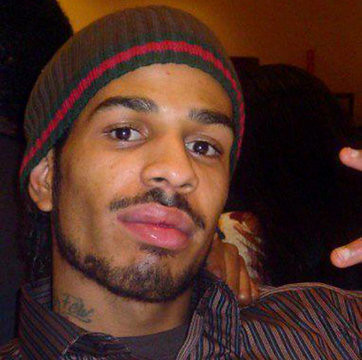
If ISIS were at all interested in attacking soft targets in the USA, Douglas McCain would have been perfect for the task... imagine if one of the homies in Ferguson Missouri walked over to a group of policeman there and blew himself up... American boots would be back on Iraqi ground in days. Obviously ISIS is not interested in that at all, they are intent on doing just exactly what they are doing now: building an Islamic state in the vacuum the United States created when they invaded Iraq. And this is an idea that is inspiring thousands of young Muslims all over the  world, including, it appears, the USA as well.

ISIS say they want to restore the "caliphate". What is this really all about?

Here I hope my readers would pardon me quoting chosen bits of something I wrote all the way back in 2011.

Just substitute "ISIS" for "Al Qaeda" (don't bother, I'll do it for you).

Now this caliphate business may sound like something right out of the "1001 Arabian Nights", redolent of Sindbad the Sailor and Aladdin and his magic lamp, or a world empire,  but here it might be useful to recall that the last Islamic caliphate ended as recently March 3, 1924, when Kemal Ataturk closed it down, threw out the Sultan (Caliph) and officially ended the Ottoman empire and westernized Turkey.  Basically then, what al Qaeda and ISIS are trying to achieve is the Islamic restoration of what was the Arab part of the Ottoman empire, but run by Arabs not by Turks...That's what Lawrence of Arabia (Peter O' Toole)  was promising the Arabs (Alec Guinness and Anthony Quinn)... remember? 
Is this really that weird?
If you stop and think for a bit and you know your world history since WWI, you will recall that every attempt to mobilize the Arabs in order for them break from the grip of the colonial powers and the USA: pan-Arab nationalism, local nationalism, Arab varieties of socialism, military dictators or a mixture of all of these, has proved ineffectual in advancing the agenda of unity and full sovereignty. Naturally Britain, France and, of course, the USA were pleased by this failure and have always done everything in their power, from bribes to coups, to assassinations, to make that outcome inevitable. Oil or Israel, its all the same from the pan-Arab nationalist point of view, keeping the Arabs down was always the bottom line.
By a process of elimination pan-Arab nationalism has hit on the most reductive version of Islam as the only movement, ideology and source of political energy that is so decocted and fibrous and emotionally satisfying to it adherents that it cannot be co-opted, re-engineered, de-contented and manipulated by the economic/cultural power of the USA.(...) What many Muslims, violent and non-violent alike seem to have hit on is that their ancestral religion is indigestible by globalization. It is a music that globalization, in its American version, simply cannot play. 

Today (...) even moderate Muslims, people that don't plan on putting a bomb in anybody's jockey shorts, are wearing beards and hijabs and chorusing, "Islam is the answer": They see it as a vaccine against being digested and assimilated and then excreted by the dynamics of globalization.
Are Muslims just being insanely paranoiac when they accuse the United States of trying to "destroy" Islam?
In my opinion, yes and no. "Yes", from the American point of view, where we think it jolly nice if some people go to church on Sunday, others go to temple on Saturday and, what the heck, others can go to mosque on Friday if they want to... but for the rest of what is left of the week, it is business as usual or else.
"No", from the point of view of many Muslims, if by "to destroy" means "to trivialize" their religion, which, in their view, is a seven day, 24 hour a day project, which is the arbiter of all human affairs. This is contrary to the rules of our economic system: within globalization the "market" has taken on the role that Islam assigns to God. Therefore Islam being indigestible in its present form must be reshaped or "Disneyfied" if you will. Except it can't be and still be Islam.
More than confronting the American people themselves, it seems to me that Muslim fundamentalists are confronting history's most powerful exponent of a system that was once described as turning "all that is solid into air" and profaning everything sacred; leaving commerce as the fundamental activity of all human beings. If we consider in what shape our economic system has left the teachings of Jesus Christ, perhaps the Muslims aren't as far off target as they appear at first glance.
If you stop and think about it, every traditional relationship between human beings that ever existed anywhere, clan, tribe, nationality, religion, family authority, has been either dissolved or degraded by our economic system: this is what we have lost in exchange for our standard of living. We happen to be cool with that, but not everybody else is.
Be that as it may, the principal objective of Muslim fundamentalists, in my opinion, is to eject an alien civilization (us), and all those who empower it (ME regimes), from the spiritual-emotional center of Islam. At heart this is just an continuation of the dismantling of the Euro-American (white) domination of the world that began at the end of WWII, a domination which globalization has given a new breath of life.
So basically on a transnational scale similar to what Marxism/Leninism once was, this is yet another "national liberation struggle". 
If we look at the cost-effectiveness of everything Al Qaeda/ISIS have done since the attack on the USS Cole and the African embassies and compare it with the sacrifices made by the Vietnamese people to finally gain their independence, I imagine that sooner or later the Muslim fundamentalists are going to succeed in driving us out of the Middle East.
What happens then?
Obviously if there is a general Islamist revolution in the Middle East followed by the Magreb, with America's client regimes falling like dominoes, it would have the immediate effect of pushing the price of oil through the roof and that alone would bring on a major economic crisis. It would be every man for himself as Europe, Japan and China scrambled to assure their energy supplies. This might bring protectionism roaring in, if it didn't start a series of wars. Israel, of course, might always do something crazy, but I think that in such a situation, observers might be amazed at how "prudent" the Israelis could be, if Egypt, Jordan and Syria, for example, fell to the Islamists in short succession.
Whatever finally happened, the period of transformation would be a harrowing, violent roller coaster ride, however, when the transformation had been completed, we would find the resulting situation:
  1. The new rulers would immediately have to find some way of feeding their populations
  2. The only thing they would have to sell to feed them would be oil
  3. The thirst of the developed and developing nations for oil would be as great as ever.
In those three points we have the makings of a workable peace.
What would that peace look like?
The best model I can think of would be some Muslim/Judeo/post-Christian version of the Treaty of Westphalia, a miracle of diplomacy whereby Protestants and Catholics managed to end the "Thirty Years War", religious conflict in Europe, and perhaps most importantly enshrined the idea of state's non-meddling in the internal affairs of other states. This idea of inviolable sovereignty had managed to limp along for hundreds of years until Clinton, Bush, Blair and now Obama, under aegis of the neocons and liberal interventionists trashed it... with the results we are living with today

In some perfect neo-Westphalian world, the Muslim minority of Europe would be allowed to practice their religion in peace and the Christian and Jewish minorities in the Middle East practice theirs. Too good to be true? Well, the part about Christians and Jews being able to practice their religions in peace in the Middle East is a workmanlike description of how the Ottoman empire worked, otherwise how do you think that 19th century Zionist settlers under the patronage of the Rothschilds were allowed to settle in Palestine in the first place? And not just the Ottomans, many westerners don't realize that until Israel's appearance on the scene in 1948 that there had been a vibrant Jewish community in Mesopotamia for over 4,000 years!
The bit about the Ottoman empire being a place where the three religions "of the book" lived in peace is why, contrary to many commentators, I view very favorably Turkey's moves to cool their relations with Israel and reclaim a prominent place in the world of Islam. Turkey's moderating role on orthodox Islam in the post-American-hegemony, multipolar world of compartmentalized and case by case globalization is a key one.
"Yihye tov" as the Israelis say, which more or less means, "things will get better," but more accurately, "it will be alright on the night," meaning: "with optimism plus improvisation things will probably turn out OK".  We live in hope. DS

Friday, August 01, 2014

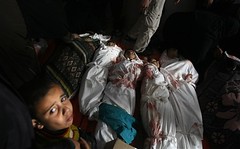
Hamas presents its "price tag"

The US has said the shelling of a UN shelter in Gaza is "totally unacceptable and totally indefensible". In its strongest criticism yet of Israel's offensive in the Palestinian territory, the US - Israel's closest ally - also said the civilian casualties were "too high". It urged Israel to do more to protect civilian life. BBC News

The European Union on Thursday condemned the shelling of a United Nations school and crowded Gaza market the previous day, urging an immediate probe into the "unacceptable" deaths of civilians. "It is unacceptable that innocent displaced civilians, who were taking shelter in designated UN areas after being called on by the Israeli military to evacuate their homes, have been killed," the EU's diplomatic service said in a statement. Agence France-Presse

I’m no fan of Hamas, quite the contrary. But Israel’s attempt to put all the blame on Hamas is outrageous. The international community will soon judge this war’s atrocities. Hamas may be reprimanded, deservedly, but Israel will be condemned and ostracized far more. And then Israelis will say, ‘It’s Hamas’ fault. And the world will laugh. Haaretz

AIPAC rules. It's the Jewish community's National Rifle Association, which also uses its clout against children. To be fair, it is not the Jewish community that AIPAC represents but the organized Jewish community, a small minority of Jews. I still believe that most American Jews, always progressive and humanitarian, have not abandoned 3000 years of Jewish history and tradition to support this barbarism. M. J. Rosenberg
The story here is not the condemnations themselves, but how long they took in coming and how little space they initially receive in the American media and how that was organized... That is the real story of the Gaza "war" (massacre).

I am about to turn 70, and when I was a boy Jewish people were, for me, Albert Einstein, Arthur Rubinstein, Sandy Koufax and Sid Caesar... Today, I'm sorry to say, they are: Binyamin Netanyahu, AIPAC and Sheldon Adelson... way to go Israel, Mazel tov. DS

Saturday, July 26, 2014

My Gaza rant (part two)

Gaza
photo mmansour


To whom it may concern:
"Oppressed beneath the weight of their own corruption and of military violence, they for a long while preserved the sentiments, or at least the ideas of their free-born ancestors" Edward Gibbon - "The Decline and Fall of the Roman Empire"
Relevant quotes:
"There is no more Palestine. Finished . . ." Moshe Dayan As quoted in TIME Magazine (30 July 1973)

"We don't have a solution, and you will continue living like dogs, and whoever wants will go, and will see how this procedure will work out." Moshe Dayan speaking of the Palestinians, in Mehiro shel Ihud (Revivim, 1985) by Yossi Beilin, p. 42

"Um-Shmum" David Ben Gurion

DS

Thursday, July 24, 2014

My Gaza rant

Dov Lior, the rabbi of the settlement of Kiryat Arba, has issued a religious ruling permitting the total destruction of Gaza if Israel’s military leaders deem it necessary. Lior is considered one of the more extreme rabbis on the religious right. In his ruling, he wrote (...) “The defense minister may even order the destruction of Gaza so that the south should no longer suffer, and to prevent harm to members of our people who have long been suffering from the enemies surrounding us,” he wrote. Haaretz
A statement like the above in the mouth of say, Harry Truman, would have been rather normal during World War II; the days of Hiroshima and the fire bombing of Dresden and might even make sense in today's Israel... that is if Israel were in any danger of being overrun and destroyed by her many enemies... but that is far, far, from the case. 

Leaving moral reservation's aside, Israel's reaction is purely hysterical and enormously counterproductive to their interests, both long and short term.

This hysteria is what frightens me most.

One of the things that worries me most is that, having the Iron Dome anti-rocket system that destroys over 90% of incoming missiles the Israelis don't have the sense to hunker down and sweat it out till the blockaded Hamas runs out of rockets, just using drones etc to keep the Hamas fighters off balance... 

Because with their monumental lack of sangfroid they have allowed Hamas to sucker them into a street by street, house by house, toe to toe, man to man, infantry battle, where all their technological advantages are neutralized. The Palestinian's secret weapon, their greatest war resource in the long run is their birthrate and their willingness to die for their cause. They are using these strategic advantages now.

Although the ratio of casualties is around ten to one the IDF is taking what by hysterical, Israeli standards are very heavy casualties and what is much more important in the long run, they are getting the sort of worldwide "baby killer" reputation that did so much damage to America's prestige and influence during the war in Vietnam... Israel is far from being as unsinkable as the USA... and perhaps more important... the mechanisms by which the tail wags the dog in Israel's relationship with America are getting creakingly obvious to even the dullest American wits. DS


Sunday, July 13, 2014

Lady Thatcher's Koan

Dirty Dancing
In almost any question, no matter how complex, there is an axis, hinge, fulcrum, upon and around which the entire question revolves. Discovering that point is often produced after concentrated immersion in the problem in all its facets, but the discovery itself is experienced as an intuitive flash.... what Zen Buddhists call "satori". In their discipline they make use of riddles called "Koans" to trigger such insights.
Koan:  a paradox to be meditated upon that is used to train Zen Buddhist monks to abandon ultimate dependence on reason and to force them into gaining sudden intuitive enlightenment. Merriam-Webster
Here is a sample koan:
A monk asked Zhàozhōu, "Does a dog have Buddha nature or not?" Zhaozhou said, "Wú".
Margaret Thatcher, of all people, once delivered herself of a koan, which, in my opinion,  if meditated upon sufficiently, explains much of what we are living through today with the triumphant "Conservative Revolution" that she and Reagan led and also gives valuable insights in how to resist and perhaps even reverse that revolution.

Here is Maggie's koan
"Who is society? There is no such thing! There are individual men and women and there are families." Margaret Thatcher - 1987
In my view, this "koan" encloses all the contradictions and even the agenda of the Thatcher/Reagan,  Conservative Revolution, the political, social and economic wasteland that we inhabit today.

Let's get into our lotus position and have a closer look at this thing, let us in the words of the immortal Spike Milligan, "scrutinize it with an intense scrute".

First question, "who is society"? 
a. The totality of social relationships among humans.
b. A group of humans broadly distinguished from other groups by mutual interests, participation in characteristic relationships, shared institutions, and a common culture.
c. The institutions and culture of a distinct self-perpetuating group. The Free Dictionary
In other words: anyone who actively participates in the affairs of a community within the larger community, be it a church, mosque or temple, or someone who canvases for a political party or a charity... or simply anyone who takes the trouble to pick up a piece of litter, that he/she didn't drop on the sidewalk and walks over to a public wastebasket and throws it away. That is society... Maggie said it doesn't exist... If wishes were horses, beggars would ride.

Who are the "individual men and women" that Lady Thatcher mentions?

Knowing her a little, I would think that she was referring to what I would now call "Piketty individuals", one-percenters like Bill Gates, Warren Buffet or the Koch brothers, people whose activities are constrained by little more than the laws of physics... I think Lady Thatcher would prefer that other, lesser, "individuals" be of  the "Bowling Alone" variety; sitting by themselves on their soft sofas in a dark living room watching endless TV series, while eating popcorn and guzzling super-size, sugary drinks.

And the families?

Again, knowing her, I imagine that she was thinking of "Piketty" families:
The book argues that the world today is returning towards "patrimonial capitalism", in which much of the economy is dominated by inherited wealth: Their power is increasing, creating an oligarchy. Piketty cites novels by Honoré de Balzac, Jane Austen and Henry James to describe the rigid class structure based on accumulated capital that existed in England and France in the early 1800s. Wikipedia
I certainly don't imagine she was thinking about couples with a high school education both working 60 hour weeks, weekends included, at minimum wages, whose children are being raised by a TV set, going to sub-standard, tax-starved public schools and without medical care.

And strangely enough, this is where the sado-libertarian ideology that Thatcher-Reagan represent has exposed a vulnerable flank in its defenses... religious conservatives... yes the, "every sperm is sacred", crowd. The new Pope has said that our economic system is "inhuman", more anti-Thatcher than that is hard to imagine. 
Respect for the person means not only guaranteeing their political and civil rights, the pope said, but also "offering each person the possibility of having effective access to the essential means of sustenance: food, water, shelter, health care, education and the possibility of forming and supporting a family."(...) "There cannot be true peace and harmony if we do not work for a society that is more just and marked by solidarity, if we don't overcome selfishness, individualism and special interests at every level," he said. Catholic News Service
Maggie would turn in her grave reading the above.

With that in mind, the Christian pro-life movement should be pressed to define what sort of society would be "human" enough to allow families to bring endless children into it and more importantly, how such a society could be achieved. 

Progressives should hold Christian's feet to the fire on this question. "OK, agreed, so no more abortion, so no more contraceptives, then where is the tax money coming from to pay for the nurseries, the schools, the universities, the hospitals, etc for all these humans?" "Can a system organized like ours do all this and if not, how could it be organized to be 'human' or are you OK with a system that the Pope defines as inhuman?" The Ayn Rand crowd couldn't care less about this, but certainly any person raised in the Abrahamic traditions would be discomfited by these questions.

In my opinion this is the "sound of one hand clapping" moment for progressives. DS

Sunday, July 06, 2014

The Israelis are playing with fire...


Nick Cook, 36, of Grand Ledge did two tours in Iraq and, as an Army troop commander, lost five soldiers. “For me, it’s very upsetting,” he said, “I watch what’s happening there. My first six months, it was very intense fighting in Baghdad, but then there was prosperity and good news. And to see that now on the verge of collapse, and knowing I lost five soldiers, it’s very hard. These kids may have died in vain.” (...) It also was a costly war financially for the U.S. The war will eventually cost U.S. taxpayers at least $2.2 trillion, including long-term care for wounded veterans, according to a 2013 study by the Costs of War project, based at Brown University’s Watson Institute for International Studies. Detroit Free Press
"If people don't do politics, others will do it for you. And when others do it for you, they can steal your rights, your democracy and your wallet." Pablo Iglesias - Podemos

The Middle East now has been torn apart by American invasions and attacks, and careless ideas about how to remake other peoples’ lives according to our own ideas about how they should live and behave and believe. It’s been like the Huns passing through: millions are dead, cities in ruins, the Muslims at war with one another. Iraq and Syria, and probably Jordan, as they exist today, and possibly Lebanon, may never recover from this. The Arabs will survive, and one day Palestine and ancient Syria and Mesopotamia will undoubtedly be reconstituted. Israel? It has existed as a modern state for little more than six decades, although it too existed in antiquity. Will modern Israel still exist at the end of this century? After all that has, and will, happen? I wonder what is the answer. William Pfaff

Through their actions, young American Jews can shape the way a Jewish state wields power. And how Jews behave with power represents a post facto referendum on the Jewish ethical tradition itself. We should tell them that if they believe Jews possess a special passion for justice, they must prove it. And they must prove it in Israel, because although justice is endangered in the United States and all over the world, only in Israel is the Jewish people’s honor at stake. Peter Beinart - Haaretz
Things change if people make them change.

Things have changed since the American people were encouraged to put Vietnam behind them and "move on". The "gate keeper" function of  "mainstream media" which worked mightily to that end is, if not dead, very, very sick and not expected to recover... especially when confronting something as stubborn as Middle Eastern reality.

Unlike "manufactured consent" social media opinion  today is largely grassroots, village-like. It is a  sullen, brooding, self-confirming, bench tested, consensus, slow to build, hard to budge and in this sense "authentic".

Many commentators discount the sullen power of public opinion, this is most unwise. Publicists and think tanks can spend billions trying to convince the public that the sky is green and the grass is blue, but to no effect, finally their efforts boil down to Redd Fox’s cheating wife, who, when caught in the act, tells her furious husband, "go on, believe your goddamn, lying eyes!".

This is now the case of American public opinion and the Middle East. Liberal-Interventionists can whine and Neocons can howl, but Americans have had enough of the Middle East, they will not be easily dragged back there again to spend blood and treasure poring sand down a rat hole and will resent mightily anyone who tries to drag them back.

Netanyahu and the settlers should not press their luck much farther, if Israel negotiates a two state solution with the Palestinians and pulls back to something like the 1967 borders, I believe that Americans would still be willing and still be able to defend that status with decisive armed force and considerable soft power, but that is certainly not the direction things are moving. What I don't think is that Americans will agree to sending their sons and daughters to die defending apartheid and ethnic cleansing or agree to pay for that out of their taxes. Time is running out. DS

Saturday, June 28, 2014

The "Piketty Effect" or the "One-Percent" can be harmful to your health

Collage - David Seaton
"Anybody who reads the newspaper will be aware that, in the United States, the “one per cent” is taking an ever-larger slice of the economic pie. But did you know that the share of the top income percentile is bigger than it was in South Africa in the nineteen-sixties and about the same as it is in Colombia, another deeply divided society, today? In terms of income generated by work, the level of inequality in the United States is “probably higher than in any other society at any time in the past, anywhere in the world." Thomas Piketty - quoted in The New Yorker
I don’t want some rich person’s mansion or bank account. I just don’t want to pay for them with our schools and roads and postal service. Marym in IL- Firedoglake

While mulling over the huge impact of Thomas Piketty's book,"Capital in the Twenty-First Century", I got this nagging feeling that I had been here before, that this was so familiar, but I couldn't put my finger on what it was... 

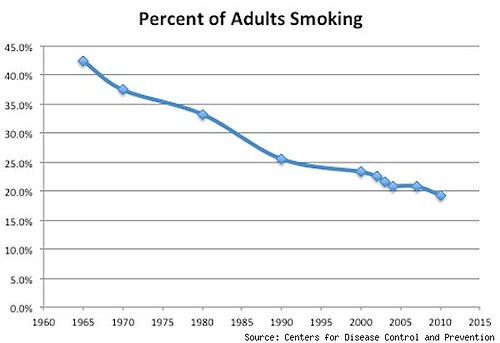
Then it came to me... This is like when it was statistically proven that smoking causes cancer, and then a shockingly cancer ravaged, near death, much loved, proverbial chain smoker, John Wayne, showed up on that Oscar night in 1979... Only this time, in the case of the side-effects of inequality, the sequence has been reversed: first we are ravished, then near death and then we get the explanatory statistics.

However, I find the similarities striking: an enormous "public-relations" industry, including (massively) Hollywood, devoted over decades to convincing millions of men, women and children that something useless, expensive and totally harmful, was not only not harmful, it was "cool".

Finally the statistical evidence combined with the sight of iconic personalities wasted by the smoking habit has brought about a sea change in public opinion, which has caused millions of people to give up the habit or never start smoking in the first place and forced the passage of stringent legislation, bucking the efforts of big tobacco, one of America's most powerful lobbies.  

Today, far from being seen as cool, smokers are forced to huddle pitifully outdoors in the dead of winter, to get their "fix". 

Statistical evidence combined with raw emotion caused this massive change in public opinion. 

Does this mean that thanks to the ravages of the financial crisis and the findings of professor Piketty we  are going to see pitiful, former billionaires huddling on America's sidewalks anytime soon?

I wouldn't hold my breath waiting for it.

What we are going to see, I think, is an enormous, tectonic conflict between the sea change of Piketty empowered public opinion and the enormous power of the one-percent to corrupt the political process, which will dwarf anything that the tobacco lobby could ever have even dreamt of. DS

Sunday, June 22, 2014

Notes on the new populism


Classic left wing parties are missing the boat today, almost to the point of irrelevance,  because the traditional "working class", which was their power base, has been largely fragmented and is now practically powerless as the enormous "reserve army of labor" that globalization provides means that the worker´s principal weapon, withdrawing their labor, is no longer effective, increasingly even in skilled or jobs requiring higher education: if an American legal assistant is expensive, get an Indian lawyer in India to do the paperwork at a tenth the price per hour. But this has a certain "death spiral" effect.

The"killer contradiction" today is that while workers are no long needed more and more consumers are. Globalization has also brought on overproduction, a glut of consumer goods flood the markets.

How are unemployed or underemployed formerly middle class people, brought up on the idea of their right, even duty to consume, consume? Credit? Been there, done that.

So the real "revolutionary protagonist" today is the
enormous, but increasingly declassé and naturally resentful middle class that was created before globalization. Some sort of populism,  "us against the one-percent" is the only possible progressive game in town now. 

The challenge is to keep this populism international, progressive and not nationalistic-racist, reactionary etc. 

That is why Thomas Piketty work, "Capital in the Twentyfirst-Century" is a great help, especially among statistic loving Americans, in building objective political consciousness in the middle class for this struggle, which is really just beginning. DS

Friday, June 20, 2014

Groundhog day in Iraq and... you name it

Onward and upward
Sometimes, when you get older you get what Yogi Berra called the "dejá vu all over again" feeling while observing life and especially world affairs; a little like an usher in an all day movie theater might get... the moviegoers are glued to the screen to see if the hero gets the girl or the bad guy gets his just desserts, while you who have seen this film a dozen times or more before are pulling back curtains, opening doors and spraying air freshener... From Vietnam through Iraq and back to Iraq... from 1964 to 2014: 50 years of my life watching, the drip, drip, drip, of useless bloodshed, death and stupidity...

Perhaps the time has come to put on a saffron robe, take up a begging bowl and retire to a forest hermitage to contemplate my navel or maybe just take a big dose of fruit salts. DS

Sunday, June 15, 2014

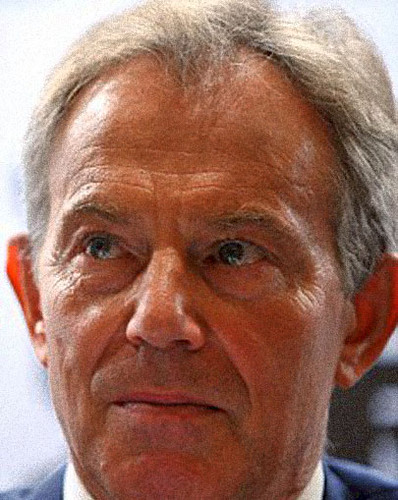
Chutzpah, thy name is Tony Blair

Nobody here but us chickens boss
In a defense of his actions in Iraq, Blair attacked as "extraordinary" any notion the country would be stable if Saddam Hussein had stayed in power. (...) Tony Blair has strongly rejected claims that the 2003 US-UK invasion of Iraq was to blame for the current crisis gripping the country, pointing the finger instead firmly at the Maliki government and the war in Syria. In a passionate essay published on his website, the former prime minister said it was a "bizarre" reading of the situation to argue that the US-British invasion of Iraq had allowed the growth of Sunni jihadist groups such as the Islamic State in Iraq and the Levant (Isis), whose fighters have swept through towns and cities north and west of Baghdad over the past week. "We have to liberate ourselves from the notion that 'we' have caused this. We haven't. We can argue as to whether our policies at points have helped or not: and whether action or inaction is the best policy. But the fundamental cause of the crisis lies within the region not outside it Guardian

Leo Rosten in The Joys of Yiddish defines chutzpah as "gall, brazen nerve, effrontery, incredible 'guts,' presumption plus arrogance such as no other word and no other language can do justice to." In this sense, chutzpah expresses both strong disapproval and condemnation. In the same work, Rosten also defined the term as "that quality enshrined in a man who, having killed his mother and father, throws himself on the mercy of the court because he is an orphan." Chutzpah amounts to a total denial of personal responsibility, that renders others speechless and incredulous ... one cannot quite believe that another person totally lacks common human traits like remorse, regret, guilt, sympathy and insight. The implication is at least some degree of psychopathy in the subject, as well as the awestruck amazement of the observer at the display. Wikipedia
Today I am speechless: enjoy. DS

Monday, June 09, 2014

Interregnum... after the ball was over

This week William Hague, Britain’s foreign secretary, told the inaugural London Conference hosted by Chatham House that the world was not simply going through a difficult patch, but had entered a period of “systemic disorder”. Financial Times

Nowadays, both advanced economies (like the United States, where unlimited financing of elected officials by financially powerful business interests is simply legalized corruption) and emerging markets (where oligarchs often dominate the economy and the political system) seem to be run for the few. For the many, by contrast, there has been only secular stagnation, with depressed employment and stagnating wages. Nouriel Roubini
The crisis consists precisely in the fact that the old is dying and the new cannot be born; in this interregnum a great variety of morbid symptoms appear. Antonio Gramsci

After the ball was over
Nellie took out her glass eye
Put her false teeth in water
Corked up her bottle of dye
Put her false leg in the corner
Hung up her wig on the door
And all that is left goes to bye byes
After the ball
After The Ball Was Over
What kind of animal are we talking about?
I have to admit that I'm getting bored, but bored as combat soldiers get bored, where fear and boredom mix. Bored with the "systemic disorder" of the "interregnum", the randomness, chaotic entropy of it, which defies rational ordering or analysis: anxiety without any horizon.

At the bottom there is something very simple: when they asked the legendary Willie Sutton why he robbed banks he replied, "because that is where the money is". The money is in tax-havens and it must be taxed and redistributed if humanity is going to have any chance of a "human" future.
It would seem much more useful, in terms of building the capacity to address the environmental crisis, to frame the issue of the environment as linked to a broader struggle that includes the redistribution of income and wealth to more equitably share the costs of environmental restraint; a cultural shift in the balance between individual consumption of goods and collective services; the development of public spaces and desperately needed infrastructural renewal (including mass transit); and the conversion of potentially productive facilities rejected by the market to the production of socially useful and environmentally necessary products and services. Such a framing would also tie the environmental crisis to the obvious need to place democratic planning on the agenda and go so far as to start talking about making private banks into public utilities so that we have access to the financial resources to carry out the above initiatives. Sam Gindin - Jacobin
Alas, who is going to ever bell this cat? DS

Monday, June 02, 2014

Losing it.....

Please pardon me quoting myself, but...
My clearest reading of 2014's tea leaves is "instability": worldwide instability and in my opinion this instability has its origins at the heart of the most developed economies of the western world. The causes? We are undergoing a technological revolution and process of globalized outsourcing, combined with a reduction of the welfare state that is severely degrading the middle class in developed countries and converting them slowly, but surely into working-poor. Anyone who has read a bit of history could tell you how dangerous that is. Newslinks - 2014 and Welcome To It
On top of that, like whipped cream, I would put the following from today's Financial Times
Economic forecasters have yet to internalize the fact that the US economy has fundamentally altered. The purchasing power of the majority of Americans has not only stagnated since the recovery began five years ago – it has actually declined. Edward Luce - Financial Times
 And on top of that, like a maraschino cherry, this from no other than His Holiness the Pope:
Populism in Europe, trust and mistrust, some theories about the Euro ... I don’t know much about this kind of thing. But unemployment is serious: we have a global economic system that is centered on money, not on the human being. In order to keep going, this system discards things. It discards children: birth rates are not high, in Italy the average couple has less than two children and in Spain even less. It discards the elderly, even through euthanasia in disguise, medicine is only administered up until a certain point. And young people are discarded too.  I think unemployment among Italy’s young is 40%, in Spain it’s 50%, in Andalusia, 60%. There is an entire generation of people that is not studying or working. This culture of waste is very serious. Europe is not the only place where it exists, but it is strongly felt in Europe. It is an inhumane economic system. Pope Francis
Spain, where I live, is not anywhere near collapsing, but the conditions that the Pope mentions are leading to some of the most coherent, practical, active, alternative politics that I have ever seen:
Until recently, it appeared that the Spanish indignados movement had fizzled out. But on Sunday evening, a fledgling party born from its ashes proved otherwise, winning five seats and 1.2 million votes in Spain's European elections. - The Guardian
The name of the new party is "Podemos", which most translate as the first person plural of the verb "poder", "We Can", but Spanish speakers notice that podemos is also the subjunctive, first person plural of the verb "podar" (to prune) or "Let's Prune". 

The elections were on Sunday the 25th of May

I suppose it's just a coincidence, but the King of Spain has abdicated exactly one week later.

How has technology caused so much pain and confusion?

At the bottom of it is the enormous increase in productivity brought on by information technologies. We simply produce much more than we can possibly consume: we need lots of consumers and much fewer workers.  How are underemployed people supposed to buy anything? On credit. Something has to give, has given.

With lower costs and more technology, profits rise and much of this gain is reinvested in more productivity-raising technology, which makes more skills and the people who have them redundant. This means, perversely, that more profits usually lead to less jobs or much poorer jobs. This paradigm, which until recently only held true for the poorly educated, is now reaching the ranks of university graduates. Now, with digital technology, even high intellectual output tasks can be outsourced to where people with postgraduate degrees can be hired for the same cost per hour as high school graduates in a developed country.

Result: As more money is invested in raising productivity, fewer and fewer people can produce more and more for a market glutted with products that fewer and fewer people can afford to buy without going into debt.

Salaries don't rise because most workers are not really needed that badly and are easy to replace if they go on strike, complain or even report in sick.. and thus they have no bargaining power. Any shortages such as one resulting from low birthrate in developed countries can be solved by outsourcing the jobs to poorer countries with high birthrates.

All people are really required to do is to buy many things that they don't really need, which they can do, even with a McJob, by using a credit card... hereby kicking the can into the future: a future with poorer paying jobs, less horizon, more need of credit to participate, with less chance of ever paying back the debts incurred.

To make underpaid workers buy things that objectively they don't need, an entire industry (marketing) exists to make them dissatisfied with what they already have. Perversely, unhappiness becomes a social good in such an economic arrangement. A thrifty person, content with his lot, who for thousands of years was seen, in all traditions, as a wise and sensible man; in this contemporary situation is seen as a public enemy to be "stimulated". 

As to what the contributions technology and advanced communications might make to improving America's economy, awhile back I read Fareed Zakaria's, "The Post American World", where Zakaria writes about advances in nanotechnology:
At some point in the future, or so I'm told, households will construct products out of raw materials, and businesses will simply create the formulas that turn atoms into goods.
The idea is that you put some powder you order on the Internet into a washtub, add water and out walks a TV set, thus putting millions of Chinese people out of work.

Whether this ever happens or not, the fact that somebody might think it was a good idea and that a lot of money was being invested in making it happen would have to put you on your guard a bit: it's the thought that counts.

In a sense our entire "civilization" is sort of a universal "Ponzi scheme". If the wheel stops even for a moment it all comes tumbling down.

It's amazing that a structure this artificial, that fills so few truly human needs, has taken so long to nearly collapse.

What will collapse, if it ever comes, look like?

The best metaphor, the most poetic illustration of political collapse that I have ever seen is the video below this piece: Rumanian dictator Nicolae Ceausescu's last speech, a man of absolute power for decades, only a matter of hours before being shot. In itself, like a perfect work of art it shows in less than ten minutes a process that in a country as marvelously structured as the USA might take more than twenty years, if it happened at all.

I think that America's system is so well carpentered that if it ever collapses it will appear till the last moment like a termite-ridden piece of furniture: absolutely normal looking till someone or something puts too much weight on it. DS


Wednesday, May 14, 2014

What is really behind the Ukraine crisis

Russia's reaction to the move to overthrow Ukraine's government, take it into the EU and from there, probably into NATO was the most predictable thing in the world, just the sort of thing that George H.W. Bush, Kohl, Mitterrand and yes, even Margaret Thatcher wanted to avoid. In American terms imagine Washington's reaction if a Panamanian Hugo Chavez allied Panama with Cuba, filled the Canal Zone with Cuban advisers and threatened to close it... the marines would be there the next day. That is more or less what the Ukraine means to Russia. So Putin reacted in a totally predictable way. History is full of great wars that began with less cause. It is logical to think that the result we have before was calculated to benefit someone. Why deliberately take the risk of cornering a major atomic power in its traditional space?

Why would anyone else but Russia take such enormous risks for such a broken, corrupt, mess as Ukraine?

When you want to understand a major international crisis, or almost anything else for that matter, one of the first things to do is to take a step back and try to fit it into the "big picture". 

In international affairs, that is best done by reading history and studying maps.

The Ukrainian crisis is splitting Europe apart and turning Russia into an "enemy" again.

When I step back and look at maps and history, I come to the conclusion that Ukraine is merely a handy tool in a much larger operation, which is to interrupt and foil any and all efforts by the Chinese, Russians and the Europeans to create a Euro-Asian "prosperity sphere", bringing fluid movement of goods to and from China, by land from Europe across Russia and Asia. Think of all the synergies of European added value, brands and know how, combined with Russia's natural resources and technology all plugged into China's enormous markets and efficient mass, low-cost manufacturing.

The only real obstacles to this flow, Asia/Europe/Asia are political and even during the Cold War it went on quite a bit. For example, in the 1960s, before cheap flights, many Japanese students who wanted to visit Europe, used to take the boat from Japan to Vladivostok, from there the Tran-Siberian Express to Moscow, thence to Warsaw and finally Paris. In those same years a Canadian friend of mine made his first trip to India in a Volkswagen minibus.

It worked like this: a German fellow used to buy second hand minibuses in Stuttgart, load them up with hippies to pay the gas and then drive all the way to India, sell the bus (it was illegal to import them into India and he sold them for an enormous profit) and then he'd fly back to Germany and start the process all over again. 

The bus full of hippies drove through the Shah's Iran, from there though Afghanistan, where, before the CIA invented the Taliban and Al Qaeda, Kabul was filled with girls in miniskirts and cheap opium and hashish (hippy paradise) and from there across Pakistan and into India.

Off and on going back to Marco Polo and beyond, that is how the world more or less worked; interrupted by an occasional crusade now and then: caravans buying and selling across frontiers, languages and cultures, for hundreds and hundreds of years.

Analyzing how and why that is no longer possible would teach you volumes about modern history and its mechanisms.  The idea of fluid communication and trade Europe/Asia/Europe is nothing new, it is like the law of gravity... What is abnormal are the obstacles: they are all political.

With that in mind let us look at China's "New Silk Road" initiative, which, with all the hoohah in Ukraine, is getting very little coverage in the press these days. Some of my readers will only know "Silk Road" as a website where drugs can be acquired  anonymously, but the original Silk Road story is a bit more interesting than that. You can read up on the original version in Wikipedia.

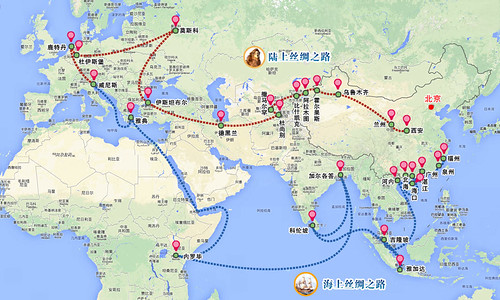
Below you'll find Xinhua's map of China's "New Silk Road" project.

The new "Silk Road"
Before going on it would be well to remember that the World Bank expects China to become the world's largest economy sometime in 2014:
Many economists expect China to eclipse the U.S. as the world's largest economy sometime in the next few decades, but new World Bank data suggests that the transition could come much sooner. Is China ready now to assume its spot as the world's No. 1 economy? If so, what does it mean for the U.S., investors, and you? Motley Fool
With that in mind read the following:
The maps of the two Silk Roads drive home the enormous scale of the project: the Silk Road and Maritime Silk Road combined will create a massive loop linking three continents. If any single image conveys China’s ambitions to reclaim its place as the “Middle Kingdom,” linked to the world by trade and cultural exchanges, the Xinhua map is it. Even the name of the project, the Silk Road, is inextricably linked to China’s past as a source of goods and information for the rest of the world. The Diplomat
Here is how it connects to Europe:
DUSSELDORF, Germany, March 29 (Xinhua) -- Chinese President Xi Jinping Saturday called on China and Germany to work together to build the Silk Road economic belt. Xi made the remarks during a visit to Port of Duisburg, the world's biggest inland harbor and a transport and logistics hub of Europe. He said China's proposal of building the Silk Road economic belt, based on the idea of common development and prosperity, aims to better connect the Asian and European markets, will enrich the idea of the Silk Road with a new meaning, and benefit all the people along the belt. China and Germany, at the opposite ends of the belt, are two major economies that serve as the driving engines for economic growth respectively in Asia and Europe, Xi noted.
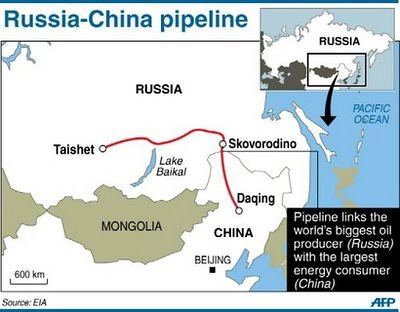
How does Russia fit into this? Now look at this map:


What or who is missing in all these maps and snippets?

The United States of America, that's what. 

The USA is nowhere in this picture... out of the loop... We can't have that can we?

What to do?

Double, double toil and trouble; fire burn, and caldron bubble. That's what. DS

Saturday, May 03, 2014

Newslinks Interruptus

Just a note to my readers to apologize for posting with such irregularity. 

The last few months have been very hectic, between earning a living, accompanying a family member every day of a two month, life or death sojourn in the hospital; half of it in intensive care (he's OK now) and then, till about yesterday, another couple of months moving house, with all that entails in endless hefting and bricolage: I confess to being remiss in blogging in both thought, word and deed.

And now... My wife and I are going off for a week of absolutely needed beach rest, an "everything included", package on the Spanish coast, where God willing, we will sleep like cats and eat like pigs... after that I should be able to get back to decent blogging with some regularity.

Anyone who reads this must be a diehard, Newslinker, coming back to the same post over and over again. I thank you truly for your patience and I hope that I can make it up to you in the next few months. DS

Sunday, April 27, 2014

Artificial Intelligence: the central question

AI in the hands of Goldman Sachs?
One can imagine such technology outsmarting financial markets, out-inventing human researchers, out-manipulating human leaders, and developing weapons we cannot even understand. Whereas the short-term impact of AI depends on who controls it, the long-term impact depends on whether it can be controlled at all. Stephen Hawking, Max Tegmark, Stuart Russell, Frank Wilczek
I am in the midst of reading, "Smart Machines", by John E. Kelly and Steve Hamm of IBM, which is basically a promotion of that multinational's "Watson" super computer....  And it all sounds so wonderful... The millennium has finally arrived and humanity will live happily ever after! 

I thought that kind of optimism about technological progress being linked to moral progress was fatally wounded in the trenches of World War One and breathed its last at Auschwitz or Hiroshima (take your pick).

And if the last, deregulated, post-Reagan years have taught us anything, especially the criminal fraud of the invasion of Iraq, followed by the recent and ongoing financial meltdown, it would be that the top of our increasingly oligarchical society is chockablock with shallow, psychopathic/sociopathic manipulators with no empathy for the rest of humanity or care for its general welfare.

Who could be so innocent as to believe that such an instrument as artificial intelligence will not fall into such hands?

If the 20th century taught us anything at all, it should be that we have no definite answer to "The Shadow's" famous question, "Who knows what evil lurks in the hearts of men?"

However with the help of Artificial Intelligence we just might get the answer to that one. DS

Saturday, April 19, 2014

The "butterfly effect" revisited

Moth by night
In chaos theory, the butterfly effect is the sensitive dependency on initial conditions in which a small change at one place in a deterministic nonlinear system can result in large differences in a later state. The name of the effect, coined by Edward Lorenz, is derived from the theoretical example of a hurricane's formation being contingent on whether or not a distant butterfly had flapped its wings several weeks earlier. Wikipedia
I remember that the "butterfly effect" was much in vogue in the late 1990s and was often quoted by the chaos theoreticians that were instrumental in designing the risk modeling that ruled finance up till 2008 and signally failed to predict the implosion of the financial system.

I think that today it would be more appropriate to talk about the "moth effect".

Moths are not as conventionally "pretty" as butterflies, but are often stunningly beautiful in a rather sinister way; and yes they flap their wings too and they often arrive in large numbers and eat their way through closets full of wool or gardens full of geraniums. 

Unlike the butterfly, the moth is seen as a plague and a pest... you don't go to the store to buy "butterflyballs", do you?

And then, rather poetically: on balmy, breathless, summer nights, moths often commit suicide en masse in the flickering flames of dinner candles, driven by their love, need and obsession with light... 

The romantic, sinister, light-driven and pestilent moth: a fitting symbol of our time.

The greatest clusters of metaphorical, wing flapping, wool chewing, suicidal moths that I detect today seem to me to be long term products of our economic system, such as the doomsday effect of global warming and the Oozlum bird effects of the advances in Artificial Intelligence. 

Global warming is the long term effect of the industrial revolution and its spread to the entire globe, but so is Artificial Intelligence.
One can imagine such technology outsmarting financial markets, out-inventing human researchers, out-manipulating human leaders, and developing weapons we cannot even understand. Whereas the short-term impact of AI depends on who controls it, the long-term impact depends on whether it can be controlled at all.  Stephen Hawking and friends - Huffington Post
But long before it comes to all that, in the near future AI will be putting nearly everyone (except maybe the people who clip the toenails and give blowjobs to elderly billionaires) out of work.

AI is the result of the geometrically accelerating drive for technological innovation, which we are told is wonderful and which will solve all our problems, but which in fact is not really a search for the greatest good for the greatest number, but on the contrary, generally driven by the intense dog eat dog competition of our economic system, where to avoid being eliminated, management and shareholders are constantly looking for greater efficiencies in cutting costs and getting more productivity with fewer people, even if this reduces the number of potential consumers. The now classic metaphor for this is Kodak, which once had 140,000 employees being replaced by Instagram, which had 13 employees when Facebook bought it.

Ironically, this pressure to innovate may finally be what fatally destabilizes our system. DS

Saturday, March 22, 2014

How isolated is Russia?

With Russia facing sanctions from the US and some other countries after it annexed Crimea from Ukraine, India on Wednesday made it clear that it will not support any "unilateral measures" against Russian government. Times of India

Based on the fact that Russia and Ukraine have deep cultural, historical and economic connections, it is time for Western powers to abandon their Cold War thinking, stop trying to exclude Russia from the political crisis they failed to mediate, and respect Russia's unique role in mapping out the future of Ukraine. Xinhua
I have very little time for carefully constructed posts at the moment, so just a few lines hastily put together. 

Reading the news about American and EU sanctions against Russia, I am beginning to suspect that there is something more cooking here than the "story" we are being fed by the MSM. 

It might be noted that in his big speech, Putin thanked both China and India for their support... Can we say that Russia is "isolated" from the "international community" with 1/2 of humanity on their side?... DS

Sunday, March 16, 2014

MH370: Ocean's Eleven meets Charles Manson?


The question nobody seems to be asking about the mysterious, disappearing, Malaysian flight is: was there anything of extraordinary value riding in the baggage hold?
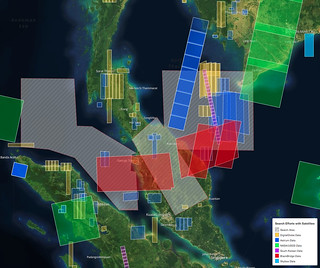
Search efforts for Flight MH370 from space

 What could that be?

Anybody's guess. If this were a "caper" movie, what is in the baggage hold would be its "MacGuffin", which is simply a mysterious object that moves the film's dramatic action. 

By now I would rule out terrorism, if that were the case the plane would have been flown directly into a target or landed in some well-publicized, international, airport where the terrorists would make "demands" in exchange for passenger-hostages. That hasn't happened.

At this point, anything but a heist is, in my opinion, outside of rational calculation... it could be something completely insane, but that by definition defies rational calculation. 

The heist theory:

To be worth the elaborate preparations and enormous risk involved, whatever the MacGuffin is, it must be of incalculable value and yet small enough to be packed unobtrusively in an ordinary container, one of hundreds, say a suitcase, and it would have to be something that didn't set off bells ringing when it passed through the airport scanners.

What about the passengers?

It doesn't look good, I'm afraid. Terrorists crave witnesses, that is the whole point of what they do, but thieves don't. By now the plane has long landed, probably been destroyed and the hijackers long gone with their prize, and the only people that could ever identify them or tell the story of what they did are the passengers. Without witnesses the perpetrators will be presumed dead too, ready to take now identities. It doesn't look good.

The most disturbing thing I have read so far is that after turning off the instruments that would reveal the plane's location, it climbed to 45,000 feet, which is above its maximum recommended altitude and then after a while, dived down to a very low 20,000 feet. At 45,000 feet, all they would have to do is to turn off the oxygen and depressurize the cabin and the passengers would quickly pass out and expire in a few minutes and then down at 20,000 feet, it would only take a few people a short time to toss the remains of the passengers out of the plane's back door... On land it is quite a job to dispose of over 200 human bodies, but scattering them from altitude over the shark infested Indian Ocean, no.

Another heist alternative is that of a military, special-ops mission, but in that case, the MacGuffin would be beyond anything my poor imagination can come up with and the fate of the passengers would be even more dismal... As Machiavelli would have you note, throughout history, great statesmen have been capable of greater cruelty than even the coldest criminal. 

The cruelty of this caper (if that is what happened) is why I call this post, "Ocean's Eleven meets Charles Manson"

I certainly hope and pray to be proven wrong on all this and that the coming days will show my speculations to be utterly foolish, tin-hattedness.  DS

Tuesday, March 04, 2014

Ukraine: belling the cat

In situations of conflict there is an acknowledged advantage given to those with their back to the wall. With survival at stake the ones with nothing to lose by fighting are at an advantage. In previous posts I've suggested that Americans could better understand the Russian position if they imagined the US reaction if America's access to the Panama Canal was threatened. The United States once invaded Panama for that very reason:
The United States Invasion of Panama, code-named Operation Just Cause, was the invasion of Panama by the United States in December 1989. It occurred during the administration of U.S. President George H. W. Bush, and ten years after the Torrijos–Carter Treaties were ratified to transfer control of the Panama Canal from the United States to Panama by 1 January 2000. During the invasion, de facto Panamanian leader, general, and dictator Manuel Noriega was deposed, president-elect Guillermo Endara sworn into office, and the Panamanian Defense Force dissolved. Wikipedia
It could be argued that Russia's interests are under much more threat today in the Ukraine than America's were in Panama in 1989. Are Russians being unjustifiably paranoid here? Here is how a notable neoconservative commentator urges a "full-throated American support for Ukraine’s revolution".
"Without Ukraine, there’s no Russian empire."
Obviously the Russians would be fools if they took US human rights rhetoric all that seriously, as anything but a smokescreen for America's own "imperialist" goals, which are to isolate Russia in a corner of Asia.

So, it seems clear to me that the Russians are the ones in the "to be or not to be" position.

Are the Europeans going to significantly sanction Russia? Doubtful. It is easy to criticize the EU in Washington, but Europeans have a lot more skin in the game than Americans do.
Given that Europe’s economic relationship with Russia is multiple times that of the United States, securing the region’s cooperation will be paramount to any effort by Washington to secure significant sanctions. Yet such ties will not be lightly jeopardized, observers say, even in the defense of a fellow European nation under threat. (...) On Tuesday, the Estonian newspaper Ohtuleht ran an editorial worrying about the economic links between Russia and Western European economies dependent on its gas supplies. “What government would dare to suggest to its voters to spend the next winter in a cold apartment just because of a peninsula nobody can point out on the map?” Washington Post
And if Europe actually decided to go to the mat with Russia, would it work?
Unlike Europe, however, Russia’s capacity for economic hardship is almost limitless, as has been repeatedly demonstrated throughout history. In any contest over pain thresholds, Russia would win hands down. Jeremy Warner - The Telegraph 
Would the USA lose anything significant by taking the moral high ground and reducing relations between the two countries? Yes, it would and in a very important way. Here is an angle which strangely nobody seems to have mentioned: one of the major objectives of the Obama administration is withdraw all but a token force from Afghanistan. I understand that getting the masses of American equipment out of Afghanistan would be nearly impossible without Russia's logistical cooperation. Here is what the US State Department has to say about Russo-American cooperation there:
The United States recognizes Russia’s contribution to building a better future for the Afghan people.(...) We take note of the significant contribution to international security that has resulted from the arrangements between the United States and Russia – bilaterally and through NATO – to support ground and air transit into and out of Afghanistan. In accordance with these arrangements, over 2,200 flights, over 379,000 military personnel, and over 45,000 containers of cargo have been transported through Russia in support of operations in Afghanistan.(...) The United States and Russia continue to face a common threat from terrorism, including from al-Qa’ida and other groups operating in and around Afghanistan. We are working together to disrupt terrorists’ operational networks and undermine their access to financial resources.  U.S. State Department
If I had to bet, I would analyze it like this. The Russian position is simple, easy for the Russian people to understand. The American position to a great extent is shallow posturing, with very little at stake. The European position is complicated: sending money to Ukraine is like poring sand down a rat hole as the people who have replaced Viktor Yanukovych are said to be every bit as dishonest as he is and any meaningful, economic sanctions on Russia would bring much pain on EU citizens at a time when the entire European project is being questioned by a wave of populists. This brings us to Ukraine. Ukraine's position is purely chaotic, totally fluid and flat broke. There is where I think the denouement will come from... the political/economic implosion of the Ukraine, with Russia shoring up the Russian speaking part. DS