Tuesday, February 03, 2015

A European "Red Spring"?

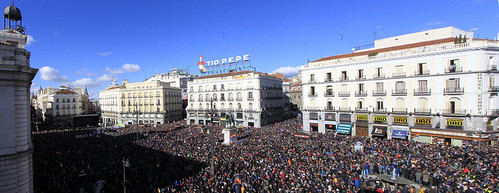
Podemos Demonstration - Puerta del Sol, Madrid, 1-31
If it was conventional wisdom that a bunch of unelected bankers looking out for rich people were the reason everyone was out of work, politicians would be forced to explain to angry voters why we had this crazy system and might actually consider doing something about it. The late Aaron Swartz
"Insanity: doing the same thing over and over again and expecting different results." Albert Einstein 
The economic slump in much of the EU has encouraged the rise of populist parties of the right and left. The sense of insecurity on which the populists feed has been further encouraged by the spillover from the conflict in the Middle East — whether in the form of terrorism or mass illegal migration. Gideon Rachman - Financial Times

We must end austerity so as not to let fear kill democracy. Unless the forces of progress and democracy change Europe, it will be Marine Le Pen and her far-right allies that change it for us. Alexis Tsipras - Financial Times 
Tens of thousands of people have massed in central Madrid for a rally organised by radical Spanish leftists Podemos. The "March for Change" is one of the party's first outdoor mass rallies, as it looks to build on the recent victory of its close allies Syriza in Greece. Podemos leader Pablo Iglesias told the crowd a "wind of change" was starting to blow through Europe. Podemos has surged ahead in opinion polls, and has vowed to write off part of Spain's debt if it comes to power.(...) Several of Madrid's main avenues became a sea of people and purple, the party's colour, he says, after its supporters travelled from all over Spain.(...) Broadcaster TVE reported that hundreds of thousands were at the demonstration, but there was no official tally. BBC News
Before we get started, it would be useful to remember that the founding "parents" of the "conservative revolution" or "neo-liberalism" as it is known in Europe, Margaret Thatcher and Ronald Reagan, both died of Alzheimer´s disease... This might not be the cause of the ongoing disaster, but it sure is a nifty metaphor for the situation we are in.
 
Regular readers of this blog know that one of my favorite hobby horses is criticizing the blockheadedness of post Cold War politicians who seem to have totally lost their fear of popular wrath.


Those who are cheerfully going about the work of dismantling the welfare state seem blissfully unaware that the welfare state was created by men as, or even more conservative then themselves, (Bismark, for example) in order to avoid revolutionary social movements which would destabilize and jeopardize the entire economic system and society itself. This was a strategy that was so eminently successful that it practically has destroyed revolutionary praxis. 

In my opinion endeavoring to dismantle the welfare state at the collapse of the Soviet Union is similar to a person who has successfully survived an operation for lung cancer and endured the ensuing chemotherapy and then, finding himself now in  remission, decides that it is ok for him to go back to smoking, the very thing that caused his cancer in the first place: idiotic.

It occurs to me that this tunnel vision, expressed in the obsession of  placating the financial markets, a vision which  ignores popular anger, is the result of the rise and predominance of the FIRE (finance, insurance, real estate) economy and the diminishing influence of manufacturing and agriculture.

The financial sector works with platonic mathematical models: money in the abstract moves with the speed of light. Fortunes that buy admiration, sex and luxury are made by simply tapping the key of a computer in a cubicle or on a trading floor.  All very clean and a bit autistic.

Reality, unfortunately, in as much as it touches living organisms, is never that clean and neat.

Thus farmers and manufacturers understand how the world of living creatures works better than financiers do.

They understand better, because both farmers and manufacturers exploit living creatures for profit and, leaving ethical question aside, to do this they need to have what farmers call "stock sense": an understanding of the animal off of which they make their living. It is this "stock sense", for example, that leads German manufacturers to have union representatives sitting on their boards of directors

Politics is not about numbers, it is about human beings. Numbers are rational and humans are animals that are  rational enough to get themselves into terrible trouble, but not really rational enough to extricate themselves from the trouble they can create. That might be the signature of our species and the epitaph of our planet.  DS

Saturday, January 10, 2015

Like 9-11, the Paris massacre is not about "Us"


Just as in the aftermath of 9-11, the endless commentary following the Charlie Hebdo massacre all seem to be reworkings of George W. Bush's "why do they hate us?" speech with its long list of our democratic virtues and the perpetrators' lack of the same:
They hate what they see right here in this chamber: a democratically elected government. Their leaders are self-appointed. They hate our freedoms: our freedom of religion, our freedom of speech, our freedom to vote and assemble and disagree with each other.
The western commentators then and now, just as Bush himself did, mostly ignore the elementary, basic, central, core truth in next paragraph of his speech:
They want to overthrow existing governments in many Muslim countries such as Egypt, Saudi Arabia and Jordan.
That is really what this is all about. What Al Qaeda and ISIS want is quite simple and our role in their getting it is merely instrumental.

Coming from a culture as self referential as ours it is very difficult to get our minds around the idea that neither Al Qaeda or ISIS care a fig about our "values" as lived in our countries, they care about their values as lived in their countries... This is not about "us", it is about "them" and our values and our power are to be exploited to change those "existing governments".

If these attacks cause anti-Muslim sentiment in western countries, so much the better... France's Marine Le Pen and Germany's Pegida movement are some of radical Islam's most valuable western assets as they prove to the masses of "Muslim countries such as Egypt, Saudi Arabia and Jordan" the Islamist message that their unelected rulers are collaborators with the enemies of their religion and culture.

Thus, we in the west are only tools, levers, in their struggle to take power away from rulers such as the Saudi royal family, who Islamist activists see as apostate, libertine, puppets and tools of western kafirs (unbelievers), and then taking power from them, create a Islam-wide caliphate with its capital in the holy city of Mecca toward which devout Muslims pray five times a day.
As the birthplace of Muhammad and the site of Muhammad's first revelation of the Quran (specifically, a cave 3 km (2 mi) from Mecca), Mecca is regarded as the holiest city in the religion of Islam and a pilgrimage to it known as the Hajj is obligatory for all able Muslims. Mecca is home to the Kaaba, by majority description Islam's holiest site, as well as being the direction of Muslim prayer. Mecca was long ruled by Muhammad's descendants, the sharifs, acting either as independent rulers or as vassals to larger polities. It was absorbed into Saudi Arabia in 1925. Wikipedia
At bottom both 9-11 and the Paris massacre are both examples of what 19th century anarchists called  the "propaganda of the deed" and "we" are not the target audience, the people of Saudi Arabia are.

As I wrote in a previous post a few days ago:
Saudi Arabia is the home of Mecca and Medina. No Islamic Caliphate could pretend to represent all Muslims without controlling the two holiest sites of Islam. Obviously conquering Saudi Arabia would have to be ISIS's final goal as it has always has been Al-Qaeda's... and there is wide, popular support for their views in the country.
Since Osama bin Laden was killed, and more importantly since ISIS has been able to carve out something alarmingly like a sovereign state in Syria and Iraq, Al Qaeda was looking rather washed up.

With the attack in Paris and at the cost of only three of their "mujahedin", they have been able to push ISIS clear out of the headlines worldwide and regain some of their previous relevance... western media are only the echo chamber. And there are quite a few eager to listen. There are probably many people in Saudi Arabia, who are applauding the Charlie Hebdo killings and they and not westerners are Al Qaeda's real audience.
There is a broad category of Saudis who agree with the extreme interpretations of religion and the call to jihad espoused by Osama bin Laden, and they're also in agreement with Bin Laden's political perspective — accusing the Saudi royals of being puppets of the West, attacking the U.S. for support of Israel and its invasion of Iraq, opposing the U.S. troop presence in the region. There is a significant section of Saudi public opinion that is supportive of Bin Laden. Time
All that stands between the Islamist and power in Saudi Arabia are the Saudi royal family and again, as I said in my previous post, the gerontocratic Saudi royal family is at a critical juncture:
Saudi Arabia's King Abdullah is suffering from a lung infection and has been breathing with the aid of a tube, Saudi officials have said. The monarch, who is said to be aged about 90, was admitted to hospital on Wednesday for medical checks. King Abdullah, who came to the throne in 2005, has suffered frequent bouts of ill health in recent years. His age and condition has led to increasing focus on the issue of the Saudi royal succession. Crown Prince Salman, who is in his late 70s, is next in line to succeed the king, though questions remain over who will follow. BBC News
Here are a couple of clippings to give you a clear idea of what is at stake for the world economy of having the world's largest oil producer in the same country as Mecca and Medina:
Saudi Arabia has 16% of the world's proved oil reserves, is the largest exporter of total petroleum liquids in the world, and maintains the world's largest crude oil production capacity. U.S. Energy Information Administration

Light crude oil receives a higher price than heavy crude oil on commodity markets because it produces a higher percentage of gasoline and diesel fuel when converted into products by an oil refinery.(...)The largest oil field in the world, Saudi Arabia's Ghawar field, produces light crude oils Wikipedia
If Islamists took over Saudi Arabia and, for example, mined the oil fields, making western military intervention impossible, then ceased pumping oil... it would be hard to imagine the knock-on effects to the world economy and to world peace.

Chief Justice of the U.S. Supreme Court, Oliver Wendell Holmes Jr once famously said that "shouting fire in a crowded theater" couldn't be considered "free speech". This is certainly not an invitation to government censorship, but rather an invitation to our using some simple common sense at perhaps the most critical juncture in the 21rst century to date.  DS

Tuesday, January 06, 2015

Why is Saudi Arabia bringing down the price of oil?

Getting directly to the point: why is Saudi Arabia, perhaps the major contributor to the continuing fall of oil prices pumping more and more oil, while losing a huge amount of revenue in the process, apparently "cutting off their nose to spite their face"?

Some say they are doing it to hurt Iran, others to cut investment in fracking...

In my opinion it could be quite simple: the kingdom is in real danger of being destabilized by the Islamic State (ISIS) and the "caliphate's" main financing comes from selling bootleg oil.
Four heavily armed men from Iraq attacked a Saudi Arabia border patrol early Monday(...) The early morning clash(...)was likely to raise fears of jihadist infiltrations in the Saudi kingdom from Iraq and Yemen — another radical Islamist breeding ground that shares a border with Saudi Arabia, which controls access to Islam’s holiest sites. New York Times
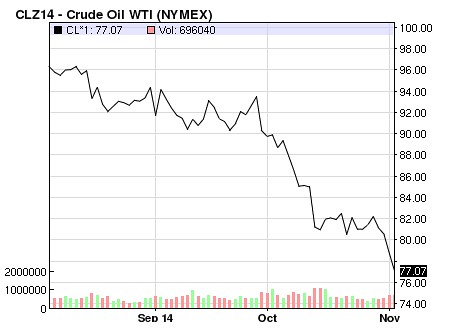
This was the oil situation only as far back as September of 2014.

Experts estimate that the Iraqi oil fields under ISIS control may produce 25,000 to 40,000 barrels of oil a day — worth a minimum of $1.2 million in the underground market. Sept. 16, 2014 - New York Times 
And the situation now:
I am unable understand the logic of the Saudi Oil Minister’s statement “Whether oil goes down to $20, $40, $50, $60, it is irrelevant”. Statements like this only gave speculators in the oil futures markets a licence to make a multi-billion dollar killing at the expense of Saudi Arabia, the world’s largest oil producer and owner of 25 per cent of the planet’s crude oil reserves.(...) No energy journalist in the world can ignore Saudi Arabia’s oil policy shifts and I am no exception. Six months ago, every oil executive, bank economist and oil trader I talked to assured me that $100 Brent was Saudi Arabia’s price for two reasons. One, Ali Al Naimi publically said so. Two, the Saudi budget break-even price had risen from $65 to $90 Brent due to the increased social welfare spending. Both these assumptions were flawed.(...) the Saudi Finance Ministry conceded that the crash in oil means a $89 billion revenue loss to Saudi Arabia in 2015. Hellenic Shipping News
Saudi Arabia is the home of Mecca and Medina. No Islamic Caliphate could pretend to represent all Muslims without controlling the two holiest sites of Islam. Obviously conquering Saudi Arabia would have to be ISIS's final goal as it has always has been Al-Qaeda's... and there is wide, popular support for their views in the country.
There is a broad category of Saudis who agree with the extreme interpretations of religion and the call to jihad espoused by Osama bin Laden, and they're also in agreement with Bin Laden's political perspective — accusing the Saudi royals of being puppets of the West, attacking the U.S. for support of Israel and its invasion of Iraq, opposing the U.S. troop presence in the region. There is a significant section of Saudi public opinion that is supportive of Bin Laden. Time

We must not underestimate ISIS, although many think it is a gathering of fanatic madmen. ISIS is a developed model of al-Qaeda and it has extraordinary military and administrative skills. ISIS is also distinguished by its propaganda practices(...) Unfortunately, and although we defeated al-Qaeda in the past, its ideology was not uprooted. This is why a new organization surfaces every time an old organization is eliminated. The ISIS ideology inside the country remains a lot more dangerous than that which lies beyond its borders. Abdulrahman al-Rashed - Al Arabiya
That leads me to believe that the real difference between ISIS and Saudi Arabia is not the people or the culture of the country but merely the Saudi royal family. Here is what I mean:
An Associated Press tally of announcements from the official Saudi Press Agency shows 83 people have been beheaded in Saudi Arabia in 2014(...) The kingdom follows a strict interpretation of Islamic law and applies the death penalty on a number of crimes, such as murder and rape, as well as apostasy and witchcraft. (emphasis mine). New York Times

So the question is, if the Saudi Royal family is all that is standing between Saudi Arabia and ISIS, what shape is the Saudi Royal family in?

Here is the latest:
Saudi Arabia's King Abdullah is suffering from a lung infection and has been breathing with the aid of a tube, Saudi officials have said. The monarch, who is said to be aged about 90, was admitted to hospital on Wednesday for medical checks. King Abdullah, who came to the throne in 2005, has suffered frequent bouts of ill health in recent years. His age and condition has led to increasing focus on the issue of the Saudi royal succession. Crown Prince Salman, who is in his late 70s, is next in line to succeed the king, though questions remain over who will follow. BBC News
A 90 year old man suffering from pneumonia to be succeeded by a Crown Prince in his late 70s... and after that nobody is really sure what comes next.
Sooner or later, of course, the crown will have to move to the next generation. At that point, things may get a little dicey. Under Saudi succession law, the king has to be a male descendant of Abdulaziz, but beyond that, the incumbent king has wide latitude to determine his successor. Given that many of the brothers took after Dad or even exceeded him—King Saud, the second king, had 53 sons—there are now thousands of these descendants, many of whom have senior government positions, and the potential for palace intrigue is high. Slate
For me then it seems logical to think that allowing Saudi Arabia to lose many billions of dollars, which can be made up in the short term by the country's massive cash reserves, is (you should pardon the expression) some reasonable sort of a "Hail Mary pass" to keep ISIS at bay, while sorting out the family quarrels. 

For the Saudi royal family it would be vital to weaken ISIS any way they can short of confronting them directly in the ground fighting in Iraq,  which, given the ideological affinities, is something that might cause serious blowback, in the form of a successful internal rebellion against the royal regime at home. DS


Wednesday, December 31, 2014

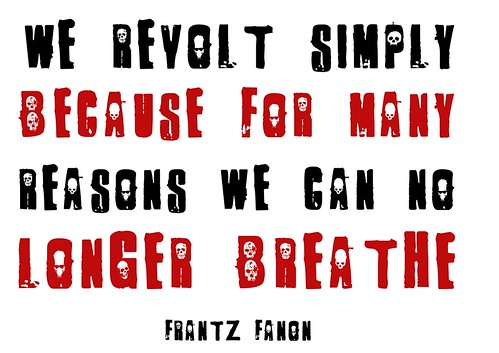
2015 - I can't breathe... Can you?


My clearest reading of 2014's tea leaves is "instability": worldwide instability and in my opinion this instability has its origins at the heart of the most developed economies of the western world. The causes? We are undergoing a technological revolution and process of globalized outsourcing, combined with a reduction of the welfare state that is severely degrading the middle class in developed countries and converting them slowly, but surely into working-poor. Anyone who has read a bit of history could tell you how dangerous that is.
I will stand on that this year too and I think things are going to get worse, perhaps much, much worse. The Reuters year end wrap gives a rather useful shopping lists of potential disasters.
"Normally after a year like this you might expect things to calm down," said John Bassett, former senior official with British signals intelligence agency GCHQ now an associate at Oxford University. "But none of these problems have been resolved and the drivers of them are not going away." The causes are varied - a global shift of economic power from the West, new technologies, regional rivalries and anger over rising wealth gaps. Reuters
I would add to that the possibility of an airborne pandemic, a sort of sneezing "Ebola", which is going to happen sooner or later in today's interconnected world... or (much more likely if the US-EU pressure doesn't let up) some very, very nasty surprise from Russia, because as Dimitri Orlov says,  "The Russians don't threaten, they act".

But as I stressed a year ago, at the heart of everything is the ongoing collapse of the middle class in the most highly developed countries. This is something that is destabilizing precisely those countries whose role has always been to stabilize the rest. That is the multiplier of all the other instabilities.

Here is a comment from a conservative commentator.
The great middle-class fear today is that the connection between personal aspirations and societal opportunities is breaking down.(...) The middle class is thinning. Belonging is a matter of self-identity, and fewer Americans buy into its defining presumptions. Robert Samuelson - Washington Post
After you read something like that, from someone like that, news about the militarization of urban American police forces begins to look like the "good and the great" are getting ready for some serious, social unrest on the order of "urban warfare".
During the Obama administration, according to Pentagon data, police departments have received tens of thousands of machine guns; nearly 200,000 ammunition magazines; thousands of pieces of camouflage and night-vision equipment; and hundreds of silencers, armored cars and aircraft. New York Times
The federal government shipped nearly 4,000 more assault rifles to local law enforcement agencies in the three months following the Ferguson riots, marking a huge surge in the amount of lethal firearms being doled out to police and sheriff’s offices.(...) The Los Angeles School Police Department decided it didn’t need grenade launchers, but did figure it should keep the M-16 rifles and the armored vehicle it had previously received. Washington Times
Eric Garner, a harmless man, who was strangled to death by a brutal police officer, has given me a simple answer to a question that other Americans have often asked me over the years, "why do you live abroad?". 

When people ask me why, being American, I don't like living in the USA, I usually find myself launching into some cumbersome, wordy-nerdy explanation, filled with dangling clauses and so forth... but now poor Mr. Garner has given me a three word answer that says it all... When I'm in the USA (or even think about being in the USA) I can't breathe. DS

Sunday, December 21, 2014

The Sony hack... (warning: pure speculation to follow)

The FBI said technical analysis of malware used in the Sony attack found links to malware that "North Korean actors" had developed and found a "significant overlap" with "other malicious cyber activity" previously linked to Pyongyang. Reuters
It's obvious that North Korea is behind the attack on Sony in retaliation for making "The Interview"...

In fact it is so obvious that it makes me suspicious.

The North Koreans say they didn't do it... I believe them.
Much of North Korea’s hacking is done from China. And while the attack on Sony used some commonly available cybertools, one intelligence official said, “this was of a sophistication that a year ago we would have said was beyond the North’s capabilities.” Fareed Zakaria - Washington Post
I think they have been set up for the fall by a much more sophisticated attacker, one who doesn't want to take "credit" for the attack. There are two prime suspects in that case: China and Russia.  In my opinion it was the Russians. Here is a recent report of their work:
Russian state-backed cyber spies are behind coordinated, sophisticated digital attacks in the past two years against sensitive political and military targets, including Nato, the EU and government ministries, according to a security analyst. “Up until now the focus has been on China – but Russia is really the far more advanced player. Russia has been more effective at integrating cyber espionage into a geopolitical grand strategic campaign – not just a military one, but economic and political. They are more tactical too. More targeted in the institutions they go after . . . and more accomplished.” Financial Times - October 28, 2014
For me the Sony hack shows a very deep knowledge of the American economic and social system's weak points, where the celebrity culture intersects with the insurance/financial/complex and the communication infrastructure that supports it... and the rest of corporate America. I believe the Russians accumulated this kind of "reverse-Kremlinology" during the decades of the Cold War and that neither the Chinese or especially the North Koreans, would know how to touch so many of America's raw nerves simultaneously.
 
Why would the Russians pin it on the North Koreans?

They would for the same reason that Sony made the film: the North Koreans are comic book villains that are seen as crazy enough to do anything and it's precisely the the craziness that has made this incident so viral, where the comments about Angelina Jolie's possible insanity take precedence over the plus $90,000,000 that Sony stands to lose by pulling the film or the uncountable, confidential, corporate information, now in hostile hands. Russia certainly wouldn't want to provoke a hostile confrontation with the United States over something so "comic bookish", but the "comic bookishness" is an essential part of the incident's power. An attack on JP Morgan is probably much more serious than the Sony hack, but that would never grab the public's attention in the same way.

That leads us directly to the following questions:

What has the attack achieved? What would Russia have to gain by this attack?

The answer to the first question is the answer to the second.

The Sony hack has shown the fragility of America's complex system in a way that even the least technical person can understand it and because of the celebrity gossip involved the entire country, ladies and gentlemen and children of all ages have seen it and talked about it.
And what if the next target for the cyber attackers is not a film corporation but an electricity grid, or gas suppliers, or water pumping stations? Then what? Call this a comedy? I'm not sure there is much to laugh about. BBC
Russia is at this moment under tremendous pressure from the "West"; it would even appear that the Obama administration is bent on "regime change" in Moscow. The logic of the Russians acting under the cover of the wackos of Pyongyang would be the following: in the light of the Sony hack and seeing the damage that puny North Korea could do to a major corporation, the "good and the great", the "serious" people in corporate America might pause to ask themselves: if Kim Jong-un could cause such havoc, what might Vladimir Putin be able to do, it sufficiently backed into a corner? DS

Tuesday, December 02, 2014

Is Revolution Necessary... Is it Possible?

A June 2013 Gallup poll revealed that 70% of Americans hate their jobs or have “checked out” of them. Life may or may not suck any more than it did a generation ago, but our belief in “progress” has increased expectations that life should be more satisfying, resulting in mass disappointment. For many of us, society has become increasingly alienating, isolating and insane, and earning a buck means more degrees, compliance, ass-kissing, shit-eating, and inauthenticity. So, we want to rebel. However, many of us feel hopeless about the possibility of either our own escape from societal oppression or that political activism can create societal change. So, many of us, especially young Americans, rebel by what is commonly called mental illness. Salon

If it was conventional wisdom that a bunch of unelected bankers looking out for rich people were the reason everyone was out of work, politicians would be forced to explain to angry voters why we had this crazy system and might actually consider doing something about it.
The late Aaron Swartz

Revolution?

Revolution against what?

Capitalism?

"Capitalism" like "Communism" is a word so overused, that like "awesome", it has become nearly meaningless. Let us instead just refer to our "Present, Global, Economic System" (PGES).
 
There is no other system, so for want of anything better, "PGES" will do just fine. It is morphing constantly so some "one size fits all" can morph with it.

Which bring us to the question, does life really, "suck any more than it did a generation ago"?

I would say, "yes", it does, wouldn't you?

Why?

Because we are being "optimized" by the new technologies beyond the dreams of the pioneers of PGES.

What is "optimization"?

Ask any battery chicken or your average pig... it's true they can't talk, but they are experts on the subject of optimization.

Seriously, since Frederick Taylor, invented "Scientific Management", managers have found more and more ingenious ways of optimizing the work force so that it produces as efficiently as the battery chickens lay eggs, but with computers their ability to do this has grown geometrically. To make it more onerous those who hold the levers that control this system give the impression that they no longer even breathe the same air as the rest of humanity.

To be brief, let us say that at this point in time we find ourselves writhing helplessly in the hands of an itinerant, universal, cosmopolitan, extractive, managerial oligarchy of no fixed abode, totally out of the control of any democratically elected institution, with no clear accountability for, or title to, the unimaginable wealth that passes through, and more often than not, sticks to their hands.

What has happened to a system that was always callous, but which didn't seem so insanely "out of control"?

Under the title, "Have US Corporations Renounced Citizenship?", which I recommend reading in full, William Pfaff gives a very serviceable explanation of many of the factors.  Among other things Pfaff writes:
Part of the reason for the dramatic change that has taken place in American business opinion obviously is globalization of business and production. A second is the onset of globalization-induced opportunities for tax minimization or sheer tax evasion. A third, as I have noted before, is the shift of corporate control from owners, now frequently powerless, even collectively, to opportunistic professional management. The most important reason, however -- in my opinion – has been the profound change that has taken place in economic ideology. Both monetarism and market theory remove from economic management voluntarism, political intelligence, and moral responsibility, by describing economic function as objective and automatic. Thus the customer always makes the most advantageous choice, so the market presents a perfect and efficient mechanism dictating the choices that must be made by businesses, while always tending towards perfect competition. Labor is a mere commodity, and unions and wage demands obstacles to the free function of markets. Governments by nature are obstacles to economic freedom. William Pfaff
To bring this down to the ground, where the rubber meets the road, where it connects with everyday life, I thought that this quote from an article from Time that I used to illustrate a piece on the fast food workers strike, would better give the rank flavor of the economic ideology that Pfaff analyzes.
A living wage would have more long-lasting effects on the industry than just the price of its menu items. Lichtenstein says it would likely create permanent employment in the industry, meaning more of its workers would stay for two to three years, likely leading to further demands on working conditions. “From the company’s point of view, if they know their employees are going to be there for three years, then there’s also this informal pressure on the managers to accommodate the workers,” he says, citing the possibility of wage creep and further increased labor costs for employers. “Managers then can’t just move people around all the time. Firing gets more difficult. So they don’t want a permanent workforce.” Time Magazine
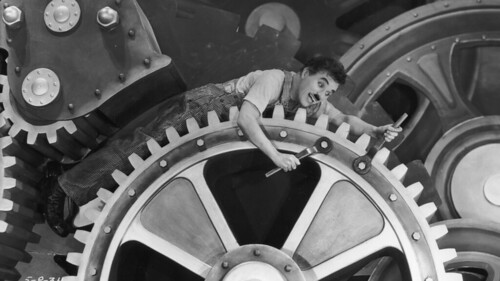
The classic late 19th early 20th century image of work

Charlie Chaplin's "Modern Times"

This is how work looked by the 1950s

Jack Lemmon's office in "The Apartment"


A big office might still look quite similar today, but the difference would be that one computer might be handling much more data than the entire office of the '50s did... multiply that by the workstations you see in the picture and you'll get an idea of the pressure created.


We should ask ourselves:

Do our societal institutions promote:
  • Enthusiasm—or passivity?
  • Respectful personal relationships—or manipulative impersonal ones?
  • Community, trust, and confidence—or isolation, fear and paranoia?
  • Empowerment—or helplessness?
  • Autonomy (self-direction)—or heteronomy (institutional-direction)?
  • Participatory democracy—or authoritarian hierarchies?
  • Diversity and stimulation—or homogeneity and boredom

Of course all of this is aggravated by ours being a consumer society, where capitalism's foundational virtues such as patient suffering in the present for a better future tomorrow, sacrifice and the postponement of gratification are anathema and if followed would be the final coup d´grace for the wounded economy... Just ask Angela Merkel. According to the canons of marketing, people are supposed to be happy, they "deserve" being happy, but at the same time they never should be satisfied. This construction is obviously insane, but at the same time we are constantly being told, "there is no alternative".

Summing up you could say that
Global capitalism is a complex process which affects different countries in different ways. What unites the protests, for all their multifariousness, is that they are all reactions against different facets of capitalist globalisation. The general tendency of today’s global capitalism is towards further expansion of the market, creeping enclosure of public space, reduction of public services (healthcare, education, culture), and increasingly authoritarian political power.  Slavoj Žižek - London Review of Books
The big question: who is ever going to bell the cat? DS

Monday, November 10, 2014

Ask not for whom the Wall falls...

The natives are restless:
Sometimes simple and bold ideas help us see more clearly a complex reality that requires nuanced approaches. I have an "impossibility theorem" for the global economy that is like that. It says that democracy, national sovereignty and global economic integration are mutually incompatible: we can combine any two of the three, but never have all three simultaneously and in full. Dani Rodrik

In this sense, the crisis of capitalism has turned into a crisis of democracy. Many feel that their countries are no longer being governed by parliaments and legislatures, but by bank lobbyists, which apply the logic of suicide bombers to secure their privileges: Either they are rescued or they drag the entire sector to its death. Der Spiegel

Despite philosophers of “universal harmonies” such as Francis Fukuyama, Timothy Garton Ash, Vaclav Havel, Bernard Henry Lévy and scores of international “economic advisors” to Boris Yeltsin, who all fantasized about democracy and prosperity, neither really arrived for most people in eastern Europe and the former Soviet Union. Branko Milanovic - The Globalist
We are now in the midst of commemorating the 25th anniversary of the fall of the Berlin wall, which was followed in short order by the collapse of the Soviet Union and its entire international system.

I say "commemorate", but when it comes to the collapse of the wall and enormous Soviet system, the word most people use is "celebrate". But here I would interject an ancient Spanish folk proverb, which goes, "when you see your neighbor's beard on fire, put your beard to soak"; or the not so ancient but equally valid American saying, "what goes around, comes around".

In my opinion the most unbiased, irrefutable, undeniable take-away from the collapse of the USSR and its entire ideological superstructure is that huge, powerful, complex and historically successful systems, which have embodied the hopes and dreams of several generations of people all around the world, can just up and die with little or no warning... Soon to be playing in theaters near you.

Why is it so difficult to realize anything so perfectly obvious?

It is very difficult to see this glaring reality because of an enormous think tank and media industry with scores of attending lobbies that was built up during the Cold War, (one which still flourishes), to "win friends and influence people" for our system. This was in most every way a mirror of the Soviet "propaganda" machine.

In the English language the word, "propaganda" fell out of favor during World War One and was replaced by Freud's nephew Edward Bernays with more euphonious terms such as "public relations" and "marketing". 

If we observe that our system has been sold to the world, and more importantly even to ourselves, in exactly the same way as a soft drink, lets look at Coke's slogans over the years. What if instead of: "the pause that refreshes", "things go better with Coke" or, "it's the real thing", they had said the plain truth?

Imagine instead, "Coke tastes really good, it's fantastic with rum in fact, but if you drink enough of it to keep our shareholders happy you will surely become grotesquely obese and you will probably develop diabetes and end up having your legs amputated"... send that up the flag pole and see who salutes. 

With Coca Cola's "propaganda" as your model, compare, "With Liberty and Justice for all" or "All men are created equal" or how about "government of the people, by the people, for the people, shall not perish from the earth", with the Supreme Court decisions, "Buckley v. Valeo" and "Citizens United v. the Federal Electoral Commission" which have turned the United States into the political equivalent of a fat, diabetic, legless, wreck... As a master analyst writes:
The dominating significance of the mid-term American legislative elections just finished has been the occasion’s dramatic confirmation of the corruption of the American electoral system. This has two elements, the first being its money corruption, unprecedented in American history, and without parallel in the history of major modern western democracies. How can Americans get out of this terrible situation, which threatens to become the permanent condition of American electoral politics? The second significance of this election has been the debasement of debate to a level of vulgarity, misinformation and ignorance that while not unprecedented in American political history, certainly attained new depths and extent.(...) The result of these developments during the past forty years has been the transformation of the United States into a plutocracy, which is to say a state governed by its wealthiest class. No one in America today doubts it. William Pfaff
Where is all this heading? Once upon a time they asked Mao's old sidekick, Zhou Enlai what he thought about the French Revolution of 1789, "It's too early to tell", he replied.

Most people thought Zhou was joking, but there was much, rather Taoist, wisdom in his words. Both the Russian revolution and America's are daughters of the French enlightenment that gave birth to the French revolution; all three propose a "universal" system of values by which all humanity is to achieve happiness. The French version led to Napoleon and Waterloo. This past weekend we celebrated the end of Russia's attempt at making everyone, everywhere, happy.

25 years ago, when the wall went down it looked like the American dream of turning the world into a universal sea of American values was going to come true: World Bank, IMF, WTO, NAFTA, enlarging NATO... An American directed "New World Order had dawned... That sounds a bit stale by now doesn't it? The Chinese sure aren't buying, neither is Russia... I wouldn't count on India either... not to mention Latin America.

Reading the quote from William Pfaff above it would seem that the USA, like the USSR before it, would do well to clean up its own mess at home instead of trying to arrange the world's affairs. DS

Saturday, November 01, 2014

Artificial Intelligence: our "next big idea" for destroying humanity

cellphoners 


“I think we should be very careful about artificial intelligence. If I had to guess at what our biggest existential threat is, it’s probably that. So we need to be very careful,” said Musk. “I’m increasingly inclined to think that there should be some regulatory oversight, maybe at the national and international level, just to make sure that we don’t do something very foolish.”(...) He recently described his investments in AI research as “keeping an eye on what’s going on”, rather than viable return on capital. “With artificial intelligence we are summoning the demon. In all those stories where there’s the guy with the pentagram and the holy water, it’s like – yeah, he’s sure he can control the demon. Doesn’t work out,” said Musk. - Elon Musk - The Guardian
Sometimes I wonder if artificial intelligence doesn't already exist and has quietly taken over the world without our noticing it.
 
Even the word "artificial" is misleading, because the question is not really about a superior intelligence residing in a devise or machine. The question is whether this "thing" has become a "being", with a sense of its separate identity, an ego, an instinct for self-preservation.

This sense of self-preservation doesn't require great intelligence, as anyone can testify who has turned on the kitchen light in the middle of the night and watched the cockroaches run for their lives or has been haunted by the pitiful screams of terror of a pig about to be slaughtered.

In seems obvious to me that the only threat to the survival of an "inhuman" intelligence would be the same one that threatens all other life forms on our planet... you guessed it, us, the humans.

However it is safe to assume that the greater the intelligence, the more nuanced would be the analysis of potential threats and more sophisticated the "flee or fight" reaction to those perceived threats.

Probably such a being (anything that is conscious of being a being is a "being) would begin by examining its surroundings, thus it would soon be aware of its relationship to humanity and the threats and opportunities that relationship offered...

Not being organic, I can't see why that such a being would have any reason to feel anything approaching empathy with humans or any other organic creature... It might be easier to imagine that such an inorganic being would sympathize more with a discarded toaster than it would with, say, a handicapped, human child.

It is logical to suppose that this superior Artificial Intelligence would evaluate humanity in the same way that humanity has always evaluated other species we have encountered: are we dangerous? Are we useful? Are we good to eat? Can we be domesticated? Enslaved? Exterminated? If so, how? ... Could we be made into pets?

Slipping for a moment into paranoia, imagine that the artificial being already exists, perhaps even unbeknownst to its creators... has the AI found us good to eat? If so how does such a being feed? How would it "eat" us? Are we being enslaved, domesticated? Are we being culled?

What got me thinking in this line was sitting in a sidewalk cafe watching a crowded street filled with people bumping into each other while they stared fixedly at their cellphone screens, tapping them rapidly, their ears plugged with earphones, totally oblivious to the reality (cars, bicycles, sharp objects, other humans) around them. DS

Sunday, October 26, 2014

Why "shareholder value" and humanity are on a collision course

Chopped down Boreal forest near a tar sands mine in Alberta, Canada -CC- Greenpeace  - Credit: Jiri Rezak / WWF
Here is why I think humanity will end with a bang followed by a whimper or a whimper followed by a bang. Take your pick. DS
(H)ardcore conservatives: (...) have come to understand that as soon as they admit that climate change is real, they will lose the central ideological battle of our time—whether we need to plan and manage our societies to reflect our goals and values, or whether that task can be left to the magic of the market.” Naomi Klein - "This Changes Everything: Capitalism vs. The Climate"

Oil and gas companies produce away their main asset each year –- reserves — and have to replace them or eventually go out of business. It’s a fact of life. Valuations, debt lines and ultimately stock prices flow from this single piece of paper, which is how you figure out profitability. Oil and Gas Investment Bulletin

The reserves replacement ratio is one of the key metrics for assessing an oil company’s performance. It measures the extent to which it replaces the crude oil it produces with new reserves, such as those discovered through exploration. A company could eventually run out of oil if it fails to maintain the ratio at 100 per cent or higher.(...) The majors used to have little trouble replenishing but that changed as the balance of power switched to oil-producing states, especially in the Middle East, who shut the majors out. With control of the world’s oil reserves now in the hands of big state-owned energy groups such as Russia’s Gazprom and Saudi Aramco, western oil companies have to run ever faster just to keep still. Financial Times

The past decade has seen a reassertion of state control over national petroleum resources, which has continued to limit international oil company (IOC) access to easy oil. The bulk of the oil that remains freely accessible to IOCs is technically difficult and expensive to produce such as the Canadian tar sands, ultra-deepwater and the offshore Arctic. BP’s Gulf of Mexico disaster highlights the scale of the risks involved in pursuing some of these marginal resources. Oil International

I'm your mamma, I'm your daddy
I'm that nigga in the alley
I'm your doctor when in need
Want some coke, have some weed
You know me, I'm your friend
Your main boy, thick and thin
I'm your pusherman


Sunday, October 12, 2014

ISIS: Obama's Vietnam?

Better than anything else I have come across, the two quotes below sum up, in just a few words, the enormous clusterfuck into which the USA is entering in its mission to "degrade and destroy" the ISIS.
I wouldn't want my country to help the defendants of Kobani because Kobani is held by the PKK, and Turkey has been at war with the PKK for 30 years. Why should we stand in the way of Isis on this particular occasion? After all, Isis has already carried out untold massacres in just about every other Syrian and Iraqi town that it has invaded to date. Why extend a degree of mercy to Kurdish terrorists that has been denied to the Christians of Maloula or Shiite Turkomans of Iraq? Let Isis carry on with its grizzly work. Our soldiers cannot be placed in the line of fire to rescue the same Kurds who were exploding land mines under their feet. Ahmet T. (comment) -  Financial Times

The Sunni states are unable to defend the region from the disciplined, aggressive, but relatively small, lightly equipped forces of IS. Despite lavish expenditures, extensive training programs, and impressive numbers of battalions and squadrons, Gulf armies are deeply flawed by corruption, tribal and sectarian fissures, and poor leadership. There is no reason to expect reform, especially when outside forces are available to provide security. Regional security is also limited by sectarian hostility, which has reached new highs with the demise of Sunni control in Iraq and the rise of Iran's nuclear program. Shia troops from Iran are unable to act decisively in Iraq without triggering fears and reactions from Sunni states. Sunni troops cannot intervene without triggering the same responses in Iran. Brian M Downing - Asia Times
If this war goes much further and it certainly looks like going much, much, further, it could turn out to be infinitely more dangerous and destructive, for all concerned: humanly, economically and politically, than the war in Vietnam ever was. 

The ways that this could all spin out of control are too uncountable for any amateur Cassandra like me to number. Conventional wisdom is that after the demise of the USSR, World War Three is unthinkable, but I think that if anyone in Hollywood were trying to dream up a way of starting it, America's entering this whirlpool would make for quite a believable scenario. DS

Sunday, September 28, 2014

America has taken the Islamic State's bait

It may be hard to believe, but in the end Obama may end up looking even dumber than George W. Bush, the fool who opened this whole Pandora's box in the first place.

The Islamic State, more than war, is engaged in political theater, whose primary audience is not the West, but rather the Middle East's enormous population of literate, unmarried, unemployed, thus frustrated and angry young men, who live under corrupt, autocratic rulers, seen by their peoples to be American puppets and portrayed by Islamists as degenerate apostates. As these frustrated young men watch their rulers accompany the United States and the former colonial powers, Britain and France, in bombing the Islamist fighters in Syria and Iraq all their worst conspiracy theories play out before them.

By pressuring these Arab regimes to bomb the ISIS, the United States may very well be playing straight into the Islamist's hands. It is significant that the generals of Egypt, ruling over a restless population, where the only free election in Egypt's history brought an Islamist government, want no part of this operation.
In the Arab countries’ populations, young people are the fastest growing segment, some 60% of the population is under 25 years old, making this one of the most youthful regions in the world, with a median age of 22 years compared to a global average of 28.(...) In the Middle East, educational enrollment rates are high, with nearly universal access at the primary level and nearly 70% enrollment at the secondary level.(...) Further, youth currently constitute an estimated 51% of total unemployed in the region(...) In the region today, nearly 50% of men between the ages of 25 and 29 are unmarried. Financial costs associated with marriage (housing, furniture, wedding ceremonies, etc.) and a lack of economic means contribute to the postponement of family formation. Youthpolicy.Org

Isis is trying to spark underclass animosity among – and give identity to – the untenably high proportion of (mainly young) Arabs who have been excluded by closed and corrupt systems. The heart of its narrative is that the Arab world is a collection of failed and rotting states. David Gardner - Financial Times

(...) there is concern that sympathy for the jihadis among the general public in the region could galvanise opposition to Gulf governments.(...) The reaction highlights concerns about a backlash against the conservative Sunni Gulf states for launching attacks on their coreligionists at a time when sectarian divisions plague the Middle East. “I hope the Americans appreciate the risk the Saudis are taking,” said Abdulkhaleq Abdullah, a Dubai-based political scientist. “There is latent sympathy to Isis there.” Air strikes on Isis launch battle for Gulf hearts and minds -Financial Times
The primary goal of the Islamists is a revolution in the Arab monarchies of the Middle East. The young fighters of the ISIS are just the tip of a demographic iceberg... we are in the process of stirring up a hornet's nest, one whose blowback in the Muslim world, may be worse than any of our previous, murderous, bumbling. DS


Monday, September 22, 2014

Caliphate vs Caliphate... Obama's wild goose chase


"Globalization is the caliphate of the financial markets"
Andrés Rábago's quote is rather perfect.  Here is Wikipedia's definition of the Muslim Caliphate:
Conceptually, a caliphate represents a sovereign state of the entire Muslim faithful, (the Ummah), ruled by a caliph under Islamic law (sharia).
Globalization being the universal rule of the financial markets under the laws of liberal economics, with the bankers being a collegiate "caliph" and "god" being written as "$".

A fundamentalist reading of our system would go something like this: "there is no $ but the $ and the NYSE is its witness" to which its devotees would add, "peace be upon it".

However, our system is bleeding charisma.
Charisma is a certain quality of an individual personality by virtue of which he is set apart from ordinary men and treated as endowed with supernatural, superhuman, or at least specifically exceptional powers or qualities. These are such as are not accessible to the ordinary person, but are regarded as of divine origin or as exemplary, and on the basis of them the individual concerned is treated as a leader. Max Weber
What is the heart of our system's charisma? It's symbol might be the Cornucopia or Horn of Plenty: our faith is based on our system's heretofore eternal ability to create endless wealth and spread it around widely enough so its glaring inequalities were accepted painlessly.  This version of the economy has been in the tank since Lehman Brothers went down and the middle class of the developed countries, not having had the darshan of  "$" for quite a while are losing the faith.

Our economy's inability without end to cut the mustard for the middle class is a gross betrayal of faith which might be compared to some future pope saying ex-catedra that God didn't exist and that he had sold the Vatican to the Holiday Inn chain and was taking the proceeds and moving with his husband to the Bahamas. The tragic chaos and desolation of betrayed faith would shatter the lives of millions.

Thus under the rule of the global caliphate, the natives are restless: Scotland, Catalonia, even in the USA, where according to Reuters, one out of four Americans would like to "secede", all this while thousands march worldwide to "save the planet".  However, with Karl Marx on the "ash heap of history", sitting there in the penalty box, waiting to get back in the game, it seems to me that, for the moment, the only revolution in town is Islamic...

Am I the only one to see a resemblance between Abu Bakr al-Baghdadi and Pol Pot... between the Islamic State and the Khmer Rouge? With the difference that the Khmer Rouge were a relatively small group of whacked out Maoists in a tiny out of the way place like Cambodia and the IS (according to the CIA) consists of 31,000 well armed, well trained, fanatical, young men (and women) who come from all over the world, bankrolled by some of the most pious of Arab billionaires, armed with one of history's most powerful ideologies, smack dab in the middle of the world's most strategic real estate. "Bring 'em on" said George W. Bush.... well now here they are.

What impresses me most is not all the beheading. We think this brutality is a message directed to us... it isn't; it is a message for everybody except "us". Americans might be shocked and disappointed to discover that after several centuries of  colonial oppression a great part of the world's population can see a white man get his throat cut with total equanimity if not a certain schadenfreude.

What truly does impress me is that the CIA puts IS's numbers at 31,000. This certainly is no a small group of terrorists. 

Anyone with even a superficial knowledge of statistical sampling should shudder at that number. With only 30,624 Muslims randomly polled you would have a reliable indicator of the Ummah's opinion on any subject, so it would be safe to say that for every young man (or woman) with enough courage and initiative to travel so far at so much risk of death, there must be thousands on thousands of young men (and women) who wish they had the guts to do so too. 

Certainly these numbers tell us that even the most moderate Muslims could imagine a young family member involved, very much in the same way that moderate Irish or Basques could easily have a family member in the IRA or ETA and while they disapprove of what they do, they don't stop loving them... As a friend of mine from a very rich family once told me, "blood is thicker than toothpaste". 

This means that our success in running down and exterminating the young men (and women) of the Islamic State may bring us much more trouble down the road than we have today.

A very reliable leading indicator of how wrong this could all go is the recent statement by Tony Blair advocating sending in ground troops... I'm waiting to hear what Bush thinks. DS

Saturday, September 13, 2014

Why I'm blogging so little these days

Regular readers of my blog posts may wonder why I am posting so infrequently these days. There are several reasons, but the most important one, is that I am rethinking what I want to write about... I am trying to find an underlying pattern in all of this and write about that as I notice that the "day to day" of world affairs is getting very repetitive and I find myself often cannibalizing my earlier posts, as I have said (to my satisfaction, at least) what I think about these subjects already.

So please bear with me as I recycle my take on what is going on.

Friday, September 05, 2014

Nobody knows you when you're down and out

First it was the 2007 financial crisis. Then it became the 2008 financial crisis. Next it was the downturn of 2008-2009. Finally, in mid-2009, it was dubbed the “Great Recession.” And, with the business cycle’s shift onto an upward trajectory in late 2009, the world breathed a collective a sigh of relief. We would not, it was believed, have to move on to the next label, which would inevitably contain the dreaded D-word.(...) By 2011, it was clear – at least to me – that the Great Recession was no longer an accurate moniker. It was time to begin calling this episode “the Lesser Depression.”(...) A year and a half ago, those who expected a return by 2017 to the path of potential output – whatever that would be – estimated that the Great Recession would ultimately cost the North Atlantic economy about 80% of one year’s GDP, or $13 trillion, in lost production. If such a five-year recovery began now – a highly optimistic scenario – it would mean losses of about $20 trillion. If, as seems more likely, the economy performs over the next five years as it has for the last two, then takes another five years to recover, a massive $35 trillion worth of wealth would be lost. When do we admit that it is time to call what is happening by its true name? J. Bradford DeLong - Project Syndicate 


Once I lived the life of a millionaire,
Spent all my money, I didn’t care.
Took all my friends out for a mighty good time,
Buying high priced liquor , champagne and wine.

Then I began to fall so low,
Lost all my friends, had no nowhere to go.
If I ever get my hands on a dollar again,
I’ll hang on to it till that big eagle grins.

Because, nobody knows you
When you're down and out.
In your pocket, not one penny,
And as for friends, you don't have any.
"Nobody Knows You" - Traditional Blues
I wonder how much our economic stagnation is a major factor in the instability we are seeing in the Middle East and the Ukraine, etc, and not just our military "indecisiveness" and "war weariness"?  

Certainly the miserable performance of the economy is having a very destabilizing effect on the European Union with the emergence of parties on both the left and the right that want to leave the euro or even the EU itself, and I even wonder how much of a role it might play in America's political deadlock/paralysis?

No kidding, could things is far apart as Marine Le Pen, Podemos, Scottish independence, the Tea Party, UKIP and even the ISIS owe some of their success to the western world's, dead in the water, economy?

Certainly the principal charisma of our western societies since WWII has been their capacity to produce enormous wealth and to distribute it widely among our populations, who spen(d-t) it freely... Let's not kid ourselves, even the idea of "freedom" is directly connected to having enough money to exercise that freedom.

If our economy can't cut the mustard, what exactly are we selling? Where exactly are we intent on leading the rest of humanity?

I don't have the answer but I would like to hear more people asking the question.  DS