Showing posts with label economy. Show all posts

Friday, September 05, 2014

Nobody knows you when you're down and out

First it was the 2007 financial crisis. Then it became the 2008 financial crisis. Next it was the downturn of 2008-2009. Finally, in mid-2009, it was dubbed the “Great Recession.” And, with the business cycle’s shift onto an upward trajectory in late 2009, the world breathed a collective a sigh of relief. We would not, it was believed, have to move on to the next label, which would inevitably contain the dreaded D-word.(...) By 2011, it was clear – at least to me – that the Great Recession was no longer an accurate moniker. It was time to begin calling this episode “the Lesser Depression.”(...) A year and a half ago, those who expected a return by 2017 to the path of potential output – whatever that would be – estimated that the Great Recession would ultimately cost the North Atlantic economy about 80% of one year’s GDP, or $13 trillion, in lost production. If such a five-year recovery began now – a highly optimistic scenario – it would mean losses of about $20 trillion. If, as seems more likely, the economy performs over the next five years as it has for the last two, then takes another five years to recover, a massive $35 trillion worth of wealth would be lost. When do we admit that it is time to call what is happening by its true name? J. Bradford DeLong - Project Syndicate 


Once I lived the life of a millionaire,
Spent all my money, I didn’t care.
Took all my friends out for a mighty good time,
Buying high priced liquor , champagne and wine.

Then I began to fall so low,
Lost all my friends, had no nowhere to go.
If I ever get my hands on a dollar again,
I’ll hang on to it till that big eagle grins.

Because, nobody knows you
When you're down and out.
In your pocket, not one penny,
And as for friends, you don't have any.
"Nobody Knows You" - Traditional Blues
I wonder how much our economic stagnation is a major factor in the instability we are seeing in the Middle East and the Ukraine, etc, and not just our military "indecisiveness" and "war weariness"?  

Certainly the miserable performance of the economy is having a very destabilizing effect on the European Union with the emergence of parties on both the left and the right that want to leave the euro or even the EU itself, and I even wonder how much of a role it might play in America's political deadlock/paralysis?

No kidding, could things is far apart as Marine Le Pen, Podemos, Scottish independence, the Tea Party, UKIP and even the ISIS owe some of their success to the western world's, dead in the water, economy?

Certainly the principal charisma of our western societies since WWII has been their capacity to produce enormous wealth and to distribute it widely among our populations, who spen(d-t) it freely... Let's not kid ourselves, even the idea of "freedom" is directly connected to having enough money to exercise that freedom.

If our economy can't cut the mustard, what exactly are we selling? Where exactly are we intent on leading the rest of humanity?

I don't have the answer but I would like to hear more people asking the question.  DS

Wednesday, December 26, 2012

The Spanish Economic Crisis Explained

David Seaton's News Links
In case you are interested, this hour long documentary from the BBC gives a very workmanlike breakdown of how it all happened.
Spain is the canary in the coal mine for the world's top economies, because of its large size and its fragility. The story carries lessons for everyone, everywhere. What happens in Spain first can happen later in more robust economies.
Well made and clearly explained, in one hour with this video, you'll be up to speed. DS

Saturday, October 27, 2012

What are things like in Spain right now? Watch the video.

David Seaton's News Links

See SpongeBob SquarePants duke it out with Hello Kitty in Madrid’s Puerta del Sol… (where the “Indignados” camped out last year). DS

Friday, September 28, 2012

Spain could indicate the direction America is taking

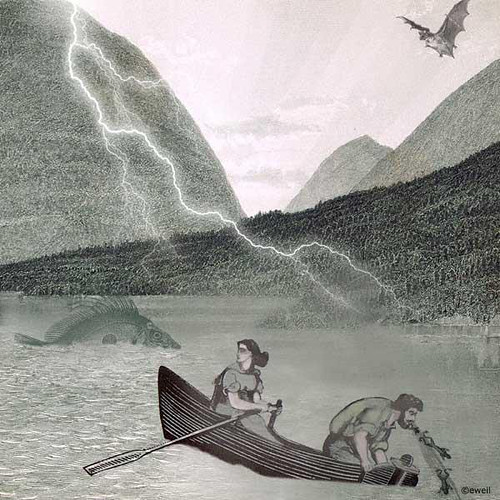
The Economy - Eleonore Weil
"The Economy"
Suddenly, Spain and Greece are being racked by strikes and huge demonstrations. The public in these countries is, in effect, saying that it has reached its limit: With unemployment at Great Depression levels and with erstwhile middle-class workers reduced to picking through garbage in search of food, austerity has already gone too far.  Paul Krugman - New York Times

What began as an economic storm has blown into a full-scale political crisis. Amid popular discontent and separatist protests, Spain has stumbled towards a crossroads: without decisive action by the government, the post-Franco democratic settlement is at risk. Financial Times
David Seaton's News Links
It is said that every historical phase carries within it the embryo of the next phase to be born in the future. If this is so, then someday we may come to consider the mountain of debt that threatens to crush our present system as an explanatory, broken condom.
One of the paradoxes here is that the enormous robustness of the United States, its size, population, its natural resources, military power and perhaps most of all, its ability to create money out of thin air to pay its debts, probably means that it would not see the total systemic crisis arriving until it was too late to really do anything about it.  
If Americans wonder where the world economic crisis is taking them, a look at what Spain is going through right now might give them some serviceable hints.
Spain is one of the world's oldest nation-states, with a population of 40M and a large economy somewhere in the world's top ten. Thus, unlike Greece, it is large enough and complex enough to serve Americans as a guinea pig.
Spain is infinitely more fragile and vulnerable than the USA, but for that very reason it is able to provide a valuable early warning for Americans... in much the same way that coal miners used to take little canary birds down into the mine to detect odorless, poisonous gases. Long before the burly miners noticed anything, the tiny bird would keel over in a faint from gas inhalation. When the canary passed out, the miners would run for the exit. Spain has just keeled over...
The distress signals coming from the American system are much more subtle than those emanating from Spain.
Here, for example is some socially ominous data:
Lower-paying jobs, with median hourly wages from $7.69 to $13.83, accounted for just 21% of the job losses during the recession. But they've made up about 58% of the job growth from the end of the recession in late 2009 through early 2012. Los Angeles Times
Whether people are actually "entitled" to "to health care, to food, to housing, to you name it" is open for discussion. But, the fact is that if enough of them don't have any plausible way of getting health care, food or housing, finally they are going to turn against any system that denies them these things. And if the number of the disgruntled is sufficient then, to maintain some sort of order and domestic tranquility, the system will have to give them health care, food and housing, whether they want to do so or not.
Probably the reason the American right wing has become so grotesquely strange and wacky of late is that the extremely lucid money financing all the zany craziness is aware that somewhere down the road, if the trends of growing middle class impoverishment continue, some sort of serious redistribution, strongly reminiscent of socialism, is going rear its head.
To me it is clear that the people who are willing to pay $50K to hear Romney talk over rubber chicken are trying to deny the declining middle class and the growing mass of working poor any kind of clarity of thought, if possible. If the Spanish crisis is any harbinger of things to come, it will be the people's stomachs however that will finally do the talking. DS


Tuesday, July 24, 2012

The pain in Spain and America's iron jaw

David Seaton's News Links
This remobilisation of Spanish society, lulled into comfort and complacency during the boom years, in some senses recalls the fevered political and street activity of the transition to democracy after the death of the dictator Francisco Franco in 1975. Yet it is more amorphous and experimental, bypassing politics and Spain’s increasingly tarnished institutions.(...) A salient feature of the present crisis – beyond the immediate drama of Spain’s cost of borrowing and the broader eurozone crisis – is the extent to which Spain’s institutions, the linchpins of the vibrant democracy Spaniards painstakingly built after Franco, have been battered. Financial Times
I don't usually like to blog here about Spain, where I live, because I would have to spend too much time explaining the context of a very complex reality to the majority of my readers, who probably come to that reality burdened with a multitude of cliches about Spain, cliches that I find too boring to clear away. I write about politics, I'm not a travel writer.
I'll make a bit of an exception now in order to explore the advantages that come wrapped in Spain's weakness and the disadvantages for the American people inherent in America's enormous natural strength.
Spain, unlike the USA, is by nature poor, with few natural resources, with practically no rivers of any commercial use, a dry, rocky, challenging terrain that has always made communication between its regions difficult. It is also an extraordinarily beautiful land, but as any farmer of Iowa's flat, boring landscape will tell you, "pretty land is bad land to farm". 
It is a landscape that breeds hardy, fibrous and energetic men and women. This ungenerous, hardscrabble, land is what drove the conquistadors to discover and conquer the Americas take its gold, and create what was then the world's largest empire.
When that empire fell apart Spain languished until Europe's post war prosperity lifted all the boats and finally provided Spain with the capital necessary to modernize its infrastructure and give opportunity for the Spanish people, called "the Prussians of the south", to express again their native energy by building Europe's fourth largest economy.
Today Spain is trying to dig itself out of the debris of an enormous real estate bubble created out of the euphoria of finally finding low interest money in their pockets after centuries of privation.
As the snippet from the Financial Times above indicates this has led to a massive questioning of the basic construction of the Spanish state. In other words, in the midst of disaster the Spanish people are discovering, in the words of Marx and Engels that,
"All that is solid melts into air, all that is holy is profaned, and man is at last compelled to face with sober senses, his real conditions of life, and his relations with his kind."
And I would maintain that such a facing with sober senses the real conditions of one's life and the relations with one's kind, is one of the most beneficial exercises a human being could undertake in the short time he or she is given to live. I think it was Socrates that said that an unexamined life wasn't worth living. And it is trying to imagine the American people en masse ever waking up to the extent that Spanish people are waking up now, that leads me to meditate on the advantages of weakness and the deadening, sluggish, tyranny of strength.
I have observed over the years that those who can drink large quantities of alcohol without showing its effects are the ones who die of cirrhosis, that the boxers that can't be knocked down, no matter how hard they are hit, are the ones that end up punchy and I wonder if this also applies to the living flesh of the common people of a country whose elites are the most wealthy and powerful and self satisfied in the history of our species.
The United States of America is so big, so populated, so rich, with such a smug and layered plutocracy, so tyrannized by endless interest groups that I cannot imagine the American people ever taking to the streets in a general strike or even more tragically, I cannot imagine that it would ever make any difference at all to their reality if they did. DS


Tuesday, July 17, 2012

What exactly is the USA?

David Seaton's News Links
Right now the question would have to be: what exactly is the USA??

The people?

The system?

The economy?

Whose economy?

What exactly is the USA?

This is really important in America's case, more so than in other countries, because "American" isn't an ethnic group or a religion or even a language and shared history; people move around a lot and are not deeply rooted and to top it off the family structure isn't very strong. All of these factors are what normally make up a "nationality". So the question, "what exactly is the USA" is something every new generation of Americans has to answer... and I believe it is getting more difficult.
When, back in the 50s "Engine Charley" Wilson enunciated his famous formula: "what is good for General Motors is good for the USA and vice versa", he was probably right, or it least  the phase made  some sense at that time. Today, could you say something like that about General Motors or substitute any other American corporation's name for GM's? Would it still make any sense? Try it with "Goldman Sachs".
Right now, we are looking at the possibility that the economy may "recover", but that its "recovery" will not mean any jobs. So we have to go back to the original question, The people? The system? The economy? Whose economy?  What exactly is the USA?
I think that the difficulty in answering this question, "what exactly is the USA", is what makes the situation much more worrisome today than the crisis of the 70s or even the 1930s. DS

Monday, July 09, 2012

The World Economy: into the Wild Blue Yonder

David Seaton's News Links
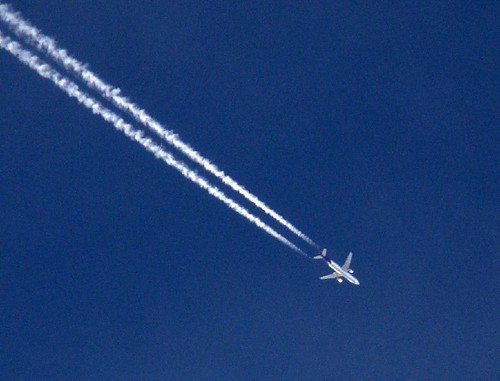
 Jet
It would be comforting for many to imagine that our globalized economy is a conspiracy,  a murky cabal, directed from the shadows by some Bilderberger-ish, ecumenical-protocol, of sinister "elders", who are pulling all the strings.
I say comforting because presumably, if sufficiently intimidated, the people who got us into this mess could easily pull their strings and get us out.
However, I am afraid that instead of being something so tidy, there are no identifiable human hands on the controls of our world and the whole thing is simply on automatic pilot...
How does that work?
I could illustrate that with an old joke I recall.
An airliner takes off full of people and a metallic voice comes over the speaker system:
"Welcome aboard Acme Airlines flight 505 to London, the first totally automatic flight in aviation history, this is your computerized control system speaking, totally free from any possibility of human error, there is no pilot on board,. We hope you enjoy your flight. We will be flying at an altitude of 30,000 feet, 30,000 feet, 30,000 feet, 30,000 feet, 30,000 feet, 30,000 feet, 30,000 feet, 30,000 feet, 30,000 feet, 30,000 feet, 30,000 feet, 30,000 feet, 30,000 feet, 30,000 feet, 30,000 feet, 30,000 feet, 30,000 feet, 30,000 feet,  30,000 feet....
That is where I think we are right now. No one is in charge: the system itself has taken over and has no idea of the future but to grow endlessly.
In globalization, the deregulated system expresses itself freely qua-system and even the famous buttinsky billionaires like Sheldon Adelson or the Koch Brothers and their Tea Party accolytes are mere puppets, reacting like Pavlovian pooches to the stimuli produced by the unshackled world mishagoss, as are those politicians they use their billions to influence (buy, bribe).
I call this system "stateless-imperialism".
Classical state imperialism could be illustrated by the 19th century British empire's destruction of India's native textile industry and forcing Indians to buy cheap, industrially produced, cloth from Britain's satanic mills. This captive market made Britain rich and caused many an Indian weaver to literally starve to death and sucked commercial life out of India's villages.
In short imperialism was generally good for the British, but generally bad for the Indians and the distinction between being British and being Indian was clearly marked with indelible ink.
Stateless imperialism is quite similar in its effects, but the lines of winners and losers has little reference to state boundaries, color or creed.
A roughly hypothetical example might go something like this. The prices on the world cotton market, chock a block with subsidies, but without significant tariff barriers, fall dramatically and this allows the reborn Indian textile industry to turn out a lot of cloth cheaply and allows the many brown and nimble fingers of sweatshop ladies in India and other Asian countries to turn out attractive clothing at near-slave wages; clothing which is to be sold by multinationals in expensive boutiques all over the developed world and after being worn there, turns up second hand in the street markets of Africa thereby putting native African industry out of business.
Meanwhile, thousands of Indian cotton farmers, with the collapse of world cotton prices, finding themselves drowning in debts they are unable to pay, commit suicide, leaving their widows and orphaned children to sell themselves into indentured servitude to eventually pay those debts.
Of course in this environment the British textile industry disappeared ages ago and its descendents loiter on street corners wearing hoodies.
All of this is logical, cause and effect. Just business... unchained business.
The suffering is the same as in state-imperialism, but in stateless-imperialism there is no "king and country" and no "viceroy" and certainly no one lining up to "bear the white man's burden". In classic state-imperialism, identifiable robber barons, celebrated in song and story, controlled entire industries. Today there are no Henry Ford or John D. Rockefeller figures, once upon a time there was a man actually named J. P. Morgan, God only knows what or who J. P. Morgan really is today. Now, like "flight 505 to London", the world economy is flying itself... look ma, no hands.
When I say this world system is on automatic-pilot, I'm not saying that are no human beings involved in running these mechanisms, only that these humans are merely hired managers with stock options, whose only assignment is to maximize shareholder value, if they don't do so they will soon be replaced by their board of directors, men and women who themselves represent only a tiny fraction of the total, largely faceless, equity. In short, faceless men and women create "value" for faceless often momentary shareholders in mastodonic enterprises of no clear national or personal affiliation and whose only horizon is the quarterly report.
Many have ridden this impersonal process to wealth, but none control it and the fallen lie all about us and the walking wounded crowd the roads. DS

Wednesday, February 22, 2012

The Darkest Hour Is Just Before Dawn

David Seaton's News Links
Between the civil war in Syria, for that is what it is, and the threat of an Israeli attack on Iran, which would set the region -- at the very least -- ablaze, and probably start off a chain of events that could tip the whole world into full-scale depression, we have plenty to worry about... things that could pull our attention decisively away from the saga of Jeremy Lin.
At the bottom of what most of us worriers worry about is the economic crisis. In a nutshell we are looking at the result of an increasingly "friction-less" world market.
Perhaps the core problem is that we are a consumer economy and our consumption, from designer tee-shirts  to the iPad and the iPhone, depends almost entirely on the slave wages and slave working conditions of millions upon millions of Chinese workers, who, without old age pensions and healthcare, save all their money and so do not consume what we produce. Our money goes there and it doesn't come back and our own workers are impoverished by this phenomenon and thus also consume less and less.
And if we managed to solve this problem and the Chinese workers earned enough to consume like we do, we the "breathing class" would suffocate in the ensuing pollution and if the enriched Chinese chose to eat cereal-fed, animal protein on the scale we do, mass starvation in the third (or not so third) world would result... without entering into the feedlot methane gas and water pollution issues that enough steers, swine and chickens to supply a billion Chinese with a diet like ours would produce.
The sheer contradiction and intractability enclosed in the scenario described means that inevitably our entire system is in question and our priorities must adjust to this new reality and adjust they will, even if it takes great wars and massive civil disturbance to bring the adjustments about.
In every established hierarchy, those who most benefit from the statu quo naturally write the rules and laws that best suit their interests and also do their best to create an intellectual and political climate that makes any real questioning of that situation "unthinkable".
Nobody describes this paradox better than the Slovenian philosophe à tout faire, Slavoj Zizek does:
In such a constellation, the very idea of a radical social transformation may appear as an impossible dream—yet the term ‘impossible’ should make us stop and think. Today, possible and impossible are distributed in a strange way, both simultaneously exploding into excess. On the one hand, in the domains of personal freedoms and scientific technology, we are told that ‘nothing is impossible’: we can enjoy sex in all its perverse versions, entire archives of music, films and tv series are available to download, space travel is available to everyone (at a price). There is the prospect of enhancing our physical and psychic abilities, of manipulating our basic properties through interventions into the genome; even the tech-gnostic dream of achieving immortality by transforming our identity into software that can be downloaded into one or another set of hardware.  On the other hand, in the domain of socio-economic relations, our era perceives itself as the age of maturity in which humanity has abandoned the old millenarian utopian dreams and accepted the constraints of reality—read: capitalist socio-economic reality—with all its impossibilities. The commandment you cannot is its mot d’ordre: you cannot engage in large collective acts, which necessarily end in totalitarian terror; you cannot cling to the old welfare state, it makes you non-competitive and leads to economic crisis; you cannot isolate yourself from the global market, without falling prey to the spectre of North Korean juche.
Zizek concludes: "Today we do not know what we have to do, but we have to act now, because the consequence of non-action could be disastrous."
The disruption of existing relationships of power and authority, that the inevitable changes the situation will increasingly demand, goes a long way to explaining the polarization of much of politics today; especially where the world's power is still predominately brokered, the USA. And it is no surprise that the sound and the fury is mostly coming from the right, those who represent those who have much to lose if today's existing relationships of power and authority should ever change.
So that is the real bottom line: we have the privilege of living in a time of profound changes... a time of fear and a time of hope. As to hope, hopefully the metaphor that titles this post is apt, and the darkest hour does come just before dawn. DS

Thursday, November 25, 2010

Tuesday, September 28, 2010

What exactly is the USA?

These are terrible times for many people in this country. Poverty, especially acute poverty, has soared in the economic slump; millions of people have lost their homes. Young people can’t find jobs; laid-off 50-somethings fear that they’ll never work again. Yet if you want to find real political rage — the kind of rage that makes people compare President Obama to Hitler, or accuse him of treason — you won’t find it among these suffering Americans. You’ll find it instead among the very privileged, people who don’t have to worry about losing their jobs, their homes, or their health insurance, but who are outraged, outraged, at the thought of paying modestly higher taxes. Paul Krugman - New York Times
David Seaton's News Links
Right now the question would have to be, what exactly is the USA? The people? The system? The economy? Whose economy?

What exactly is the USA?

This is really important in America's case, more so than in other countries, because "American" isn't an ethnic group or a religion or even a language and shared history, and people move around a lot and are not deeply rooted; and to top it off the family structure isn't very strong. All of these factors are what normally make up a "nationality". So the question, "what exactly is the USA" is something every new generation of Americans has to answer... and I believe it is getting more difficult.

When, back in the 50s "Engine Charley" Wilson enunciated his famous formula: "what is good for General Motors is good for the USA and vice versa", he was probably right, or it least  the phase made  some sense at that time. Today, could you say something like that about General Motors or substitute any other American corporation's name for GM's? Would it still make any sense? Try it with "Goldman Sachs".

Right now, we are looking at the possibility that the economy may "recover", but that its "recovery" will not mean any jobs. So we have to go back to the original question, The people? The system? The economy? Whose economy?  What exactly is the USA?

I think that the difficulty in answering this question, "what exactly is the USA", is what makes the situation much more worrisome today than the crisis of the 70s or even the 1930s. DS

PS:  Roger Cohen's article in the NYT relates nicely to what I am talking about:
On a weeklong visit, I found a mood of deep unease in an America that seems to have descended into tribalism — not ethnic, but political, economic and social. Uncertainty is pervasive. The government’s rescue of Wall Street combined with the acute difficulties of a middle class struggling to get by on stagnant or falling incomes has sharpened resentments.(...) Fragmentation holds sway. The stock market used to be a fair proxy for the state of the economy. Now it’s a market of traders, not investors. They want to know what the spread is today and tomorrow; they can make money on the way up or down; they care far less about U.S.A. Inc. So the market goes where it goes — up of late but largely directionless (which makes it harder on those up-or-down traders) — while out on Main Street the struggle to make family payroll continues. People work longer hours, they juggle how to cover their kids’ needs, how to de-leverage just a little — and they’re still meant to “consume” for the economy’s sake. The share of national income held by the top 1 percent of American families has doubled in recent decades to 20 percent. That’s a huge shift. I spoke to Doug Severance, a Vietnam vet who’s a hotel employee in Aspen, Colorado. “When I moved here in 1984 we were all family,” he said. “Now either you arrive in a Lear Jet or you’re a servant.”

Sunday, June 20, 2010

Wile E. Coyote enters into contradiction (beep beep)


“The ultimate reason for all real crises always remains the poverty and restricted consumption of the masses as opposed to the drive of capitalist production to develop the productive forces as though only the absolute consuming power of society constituted their limit.” [Marx - Capital, Volume III, Chapter 30]
David Seaton's News Links
There are certain ancient temples, where, perhaps once in decades, the sunlight will shine through a tiny, hidden crack in the temple wall and for only a moment illuminate a small, unnoticed, obscure, hieroglyph among thousands... the one that contains the mystery of mysteries... The old chestnut quoted above is like that, for decades and decades it made little sense and now, sweet mystery of life, at last I know the meaning of it all.

It goes like this:

Because of the intense pressure of needing to be "competitive", over the years business has found ways of producing more and more things to sell, using fewer people at home or using "cheaper" people in other countries to produce them. That is why for many years now workers salaries have been more or less stagnant in real terms. This makes it difficult for impoverished people  to purchase all the things that business can produce. This has been "solved" on one hand by more and more "efficiency", technology and cheap foreign labor (thus keeping salaries and prices down) and by lowering interest rates below the rate of inflation, practically begging them to take loans so, in this way, people wouldn't notice that they were poor... almost like giving money away... almost.

Like when Wile E. Coyote, out chasing the roadrunner, runs off a cliff and everything is fine until he looks down and then hoo hooo hooooooooooo thud he crashes to the canyon floor, the lenders got nervous, didn't want to loan any more and wanted their money back, but there actually wasn't any money there when the credit dried up.

Here we see that the "invisible hand" has been working for years and years like a cosmic Bernie Madoff... but unlike in Bernie's case, now the rest of us have to do his time.

But hey, it gets worse.

The Chinese and the Indians are not content with pressing their noses to the candy store window, they want to consume too. Here is my favorite conservative economist Martin Hutchinson on what is coming down the pipe:
I have been predicting for some time now that the inflation-suppressing effect of globalization would soon come to an end, with unpleasant results for all the cheap-money western economies. The decision by the Taiwanese contract manufacturer Foxconn to raise wages in its 300,000-employee Chinese factory by 30%, with an additional 66% to be paid as bonuses based on output, suggests that the cost revolution in outsourcing is now fully upon us. Needless to say, we are wholly unprepared.(...) Food prices in India are currently 16.7% above those of a year ago, while overall wholesale price inflation is rising at 9.6%. Like Chinese, Indian labor costs are outpacing any possible productivity improvements, with wage rises of as much as 20% in urban areas. Not only does this indicate that Indian interest rates need to rise sharply from their current 3.75%, but it also suggests that outsourcers are going to find India as well as China an increasingly expensive place to do business.(...) If the two largest sources of cheap labor that provide manufacturing and service capacity for globalized businesses both have high inflation and there are few alternatives available, then the conclusion is inescapable: cost inflation is about to hit Western economies in a big way.(...) Western sentimentalists are rejoicing currently at the vast improvements in living standards for the Foxconn workforce. They should withhold their joy; the long-term costs of those wage increases will be paid in the West.
So on top of unemployment, stagnant salaries, paying down debt, reassuring the markets and no credit, we are going to have inflation too. The answer to all of this of course is more productivity, more efficiency, not raising salaries, while inflation eats away what little buying power those salaries had.

But, of course if people are out of work and prices are going up, they are not going to be buying much stuff, so a lot of Chinese and Indian factories are going to close

This is what the old guy who opened this rant used to call "contradictions".

The result... Well, many years ago, when I was a little boy, my dad, who though a Brooks Brothers clad executive, was a fanatical Democrat, used to play a practical joke at election time; when he took cabs or went for lunch at expensive restaurants, he would leave really stingy tips with a cheery, "Vote Republican!".

When I was a boy that was a joke...

Nowadays that is probably what the people getting stiffed are going to do... vote Republican.

That is the part old Karl never really got figured out. DS

Thursday, January 15, 2009

What it's all about

Photo AmyPalko

David Seaton's News Links
Sometimes it is possible to explain up an entire situation , no matter how complex, with only a few words. This is how Dimitri Orlov has masterfully summed up the present dilemma of the United States:
No matter what your political persuasion might be, there is simply no way that an economically insecure, badly educated, badly treated population can be made to thrive, and this sets the stage for some very bad economic performance. Dimitri Orlov
I think that those words should be hung up on the Washington Monument, in flashing neon lights, in time for Barack Obama's inauguration ceremony.

That is what it is all about really, developing people's potential: ignorant, unhealthy, stunted people cannot be either happy or productive. When people are just left hung out to dry they wither. This from BBC News:
The rapid mass privatisation which followed the break up of the Soviet Union fuelled an increase in death rates among men, research suggests.The UK study blames rapidly rising unemployment resulting from the break-neck speed of reform. The researchers said their findings should act as a warning to other nations that are beginning to embrace widespread market reform. The study features online in The Lancet medical journal. The researchers examined death rates among men of working age in the post-communist countries of eastern Europe and the former Soviet Union between 1989 and 2002. They conclude that as many as one million working-age men died due to the economic shock of mass privatisation policies. Following the break up of the old Soviet regime in the early 1990s at least a quarter of large state-owned enterprises were transferred to the private sector in just two years. This programme of mass privatisation was associated with a 12.8% increase in deaths. The latest analysis links this surge in deaths to a 56% increase in unemployment over the same period. However, it found some countries with good social support networks withstood the turmoil better than others.
The suffering that the American people are about to endure, or are already enduring, shouldn't be such a surprise, some people had identified many of the problems we have today several years ago. I was emptying some drawers yesterday when I came across an old article from the March 2003 Guardian, which shows that alarm bells were already going off even then.
The alternative interpretation looks at the effects of 20 years or so of financial deregulation on the demand for consumer and business credit, the size of the US trade deficit, the changing balance between investment in real assets as opposed to speculation, and the quality of corporate earnings. From this perspective, the US economy is in far worse shape now than it was in 1991, sustained only because a bubble in housing has taken the place of the bubble in stocks.While incomes were rising by a modest 2% last year, borrowing was going up by 9%, mainly because consumers were able to borrow on the back of house price increases. As one analyst puts it, you have to ask how sustainable an economy is when consumers are using their homes as cashpoint machines.(...) Like US consumers, companies appear to be in denial about the extent of these structural problems. Sooner or later, they will have to be rectified. Expansionary macro-economic policies help, but only in the way that pain-killers help a struggling athlete; by temporarily deadening the pain.
Larry Elliot- The Guardian, March 10, 2003
What could long term remedies be, beyond the "stimulus", now planned which will probably have the same effect that Larry Elliot describes above, the "pain-killers that momentarily deaden an athlete's pain."? David Walker, until just the other day and for ten years, America's chief accountant and another analyst who has been warning that the sky was falling for a long time, has this to say:
The US is at a critical crossroads. Our future will depend on actions taken within the next few years. We must turn the economy round and address the long-standing challenges associated with our entitlement programmes, spending policies, regulatory approaches and tax systems.(...) The president and Congress must put a process in place that will enable elected officials to reimpose tough statutory budget controls and reform our nation’s Social Security, Medicare, healthcare and tax systems. All these require significant reforms that Washington has delayed for too long. David Walker - Financial Times (the writer was head of the US Government Accountability Office from 1998 to 2008)
We must "address the long-standing challenges associated with our entitlement programs" and "reform our nation’s Social Security, Medicare and health care". When a bookkeeper talks about "reform" he usually means "cutting costs". How does cutting costs in pensions, and health care effect a population that is already "economically insecure, badly educated (and) badly treated".

Did you hear anybody talking about cutting defense spending?

Neither did I.


That millions of their fellow citizens are suffering inadequate health care and poor education seems to leave many Americans completely unfazed.


In Joshua Landis's
blog today, I read a quote from Britain's great World War One poet, Wilfred Owen titled "Insensibility".
Wretched are they, and mean
With paucity that never was simplicity.
By choice they made themselves immune
To pity and whatever mourns in man
Before the last sea and the hapless stars
Because, finally, America, like every other country in the world is about people, isn't it?.. Because this, life itself, is all about people isn't it? ... Or isn't it? DS

Monday, November 17, 2008

The world in waiting


You might have thought that an emergency gathering of leaders from the world’s 20 main rich and emerging economies, with the global economy poised for its worst slump since the Great Depression, would have aroused some interest. The event was deemed unworthy of the main section of Saturday’s New York Times. (Room was found on the front page for a story about how hard it is to open the “clamshell” packaging of toys and electronic gadgets. The summit, “A crisis in finance”, made page 3 of the business section.) On television news, world leaders’ efforts to stave off disaster were displaced by speculation about Hillary Clinton’s next job and by fires in California (four firemen injured).(...) neither the new president nor the Congress will seriously contemplate anything that might be seen as a surrender of sovereignty to international bodies. Desirable though it may be in principle to create some kind of supranational financial regulator, for example, this is not going to happen. In the regulatory sphere, as with fiscal and monetary policy, US policymaking will remain national for the foreseeable future. Clive Crook - Financial Times

It is notable that two major centers of power issued statements on the geopolitical scene that were quite forthright. Both the European Union in a unanimous statement and President Lula of Brazil said they looked forward to renewing collaboration with the United States, but this time as equals, not as junior partners. (...) Can Obama accept the fact that the United States is no longer the world's leader, merely a partner with other power centers? And, even if he can, can he somehow get the American people to accept this new reality? Immanuel Wallerstein
David Seaton's News Links
The ground breaking "Bretton Woods II" meeting in Washington last weekend was strangely absent from American media. Why?

It may be because the end of American world hegemony it foretells is simply too depressing for Americans to read and hear about. Immanuel Wallerstein, who is otherwise quite hopeful in regards to Obama, asks the $64 question upon which much of the success or failure of his presidency depends:
Can Obama accept the fact that the United States is no longer the world's leader, merely a partner with other power centers? And, even if he can, can he somehow get the American people to accept this new reality?
That is the central question: can he himself accept it and if so can he get Americans to accept that "American Exceptionalism", of which he is considered by many to be "exhibit A", is finished?

Probably not. As different as he and Bush and Clinton and Reagan are, they are all presidents of the USA and form follows function. Only Jimmy Carter, timidly and briefly, tried to awaken Americans to reality and he is still reviled for doing so.

However, if with his intelligence and eloquence, Barack Obama can somehow midwife this end of the "dream" and the liberation that the reality of its ending represents, then and only then, will he have the chance to become one of America's greatest presidents. DS

Tuesday, November 11, 2008

Reality check


Those who think that they have just voted to legalize Utopia (and I hardly exaggerate when I say this; have you been reading the moist and trusting comments of our commentariat?) are preparing for a disillusionment that I very much doubt they will blame on themselves. The national Treasury is an echoing, empty vault; our Russian and Iranian enemies are acting even more wolfishly even as they sense a repudiation of Bush-Cheney; the lines of jobless and evicted are going to lengthen, and I don't think a diet of hope is going to cover it. Nor even a diet of audacity, though can you picture anything less audacious than the gray, safety-first figures who have so far been chosen by Obama to be on his team? (...) In other words, there is something pain-free and self-congratulatory about the Obama surge. This has happened before, of course, with the high-sounding talk about the "New Frontier," the "Great Society," and "Morning in America." It's just that this time it's more than usually not affordable. There are many causes of the subprime and derivative horror show that has destroyed our trust in the idea of credit, but one way of defining it would be to say that everybody was promised everything, and almost everybody fell for the populist bait. Christopher Hitchens - Slate
David Seaton's News Links
There are many who still believe that history is made from the biographies of "great men", when in fact political reality is the product of the interacting forces generated by the natural conflict of interests of the sum total of the world's inhabitants who press against each other individually and collectively in their struggle to obtain some acceptable result... Some groups, notably the wealthy and the powerful press more than others, but the total interaction is infinitely complex and individuals have little effect on its outcome.


For a long time, many of the most scientific political thinkers were sure that the synthesis of all these conflicts would lead inevitably to a result that would benefit humanity and so the process was called "progress". Today most would agree that we are moving somewhere, but nobody knows really where, and almost no one thinks that we will ever "arrive", or if we did that we would be much pleased with the result.


We are talking about a process.


Truly no man or woman or woman living is above or outside this process.


Barack Obama is a product of the same social and political process that produced and elected Eisenhower (To go back any further than Eisenhower, before the days of television is to engage in political archaeology), JFK, LBJ, Nixon, Ford, Carter, Reagan, G.H. W. Bush, Clinton and... has elected and reelected, George W. Bush.

Many seem to feel that Barack Obama has been anointed more than elected and that he is somehow absolved of the same law of gravity that weighed upon his predecessors, illustrious and otherwise.

The major difference between Obama and his predecessors is not his color or his intelligence, it is the greatly diminished power that he will inherit.

Just as it is a very different thing to be the CEO of General Motors today then it was when "Engine Charlie" Wilson declared that what was "good for General Motors is good for the USA" (and by extension the world) so it too is a very different thing to be President of the USA today then it was in the Reagan period.


It’s another world.

At the end of WWII the United States was “the last man standing”.

At the end of the Cold War, the USA was the unquestioned hegemon.

That has all changed.


Not only is the USA now flat broke, its only unquestioned superiority, its massive military power, is proving ineffective in producing favorable and predictable outcomes.

Another massive change is that the Anglo-American version of capitalism is being seriously questioned, this, in economic terms, is as if Pope Benedict had hung out a “gone fishin’” sign on Saint Peter's, a great vacuum exists where recently there stood a temple of legitimacy.

Everyone around the world is pleased thst Obama, right down to his color, is nothing like Bush, but that doesn't mean that the hard men and women who manage things are so pleased that they will forget for a moment what their objectives are: nor will the stream of events open like the waters of the Red Sea to Obama's "soft power".

I think everything will be sweetness and light with Obama exactly until - and not one moment longer - he tries to show “leadership”: meaning trying to push people to go where they don’t want to go.

At that moment he will be just one more president of a bankrupt USA that loses wars and destroys shareholder value. DS

Monday, July 02, 2007

The conundrum of America’s economy - Economist

"The market was so leveraged, and the instruments so complicated, that no one seemed understand what would happen if it all began to unwind." - Economist
David Seaton's News Links
That is the key phrase, everything.... and I mean EVERYTHING, revolves around things that nobody understands. DS

The conundrum of America’s economy - Economist

Abstract: There are plenty of ominous signs. The housing market, long the mainstay of America’s economic boom, is sagging. Defaults in the subprime lending market grow ever more worrisome. The core inflation rate, which excludes food and energy, is not exactly subdued: consumer prices were up by 2.2% in May from a year ago. Add in the tepid GDP growth and the mix is making consumers nervous.(...) As vexing a concern is the effect that a slowing housing market will have on the mountain of debt and debt-related instruments that were issued to finance the boom. The most frightening aspect of the problems at two hedge funds run by Bear Stearns, both heavily exposed to the subprime-mortgage market, was not that a big bank had been plunging into risky assets; it was the revelation of how little anyone knew about the risks involved. The market was so leveraged, and the instruments so complicated, that no one seemed understand what would happen if it all began to unwind.
READ IT ALL

Wednesday, March 14, 2007

Don't Look down....

David Seaton's News Links
The article that I've clipped from today's BBC News looks like it was written by Nouriel Roubini last summer. To have some idea of where this mess is probably headed, read recent Roubini. But, if instead of just sniffing at it, you prefer to take it intravenously, read this from Prudent Bear.
What notes of good cheer do I have to add to the opinions of these well qualified purveyors of doom? I would only point out discreetly that although since WWII there have been recessions, slow-downs and scares, nothing this bad has ever loomed large under the leadership of someone the entire world considers a hopeless idiot-fool and whose measure is daily taken by every tinpot dictator and autocrat in the world.
What Bush has done and is daily doing in Iraq, combined with the lack of an effective response by America's institutions... Reelecting him, for example... The images of Katrina etc, etc, have caused many to entertain grave doubts about America's health and power: social, military... everything except the economy.
Most of the world's conservatives, horrified by Bush's deflation of America's mojo, invoke the US economy the way someone with a wasting disease might invoke Saint Jude Thaddeus. If the economy tanks too, the feeling of existing in a vacuum for those all over the world who owe their safety and prosperity to holding the American coat may be extreme, and that in turn might set off chains of events, all of them disagreeable and difficult to predict. DS

World stocks tumble on US fears – BBC News
European stocks have joined a global sell-off after concerns about the US economy and mortgage industry hurt markets in Asia and dented Wall Street. The UK's FTSE tumbled 110.4 points, or 1.8%, to 6,050.8. Earlier, Japan's Nikkei index closed 2.9% lower, and New York's Dow Jones index ended down 2%. Indexes in Hong Kong, Malaysia, India and Australia fell more than 2%. The sell-off comes as stocks were starting to recover from a sharp slump that rocked markets late last month. Analysts said that market volatility was likely to continue, and any recovery would be short-lived. Although analysts said Asia's leading economies remained fundamentally strong, markets across the region are particularly sensitive to signs of a possible economic slowdown in the US. The US economy, by far the world's biggest, is a key export market for Asian companies. This latest round of selling has been sparked by concerns over the US sub-prime mortgage market. Sub-prime lenders target consumers with poor credit histories and they have been hit by an increase in defaults and bad loans. Figures have shown that late mortgage payments and home repossessions in the US had hit their highest level since records began. New Century, the second-biggest sub-prime mortgage lender in the US, is seen by many observers to be close to bankruptcy and the fear among investors is that this will ripple out into more stable parts of the economy. "If the US sub-prime mortgage problems get worse, it could begin to hurt US consumers, and that would be very hurtful for exporters," said Kim Yung-min, a fund manager at SH Asset Management in Seoul. "This month could be very bad," he added. Wall Street's slide on Tuesday also gained momentum from a US Commerce Department report that showed retail sales rose at a lower-than-expected rate of 0.1% in February, suggesting consumer spending could be slowing down.

Thursday, January 25, 2007

Al Gore: "We have left undone those things which we ought to have done; And we have done those things which we ought not to have done."

"There is a wild card. On Feb. 25, America will watch the Academy Awards, where the Oscar for best documentary will likely go to "An Inconvenient Truth." If Al Gore wins the Oscar, addresses the nation for two minutes on global warming and the war, then appears on Oprah, Leno, Letterman, Stewart and Colbert, a subsequent declaration of candidacy would put him in the top tier. " Pat Buchanan
David Seaton's News Links
The news about candidates now is mostly about how much money they are raising and how eager they are find correct positions and how much they want the job. It all has the flavor of a reality show, a talent contest, or something with Donald Trump; a slight flavor of Paris Hilton or "Little Miss Sunshine". This does not fit the political mood of the times. This is a very grave and deadly moment, colored by cynicism and war crimes, of doubt, failure and defeat... of betrayal of trust. Of regret.

One of America's biggest regrets must be that George W. Bush stole the 2000 election from Al Gore. If Gore had been sworn in instead of Bush, we know now that we wouldn't have invaded Iraq. Hillary, like Gore's running mate, Joe Lieberman, was all for the invasion of Iraq and would probably support military action against Iran. As for Barack Obama, he was an Illinois state senator at the time... he says he was against the war, but did he inhale?

Having something you want with all your heart, which you have won fairly, literally stolen from you is about as bitter an experience as any man or woman can face in life. I'll freely admit that I never really had any clear impression of Al Gore at all until I observed how he carried himself in "defeat". Gore's reaction showed no bitterness, anger or pettiness. America, with its horror of losing, has not learned what a wise and demanding master the pain of defeat is. Spaniards, who have long experience of both triumph and defeat, say that the bravery of a man is like the taste of a melon, until they are cut open, you don't know what is inside. So now we know two important things for sure about Al Gore: he wouldn't have started the war and that he has a strong heart. Do we really know much of anything of comparable value about any other candidate for the Democratic nomination?

In global warming Gore has found an issue of universal concern and has carved himself a universally recognized position as an authority on it. He did this quietly, patiently and methodically. Even if adopting global warming were only a strategy to recreate his political career, it is such a long headed strategy and so subtly executed that it would prove a capacity of analysis, judgment, self control and execution that have long been (longer than six years) missing from the White House. One thing for sure, Al Gore shouldn't have to beg for the presidency. We cannot turn back the clock or undo the harm undone, but there can be second acts in American life. DS

Tuesday, December 26, 2006

Toyota to pass GM - Deming ora pro nobis!

David Seaton's News Links
News Item - Associated Press: Toyota Motor Corp. on Monday reported its 25th straight month of growth in worldwide production as it closed in on General Motors' position as the world's biggest vehicle maker.(...) Last week, Toyota executives in Japan laid out a production target of 9.42 million vehicles for next year, a 4 percent increase over the 9.04 million vehicles it expects to produce this year and more than the 9.2 million that Detroit-based General Motors Corp. is estimated to have produced this year. GM has not given targets for next year, but has been forced to scale back production after seeing its market share eroded by Toyota and other Asian automakers, which have a reputation for better fuel efficiency.
I can remember so far back that I can remember when a joke circulated that Toyota was going to merge with Chevrolet and make the "Toileta"... How the mighty are humbled, yadda, yadda. The irony is that the success of Japanese manufacturing owes a lot to the man in the picture, W. Edwards Deming, the father of "Japanese quality". When you read his "14 Points" and "Seven Deadly Diseases" it all resonates with the plain, solid, good sense that you would expect from someone born in the deepest, über-American, Sioux City, Iowa. But strangely enough, nothing could be more "foreign" to the contemporary, American, business culture than the pragmatic humanism Deming advocated. Here is a Deming Zen koan to meditate upon, "Everyone must understand the damage and loss to the whole organization from a team that seeks to become a selfish, independent, profit centre." The decline of the United States and its possible recovery are all in the story, thought and works of W. Edwards Deming. DS

"Innovation comes from people who take joy in their work."
W. Edwards Deming

Deming's 14 Points

1. Create constancy of purpose for improvement of products and service.

2. Adopt a new philosophy: we are in a new economic age.

3. Cease dependence upon inspection as a way to achieve quality.

4. End the practice of awarding business based on price tag.

5. Constantly improve the process of planning, production, and service- this system includes people.

6. Institute training on the job.

7. Institute improved supervision (leadership)

8. Drive out fear.

9. Break down barriers between departments.

10. Eliminate slogans/targets asking for increased productivity without providing methods

11. Eliminate numerical quotas.

12. Remove barriers that stand between workers and their pride of workmanship.

13. Institute programs for education and retraining.

14. Put all emphasis in the company to work to accomplish the transformation.

Seven Deadly Diseases

1. Lack of constancy of purpose to plan a marketable product and service to keep the company in business and provide jobs.

2. Emphasis on short-term profits.

3. Personal evaluation appraisal, by whatever name, for people in management, the effects of which are devastating.

4. Mobility of management; job hopping.

5. Use of visible figures for management, with little or no consideration of figures that are unknown or unknowable.

6. Excessive medical costs.

7. Excessive costs of warranty, fueled by lawyers that work on contingency fees.

Friday, December 01, 2006

Krugman on the coming recession - NYT

David Seaton's News Links
The bursting of the housing bubble has an objective effect on the economy, of course, but I'm more interested in the subjective effects of the loss of value of the only thing most Americans possess that is of any real value. What is the subjective cost of the loss of the "wealth effect": the idea that one is rich because of the sharp rise in the paper value of one's dwelling? As the disaster in the Middle East gathers speed and steam and its complex knock-on effects make themselves evident, we could be looking at the sinister synergies of a massive "feel bad" movement. If a war went sour with everybody feeling rich it would be different from losing a war when people are feeling recently impoverished... There is a good chance that we'll soon be looking at a "perfect storm" of pessimism. DS
Abstract: The last time things were this confused was early in 2001, when most economists failed to realize that the United States was sliding into recession. If that sounds ominous, it should: the bond market, which has a pretty good record of forecasting recessions, is pointing toward a serious economic slowdown next year. Before I explain what the bond market is telling us, let’s talk about why the economy may be at a turning point. Between mid-2003 and mid-2006, economic growth in the United States was fueled mainly by a huge housing boom... That housing boom has now gone bust. But the optimists and pessimists disagree both about how bad the bust will get and about how much damage the housing slump will do to the economy... Most, though not all, of the ... economic numbers that came out this week were ... substantially weaker than expected. Pessimists feel vindicated by the downbeat data. Nouriel Roubini..., who has been forecasting a housing-led recession for some time, ... predicts zero growth for the current quarter. Economists at Deutsche Bank say the same thing.(...) most forecasters are still telling us not to worry. So whom should you listen to? And how can you avoid believing what you want to believe? Maybe the best answer is to look at what the financial markets say. Not the stock market, which is a notoriously bad indicator of the economy’s direction, but the bond market. (Paul Samuelson, the Nobel Prize-winning ... economist, famously quipped that the stock market had predicted nine of the last five recessions). Since last summer, when the housing bust became unmistakable, interest rates on long-term bonds have fallen sharply. They’re now yielding much less than short-term bonds. The fact that investors are willing to buy those long-term bonds anyway tells us that these investors expect interest rates to fall. And that will happen only if the economy weakens, forcing the Federal Reserve to cut rates. So bond buyers are, in effect, betting on a future economic slowdown. How serious a slump is the bond market predicting? Pretty serious. Right now, statistical models ... give roughly even odds that we’re about to experience a formal recession. And since even a slowdown that doesn’t formally qualify as a recession can lead to a sharp rise in unemployment, the odds are very good — maybe 2 to 1 — that 2007 will be a very tough year. Luckily, we’ve got good leadership for the coming economic storm: the White House is occupied by a man who’s ideologically flexible, listens to a wide variety of views, and understands that policy has to be based on careful analysis, not gut instincts. Oh, wait. READ IT ALL (bootleg)

Saturday, November 25, 2006

Dollar: Waiting for Monday

David Seaton's News Links
Enjoy this Thanksgiving weekend. Monday might be a little rough. Everybody has been waiting for the dollar to drop, but nobody wanted to start the rush for the door. You may have heard the old saying, "if you owe the bank a thousand dollars, you have a problem, if you owe the bank a million dollars, the bank has a problem." The dollar has been living on that principal for a long time. People and governments all over the world have their savings in dollars, nobody wants to rock the boat. However, once the rush starts for the door, nobody wants to be the last one holding devalued dollars. Vicious circle kind of thing. Like the proverbial lemmings, once the punters start to shed dollars it's hard to know where they'll stop. So enjoy this this Thanksgiving weekend. Monday might be a little rough. DS
New York Times: “This drop in the dollar has been justified for some time,” said Chris Turner, head of foreign exchange strategy at ING Baring in London. “The American economy could do more than simply land softly, and Europe is pretty strong right now.” But there was no single event yesterday to touch off such a sharp drop in the value of the dollar. Rather, economists said, it was a culmination of recent signs of weakness in the American economy that investors found troubling. Some experts said that could suggest that the dollar’s losses would deepen. Julian Jessop, chief international economist for Capital Economics in London, said in a research note yesterday that the sudden drop in the dollar was “an indication of a much more fundamental lack of support for the currency.” He said this suggests that “the falls will be all the larger once the markets do start to anticipate persistently sluggish growth.”

Wal-Mart sees weak sales as holiday season starts - Reuters
Wal-Mart Stores Inc. predicted a rare decline in monthly sales on Saturday, even as U.S. bargain-hunters jammed stores in search of gifts at the start of the crucial holiday shopping season. Wal-Mart, the world's biggest retailer, sounded a cautious note for retailers as they began a second day of Thanksgiving weekend sales with deep discounts and early bird specials on items ranging from cashmere sweaters to big-screen plasma televisions. Wal-Mart estimated that November sales fell 0.1 percent at its U.S. stores open at least a year -- a closely watched retail measure known as same-store sales.(...) "We would frankly have expected better," Merrill Lynch retail analyst Virginia Genereux wrote in a note to clients dated Friday, pointing out that Wal-Mart had slashed prices on popular toys, electronics and other gift items to lure customers. The retailer's widely publicized $4 generic drug program should have drawn more shoppers, too. Investors are watching holiday sales particularly closely this year to gauge how consumers are coping with a slowdown in the housing market that has already hurt home improvement retailers and furniture stores. Consumer spending accounts for some two-thirds of U.S. economic activity, and the November-December holiday season makes up anywhere from 20 percent to 40 percent of retailers' annual sales.