 |
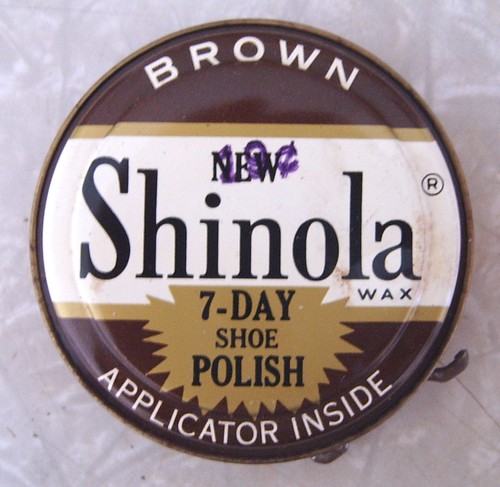
| Shinola, take a whiff |
Contemplating the mere possibility that something that should only be handled with forceps like Trump could now lead a party once led by Abraham Lincoln or Dwight Eisenhower; one gets the feeling that the spirit of the republic is a little like the Bruce Willis character in The Sixth Sense, dead, but doesn't know it yet.
In that film, only one small boy seems to understand the situation. Today the social media are crowded with "small boys" of every political, or conspiracy stripe, all of them shouting out their versions of the system's multi-odorous shoe.
There is certainly a
sense that something is terribly wrong, something mysterious, but I
think it could be something quite simple, if intractable, that is
afflicting the system. Like the Bruce Willis character, we really don't
understand our true situation. In my opinion we are going through
something similar to what the USSR went through nearly twenty five years ago. Twenty five years may seem a long time to someone under
forty, but in historical terms it is nothing more than a blink of the
eye. After all, from the Versailles Peace Conference in 1919 to the outbreak of
World War Two in 1939 was only twenty years.
Absurd, you say, the two
systems are totally different, like oil and water ... on the contrary, I would say that
the similarities between them are more interesting than the differences and that
America has simply been more efficient than the USSR ever was in resisting
the same acids that are eating away at its structures of social control in much the same
way as they devoured the Soviet's.
Both the USSR and the USA
have relied on huge government spending to propel their economies. The
role of government funded research has been essential in almost every
high tech area: computers, the Internet, aviation, etc, in all of them
the input of the state has been paramount. Where the United States won
hands down was in turning the sophisticated technology so expensively
acquired into affordable consumer products and fomenting never-never
credit to keep them affordable when salaries stagnated.
"What about freedom?" you
say, to which I would reply that the social control of the Soviet
system was extraordinarily brutal and primitive compared to our system
of social control, which is infinitely more sophisticated than theirs
was. I never lived in the Soviet Union and my experience of how a
well-oiled dictatorship controls public opinion comes from having lived
in Franco's Spain. Franco lasted forty years and the Soviets lasted
seventy. Although the USSR was communist and Spain's regime was
authoritarian/fascist, the similarities in maintaining control were great.
Under Franco, all
newspapers were of course owned by people approved of by the regime,
however until very late into the dictatorship, all articles appearing in
them were previously censored by government officials before publication, after previous censorship ceased any
violation of the regime's standards could be punished by imprisonment
and fines. There was only one television channel to begin with, later
two, both state owned and censored, as were all books, stage plays and
films, which were previously dubbed into Spanish, (with often curious results). There were private
radio stations, but they all connected to the state radio for their
hourly news programs. Here is something that will give you an idea of
how paranoiac such a regime can be: radio dispatched taxis came into use
in the USA in the late 1940s, but they were still forbidden in Spain
until well after the dictator's death in 1975, as they constituted an
independent communication network outside state control. There is no way
that the Franco regime could have ever tolerated the Internet, cell
phones, SMS or social networks such as Twitter or Whatsapp.
Getting back to the
Soviet Union I have read that you needed very high level permission to
even have access to a photocopying machine there. Thus the modest mimeograph machine was an important instrument in the USSR's downfall.
Bottom line: A system of social control cannot operate successfully in an environment of free movement of information.
Bottom line: A system of social control cannot operate successfully in an environment of free movement of information.
This is where, until now, the USA has
always been more sophisticated and effective, however, like the
mysterious intruder in Edgar Allen Poe's "The Masque of the Red Death,"
you can run, but you can't hide and the same access to information that brought down
the Soviets and would have made Franco's regime impossible, have in America morphed under the combination of military technology,' hooked to an
insatiable consumer society, and are now even eating away at the US system.
As we observe in the
political paralysis of today, we can see that the Founding Fathers of 18th century, in an America then WASP, religiously and ethnically quite homogeneous, created a political structure that was not designed to
reflect a society as complex and multifaceted as contemporary America's
has turned out to be.
The centrifugal forces of
a country as huge and diverse as America's were kept more or less
under control until recently by what Edward Bernays and Walter Lippmann called, "the management of consent,"
that is to say the American science of public relations applied to
forming public opinion.
Heretofore "freedom of the press" in the first place required enough money to buy a press, therefore the creation of opinion was in the safe hands of people with enough money to pay to play. The major newspapers, radio and TV networks and of course Hollywood all worked together naturally to manufacture a national opinion leading to political consensus. Compare this to Twitter and cellphone videos of the police shooting black people.
Heretofore "freedom of the press" in the first place required enough money to buy a press, therefore the creation of opinion was in the safe hands of people with enough money to pay to play. The major newspapers, radio and TV networks and of course Hollywood all worked together naturally to manufacture a national opinion leading to political consensus. Compare this to Twitter and cellphone videos of the police shooting black people.
Herein lies the
importance of the recent idea of the "people" being 99% and everything being owned and run for the benefit of the "one-percent": this is a self generating
phenomenon, which has required minimal capital outlay to influence the
opinion of millions of people, and which is helping a critical mass of opinion to "tell
the shit from the Shinola". The downside of all this being political instability.
This phenomenon is totally outside the control of those who have always manufactured consent until now. As an example: Walter Cronkite's role as the symbol of unified national opinion would be impossible today.
This is only the beginning, in a couple of years we will be look back on this present moment tenderly like watching a home movie of a baby's first steps.
This phenomenon is totally outside the control of those who have always manufactured consent until now. As an example: Walter Cronkite's role as the symbol of unified national opinion would be impossible today.
This is only the beginning, in a couple of years we will be look back on this present moment tenderly like watching a home movie of a baby's first steps.
However "our" system has
been reacting to this danger which its own technology and marketing have
produced and under the cover of the war on
terrorism, the National Security Agency. the FBI or the guardians of intellectual property, are putting
mechanisms in place that only await a "national emergency" to tug on our
leash.
In short this is a fight that is never fully won, but never must be lost.
A toast to Shinola! DS

