Showing posts with label liquidity crisis. Show all posts

Thursday, October 09, 2008

Some post-debate analysis


"Although Obama is winning, neither he nor McCain seems to have a genuine grasp of how grave our economic situation is, how stark the prospect of a looming possible Depression. You'd never know from this evening that 5000 Dow points have been lopped since the previous debate and that those retired or near retirement have seen their portfolios crushed and have no hopes of recouping those losses in their nonproductive years. Not to mention all the job losses that the Wall Street plummet portends." James Wolcott - Vanity Fair

"Though both candidates spent a while (and it felt like longer) on the economic emergency, I didn’t feel that either’s comments advanced the discussion, or seemed equal to the gravity of the situation. Almost the first words out of McCain’s mouth were “energy independence”; almost the first words out of Obama’s were “blame deregulation”. We know, we know. Neither gave much indication that the crisis was leading them to think things through afresh; one wonders what it would take to do that." Clive Crook - Financial Times

“These days, you have to struggle,” she said. “As a kid, I used to be able to go to the movies or to the zoo. Now you can’t take your children to the zoo or go to the movies, because you’ve got to think how you’re going to put food on the table.” Snodgrass’s parents had raised four children on two modest incomes, without the ceaseless stress that she was enduring. But the two-parent family was now available only to the “very privileged.” She said that she had ten good friends; eight of them were childless or, like her, unmarried with kids. “That’s who’s middle-class now,” she said. “Two parents, two kids? That’s over. People looked out for me. These kids nowadays don’t have nobody to look out for them. You’re one week away from (a) losing your job, or (b) not having a paycheck.” George Packer - New Yorker
David Seaton's News Links
Americans are so used to suffering privately in a general climate of cheerful banality, and have so little knowledge of history, that they may not realize what a potentially perilous moment we are living in.

With the world economy in spitting distance of collapsing, the lame duck President of the United States, in the process of losing two wars, has approval ratings of under thirty percent, and in an exclusively two party system, with no other alternative possible, the Congress, controlled by the opposition, has approval ratings of under twenty percent.

At this juncture, one of the objectively gravest in US history, the American people are being asked to choose for their new leader between two political dwarfs who have not managed put forward any major ideas or to suggest any meaningful, much less inspiring, path out of the situation.

This is as close to systemic failure as I can imagine.

In many extremely civilized countries this would guarantee millions of sullen, if not violent, demonstrators in the streets demanding action.

With much less cause, many countries have suffered coup d'etats.

The question would be: is inane banality and a fundamental lack of seriousness, America's fatal curse or its saving grace? DS

Wednesday, October 01, 2008

The vaporization of value

David Seaton's News Links
Part of today's hysteria is sensation that value is disappearing into thin air. However, this has been going on for a long time.

If every dollar printed represented an actual quantity of gold which you could redeem and take home, then naturally the amount of money available would be very small and there wouldn't be enough to go around. Scarcity and value are closely connected.

The rebellion against "hard", gold based money the working people's eternal need for easy credit, was what was behind William Jennings Bryant's famous, "You shall not press down upon the brow of labor this crown of thorns; you shall not crucify mankind upon a cross of gold" speech.

Making easy credit available has made it possible for modern capitalism to avoid the tensions that Marx predicted would finally bring it down. Now instead of being "prisoners of want", most of us have houses, cars, fine clothing and travel, all on credit or what the English used to call the "never, never". Things that in Bryant's day only rich people could ever dream of.

So, when people described as NINJA or "No Income, No Job, No Assets" were given mortgages for expensive homes, this was just taking installment purchasing to its ad absurdum conclusion. Why not eliminate value from the transaction altogether? The only value would be the service charges and commissions. Brilliant. Why not sell the resultant paper over and over again, take a commission every time? Who is keeping score? Brilliant.

All this is a bit of a house of cards, it depends on people actually believing that dollar bills, which are only colored pieces of paper, a "fiat currency," which cannot be redeemed for gold, have any value or, stretching that belief even farther, that pieces of paper or electronic symbols on a computer screen that only represent those intrinsically worthless dollar bills have any actual value. If people lose that confidence even for a moment, then, like Saint Peter trying to walk on the water, or Wylie Coyote trying to walk on air, they sink.... heh, heh... we all sink... it now appears. DS

Wednesday, July 16, 2008

Shake your booty! What, no booty left?

"This is by far the worst financial crisis since the Great Depression" Nouriel Roubini
"A total collapse of the US financial system, while not inevitable, is a contingency which should now be planned for." Martin Hutchinson, Prudent Bear
David Seaton's News Links
There is a lot of talk these days about the role of humor in American politics; whether or not a candidate is a suitable butt for jokes,
whether or not they can "laugh at themselves" and so on and so on. Whether or not humor is "appropriate".

The American national pastime of navel gazing aside, whoever the next president of the United States is, he should, without delay, get fitted out for an getup like the fellow in the photo is wearing... make up and all. Because that is going to be the role of the next POTUS on the world stage in the foreseeable future.

Losing two wars is something the world can chalk off to youthful folly, people seem ready to forgive and forget
unprovoked invasions and the deaths and torture of hundreds of thousands of human beings; but destroying the livelihood of millions of people around the world though ideologically driven, financial frivolity is a little harder to swallow. They are going to resent it.

Whatever the world looks like in 2012, it's going to look as different from today as the world looked after the fall of the Berlin Wall.

If I were the next president of the US, I would try to inspire the people with a ringing speech.
My fellow Americans (pause): This is the time (pause, with meaningful gaze into the middle distance) This is the time (pause) for the American people... (pause) to dig deep into the wellsprings and treasures of our popular culture (long pause) to dig deep into our roots (pause), in order to find the strength and the inspiration to carry us through the difficult days to come.

My fellow Americans, Try this on for size.
(marine band strikes up, POTUS sings in a pleasing baritone):
Once I lived the life
of a millionaire
Spending my money
Oh I didn't care
Taking my friends out
For a mighty good time
Buyin' high priced liquor
Champagne and wine

Oh but just as soon

As my money got low
I couldn't find nobody
And I had no place to go

In my pockets, not one penny

And as for my friends,

Man, I hadn't any
So, if I ever get my hands
On a dollar again
I'm gonna hold on to it
Till that big eagle grins
Cause it's mighty strange,

Without a doubt


Nobody wants you

When you're down and out

"Nobody wants you when you're down and out" - Jimmie Cox
DS

Wednesday, October 17, 2007

How many divisions (investment funds) has the Dalai Lama got?

David Seaton's News Links
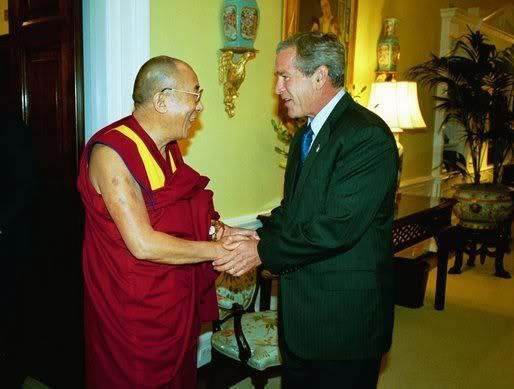
The Dalai Lama is a great spiritual leader, I follow his discourses with great interest, indeed reverence. However, as a chief of state, I can't see that he is a great example of the democratic principals that George W. Bush says he is committed to bringing to the world with fire and the sword.

As I understand it Tibet's chief of state is chosen when a group of monks show a child personal effects of the last chief of state and if he recognizes them as his own, then he becomes the new chief of state... Come to think of it, that's not a whole lot different to the way Bush got to chief of state himself. Still I don't see why it was absolutely necessary to offend China on democratic principals. Because China is in a position to express its displeasure in many interesting ways.

People who understand money tell me that there is a liquidity crisis in the world, a rather desperate shortage of cash.

China has a huge amount of cash. They want to invest it in the west. It seems to me that this information doesn't square with the photo above.

In the same way I don't understand the timing of the Armenian genocide vote in the US Senate, I don't understand the timing of the photo above. Somebody is going to end up being humiliated and I don't think it's going to be the Chinese. DS


Martin Wolf: The brave new world of state capitalism - Financial Times
Abstract: Globalisation was supposed to mean the worldwide triumph of the market economy. Yet some of the most influential players are turning out to be states, not private actors. States play a dominant role in ownership and production of raw materials, notably oil and gas. Now states are also emerging as owners of wealth. This is creating widespread concern. Does that narrow focus make sense? The broad answer is No.(...) In all, they control some $2,200bn, with $2,100bn in the top 20 funds. The seven biggest belong (in order of estimated size) to Abu Dhabi ($625bn), Norway ($322bn), Singapore – GIC ($215bn), Kuwait ($213bn), China ($200bn), Russia ($128bn) and Singapore – Temasek ($108bn).(...) The sovereign funds remain far smaller than official foreign currency reserves (approximately $5,600bn). But the expectation is that these funds will grow rapidly, possibly to exceed official currency reserves in a number of years. If recent growth were to continue, the total value would reach $13,000bn over the next decade. This might then be 5 per cent of total global financial wealth.(...) Many sovereign wealth funds should raise no concerns whatsoever. The worrying ones are only those that do seek dominant positions or outright ownership of strategically important businesses. If the fund belonged to a government deemed potentially hostile, the concern must be bigger. It would be reasonable to keep control of companies operating in defence or high technology out of the ownership of funds belonging to any foreign government, let alone a potentially hostile one. But interesting questions arise elsewhere: what would people feel about Chinese government ownership of a big media operator?(...) the owners of the sovereign wealth funds need to understand their own best interests. They should manage their money professionally and transparently. This is also the way to minimise friction with host countries. If they refuse to abide by these principles, they must expect trouble. Yet trouble should not go out of its way to look for them: far, far worse things can happen than for China to come to the west bearing the chequebook it has earned by its people’s remarkable efforts. READ IT ALL