Showing posts with label Chavez. Show all posts

Wednesday, March 06, 2013

On the death of Hugo Chávez


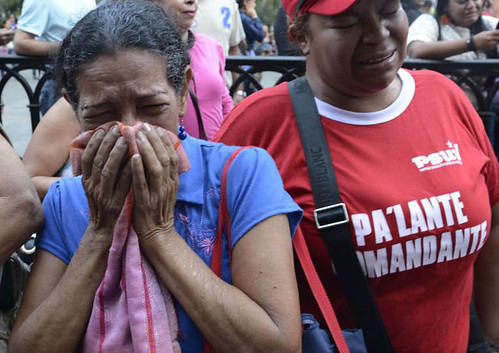
Crying for Hugo

A little old lady interviewed by El País in a mourning crowd of Venezuelans gave the most insightful analysis of Hugo Chávez and his probable legacy: "He gave us an identity!". 
Latin America is filled with people like that old lady, they are the overwhelming majority: poor, brown, left out and despised by the white, Criollo minority that has ruled the continent since colonial times. Chávez has given them an identity, an icon and marked a path. How attractive that identity, that Icon and that path are in South America can be judged by the reaction of Brazil's moderate president, Dilma Roussef, quoted in The Guardian, "The loss is irreparable. He was a great leader and friend of Brazil. President Chávez will live on in the empty space that he filled in the heart of history and the struggle of Latin America."
Paradoxically the conditions that brought forth Hugo Chávez in South America, obscene wealth and inequality in the midst of poverty, squalor and injustice, are being replicated right now in the developed world. Chávez's death coincides with the Dow Jones index hitting "all time highs", while, as John Gapper writes in the Financial Times, with unemployment hanging over their heads, the working poor and even university educated, middle class Americans are being encouraged to work longer hours at lower pay.... and in Europe? Much of its south is busy looking for their Hugo Chávez.
Hugo Chávez is/was not a freak accident, he is a leading indicator of the United State's loosening grip in the midst of the most important systemic crisis since the Great Depression. DS

Saturday, November 18, 2006

In Nicaragua: Chavez 1, Bush 0 - Greg Grandin - Washington Post

David Seaton's News Links
When you live in a Spanish speaking country for any length of time and become fluent in the Spanish language and begin to mix freely and even go to school with Latin-Americans, you will receive, whether you like it or not, what might be euphoniously known as an "alternative narrative" to "American exceptionalism". This experience was the beginning of my political consciousness, such as it is. Reagan's war in Nicaragua was every bit as criminal as Bush's war in Iraq and the World Court condemned it as criminal and was ignored. A lot of the same players are involved in both stories. DS
Abstract: Both Hugo Chavez and George Bush made it clear who they wanted to win last week's presidential election in Nicaragua: the first backed Daniel Ortega, the ex-guerrilla and Sandinista leader; the second, conservative banker Eduardo Montealegre. But the difference in the way each supported their candidate says much as to why the United States is so distrusted in Latin America. Venezuela helped Ortega by selling cheap oil with long-term, low-interest credit to Nicaraguan municipalities, a popular move since the country is gripped by a severe energy crisis. Caracas also donated tons of fertilizer and provided free eye surgery to hundreds of cataract patients. Chavez's critics pointed out this aid was nothing compared with what Washington gives Nicaragua, more than a billion dollars since Ortega was voted out of office in 1990. But roughly half of this aid goes just to keeping Nicaragua's bankrupted economy afloat, either in the form of debt relief or covering currency shortfalls, which in effect works as a subsidy to U.S. creditors and exporters, thus limiting its PR value. And of course this money pales in comparison to many billions of dollars of damage that Washington caused in Nicaragua with its devastating Contra War. In fact, the U.S. conditioned its financial assistance on Nicaragua abandoning its attempt to collect the estimated $17 billion that the World Court, in 1986, ordered Washington to pay to Managua as reparations for waging its illegal war against the country. But the real difference is that Chavez never threatened to punish Nicaraguans if they didn't vote as he hoped they would. Caracas offers all carrot and no stick. The Bush administration, in contrast, warned that an Ortega victory could bring aid cuts and trade sanctions, while Congressional Republicans said that they would pass legislation prohibiting Nicaraguans living in the U.S. from sending money home. Nicaragua is the hemisphere's second poorest country, and very heavily dependent on foreign aid and remittances; and such retaliation, if enacted, would be ruinous. That Washington reserves this kind of intimidation only for small and powerless nations like Nicaragua as opposed to a country like Mexico, where it was careful not to intervene in last summer's election, only serves to reinforce the opinion of many Latin Americans that the U.S. is a bully.(...) Jeane Kirkpatrick is one of those foreign-policy hawks who blame Chavez for Ortega's comeback. In the 1980s, as Ronald Reagan's ambassador to the UN Kirkpatrick defended the Contra War as part of a broader foreign policy that would both "protect U.S. interest and make the actual lives of actual people in Latin America somewhat better." Nicaraguans are still waiting for the second half of that pledge to be fulfilled. READ IT ALL