Showing posts with label Latin America. Show all posts

Friday, March 15, 2013

What is the new Pope about?

David Seaton's News Links
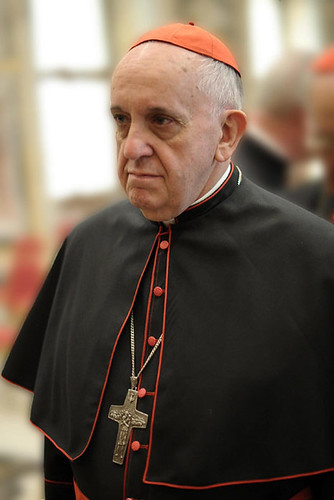
Jorge Mario Bergoglio en El Vaticano
His Holiness Pope Francis
Francis is no liberal. He had no truck with liberation theology, the popular movement in Latin America and elsewhere which links the church’s work to radical social change, even though many of its supporters have been Jesuits. Not Francis: he is close to the conservative Communion and Liberation movement. The Economist
Latin America is the breadbasket and center of gravity of the Roman Catholic Church today, both in number of faithful and number of vocations. But there are storm clouds on the horizon;  two movements have the Church worried in Latin America and the problems they cause are interconnected: on one hand the revolutionary movements of the Bolivarian variety, which threaten the position of the propertied classes and on the other the growing, US financed, Evangelical Protestant penetration in the continent.
Though as socially conservative as the Catholics, the Evangelicals are ultra-conservatives on economic issues following the US model and very much part of the reactionary culture of the American south. The problem for the Catholic Church is that if they cannot stop the left wing revolutionaries from making inroads in the Catholic population, the rich criollo's money in South America will begin to flow toward the Evangelicals to see if they can do the job, thus leaving the Church without cash and vocations.
Don't expect any loosening of Church doctrine under the new pope, Jorge Mario Bergoglio. Karol Wojtyla and his enforcer Josef Ratzinger, systematically carried out  a 35 year long purge of all "green shoots" of John XXIII, Paul VI and Vatican II. This has been deep and thorough and every trace of progressive thought has been exhaustively eradicated from the Church aparat. Bergoglio is a product of that purge and a collaborator in carrying it out. The Jesuit order was once a hotbed of left wing liberation theology, Bergoglio made his bones helping to stamp that out.
There is a lot of disturbing news about the new pope coming out of Argentina.  He is accused of operating hand in glove with the Videla regime... it might be a good idea to moderate our enthusiasm for this "Franciscan" simplicity of his till all that is cleared up. DS

Sunday, September 13, 2009

September Song

9-11 - El Roto
The Obama administration has proposed regulatory changes, but even their backers say they face a difficult road in Congress. For now, banks still sell and trade unregulated derivatives, despite their role in last fall’s chaos. Radical changes like pay caps or restrictions on bank size face overwhelming resistance. Even minor changes, like requiring banks to disclose more about the derivatives they own, are far from certain. New York Times

(H)ealth care reform, while an overdue imperative, still is overshadowed in existential urgency by the legacies of the two devastating cataclysms of the Bush years, 9/11 and 9/15, both of whose anniversaries we now mark. The crucial matters left unresolved in the wake of New York’s two demolished capitalist icons, the World Trade Center and Lehman Brothers, are most likely to determine both this president’s and our country’s fate in the next few years. Both have been left to smolder in the silly summer of ’09. Frank Rich - New York Times

(T)here is still a mammoth, gaping hole at Ground Zero. Bureaucratic gridlock, partisan bickering, old-fashioned greed and failed leadership have all been blended together perfectly in one big pot to create a colossal, historic stew of inaction. Paul Rieckhoff - Huffington Post

President Obama made clear during last year's presidential campaign that Afghanistan would be his war if he was elected. Since being sworn in, true to his word, he has made the Afghan war a national security imperative because that's where al Qaeda is. At least, that's where Mr. Obama thinks it is. But nothing is less certain. Arnaud de Borchgrave - Washington Times

He has decided to expand the current system, not fix it. David Brooks - NYT
David Seaton's News Links
I have have held off commenting on the president's health care speech to congress in order to read the opinions of better qualified analysts: the general opinion seems to be that it was a very fine speech, but that no one is really that sure what he said. By now it seems pretty clear that whatever comes out of it this process will resemble what other developed western countries consider universal health coverage to the degree that a spavined camel resembles a racehorse.

As important as health care is (and what in a "serious" country could be more important?) the real story today is paralysis and this paralysis is, if nothing else, bipartisan. And it is bipartisan because it is systemic, something that has been brewing since the end of the Second World War and which now is coming to a head. Neither party has either the ideas nor the power to fix it and I am of the opinion that even if they fell into each other's arms and took a blood oath of mutual fealty; that even together, they wouldn't have either the ideas nor the power to fix it.

That is the reason why I was quite lukewarm about a Democrat -- any Democrat -- taking the White House at this moment. I have a very strong feeling that this president -- any president -- is set to preside over what many will see as the collapse of America's "empire" and whichever party is in the White House when this happens will take the blame for it... I would have preferred -- call me sentimental -- that the Republicans had taken the historic hit... I was hoping (not really believing) that the Democrats would be the ones to try to put Humpty Dumpty together again... it was not to be.

What will this collapse of "America's empire" look like?

It will look very similar to the collapse of Spain's empire and will feature some of the same players.

South America is going south... again.

The United States is so deeply entangled in and obsessed by the Middle East and Af-Pak that it has taken its eyes and energies off its proverbial back yard, Latin America. Because of its dependence on oil and the power of the Israel lobby it will find it impossible to refocus in time. There are simply not enough resources to control the Middle East and Southwest Asia and project power in South America at the same time. As professor Andrew Bacevich puts it, "we haven't got the money and we haven't got the troops".

Latin America gained its "first" independence at the beginning of the 19th century, when a prostrate Spain, exhausted from the Napoleonic wars, relaxed its grip. And now with a distracted and overburdened America relaxing its grip, Latin America is poised to gain its "second" and perhaps definitive independence.

Latin America and the United States have much in common, it is the proportions of the components that differ the most. All of us are great producers of raw materials and commodities, where not too much is manufactured (anymore). To understand the political mix of most of Latin America excluding lily white Argentina, Uruguay and Chile, known as the "Southern Cone," the USA will serve as a good model.

Imagine that instead of 12% and 1.5% of the population respectively, African and Native- Americans represented in varying proportions, 70 to 80+ percentage of the US population. Imagine that the distribution of wealth was similar to what it is right now. Here is how the sociology department of the University of Southern California, Santa Cruz describes it:
In the United States, wealth is highly concentrated in a relatively few hands. As of 2004, the top 1% of households (the upper class) owned 34.3% of all privately held wealth, and the next 19% (the managerial, professional, and small business stratum) had 50.3%, which means that just 20% of the people owned a remarkable 85%, leaving only 15% of the wealth for the bottom 80% (wage and salary workers). In terms of financial wealth (total net worth minus the value of one's home), the top 1% of households had an even greater share: 42.2%.
Now imagine that all the people with the money were of European descent and all the people without money were of color (not too difficult, is it?) now imagine that a series of political figures that combined the qualities of Doctor Martin Luther King and Sitting Bull appeared... That is what is happening in Latin America right now, while the United States faces the wars of Iraq and Afghanistan and quite probably Iran and has no marines left over to send.

President Barack Obama -- it could have (sigh) been McCain -- will have the dubious privilege of sitting by helplessly while the United States of America gets ridden out of Latin America on a rail. DS

Saturday, March 31, 2007

United Fruit by any other name...


David Seaton's News Links
"Why do they hate us?" Americans ask. Well, in Latin America its this cheerful-killer, "oh what fun" thing; a huge toothy grin mixed with a murdering greed which stops at nothing... kind of like if Genghis Khan could tap dance... for a start.

Amy Goodman's "Chiquita Banana" story here below, is a rather perfect example of this phenomenon. "Chiquita" is the cute new name of United Fruit, which really was in need of some serious re-branding. In United-Chiquita's case it's as if Count Dracula had himself re-branded as "Vladdy-Daddy". Still out for blood, but
cute. DS

Amy Goodman: Chiquita slips money to terrorists - Seattle Post-Intelligencer
Abstract: What do Osama bin Laden and Chiquita bananas have in common? Both have used their millions to finance terrorism. The Justice Department has just fined Chiquita Brands International $25 million for funding a terrorist organization -- for years. Chiquita also must cooperate fully with ongoing investigations into its payments to the ultra-right-wing Colombian paramilitary group Autodefensas Unidas de Colombia. Chiquita made almost monthly payments to the AUC from 1997 to 2004, totaling at least $1.7 million. The AUC is a brutal paramilitary umbrella group, with an estimated 15,000 to 20,000 armed troops. It was named a terrorist organization by the U.S. on Sept. 10, 2001. Among its standard tactics are kidnapping, torture, disappearance, rape, murder, beatings, extortion and drug trafficking. Chiquita claims it had to make the payments under threat from the AUC to protect its employees and property. Chiquita's outside lawyers implored them to stop the illegal payments, to no avail. The payments were made by check through Chiquita's Colombian subsidiary, Banadex. When Chiquita executives figured out how illegal the payments were, they started delivering them in cash. Chiquita sold Banadex in June 2004 when the heat got too intense.(...) Chiquita has had a long history of criminal behavior. It was the subject of an extraordinary exposé in its hometown paper, The Cincinnati Enquirer, in 1998. The paper found that Chiquita exposed entire communities to dangerous U.S.-banned pesticides, forced the eviction of an entire Honduran village at gunpoint and its subsequent bulldozing, suppressed unions, unwittingly allowed the use of Chiquita transport ships to move cocaine internationally, and paid a fortune to U.S. politicians to influence trade policy. The lead reporter, Mike Gallagher, illegally accessed more than 2,000 Chiquita voice mails. The voice mails backed up his story but his methods got him fired. The Enquirer issued a front-page apology and paid Chiquita a reported $14 million. The voice-mail scandal rocked the Enquirer, burying the important exposé. Chiquita was formerly called the United Fruit Co., which with the help of its former lawyer, Secretary of State John Foster Dulles, and his brother Allen Dulles' Central Intelligence Agency overthrew the democratically elected president of Guatemala, Jacobo Arbenz Guzman, in 1954. And you can go back further. Colombian Nobel Laureate Gabriel Garcia Márquez wrote in his classic "One Hundred Years of Solitude" about the 1928 Santa Marta massacre of striking United Fruit banana workers: "When the banana company arrived ... the old policemen were replaced by hired assassins." While the U.S. is seeking extradition of Colombia-based Chiquita executives, the administration of President Alvaro Uribe in Colombia, with its own officials now linked to the right-wing paramilitaries, has countered that Colombia would seek the extradition of U.S.-based Chiquita executives. Colombian prosecutors are also seeking information in Chiquita's role in smuggling 3,000 AK-47 rifles and millions of rounds of ammunition to paramilitaries in November 2001. READ IT ALL

Monday, March 12, 2007

Shamans clean up after Bush

Cakchiquel Capital City of IXIMCHE
David Seaton's News Links
I think a flying squad of Native-American shamans should be flown everywhere in the world that Bush visits hereafter in order to perform these cleansing ceremonies.

In might be a good thing to station a permanent detail of Shamans in Washington to follow Bush's motorcades (at a discreet distance, of course) and keep cleansing those vibrations. It can't hurt and it might save the planet, who knows?

This is definitely an idea whose time has come. DS

Ruins to Be Cleansed Following Bush Visit - Der Spiegel
Abstract: A site close to the hearts of the indigenous Maya people of Guatemala is to be spiritually de-contaminated after a visit by US president George Bush. Mayan Indian priests in Guatemala have vowed to hold a cleansing ceremony following a Monday visit by US president George W. Bush to sacred ancient ruins. As part of his stopover in the tiny, Central American nation during a five-nation-tour of Latin America, Bush's itinerary has him visiting the Mayan ruins of Iximiche, some 50 kilometers west of Guatemala City. Native dances and a welcoming ceremony will greet the president when he arrives at the ruins of the former capital of the Kaqchikel Maya people. But after he leaves, Mayan leaders say that a special cleansing ceremony to restore peace and harmony will be necessary to remove negative energy left by Bush's visit. "We will burn incense, place flowers and water in the area where Bush has walked to clean out the bad energy," said Jorge Morales Toj, a Guatamalan youth leader. He added that Bush's visit to Iximiche treats the Mayan people as little more than a tourist attraction. Resentment in Guatemala against the United States remains high due to CIA support for the overthrow of a democratically-elected socialist government in 1954 and US support for Guatemalan military governments during the country's 1960-96 civil war -- a conflict that left about a quarter million people dead or missing. A scorched earth counter-insurgency campaign at the peak of the war saw US-backed troops destroy entire Mayan villages. READ IT ALL

Tuesday, December 12, 2006

Tuesday, November 28, 2006

Ecuador Elections: give it back to the Indians


David Seaton's News Links

If you were trying to find some common factor that defines our era, it is the previously silent finding voice. The new, inexpensive communication systems put those with common language and values into comfortable contact with each other across formidable physical obstacles. Thus Muslims around the world, combining Arabic, the Koran and the Internet, are in the process of forming a common Islamic consciousness, much to the discomfort of non-Muslims. Language + shared values + similar economic conditions X Internet = trouble for those in charge. In Spanish America all these ingredients exist: common language, colonial past and downtrodden Indians. Unlike North America, all the South American rivers run in the wrong direction and all the mountains are in the wrong place and this has kept the different peoples separated. The white settlers of one Latin American country are not interested in the white settlers of the other countries, looking only toward Europe and especially to the USA which is seen to guarantee their position economically and if necessary militarily. Fluid communication between the impoverished Indians of the different countries, or even communication between the Indians of any one country was science fiction until the very recent past. All this has changed in only a few years. All the ingredients being in the pot and the heat turned up, the smells from the kitchen are wafting through the house. DS
Ecuador Elections: This eruption is irreversible - The Guardian
Abstract: The red tide sweeping through Latin America, checked in Peru and Mexico, has achieved another memorable record this week in Ecuador. The substantial electoral victory of Rafael Correa, a clever, young, US-educated economist and former finance minister, marks a further triumph for Hugo Chávez of Venezuela and his Bolivarian revolution, which has long sought to ignite Latin America's "second independence".(...) Unlike most US-trained academics in Latin America, Correa is an economist of a radical persuasion. He has been an outspoken critic of the neo-liberal economics of the globalised world, and an opponent of the so-called Washington consensus that has imposed this ideology on Latin America in the past 20 years. He cannot be easily dismissed as a caudillo or a populist, but was the intelligent choice against his absurdly rightwing millionaire opponent, Álvaro Noboa, whose electoral bribes were too outrageous to be effective. Yet significantly, both candidates stood outside the existing party system. The Correa victory marks a seismic explosion in Ecuador's traditional politics. During the past decade, a series of popular demonstrations, military coups, and temporary governments have given clear warning of changes to come. Similar shifts occurred in Venezuela and Bolivia, where the termites of bureaucratic incompetence and corruption hastened the collapse of the old order. Nothing was left but an ineffective opposition that has proved leaderless and demoralised. Correa, like Chávez and Morales, will move swiftly towards establishing a constituent assembly to give a more representative voice to the country's indigenous majority.(...) Whatever the psephological details, the wave of popular feeling aroused in Ecuador, as in Bolivia earlier this year, clearly indicates the irreversible shift in power. The peoples subdued by Cortés and Pizarro 500 years ago are beginning to rebel against white settler rule. Simón Bolívar, after travelling through Colombia, Ecuador and Peru during the independence wars in the early 19th century, recorded his impression in 1825 that "the poor Indians are truly is a state of lamentable depression. I intend to help them all I can: first as a matter of humanity; second, because it is their right; and finally, because doing good costs little and is worth much." READ IT ALL

Saturday, November 18, 2006

In Nicaragua: Chavez 1, Bush 0 - Greg Grandin - Washington Post

David Seaton's News Links
When you live in a Spanish speaking country for any length of time and become fluent in the Spanish language and begin to mix freely and even go to school with Latin-Americans, you will receive, whether you like it or not, what might be euphoniously known as an "alternative narrative" to "American exceptionalism". This experience was the beginning of my political consciousness, such as it is. Reagan's war in Nicaragua was every bit as criminal as Bush's war in Iraq and the World Court condemned it as criminal and was ignored. A lot of the same players are involved in both stories. DS
Abstract: Both Hugo Chavez and George Bush made it clear who they wanted to win last week's presidential election in Nicaragua: the first backed Daniel Ortega, the ex-guerrilla and Sandinista leader; the second, conservative banker Eduardo Montealegre. But the difference in the way each supported their candidate says much as to why the United States is so distrusted in Latin America. Venezuela helped Ortega by selling cheap oil with long-term, low-interest credit to Nicaraguan municipalities, a popular move since the country is gripped by a severe energy crisis. Caracas also donated tons of fertilizer and provided free eye surgery to hundreds of cataract patients. Chavez's critics pointed out this aid was nothing compared with what Washington gives Nicaragua, more than a billion dollars since Ortega was voted out of office in 1990. But roughly half of this aid goes just to keeping Nicaragua's bankrupted economy afloat, either in the form of debt relief or covering currency shortfalls, which in effect works as a subsidy to U.S. creditors and exporters, thus limiting its PR value. And of course this money pales in comparison to many billions of dollars of damage that Washington caused in Nicaragua with its devastating Contra War. In fact, the U.S. conditioned its financial assistance on Nicaragua abandoning its attempt to collect the estimated $17 billion that the World Court, in 1986, ordered Washington to pay to Managua as reparations for waging its illegal war against the country. But the real difference is that Chavez never threatened to punish Nicaraguans if they didn't vote as he hoped they would. Caracas offers all carrot and no stick. The Bush administration, in contrast, warned that an Ortega victory could bring aid cuts and trade sanctions, while Congressional Republicans said that they would pass legislation prohibiting Nicaraguans living in the U.S. from sending money home. Nicaragua is the hemisphere's second poorest country, and very heavily dependent on foreign aid and remittances; and such retaliation, if enacted, would be ruinous. That Washington reserves this kind of intimidation only for small and powerless nations like Nicaragua as opposed to a country like Mexico, where it was careful not to intervene in last summer's election, only serves to reinforce the opinion of many Latin Americans that the U.S. is a bully.(...) Jeane Kirkpatrick is one of those foreign-policy hawks who blame Chavez for Ortega's comeback. In the 1980s, as Ronald Reagan's ambassador to the UN Kirkpatrick defended the Contra War as part of a broader foreign policy that would both "protect U.S. interest and make the actual lives of actual people in Latin America somewhat better." Nicaraguans are still waiting for the second half of that pledge to be fulfilled. READ IT ALL