David Seaton's News Links
It might not be too much of an exaggeration to say that Richard Gere is a Weapon of Mass Destruction.
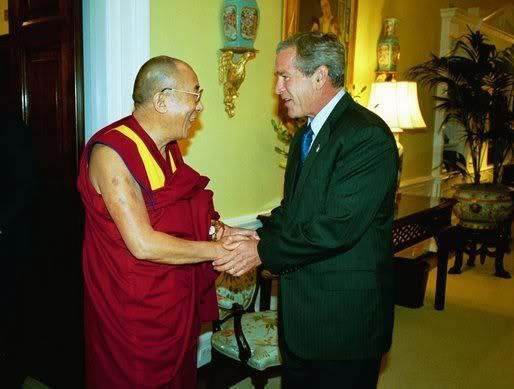
When westerners think of Tibet they think of the Tibetan spiritual superstar, the Dalai Lama and they naturally sympathize with the Tibetan’s desire for independence.
The Chinese, imagining an independent Tibet in NATO, with Mount Everest covered with American radar and CIA listening equipment, don’t.
Unfortunately for Tibetans, Tibet, besides its art treasures, the marvels of its Himalayan landscapes and the spiritual wealth of its unique form of Buddhism, has vast amounts of timber, uranium and gold that resource hungry China covets and a unique strategic position overlooking the world’s other rising giant, India. To expect the Chinese to trade any of this for a brilliant Olympic opening ceremony is disingenuous to the point of cynicism.
So, as HDS Greenway wrote in the Boston Globe, “If Tibetans are encouraged to further resist, it will be as with the Hungarian uprising, or the call for Iraqis to rise up during the first Gulf War - a hollow gesture that will lead to more repression in which the United States has no intention to intervene.” Writing in the Guardian, Parag Khanna quoted a Chinese intellectual, "The Soviet Union collapsed because they experimented with glasnost before they achieved unity among the peoples." Khanna observes that, “Large empires are maintained through a combination of force and law; and as recent weeks illustrate, China is determined not to waver.”
Western globalization's discourse today is so filled with self-referring, self serving ideological constructions, that contemporary China's radical pragmatism seems mysterious. The authoritarian Marxist-Leninist Communist Party of China has taken China on a path that has little to do with Marx but quite a bit to do with Lenin. Lenin himself defined “Communism” simply as “state power plus the electrification of the whole country.” If we change the word “electrification” for “development”, we have a very workmanlike description of today’s China. DS
Abstract: It is difficult to find a westerner who does not intuitively support the idea of a free Tibet. But would Americans ever let go of Texas or California? For China, the Anglo-Russian great game for control of central Asia was neither inconclusive nor fruitless, something that cannot be said for Russia or Britain. Indeed, China was the big winner.(...) Both Tibet and Xinjiang have the misfortune of possessing resources China wants and of being situated on the path to resources China needs: Tibet has vast amounts of timber, uranium and gold, and the two territories constitute China's geographic gateway for trade flow outward - and energy flow inward - with Kazakhstan, Kyrgyzstan, Tajikistan, Afghanistan and Pakistan. Decades of labour by the army and swarms of workers have paved the way for unchallenged Chinese dominance. The high-altitude train linking Shanghai and Lhasa that began service in 2006 represents not the beginning of Chinese hegemony, but its culmination. Tibet and Xinjiang today set the stage for the birth of a multi-ethnic empire in ways that resemble nothing so much as America's frontier expansion nearly two centuries ago. Chinese think about their mission civilatrice much as American settlers did: they are bringing development and modernity. Asiatic, Buddhist Tibetans and Turkic, Muslim Uighurs are being lifted out of the third world - whether they like it or not. They are getting roads, telephone lines, hospitals and jobs. School fees are being reduced or abolished to promote basic education and Chineseness. Unlike those Europeans who seek to define the EU as a Christian club, there are no Chinese inhibitions about incorporating Muslim territories. The new mythology of Chinese nationalism is based not on expunging minorities but granting them a common status in the paternalistic state: Uighurs and Tibetans, though not Han, are told they are Chinese. "The Soviet Union collapsed because they experimented with glasnost prematurely, before the achieved unity among the peoples," explains a Chinese intellectual in Shanghai who studies central Asia. Large empires are maintained through a combination of force and law; and as recent weeks illustrate, China is determined not to waver.(...) Ironically, China's near absolute sense of security over both provinces is the greatest hope for a Chinese glasnost: China no longer faces any meaningful resistance to its rule and so some day may lighten up. Spiritual Tibetans have long looked south to Nepal and India for their cultural underpinnings, and in the 18th century Tibet was allowed a functional autonomy from China, a model the current Dalai Lama has proposed. Once he passes the scene, China might be less anxious about cultural exchange between Buddhists, further restoring Tibet's role as the Silk Road passage it was when Dunhuang's Caves of the Thousand Buddhas were carved, more than a millennium ago. Tibetans and Uighurs will gradually become more prosperous than their neighbouring Mongols, Kyrgyz, Tajiks, Afghans, Pakistanis, Indians, and Nepalis - and this may provide a basis for Chinese claims of a benevolent hegemony elsewhere in Asia. But China will achieve that dominance before it talks about it. READ IT ALL