Showing posts with label defeat. Show all posts

Tuesday, October 02, 2007

Is our children lost their mojo?

David Seaton's News Links
A major part of US charisma has always been its cheerful air of "can do" competence. With Iraq, this has gone with the wind.

Today's American narrative would have Neal Armstrong step out of the Apollo and fall flat on his face. Henry Ford would have to recall all the Model Ts. Cole Porter would write like Bush speaks... You catch my drift. I find this directly attacks my self-image as an American... I resent it like hell.

This is not only a loss for the United States, it is a loss for the world similar to a child losing its belief in Santa Claus. For the rest of your life there is what Sartre would call "a Santa Claus shaped hole" in your life. The world won't miss American imperialism, but it will sure miss the cheerful, confident and competent, "can do", American. I miss me already. DS

Applebaum: Would You Follow the Country That Bungled Iraq? - Washington Post
Abstract: Why don't they like us as much as they used to? "They" in this latter question are our very, very closest allies. By this I don't mean France, or even Canada,(...) No, the more interesting question is why support for American leadership has declined among our traditional friends: Britain, Poland, Germany, Italy, the Netherlands. And it has declined -- drastically. Since 2002, according to the latest German Marshall Fund " transatlantic trends" survey, support for "U.S. leadership in world affairs" -- that's whether they want to follow our political lead, not whether they think we're nice -- has plunged by 30 percentage points in Germany, 26 points in Italy, 24 points in Poland, 23 points in the Netherlands and 22 points in Britain. More generally, support for U.S. leadership, which was at 64 percent across Europe in 2002, is now at 36 percent (though that figure includes the touchier countries).(...) Europeans worry about global warming than Americans, but the difference (85 percent vs. 70 percent) is not as great as one might think. And we all worry about everything else -- international terrorism, a nuclear Iran, global epidemics -- in almost equal measure. This last point strikes me as most interesting: For in fact, it indicates that what our closest friends really dislike is not our traditional pushiness, our violent movies or even our current president (though they don't like him much) but our incompetence. A full third blame the perceived decline of the transatlantic alliance on the "mismanagement of Iraq." Not the invasion of Iraq, the "mismanagement" of Iraq. Which makes sense: If you're really worried about Iran, do you want to put your faith in the United States, the country that bungled Iraq? If you really care about Islamic fundamentalism, do you want to be led by the country that, distracted by Iraq, failed to predict the return of the Taliban in Pakistan and Afghanistan?(...) Countries that would once have supported American foreign policy on principle, simply out of solidarity or friendship, will now have to be cajoled, or paid, to join us. Count that -- along with the lives of soldiers and civilians, the dollars and equipment -- as another cost of the war. No one wants to be on the losing team. READ IT ALL

Monday, July 23, 2007

Iraq: crime and punishment

David Seaton's News Links
This article from the New York Review of Books by Peter W. Galbraith is about as clear and complete an analysis of America's disaster in Iraq and Iraq's disastrous encounter with America that you are likely to find anywhere. If you can still stand reading about it, a must read.

However having said that, I have to insist that this otherwise fine article is obviating what for me is a key point: the criminal nature of America's intervention in Iraq and the necessity of a catharsis that determines the criminal responsibilities of those who led the country to war and punishes them with a severity corresponding to their crimes.

It should be pointed out to those who are unmoved by the sufferings of the people of Iraq, that America's young men and women who have been maimed or killed in Iraq, have not just "died in vain", which is an absurd idea. (Is an automobile accident or colon cancer "dying in vain"?) What has happened to them is far, far worse: they have been mutilated or killed while carrying out a criminal enterprise, as if they had been shot while robbing a gas station or a convenience store. That should not be allowed to stand. DS

Iraq: The Way to Go - New York Review of Books
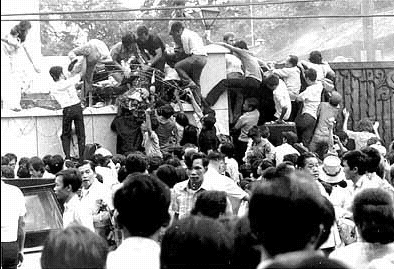
Abstract: The Iraq war is lost. Of course, neither the President nor the war's intellectual architects are prepared to admit this. Nonetheless, the specter of defeat shapes their thinking in telling ways. The case for the war is no longer defined by the benefits of winning—a stable Iraq, democracy on the march in the Middle East, the collapse of the evil Iranian and Syrian regimes— but by the consequences of defeat. As President Bush put it, "The consequences of failure in Iraq would be death and destruction in the Middle East and here in America." Tellingly, the Iraq war's intellectual boosters, while insisting the surge is working, are moving to assign blame for defeat. And they have already picked their target: the American people. In The Weekly Standard, Tom Donnelly, a fellow at the neoconservative American Enterprise Institute, wrote, "Those who believe the war is already lost—call it the Clinton-Lugar axis—are mounting a surge of their own. Ground won in Iraq becomes ground lost at home." Lugar provoked Donnelly's anger by noting that the American people had lost confidence in Bush's Iraq strategy as demonstrated by the Democratic takeover of both houses of Congress. (This "blame the American people" approach has, through repetition, almost become the accepted explanation for the outcome in Vietnam, attributing defeat to a loss of public support and not to fifteen years of military failure.) Indeed, Vietnam is the image many Americans have of defeat in Iraq. Al-Qaeda would overrun the Green Zone and the last Americans would evacuate from the rooftop of the still unfinished largest embassy in the world. President Bush feeds on this imagery.(...) But there will be no Saigon moment in Iraq. Iraq's Shiite-led government is in no danger of losing the civil war to al-Qaeda, or a more inclusive Sunni front. Iraq's Shiites are three times as numerous as Iraq's Sunni Arabs; they dominate Iraq's military and police and have a powerful ally in neighboring Iran. The Arab states that might support the Sunnis are small, far away (vast deserts separate the inhabited parts of Jordan and Saudi Arabia from the main Iraqi population centers), and can only provide money, something the insurgency has in great amounts already. Iraq after an American defeat will look very much like Iraq today—a land divided along ethnic lines into Arab and Kurdish states with a civil war being fought within its Arab part. Defeat is defined by America's failure to accomplish its objective of a self-sustaining, democratic, and unified Iraq. And that failure has already taken place, along with the increase of Iranian power in the region.(...) In laying out his dark vision of an American failure, President Bush never discusses Iran's domination of Iraq even though this is a far more likely consequence of American defeat than an al-Qaeda victory. Bush's reticence is understandable since it was his miscalculations and incompetent management of the postwar occupation that gave Iran its opportunity. While opposing talks with Iran, the neoconservatives also prefer not to discuss its current powerful influence over Iraq's central government and southern region, persisting in the fantasy—notwithstanding all evidence to the contrary—that Iran is deeply unpopular among Iraq's Shiites and clerics. (At the same time, US officials accuse Iran of supplying Iraqi Shiite militias with particularly lethal roadside bombs.)(...) In the parts where we can accomplish nothing, we should withdraw. But there are still three missions that may be achievable—disrupting al-Qaeda, preserving Kurdistan's democracy, and limiting Iran's increasing domination. These can all be served by a modest US presence in Kurdistan. We need an Iraq policy with sufficient nuance to protect American interests.Unfortunately, we probably won't get it. READ IT ALL

Sunday, July 22, 2007

Unoriginal title - Baghdad/Saigon: dejá vue, all over again

David Seaton's News Links
Bush can prattle on about "victory" till he is blue in the face, but this news item from the Washington Post says all that needs to be said about the direction the war in Iraq is taking... taking with breakneck speed. DS

Envoy Urges Visas For Iraqis Aiding U.S. - Washington Post

Abstract: The American ambassador in Baghdad, Ryan C. Crocker, has asked the Bush administration to take the unusual step of granting immigrant visas to all Iraqis employed by the U.S. government in Iraq because of growing concern that they will quit and flee the country if they cannot be assured eventual safe passage to the United States. Crocker's request comes as the administration is struggling to respond to the flood of Iraqis who have sought refuge in neighboring countries since sectarian fighting escalated early last year. The United States has admitted 133 Iraqi refugees since October, despite predicting that it would process 7,000 by the end of September. "Our [Iraqi staff members] work under extremely difficult conditions, and are targets for violence including murder and kidnapping," Crocker wrote Undersecretary of State Henrietta H. Fore. "Unless they know that there is some hope of an [immigrant visa] in the future, many will continue to seek asylum, leaving our Mission lacking in one of our most valuable assets."(...) Overall estimates of the number of Iraqis who may be targeted as collaborators because of their work for U.S., coalition or foreign reconstruction groups are as high as 110,000. The U.N. refugee agency has estimated that 20,000 Iraqi refugees need permanent resettlement. In the cable he sent July 9, Crocker highlighted the plight of Iraqis who have assumed great risk by helping the United States. Since June 2004, at least nine U.S. Embassy employees have been killed -- including a married couple last month. But Iraqi employees other than interpreters and translators generally cannot obtain U.S. immigrant visas, and until a recent expansion that took the annual quota to 500 from 50, interpreter-translator applicants faced a nine-year backlog. As a result, Crocker said, the embassy is referring two workers per week to a U.S. asylum program. Outside analysts and former officials say the number of Iraqi staffers at the embassy has fallen by about half from 200 last year, while rough estimates place the number of Iraqi employees of the U.S. government in the low thousands. A 43-year-old former engineer for the U.S. Embassy who gave his name as Abu Ali said Iraqis working with Americans at any level must trust no one, use fake names, conceal their travel and telephone use, and withhold their employment even from family members. Despite such extreme precautions, he said they are viewed as traitors by some countrymen and are still mistrusted by the U.S. government. "We have no good end or finish for us," said Ali, who quit the embassy in June and moved to Dubai with his four children. READ IT ALL

Monday, April 09, 2007

Bacevich's questions for candidates

David Seaton's News Links
Professor Andrew Bacevich is one of the clearest thinking political analysts working in the United States. As a graduate of West Point he knows that strategic thinking begins with asking the right questions.


Answers to those questions themselves may change with the circumstances, but woe to the strategist that asks the wrong questions.

Obviously to ask the right questions you have to have a realistic idea of who you are, where you are and what you hope to achieve. For example, if you are in Paris and ask a passerby directions to "Times Square", you will probably find that unproductive.

As Professor Bacevich points out, all serious discussion of Iraq and post-Iraq revolves around recognizing that the United States has failed in Iraq. All presidential candidates should then ask themselves, "who we are, where we are and what we hope achieve". If they don't have plausible answers to those questions they have no business asking Americans for their votes. DS

Bacevich: 'Your Iraq plan?' is a pointless question - Los Angeles Times

Abstract: For today's presidential candidates, the question is unavoidable: What is your plan for Iraq?(...) However sincere, such questions are also pointless. To pose them is to invite dissembling. The truth is that next to nothing can be done to salvage Iraq. It no longer lies within the capacity of the United States to determine the outcome of events there. Iraqis will decide their own fate. We are spectators, witnesses, bystanders caught in a conflagration that we ourselves, in an act of monumental folly, touched off. The questions that ought to be asked now — but so far have not been — are of a different order.(...) Recall that Bush saw Baghdad not as the final destination of his global war on terror but as a point of departure. He imagined that liberating Iraq might trigger a flowering of Arab democracy.(...) None of that has come to pass. Baghdad has become a cul-de-sac. Having plunged into a war he cannot win, Bush will not relent. Iraq consumes his presidency because the president wills that it should. He has become Captain Ahab: His identification with his war is absolute. As a consequence, the "global" effort aimed at eliminating Islamic terror, launched back in September 2001, has narrowed in scope. Today the global war is global in name only. In reality, it has become a war for Mesopotamia.(...) Ritualistic allusions to freedom as the antidote to terrorism still occasionally crop up in presidential speeches, but rhetoric no longer translates into action. An administration that once touted its expansive and principled approach to preventing another 9/11 has abandoned principle. Now there is only Iraq and the effort to ensure that today's news out of Baghdad isn't any worse than yesterday's. Our political attention, then, needs to turn to whether the president's would-be successors can do what Bush cannot: acknowledge our failure in Iraq and look beyond it. Candidates who still find merit in an open-ended global war on terror should explain how we prevail in such an enterprise. Given the lessons of Iraq, what exactly does it mean to wage such a global war? Where can we expect to fight next, and against whom? What will victory look like? Candidates who, in light of Iraq, have become skeptical of open-ended global war as a response to violent Islamic radicalism should be pressed to describe their alternative. How do they define the threat? How do they propose to deal with it? Will they isolate it? Contain it? Subvert it? Relying on what means and at what costs? "What's your plan for Iraq?" was the right question back in 2002 and 2003 — although it went largely unasked and almost completely unanswered then. But as we approach the 2008 presidential election, though the tragedy of Iraq continues to unfold, that question is moot. The one that matters is this: As President Bush departs and leaves the United States bereft of a coherent strategy, what should fill that void? READ IT ALL

Friday, April 06, 2007

Where we stand... or are stood on

A much bigger story is unfolding: the epic collapse of the Bush Administration.(...) When Bush came to office--installed by the Supreme Court after receiving fewer votes than Al Gore--I speculated that the new President would have to govern in a bipartisan manner to be successful. He chose the opposite path, and his hyper-partisanship has proved to be a travesty of governance and a comprehensive failure. I've tried to be respectful of the man and the office, but the three defining sins of the Bush Administration--arrogance, incompetence, cynicism--are congenital: they're part of his personality. They're not likely to change. And it is increasingly difficult to imagine yet another two years of slow bleed with a leader so clearly unfit to lead. Joe Klein - Time Magazine
David Seaton's News Links
I was hunting around for an image to express the situation the United States finds itself in today, and I pulled up this surrealistic still from an ancient Laurel and Hardy masterwork. I think is speaks much more clearly than the Joe Klein clipping I've tacked underneath it.

America's situation, like the one Laurel and Hardy find themselves, is impossible. There is no way out. A gag writing genius came up with theirs, but one of the biggest jerks in the history of the United States has come up with ours. Truly a nightmare! Impeachment is out of the question... President Cheney? President Rice? President Pelosi? Who's on first? Like a mule in a hail storm we just have to stand here and take it till its over.

Perhaps the most painful part is that this wound is self inflicted. Knowing full well who they had as president the American people re-elected him.

I lived through the Spanish "transition" from Franco's dictatorial, fascist regime to a democracy. Most Spanish people were voting for the first time in their lives. It was beautiful... They were very careful with their votes. Franco had taken control by way of a coup d'etat followed by a bloody civil war. Franco was supported by a powerful minority: Church, army, landowners. A Spanish version of Bush's "base". The majority of Spaniards opposed Franco and fought him tooth and nail until they were overpowered. They gave it their best shot, lost and then they were put in front of firing squads, imprisoned, tortured, humiliated and oppressed for nearly forty years... But at least they had the satisfaction of knowing that they had never actually voted for Franco.
DS

Friday, January 12, 2007

Bush: "full of passionate intensity", looses the "blood-dimmed tide"

Turning and turning in the widening gyre
The falcon cannot hear the falconer;
Things fall apart; the centre cannot hold;
Mere anarchy is loosed upon the world,
The blood-dimmed tide is loosed, and everywhere
The ceremony of innocence is drowned;
The best lack all convictions, while the worst
Are full of passionate intensity.
The Second Coming - William Butler Yeats (1865-1939)

David Seaton's News Links
In the 1960s, when there were still a lot of them around, I was fascinated by European survivors and their stories. The stories of Jews who had lived in Germany during the rise of Hitler: just normal people going about their lives, while facing an indescribable abyss. The stories of Spaniards who had lived the hope of Spain's Republic and then had seen their youth and hopes destroyed by the fascist reaction, the civil war and its brutal, impoverishing aftermath.

If you could get them to talk about their experiences at length, there seemed to be many a common thread to their stories. One that fascinated me was this universal memory of how life tasted on the threshold of disaster. A common memory of how totally 'normal' everything was until suddenly it wasn't. A normalcy that, seen from hindsight, was a dream to be remembered with a mixture of nostalgia and bitterness.

Many of these people I have spoken to were politically aware, not unconscious of the dangers and tensions around them, but the natural optimism running in our blood, an optimism that keeps our species chugging along over peaks of sublime achievement and racing down through troughs of filthy cruelty; that optimism buoyed their spirits and convinced them, from moment to moment, that everything would be alright in the end. Also, many spoke of a feeling of helplessness, a gnosis that nothing they could have done would have changed anything in the slightest and also, perhaps, the regret of not having squeezed the last drop of juice from the apple before the fall.

The memories of those conversations comes back to me constantly as I read the news these days. I haven't settled on cheerful fatalism or dour foreboding as the path to follow: probably the moody mixture, a tincture of both, ire and saudade, that a Celtic nature dictates.
DS

Saturday, January 06, 2007

Bush, the American Brezhnev

David Seaton's News Links
Bush and what has always been known as the "establishment", both Democrat and Republican, have finally realized that the United States is facing a major strategic defeat in the Middle East... A defeat such as the United States has never faced before. The fact that it has never happened before means that the analogies used, such as "Vietnam" are too feeble to carry the full meaning of it clearly. This defeat will not produce a "Iraq Syndrome"; a national navel contemplation and wound licking. A strategic defeat has strategic consequences. What will happen when (not if) the US is defeated in Iraq? A strategic defeat on the order of a US version of the "Invincible Spanish Armada" means a sharp, dramatic and drastic loss of American influence in the world. The knock-on effects are so complex and far reaching as to incalculable. (They should have thought of this before they started, now it's much too late, but what the heck). This in turn will affect the bottom line of America's major corporations... The Democrats form part of all of this too, so don't expect miracles from them.... And of course there is always Israel... The skinny is, if you are or are going to be of draft age anytime in the next five or ten years, this would be a good time to start sending your CV up north to Canada. Below is a marvelous analysis by my favorite pundit William Pfaff, which will certainly clear and concentrate your mind wonderfully, as it did mine. DS
"Surging" to Defeat - William Pfaff
Abstract: White House spokesman Tony Snow said last week that the theme of President George W. Bush’s new Iraq policy, to be announced shortly, is “victory, winning.” If so it will be nothing new, only more of the same.(...) This means reinforcing failure, a common and much-deplored military impulse. It is not accompanied by an explanation of why, despite more than three years’ evidence to the contrary, what the U.S. wants to do in Iraq is feasible.(...) The Baker-Hamilton Commission tried to provide the administration with the political “cover” to abandon this impossible effort. It failed to convince, despite the commission’s many sensible judgements, because of the near-impossibility of providing a way for the United States to leave Iraq that is not a clear admission of failure, and does not have very bad consequences in Iraq and elsewhere. The consequences of leaving later will probably be worse, but that does not move this White House, since its occupants will be gone at the end of next year.(...) The commission’s recommendations are being mostly ignored by Democrats as well as Republicans because both parties and their principal leaders, including nearly all of their possible presidential candidates, are deeply compromised by having from the start supported the Bush administration’s “global war against terror.”(...) Individually, politicians in Washington have reason to fear that if they back away from the war now, and Bush continues the Iraq conflict into the presidential election year of 2008, they may face the electoral accusation of betraying their own previous commitments, and be attacked by their opponents for lack of patriotism and “surrender” to terrorism. Worse yet, accepting defeat in Iraq seems a national capitulation in ways much wider than Iraq.(...) he obstacle to such a capitulation is that not only President Bush and those Republican legislators, but nearly all of the Democratic legislators as well, supported from the start the plan to invade Iraq and democratize the Middle East. They uncritically believed in the United States as sole superpower, militarily omnipotent, responsible for international security, and moral and political leader of a world in which history had recently come to an end in the triumph of American democracy over Communism. There remained only for Washington to install that democracy in a few unruly corners of the earth, and kill all the Islamic radicals who want to defy the inevitable. With this record of past commitment, how can defeat in Iraq be acceptable? To do so amounts to acknowledgement of the defeat of the moral and political stance of the United States since the end of the cold war. This may yet prove a longer war than anyone now thinks.
READ IT ALL

Friday, December 22, 2006

Bacevich cuts to the bone

David Seaton's News Links
Professor Andrew Bacevich of Boston University, formerly Colonel Andrew Bacevich, US Army, is one of the most incisive political thinkers in America's intellectual panorama. The world of American think tanks has turned US geopolitical discourse into a massive, over-funded, Swiftian Academy of Lagado, where sunbeams are extracted from cucumbers and a quick journey to the heart of any matter would put a lot of scholars out of work. Bacevich, however, cuts to the bone. His book, "The New American Militarism: How Americans Are Seduced by War," is an absolute 'must read': an invaluable starting point for any serious discussion about the terrible situation that the US has created for itself. Obviously, without a keystone or linchpin, without finding the axis around which the problem revolves, we will never find our way out of the labyrinth. This article from The International Herald Tribune, which is quoted below, will give you some idea of Professor Bacevich's unerring instinct for constantly locating the center of gravity of these questions. DS
Bush's illusions - International Herald Tribune

Abstract:
The world's only superpower no longer acts; instead, it reacts, usually to whatever happens to be the latest bad news out of Baghdad. As events in Iraq slip out of his control, President George W. Bush's strategy for waging his "global war on terror" lies in ruins. He is navigating without a compass. It wasn't supposed to be this way. Recall that for the architects of Operation Iraqi Freedom, taking down Saddam Hussein never qualified as more than a preliminary objective. Baghdad was not Berlin. It was Normandy, the jumping-off point for a much larger enterprise.(...) Skeptics saw the Freedom Agenda as little more than eyewash. The real object of the exercise, they insisted, was to assert U.S. control over the oil-rich Gulf. The aim of the global war on terror was not to share the blessings of liberty but to expand the perimeter of the American empire. Whether the name of the game was liberation or dominion, Iraq was a crucial test case. Iraq's transformation into the first Arab democracy — or (depending on your point of view) its conversion into a compliant protectorate — promised to validate the Bush administration's concept of global war. Victory in Iraq would also affirm key assumptions underlying that concept: that U.S. forces are invincible and unstoppable; that preventive war works; that the concerns of other major powers or the absence of a UN Security Council mandate need not constrain American freedom of action. In short, Iraq constituted step one. Success there would pave the way for the Bush administration to proceed along similar lines to steps two, three and four. The disappointments and frustrations resulting from that first step now leave the entire project in a shambles. If the United States cannot democratize Iraq, then to imagine that democracy will emerge from the barrel of an American gun in Iran, Syria, Egypt or Saudi Arabia is simply fanciful. If U.S. troops cannot pacify Iraq, then only the truly deluded would court a further military showdown that could oblige American forces to pacify Iraq's neighbors as well. The United States already has too much war for too few soldiers.(...) As if tacitly acknowledging that they have spent all their ammunition strategically, Bush and his lieutenants now preoccupy themselves with operational matters that ought to fall within the purview of field commanders.(...) Fighting the Battle of Baghdad does not qualify as presidential business. Devising an effective response to the threat posed by Islamic radicalism does. On that score, however, the most pressing question is this: Does open-ended global war provide the proper framework for formulating that response? Or has global war, based on various illusions about American competence and American power, led to a dead end? READ IT ALL