David Seaton's News Links
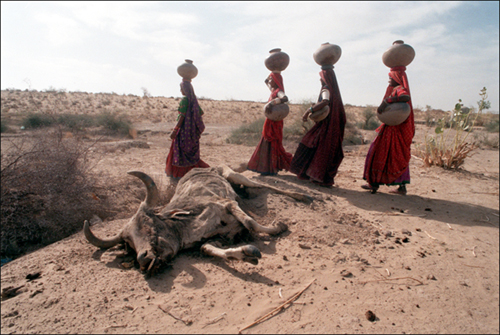
Above is a picture of a golf course in the middle of a desert. Take a close look, because when someday in the future you tell your grandchildren that at the beginning of the 21rst century, millions of liters of drinking water were used so that people could hit a little ball around in the middle of a desert with a stick, they are going to think that you have Alzheimer. DS
Much of U.S. Could See a Water Shortage - Associated Press
Abstract: An epic drought in Georgia threatens the water supply for millions. Florida doesn't have nearly enough water for its expected population boom. The Great Lakes are shrinking. Upstate New York's reservoirs have dropped to record lows. And in the West, the Sierra Nevada snowpack is melting faster each year. Across America, the picture is critically clear - the nation's freshwater supplies can no longer quench its thirst. The government projects that at least 36 states will face water shortages within five years because of a combination of rising temperatures, drought, population growth, urban sprawl, waste and excess. "Is it a crisis? If we don't do some decent water planning, it could be," said Jack Hoffbuhr, executive director of the Denver-based American Water Works Association.(...) "We've hit a remarkable moment," said Barry Nelson, a senior policy analyst with the Natural Resources Defense Council. "The last century was the century of water engineering. The next century is going to have to be the century of water efficiency." The price tag for ensuring a reliable water supply could be staggering. Experts estimate that just upgrading pipes to handle new supplies could cost the nation $300 billion over 30 years. "Unfortunately, there's just not going to be any more cheap water," said Randy Brown, Pompano Beach's utilities director.(...) Australia is in the midst of a 30-year dry spell, and population growth in urban centers of sub-Saharan Africa is straining resources. Asia has 60 percent of the world's population, but only about 30 percent of its freshwater. The Intergovernmental Panel on Climate Change, a United Nations network of scientists, said this year that by 2050 up to 2 billion people worldwide could be facing major water shortages.(...) Coastal states like Florida and California face a water crisis not only from increased demand, but also from rising temperatures that are causing glaciers to melt and sea levels to rise. Higher temperatures mean more water lost to evaporation. And rising seas could push saltwater into underground sources of freshwater.(...) "We just passed a crossroads. The chief water sources are basically gone," said John Mulliken, director of water supply for the South Florida Water Management District. "We really are at a critical moment in Florida history."(...) Californians use nearly 23 trillion gallons of water a year, much of it coming from Sierra Nevada snowmelt. But climate change is producing less snowpack and causing it to melt prematurely, jeopardizing future supplies. Experts also say the Colorado River, which provides freshwater to seven Western states, will probably provide less water in coming years as global warming shrinks its flow.(...) "The need to reduce water waste and inefficiency is greater now than ever before," said Benjamin Grumbles, assistant administrator for water at the Environmental Protection Agency. "Water efficiency is the wave of the future." READ IT ALL
Much of U.S. Could See a Water Shortage - Associated Press
Abstract: An epic drought in Georgia threatens the water supply for millions. Florida doesn't have nearly enough water for its expected population boom. The Great Lakes are shrinking. Upstate New York's reservoirs have dropped to record lows. And in the West, the Sierra Nevada snowpack is melting faster each year. Across America, the picture is critically clear - the nation's freshwater supplies can no longer quench its thirst. The government projects that at least 36 states will face water shortages within five years because of a combination of rising temperatures, drought, population growth, urban sprawl, waste and excess. "Is it a crisis? If we don't do some decent water planning, it could be," said Jack Hoffbuhr, executive director of the Denver-based American Water Works Association.(...) "We've hit a remarkable moment," said Barry Nelson, a senior policy analyst with the Natural Resources Defense Council. "The last century was the century of water engineering. The next century is going to have to be the century of water efficiency." The price tag for ensuring a reliable water supply could be staggering. Experts estimate that just upgrading pipes to handle new supplies could cost the nation $300 billion over 30 years. "Unfortunately, there's just not going to be any more cheap water," said Randy Brown, Pompano Beach's utilities director.(...) Australia is in the midst of a 30-year dry spell, and population growth in urban centers of sub-Saharan Africa is straining resources. Asia has 60 percent of the world's population, but only about 30 percent of its freshwater. The Intergovernmental Panel on Climate Change, a United Nations network of scientists, said this year that by 2050 up to 2 billion people worldwide could be facing major water shortages.(...) Coastal states like Florida and California face a water crisis not only from increased demand, but also from rising temperatures that are causing glaciers to melt and sea levels to rise. Higher temperatures mean more water lost to evaporation. And rising seas could push saltwater into underground sources of freshwater.(...) "We just passed a crossroads. The chief water sources are basically gone," said John Mulliken, director of water supply for the South Florida Water Management District. "We really are at a critical moment in Florida history."(...) Californians use nearly 23 trillion gallons of water a year, much of it coming from Sierra Nevada snowmelt. But climate change is producing less snowpack and causing it to melt prematurely, jeopardizing future supplies. Experts also say the Colorado River, which provides freshwater to seven Western states, will probably provide less water in coming years as global warming shrinks its flow.(...) "The need to reduce water waste and inefficiency is greater now than ever before," said Benjamin Grumbles, assistant administrator for water at the Environmental Protection Agency. "Water efficiency is the wave of the future." READ IT ALL