Wednesday, March 11, 2009

Mission improbable

Your mission, if you should choose to accept it is to save capitalism. This economy will self-destruct in 5 seconds
David Seaton's News Links
Universal health care, free university education for all, a more realistic foreign policy, freeing science from superstition... All of these Obama initiatives not only sound good, they sound wonderful, thrilling.

But somehow, at this moment, the new president and his government's lovely initiatives mostly remind me of the pediatricians and the nurses at a children's cancer ward organizing a big Christmas party... for the summer.

Aside from Santa Claus, the doctors don't know who else will still be around to decorate the tree, but at least thinking about the future goodies takes our minds off of our poor little, pale, bald heads.

For, truly, at this point it is not just "it's the economy, stupid", it is more like "it's the economy, dear Jesus".
Most Americans (53%) now think the United States is at least somewhat likely to enter a 1930’s-like depression within the next few years.(...) The most recent survey also found that half of all adults (49%) say today’s children will not be better off than their parents. Only 26% hold the more optimistic view, while another 25% are not sure. Rasmussen Reports
Even Obama-friendly commentators of impeccable professional qualifications like Paul Krugman are beginning to have serious doubts whether Obama and Geithner have the political will to do what it takes to save the economy from a depression.
Last month, in his big speech to Congress, President Obama argued for bold steps to fix America’s dysfunctional banks. “While the cost of action will be great,” he declared, “I can assure you that the cost of inaction will be far greater, for it could result in an economy that sputters along for not months or years, but perhaps a decade.” Many analysts agree. But among people I talk to there’s a growing sense of frustration, even panic, over Mr. Obama’s failure to match his words with deeds. The reality is that when it comes to dealing with the banks, the Obama administration is dithering. Paul Krugman: The Big Dither - New York Times
Here is how financial strategist David M. Smick put the cost of this "dithering" in the Washington Post:
Our present position is unsustainable. The longer we delay fixing the banks, the faster the economy deleverages, the more credit dries up, the further the stock market falls, the higher the ultimate bank bailout price tag for the American taxpayer, and the more we risk falling into a financial black hole from which escape could take decades.
Even Thomas Friedman chips in his two cents worth in his inimitable, "dwarf in the locker room" style.
Friends, this is not a test. Economically, this is the big one. This is August 1914. This is the morning after Pearl Harbor. This is 9/12. Yet, in too many ways, we seem to be playing politics as usual. Our country has congestive heart failure. Our heart, our banking system that pumps blood to our industrial muscles, is clogged and functioning far below capacity. Nothing else remotely compares in importance to the urgent need to heal our banks. Yet I read that we’re actually holding up dozens of key appointments at the Treasury Department because we are worried whether someone paid Social Security taxes on a nanny hired 20 years ago at $5 an hour. That’s insane. It’s as if our financial house is burning down but we won’t let the Fire Department open the hydrant until it assures us that there isn’t too much chlorine in the water.
It seems unanimous.
Treasury Secretary Timothy Geithner, who may be President Obama's biggest mistake, has not been able to inspire confidence or convince a frantically anxious public that he knows what he is doing. The man, whose TV personality is that of a slightly sneaky, know-it-all-ish technocrat, is overwhelmed and understaffed in what at the moment is the second-most-important job in the American government. Nicholas Von Hoffman - The Nation
None other than the great Roubini,
"also took issue with the $800 billion stimulus package, saying it's not enough. For one thing, there's only $200 billion upfront, and half of that is a tax cut, which Roubini calls "a waste of money" that is not going to make a difference."
The entire world is waiting, hoping and maybe some are still expecting that Barack Obama will wave a magic wand and everything will be alright. However it could very well be that Obama and his "good vibes" will be swept away by events. As Martin Wolf wrote in the Financial Times:
The ability of the west in general and the US in particular to influence the course of events will also be damaged. The collapse of the western financial system, while China’s flourishes, marks a humiliating end to the “uni-polar moment”. As western policymakers struggle, their credibility lies broken. Who still trusts the teachers?
The other night we had dinner with an old friend, an American lady, the widow of a Spanish architect, who works in the Spanish ministry of culture. Needless to say she is a passionate Democrat and an Obamite. She made an interesting observation about the financial crisis.

"Everything is so quiet..." she said, "In the run up to the war in Iraq, literally millions of angry Spanish people took to the streets to protest against the USA... but the war itself had little effect on the daily life of Spaniards. Now, in this economic crisis, which has its origins in America, it's as if the United States of America had personally dropped a bomb on every Spanish family... You'd think they'd be burning down the US embassy, but they aren't... not yet. It's kinda weird, when you think about it, isn't it?" she said. You betcha.


We have entered terra incognita.

Those of us who like to "think outside the box" are having trouble even
locating the box these days.

Reality has always been a moving target, but now it appears a moving hologram. The world may be so different in a year of two that its own mother wouldn't recognize it.

The only thing I'm sure of at the moment is that if things are ever going to get better they are going to have to get a helluva lot worse. Idols are falling, more must fall.

This crisis has radically changed the political landscape and the sudden loss of authority of what Martin Wolf calls "the teachers"
has opened the door for language and thinking to enter mainstream discourse, that only a few weeks ago would have been unthinkable.

"Populism" is a funny word. In the American media it usually has a pejorative connotation. But here is how Wikipedia defines it:
The word populism is derived from the Latin word populus, which means people in English (in the sense of "nation," as in: "The Roman People" (populus Romanus), not in the sense of "multiple individual persons" as in: "There are people visiting us today"). Therefore, populism espouses government by the people as a whole (that is to say, the masses). This is in contrast to elitism, aristocracy, synarchy or plutocracy, each of which is an ideology that espouse government by a small, privileged group above the masses.
Lula, the president of Brazil put it this way in no less than the Financial Times:
"I am not worried about the name to be given to the economic and social order that will come after the crisis, so long as its central concern is with human beings."
Nobel Prize winner, Amartya Sen went even a bit further in the New York Review of Books
The market economy has depended for its own working not only on maximizing profits but also on many other activities, such as maintaining public security and supplying public services—some of which have taken people well beyond an economy driven only by profit. The creditable performance of the so-called capitalist system, when things moved forward, drew on a combination of institutions—publicly funded education, medical care, and mass transportation are just a few of many—that went much beyond relying only on a profit-maximizing market economy and on personal entitlements confined to private ownership. Underlying this issue is a more basic question: whether capitalism is a term that is of particular use today. The idea of capitalism did in fact have an important role historically, but by now that usefulness may well be fairly exhausted.
A mainstream, Nobel Prize winning economist saying the usefulness of capitalism, "may well be exhausted"! The unspeakable is being spoken.

You, like me, may find this change of language and the new horizons it presents filled with hope, but you better believe
there are quite a few people who it is surely making terminally nervous.

As we noted last week, the people who stand to lose money, power and prestige through this sea change in the political mood are certainly not going to take these losses lying down.

I think that this is one of the lines they are going to take:
While the Obama administration seeks to improve America’s position vis-à-vis Iraq, Afghanistan, Israel-Palestine, Europe, and Asia, the most critical foreign-policy front of all – the home front—is looking brittle. This development is new, as for almost seven decades – ever since Pearl Harbor—policymakers have taken for granted that the homefront would cooperate with military missions and expenditures.(...) The fact that the public has docilely accepted this arrangement for so long does not mean that it will continue to do so. Despite the many new billions that President Obama’s budget allocates for jump-starting the economy, he intends to substantially cut the Pentagon’s money-line.(...) What I foresee is a more gradual siphoning of money away from vital programs over the next decade, even as China, India, and other countries enlarge their navies and other forces. This will not necessarily lead to a security dilemma for the U.S., but it will certainly lead to a multipolar world and the end of American dominance. The only development that could change this equation would be a new and sudden threat – and one other than mass-casualty terrorism."The Shrinking Superpower", Robert D. Kaplan, The Atlantic
Or this:
We are on the verge – within 10 years – of a major collapse of evangelical Christianity. This breakdown will follow the deterioration of the mainline Protestant world and it will fundamentally alter the religious and cultural environment in the West.(...) This collapse will herald the arrival of an anti-Christian chapter of the post-Christian West. Intolerance of Christianity will rise to levels many of us have not believed possible in our lifetimes, and public policy will become hostile toward evangelical Christianity, seeing it as the opponent of the common good. Michael Spencer - Christian Science Monitor
It is indeed a great blessing that the Soviet Union has disappeared. This disappearance at least makes true change possible. The presence of a rival superpower with an alternative economic system and ideology at this moment would mean that this crisis could only lead America farther to the right.

Seen this way the crisis couldn't have come at a better time.

As it is someday the United States may just be able to muddle its way through by sheer process of elimination into something more humane. DS

Wednesday, March 04, 2009

This is just starting...


David Seaton's News Links
The central issue in American politics now is whether the country should reverse a three-decade-long trend of rising inequality in incomes and wealth. E.J. Dionne Jr. - Washington Post

This budget says the Republicans had Mr Obama right all along. The draft contains no trace of compromise. It makes no gesture, however small, however costless to its larger agenda, of a bipartisan approach to the great questions it addresses. It is a liberal’s dream of a new New Deal. Clive Crook - Financial Times
President Obama proposes to raise the taxes of America's richest citizens, whose tax bill has been getting smaller and smaller for the last thirty years. This disagreeable prospect finds the political defenders of this wealthy minority, the Republican party, in a state of ideological collapse, with the prestige of the market economy and Reaganomics in tatters.

Now, in trying to forecast how this situation will play out I base a lot of my analysis on a assumption that many may find quite controversial or even unfair. This assumption, briefly stated, is as follows: that the possessors of huge amounts of money are, with many honorable exceptions, greedier and more ruthless in the acquisition and defense of their wealth than the average person is of his modest possessions and that they also have at their disposal many more tools to express these traits than the average person does.

As I say, many may find this characterization of the rich unfair, however if you take this assumption of mine as a given, it is safe to say that the wealthiest Americans are not going to take the prospect of paying more taxes lying down. They will fight hard and fight to win.

How will they fight?

Before continuing, I would like to make a short aside to remember something an old Spanish communist told me way back in the 1970s. He said, "David,
if the right ever called for a mass demonstration behind the slogan, 'Workers arise, defend the property of the wealthy!', nobody would come, maybe ten people might show up. So the wealthy have to call up mass movements to defend their interests behind the screen of, 'God and country' or even racial hatred".

How is that for teaching the ABCs?

For some thirty years, the American political conversation has been dominated by a strain of ideological conservatism that wields market fundamentalism as a sword and cultural populism as a shield. Hendrik Hertzberg - New Yorker
It is difficult to overstate the significance of this breakdown of faith in the market economy, because we are talking about transcendence. To have the economy collapse the way it is doing does not just mean material hardship, it is a "dark night of the soul" for many Americans.

It might sound like a crude joke, but for many Americans the line where capitalism ends and where Jesus begins has been steadily blurred and wrapped in the flag since the beginning of the "Cold War" and the "red scare" of the late 40s and early 50s. If you choose to consider that an accident or a coincidence, well it's a free country, isn't it?

Since the fall of the Berlin Wall this transformation of money making into a universal faith open to all, where everybody wins, has become worldwide. This can take paradoxical forms:
A couple of years ago, John Berger made a salient point apropos of a French publicity poster of the internet investment brokers' company Selftrade: under the image of a hammer and sickle cast in solid gold and embedded with diamonds, the caption reads "And if the stock market profited everybody?" The strategy of this poster is obvious: today, the stock market fulfils the egalitarian Communist criteria, everybody can participate in it. Slavoj Žižek - "The Undead Lenin"
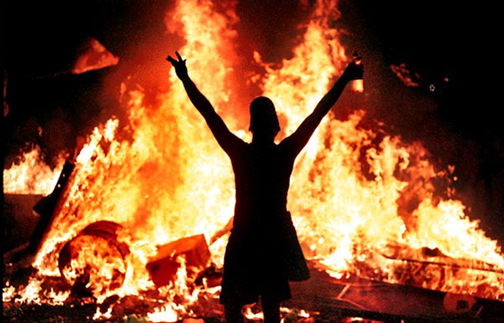
For a long time not only have the wealthy had their money practically untouched, they have been admired and encouraged to flaunt it. That era has crashed and is burning.

I wrote this in June 2007:
Millions of middle-middle class people who have been living in a dream world, thinking that were somehow part of the same universe as Bill Gates, are going to have to make drastic decisions about allocating their resources if they are not to lose their homes. They are going to re-discover why there was ever a universal demand for good, free public schools and universities or (in the countries lucky enough to have gotten that far) first class, free public health care in the first place. They will rediscover the nearness of the abyss of destitution and humiliation that terrified their parents and grandparents who lived through the Great Depression. As much as an economic and political readjustment, it will be a cultural change, for never before in history have so many "normal" people identified with the wealthy and considered them harmless or even benevolent.
The "sword of market fundamentalism" is broken:
President Barack Obama enjoys widespread backing from a frightened American public for his ambitious, front-loaded agenda, a new poll indicates. He is more popular than ever, Americans are hopeful about his leadership, and opposition Republicans are getting drubbed in public opinion, the new Wall Street Journal/NBC News poll suggests. Wall Street Journal
That leaves the "shield of cultural populism" as untrammeled wealth's last line of political defense: Jesus, fear and the flag. The shield can be couched in calm, reasonable language:
Even though Obama’s audacious agenda might provide short-term relief to the economic and social challenges that now beset us, over the long term the Obama revolution is likely to erode first the religious and then the civic and moral fabric of the nation. Undoubtedly, this is not the change religious believers who put their faith in Obama last November are hoping for from this president. But if the European experiment with the welfare state tells us anything, it tells us that this is the change we can expect from a successful Obama revolution. W. Bradford Wilcox - Witherspoon Institute
Or it can be the red meat on display at the recent Conservative Political Action Conference :
In an address at CPAC, former Arkansas Gov. Mike Huckabee compared Obama and the Democrats' agenda to that of the former Soviet Union. "Lenin and Stalin would love this stuff," Huckabee said. Market Watch - Wall Street Journal
The rage is close to the surface:
"What is so strange about being honest and saying I want Barack Obama to fail, if his mission is to restructure and reform this country so that capitalism and individual liberty are not its foundation?" (Rush) Limbaugh said at the Conservative Political Action Conference. Boston Globe
Probably the only card left to play with the economy in meltdown is the fear card and it certainly wasn't expressed subtly at CPAC conference:
Former UN Ambassador John Bolton believes the security of the United States is at dire risk under the Obama administration. And before a gathering of conservatives in Washington on Thursday morning, he suggested, as something of a joke, that President Barack Obama might learn a needed lesson if Chicago were destroyed by a nuclear bomb. Mother Jones
That is crazy talk, but that gives us a clear idea of the present fantasies of the neocons and we have certainly learned though painful experience that they are not people who are readily satisfied with just fantasies: they tend to act out.

By now, after eight years of Bush, I take these people seriously. There are at this moment a group of very well funded, well organized people who would rejoice if the United State suffered a huge terrorist attack or was dragged into a major war.

Armageddon is probably the last, best chance that the "Conservative Revolution" has of surviving and the only chance the super rich of America have of not ending up paying, what for them would seem, Scandinavian scale taxes.

They have plenty of potential disasters to choose from, for today's world is a "target rich" environment.

Finally the success of president Obama's "revolution" may well depend on the goodwill of the Communist Party of China and their endless purchasing of US debt, the cooperation of Vladimir Putin in Afghanistan and beyond, the passivity of the Ayatollahs of the Islamic Republic of Iran, the good faith of the Israeli Likud, which itself depends on the support of neofascist, Avigdor Lieberman... and of course, last of all, but not least of all, the acquiescence and quiescence of Al Qaeda.


Have I left anybody out?

The major challenge of progressives in the months and years to come will be to keep America out of war. DS

Wednesday, February 25, 2009

It's been a long time coming...

David Seaton's News Links
"We are in trouble today because we have allowed a culture of corruption and dishonesty to permeate our institutions and pollute our public discourse." Stephen M. Walt
Who would expect that such a noted "realist" in foreign affairs as Stephen Walt would say something so innocent. If only it were that simple. In reality the problem is systemic, not a result of individual or collective frailty.

As Daniel Gross wrote in Slate,
In the past few months, we've been riveted and disgusted by the exploits of scamsters like Bernard Madoff and Allen Stanford (characters who, if they didn't exist, would have to be invented by Tom Wolfe). It's both easy and convenient to hold them up as the ultimate symbols of the just-ended boom. But we shouldn't. While there was some crime in the mortgage industry, law-abiding, respectable, upstanding citizens caused the overwhelming majority of financial losses suffered thus far. Skeezy money managers and mobbed-up boiler rooms didn't create the economic catastrophe. It was visited on us by firms in the Dow Jones Industrial Average and S&P 500—companies that trace their origins back to the 1800s, run by graduates of Yale and Harvard. The people who blew up the system weren't anarchists.
That we are surprised and offended by the behavior of these supposedly "law-abiding, respectable, upstanding citizens" is itself a throwback to our pre-industrial past.

One of the most interesting insights of Eric Hobsbawm, perhaps the world's foremost living historian, is that early capitalism inherited from previous phases of civilization such as feudalism and the bourgeois revolution, a wealth of valuable social assets that were fundamental to its initial success.


Social and cultural assets such as thrift, the postponing of gratification, the importance of the family unit and even what the Bible calls "the fear of God" were fundamental in creating the "work ethic" that was essential to the early success of capitalism.


However important these values might have been to our capitalist system in its foundational moment, the system in itself is indifferent to them, for its only focus is on continuous and unlimited growth and profits.


When finally push comes to shove, if something cannot be qualified on a balance sheet it will be seen as irrelevant, often with great and wrenching regret for those involved in taking the decisions, for those among us who must decide are also inheritors of western civilization and its moral and ethical values... but the logic of the system is the master, not they: that logic must take precedence over their feelings of common humanity.

A created reality has become more real than flesh and blood.

If thrift, sacrifice, solidarity, the family or any other value comes into conflict with growth and profit, it is simply left to wither. That is how the lean and lanky, thin lipped, American puritan, with his calloused hands, was inflated to obesity and taught to shake his booty and shop till he dropped.

Thomas Frank's book,
"The Conquest of Cool" , will fill in some of the blanks in this process for my readers.

And unfortunately, the collapse we are living through right now, being systemic, an
organic crisis, has no easy remedy. Trying to stabilize an unstable system is just as likely to destabilize it further.

Intervening
in complex systems without complete knowledge is extremely perilous. It would be wise to be skeptical of stimulus plans and other remedies; unless those who intervene have the skill and knowledge of brain surgeons - economists don't - the cure will often be worse than the disease.

Jeffery Sachs (yes, the same man who once
nearly destroyed Russia while "reforming" it) wrote this in The Scientific American :
The U.S. political-economic system gives evidence of a phenomenon known as “instrument instability.” Policy makers at the Federal Reserve and the White House are attempting to use highly imperfect monetary and fiscal policies to stabilize the national economy. The result, however, has been ever-more desperate swings in economic policies in the attempt to prevent recessions that cannot be fully eliminated. President Barack Obama’s economic team is now calling for an unprecedented stimulus of large budget deficits and zero interest rates to counteract the recession. These policies may work in the short term but they threaten to produce still greater crises within a few years.(...) The lessons of the high inflation of the 1970s had supposedly chastened policy makers against trying to fine-tune the economy. The quest for never-ending full employment had contributed to high inflation in that decade, which required years of economic pain to wring out of the system. Monetary policies thereafter were supposed to be “steady as she goes,” not trying to smooth out every fluctuation and business cycle in the economy. During the decade from 1995 to 2005, then-Federal Reserve chairman Alan Greenspan over-reacted to several shocks to the economy. When financial turbulence hit in 1997 and 1998—the Asian crisis, the Russian ruble collapse and the failure of Long-Term Capital Management—the Fed increased liquidity and accidentally helped to set off the dot-com bubble. The Fed eased further in 1999 in anticipation of the Y2K computer threat, which of course proved to be a false alarm. When the Fed subsequently tightened credit in 2000 and the dot-com bubble burst, the Fed quickly turned around and lowered interest rates again. The liquidity expansion was greatly amplified following 9/11, when the Fed put interest rates down to 1 percent and thereby helped to set off the housing bubble, which has now collapsed. We need to avoid reckless short-term swings in policy.
Nobody is better qualified than Jeffery Sachs to know how tinkering can turn into tampering and how that tampering can destroy the lives and fortunes of millions.

What we are living today is perhaps history's most complete illustration of our "alienation": we are "strangers" to ourselves... every human being in the world has awakened at the same time to discover that everyone, everywhere lives in a system that we humans have created, but whose chaotic complexity has made it as uncontrollable as the weather and perhaps even less predictable.

Our economic system seems to be even more powerful than the weather, which it also seems to be destroying. It is certainly not our friend.


We are in no way its master, it is ours: we never have controlled it really, but this simultaneous, worldwide collapse brings that truth home and that is what is most unsettling about it. Our helplessness in the face of our "Frankenstein".


Like Gertrude Stein's, "a rose is a rose is rose", I would tell Professor Walt that, "We are in trouble today because we are in trouble today, because we are in trouble today".

That sense of helplessness is what is going to deepen and define this generation's sojourn: putting humanity back into the hands of humanity will be its challenge.
DS

Sunday, February 22, 2009

Sisyphus gets organized

David Seaton's News Links
There are different strategies for confronting the crisis.

Me, I use what Woody Allen calls "the old Indian trick", (crying and begging).

I am simply accepting all work of any kind that comes my way and that is within what is (still, for the moment) my usual pay scale.

The idea is that it can't (it certainly could) all dry up at the same time, inshallah.

Lot's of irons in the fire seems to me the best way of facing the multitude of uncertainties the present situation holds. What seems to be a wonderfully solid client can go belly up from one day to the next these days... better to have several.

Mister Micawber's strategy: "something will turn up" is only workable if you scratch around, chicken fashion, leaving no worm unturned.

This does have its price in wear and tear.

Since I began blogging, I have tried to write something nearly every day, but
I am getting the feeling that so much multitasking has recently been draining some of the quality out of my work.

This dawned on me the other day, when instead of a thought provoking observation about world politics, I posted a recipe for "tortilla española". It came to me as a revelation, "Davey old son, you are getting a bit punchy, time to get one's doodoo together. Method and organization are needed!"

Studying my schedule, I saw that Wednesday afternoon is when I have the most time available to devote to writing something decently researched, reasonably well crafted and with some solid analysis in it.

So barring flashes of irrepressible inspiration (and a few hours off) I shall endeavor to write a long weekly piece, for which I shall be making notes the rest of the week. I'll probably post this little polished gem on Wednesday evenings sometime around 20:30 hours (8PM) Madrid time.

I'll probably lose some readers with this, but I think that if I keep being reduced to posting recipes I would lose them anyway.

I thank you in advance for your kind understanding. DS

Thursday, February 19, 2009

Quote of the day: Zoellick's question

"What started as a financial crisis, became an economic crisis, is now becoming an unemployment crisis - and to what degree does it become a human and social crisis?" Robert Zoellick - World Bank president
David Seaton's News Links
"To what degree does it become a human and social crisis?"

That is the big question isn't it and a rather stupid one, if you think about it. It is as if economic problems and unemployment problems were not occurring among human beings and were not therefore automatically social problems in nature.

That the question could be glibly formulated in this way by the head of the "world" bank is surely part of the problem itself.

In Zoellick's question it seems implicit that finance and economics are like the weather, existing outside of humanity, with laws of their own instead of being human creations that, as humans have made them, humans can remake them... and are remaking them constantly.

That separation of economics from its human component is perhaps the most transcendental characteristic of the "conservative revolution", which appears to be collapsing around our ears at the moment. DS

Wednesday, February 18, 2009

Crisis: survival tips

Her Serene Majesty, the Tortilla de Patatas
David Seaton's News Links
Making it through the "lost decade" that appears to be waiting for us is surely going to be heavy going and in the hard scrabble of making ends meet, a person can work up a good appetite. Those who think they cannot live without large quantities of beef may look in their wallets and end up muttering, "yes we can".

How to eat well on a shoestring?

Today I'm going to introduce you to what is probably Spain's most popular dish, the "tortilla de patatas", which has nothing to to do with the Mexican cornmeal tortilla. "torta" means cake in Spanish and tortilla means "little cake" and patatas mean potatoes. So, we are talking about something cake-like made with potatoes and eggs and usually onions and sometimes green peppers or spicy, chorizo sausage, or even spinach. If you have ever eaten one, by now you are drooling all over your mouse.

This dish is simplicity itself, its success depends on the quality of the ingredients used and the care taken in preparing it. With practice a certain perfection can be obtained: moist, but not too moist, soft but not too soft, brown, but not too brown (sigh), which will astound you. How can something so cheap and so simple be so fine?

I have spent some time hunting around to find a decent tortilla de patatas recipe in English. Some of the American versions I came across were dead weird, with sour cream and ovens. But I finally came across the following orthodox Spanish tortilla recipe in Dean Derhak's page. With a few additions and subtractions of mine, here it is:

Ingredients:
1 cup olive oil
four large potatoes (peel and cut into small pieces about 2mm thick)
salt to taste
one large onion, thinly sliced
four large eggs.

Some people add thin slices of green pepper together with the onion. (or chorizo)

Heat the oil in a 9-inch skillet, add potato pieces, one slice at a time so that they don't stick. Alternate layers of potato and onion. COOK slowly, medium flame. DO NOT FRY!! Turn occasionally until potatoes are tender, but NOT brown. They must be loose, not "in a cake".

Beat eggs in a large bowl with a fork. Salt to taste. Drain potatoes. Add potatoes to beaten eggs, pressing them so that eggs cover them completely. Let sit for 15 minutes. Heat 2 tbsps of the oil in large skillet. Add potato-egg mixture, spreading quickly. Lower the heat to medium-high. Shake pan to prevent sticking (crucial step!!) When potatoes start to brown, put a plate on top skillet and flip to cook other side, adding another tbsp of oil. Brown on the other side. Can flip three or four times for better cooking. (Be careful to make sure that there is not too much hot oil left in the pan when you do the number of putting the plate on top of the skillet, turning the skillet upside down and then sliding the turned tortilla back into the skillet. If you are not careful the hot oil will roll right down your arm.)
This little miracle is usually eaten cold. It is great for breakfast with hot coffee or for lunch with red wine.

With the stomach thus taken care of, now for some music.

A few years back I discovered an online radio station that I dearly love, called "Jambalaya Jam", the creation of someone with the real down home name of Steven Polatnick, who provides round the clock music of all colors and kinds from the drowned city of New Orleans. I can listen to it for hours. It's free. Here is the link.

If you are short on cash to buy CDs and software, go visit the treasure house of search engine genius, Jimmy Ruska.

This is just a beginning. I hope readers will add to this short list of suggestions of how to get through hard times. DS

Tuesday, February 17, 2009

One day at a time

David Seaton's News Links
If you think reading me is a bummer, you should check out one of my favorite commentators, Gideon Rachman, chief foreign affairs columnist over at the Financial Times, who has turned out one of the bleakest and blackest futuristic fantasies going since, "Blade Runner" in today's piece, titled, "November 2012: a dystopian dream".

Here is a sample:
It is November 7 2012. At three in the morning, an exhausted-looking President Barack Obama appears before weeping supporters in the ballroom of the Chicago Hilton and concedes defeat. The euphoria of his victory-night speech in Grant Park four years earlier is a distant memory. The Obama administration has been overwhelmed by America’s economic problems. Sarah Palin is the new president of the US. Elected on a ticket of populism at home and nationalism overseas, President-elect Palin starts to take congratulatory phone calls from foreign leaders. First on the line is Avigdor Lieberman, the prime minister of Israel; then comes President Vladimir Putin of Russia. Five different leaders claiming to speak in the name of the European Union try to place calls – but they are all put on hold. As for the Chinese leadership, the new president is not speaking to them. How could she, after she has campaigned against the “communist currency manipulators of Beijing”?(...) The world event that had most damaged Mr Obama was Iran’s successful test of a nuclear weapon in 2011. The Republicans had hammered home their message that Mr Obama was “a second Jimmy Carter”, who had been duped by hopes of striking a grand bargain with Iran.(...) As the morning of November 7 wore on, President Palin herself took to the stage in Anchorage, Alaska. Her supporters cheered and waved ice hockey sticks. “I’ve got a message for the mullahs and the commies,” she roared: “America is back.”
The reason that this is so horribly funny... so horrible and so funny is that the probability of something like this coming to pass are quite high. The situation we are in at the moment looks very much like what is called in the Marxist jargon an "organic crisis" or to use Murphyist language, whatever can go wrong will (has already) go (gone) wrong, and at the worst possible time, in the worst (we hope it can't get worse) possible way.

The chances of all this turning out well, are very small, even if Obama were FDR, Abraham Lincoln and Laurel and Hardy all rolled up in one.


Assuming no financial regulators or bank chairmen are reading this post, none of
us brought this crisis on, but, as it always happens through the history of our system, we the fussvolk are going to end up paying for the broken crockery and holding the bag. In many ways, ours is the role of the proverbial mule caught in a hail storm... we have to just stand here and take it.
Man is distinct from all other animal species in that his needs have no limits and are completely elastic; no other animal can repress his needs in as extraordinary a way, and limit his conditions of life to such a minimum. Karl Marx - Capital
The only way that this ghastly mess can be made a "lemonade from lemons" situation is if it causes enough people do some very serious thinking about the system itself... and I am sure that is going to happen and in fact is already happening.

However, I am just as sure that there are many people, and not just the Rush Limbaughs of this world, that don't want all that thinking to lead to any significant change in the status quo.


The classic ways of interrupting this process of thought - pregnant with action - from leading to anything meaningful is for those who feel threatened by it to cultivate paranoia, xenophobia, nationalism and religious hysteria, all of which have often proven to have fertile soil in the USA.


As you can see, Gideon Rachman has covered that in his satire.


These, as the Chinese curse would have it, are interesting times.
The great danger arising out of this economic collapse is war. We have to be alert for that and denounce that and fight against that. Useful work I think. More useful than shopping till you drop. DS

Monday, February 16, 2009

More on the bright side

David Seaton's News Links
I am often accused of being a doomster but I am not. I read the horrid economic news with very mixed feelings: fear, compassion, self-pity and hopeful exhilaration are all combined.

The first three are easy for my readers to figure out. I'm sure many share one or all of them with me. The last one, hopeful exhilaration, may need some more explaining.

Let's have a sample of fully documented mainstream doomsterism. First this from Samuelson:
Since the early 1980s, American economic growth has depended on a steady rise in consumer spending supported by more debt and increasing asset prices (stocks, homes). Just as the mid-1980s signaled the end of Japan's export-led growth, the present U.S. slump signals the end of upbeat, consumption-led growth. But its legacy is an overbuilt and overemployed consumption sector, from car dealers to malls. The question is whether our system is adaptive enough to create new sources of growth to fill the void left by retreating shoppers.
And then this from Krugman:
If you want to see what it really takes to boot the economy out of a debt trap, look at the large public works program, otherwise known as World War II, that ended the Great Depression. The war didn’t just lead to full employment. It also led to rapidly rising incomes and substantial inflation, all with virtually no borrowing by the private sector. By 1945 the government’s debt had soared, but the ratio of private-sector debt to G.D.P. was only half what it had been in 1940. And this low level of private debt helped set the stage for the great postwar boom. Since nothing like that is on the table, or seems likely to get on the table any time soon, it will take years for families and firms to work off the debt they ran up so blithely. The odds are that the legacy of our time of illusion — our decade at Bernie’s — will be a long, painful slump.
Just a sample, and not of wild men like Kunstler or Orlov: these are Samuelson and Krugman talking, but they are talking real pain.

This incipiant pain reminds me of my favorite quote from Spike Milligan's legendary BBC radio, "The Goon Show",
(horrible, blood curdling scream in off) ARRRRRRRRRRRRRRGGGH!

Spike: "Listen, someone is screaming in agony... fortunately I speak it fluently."
I don't know if I'm alone in this, but almost everything important that I have ever learned in my now long-toothed life has been won with certain pain. I associate intense discomfort with the acquisition of valued knowledge. Mind you, I don't find suffering "redeeming" or even pleasurable, only instructive.

The elite School of Hard Knocks is finally opening its ivy clad halls to America's core, its heart: the great American middle class.

Both Samuelson and Krugman fear a coming "lost decade", however, instead of a "lost" decade, I see a the possibility of a decade of discovery, of restless interrogation, of world transforming consciousness. For the American middle class and its docile belief in its methods, myths and heroes is both the first victim and the principal instrument, the cutting edge, of the system and its failure. These bland, well meaning people are the vanguard. For the world to ever change they must change first.

I am exhilarated by the prospect of white bread, middle class, "normal" Americans finally beginning to seriously question their system. By this I mean Americans asking the same kind of questions that South Americans, for example, often ask themselves: "I am a hard worker and the land I live in is rich in raw materials of every kind... why am I poor?" And the white bread gringos finally coming to the same conclusion that our Latin cousins came to long ago: "because a infinitesimally tiny minority of the population, an astronomically wealthy few, who couldn't care less whether I or my children live or die, has arranged the world and its commerce and institutions entirely to their own benefit".

If it takes the American middle class ten years of being put through the jumps just to metabolize that, it will be a decade well spent, one whose praises their children and their children's children and the whole world will happily sing. For this is knowledge that has been in the possession of not just South Americans, but most of our planet's inhabitants for centuries untold. However, the day that middle class Americans, with tears and travail acquire it... the world will finally change. That is if they don't turn to fascism first, of course. DS

Friday, February 13, 2009

Nobody knows you when you are down and out


David Seaton's News Links
If you wanted to express the full meaning of the present situation in tight lipped, grim fashion, this might be it. The new director of America's national intelligence, Dennis C. Blair,
expressed concern about long-term harm to America’s reputation. The crisis that began in American markets has already “increased questioning of U.S. stewardship of the global economy”

Since the end of the Second World War the United States has been the guarantor of the world's market economy, which since the fall of the Soviet Union is the only "world economy".
Almost all, if not all, of the world's raw materials are priced in dollars which only the United States can print. This has meant, roughly, that the United States could go into the world's "supermarket" and pay with IOUs, redeemable with... more IOUs.

It is impossible to exaggerate the benefits that most Americans have derived from the US being able to write the rules of the game in its own behalf. At his moment, the "too big to fail" and "the only game in town" factors are literally the only things that are keeping a hollowed out American economy still on its feet.

Here is how it works: Luo Ping, a director-general at the China Banking Regulatory Commission, said that China would continue to buy Treasuries in spite of its misgivings about US finances: “We hate you guys. Once you start issuing $1 trillion-$2 trillion . . .we know the dollar is going to depreciate, so we hate you guys but there is nothing much we can do. Except for US Treasuries, what can you hold?” he asked. “Gold? You don’t hold Japanese government bonds or UK bonds. US Treasuries are the safe haven. For everyone, including China, it is the only option.” So we see that the ultimate repository of value, "the only option", the US dollar, that is a "fiat currency", meaning that there is nothing behind it except the reputation of the issuer, is increasingly being viewed as "funny money". This is the slipperiest of all possible slippery slopes.

This has only worked till now because the world has believed (imagined?) that the USA was a "serious" country. That has all changed in only a few months. Now the United States, to use the words of a great American, has "screwed up"... big time.
The American financial system, the core of the world financial system, has proved to be an enormous, fraudulent pyramid. Bernard L. Madoff's face, not George Washington's, should be on the dollar bill.

This will be the most important, long term effect of this crisis on the lives of Americans and it will be for generations to come, to the same extent that America's financial centrality has splendidly benefited preceding generations.


The bottom line might be:
"Ye are the salt of the earth: but if the salt hath lost his savour, wherewith shall it be salted? it is thenceforth good for nothing, but to be cast out, and to be trodden under foot of men." Matthew 5:13
You can bet that at this very moment some of the finest financial minds in the world are trying to figure out how to escape from the grip of the toxic dollar without bringing the entire shebang down on their heads.

When they hit upon a solution, this will mean that Americans will have to find something else than dollars to pay their debts with, just as today the Argentinians have to change their shaky pesos into dollars to pay their debts: which is something that has impoverished what was once one of the world's most prosperous nations and made their legendary standard of living a haunting memory.


In short, what was not long ago America's most powerful instrument, its currency's universal value, is now its greatest vulnerability and a string that its rivals will use to pull and jerk it around with at will.

Americans are a very proud people. I cannot predict how they may react to this sudden loss of wealth, standard of living, self-respect and reputation, but I doubt if it will be pleasant. DS

Tuesday, February 10, 2009

Looking on the bright side


People learn quickly. As Lenin recognized: they can learn in 20 days what they forgot in 20 years. Richard Gott - Guardian

When Confucius was asked what the first thing he would do if he were named Emperor was, he replied, "I would clarify the language".

David Seaton's News Links
The longer I hang around on this planet, the more sense Confucian "clarification of language makes" to me.

Contemporary American English is especially treacherous in this regard. In the USA a lover may be known as a "significant other" or even as a "partner": as if all the rumpypumpy was happening in a law office or a hardware store. In this slippery dialect problems aren't called problems, they are called "issues" and child molestation is called "inappropriate behavior"... it goes on and on.

In the world of politics, the horror of plain speech, the effort to verbally cloud, obfuscate and confuse goes to truly Orwellian lengths. Thus, the world wide, historical and universal color of revolutionary socialism: red, is used in America to denominate reaction... as in "red state". So in contemporary American English a "red state" is not Cuba or Vietnam, it is Texas or Oklahoma. In Texas the song isn't "The East is Red", it's "The East is Blue".

So naturally, in the USA, this Alice-less wonderland, Marx, instead of being associated with the struggles of the working class, is much more likely to be associated with white wine and Camembert cheese: "elitism" is of course the word used to describe political agitation in favor the less fortunate. Thus certain otherwise extremely useful terms associated with Marx may sound a trifle exotic, indeed dangerous to most American ears.

Two terms that I'd like to fling carelessly around today are "use-value" and "exchange-value." Technically accurate definitions of these terms can be found here and here.

To bring home some of the intrinsic meaning contained in these concepts and to make them more "real", I would give the following example. Imagine you are a graduate engineer, who speaks four languages with an MBA from Harvard. You are a hard worker with many skills and much knowledge, all of which may be very useful to yourself or to friends and family or to anyone who comes up and asks you, solving problems and devising strategies to improve the quality of life. This might be a loose definition of your use-value, just as the walls and the roof of your house keep out the wind and the rain and give you shelter and home, which is its basic use-value.

However, until you take your skills or your house to the market and try to sell them, they have no "exchange-value". They will acquire that value and become a commodity when they are exchanged for a "universal medium of exchange" (read money). In the well oiled, smoothly functioning capitalist system that the United States embodies as no other, the conversion of "use" to "exchange" is normally so fluid, so automatic, that many may have spent their whole lives confusing the two and thinking that something that isn't a commodity, which cannot be exchanged for money, has no value, is of no use... useless.

This automatic identification of usefulness and exchange-value tends to fray in a depression. You as a graduate engineer with an MBA may find yourself out of work with few immediate prospects of finding any. You know you are still a useful person, but now you have no exchange value because the system finds you useless. The collapse of the financial system and with it much of the the power to exchange means that many people are going to find themselves in the place of our imaginary engineer or are already there. When the system of exchange breaks down the useful - people and things - become useless. Useless houses rot and so do useless people: for people this is painful. When you begin to feel useless the system is destroying you.

In 2002, when the following text by Slovenian philosopher Slavoj Zizek was written, many who stumbled upon it would have dismissed it as so much elitist mumbo jumbo. Read in the light of the present deepening crisis, its relevance jumps out at the reader. Just in case some readers find it a little heavy going, I have taken the liberty of highlighting some of Zizek's words in boldface. Adjusting for the jargon and the technocisms, try this on for size:
"Marx located the elementary capitalist antagonism between use- and exchange value: in capitalism, the potentials of this opposition are fully realized, the domain of exchange value acquires autonomy, is transformed into the specter of self-propelling speculative capital which uses the productive capacities and needs of actual people only as its dispensable temporal embodiment. Marx derived the very notion of economic crisis from this gap: a crisis occurs when reality catches up with the illusory self-generating mirage of money begetting more money- this speculative madness cannot go on indefinitely; it has to explode in ever stronger crises. The ultimate root of the crisis for Marx, is the gap between use-value and exchange value: the logic of exchange value follows its own path, its own mad dance, irrespective of the real needs of real people." Salvoj Zizek - Revolution at the Gates
So that is the situation we are presently facing. People who know how to work hard and love to work hard will have no work. Powerful machines will sit idle and rust and so will powerful minds and hearts.

There is a bright side to all of this: lucidity has its price, but once acquired it is priceless. Perhaps Americans will finally learn again to call things by their real names. DS

Saturday, February 07, 2009

Looking at the crisis from Spain


“Courage is grace under pressure.”
Ernest Hemingway

David Seaton's News Links
The most significant thing about the financial crisis, up till now, is that it is universal.

Something with its origins in the US financial sector has hit the entire world economy and the numbers are horrible everywhere. Millions of people are suffering from the effects of an economic philosophy and ideology that was hatched in America's nest, just as those same millions enjoyed the economic boom that nest and philosophy produced, until the bubble burst.


For the first time in history we are all sailing in the same leaky boat.

Spain in no exception. Their wish to be a major player and to end the long isolation Franco brought upon them has been amply granted, for good and for bad.

I have known the country in austere and dignified poverty and as out of the world as Tibet and now, only a few years later, its banks are considered the best run in the world, its film directors and actors win Oscars, and Spanish athletes like, Miguel Indurain, Rafa Nadal, Pau Gasol and the European champion national soccer team have lifted the self confidence and self esteem of all the younger generations.

The Spanish people have taken full advantage of the opportunities a fortunate economic and political context have brought their way and now the best nourished and best educated young people in Spain's history will face a crisis which pales in comparison with what their much less educated and less well nourished grandparents faced with such fierce stoicism in the 1930s.

Spain is not a continental power like the United States with its huge population and endless natural resources, but neither is it Iceland or the Ukraine: Spain is being hit hard, very hard. However I would argue that Spain is a country, a society, that as they say in boxing, can take a punch. I have personally seen Spain take quite a few.

I have seen three really bad recessions here: at the end of the 70s after Franco's death, with double digit inflation, in the late 80s when 50 banks had to be nationalized and at the beginning of the 90s with unemployment as high as 24%... and life went on just the same. I was living entirely on the local economy by then and the good humored "grace under pressure" and lack of self-dramatization of the average Spanish person in times of economic catastrophe made the deepest of impressions on me.

Looking for the formula I came to this, not terribly original conclusion: the Spanish extended family is probably the country's greatest resource in troubled times.

The closest friends of most adult Spaniards I know are their brothers, sisters and cousins, closely followed by people they went to grade school through university with. This correlates with the extreme reluctance most Spanish men and especially their wives, have for moving to another town, even if there are better jobs waiting for them there, since this would mean losing their family social network. If you marry a Spanish girl you can go and work anywhere in the world as long as she can eat lunch with her mother and sisters at least twice a week.


This lack of work force mobility creates several percentage points of normal Spanish unemployment. That is the downside, the upside is the strength of the social fabric.

Spanish social life is an endless round of weddings, baptisms, first communions, pub crawls with friends and late dinners with lively conversation into the small hours over the ruins of a copious, well irrigated, meal. High consumption of hard goods and services adds to the charms of this existence based on eating and drinking with family and friends you've known since childhood, but cutting back on it all doesn't affect the basic underpinnings of this extended family life.

There is just as much pain as anywhere else in Spain when jobs are lost and payments fall behind or mortgages are foreclosed, but in Spain there are many shoulders to cry on and helping hands to turn to. And if you haven't lost your job you are supposed to help family, through the cousins by the dozens, that have.

If we add to this social fabric a modern, universal health system of socialized medicine, where no one, adult or child lacks for a free family doctor, hospitalization, pediatrician etc, even if unemployed, then it is obvious that the stress levels of a Spanish recession are very different from those in the states or even socially advanced northern Europe, where, like the states, nuclear families or single parent families are the rule.

In short people here are not alone for a minute of their lives and not afraid of getting ill, they are usually surrounded, practically suffocated, by their family and childhood friends. I imagine that not a few of my readers could get a little wistful thinking that proposition over.

So, summing up: this recession is going to be hard on everyone, everywhere, for a long time. The traditional Spanish family and social values were developed for hard times: Spain, through its history has rarely known any others. Coming into this universal mess, Spaniards are healthier, better nourished and better educated than they ever were before.

In a universal recession/depression, where there is nowhere to run to, nowhere to hide, there are a lot worse places to ride it out than Spain. DS

Friday, February 06, 2009

A political cartoon from Spain

"They are against protectionism, but wherever they go they are always surrounded by bodyguards"
David Seaton's News Links
Andrés Rábago, who signs "El Roto" (the broken one) is more than a political cartoonist: his drawings are brilliant, tiny, essays in the bitterest traditions of the blackest, Spanish, anarchist humor.

The one I have chosen today is especially poisonous.

Enjoy! DS

Wednesday, February 04, 2009

Let's not dramatize Daschle


The California Energy Crisis - Wikipedia
The 2004 release of transcripts of taped conversations among Enron electricity traders in the summer of 2001 revealed that company insiders not only knew they were stealing from California and other states, but gloated about it. (...) At a time when streets in Northern California were lit only by head lights, factories shut down and families were trapped in elevators, Enron Energy traders laughed:
"Just cut 'em off. They're so f----d. They should just bring back f-----g horses and carriages, f-----g lamps, f-----g kerosene lamps."
David Seaton's News Links
I don't want to dramatize the Daschle affair, it's just another drop in the boundless ocean of America's ongoing Satyricon.

The decadence of a society is a very mysterious thing. Many people recognize it, denounce it, rail against it; finally even a majority of its members might acknowledge it, but somehow, seeing it, recognizing and denouncing it doesn't change it. Decadence doesn't come about overnight, it is chaotic in its complexity and may go on a long time and rarely ends painlessly.

I suddenly became very pessimistic about the direction the USA was taking way back in the California electricity crisis that lasted from May 2000 to September 2001. I intuitively felt/feel that everything followed out of that: Enron, Iraq and all the ensuing Katrina and financial drek.

The California energy crisis was soon forgotten in the drama of 9/11, but for me it was more significant then the attack on New York and Washington.

9/11 was basically imperial blow back as if Sitting Bull and Crazy Horse could have raided Wall Street with a Sioux war party in the 1870s.

However, the California energy crisis was about a group of highly trained and skilled, educated, pampered Americans, 'masters of the universe' who had banded together to cripple America's most important state. This was terrorism truly worthy of Guantánamo.

I suddenly had the feeling that America was an empty shell.

The only way I can describe the feeling I had/have was that the USA had/has lost its Dharma.

Bush was for me only a symptom, never a cause.

Trying to pin it all on Bush is to distract attention from the hollowing out of a society. Bush had the merit of his clumsy inarticulateness, a magic buffoon who let people get a glimpse, a whiff, of how things really were.

The American people have now pinned their hopes on Barack Obama, who is no buffoon, magic or otherwise.

Can the new president fix it?

In Hindu mythology Rama restored Dharma and initiated the golden age of "Ramaraj"

Here copied and pasted from Wikipedia is a wonderfully condensed resume of the monumental Ramayana:

Rama's life and journey is one of perfect adherence to dharma despite harsh tests of life and time. For the sake of his father's honour, Rama abandons his claim to Kosala's throne to serve an exile of fourteen years in the forest. His wife, Sita and brother, Lakshmana being unable to live without Rama decide to join him, and all three spend the fourteen years in exile together. This leads to the kidnapping of Sita by Ravana, the Rakshasa monarch of Lanka. After a long and arduous search that tests his personal strength and virtue, Rama fights a colossal war against Ravana's armies. In a war of powerful and magical beings, greatly destructive weaponry and battles, Rama slays Ravana in battle and liberates his wife. Having completed his exile, Rama returns to be crowned King in Ayodhya (the capital of his Kingdom) and eventually becomes Emperor of the World, after which he reigns for eleven thousand years – an era of perfect happiness, peace, prosperity and justice known as Rama Rajya.
Alas, we are not Hindus, today's crisis is not mythological, Washington is not Ayodhya, we don't have eleven thousand years and, if the Daschle affair is any measure, I'm afraid Obama is no Rama. DS

Tuesday, February 03, 2009

The tax farce


"Rule of all without rule of oneself would prove to be as deceptive and disappointing as a painted toy-mango, charming to look at outwardly but hollow and empty within." Conquest of Self - M.K. Gandhi

President Obama’s choice for the position of chief White House performance officer has withdrawn from consideration for the post, an administration official said Tuesday, after coming forward with concerns about her tax returns. New York Times

Thomas A. Daschle, President Obama's choice to be secretary of Health and Human Services, has withdrawn his nomination, White House officials announced shortly after noon. Daschle cited the distractions that followed his failure to pay all of his taxes in recent years. Washington Post

Obama is off to a very shaky start. The belief that he is ready to push for a fundamental remaking of America has weak evidence in its favor, despite his intelligence and his intellectual openness. The United States is getting good grammar. It needs bold remaking. Immanuel Wallerstein
David Seaton's News Links
Gee, that didn't last long did it?

As skeptical as I have often been about Obama, I admit that the last place I ever expected him to trip up was on something sleazy like this.


The word was that everyone being considered for even minor positions in the Obama administration was being exhaustively vetted, gone over with a fine tooth comb, held up to the light like a dangling chad...

It has been my experience that one of the first things that those doing vetting normally want to look at are people's tax returns. Official financial records are usually the easy part, looking under rocks for the nasty stuff comes much later. So, I think that it would be fair to say that failure to check simple information concerning important, cabinet level, nominations is indicative of extremely poor staff work, wouldn't it?

I've been away so long, somebody tell me: are America's tax laws now like those curious old laws against sodomy and miscegenation that used to be on the books in the south? If this is so, then what is all the fuss about? I'm sure that Obama could nominate someone who was openly gay to a cabinet position without it being a problem. Why not a tax evader?


Of course the comparison is absurd: obviously public officials are supposed to obey the laws that they pass and are sworn to enforce. The state lives from the taxes it collects, so paying taxes is fundamentally important for anyone who aspires to public life and not just a question of personal taste like an individual's sexual orientation.

I always expected Obama to come up hard against reality in places like the Middle East, Afghanistan and, of course, on the economy, but not on something as idiotic as this.

The staff work has been so lousy on this that I fear we are only looking at the tip of an Iceberg here.

I wonder what the Obamese equivalent of "
heckuva job Brownie" will turn out to be? DS