Saturday, June 28, 2014

The "Piketty Effect" or the "One-Percent" can be harmful to your health

Collage - David Seaton
"Anybody who reads the newspaper will be aware that, in the United States, the “one per cent” is taking an ever-larger slice of the economic pie. But did you know that the share of the top income percentile is bigger than it was in South Africa in the nineteen-sixties and about the same as it is in Colombia, another deeply divided society, today? In terms of income generated by work, the level of inequality in the United States is “probably higher than in any other society at any time in the past, anywhere in the world." Thomas Piketty - quoted in The New Yorker
I don’t want some rich person’s mansion or bank account. I just don’t want to pay for them with our schools and roads and postal service. Marym in IL- Firedoglake

While mulling over the huge impact of Thomas Piketty's book,"Capital in the Twenty-First Century", I got this nagging feeling that I had been here before, that this was so familiar, but I couldn't put my finger on what it was... 

Then it came to me... This is like when it was statistically proven that smoking causes cancer, and then a shockingly cancer ravaged, near death, much loved, proverbial chain smoker, John Wayne, showed up on that Oscar night in 1979... Only this time, in the case of the side-effects of inequality, the sequence has been reversed: first we are ravished, then near death and then we get the explanatory statistics.

However, I find the similarities striking: an enormous "public-relations" industry, including (massively) Hollywood, devoted over decades to convincing millions of men, women and children that something useless, expensive and totally harmful, was not only not harmful, it was "cool".

Finally the statistical evidence combined with the sight of iconic personalities wasted by the smoking habit has brought about a sea change in public opinion, which has caused millions of people to give up the habit or never start smoking in the first place and forced the passage of stringent legislation, bucking the efforts of big tobacco, one of America's most powerful lobbies.  
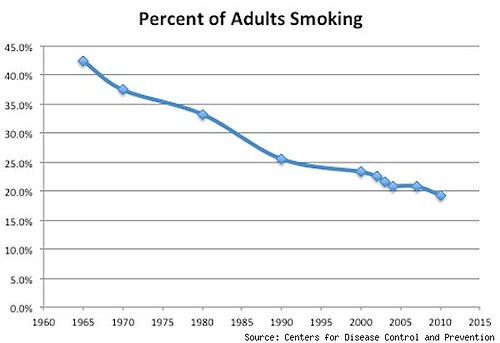
Today, far from being seen as cool, smokers are forced to huddle pitifully outdoors in the dead of winter, to get their "fix". 

Statistical evidence combined with raw emotion caused this massive change in public opinion. 

Does this mean that thanks to the ravages of the financial crisis and the findings of professor Piketty we  are going to see pitiful, former billionaires huddling on America's sidewalks anytime soon?

I wouldn't hold my breath waiting for it.

What we are going to see, I think, is an enormous, tectonic conflict between the sea change of Piketty empowered public opinion and the enormous power of the one-percent to corrupt the political process, which will dwarf anything that the tobacco lobby could ever have even dreamt of. DS

Sunday, June 22, 2014

Notes on the new populism


Classic left wing parties are missing the boat today, almost to the point of irrelevance,  because the traditional "working class", which was their power base, has been largely fragmented and is now practically powerless as the enormous "reserve army of labor" that globalization provides means that the worker´s principal weapon, withdrawing their labor, is no longer effective, increasingly even in skilled or jobs requiring higher education: if an American legal assistant is expensive, get an Indian lawyer in India to do the paperwork at a tenth the price per hour. But this has a certain "death spiral" effect.

The"killer contradiction" today is that while workers are no long needed more and more consumers are. Globalization has also brought on overproduction, a glut of consumer goods flood the markets.

How are unemployed or underemployed formerly middle class people, brought up on the idea of their right, even duty to consume, consume? Credit? Been there, done that.

So the real "revolutionary protagonist" today is the
enormous, but increasingly declassé and naturally resentful middle class that was created before globalization. Some sort of populism,  "us against the one-percent" is the only possible progressive game in town now. 

The challenge is to keep this populism international, progressive and not nationalistic-racist, reactionary etc. 

That is why Thomas Piketty work, "Capital in the Twentyfirst-Century" is a great help, especially among statistic loving Americans, in building objective political consciousness in the middle class for this struggle, which is really just beginning. DS

Friday, June 20, 2014

Groundhog day in Iraq and... you name it

Onward and upward
Sometimes, when you get older you get what Yogi Berra called the "dejá vu all over again" feeling while observing life and especially world affairs; a little like an usher in an all day movie theater might get... the moviegoers are glued to the screen to see if the hero gets the girl or the bad guy gets his just desserts, while you who have seen this film a dozen times or more before are pulling back curtains, opening doors and spraying air freshener... From Vietnam through Iraq and back to Iraq... from 1964 to 2014: 50 years of my life watching, the drip, drip, drip, of useless bloodshed, death and stupidity...

Perhaps the time has come to put on a saffron robe, take up a begging bowl and retire to a forest hermitage to contemplate my navel or maybe just take a big dose of fruit salts. DS

Sunday, June 15, 2014

Chutzpah, thy name is Tony Blair

Nobody here but us chickens boss
In a defense of his actions in Iraq, Blair attacked as "extraordinary" any notion the country would be stable if Saddam Hussein had stayed in power. (...) Tony Blair has strongly rejected claims that the 2003 US-UK invasion of Iraq was to blame for the current crisis gripping the country, pointing the finger instead firmly at the Maliki government and the war in Syria. In a passionate essay published on his website, the former prime minister said it was a "bizarre" reading of the situation to argue that the US-British invasion of Iraq had allowed the growth of Sunni jihadist groups such as the Islamic State in Iraq and the Levant (Isis), whose fighters have swept through towns and cities north and west of Baghdad over the past week. "We have to liberate ourselves from the notion that 'we' have caused this. We haven't. We can argue as to whether our policies at points have helped or not: and whether action or inaction is the best policy. But the fundamental cause of the crisis lies within the region not outside it Guardian

Leo Rosten in The Joys of Yiddish defines chutzpah as "gall, brazen nerve, effrontery, incredible 'guts,' presumption plus arrogance such as no other word and no other language can do justice to." In this sense, chutzpah expresses both strong disapproval and condemnation. In the same work, Rosten also defined the term as "that quality enshrined in a man who, having killed his mother and father, throws himself on the mercy of the court because he is an orphan." Chutzpah amounts to a total denial of personal responsibility, that renders others speechless and incredulous ... one cannot quite believe that another person totally lacks common human traits like remorse, regret, guilt, sympathy and insight. The implication is at least some degree of psychopathy in the subject, as well as the awestruck amazement of the observer at the display. Wikipedia
Today I am speechless: enjoy. DS

Monday, June 09, 2014

Interregnum... after the ball was over

This week William Hague, Britain’s foreign secretary, told the inaugural London Conference hosted by Chatham House that the world was not simply going through a difficult patch, but had entered a period of “systemic disorder”. Financial Times

Nowadays, both advanced economies (like the United States, where unlimited financing of elected officials by financially powerful business interests is simply legalized corruption) and emerging markets (where oligarchs often dominate the economy and the political system) seem to be run for the few. For the many, by contrast, there has been only secular stagnation, with depressed employment and stagnating wages. Nouriel Roubini
The crisis consists precisely in the fact that the old is dying and the new cannot be born; in this interregnum a great variety of morbid symptoms appear. Antonio Gramsci

After the ball was over
Nellie took out her glass eye
Put her false teeth in water
Corked up her bottle of dye
Put her false leg in the corner
Hung up her wig on the door
And all that is left goes to bye byes
After the ball
After The Ball Was Over
What kind of animal are we talking about?
I have to admit that I'm getting bored, but bored as combat soldiers get bored, where fear and boredom mix. Bored with the "systemic disorder" of the "interregnum", the randomness, chaotic entropy of it, which defies rational ordering or analysis: anxiety without any horizon.

At the bottom there is something very simple: when they asked the legendary Willie Sutton why he robbed banks he replied, "because that is where the money is". The money is in tax-havens and it must be taxed and redistributed if humanity is going to have any chance of a "human" future.
It would seem much more useful, in terms of building the capacity to address the environmental crisis, to frame the issue of the environment as linked to a broader struggle that includes the redistribution of income and wealth to more equitably share the costs of environmental restraint; a cultural shift in the balance between individual consumption of goods and collective services; the development of public spaces and desperately needed infrastructural renewal (including mass transit); and the conversion of potentially productive facilities rejected by the market to the production of socially useful and environmentally necessary products and services. Such a framing would also tie the environmental crisis to the obvious need to place democratic planning on the agenda and go so far as to start talking about making private banks into public utilities so that we have access to the financial resources to carry out the above initiatives. Sam Gindin - Jacobin
Alas, who is going to ever bell this cat? DS

Monday, June 02, 2014

Losing it.....

Please pardon me quoting myself, but...
My clearest reading of 2014's tea leaves is "instability": worldwide instability and in my opinion this instability has its origins at the heart of the most developed economies of the western world. The causes? We are undergoing a technological revolution and process of globalized outsourcing, combined with a reduction of the welfare state that is severely degrading the middle class in developed countries and converting them slowly, but surely into working-poor. Anyone who has read a bit of history could tell you how dangerous that is. Newslinks - 2014 and Welcome To It
On top of that, like whipped cream, I would put the following from today's Financial Times
Economic forecasters have yet to internalize the fact that the US economy has fundamentally altered. The purchasing power of the majority of Americans has not only stagnated since the recovery began five years ago – it has actually declined. Edward Luce - Financial Times
 And on top of that, like a maraschino cherry, this from no other than His Holiness the Pope:
Populism in Europe, trust and mistrust, some theories about the Euro ... I don’t know much about this kind of thing. But unemployment is serious: we have a global economic system that is centered on money, not on the human being. In order to keep going, this system discards things. It discards children: birth rates are not high, in Italy the average couple has less than two children and in Spain even less. It discards the elderly, even through euthanasia in disguise, medicine is only administered up until a certain point. And young people are discarded too.  I think unemployment among Italy’s young is 40%, in Spain it’s 50%, in Andalusia, 60%. There is an entire generation of people that is not studying or working. This culture of waste is very serious. Europe is not the only place where it exists, but it is strongly felt in Europe. It is an inhumane economic system. Pope Francis
Spain, where I live, is not anywhere near collapsing, but the conditions that the Pope mentions are leading to some of the most coherent, practical, active, alternative politics that I have ever seen:
Until recently, it appeared that the Spanish indignados movement had fizzled out. But on Sunday evening, a fledgling party born from its ashes proved otherwise, winning five seats and 1.2 million votes in Spain's European elections. - The Guardian
The name of the new party is "Podemos", which most translate as the first person plural of the verb "poder", "We Can", but Spanish speakers notice that podemos is also the subjunctive, first person plural of the verb "podar" (to prune) or "Let's Prune". 

The elections were on Sunday the 25th of May

I suppose it's just a coincidence, but the King of Spain has abdicated exactly one week later.

How has technology caused so much pain and confusion?

At the bottom of it is the enormous increase in productivity brought on by information technologies. We simply produce much more than we can possibly consume: we need lots of consumers and much fewer workers.  How are underemployed people supposed to buy anything? On credit. Something has to give, has given.

With lower costs and more technology, profits rise and much of this gain is reinvested in more productivity-raising technology, which makes more skills and the people who have them redundant. This means, perversely, that more profits usually lead to less jobs or much poorer jobs. This paradigm, which until recently only held true for the poorly educated, is now reaching the ranks of university graduates. Now, with digital technology, even high intellectual output tasks can be outsourced to where people with postgraduate degrees can be hired for the same cost per hour as high school graduates in a developed country.

Result: As more money is invested in raising productivity, fewer and fewer people can produce more and more for a market glutted with products that fewer and fewer people can afford to buy without going into debt.

Salaries don't rise because most workers are not really needed that badly and are easy to replace if they go on strike, complain or even report in sick.. and thus they have no bargaining power. Any shortages such as one resulting from low birthrate in developed countries can be solved by outsourcing the jobs to poorer countries with high birthrates.

All people are really required to do is to buy many things that they don't really need, which they can do, even with a McJob, by using a credit card... hereby kicking the can into the future: a future with poorer paying jobs, less horizon, more need of credit to participate, with less chance of ever paying back the debts incurred.

To make underpaid workers buy things that objectively they don't need, an entire industry (marketing) exists to make them dissatisfied with what they already have. Perversely, unhappiness becomes a social good in such an economic arrangement. A thrifty person, content with his lot, who for thousands of years was seen, in all traditions, as a wise and sensible man; in this contemporary situation is seen as a public enemy to be "stimulated". 

As to what the contributions technology and advanced communications might make to improving America's economy, awhile back I read Fareed Zakaria's, "The Post American World", where Zakaria writes about advances in nanotechnology:
At some point in the future, or so I'm told, households will construct products out of raw materials, and businesses will simply create the formulas that turn atoms into goods.
The idea is that you put some powder you order on the Internet into a washtub, add water and out walks a TV set, thus putting millions of Chinese people out of work.

Whether this ever happens or not, the fact that somebody might think it was a good idea and that a lot of money was being invested in making it happen would have to put you on your guard a bit: it's the thought that counts.

In a sense our entire "civilization" is sort of a universal "Ponzi scheme". If the wheel stops even for a moment it all comes tumbling down.

It's amazing that a structure this artificial, that fills so few truly human needs, has taken so long to nearly collapse.

What will collapse, if it ever comes, look like?

The best metaphor, the most poetic illustration of political collapse that I have ever seen is the video below this piece: Rumanian dictator Nicolae Ceausescu's last speech, a man of absolute power for decades, only a matter of hours before being shot. In itself, like a perfect work of art it shows in less than ten minutes a process that in a country as marvelously structured as the USA might take more than twenty years, if it happened at all.

I think that America's system is so well carpentered that if it ever collapses it will appear till the last moment like a termite-ridden piece of furniture: absolutely normal looking till someone or something puts too much weight on it. DS


Wednesday, May 14, 2014

What is really behind the Ukraine crisis

Russia's reaction to the move to overthrow Ukraine's government, take it into the EU and from there, probably into NATO was the most predictable thing in the world, just the sort of thing that George H.W. Bush, Kohl, Mitterrand and yes, even Margaret Thatcher wanted to avoid. In American terms imagine Washington's reaction if a Panamanian Hugo Chavez allied Panama with Cuba, filled the Canal Zone with Cuban advisers and threatened to close it... the marines would be there the next day. That is more or less what the Ukraine means to Russia. So Putin reacted in a totally predictable way. History is full of great wars that began with less cause. It is logical to think that the result we have before was calculated to benefit someone. Why deliberately take the risk of cornering a major atomic power in its traditional space?

Why would anyone else but Russia take such enormous risks for such a broken, corrupt, mess as Ukraine?

When you want to understand a major international crisis, or almost anything else for that matter, one of the first things to do is to take a step back and try to fit it into the "big picture". 

In international affairs, that is best done by reading history and studying maps.

The Ukrainian crisis is splitting Europe apart and turning Russia into an "enemy" again.

When I step back and look at maps and history, I come to the conclusion that Ukraine is merely a handy tool in a much larger operation, which is to interrupt and foil any and all efforts by the Chinese, Russians and the Europeans to create a Euro-Asian "prosperity sphere", bringing fluid movement of goods to and from China, by land from Europe across Russia and Asia. Think of all the synergies of European added value, brands and know how, combined with Russia's natural resources and technology all plugged into China's enormous markets and efficient mass, low-cost manufacturing.

The only real obstacles to this flow, Asia/Europe/Asia are political and even during the Cold War it went on quite a bit. For example, in the 1960s, before cheap flights, many Japanese students who wanted to visit Europe, used to take the boat from Japan to Vladivostok, from there the Tran-Siberian Express to Moscow, thence to Warsaw and finally Paris. In those same years a Canadian friend of mine made his first trip to India in a Volkswagen minibus.

It worked like this: a German fellow used to buy second hand minibuses in Stuttgart, load them up with hippies to pay the gas and then drive all the way to India, sell the bus (it was illegal to import them into India and he sold them for an enormous profit) and then he'd fly back to Germany and start the process all over again. 

The bus full of hippies drove through the Shah's Iran, from there though Afghanistan, where, before the CIA invented the Taliban and Al Qaeda, Kabul was filled with girls in miniskirts and cheap opium and hashish (hippy paradise) and from there across Pakistan and into India.

Off and on going back to Marco Polo and beyond, that is how the world more or less worked; interrupted by an occasional crusade now and then: caravans buying and selling across frontiers, languages and cultures, for hundreds and hundreds of years.

Analyzing how and why that is no longer possible would teach you volumes about modern history and its mechanisms.  The idea of fluid communication and trade Europe/Asia/Europe is nothing new, it is like the law of gravity... What is abnormal are the obstacles: they are all political.

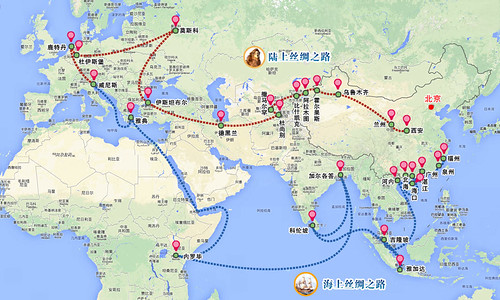
With that in mind let us look at China's "New Silk Road" initiative, which, with all the hoohah in Ukraine, is getting very little coverage in the press these days. Some of my readers will only know "Silk Road" as a website where drugs can be acquired  anonymously, but the original Silk Road story is a bit more interesting than that. You can read up on the original version in Wikipedia.

Below you'll find Xinhua's map of China's "New Silk Road" project.

The new "Silk Road"
Before going on it would be well to remember that the World Bank expects China to become the world's largest economy sometime in 2014:
Many economists expect China to eclipse the U.S. as the world's largest economy sometime in the next few decades, but new World Bank data suggests that the transition could come much sooner. Is China ready now to assume its spot as the world's No. 1 economy? If so, what does it mean for the U.S., investors, and you? Motley Fool
With that in mind read the following:
The maps of the two Silk Roads drive home the enormous scale of the project: the Silk Road and Maritime Silk Road combined will create a massive loop linking three continents. If any single image conveys China’s ambitions to reclaim its place as the “Middle Kingdom,” linked to the world by trade and cultural exchanges, the Xinhua map is it. Even the name of the project, the Silk Road, is inextricably linked to China’s past as a source of goods and information for the rest of the world. The Diplomat
Here is how it connects to Europe:
DUSSELDORF, Germany, March 29 (Xinhua) -- Chinese President Xi Jinping Saturday called on China and Germany to work together to build the Silk Road economic belt. Xi made the remarks during a visit to Port of Duisburg, the world's biggest inland harbor and a transport and logistics hub of Europe. He said China's proposal of building the Silk Road economic belt, based on the idea of common development and prosperity, aims to better connect the Asian and European markets, will enrich the idea of the Silk Road with a new meaning, and benefit all the people along the belt. China and Germany, at the opposite ends of the belt, are two major economies that serve as the driving engines for economic growth respectively in Asia and Europe, Xi noted.
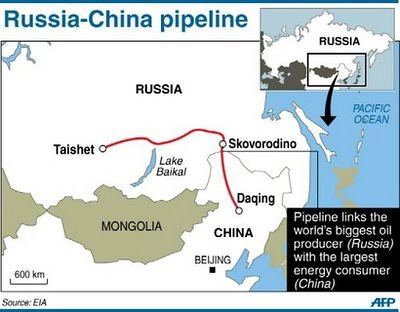
How does Russia fit into this? Now look at this map:


What or who is missing in all these maps and snippets?

The United States of America, that's what. 

The USA is nowhere in this picture... out of the loop... We can't have that can we?

What to do?

Double, double toil and trouble; fire burn, and caldron bubble. That's what. DS

Saturday, May 03, 2014

Newslinks Interruptus

Just a note to my readers to apologize for posting with such irregularity. 

The last few months have been very hectic, between earning a living, accompanying a family member every day of a two month, life or death sojourn in the hospital; half of it in intensive care (he's OK now) and then, till about yesterday, another couple of months moving house, with all that entails in endless hefting and bricolage: I confess to being remiss in blogging in both thought, word and deed.

And now... My wife and I are going off for a week of absolutely needed beach rest, an "everything included", package on the Spanish coast, where God willing, we will sleep like cats and eat like pigs... after that I should be able to get back to decent blogging with some regularity.

Anyone who reads this must be a diehard, Newslinker, coming back to the same post over and over again. I thank you truly for your patience and I hope that I can make it up to you in the next few months. DS

Sunday, April 27, 2014

Artificial Intelligence: the central question

AI in the hands of Goldman Sachs?
One can imagine such technology outsmarting financial markets, out-inventing human researchers, out-manipulating human leaders, and developing weapons we cannot even understand. Whereas the short-term impact of AI depends on who controls it, the long-term impact depends on whether it can be controlled at all. Stephen Hawking, Max Tegmark, Stuart Russell, Frank Wilczek
I am in the midst of reading, "Smart Machines", by John E. Kelly and Steve Hamm of IBM, which is basically a promotion of that multinational's "Watson" super computer....  And it all sounds so wonderful... The millennium has finally arrived and humanity will live happily ever after! 

I thought that kind of optimism about technological progress being linked to moral progress was fatally wounded in the trenches of World War One and breathed its last at Auschwitz or Hiroshima (take your pick).

And if the last, deregulated, post-Reagan years have taught us anything, especially the criminal fraud of the invasion of Iraq, followed by the recent and ongoing financial meltdown, it would be that the top of our increasingly oligarchical society is chockablock with shallow, psychopathic/sociopathic manipulators with no empathy for the rest of humanity or care for its general welfare.

Who could be so innocent as to believe that such an instrument as artificial intelligence will not fall into such hands?

If the 20th century taught us anything at all, it should be that we have no definite answer to "The Shadow's" famous question, "Who knows what evil lurks in the hearts of men?"

However with the help of Artificial Intelligence we just might get the answer to that one. DS

Saturday, April 19, 2014

The "butterfly effect" revisited

Moth by night
In chaos theory, the butterfly effect is the sensitive dependency on initial conditions in which a small change at one place in a deterministic nonlinear system can result in large differences in a later state. The name of the effect, coined by Edward Lorenz, is derived from the theoretical example of a hurricane's formation being contingent on whether or not a distant butterfly had flapped its wings several weeks earlier. Wikipedia
I remember that the "butterfly effect" was much in vogue in the late 1990s and was often quoted by the chaos theoreticians that were instrumental in designing the risk modeling that ruled finance up till 2008 and signally failed to predict the implosion of the financial system.

I think that today it would be more appropriate to talk about the "moth effect".

Moths are not as conventionally "pretty" as butterflies, but are often stunningly beautiful in a rather sinister way; and yes they flap their wings too and they often arrive in large numbers and eat their way through closets full of wool or gardens full of geraniums. 

Unlike the butterfly, the moth is seen as a plague and a pest... you don't go to the store to buy "butterflyballs", do you?

And then, rather poetically: on balmy, breathless, summer nights, moths often commit suicide en masse in the flickering flames of dinner candles, driven by their love, need and obsession with light... 

The romantic, sinister, light-driven and pestilent moth: a fitting symbol of our time.

The greatest clusters of metaphorical, wing flapping, wool chewing, suicidal moths that I detect today seem to me to be long term products of our economic system, such as the doomsday effect of global warming and the Oozlum bird effects of the advances in Artificial Intelligence. 

Global warming is the long term effect of the industrial revolution and its spread to the entire globe, but so is Artificial Intelligence.
One can imagine such technology outsmarting financial markets, out-inventing human researchers, out-manipulating human leaders, and developing weapons we cannot even understand. Whereas the short-term impact of AI depends on who controls it, the long-term impact depends on whether it can be controlled at all.  Stephen Hawking and friends - Huffington Post
But long before it comes to all that, in the near future AI will be putting nearly everyone (except maybe the people who clip the toenails and give blowjobs to elderly billionaires) out of work.

AI is the result of the geometrically accelerating drive for technological innovation, which we are told is wonderful and which will solve all our problems, but which in fact is not really a search for the greatest good for the greatest number, but on the contrary, generally driven by the intense dog eat dog competition of our economic system, where to avoid being eliminated, management and shareholders are constantly looking for greater efficiencies in cutting costs and getting more productivity with fewer people, even if this reduces the number of potential consumers. The now classic metaphor for this is Kodak, which once had 140,000 employees being replaced by Instagram, which had 13 employees when Facebook bought it.

Ironically, this pressure to innovate may finally be what fatally destabilizes our system. DS

Saturday, March 22, 2014

How isolated is Russia?

With Russia facing sanctions from the US and some other countries after it annexed Crimea from Ukraine, India on Wednesday made it clear that it will not support any "unilateral measures" against Russian government. Times of India

Based on the fact that Russia and Ukraine have deep cultural, historical and economic connections, it is time for Western powers to abandon their Cold War thinking, stop trying to exclude Russia from the political crisis they failed to mediate, and respect Russia's unique role in mapping out the future of Ukraine. Xinhua
I have very little time for carefully constructed posts at the moment, so just a few lines hastily put together. 

Reading the news about American and EU sanctions against Russia, I am beginning to suspect that there is something more cooking here than the "story" we are being fed by the MSM. 

It might be noted that in his big speech, Putin thanked both China and India for their support... Can we say that Russia is "isolated" from the "international community" with 1/2 of humanity on their side?... DS

Sunday, March 16, 2014

MH370: Ocean's Eleven meets Charles Manson?


The question nobody seems to be asking about the mysterious, disappearing, Malaysian flight is: was there anything of extraordinary value riding in the baggage hold?
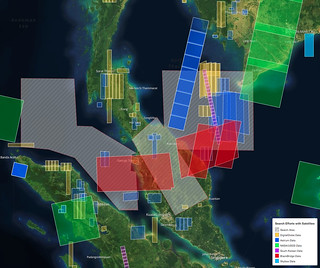
Search efforts for Flight MH370 from space

 What could that be?

Anybody's guess. If this were a "caper" movie, what is in the baggage hold would be its "MacGuffin", which is simply a mysterious object that moves the film's dramatic action. 

By now I would rule out terrorism, if that were the case the plane would have been flown directly into a target or landed in some well-publicized, international, airport where the terrorists would make "demands" in exchange for passenger-hostages. That hasn't happened.

At this point, anything but a heist is, in my opinion, outside of rational calculation... it could be something completely insane, but that by definition defies rational calculation. 

The heist theory:

To be worth the elaborate preparations and enormous risk involved, whatever the MacGuffin is, it must be of incalculable value and yet small enough to be packed unobtrusively in an ordinary container, one of hundreds, say a suitcase, and it would have to be something that didn't set off bells ringing when it passed through the airport scanners.

What about the passengers?

It doesn't look good, I'm afraid. Terrorists crave witnesses, that is the whole point of what they do, but thieves don't. By now the plane has long landed, probably been destroyed and the hijackers long gone with their prize, and the only people that could ever identify them or tell the story of what they did are the passengers. Without witnesses the perpetrators will be presumed dead too, ready to take now identities. It doesn't look good.

The most disturbing thing I have read so far is that after turning off the instruments that would reveal the plane's location, it climbed to 45,000 feet, which is above its maximum recommended altitude and then after a while, dived down to a very low 20,000 feet. At 45,000 feet, all they would have to do is to turn off the oxygen and depressurize the cabin and the passengers would quickly pass out and expire in a few minutes and then down at 20,000 feet, it would only take a few people a short time to toss the remains of the passengers out of the plane's back door... On land it is quite a job to dispose of over 200 human bodies, but scattering them from altitude over the shark infested Indian Ocean, no.

Another heist alternative is that of a military, special-ops mission, but in that case, the MacGuffin would be beyond anything my poor imagination can come up with and the fate of the passengers would be even more dismal... As Machiavelli would have you note, throughout history, great statesmen have been capable of greater cruelty than even the coldest criminal. 

The cruelty of this caper (if that is what happened) is why I call this post, "Ocean's Eleven meets Charles Manson"

I certainly hope and pray to be proven wrong on all this and that the coming days will show my speculations to be utterly foolish, tin-hattedness.  DS

Tuesday, March 04, 2014

Ukraine: belling the cat

In situations of conflict there is an acknowledged advantage given to those with their back to the wall. With survival at stake the ones with nothing to lose by fighting are at an advantage. In previous posts I've suggested that Americans could better understand the Russian position if they imagined the US reaction if America's access to the Panama Canal was threatened. The United States once invaded Panama for that very reason:
The United States Invasion of Panama, code-named Operation Just Cause, was the invasion of Panama by the United States in December 1989. It occurred during the administration of U.S. President George H. W. Bush, and ten years after the Torrijos–Carter Treaties were ratified to transfer control of the Panama Canal from the United States to Panama by 1 January 2000. During the invasion, de facto Panamanian leader, general, and dictator Manuel Noriega was deposed, president-elect Guillermo Endara sworn into office, and the Panamanian Defense Force dissolved. Wikipedia
It could be argued that Russia's interests are under much more threat today in the Ukraine than America's were in Panama in 1989. Are Russians being unjustifiably paranoid here? Here is how a notable neoconservative commentator urges a "full-throated American support for Ukraine’s revolution".
"Without Ukraine, there’s no Russian empire."
Obviously the Russians would be fools if they took US human rights rhetoric all that seriously, as anything but a smokescreen for America's own "imperialist" goals, which are to isolate Russia in a corner of Asia.

So, it seems clear to me that the Russians are the ones in the "to be or not to be" position.

Are the Europeans going to significantly sanction Russia? Doubtful. It is easy to criticize the EU in Washington, but Europeans have a lot more skin in the game than Americans do.
Given that Europe’s economic relationship with Russia is multiple times that of the United States, securing the region’s cooperation will be paramount to any effort by Washington to secure significant sanctions. Yet such ties will not be lightly jeopardized, observers say, even in the defense of a fellow European nation under threat. (...) On Tuesday, the Estonian newspaper Ohtuleht ran an editorial worrying about the economic links between Russia and Western European economies dependent on its gas supplies. “What government would dare to suggest to its voters to spend the next winter in a cold apartment just because of a peninsula nobody can point out on the map?” Washington Post
And if Europe actually decided to go to the mat with Russia, would it work?
Unlike Europe, however, Russia’s capacity for economic hardship is almost limitless, as has been repeatedly demonstrated throughout history. In any contest over pain thresholds, Russia would win hands down. Jeremy Warner - The Telegraph 
Would the USA lose anything significant by taking the moral high ground and reducing relations between the two countries? Yes, it would and in a very important way. Here is an angle which strangely nobody seems to have mentioned: one of the major objectives of the Obama administration is withdraw all but a token force from Afghanistan. I understand that getting the masses of American equipment out of Afghanistan would be nearly impossible without Russia's logistical cooperation. Here is what the US State Department has to say about Russo-American cooperation there:
The United States recognizes Russia’s contribution to building a better future for the Afghan people.(...) We take note of the significant contribution to international security that has resulted from the arrangements between the United States and Russia – bilaterally and through NATO – to support ground and air transit into and out of Afghanistan. In accordance with these arrangements, over 2,200 flights, over 379,000 military personnel, and over 45,000 containers of cargo have been transported through Russia in support of operations in Afghanistan.(...) The United States and Russia continue to face a common threat from terrorism, including from al-Qa’ida and other groups operating in and around Afghanistan. We are working together to disrupt terrorists’ operational networks and undermine their access to financial resources.  U.S. State Department
If I had to bet, I would analyze it like this. The Russian position is simple, easy for the Russian people to understand. The American position to a great extent is shallow posturing, with very little at stake. The European position is complicated: sending money to Ukraine is like poring sand down a rat hole as the people who have replaced Viktor Yanukovych are said to be every bit as dishonest as he is and any meaningful, economic sanctions on Russia would bring much pain on EU citizens at a time when the entire European project is being questioned by a wave of populists. This brings us to Ukraine. Ukraine's position is purely chaotic, totally fluid and flat broke. There is where I think the denouement will come from... the political/economic implosion of the Ukraine, with Russia shoring up the Russian speaking part. DS 

Wednesday, February 26, 2014

A note (rant) on the Ukraine


I have to say something about the situation(s) in the Ukraine, I haven't had much time to post recently, being in the middle of moving house, so instead of a neatly constructed post this will take the form of a simple rant.

First reality: any attempt to deny Russia access to the Crimea would be similar to denying the USA access to the Panama canal... In America's case that would constitute an act of war.

There are those that even think Ukraine should join NATO. Great wars have begun on flimsier grounds than that too. Making a mortal enemy of Russia over the Ukraine would be incredibly stupid... The Poles might love that, but frankly, I don't think the Germans will go for it at all. 

I think that I've said before that I consider that George H.W. Bush's defeat by Bill Clinton was a geopolitical tragedy. The difference between the treatment that a defeated German received from Truman and the Marshall plan and what Clinton's America did to Yeltsin's Russia seem astoundingly stupid if you think about it.

Nearly 190,000 Americans died fighting Nazi Germany and a defeated Germany was treated with great generosity.  As far as I know, throughout the Cold War no Russian soldier ever killed an American soldier, we were even allies in defeating the Nazis, but when Russia was down, America led by Bill Clinton, kicked them in the teeth. and because of that the Russians have every right to be totally cynical about America's intentions and every right to consider the USA as a sinkhole of hypocrisy and Snowden's revelations only confirm that view. 

Ukraine is in a ruinous state and neither the EU or the IMF nor the US Congress, for that matter are in any shape to fill its coffers even if the money wasn't immediately drained off by Ukraine's notoriously corrupt oligarchs, who occupy the entire political spectrum. That sound familiar? Certainly there seems to be a growing consensus (even among many American conservatives) that America's policy and financial elites are "mad, bad and dangerous to know.

I think it is simply frivolous idiocy to try to "contain" Russia. This is all being cooked up by the same neocon imbeciles that invaded Iraq... Victoria Nuland is married to the fellow who wrote, "Americans are from Mars and Europeans are from Venus". Cutting to chase: anything these people touch is tainted and will lead to disaster. 

End of rant.  DS

Saturday, February 15, 2014

Don't cheapen the Holocaust by making it shopworn


Humanity has seen many genocides since our ancestors killed off all the Neanderthals... 

The Holocaust is different.

How is this genocide different from all other genocides?

There is a qualitative difference between ordinary enraged insanity and the carefully planned and managed destruction of an entire people (one of the founders of our civilization) carried out by one the most developed and cultured peoples of that same civilization.

It is the end of the idea, the hope, the faith, that material progress leads to spiritual progress.

The difference between any other genocide and the Holocaust is that in the Holocaust all the techniques of over a century of miraculous scientific and technical "progress", were applied to the task.

The Holocaust is not just another pogrom, ethnic cleansing or enraged genocide. It is the industrial scale, ice-cold destruction of an entire group of human beings using all the tools of modern logistics, recycling and information management, just as if the victims were nothing more than pigs or chickens going to market. The ultimate in depersonalization, in dehumanization: it is the summit of humanity's alienation from itself. It is the dark side of all the material progress made since the industrial revolution... All modern progress since the Enlightenment devoted to evil. 

Because of the symbolism involved the Holocaust is not the same as, for example, the Turkish genocide of Armenians, or the atrocities of Rwanda. Why not?

Germany, pre-Hitler, represented the cutting edge of technology, science and "kultur": the land of Einstein and Adorno, not "just" Bach, Beethoven, Hegel, Kant, Marx and Goethe.  The Jews themselves, of course, before anything else, wrote the Bible, which is nothing less than the founding document of our entire western civilization. 

So we are not talking about the individual suffering involved, which is not in any way different from that of Armenians or Rwandans, but rather the suicide of any moral authority our civilization could claim to possess. That loss was summed up by Gandhi when he was asked what he thought of Western civilization, "It would be a good idea", the Mahatma replied.

In many senses our modern, western civilization died in Auschwitz

I think while we are on subject, I should go on record as saying that, for all the reasons that I have stated above,  I am in total agreement with the Jewish position that the Holocaust was totally unique and cannot be compared to any other event in history

But, for the same reason of its uniqueness, I think that it is sinfully frivolous to cheapen something as unique as the Holocaust by blandishing it as moral blackmail to cover the carefully organized and methodical oppression, humiliation and displacement of the Palestinian people. DS

Friday, February 07, 2014

Nuland and Pyett's tape

David Seaton's News Links
 
 “Clear communication expresses clear thinking, while muddled communication reflects muddled thinking” Writing Success Program at UCLA
(The English Language) becomes ugly and inaccurate because our thoughts are foolish, but the slovenliness of our language makes it easier for us to have foolish thoughts. George Orwell
You've probably heard or heard about this conversation between  US assistant secretary of state, Victoria Nuland, and Geoffrey Pyatt, US ambassador to Ukraine before reading this post. A couple of questions naturally come up, for example, how did the Russians get access to the conversation and is this a little sample of access they have acquired from Snowden or could they have done this before he arrived on the scene? 

My answer? I haven't a clue... all I can say is that Putin seems to be very, very, lucky these days.

What really brings me to write about it is the language these people use. By this I don't mean Victoria Nuland's, now famous, "fuck the EU", for me that is about the only really simple and declarative, proper English sentence in the entire recording. Here is a sample of what I mean:
Voice thought to be Pyatt's: I think we're in play. The Klitschko [Vitaly Klitschko, one of three main opposition leaders] piece is obviously the complicated electron here. Especially the announcement of him as deputy prime minister and you've seen some of my notes on the troubles in the marriage right now so we're trying to get a read really fast on where he is on this stuff. But I think your argument to him, which you'll need to make, I think that's the next phone call you want to set up, is exactly the one you made to Yats [Arseniy Yatseniuk, another opposition leader]. And I'm glad you sort of put him on the spot on where he fits in this scenario. And I'm very glad that he said what he said in response. BBC - Transcript
 Here is the quote that has grabbed the headlines and done the most damage:
Nuland: OK. He's now gotten both Serry and [UN Secretary General] Ban Ki-moon to agree that Serry could come in Monday or Tuesday. So that would be great, I think, to help glue this thing and to have the UN help glue it and, you know, Fuck the EU. BBC - Transcript
Refreshing clarity there... In the following snippet, Ambassador Pyatt outdoes himself in mixed, muddled and mangled metaphors.
Pyatt: No, exactly. And I think we've got to do something to make it stick together because you can be pretty sure that if it does start to gain altitude, that the Russians will be working behind the scenes to try to torpedo it. And again the fact that this is out there right now, I'm still trying to figure out in my mind why Yanukovych (garbled) that. In the meantime there's a Party of Regions faction meeting going on right now and I'm sure there's a lively argument going on in that group at this point. But anyway we could land jelly side up on this one if we move fast. So let me work on Klitschko and if you can just keep... we want to try to get somebody with an international personality to come out here and help to midwife this thing. The other issue is some kind of outreach to Yanukovych but we probably regroup on that tomorrow as we see how things start to fall into place. BBC - Transcript
I think it could be seriously maintained that many if not most of the endlessly repeated and disastrous failures of American diplomacy in recent (and not so recent) years can be explained by the mental activity, or lack of it, of people who produce language like this. DS


Friday, January 24, 2014

Inequality: a tale of two pyramids

David Seaton's News Links

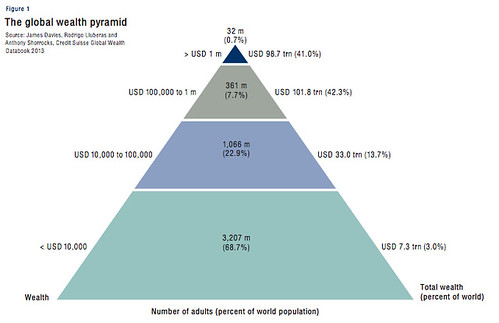
This pyramid appeared in the Washington Post.


Looking at it I was reminded of another pyramid in a classic poster from the 19th century, which could be a "poetic" rendering of the graph from the Post.


The signs are all around us, if you want to take a peek at the near future, have a look at the scheme Jeff Bezos has dreamed up over at Amazon. It is called "Mechanical Turk" and its goal is to turn clerical tasks that require education and specialized training into sweatshop piece work like making T-shirts in Bangladesh. I urge my readers take a very close look at it to see where their training and skills might be used and what pay they would receive for performing these tasks.

That is the story: in developed countries we are in the process of recreating the class differences and the ensuing class struggle of the 19th century, but this time in a world where consciousness, class or otherwise, with the new social networks, quickly becomes universal. The 1% are sitting on a powder keg. These graphs explain the Tea Party and the Koch brother's spending millions bankrolling it. The idea is to keep a person from thinking clearly and like the fellow said, avoid an individual being "at last compelled to face with sober senses his real conditions of life, and his relations with his kind."

If the problem of controlling the "powder keg" is one of consciousness, the system seems to be working rather well. It would appear that converting human beings into mental cripples is an enormous industry and they have to catch them rather young. The following is a sample of what a school teacher wrote Thomas Friedman, quoted in the New York Times.
We are dumbing down our classes.  It is an inexorable downward progression in which one day all a kid will need to pass is to have a blood pressure. The kids today are not different in ‘nature.’ ... The difference is that back then, although they didn’t want to, they would do the work. Today, they won’t. ... This is a real conversation I had with a failing student who was being quite sincere in her comments: ‘I know you’re a really good teacher, but you don’t seem to realize I have two hours a night of Facebook and over 4,000 text messages a month to deal with. How do you expect me to do all this work?’
Maybe Americans are finally waking up, but for the moment, from my perch on the other side of the Atlantic, the only one really talking any sense is Naquasia LeGrand. DS

Saturday, January 18, 2014

Explaining the virulence on the right... Social Democracy in America?

David Seaton's News Links
 Naquasia LeGrand... the right stuff
Naquasia LeGrand, the lady that tops this page, works at minimum wage shoveling fried chicken, for KFC. She is leading a fight to organize fast-food workers and raise America's minimum wage to $15. She is facing some of America's most powerful multinational corporations and an ideological set enshrined in think-tanks, PACs and mainstream media which has prevailed in the USA since the days of Ronald Reagan and... She looks like winning!

How could this happen? Not that complicated, really.

The price of elitist politics is that, in a democracy, or anything remotely resembling one, when issues become so simple and self-evident that "you don't need a weatherman to tell which way the wind blows": at that point the money's "gate-keeper" function no longer guarantees that numerically small, but powerful groups are able to achieve their desired outcomes. 

This is the sort of opposition that Ms. LeGrand is facing:
Koch-backed political coalition, designed to shield donors, raised $400 million in 2012 - Washington Post
The political network spearheaded by conservative billionaires Charles and David Koch has expanded into a far-reaching operation of unrivaled complexity, built around a maze of groups that cloaks its donors, according to an analysis of new tax returns and other documents. (...) The resources and the breadth of the organization make it singular in American politics: an operation conducted outside the campaign finance system, employing an array of groups aimed at stopping what its financiers view as government overreach. Members of the coalition target different constituencies but together have mounted attacks on the new health-care law, federal spending and environmental regulations.
They must think that it's worth the expense. 

How can a minimum wage worker like Naquasia LeGrand face anything like that, with even a ghost of a chance of succeeding?

The answer might be contained in an article about the right-wing political consultant, Frank Luntz, that I came upon in "The Atlantic".

Few people are as in touch with American public opinion as Luntz is, he has made a fortune crafting his clients' messages to suit or bend that opinion. And, according to the article, Luntz, who spends a fortune on focus groups and polls is in the depths of a black dog depression because of what he is hearing and seeing.

This what his fine-tuned nose is sniffing:
But what if the Real People are wrong? That is the possibility Luntz now grapples with. What if the things people want to hear from their leaders are ideas that would lead the country down a dangerous road? "You should not expect a handout," he tells me. "You should not even expect a safety net. When my house burns down, I should not go to the government to rebuild it. I should have the savings, and if I don't, my neighbors should pitch in for me, because I would do that for them." The entitlement he now hears from the focus groups he convenes amounts, in his view, to a permanent poisoning of the electorate—one that cannot be undone. "We have now created a sense of dependency and a sense of entitlement that is so great that you had, on the day that he was elected, women thinking that Obama was going to pay their mortgage payment, and that's why they voted for him," he says. "And that, to me, is the end of what made this country so great." The Agony of Frank Luntz - The Atlantic
Serendipity? Coincidence? On the same day I read the piece about Frank Luntz, I read the following rave review in Slate by Matthew Yglesias about a book called Social Democratic America.
It's too bad for Lane Kenworthy that his new book, Social Democratic America, was published on Jan. 3, 2014, because otherwise I'd be comfortable calling it the best public policy book of 2013. Matthew Yglesias - Slate
What is the author's social democratic menu-shopping list, agenda, for the USA

  1. Universal health insurance
  2. Universal system of one year of paid
    parental leave
  3. Universal early education
  4. Increased Child Tax Credit
  5. Universal sickness insurance
  6. Eased eligibility criteria for unemployment
    insurance
  7. Wage insurance for unexpected drops in
    income
  8. State-run supplemental defined-contribution
    pension plans with automatic enrollment
  9. Extensive, personalized job search and
    (re)training support
  10. Government as employer of last resort
  11. Minimum wage increased modestly and indexed
    to inflation
  12. Earned Income Tax Credit extended farther up
    the income ladder and indexed to average wages
    or GDP per capita
  13. Higher benefit level for social assistance
    (i.e. TANF-like programs)
  14. Reduced incarceration of low-level drug
    offenders
  15. Affirmative action shifted to focus on
    family background rather than race
  16. Expanded government investment in
    infrastructure and public spaces
  17. More paid holidays and vacation time
This policy list would be par for the course in say, Sweden, which is certainly not a "socialist" country and whose business community hosts many a billionaire. The billionaire business folk of Sweden have no problem with Kenworthy's list, but their American counterparts like the Koch brothers are spending a fortune to paralyze the country's political system to avoid what they consider "socialism", "communism" or worse.

People in the USA, certainly the Tea Party, often confuse social-democracy with "socialism", however they are very different. 

Socialism advocates state/public ownership of the means of production: for example, nationalizing the steel or automobile industry would be socialist. On the contrary, social-democracy is about "civilizing" capitalism. 

Social democracy is anything but revolutionary, FDR's New Deal was considered largely social-democratic and many felt that, by his measures, Roosevelt saved the capitalist system from destroying itself. For this very reason, the hard left, like Marxist-Leninists, consider social democrats "Judas goats" for the capitalist system. For them the harder the brand of capitalism, the easier it is to overturn; the Koch brothers are dream enemies for them.

If Frank Luntz is right about a sea change in American opinion, Naquasia LeGrand may win her fight and Kenworthy's list may be more than a pipe dream. DS

    Tuesday, December 31, 2013

    2014... and welcome to it

    David Seaton's News Links
    Prediction is very difficult, especially if it's about the future.
    Niels Bohr

    The future ain't what it used to be.
    Yogi Berra
    As luminaries such as Niels Bohr and Yogi Berra have pointed out, trying to predict the future is a mug's game... And at year's end political commentators are urged to enter a field best left to astrologers. We are almost always proved wrong, and yet every year we give it a try.

    My clearest reading of 2014's tea leaves is "instability": worldwide instability and in my opinion this instability has its origins at the heart of the most developed economies of the western world.

    The causes?

    We are undergoing a technological revolution and process of globalized outsourcing, combined with a reduction of the welfare state that is severely degrading the middle class in developed countries and converting them slowly, but surely into working-poor.

    Anyone who has read a bit of history could tell you how dangerous that is.
    To sustain a lifestyle which excludes others, or to sustain enthusiasm for that selfish ideal, a globalization of indifference has developed. Pope Francis - Washington Post

     Nouriel Roubini describes how this could play out:
    Over time, advanced economies will need to invest in human capital, skills and social safety nets to increase productivity and enable workers to compete, be flexible and thrive in a globalized economy. The alternative is – like in the 1930s - unending stagnation, depression, currency and trade wars, capital controls, financial crisis, sovereign insolvencies, and massive social and political instability. Nouriel Roubini - Project Syndicate
    Notice that Roubini puts emphasis on investing in "social safety nets", which is exactly the opposite of what is happening. Roubini says not doing this will lead to "massive social and political instability".

    People are fearful; helpless in the face of forces that they cannot control and it does not appear that the representatives that the people elect are able to control those forces... and meanwhile the suspicion grows among the people that said representatives are perhaps unwilling to try to control those forces and come to the aid of their voters, because the politicians are, in fact, merely the paid servants of an extractive, oligarchical, elite and not representing the people who voted for them at all.

    It might be pointed out that enough people coming to this conclusion would be dangerous for the smooth running of the system.

    This "democratic deficit" comes about at a moment when the traditional left: unions, socialists, social democrats and intellectuals of the left and such like seem to have abandoned any intention of producing a radical critique of the system,  a system which is devastating precisely those whom they came into being to protect...  Which came first in this case, the chicken or the egg, is something left for historians to work out, but if the organized left abstains from rising to the challenge, that leaves the field to fringe movements and to the ultra-right.

    What exactly is the left or what is it supposed to be? Aesop defined it thousands of years ago in the following fable:
    The Four Oxen and the Lion
    A Lion used to prowl about a field in which Four Oxen used to dwell. Many a time he tried to attack them; but whenever he came near they turned their tails to one another, so that whichever way he approached them he was met by the horns of one of them. At last, however, they fell a-quarrelling among themselves, and each went off to pasture alone in a separate corner of the field. Then the Lion attacked them one by one and soon made an end of all four. Moral: United we stand, divided we fall.
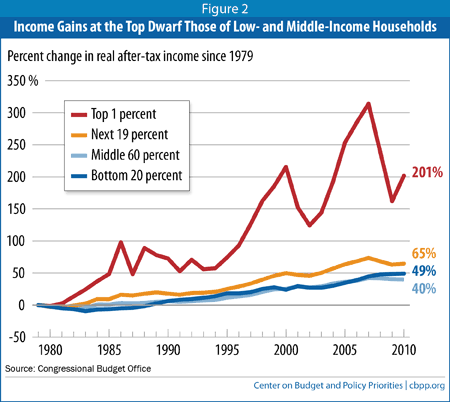
    The weak unite to protect themselves from the strong.  When, lured into complacency by their collective success, they come to value their individuality over their solidarity, the strong soon devour them (see graph above).

    Cutting to the chase, this dereliction of the organized left is leading inevitably to the rise of (shudder) "populism".

    What is populism?
    Populism [pŏpˈyə-lĭzˌəm]
    noun
    a. A political philosophy supporting the rights and power of the people in their struggle against the privileged elite.
    b. The movement organized around this philosophy.
    The American Heritage Dictionary of the English Language
    That is a pretty tame definition. Usually "populism" is a pejorative term indicating  a sham left: unscrupulous demagogues exciting ignorant mobs of fanatics, often ultra-nationalist, racist and xenophobic, and these demagogues who exploit fear and anger and their mobs are often manipulated and financed by the same "elites" they are purporting to attack. Hitler's being financed by German industrialists is one example, the Koch brothers financing the Tea Party is another.

    Trying to monitor and control a situation of inequality and massive downward mobility where the bonds of trust and solidarity between the people and those they have voted to guard, serve and protect them have been loosened or broken fosters the sort of mentality that leads to the abuses that Edward Snowden has recently uncovered: Jefferson versus Orwell, with Orwell way ahead on points.

    This degrading of many basic principals of the shared American identity and the resulting disunity and political paralysis produced by it, is a form of dry rot that has a way of spreading outwards into every corner of the globe where the USA was once a stabilizing factor, if not exactly a "force for good".

    In the more vulnerable areas the rot shows a violent and bloody face. Witness the chaos of the Middle East and much of Africa at this moment.

    But it is not just in the poor, disorganized countries of those unfortunate regions where the rot is visible.

    It should be noted that the prime ministers of two of the United States' closest allies Japan and Israel would both be classed as ultra-rightest demagogues or even fascists by the American media if instead of being close allies their countries were confronting the USA.
    Mission for the Western media:  Manage the cognitive dissonance between comforting myth and disturbing reality for the sake of its faithful readers. Peter Lee - Counterpunch
    Israel and Japan are not alone, Greece, Holland, Britain and France are also witnessing a rise of the racist, xenophobic, ultra-right.

    So I think it is safe to say that in 2014 we will see more effects of this growing instability, what exactly those effects will be is nearly impossible to predict, because there are too many players with too many variables that are too interconnected to forecast accurately how far the slide into chaos could take us.

    Situations like this have led to disasters in the past.

    Pessimists like to remind us that 2014 is the hundredth anniversary of World War One.

    Perhaps we can take comfort that, unlike the run up to the hecatomb of 1914, today we are certainly not living in any Belle Époque. DS