Showing posts with label class struggle. Show all posts

Friday, January 24, 2014

Inequality: a tale of two pyramids

David Seaton's News Links

This pyramid appeared in the Washington Post.
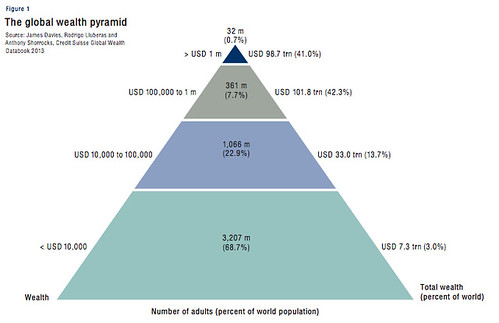

Looking at it I was reminded of another pyramid in a classic poster from the 19th century, which could be a "poetic" rendering of the graph from the Post.


The signs are all around us, if you want to take a peek at the near future, have a look at the scheme Jeff Bezos has dreamed up over at Amazon. It is called "Mechanical Turk" and its goal is to turn clerical tasks that require education and specialized training into sweatshop piece work like making T-shirts in Bangladesh. I urge my readers take a very close look at it to see where their training and skills might be used and what pay they would receive for performing these tasks.

That is the story: in developed countries we are in the process of recreating the class differences and the ensuing class struggle of the 19th century, but this time in a world where consciousness, class or otherwise, with the new social networks, quickly becomes universal. The 1% are sitting on a powder keg. These graphs explain the Tea Party and the Koch brother's spending millions bankrolling it. The idea is to keep a person from thinking clearly and like the fellow said, avoid an individual being "at last compelled to face with sober senses his real conditions of life, and his relations with his kind."

If the problem of controlling the "powder keg" is one of consciousness, the system seems to be working rather well. It would appear that converting human beings into mental cripples is an enormous industry and they have to catch them rather young. The following is a sample of what a school teacher wrote Thomas Friedman, quoted in the New York Times.
We are dumbing down our classes.  It is an inexorable downward progression in which one day all a kid will need to pass is to have a blood pressure. The kids today are not different in ‘nature.’ ... The difference is that back then, although they didn’t want to, they would do the work. Today, they won’t. ... This is a real conversation I had with a failing student who was being quite sincere in her comments: ‘I know you’re a really good teacher, but you don’t seem to realize I have two hours a night of Facebook and over 4,000 text messages a month to deal with. How do you expect me to do all this work?’
Maybe Americans are finally waking up, but for the moment, from my perch on the other side of the Atlantic, the only one really talking any sense is Naquasia LeGrand. DS

Friday, December 21, 2007

Yet more notes on populism


"A zero-sum economy leads, inevitably, to repression at home and plunder abroad. In traditional agrarian societies the surpluses extracted from the vast majority of peasants supported the relatively luxurious lifestyles of military, bureaucratic and noble elites. The only way to increase the prosperity of an entire people was to steal from another one. (...) Democratic politics became increasingly workable because it was feasible for everybody to become steadily better off.(...) in the new positive-sum world, elites were willing to tolerate the enfranchisement of the masses. The fact that they no longer depended on forced labour made this shift easier still. Consensual politics, and so democracy, became the political norm.(...) The biggest point about debates on climate change and energy supply is that they bring back the question of limits. If, for example, the entire planet emitted CO2 at the rate the US does today, global emissions would be almost five times greater. The same, roughly speaking, is true of energy use per head. This is why climate change and energy security are such geopolitically significant issues. For if there are limits to emissions, there may also be limits to growth. But if there are indeed limits to growth, the political underpinnings of our world fall apart. Intense distributional conflicts must then re-emerge – indeed, they are already emerging – within and among countries."
Martin Wolf - Financial Times

"In May, the Pew Research Center released the 2005 edition of its Political Typology, a survey that slices the American electorate into nine discrete groups. Unsurprisingly, the core of the GOP's support turns out to be drawn from "Enterprisers," affluent, optimistic, and staunchly conservative on economic and social issues alike. But the so-called Enterprisers represent just 11 percent of registered voters--and apart from them, the most reliable GOP voters are Social Conservatives (13 percent of registered voters) and Pro-Government Conservatives (10 percent of voters). Both groups are predominantly female (Enterprisers are overwhelmingly male); both are critical of big business; and both advocate more government involvement to alleviate the economic risks faced by a growing number of families. They tend to be hostile to expanding free trade, Social Security reform, and guest-worker proposals--which is to say the Bush second term agenda." This is the Republican party of today--an increasingly working-class party, dependent for its power on supermajorities of the white working class vote, and a party whose constituents are surprisingly comfortable with bad-but-popular liberal ideas like raising the minimum wage, expanding clumsy environmental regulations, or hiking taxes on the wealthy to fund a health care entitlement. To borrow a phrase from Minnesota governor Tim Pawlenty, Republicans are now "the party of Sam's Club, not just the country club." Ross Douthat & Reihan Salam - Weekly Standard
David Seaton's News Links
The bottom line that ties together all the above quotes are the taboo words, "class struggle" or what Martin Wolf artfully calls, "intense distributional conflicts."
"if there are indeed limits to growth, the political underpinnings of our world fall apart"
What does Martin Wolf mean by the "underpinnings of our world"? The great (huge understatement) British historian, Eric Hobsbawm, puts it this way in "The Age of Revolution":
"... some time in the 1780s, and for the first time in human history, the shackles were taken off the productive power of human societies, which henceforth became capable of the constant, rapid and up to the present llimitless multiplication of men, goods and services."
This is the world we have lived in since the end of the 18th century, we know no other and it is predicated on limitless growth. Limitlessness is an article of faith, so is optimism. In the article from the Weekly Standard quoted above there is a relevant paragraph on this optimism:
"...the core of the GOP's support turns out to be drawn from "Enterprisers," affluent, optimistic, and staunchly conservative on economic and social issues alike."
I'm sure my readers will have noticed that when ever they talk to one of these "Enterprisers", they invariably pooh pooh any doubts about the sustainability of our system. These people have a taliban-like faith that there will always be a technological solution to any "limit" that might ever pop up.

Until recently this optimism was not confined to the Rotarian, Republican, booster crowd, it was also an article of faith of the left. Every Soviet five year plan that ever was, was filled with this very same optimism. Up till recently the only argument between the left and the right on the question of growth was to whom would fall the privilege of fulfilling mankind's destiny to soar ever upward on the wings of growing productivity... and the right is the last man standing.


At this point, as the evidence of the reality of global warming piles up, most of these optimists are whistling past the graveyard or in denial. Some of them, however, may be prudently planning for the future.

Martin Wolf is the chief economist of the Financial Times and a wonderful journalist. In his work: at international conferences, and over a thousand dinner tables and at countless coffee sessions, he comes into daily contact with some of the most wealthy and powerful men and women in the world and those that serve them. Wolf hears them speak and most of all picks up their body language, their silences and vibrations. His article on "limits", which I am quoting abundantly is the cri de coeur of a man who, though not wealthy and powerful himself, knows the ways of the wealthy and powerful as no other does... with the possible exception of Rupert Murdoch's butler. For the language of a financial newspaper, Wolf practically weeps:
"The response of many, notably environmentalists and people with socialist leanings, is to welcome such conflicts. These, they believe, are the birth-pangs of a just global society. I strongly disagree. It is far more likely to be a step towards a world characterised by catastrophic conflict and brutal repression. This is why I sympathise with the hostile response of classical liberals and libertarians to the very notion of such limits, since they view them as the death-knell of any hopes for domestic freedom and peaceful foreign relations."
If we examine what Martin Wolf is saying logically, not even really reading between the lines,
this supremely informed man is declaring that he knows that, before they ever pay Scandinavian like income taxes, drive small cars and wear sweaters around the house on cold winter days, the elites of the United States will create a police state and go to war endlessly to dominate the resource rich areas of the world. Hyperbole? Examine George W. Bush's presidency in that light and perhaps Dubya may not really be as dumb as he looks.. Or maybe he is more like what May West said about Ronald Reagan, "dumb but willing."

At this juncture, the elites of the Republican Party begin to separate from the middle class and working class base and the only way to keep them on board would be endless war and endless fear. Terror and paranoia may be the key to 2008 election. What moldy old Marxists used to call, "false consciousness". The Republican Party, to use another worn but useful Marxist term, has entered into contradiction with itself and using Wolf's analysis as our text, is
clearly going to tear itself apart.

Who knows, Huckabee may only be a straw in the breeze, but that is the way the wind is blowing. DS

The secret to Mike Huckabee's success - Salon
Abstract: The miracle birth of the Republican candidate with the four-word name -- Mike Huckabee Iowa Front-runner -- has as much to do with social class as religion. There is nothing subtle about Huckabee's celebration of his humble roots: He gleefully told 150 supporters (some more accurately described as acolytes) in Marshalltown Thursday morning that a "Republican muckety-muck" had recently declared that Huckabee was unelectable because he had a "hick last name." Then, a few minutes later, Huckabee returned to his obsession with the name game. "I didn't grow up with a name that opened a lot of doors or had a Rolodex," he boasted, harking back to his childhood in Hope, Ark. Then, the candidate suddenly switched to a twangy version of an upper-class lockjaw accent as he recalled, "Nobody said, 'Oh, he's a Huckabee, let him in.'" After the laughter died down, Huckabee added, "I often say that for my family, summer was never a verb. We summered in hay fields and chicken yards and all kinds of stuff." Of course, Huckabee is laying it on thick, but the candidate is peddling his common-man persona more than any specific set of policies. This time around, Romney (the governor's son) and McCain (the son of an admiral) lack convincing hard-scrabble stories from their early years. And the Bush family is not exactly the embodiment of portraits in populism. Huckabee, in fact, stole a joke that Jim Hightower famously used to ridicule the elder George Bush at the 1988 Democratic Convention. "Many of you work hard," Huckabee said, as he looked out at the breakfast crowd (not a tie or a dress-for-success outfit in view) at the Best Western in Marshalltown. "That's what America's always been about. It's not about folks who were born on third base and think they hit a triple."(....) But the Democrat whom Huckabee appears to be channeling is John Edwards, who never missed an opportunity to remind voters back in 2004 that he was "the son of a mill worker." At a chaotic rally in a cramped room in a West Des Moines shopping mall Wednesday night, Huckabee lifted a signature Edwards phrase, promising that when he triumphs in Iowa on Jan. 3, "America can say thank you for restoring faith in a political system that's not just run by corporate greed but is run by ordinary citizens." Huckabee followed up in Marshalltown by uttering a line of such naked populism that the Baccarat crystal probably rattled in corporate dining rooms around the country: "Wouldn't it be nice to have a president who doesn't find himself wholly owned and completely tied to the biggest corporations in the country?"(...) In contrast, Romney, on the stump in Iowa in late November, told a joke that literally began, "A man walks into a country club." There may be a social-class barrier that explains why, despite Iowa spending that will undoubtedly top $10 million, Romney risks being upended by Huckabee -- an underfunded candidate whose campaign seems modeled on Judy Garland and Mickey Rooney putting on a "backyard musical." Gail Stecker, who works for a food-safety institute at Iowa State University in Ames, captured the Romney-the-robot problem when I spoke to her before the Huckabee speech. "I went to a Romney rally in July and decided that he's not the man for me," Stecker, who was wearing a festive garland of Christmas lights around her neck, recalled. "When Romney looks at you, he looks right through you like he doesn't care." If Romney falls short in Iowa, that sentence -- "He looks right through you" -- could serve as his epitaph. READ IT ALL

Monday, June 25, 2007

Back to class war

The worst is yet to come for the U.S. housing market.(...) The national median home price is poised for its first annual decline since the Great Depression(...) ``It's a blood bath,'' said Mark Kiesel, executive vice president of Pacific Investment Management Co. ``We're talking about a two- to three-year downturn that will take a whole host of characters with it, from job creation to consumer confidence. Eventually it will take the stock market and corporate profit.''(...) ``It's not just a housing recession anymore, it looks more and more like an economic recession,'' said Nouriel Roubini(...) ``When all these people see their mortgage payment and it's up 40 or 50 percent, they're going to say, `We can't stay in this house,''' Pimco's Kiesel said. ``And there are millions of people in this situation.'' Bloomberg
David Seaton's News Links
I can think of no more wrenching yet predictable political trend on the horizon than a general souring on the super rich. There is nothing especially new about it, quite the contrary, but like all the other "end of history" myths, the supposed end of "class struggle" is also about to hit the fan and after a long absence, the tensions that brought the social-democracy movement on stage in the first place, are eagerly waiting in the wings.

As interest rates rise and lending restrictions are put into place, millions of middle-middle class people who have been living in a dream world, thinking that were somehow part of the same universe as Bill Gates, are going to have to make drastic decisions about allocating their resources if they are not to lose their homes. They are going to re-discover why there was
ever a universal demand for good, free public schools and universities or (in the countries lucky enough to have gotten that far) first class, free public health care in the first place. They will rediscover the nearness of the abyss of destitution and humiliation that terrified their parents and grandparents who lived through the Great Depression.

As much as an economic and political readjustment, it will be a cultural change, for never before in history have so many "normal" people identified with the wealthy and considered them harmless or even benevolent. DS

The rich must be penalised - Guardian
Abstract: (...) Equality is not a penalty-free condition. It increases rather than reduces the sum of freedom - giving millions more men and women the ability and the right to exercise the choices of a free society. But it reduces the purchasing power of the top earners, whose taxes are increased to pay for the improved pensions and health care. Every great leap forward towards redistribution has been accompanied by a frank acceptance of the price that the wealthy must pay, usually accompanied by an attack on their reluctance to meet the bill.

A hundred years ago, David Lloyd George - fearful that the House of Lords would reject his budget because of the introduction of a land tax to finance "provision for the aged and deserving poor" - mounted an attack on landlords in general and landowning dukes in particular. He told of a visit to a Welsh coalmine - "three-quarters of a mile of rock and shale above us" - to illustrate the infamy of the coal-owning classes.

"The prime minister and I knock on the doors of these great landlords and say to them, 'You know these poor fellows ... Some of them are old, they have survived the perils of the trade, they are broken and they can earn no more. Won't you give something towards keeping them out of the workhouse ...?' They retort, 'You thieves ...!' If this is the view taken by these great landlords of their responsibilities to the people who, at risk of life, create their wealth, the day of reckoning is at hand."

The rhetoric is as old-fashioned as the overt class antagonism, but the essential point remains. Lloyd George was not advising the coal owners to subscribe towards the cost of a pension in order to improve productivity. He was saying to the world that security in old age is a moral necessity and has to be financed by the wealthy. Politicians who run away from the underlying principle that greater economic equality penalises the rich will never have the nerve necessary to bring about economic equality. READ IT ALL

Monday, April 02, 2007

Rebuilding the left - 2: Necessity creates the organ

"Us workin' folkses, all get together,
'Cause we ain't got a chance anymore.
We ain't got a chance anymore."
Tom Joad - Woody Guthrie
David Seaton's News Links
Paul Krugman has a very good piece in the NYT abstracted below. In it Krugman illustrates the nub of the class-politics question: you can't have a "class struggle" if working people don't believe that class exists and that if they do believe that classes exist, they are deluded into believing that they really belong "in pectore" to the upper-middle class or even to the upper classes themselves.

You obviously can't have a "class struggle" if only the richest are "struggling," using organizations like the "Club for Growth" and the "Cato Institute", which Krugman mentions or by massive donations to the Republican Party's war chest. The Democratic Party, should any pin too many hopes upon it, is also controlled by huge contributions from rich individuals and corporations; that is why Howard Dean's strategies of micro-financing have such a potential for changing US politics.

Most troubling of all is the Republican Party's deliberate effort to disenfranchise people of color. I cannot think of a clearer proof of the neo-fascism that the party of Abraham Lincoln has come to represent.

I'm a huge fan of Paul Krugman's, but if one thing is obvious to me (and probably to Paul Krugman too) it is that university professors, because of the guaranteed employment which comes with tenure, are not going to be the backbone of the reborn left... It has to be the victims who stand up for themselves and make their own FDR's speech to Congress of April 29th 1938,
"The first truth is that the liberty of a democracy is not safe if the people tolerate the growth of private power to a point where it becomes stronger than their democratic state itself. That, in its essence, is fascism -- ownership of government by an individual, by a group, or by any other controlling private power.

The second truth is that the liberty of a democracy is not safe, if its business system does not provide employment and produce and distribute goods in such a way as to sustain an acceptable standard of living.
America's challenge is to rebuild democracy, literally from the ground up. DS

Paul Krugman: Distract and Disenfranchise - New York Times
Abstract: Median income has risen only 17 percent since 1980, while the income of the richest 0.1 percent of the population has quadrupled. The gap between the rich and the middle class is as wide now as it was in the 1920s, when the political coalition that would eventually become the New Deal was taking shape. And voters realize that society has changed. They may not pore over income distribution tables, but they do know that today’s rich are building themselves mansions bigger than those of the robber barons. They may not read labor statistics, but they know that wages aren’t going anywhere: according to the Pew Research Center, 59 percent of workers believe that it’s harder to earn a decent living today than it was 20 or 30 years ago.(...) The Republican Party’s adherence to an outdated ideology leaves it with big problems. It can’t offer domestic policies that respond to the public’s real needs. So how can it win elections? The answer, for a while, was a combination of distraction and disenfranchisement. The terrorist attacks on 9/11 were themselves a massive, providential distraction; until then the public, realizing that Mr. Bush wasn’t the moderate he played in the 2000 election, was growing increasingly unhappy with his administration. And they offered many opportunities for further distractions. Rather than debating Democrats on the issues, the G.O.P. could denounce them as soft on terror. And do you remember the terror alert, based on old and questionable information, that was declared right after the 2004 Democratic National Convention? But distraction can only go so far. So the other tool was disenfranchisement: finding ways to keep poor people, who tend to vote for the party that might actually do something about inequality, out of the voting booth. Remember that disenfranchisement in the form of the 2000 Florida “felon purge,” which struck many legitimate voters from the rolls, put Mr. Bush in the White House in the first place. And disenfranchisement seems to be what much of the politicization of the Justice Department was about. Several of the fired U.S. attorneys were under pressure to pursue allegations of voter fraud — a phrase that has become almost synonymous with “voting while black.” Former staff members of the Justice Department’s civil rights division say that they were repeatedly overruled when they objected to Republican actions, ranging from Georgia’s voter ID law to Tom DeLay’s Texas redistricting, that they believed would effectively disenfranchise African-American voters. READ IT ALL (bootleg)

Thursday, November 16, 2006

Senator Jim Webb - Class Struggle - Wall Street Journal

David Seaton's News Links
As Mohammad Ali says, "Hey, you aren't as dumb as you look". Tip of the hat to Billmon for locating this soul stirring opinion piece by Democratic, Senator-elect Jim Webb of Virginia.... In the Wall Street Journal!!! Play it again Sam. DS
Abstract: The most important--and unfortunately the least debated--issue in politics today is our society's steady drift toward a class-based system, the likes of which we have not seen since the 19th century. America's top tier has grown infinitely richer and more removed over the past 25 years. It is not unfair to say that they are literally living in a different country. Few among them send their children to public schools; fewer still send their loved ones to fight our wars. They own most of our stocks, making the stock market an unreliable indicator of the economic health of working people. The top 1% now takes in an astounding 16% of national income, up from 8% in 1980. The tax codes protect them, just as they protect corporate America, through a vast system of loopholes. Incestuous corporate boards regularly approve compensation packages for chief executives and others that are out of logic's range. As this newspaper has reported, the average CEO of a sizeable corporation makes more than $10 million a year, while the minimum wage for workers amounts to about $10,000 a year, and has not been raised in nearly a decade. When I graduated from college in the 1960s, the average CEO made 20 times what the average worker made. Today, that CEO makes 400 times as much. In the age of globalization and outsourcing, and with a vast underground labor pool from illegal immigration, the average American worker is seeing a different life and a troubling future. Trickle-down economics didn't happen. Despite the vaunted all-time highs of the stock market, wages and salaries are at all-time lows as a percentage of the national wealth. At the same time, medical costs have risen 73% in the last six years alone. Half of that increase comes from wage-earners' pockets rather than from insurance, and 47 million Americans have no medical insurance at all.(...) The politics of the Karl Rove era were designed to distract and divide the very people who would ordinarily be rebelling against the deterioration of their way of life. Working Americans have been repeatedly seduced at the polls by emotional issues such as the predictable mantra of "God, guns, gays, abortion and the flag" while their way of life shifted ineluctably beneath their feet. But this election cycle showed an electorate that intends to hold government leaders accountable for allowing every American a fair opportunity to succeed.