Showing posts with label Sunni. Show all posts

Monday, September 24, 2007

US will stand down 'cause they can't stand us

"Contractors shall not be subject to Iraqi laws or regulations in matters relating to the terms and conditions of their contracts… Contractors shall be immune from Iraqi legal processes with respect to acts performed by them pursuant to the terms and conditions of a Contract or any sub-contract thereto… Certification by the Sending State that its Contractor acted pursuant to the terms and conditions of the Contract shall, in any Iraqi legal process, be conclusive evidence of the facts so certified…" CPA Order 17, dated June 27, 2004
David Seaton's News Links
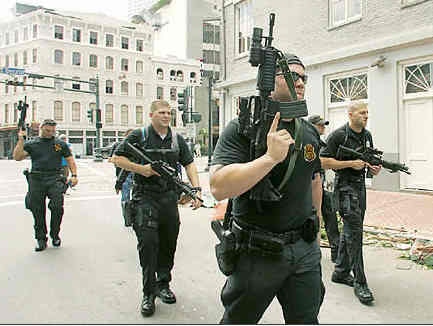
The Blackwater story makes clear that the entire American invasion and occupation of Iraq is not only illegal and immoral, but also futile and absurd because Iraq will finally only be reunited by its desire to expel the Americans. Hundreds of thousands, perhaps over a million, human beings have died, been mutilated or lost their homes to come to this. As the Spanish ask, "did we need so much luggage for such a short trip?" DS

Blackwater Shooting Crisis Rallies Baghdad - Wall Street Journal
Abstract: An escalating controversy over the alleged shooting of Iraqi civilians by a U.S. security firm has triggered the strongest challenge yet to legal immunity for some foreigners in Iraq, while providing a rare rallying cry for the country's polarized factions. But the government of Prime Minister Nouri al-Maliki has managed to galvanize broad-based opposition to an order issued in the waning days of direct American rule in Iraq that lays out broad immunity from criminal prosecution for U.S. diplomats, troops and private contractors operating in Iraq. It is known as Order 17, issued by the U.S. Coalition Provisional Authority in 2004. Iraqi officials have long chafed at the law, viewing it as an encroachment on Iraqi sovereignty. But until now, no serious effort has been made to revise it. The central government, unpopular on the streets and worried about being marginalized, appears to be using the Blackwater crisis to counter U.S. criticism that it is ineffective and to show ordinary Iraqis that it can stand up to Washington.(...) the shooting has brought together Iraq's three biggest and mostly hostile factions -- Sunni Muslim Arabs, Shiite Muslim Arabs and ethnic Kurds. This is a very good point on which everyone agrees," says Mahmoud Othman, a Kurdish member of Iraq's Parliament. "We cannot continue to have the Iraqi-American relationship solely on the basis of Order 17," says Mithal al-Alusi, a Sunni member of Parliament. The united front is a surprising turnabout.(...) Iraqis have long been outraged by what they often say is a heavy hand used by security outfits such as Blackwater, and the firms' seeming immunity against repercussions for their actions. "This is really an unfortunate situation, but it happened many times before," says Zuhair Hummadi, an adviser to Iraqi Vice President Adel Abdul-Mahdi. "This time it got out of hand." In December, a Blackwater employee shot and killed one of the vice president's guards without provocation, Iraqi officials say. The employee left Iraq and no longer works for Blackwater. Mr. Maliki himself cited six incidents involving Blackwater before the Sept. 16 shooting. "Order 17 supercedes the Iraqi law," Mr. Hummadi says. "What we need now is a new treaty." READ IT ALL

Thursday, February 15, 2007

Shiites and Sunnis

David Seaton's News Links
Thinking about the Shiites and the Sunnis, I had a little flash of insight that I'd like to cast upon the waters to see if anybody with special knowledge, like Juan Cole, could riff on it.

I understand that Iran, which is 90% Shiite has never been a colony, which makes it unique in the region. The rest of the Middle East was Ottoman or English or French, colonies, protectorates or whatever. In these situation of domination the outsiders availed themselves of the Sunnis as their interposed governing elite, even when they were a minority as in Mesopotamia/Iraq. The Arab Shiites were simply treated as hewers of wood and drawers of water when not actively persecuted: always obsessed with justice and sacrifice and allowed to dissemble their religion if in danger from the Sunnis.

So the Sunni Arabs in the Middle East have always been the clients and executors of some faraway ruler, either in Istanbul, London, Paris or Washington and the Shiites were excluded and left "wild and free".

Thinking about all this I suddenly remembered a summer I spent as kid at a Cheley camp in the Colorado Rockies. We used to go riding in large groups on these trail horses that spent their lives following the horse in front of them. One time we were visiting a "ghost town", which had a large flat field next to it and the counselors thought it would be fun if we played "capture the flag" on horse back. It was dreadful! We were all milling around trying to capture the flag or having captured it trying to escape or to catch the one who had the flag, but the poor horses instead of enjoying a good, free-form gallop, were only desperately trying to find some other horse's bottom to follow. Disaster.

Maybe the Sunni Arabs are like those trail ponies and that is why the rise of the Shiites is putting them into a panic. Perhaps the Shiite Arabs are like "mustangs" with no previous habits of government, unlike the Sunni Arabs who seem to have been the "Sepoys" of the Ottomans. The Shiites have never been anybody's man Friday, so they don't have those "trail pony" reflexes, which, as I learned as a boy, are so hard to shake off. DS

Sunday, February 04, 2007

Sunnies plus Israel: the ulimate Persian Gambit

Sunni governments - like the Egyptians, the Saudis and the Jordanians - watched with horror as their fears of a new Shia ascendancy appeared to be coming true. Such fears have prompted the beginnings of a re-alignment. "Something is happening that could have a strategic potential," says Dennis Ross, the US peace envoy to the Middle East during the Clinton years. Ambassador Ross dates the genesis of this to Saudi Arabia's criticism of Hezbollah during last summer's Lebanon war. "Iran," he said, was perceived by many Arab states "as trying to seize control of the Israel-Palestine issue and was using Hezbollah and Hamas as tools". This the Saudis and the other Sunni states saw as a threat because, as Ambassador Ross put it, "if the Iranians were in a position in which they could control the most evocative symbols in the region they could use it against these regimes". Add in the widespread unease at Iran's nuclear activities and you have a potential new alignment where the moderate Arab states and Israel all share common interests. BBC News
David Seaton's News Links
If the Iranians are able to force the Egyptian dictatorship and the Sunni Arab monarchies into an alliance with Israel and the USA against Iran, Hamas and Hezbollah, who are the only ones to have carried out effective resistance to Israel, it will totally deligitimize those regimes in the eyes of their masses and open the door for the Islamists. What looks a very clever, "divide and conquer", tactic is in fact, suicidally superficial. DS

Sunday, January 07, 2007

Make big bucks in Iraqi oil

David Seaton's News Links
This article from the Independent reminds me of the famous recipe for rabbit stew that begins, "First catch your rabbit". DS
Future of Iraq: The spoils of war - Independent
Abstract: Iraq's massive oil reserves, the third-largest in the world, are about to be thrown open for large-scale exploitation by Western oil companies under a controversial law which is expected to come before the Iraqi parliament within days. The US government has been involved in drawing up the law, a draft of which has been seen by The Independent on Sunday. It would give big oil companies such as BP, Shell and Exxon 30-year contracts to extract Iraqi crude and allow the first large-scale operation of foreign oil interests in the country since the industry was nationalised in 1972.(...) The huge potential prizes for Western firms will give ammunition to critics who say the Iraq war was fought for oil. They point to statements such as one from Vice-President Dick Cheney, who said in 1999, while he was still chief executive of the oil services company Halliburton, that the world would need an additional 50 million barrels of oil a day by 2010. "So where is the oil going to come from?... The Middle East, with two-thirds of the world's oil and the lowest cost, is still where the prize ultimately lies," he said. Oil industry executives and analysts say the law, which would permit Western companies to pocket up to three-quarters of profits in the early years, is the only way to get Iraq's oil industry back on its feet after years of sanctions, war and loss of expertise. But it will operate through "production-sharing agreements" (or PSAs) which are highly unusual in the Middle East, where the oil industry in Saudi Arabia and Iran, the world's two largest producers, is state controlled. Opponents say Iraq, where oil accounts for 95 per cent of the economy, is being forced to surrender an unacceptable degree of sovereignty.(...) Several major oil companies are said to have sent teams into the country in recent months to lobby for deals ahead of the law, though the big names are considered unlikely to invest until the violence in Iraq abates. James Paul, executive director at the Global Policy Forum, the international government watchdog, said: "It is not an exaggeration to say that the overwhelming majority of the population would be opposed to this. To do it anyway, with minimal discussion within the [Iraqi] parliament is really just pouring more oil on the fire." READ IT ALL

Saturday, January 06, 2007

Saint Saddam?

David Seaton's News Links
There are things that beggar belief. Any apologist of the Iraq war, when driven into a corner by the weight of his opponent's arguments, would finally retreat behind, "well, anyway, the Iraqis are better off without Saddam Hussein, aren't they?" The image of Saddam as a sanguinary, subhuman beast was central to the entire narrative. By dying in a manner straight out some Arab legend told around a Bedouin campfire, a lion among jackals, defiantly praising the Palestinians, his last words the Shahadah, Saddam was allowed to utterly destroy the American raison de guerre. Total incompetence or a move to deepen the split between Sunnis and Shiites leading up to an attack on Iran? Certainly for the neocons the main objective has always been Shiite Iran. However, it's difficult to see the drama of Saddam's hanging as a Zionist conspiracy; how could they know he would die so bravely? Finally, then, who is the loser in this war? Not Saddam Hussein. If death is defeat we are all losers... everybody has to die sooner or later... to enter into Arab folklore, to be sung and honored for generations, after doing almost everything you have ever wanted to do for most of your long life could certainly be considered victory. DS
Images of Hanging Make Hussein a Martyr to Many - New York Times
Abstract: In the week since Saddam Hussein was hanged in an execution steeped in sectarian overtones, his public image in the Arab world, formerly that of a convicted dictator, has undergone a resurgence of admiration and awe. On the streets, in newspapers and over the Internet, Mr. Hussein has emerged as a Sunni Arab hero who stood calm and composed as his Shiite executioners tormented and abused him.(...) in Beirut, hundreds of members of the Lebanese Baath Party and Palestinian activists marched Friday in a predominantly Sunni neighborhood behind a symbolic coffin representing that of Mr. Hussein and later offered a funeral prayer. Photographs of Mr. Hussein standing up in court, against a backdrop of the Dome of the Rock shrine in Jerusalem, were pasted on city walls near Palestinian refugee camps, praising “Saddam the martyr.” “God damn America and its spies,” a banner across one major Beirut thoroughfare read. “Our condolences to the nation for the assassination of Saddam, and victory to the Iraqi resistance.” By standing up to the United States and its client government in Baghdad and dying with seeming dignity, Mr. Hussein appears to have been virtually cleansed of his past. “Suddenly we forgot that he was a dictator and that he killed thousands of people,” said Roula Haddad, 33, a Lebanese Christian. “All our hatred for him suddenly turned into sympathy, sympathy with someone who was treated unjustly by an occupation force and its collaborators.”(...) “The Arab world has been devoid of pride for a long time,” said Ahmad Mazin al-Shugairi, who hosts a television show at the Middle East Broadcasting Center that promotes a moderate version of Islam in Saudi Arabia. “The way Saddam acted in court and just before he was executed, with dignity and no fear, struck a chord with Arabs who are desperate for their own leaders to have pride too.” Ayman Safadi, editor in chief of the independent Jordanian daily Al Ghad, said, “The last image for many was of Saddam taken out of a hole. That has all changed now.”(...) “He stood as strong as a mountain while he was being hanged,” said Ahmed el-Ghamrawi, a former Egyptian ambassador to Iraq. “He died a strong president and lived as a strong president. This is the image people are left with.” Daoud Kuttab, a Palestinian media critic and director of the online radio station Ammannet.net, said: “If Saddam had media planners, he could not have planned it better than this. Nobody could ever have imagined that Saddam would have gone down with such dignity.” Writers and commentators have stopped short of eulogizing the dictator but have looked right past his bloody history as they compare Iraq’s present circumstances with Iraq under Mr. Hussein.(...) “Was it a coincidence that Israel, Iran and the United States all welcomed Saddam’s execution?” wrote Hamadeh Faraneh, a columnist for the daily Al Rai. “Was it also a coincidence when Saddam said bravely in front of his tormentors, ‘Long live the nation,’ and that Palestine is Arab, then uttered the declaration of faith? His last words expressed his depth and what he died for.”(...) Mr. Safadi, the Jordanian editor, said: “In the public’s perception Saddam was terrible, but those people were worse. That final act has really jeopardized the future of Iraq immensely. And we all know this is a blow to the moderate camp in the Arab world.” READ IT ALL

Wednesday, January 03, 2007

Iraq: hard questions

David Seaton's News Links
Is the descent into civil war and anarchy in Iraq, and the Sunni/Shiite split that is developing there, really what was planned in the first place? Is this conflict, which may soon engulf the world's entire Islamic community, the real objective of the invasion of Iraq? As the disaster unfolds, we can see that Iraq with its mixture of oil and ethnic tensions, which was artificially cobbled together at the end of WWI, is a center of gravity of the Middle East and by extension much of the Muslim universe. By destroying the Iraqi state apparatus, have the props been knocked out from underneath the entire jerry-built edifice that the British and French constructed from the remains of the Ottoman empire? Were the doubts that kept George H.W. Bush, James Baker and Brent Snowcroft from pushing on to Baghdad in the First Gulf War, precisely the germ of the strategy for the present conflict? In other words: is what, up till now, has appeared to be only the effects of colossal ignorance, stupidity and poor organization, in fact a deliberate strategy of breathtaking cruelty and malice? Have the neocons, with their links to the Israeli ultra-right, maneuvered the United States into provoking a worldwide civil war among Muslims? DS

Friday, December 29, 2006

Iraq today... living the hell of American Empire

David Seaton's News Links
While perusing my daily ration of Juan Cole, I happened on this extraordinary report on the state of Baghdad by probably the best American reporter to ever have worked there, Hannah Allam of the McClatchy (formerly Knight-Ridder) newspapers. A voyage to hell. One of the most nauseating trends in today's punditocracy is to blame the Iraqis themselves for their suffering. This indescribable hell is the result of criminal decisions taken of their own free will by people with names well known to all. They bask in smug immunity today. The most that can happen to them is that they lose their present jobs and join the lecture circuit, the defense industry or some think tank. What is going to be needed, perhaps for decades to come, is some new Simon Wiesenthal to hunt these criminals down and bring them to trial to answer for their crimes, no matter how long it takes. DS
Hannah Allam returns to Baghdad - McClatchy Newspapers
Abstract: (Hannah Allam covers the Middle East and Islamic world as bureau chief in Cairo, Egypt. She recently returned to Baghdad on assignment, where she previously spent more than two years reporting on the war in Iraq as Baghdad bureau chief. ) A certain color of stone worn a certain way is just one of the dozens of superficial clues - like dialect, style of beard, how you pin a veil - that indicate whether you're Sunni or Shiite. These little signs increasingly mean the difference between life and death at the terrifying illegal checkpoints that surround the districts of Baghdad.(...) nowadays it seems like everything in Baghdad hinges on separation. There's the Green Zone to guard the unpopular government from its suffering people, U.S. military bases where Iraqis aren't allowed to work, armored sedans to shield VIPs from the explosions that kill workaday civilians, different TV channels and newspapers for each political party, an unwritten citywide dress code to keep women from the eyes of men. Attempts to bring people together have failed miserably. I attended a symposium called "How to Solve Iraq's Militia Problem," but the main militia representatives never showed up and those of us who did were stuck inside for hours while a robot disabled a car bomb in the parking lot.(...) I asked my colleagues to arrange meetings with old Iraqi sources - politicians, professors, activists and clerics - only to be told they'd been assassinated, abducted or exiled.(...) So many blindfolded, tortured corpses turn up that an Iraqi co-worker recently told me it was "a slow day" when 17 bodies were found. Typically, the figure is 40 or more. When the overflowing morgue at Yarmouk Hospital was bombed last month, one of our drivers wearily muttered, "How many times can they kill us?" Even the toughest of my Iraqi colleagues hit their breaking points after experiencing the indignity of being forced from their homes, the trauma of a bomb outside a doorstep, the grief for a cousin killed by a mortar, the shame of staying silent while a neighbor's house was torched. (...) For them, there is no ivory-tower debate over whether they're living in a civil war.(...) Electricity is on for just a couple of hours a day in most districts. Gas lines stretch for block after block. Food prices are higher than ever, especially for fresh produce, which requires rural farmers to make the treacherous drive to Baghdad markets. The water is contaminated. Gunmen in police uniforms stage brazen mass abductions, evaporating faith in the Iraqi security forces. READ IT ALL

Monday, December 18, 2006

Middle East: getting worse and just beginning

David Seaton's News Links
Tony Blair is making his umpteenth trip to the Middle East, joining this endless stream of "leaders" who appear deus ex machina to be photographed shaking hands with the local "leaders" and recorded making encouraging noises. It reminds me of hospital visits to a dying relative who keeps getting thinner and thinner, while everyone gets more and more cheerful and 'positive'. It might be better if all these "leaders" were silent for awhile and everyone meditated on the size and intractable complexity of the tragedy that has been set in motion. The only way this universal pustulence, born in cupidity and greed, will ever begin to heal is if the United States and the former colonial powers, France, Turkey and Britain, all begin by admitting their failure and assume their responsibility for it... Confession, penitence and restitution. DS
Ending illusions - Leader - Guardian
Abstract: It speaks volumes about the dire state of the Middle East that a foreign head of government visiting Iraq dare not stray beyond the heavily fortified "green zone" in central Baghdad and that the entire Gaza Strip - the centre of the region's latest escalating crisis - is now strictly out of bounds on security grounds. Tony Blair's pledge that British troops will stay in Iraq "until the job is done" had an unreal air as he stood by Nuri al-Maliki yesterday with the disastrous mayhem of daily life - mass kidnappings, bombings and shootings - continuing unabated, with "terrorists fighting democracy" in Mr Blair's words. Flying on to Jerusalem, the prime minister took with him another unshakeable belief - that he can help find a way out of the deadly impasse in which Palestinians and Israelis are so dangerously trapped. Mr Blair is right to want to help. The world's most intractable conflict is too volatile to be left alone even if few Arabs believe he is qualified to act as an honest broker. Not only is he George Bush's sole significant ally in Iraq but he also delayed attempts to secure a ceasefire as Israel went on the offensive in Lebanon during the summer war against Hizbullah. The phrase "perfidious Albion" may have gone out of fashion, but the sentiment is alive and well. And the phrase "kick-start" beloved of Whitehall briefings about reviving the peace process seems spectacularly inappropriate - in the sense that kicking a corpse can achieve little. READ IT ALL

Friday, December 01, 2006

You can't make this stuff up: U.S. Considers Ending Outreach to Insurgents - Washington Post

David Seaton's News Links
"There is a real sense of urgency, but there is not a sense of panic," Hadley told reporters on board Air Force One. "I think probably it's going to be weeks rather than months. It's going to be when the president is comfortable." Now if I understand this marvelous quote correctly, our beloved leader will retire to his ranch in Crawford Texas and cut a little brush and stuff and then when he is comfortable, he will decide if the United States of America, although probably unable at this stage to prevent an ethnic cleansing in Iraq, will finally participate actively in said ethnic cleansing by commission and omission. DS
Abstract from the Washington Post: The Bush administration is deliberating whether to abandon U.S. reconciliation efforts with Sunni insurgents and instead give priority to Shiites and Kurds, who won elections and now dominate the government, according to U.S. officials. The proposal, put forward by the State Department as part of a crash White House review of Iraq policy, follows an assessment that the ambitious U.S. outreach to Sunni dissidents has failed. U.S. officials are increasingly concerned that their reconciliation efforts may even have backfired, alienating the Shiite majority and leaving the United States vulnerable to having no allies in Iraq, according to sources familiar with the State Department proposal. Some insiders call the proposal the "80 percent" solution, a term that makes other parties to the White House policy review cringe. Sunni Arabs make up about 20 percent of Iraq's 26 million people.(...) Opponents of the proposal cite three dangers. Without reconciliation, military commanders fear that U.S. troops would be fighting the symptoms of Sunni insurgency without any prospect of getting at the causes behind it -- notably the marginalization of the once-powerful minority. U.S. troops would be left fighting in a political vacuum, not a formula for either long-term stabilization or reducing attacks on American targets. A second danger is that the United States could appear to be taking sides in the escalating sectarian strife. The proposal would encourage Iraqis to continue reconciliation efforts. But without U.S. urging, outreach could easily stall or even atrophy, deepening sectarian tensions, U.S. sources say. A decision to step back from reconciliation efforts would also be highly controversial among America's closest allies in the region, which are all Sunni governments. Sunni leaders in Jordan, Saudi Arabia and the Persian Gulf sheikdoms have been pressuring the United States to ensure that their brethren are included in Iraq's power structure and economy.(...) The policy review team briefed President Bush on Sunday evening with a 15-page slide presentation of its incomplete findings. Although differences have not yet been sorted out, the presentation coalesced heavily around a tilt to the Shiites, sources said. The White House review was then put on hold for Bush's summit with Iraqi Prime Minister Nouri al-Maliki. The administration had initially hoped to pull together its review about the time the Iraq Study Group released its report, but en route home from the Bush-Maliki summit in Jordan, national security adviser Stephen J. Hadley said changes to U.S. strategy may still be weeks away. "There is a real sense of urgency, but there is not a sense of panic," Hadley told reporters on board Air Force One. "I think probably it's going to be weeks rather than months. It's going to be when the president is comfortable." (emphasis added) READ IT ALL