Showing posts with label Islam. Show all posts

Monday, September 22, 2014

Caliphate vs Caliphate... Obama's wild goose chase


"Globalization is the caliphate of the financial markets"
Andrés Rábago's quote is rather perfect.  Here is Wikipedia's definition of the Muslim Caliphate:
Conceptually, a caliphate represents a sovereign state of the entire Muslim faithful, (the Ummah), ruled by a caliph under Islamic law (sharia).
Globalization being the universal rule of the financial markets under the laws of liberal economics, with the bankers being a collegiate "caliph" and "god" being written as "$".

A fundamentalist reading of our system would go something like this: "there is no $ but the $ and the NYSE is its witness" to which its devotees would add, "peace be upon it".

However, our system is bleeding charisma.
Charisma is a certain quality of an individual personality by virtue of which he is set apart from ordinary men and treated as endowed with supernatural, superhuman, or at least specifically exceptional powers or qualities. These are such as are not accessible to the ordinary person, but are regarded as of divine origin or as exemplary, and on the basis of them the individual concerned is treated as a leader. Max Weber
What is the heart of our system's charisma? It's symbol might be the Cornucopia or Horn of Plenty: our faith is based on our system's heretofore eternal ability to create endless wealth and spread it around widely enough so its glaring inequalities were accepted painlessly.  This version of the economy has been in the tank since Lehman Brothers went down and the middle class of the developed countries, not having had the darshan of  "$" for quite a while are losing the faith.

Our economy's inability without end to cut the mustard for the middle class is a gross betrayal of faith which might be compared to some future pope saying ex-catedra that God didn't exist and that he had sold the Vatican to the Holiday Inn chain and was taking the proceeds and moving with his husband to the Bahamas. The tragic chaos and desolation of betrayed faith would shatter the lives of millions.

Thus under the rule of the global caliphate, the natives are restless: Scotland, Catalonia, even in the USA, where according to Reuters, one out of four Americans would like to "secede", all this while thousands march worldwide to "save the planet".  However, with Karl Marx on the "ash heap of history", sitting there in the penalty box, waiting to get back in the game, it seems to me that, for the moment, the only revolution in town is Islamic...

Am I the only one to see a resemblance between Abu Bakr al-Baghdadi and Pol Pot... between the Islamic State and the Khmer Rouge? With the difference that the Khmer Rouge were a relatively small group of whacked out Maoists in a tiny out of the way place like Cambodia and the IS (according to the CIA) consists of 31,000 well armed, well trained, fanatical, young men (and women) who come from all over the world, bankrolled by some of the most pious of Arab billionaires, armed with one of history's most powerful ideologies, smack dab in the middle of the world's most strategic real estate. "Bring 'em on" said George W. Bush.... well now here they are.

What impresses me most is not all the beheading. We think this brutality is a message directed to us... it isn't; it is a message for everybody except "us". Americans might be shocked and disappointed to discover that after several centuries of  colonial oppression a great part of the world's population can see a white man get his throat cut with total equanimity if not a certain schadenfreude.

What truly does impress me is that the CIA puts IS's numbers at 31,000. This certainly is no a small group of terrorists. 

Anyone with even a superficial knowledge of statistical sampling should shudder at that number. With only 30,624 Muslims randomly polled you would have a reliable indicator of the Ummah's opinion on any subject, so it would be safe to say that for every young man (or woman) with enough courage and initiative to travel so far at so much risk of death, there must be thousands on thousands of young men (and women) who wish they had the guts to do so too. 

Certainly these numbers tell us that even the most moderate Muslims could imagine a young family member involved, very much in the same way that moderate Irish or Basques could easily have a family member in the IRA or ETA and while they disapprove of what they do, they don't stop loving them... As a friend of mine from a very rich family once told me, "blood is thicker than toothpaste". 

This means that our success in running down and exterminating the young men (and women) of the Islamic State may bring us much more trouble down the road than we have today.

A very reliable leading indicator of how wrong this could all go is the recent statement by Tony Blair advocating sending in ground troops... I'm waiting to hear what Bush thinks. DS

Friday, August 29, 2014

All the king's horses and all the king's men etc....

Douglas McCain
Mr. McCain’s death provides new insight for the authorities as they try to learn more about ISIS and identify the Americans who have joined a group (...) And it is a sign that ISIS, at least in this case, is willing to use Americans on the battlefield in the Middle East rather than sending them back to the United States to launch attacks, as Western officials have feared. “His death is further evidence that Americans are going there to fight for ISIS rather than to train as terrorists to attack at home.” New York Times

(Timely quote from - 2011) “The foreseeable future is Islamist – this much we know. It’s just a reality that people have to come to terms with,” says Shadi Hamid of the Brookings Doha Center. “People want to see Islam play a larger role in political life and liberals are going to have to learn to speak the language of religion and stop being the anti-Islamist choice.” Financial Times
(ISIS) has recruited marginalized, disaffected Sunni youths in Syria and Iraq who believe they are being ruled by apostate regimes. This appeal to Sunni pride has worked largely because of the sectarian policies of the Baghdad and Damascus governments. But the Islamic State has also grown because of the larger collapse of moderate, secular and even Islamist institutions and groups — such as the Muslim Brotherhood — throughout the Middle East. Fareed Zakaria - Washington Post
If ISIS were at all interested in attacking soft targets in the USA, Douglas McCain would have been perfect for the task... imagine if one of the homies in Ferguson Missouri walked over to a group of policeman there and blew himself up... American boots would be back on Iraqi ground in days. Obviously ISIS is not interested in that at all, they are intent on doing just exactly what they are doing now: building an Islamic state in the vacuum the United States created when they invaded Iraq. And this is an idea that is inspiring thousands of young Muslims all over the  world, including, it appears, the USA as well.

ISIS say they want to restore the "caliphate". What is this really all about?

Here I hope my readers would pardon me quoting chosen bits of something I wrote all the way back in 2011.

Just substitute "ISIS" for "Al Qaeda" (don't bother, I'll do it for you).

Now this caliphate business may sound like something right out of the "1001 Arabian Nights", redolent of Sindbad the Sailor and Aladdin and his magic lamp, or a world empire,  but here it might be useful to recall that the last Islamic caliphate ended as recently March 3, 1924, when Kemal Ataturk closed it down, threw out the Sultan (Caliph) and officially ended the Ottoman empire and westernized Turkey.  Basically then, what al Qaeda and ISIS are trying to achieve is the Islamic restoration of what was the Arab part of the Ottoman empire, but run by Arabs not by Turks...That's what Lawrence of Arabia (Peter O' Toole)  was promising the Arabs (Alec Guinness and Anthony Quinn)... remember? 
Is this really that weird?
If you stop and think for a bit and you know your world history since WWI, you will recall that every attempt to mobilize the Arabs in order for them break from the grip of the colonial powers and the USA: pan-Arab nationalism, local nationalism, Arab varieties of socialism, military dictators or a mixture of all of these, has proved ineffectual in advancing the agenda of unity and full sovereignty. Naturally Britain, France and, of course, the USA were pleased by this failure and have always done everything in their power, from bribes to coups, to assassinations, to make that outcome inevitable. Oil or Israel, its all the same from the pan-Arab nationalist point of view, keeping the Arabs down was always the bottom line.
By a process of elimination pan-Arab nationalism has hit on the most reductive version of Islam as the only movement, ideology and source of political energy that is so decocted and fibrous and emotionally satisfying to it adherents that it cannot be co-opted, re-engineered, de-contented and manipulated by the economic/cultural power of the USA.(...) What many Muslims, violent and non-violent alike seem to have hit on is that their ancestral religion is indigestible by globalization. It is a music that globalization, in its American version, simply cannot play. 

Today (...) even moderate Muslims, people that don't plan on putting a bomb in anybody's jockey shorts, are wearing beards and hijabs and chorusing, "Islam is the answer": They see it as a vaccine against being digested and assimilated and then excreted by the dynamics of globalization.
Are Muslims just being insanely paranoiac when they accuse the United States of trying to "destroy" Islam?
In my opinion, yes and no. "Yes", from the American point of view, where we think it jolly nice if some people go to church on Sunday, others go to temple on Saturday and, what the heck, others can go to mosque on Friday if they want to... but for the rest of what is left of the week, it is business as usual or else.
"No", from the point of view of many Muslims, if by "to destroy" means "to trivialize" their religion, which, in their view, is a seven day, 24 hour a day project, which is the arbiter of all human affairs. This is contrary to the rules of our economic system: within globalization the "market" has taken on the role that Islam assigns to God. Therefore Islam being indigestible in its present form must be reshaped or "Disneyfied" if you will. Except it can't be and still be Islam.
More than confronting the American people themselves, it seems to me that Muslim fundamentalists are confronting history's most powerful exponent of a system that was once described as turning "all that is solid into air" and profaning everything sacred; leaving commerce as the fundamental activity of all human beings. If we consider in what shape our economic system has left the teachings of Jesus Christ, perhaps the Muslims aren't as far off target as they appear at first glance.
If you stop and think about it, every traditional relationship between human beings that ever existed anywhere, clan, tribe, nationality, religion, family authority, has been either dissolved or degraded by our economic system: this is what we have lost in exchange for our standard of living. We happen to be cool with that, but not everybody else is.
Be that as it may, the principal objective of Muslim fundamentalists, in my opinion, is to eject an alien civilization (us), and all those who empower it (ME regimes), from the spiritual-emotional center of Islam. At heart this is just an continuation of the dismantling of the Euro-American (white) domination of the world that began at the end of WWII, a domination which globalization has given a new breath of life.
So basically on a transnational scale similar to what Marxism/Leninism once was, this is yet another "national liberation struggle". 
If we look at the cost-effectiveness of everything Al Qaeda/ISIS have done since the attack on the USS Cole and the African embassies and compare it with the sacrifices made by the Vietnamese people to finally gain their independence, I imagine that sooner or later the Muslim fundamentalists are going to succeed in driving us out of the Middle East.
What happens then?
Obviously if there is a general Islamist revolution in the Middle East followed by the Magreb, with America's client regimes falling like dominoes, it would have the immediate effect of pushing the price of oil through the roof and that alone would bring on a major economic crisis. It would be every man for himself as Europe, Japan and China scrambled to assure their energy supplies. This might bring protectionism roaring in, if it didn't start a series of wars. Israel, of course, might always do something crazy, but I think that in such a situation, observers might be amazed at how "prudent" the Israelis could be, if Egypt, Jordan and Syria, for example, fell to the Islamists in short succession.
Whatever finally happened, the period of transformation would be a harrowing, violent roller coaster ride, however, when the transformation had been completed, we would find the resulting situation:
  1. The new rulers would immediately have to find some way of feeding their populations
  2. The only thing they would have to sell to feed them would be oil
  3. The thirst of the developed and developing nations for oil would be as great as ever.
In those three points we have the makings of a workable peace.
What would that peace look like?
The best model I can think of would be some Muslim/Judeo/post-Christian version of the Treaty of Westphalia, a miracle of diplomacy whereby Protestants and Catholics managed to end the "Thirty Years War", religious conflict in Europe, and perhaps most importantly enshrined the idea of state's non-meddling in the internal affairs of other states. This idea of inviolable sovereignty had managed to limp along for hundreds of years until Clinton, Bush, Blair and now Obama, under aegis of the neocons and liberal interventionists trashed it... with the results we are living with today

In some perfect neo-Westphalian world, the Muslim minority of Europe would be allowed to practice their religion in peace and the Christian and Jewish minorities in the Middle East practice theirs. Too good to be true? Well, the part about Christians and Jews being able to practice their religions in peace in the Middle East is a workmanlike description of how the Ottoman empire worked, otherwise how do you think that 19th century Zionist settlers under the patronage of the Rothschilds were allowed to settle in Palestine in the first place? And not just the Ottomans, many westerners don't realize that until Israel's appearance on the scene in 1948 that there had been a vibrant Jewish community in Mesopotamia for over 4,000 years!
The bit about the Ottoman empire being a place where the three religions "of the book" lived in peace is why, contrary to many commentators, I view very favorably Turkey's moves to cool their relations with Israel and reclaim a prominent place in the world of Islam. Turkey's moderating role on orthodox Islam in the post-American-hegemony, multipolar world of compartmentalized and case by case globalization is a key one.
"Yihye tov" as the Israelis say, which more or less means, "things will get better," but more accurately, "it will be alright on the night," meaning: "with optimism plus improvisation things will probably turn out OK".  We live in hope. DS

Monday, April 22, 2013

Boston and the dilemma of "homegrown" terrorism

David Seaton's News Links
As the Spanish and British can attest since the Madrid and London attacks of 2004 and 2005, homegrown terrorism is tougher to anticipate than plots from outside. Edward Luce - Financial Times
The word "homegrown" is not really applicable to Islamic terrorism. Islam even in its most benign manifestations is always "homegrown": a simple, universally applicable, multinational, text-based, hierarchy-less, easy to understand, ideology that governs every aspect of life.
When, finally the worldwide Muslim community or Uma, using the essential, cheap and ubiquitous, communication tools of the Internet comes to a simple consensus as to who their enemies are, and there exist simple devices like pressure cookers filled with black powder for expressing their anger, no hierarchy in the shadows is needed. We can expect many individual actions similar to 19th century anarchism to follow.
What Americans need to pray for is that the millions of alienated, American born, young,black, men, who overflow their prison system, do not turn to Islam to express their anger and sense of oppression. DS

Friday, December 30, 2011

2011: the year of the Arab Spring and the year that we killed bin Laden

David Seaton's News Links
“The foreseeable future is Islamist – this much we know. It’s just a reality that people have to come to terms with,” says Shadi Hamid of the Brookings Doha Center. “People want to see Islam play a larger role in political life and liberals are going to have to learn to speak the language of religion and stop being the anti-Islamist choice.” Financial Times
2011 was the year that the US bagged Osama bin Laden. Some commentators think that this was a great victory, the beginning of the end of the "war on terror". Frankly, I think that if anything, his living so long after bringing down the towers and setting up the USA for two wars that have done enormous damage to our economy, was a huge defeat for American prestige. Dead, bin Laden is as much or more of a symbol, for those who need a symbol, than he was while alive. I cannot imagine that any other such small group of people as Al Qaeda have ever done so much damage to an enemy, one which is considered the most powerful country in the history of the world. The cost to them in dead, wounded and captured, and the money they have spent, is infinitesimal compared to the pain they have inflicted on their enemy.
Most of all, their success is as a catalyst for change in the world of Islam. As we have seen in the Arab Spring, Islam vertebrates any alternative to the military-secret police-oligarchy structure of the security states which have been the clients of the west since they became "independent" of direct colonial rule, nothing else is strong enough or well organized enough. Somewhat similar to the Catholic Church in communist Poland.
What Al Qaeda has done has been to widen the playing field. Before bin Laden showed how serious all this was, Turkey's Erdogan would never have been considered a "moderate", someone that could be a positive example to the Muslim world. The same could be said about the Muslim Brotherhood of Egypt, some of whose DNA runs though al Qaeda's veins... they too are seen as moderates when compared to the fanatical Salafists... Now they are being hopefully compared to "Christian Democrats". They owe this to Al Qaeda.
What Al Qaeda want to do is to overthrow what they perceive as the client or puppet regimes of the United States in the Middle East and they are using  US power jujitsu fashion to do that. By drawing the USA into ever more aggressive actions in the world of Islam they stimulate aversion to the "moderate" regimes that cooperate with America, in doing so, thus hastening their demise.
What is Al Qaeda's purpose in bringing down these regimes?
To restore the "Caliphate".
Huh?
Now this caliphate business may sound like something right out of the "1001 Arabian Nights", redolent of Sindbad the Sailor and Aladdin and his magic lamp, or a world empire,  but here it might be useful to recall that the last Islamic caliphate ended as recently March 3, 1924, when Kemal Ataturk closed it down, threw out the Sultan (Caliph) and officially ended the Ottoman empire and westernized Turkey.  Basically then, what al Qaeda are trying to achieve is the Islamic restoration of what was the Arab part of the Ottoman empire, but run by Arabs not by Turks...That's what Lawrence of Arabia (Peter O' Toole)  was promising the Arabs (Alec Guinness and Anthony Quinn)... remember?
Is this really that weird?
If you stop and think for a bit and you know your world history since WWI, you will recall that every attempt to mobilize the Arabs in order for them break from the grip of the colonial powers and the USA: pan-Arab nationalism, local nationalism, Arab varieties of socialism, military dictators or a mixture of all of these, has proved ineffectual in advancing the agenda of unity and full sovereignty. Naturally Britain, France and, of course, the USA were pleased by this failure and have always done everything in their power, from bribes to coups, to assassinations, to make that outcome inevitable. Oil or Israel, its all the same from the pan-Arab nationalist point of view, keeping the Arabs down was always the bottom line.
By a process of elimination pan-Arab nationalism has hit on the most reductive version of Islam as the only movement, ideology and source of political energy that is so decocted and fibrous and emotionally satisfying to it adherents that it cannot be co-opted, re-engineered, de-contented and manipulated by the USA.
I have thought of a rather outlier example of how this works, drawn straight from American culture: jazz.
At the end of the 1930s jazz had developed to point where white musicians were able to play it very well. Benny Goodman, Jack Teagarden and Gene Krupa, would be notable examples. Many young African-American musicians, notably Charlie Parker and Dizzie Gillespie, felt that their music was being stolen out from under them by white people and set out to create a way of playing that was so original and complex that the white musicians simply couldn't play it. Thus was "Be-bop" born.
What many Muslims, violent and non-violent alike seem to have hit on is that their ancestral religion is indigestible by globalization. It is a music that globalization, in its American version, simply cannot play: a sort of divine be-bop.
Today in countries like Egypt, even moderate Muslims, people that don't plan on putting a bomb in anybody's jockey shorts, are wearing beards and hijabs and chorusing, "Islam is the answer": They see it as a vaccine against being digested and assimilated and then excreted by the dynamics of globalization.
Are Muslims just being insanely paranoiac when they accuse the United States of trying to "destroy" Islam?
In my opinion, yes and no. "Yes", from the American point of view, where we think it jolly nice if some people go to church on Sunday, others go to temple on Saturday and, what the heck, others can go to mosque on Friday if they want to... but for the rest of what is left of the week, it is business as usual or else.
"No", from the point of view of many Muslims, if by "to destroy" means "to trivialize" their religion, which, in their view, is a seven day, 24 hour a day project, which is the arbiter of all human affairs. This is contrary to the rules of our economic system: within globalization the "market" has taken on the role that Islam assigns to God. Therefore Islam being indigestible in its present form must be reshaped or "Disneyfied" if you will. Except it can't be and still be Islam.
More than confronting the American people themselves, it seems to me that Muslim fundamentalists are confronting history's most powerful exponent of a system that was once described as turning "all that is solid into air" and profaning everything sacred; leaving commerce as the fundamental activity of all human beings. If we consider in what shape our economic system has left the teachings of Jesus Christ, perhaps the Muslims aren't as far off target as they appear at first glance.
If you stop and think about it, every traditional relationship between human beings that ever existed anywhere, clan, tribe, nationality, religion, family authority, has been either dissolved or degraded by our economic system: this is what we have lost in exchange for our standard of living. We happen to be cool with that, but not everybody else is.
Be that as it may, the principal objective of Muslim fundamentalists, in my opinion, is to eject an alien civilization (us), and all those who empower it (ME regimes), from the spiritual-emotional center of Islam. At heart this is just an continuation of the dismantling of the Euro-American (white) domination of the world that began at the end of WWII, a domination which globalization has given a new breath of life.
So basically this is yet another "national liberation struggle". If we look at the cost-effectiveness of everything Al Qaeda have done since the attack on the USS Cole and the African embassies and compare it with the sacrifices made by the Vietnamese people to finally gain their independence, I imagine that sooner or later the Muslim fundamentalists are going to succeed in driving us out of the Middle East.
What happens then?
Obviously if there is a general Islamist revolution in the Middle East followed by the Magreb, with America's client regimes falling like dominoes, it would have the immediate effect of pushing the price of oil through the roof and that alone would bring on a major economic crisis. It would be every man for himself as Europe, Japan and China scrambled to assure their energy supplies. This might bring protectionism roaring in, if it didn't start a series of wars. Israel, of course, might always do something crazy, but I think that in such a situation, observers might be amazed at how "prudent" the Israelis could be, if Egypt, Jordan and Syria, for example, fell to the Muslim Brotherhood in short succession.
Whatever finally happened, the period of transformation would be a harrowing, violent roller coaster ride, however, when the transformation had been completed, we would find the resulting situation:
  1. The new rulers would immediately have to find some way of feeding their populations
  2. The only thing they would have to sell to feed them would be oil
  3. The thirst of the developed and developing nations for oil would be as great as ever.
In those three points we have the makings of a workable peace.
What would that peace look like?
The best model I can think of would be some Muslim/post-Christian version of the Treaty of Westphalia, a miracle of diplomacy whereby Protestants and Catholics managed to end the "Thirty Years War", religious conflict in Europe, and perhaps most importantly enshrined the idea of state's non-meddling in the internal affairs of other states. This idea of inviolable sovereignty had managed to limp along for hundreds of years until Bush, Blair and now Obama, under aegis of the neocons and liberal interventionists trashed it... with the results we are living with today.
In some perfect neo-Westphalian world, the Muslim minority of Europe would be allowed to practice their religion in peace and the Christian and Jewish minorities in the Middle East practice theirs. Too good to be true? Well, the part about Christians and Jews being able to practice their religions in peace in the Middle East is a workmanlike description of how the Ottoman empire worked, otherwise how do you think that 19th century Zionist settlers under the patronage of the Rothschilds were allowed to settle in Palestine in the first place? And not just the Ottomans, many westerners don't realize that until Israel's appearance on the scene there had been a vibrant Jewish community in Mesopotamia for over 4,000 years!
The bit about the Ottoman empire being a place where the three religions "of the book" lived in peace is why, contrary to many commentators, I view very favorably Turkey's moves to cool their relations with Israel and reclaim a prominent place in the world of Islam. Turkey's role in the post-American-hegemony, multipolar world of compartmentalized and case by case globalization is a key one.
Of course the joker in the deck is Israel. There is always a possibility that Israel might, finding itself "eyeless in Gaza", Samson-like pull the whole thing down around their ears, but I don't think so. I imagine rather that there will be a series of tipping points, where American public opinion visibly sours on Israel's involving the US in an endless, fruitless series of wars that deteriorate America's power and endanger American lives and  the cost of gasoline, combined with the aforesaid rise of Islamic republics in the Middle East and the Magreb... not to mention Iran's future possession of the atomic bomb, followed closely by Egypt and Saudi Arabia (then probably called the Islamic Republic of  Mecca and Medina). These tipping points will send many Israelis with double nationality heading for the doors and make it obvious to those who stay that a more accommodating manner of behavior, shall we say, is now required.
"Yihye tov" as the Israelis say, which more or less means, "things will get better," but more accurately, "it will be alright on the night," meaning: "with optimism plus improvisation things will probably turn out OK". DS

Monday, November 17, 2008

The dangers of thinking that everyone is as superficial as we are

shahahdahBarack Obama is being given ominous advice from leaders on both sides of the Atlantic to brace himself for an early assault from terrorists.(...) Lord West of Spithead, the Home Office Security Minister, spoke recently of a "huge threat", saying: "There is another great plot building up again and we are monitoring this." The Times

The day after the new president's election, al Qaeda issued a little-noticed statement declaring Barack Obama a murtad, i.e. an apostate whose betrayal of Islam is judged the most heinous. Believers have the duty to execute a murtad unlike other non-believers whose death sentence is optional. Debka
David Seaton's News Links
During the recent presidential campaign there were many scurrilous and totally unfounded attacks circulating on the Internet accusing Barack Obama of being a crypto-Muslim and an enemy of Israel. This is nonsense.


I think that it is idiotic for anyone to say or to suggest that Barack Obama is not a Christian or a friend of Israel or that he in any way supports the Palestinians. Everything he says or has said, does or has done, his every vote in the Senate, even his naming Rahm Emanuel as his chief of staff, all bear this out. I repeat, that this line of attack is both ignorant and stupid.

What I do find strange is that at the same time some of Obama's most enthusiastic supporters think that, in spite of his support for Israel and his conspicuous Christianity, that simply because of his color or because he is famously named "Barack Hussein" it is going to have some enormous "healing" or soothing effect on America' relations with the Islamic world. As we can see from Al Qaeda's communique above... Nothing could be further from the truth.

These people are not Disneyland "cast members": they are not playing word games. This is not a drill.


As I have had it explained to me, if your father and grandfather were Muslims and if you have a Muslim name, but profess another religion publicly and support the enemies of Islam (Israel) that makes you an apostate, a "murtad". Here is a quote from the Wikipedia article on the subject of apostasy.
The four major Sunni and the one major Shia Madh'hab (schools of Islamic jurisprudence) agree that a sane adult male apostate must be executed
If you look up the subject in Google you will find some 1,160,000 entries referring to the subject. Laws to this effect are on the books of several Muslim countries at this very moment.

It seems to me obvious that for the United States of America to elect a president named "Barack Hussein", who is a practicing Christian and a supporter of Israel will be seen by many Muslims as the ultimate provocation and the fulfillment of the most paranoiac fantasies of the most extreme Salafists.

They would say that this is what America does to Muslims: not only does it persecute them, insult the Prophet and defame their faith, it takes the son and grandson of Muslims and turns him into the chief killer and persecutor of Muslims. A Muslim version of Damien.

The bottom line is that you can't have it both ways. It is one thing if somebody named "Bill" or "George" or "John" or "Hillary" bombs Pakistan or Iran and supplies the Israelis with weapons and quite another if someone with "Hussein" anywhere in his name does it... It's adding insult to injury. Even Daniel Pipes couldn't invent a more insulting provocation to Muslims. DS

Friday, February 29, 2008

To have your namoura and eat it too

David Seaton's News Links
There are scurrilous and totally unfounded attacks circulating in the Internet accusing Barack Obama of being a crypto-Muslim and an enemy of Israel. Nothing could be further from the truth.

I think that is stupid for anyone to say or to suggest that Barack Obama is not a friend of Israel, a Christian, or that he in any way supports the Palestinians. Everything he says or has said, does or has done, his every vote in the Senate, bears this out. I repeat, that this line of attack is both ignorant and stupid.

What I do find strange is that at the same time some of Obama's most enthusiastic supporters think that, in spite of his support for Israel and his conspicuous Christianity, that simply because of his color or because he is famously named "Barack Hussein" that this is going to simultaneously have some enormous "healing" or soothing effect on America' relations with the Islamic world.

Nothing could be further from the truth.

As I have had it explained to me, if your father and grandfather were Muslims and if you have a Muslim name, but profess another religion publicly and support the enemies of Islam (Israel) that makes you an apostate. Here is a quote from the Wikipedia article on the subject of apostasy.
The four major Sunni and the one major Shia Madh'hab (schools of Islamic jurisprudence) agree that a sane adult male apostate must be executed
If you look up the subject in Google you will find some 1,160,000 entries referring to the subject. Laws to this effect are on the books of several Muslim countries at this very moment.

So really, we cannot have it both ways*. It seems to me obvious that for the United States of America to elect a president named "Barack Hussein", who is a practicing Christian and a supporter of Israel would be seen by Muslims as the ultimate provocation and the fulfillment of the most paranoiac fantasies of the most extreme Salafists.

They would say that this is what America does to Muslims: not only does it persecute Muslims, it takes the son and grandson of Muslims and turns him into
the chief killer and persecutor of Muslims. A Muslim version of Damien.

The bottom line is that you can't have it both ways. It is one thing if somebody named "John" or "Hillary" bombs Pakistan or Iran and supplies the Israelis with weapons and quite another if someone with "Hussein" anywhere in his name does it... It's adding insult to injury.

I think that Obama's supporters should make right wing voters and people like Daniel Pipes see what a unique occasion the presidency of Barack Obama would give them to take yet another opportunity to mortally offend Islam. DS

*For the curious here is a link to Namoura

Friday, September 21, 2007

Globalization versus Islam: the unspeakable versus the inedible

David Seaton's News Links
There is a movement afoot in the world's Muslim community, sometimes violent, sometimes democratic, at its center it is "anti-imperialist".

"Imperialism" here is taken to mean the domination of non-Christian, non-European peoples, by European or Euro-American-Christians (since roughly the 1950s the Jewish people of the United States under the neologism, "Judeo-Christian" have been given the status of "honorary Christians", in much the same way that the Japanese were considered "honorary whites" under the former apartheid regime of South Africa). Certainly for the inhabitants of Muslim countries the distinction between Zionists (read Jews) and "crusaders" (read Christians) has become rather blurred over time.

At first the political tools used by "third world" countries to resist this domination were nationalism (emphasizing local sovereignty, UN seat, nationalized-socialized economy, etc.) and in many cases simultaneous alignment with the Soviet block in "national liberation struggles". In order to weaken the allure of left-wing nationalism the United States and her allies often encouraged Islamic fundamentalism and encouraged the growth of movements such as the Taliban, Hamas and Hizbullah. With the fall of the Soviet Union and the advent of globalization, secular nationalism and socialism lost practically all their usefulness as tools for loosening the grip of aliens on the economies, lives and customs of non-"European" peoples.

However, by now, many Muslims have discovered that, for better or worse, Islam is the one idea, culture and "way of life" that cannot be dissolved or co-opted by the omnivorous powers of synthesis and the economic and military hegemony of the "New World Order". Thus, as day follows night, with nowhere else to turn, "Islam is the Answer" has now become the default slogan of anti-imperialism among Muslims and may, who knows, begin to resonate among
disaffected, heretofore non-Muslims, that find themselves helpless victims of American-led globalization. DS

Democracy, not terror, is the engine of political Islam - Guardian

Abstract: Six years after 9/11, throughout the Muslim world political Islam is on the march; the surprise is that its rise is happening democratically - not through the bomb, but the ballot box. Democracy is not the antidote to the Islamists the neocons once fondly believed it would be. Since the US invaded Afghanistan and Iraq, there has been a consistent response from voters wherever Muslims have had the right to vote. In Lebanon, Iran, Iraq, Palestine, Pakistan, Egypt, Turkey and Algeria they have voted en masse for religious parties in a way they have never done before. Where governments have been most closely linked to the US, political Islam's rise has been most marked.(...) in concentrating on the violent jihadi fringe, we may have missed the main story. For if the imminent Islamist takeover of western Europe is a myth, the same cannot be said for the Islamic world. Clumsy and brutal US policies in the Middle East have generated revolutionary changes, radicalising even the most moderate opinion, with the result that the status quo in place since the 1950s has been broken. Egypt is typical: at the last election in 2005 members of the nominally banned Muslim Brotherhood, standing as independents, saw their representation rise from 17 seats to 88 in the 444-seat people's assembly - a five-fold increase, despite reports of vote-rigging by President Mubarak's ruling National Democratic Alliance. The Brothers, who have long abjured violence, are now the main opposition. The figures in Pakistan are strikingly similar. Traditionally, the religious parties there have won only a fraction of the vote. That began to change after the US invasion of Afghanistan. In October 2002 a rightwing alliance of religious parties - the Muttahida Majlis Amal or MMA - won 11.6% of the vote, more than doubling its share, and sweeping the polls in the two provinces bordering Afghanistan - Baluchistan and the North West Frontier Province - where it formed ultra-conservative and pro-Islamist provincial governments. If the last election turned the MMA into a serious electoral force, there are now fears that it could yet be the principle beneficiary of the current standoff in Pakistan. The Bush administration proclaimed in 2004 that the promotion of democracy in the Middle East would be a major foreign policy theme in its second term. It has been widely perceived, not least in Washington, that this policy has failed. Yet in many ways US foreign policy has succeeded in turning Muslim opinion against the corrupt monarchies and decaying nationalist parties who have ruled the region for 50 years. The irony is that rather than turning to liberal secular parties, as the neocons assumed, Muslims have lined up behind parties most clearly seen to stand up against aggressive US intervention.(...) the religious parties tend to be seen by the poor, rightly or wrongly, as representing justice, integrity and equitable distribution of resources. Hence the strong showing, for example, of Hamas against the blatantly corrupt Fatah in the 2006 elections in Palestine. Equally, the dramatic rise of Hizbullah in Lebanon has not been because of a sudden fondness for sharia law, but because of the status of Hassan Nasrallah, Hizbullah's leader, as the man who gave the Israelis a bloody nose, and who provides medical and social services for the people of South Lebanon, just as Hamas does in Gaza. READ IT

Thursday, July 19, 2007

Turkey: The Islamist Paradox

David Seaton's News Links
This article from the New York Times is chock full of paradoxes if you follow the Bernard Lewis, neocon reading of Islam.

The neocon nightmare is that democracy might mean Islam in the Muslim universe. Certainly if Turkey becomes a democracy by becoming more rather than less Muslim, it will shoot a million holes in the neocon narrative. It will also mean that no matter how moderate an Islamist Turkish government is, a government not run by the army and more responsive to the people's opinion will certainly be more pro-Palestinian and less hand in glove with Israel than the "secular" governments have been to date.

In short, Sunday's elections in Turkey may change the face of the Mediterranean and the Middle East... and beyond. DS

Turkey’s Election May Prove a Watershed - New York Times
Abstract: For 84 years, modern Turkey has been defined by a holy trinity — the army, the republic and its founder, Mustafa Kemal Ataturk. Each was linked inextricably to the others and all were beyond reproach. But a deep transformation is under way in this nation of 73 million and elections this Sunday may prove a watershed: liberal Turks, once the principal political supporters of the nation’s ruling secular elite, are turning their backs on it and pledging their votes to religious politicians as well as a broad new array of independents. They say they are fed up with attempts by the elite to use religion to divide Turks and that Turkey, a predominantly Muslim democracy with a rapidly growing economy, needs to relax its controlling approach towards its own citizens in order to become a modern democracy. “This election is a power struggle between those who want change and those who don’t,” said Zafer Uskul, a prominent constitutional lawyer and human rights advocate who is running from Prime Minister Recep Tayyip Erdogan’s Islamic-inspired party in southern Turkey. “Religion is just an excuse.”(...) Now, as the election approaches, unleashing a power struggle between the nation’s secular elite and a group of religious politicians who draw their support from Turkey’s lower and middle classes, a vocal new civil society may just tip the balance, and help offset the danger of rising nationalism. The number of independent candidates running have more than tripled compared to the last election, many of them members of smaller parties that would not clear a 10 percent hurdle. “You heat water to 99 degrees, and it’s still water,” said Baskin Oran, an opinionated political science professor running as an independent candidate in Istanbul. “You heat it one more degree and it’s not water any more. This one degree is the year 2007.”(...) Inherent in Turkey’s progress was a strange contradiction. The state excluded religion from public life, and looked down upon religious, traditional Turks as backward — yet when those people became more integrated in public life, it condemned them as enemies of the state. “Secular urban forces headed by the army look at these people as if they were aliens from outer space,” said Dogu Ergil, a sociology professor at Ankara University. “But they are the products of the very regime that left them out.” READ IT ALL

Sunday, July 15, 2007

Islam versus Marxist-Leninism


David Seaton's News Links
What makes the situation today more explosive than the cold war in the difference in ideological potency between Islam and Marxist-Leninism. Marxist-Leninism had a great attraction for young, nationalist intellectual elites in the third world and gave them an organizational structure, international connections and financing for forming a revolutionary vanguard and cadres.

However Marxism never had much attraction in itself for the masses in Muslim countries (or any other for that matter) and neither did proletarian internationalism. A traditional "ultra-nationalist-international" is a contradiction in terms. But, Islam squares that circle: Islam works on the level of the most militant, nationalist chauvinism, while at the same time being totally international constantly searching for common denominators among Muslims everywhere.

In the cold war equation there was no wild card factor like Israel, which at the same time stimulates nationalist and internationalist feelings among the masses and elites alike in Muslim countries. This is what makes political Islam so revolutionary... Really, all that was necessary was to add modern communications (Internet and Satellite TV) and the Israel/Palestinian/Iraq conflict to the waiting Umma to get critical mass. DS

Thursday, July 05, 2007

Islam and the new technologies

David Seaton's News Links
For me nothing is more fascinating than to see how Islam, a religion usually associated with traditional societies, has been empowered and propelled into action more than any other ideology by the new technologies.

I think it is a huge mistake not to accept that this Islamic "awakening" is a huge, worldwide movement of historic and irreversible proportions and not to positively engage those Islamists who are not exclusively engaged in violence. Putting all these people into one sack is idiotic. DS


From frontline attack to terror by franchise - Financial times
Abstract: In late 2004, a 1,600-page treatise outlining a vision of a new al-Qaeda was posted on jihadi websites. Entitled The Call for a Global Islamic Resistance, it was drafted by Abu Musab al-Suri, a Syrian mechanical engineer who had fought alongside Osama bin Laden in Afghanistan and who has long been considered a leading ideologue for al-Qaeda. Its central theme was that al-Qaeda should be less of an organisation and more of an order, in which a central base would provide primarily ideological guidance to semi-autonomous cells around the world, loosely tied to each other.(...) Whether by coincidence or design, his vision of the post-September 11 al-Qaeda has become a reality. Six years after terrorists struck New York and Washington, al-Qaeda as an organisation has been severely undermined, its haven in Afghanistan destroyed and many of its leaders captured or killed. But the violent fanaticism promoted by al-Qaeda has not only survived, it has proliferated – helped, many experts say, by the conduct of the US-led “war on terror”. The al-Qaeda order indeed appears to be thriving, with new footholds emerging just as old ones are being suppressed. While crackdowns in Saudi Arabia and Indonesia, for example, seem to have reduced the jihadi threat for now, frontlines are expanding in North Africa and Lebanon. Attacks by al-Qaeda-inspired militants have not reached the spectacular scale of September 11 but they have multiplied in numbers and diversified in geographic reach. Arab security officials say self-recruitment, largely through the internet, is replacing the radicalisation that once took place in mosques and religious schools.(...) Iraq has established itself as the most important new frontier. It plays the role of Afghanistan in the 1980s, a magnet for Arab militants looking for jihad, or holy war. The US invasion and continued military presence, meanwhile, have provided a new powerful narrative for recruiting jihadis in the Middle East and in Europe. Even more alarmingly, according to counter-terrorism officials, al-Qaeda in Iraq is aspiring to act as a regional base, sending militants to wage attacks abroad – including against tourist resorts, for example, in India. “Strategically Iraq is the new source of manpower, a platform to operate against the west and a source of high-level expertise from former Iraqi army officers,” says a western official.(...) “Algeria is one example that illustrates that there’s a correlation between home-grown Islamists and those coming back with skills and techniques learned in Iraq. And how does that apply to Europe? Well it’s right on Europe’s back door,” says a senior US military officer. In all this, it hardly matters, many experts say, whether Osama bin Laden is dead or alive. Christopher Heffelfinger, a senior analyst at West Point in the US, says: “I actually think he may be dead. But it’s irrelevant. His ambition was to set up an Islamic awakening. I think he’s done that.” READ IT ALL

Tuesday, July 03, 2007

Any color you want as long as it's Islamic

David Seaton's News Links
The "west's" (includes Japan) biggest mistake in the Muslim world has been to attempt to maintain a colonial dominance of these countries through proxy regimes denominated "moderate": corrupt, authoritarian regimes who maintain simultaneously a subservience to "western" interests and a cruel, police state apparatus to keep their fellow citizens in check. Naturally these regimes have little or no credit, either inside or outside their borders. The people of the Muslim countries seem to have come to the conclusion that the only ideology or identity that the "empire" cannot engulf and devour is Islam and they are increasingly desirous of some form of Islamic government. The "west" can only choose finally between "practical" (fight, preach, feed and teach) Islamism such as the Egyptian Muslim Brotherhood, Hezbollah and Hamas or nihilist terror of the Al Qaeda and Salafist variety. DS

Our second biggest mistake in the Middle East - London Review of Books
Abstract: The problem for Hamas is that its constituency – the rank and file – and the wider Islamist movement have now embarked on a period of introspection. What is apparent – and this can be ascertained on any number of Islamist websites – is that the mainstream Islamist strategy of pursuing an electoral path to reform is now being questioned. This will have an impact well beyond Palestine – most obviously in Egypt and Jordan. Three events have triggered this reassessment: the sanctions imposed on the Hamas government; last summer’s US-backed war to destroy Hizbullah in Lebanon; and the repression of the Muslim Brotherhood in Egypt, which raises not a peep of protest from Europeans. Continued Western hostility towards all Islamists, however moderate their policies, has also frustrated the grass-roots. At a conference held in Beirut in April, the senior Hamas official present, Usamah Hamadan, was strongly criticised by Fathi Yakan, the leader of Jamaat Islamiyah in Lebanon, for having embarked on the electoral route in the first place. Yakan pointed to the failure – experienced by all Islamists without exception – of those who have participated in their national parliaments. No MP or deputy, from Islamabad to Cairo, or anywhere in between, has succeeded in bringing any significant change to their society. At the same time, young Egyptians in the Muslim Brotherhood have been debating whether their eighty-year-old movement has lost its way. Commentators have been arguing that for it to sit in parliament – while its leaders are being interned, its economic base is being attacked, and legislation is being passed aimed at excluding movements with a religious basis from elections – undermines its credibility and invites derision. The movement, it’s suggested, is too big, rigid and ungainly, and needs to be rethought – and perhaps broken up. At issue in these discussions is whether moderate Islamist groups such as Hamas and Hizbullah will manage to retain their influence over this process of radicalisation; and whether they will survive as a cohesive, disciplined political bloc. Sunni Islamist movements are increasingly concerned at the spread of small Salafist groups that verge on the nihilistic in their disdain for political ideology and in their belief that to set fire to the remnants of colonial power is in itself enough to raise the revolutionary consciousness they hope for. Salafist groups are beginning to make inroads in Gaza, as they have already done in Iraq, Lebanon and North Africa.(...) Over the middle term it is possible to predict that a greater number of Palestinian citizens of Israel will become radicalised, as well as members of the Palestinian population as a whole. Israel’s ‘moderate’ friends among Arab leaders may disappear. It may also encounter Islamists not only in the Palestinian government, but at the Jordanian and Egyptian frontiers; and conflict with Iran, were it to occur, might finish up by sweeping away many of the region’s landmarks. This prospect may not disturb the slumbers of the Europeans, who will dismiss it as alarmist, even if their record of reading events in the area has been less than inspired. But these are the scenarios that are being taken seriously by thoughtful Islamists in the region. We should hope – that may be all we can now do – that moderate Islamist movements manage to navigate these turbulent times, in spite of European attempts to prevent Islamism, which is clearly now the dominant regional current, from reshaping Middle Eastern societies. These attempts are opening space, not for the moderate pro-Western secularists whom Europeans seek to empower, but for those who believe that to build a new society you must first burn down the old one. READ IT ALL

Wednesday, June 27, 2007

Tony Blair: Autism as a Political Philosophy

David Seaton's News Links
Autism could be defined as “an abnormal absorption with the self, marked by the inability to treat others as people.” How is autism expressed politically? On June 23rd, Tony Blair, who Bush has chosen to be the "International Community's" special peace envoy to the Middle East, had an audience with Pope Benedict XVI. According to the Guardian, "Mr. Blair's talks in Rome were largely centered on his strategy to secure a reconciliation between Islam and Christianity.” However, on the 16th June, Blair had already recommended novelist Salman Rushdie for a knighthood, an honor which appears to have set back the reconciliation between Islam and Christianity considerably. As you probably remember, in the future Sir Salman’s 1988 book, “The Satanic Verses”, the wives of the Prophet Mohammad were portrayed as prostitutes and it seems that the world’s 1.3 billion Muslims, who still take these things seriously, have taken permanent offense at this artistic liberty. Agence France-Presse quoted Egypt's parliament "To honor someone who has become famous because of his hostility to Islam is a rejection of all diplomatic principles and respect for religions". Certainly, with the death of an estimated 650,000 Iraqis already partially on his shoulders, knighting Rushdie as the opening of a diplomatic mission to the Muslim Middle East might just qualify as autistic. DS

Tuesday, May 01, 2007

Bernard Lewis: the world view behind disaster

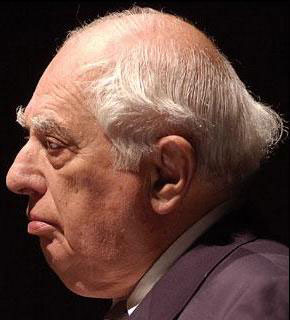
Bernard Lewis

David Seaton's News Links
The Turkish crisis is very complex and reveals as much or more about western contradictions in dealing with Islam as it does the Turkish or Muslim problems in dealing with the west.

Gideon Rachman of the Financial Times has written a very fine article about the present crisis which I've snipped for News Links. The part of Rachman's piece I most wanted to draw your attention to is Rachman's dissection of Bernard Lewis's view of Islam.

Possibly only Leo Strauss has had anywhere near Lewis's influence on the Neo-cons and probably Lewis has had a much more direct effect on the US Middle East policy disaster and the world view that drives it. This is the thinking behind where we find ourselves today. Understanding Lewis is essential and Rachman has "undressed" him in a half dozen lines. Brilliant. DS

Gideon Rachman: The Turkish paradox and the prophets of Eurabia - Financial Times
Abstract: Some of the same American conservatives who have argued passionately for Turkish membership of the EU are also now openly concerned that the character of western Europe is being changed by Muslim immigration. Europe, they shriek, is turning into "Eurabia". Yet one consequence of Turkish membership of the EU would be to grant 70m-plus Turks the right to emigrate anywhere they want in the EU. If you wanted radically to alter the demography of western Europe, admitting Turkey to the EU would be the best way of going about it. One of the world's leading experts on Turkish history is Bernard Lewis, a 90-year-old historian from Princeton University. But Mr Lewis is also a darling of the American neo-conservatives and perhaps the most eminent convert to the "Eurabia" thesis. Last month at the annual dinner of the American Enterprise Institute, an influential Washington think-tank, Mr Lewis accepted an award and gave a long, learned and rambling speech about the history of the "Muslim attack on Christendom". This, he argued, has gone through three phases and "the third wave of attack on Europe has clearly begun . . . This time it is taking different forms and two in particular: terror and migration." This is an extraordinary and dangerous argument. Mr Lewis was equating Osama bin Laden and Muslim immigrants. They are all part of the same attack on Europe. This seems a little rough on many of my neighbours in London. My local postman, hairdresser and convenience store owner are all Muslims. So are the schoolgirls who play football at my children's school - incongruously clad in headscarves and shorts. As far as I can tell, none of these people is intent on destroying western civilisation from within. The tell-tale danger sign in Mr Lewis's argument is that he constantly refers to Muslims in Europe as "they" - an undifferentiated mass. Near the end of his speech, he mused: "Is it third time lucky? It is not impossible. They have certain clear advantages. They have fervour and conviction, which in most western countries are either weak or lacking . . . " The problem with Mr Lewis's argument is that it fails to distinguish between a people and an ideology. Once you start thinking of the more than 15m Muslims living in Europe as a single, hostile bloc, you close the door to understanding and open the door to racism. Radical Islamism is a problem. Ordinary Muslims are not. READ IT ALL

Tuesday, April 24, 2007

PIPA/WorldPublicOpinion.org poll

David Seaton's News Links
The report excerpted below is a "must read", if ever there was one. It holds the keys to the future of relations with the 1.3 billion of the world's Muslims.

The majority of Muslims polled believe that their religion itself is under attack from the United States. They sympathize with many of Al Qaeda's goals, but feel that killing civilians is forbidden by Islam. They also are in favor of living under the Sharia (strict Muslim law), at the same time they are not against democracy or globalization.

My reading of this poll would be that the best way of defeating Islamic terrorism would be to stop fighting the idea of Islamic government in itself, but rather to strongly support that majority of orthodox Muslims that believe that harming civilians is forbidden by the Koran.

In short orthodox Islam is not our enemy, quite to the contrary, it is our essential ally. DS

Muslims Believe US Seeks to Undermine Islam - World Public Opinion org
Abstract: An in-depth poll of four major Muslim countries has found that in all of them large majorities believe that undermining Islam is a key goal of US foreign policy. Most want US military forces out of the Middle East and many approve of attacks on US troops there. Most respondents have mixed feelings about al Qaeda. Large majorities agree with many of its goals, but believe that terrorist attacks on civilians are contrary to Islam. There is strong support for enhancing the role of Islam in all of the countries polled, through such measures as the imposition of sharia (Islamic law). This does not mean that they want to isolate their societies from outside influences: Most view globalization positively and favor democracy and freedom of religion. These findings are from surveys in Egypt, Morocco, Pakistan, and Indonesia conducted from December 2006 to February, 2007 by WorldPublicOpinion.org with support from the START Consortium at the University of Maryland. Large majorities across all four countries believe the United States seeks to “weaken and divide the Islamic world.” On average 79 percent say they perceive this as a US goal, ranging from 73 percent in Indonesia and Pakistan to 92 percent in Egypt. Equally large numbers perceive that the United States is trying to maintain “control over the oil resources of the Middle East” (average 79%). Strong majorities (average 64%) even believe it is a US goal to “spread Christianity in the region.” “While US leaders may frame the conflict as a war on terrorism, people in the Islamic world clearly perceive the US as being at war with Islam,” said Steven Kull, editor of WorldPublicOpinion.org. READ IT ALL

Friday, January 05, 2007

Bush's African "strategery"

The CIA Factbook lists Ethiopia's religious makeup as " Muslim 45%-50%, Ethiopian Orthodox 35%-40%, animist 12%, other 3%-8%".
David Seaton's News Links
While waiting for Bush to unveil his new "strategery for victory" in Iraq , it's easy to take one's eyes off Somalia, but that would be a mistake. The Horn of Africa is one of Brent Scowcroft's major "choke points" for the flow of oil to America and its allies (clients, satellites, whatever). Ethiopia, which is one of the poorest countries in the world has invaded and is currently occupying Somalia. Let's have a closer look at the situation:
"The stability that emerged in southern Somalia after sixteen years of utter lawlessness is gone, the defeat of the ruling Islamic Courts Union now ushering in looting, martial law and the prospect of another major anti-Western insurgency.(...)the Bush Administration, undeterred by the horrors and setbacks in Iraq, Afghanistan and Lebanon, has opened another battlefront in this volatile quarter of the Muslim world. As with Iraq, it casts this illegal war as a way to curtail terrorism, but its real goal appears to be to obtain a direct foothold in a highly strategic area of the world through a client regime. The results could destabilize the whole region. The Horn of Africa, at whose core Somalia lies, is newly oil-rich. It is also just miles across the Red Sea from Saudi Arabia and Yemen, overlooking the daily passage of large numbers of oil tankers and warships through that waterway. The United States has a huge military base in neighboring Djibouti that is being enlarged substantially and will become the headquarters of a new US military command being created specifically for Africa.(...)The Ethiopian military presence in Somalia is inflammatory and will destabilize this region and threaten Kenya, a US ally and the only island of stability in this corner of Africa. Ethiopia is at even greater risk, as a dictatorship with little popular support and beset by two large internal revolts by Ogadenis and Oromos. It is also mired in a military stalemate with Eritrea, which has denied it secure access to seaports. It now seeks such access in Somalia." Salim Lone - The Nation
And, hey, the majority of Ethiopia's population is Muslim! If anyone reading this post is of draft age or is the parent of someone who is of draft age or going to turn 18 in the next 10 years, I suggest watching the Horn of Africa very closely. If the US continues any farther down this path, it will need thousands of infantrymen/women to patrol. Don't expect the Democrats to be much help either, most of this is "bipartisan"... Bush is just incredibly clumsy executing this stuff (that is actually his greatest virtue). Clinton was a political magician like David Copperfield, but Bush is like some magician at a children's party: rented tux, cards falling out of his sleeves, who reaches into his top hat and comes up with a handful of rabbit shit. Don't knock it, this how us kiddies finally learn how to spot the tricks. DS
Invading Somalia is no recipe for stability - Editorial - Financial Times
Abstract: (...) If the Ethiopians stay they risk uniting much of Somalia against them. If they go, as they say they soon will, they will leave a political vacuum, with Somalia's well-armed clans scrabbling over the carcass of the country. Eventually, it will almost certainly be the more disciplined but now radicalised Islamists that end up holding the ring. We are, in short, looking at yet another geopolitical disaster, which could spread fighting across the Horn of Africa, a region at the crossroads of the Middle East and Africa that is already blighted by floods and drought, famine and desertification, with a long history of conflict. To the north, Ethiopia's arch-rival, Eritrea, is already sending arms to the Islamists, while, to the south, the fighting has reached the borders of north-east Kenya. Admittedly, Somalia has presented peculiar difficulties since it imploded as a state 15 years ago. Its people emerged shattered from colonialism. Although among the most homogeneous in Africa, with the same language and Muslim religion and largely from the same ethnic group, they have built their identities around six rival clans and tributaries of feuding sub-clans. One can see moreover, why Somalia presses so many American buttons. As a failed state in transition from warlords' rule to an Islamist emirate, it resembles Afghanistan. The humiliation of the failed US intervention in Mogadishu in 1993 - the Black Hawk Down episode - ranks with the headlong retreat of US marines from Beirut a decade earlier. A quick, ostensible victory must also have looked very tempting for a Bush administration responsible for the debacle in Iraq. Washington claims the Union of Islamic Courts is allied to al-Qaeda. That looks as doubtful as the recent record of US intelligence. Certainly, the Islamist alliance has its extremists. Their influence and audience is now set to grow exponentially. And Somalia could indeed become a new magnet for and incubator of jihadi terrorism - just as Iraq did after the US invasion. This invasion is not the answer to Somalia's problems. Whatever the intentions of Addis Ababa and the increasingly assertive government of Meles Zenawi, the Ethiopian leader, his country is too poor and, with very long borders, too porous to stay in Somalia. The transitional government, by itself, lacks all credibility. It was created in Nairobi and confined, until last month's invasion, to Baidoa, close to Ethiopia's border. It never asserted its authority; its prime minister, Ali Mohammed Gedi, does not even command the support of his sub-clan. The Islamist alliance was able to restore order in Mogadishu and even open the ports. Its methods are brutal but Sharia law is widely accepted and, in current conditions, welcomed in Somalia. The Islamists, moreover, are not going away. Their retreat looks like the tactical prelude to guerrilla war. READ IT ALL

Wednesday, January 03, 2007

Iraq: hard questions

David Seaton's News Links
Is the descent into civil war and anarchy in Iraq, and the Sunni/Shiite split that is developing there, really what was planned in the first place? Is this conflict, which may soon engulf the world's entire Islamic community, the real objective of the invasion of Iraq? As the disaster unfolds, we can see that Iraq with its mixture of oil and ethnic tensions, which was artificially cobbled together at the end of WWI, is a center of gravity of the Middle East and by extension much of the Muslim universe. By destroying the Iraqi state apparatus, have the props been knocked out from underneath the entire jerry-built edifice that the British and French constructed from the remains of the Ottoman empire? Were the doubts that kept George H.W. Bush, James Baker and Brent Snowcroft from pushing on to Baghdad in the First Gulf War, precisely the germ of the strategy for the present conflict? In other words: is what, up till now, has appeared to be only the effects of colossal ignorance, stupidity and poor organization, in fact a deliberate strategy of breathtaking cruelty and malice? Have the neocons, with their links to the Israeli ultra-right, maneuvered the United States into provoking a worldwide civil war among Muslims? DS

Saturday, December 23, 2006

Americans are so surprised

David Seaton's News Links
One of my favorite "how dumb Thomas Friedman is" stories, is in fact an anecdote that holds a key to understanding the entire predicament that the USA has gotten itself into. The story concerns a visit Friedman made to a Pakistani madrassa, famous as the alma mater of many of the most illustrious and most fanatical of the Afghan Taliban. Following the Islamic traditions of hospitality, Friedman was received politely and offered refreshment. While they chatted, our Tom and the headmaster or head Iman of the school sipped at bottles of chilled Coca Cola. The Iman roundly and eloquently denounced the policies of the United States in the Muslim world. Friedman than asked him with an air of "gotcha", "If you don't like America's policies, why do you drink Coca Cola?" as if that were an "end of argument" crusher. The Iman calmly replied, "Because Coca Cola is sweet, but America's policies are poisonous." In a sense, the cultural problem that is at the heart of America's present failure is all there in a nutshell in that story. In their heart of hearts, most American's think that everybody, everywhere, wants to be American too... That Hamburgers and Coca Cola are mysteriously transubstantiated into the "body and blood" of the United States of America and in partaking of them, somehow foreigners join in the "mystical body" of the USA and become in some way American too. But, if you like Sushi and eat enough of it, do you develop palpebral folds on your eyes? If you own a Mercedes Benz, are you in danger of invading Poland? Like the Iman pointed out, in reality, people take the USA a la carte, what they like they take and what they don't they don't. The big mistake almost all Americans are making now is to think that they are being attacked, when if fact they are being counterattacked, they have been just too self-absorbed to ever know, or even care what was being done all over the world in their name. And now that the new technologies make it possible, they are surprised that somebody who drinks Coke could explode right next to them. If you imagined Sitting Bull and Crazy Horse with the Internet and prostrated toward Mecca, you might get some idea of what we are looking at. DS