Showing posts with label Syria. Show all posts

Sunday, November 22, 2015

Blood in Paris and beyond...

What follows is a sort of smorgasbord-compass that I have put together to help me, and hopefully others, get some idea of where this mess we now find ourselves in comes from and where it might lead us,

I hope the material quoted below might help to provide readers with a workmanlike framework for thinking about the new era we have entered into, with  ISIS' attacks on Paris...  a conflict which might be turning into the "Third Gulf War" or even WWIII.

We begin with what I would call the "mantra" to repeat constantly while reading, watching and hearing the news these days:
Multiculturalism is not a naive liberal aspiration — it is the reality of the modern world
This is simply reality:

With globalization and its new communication tools, we have all been thrown together brutally, helter skelter, in a worldwide, multinational-economy-mishmash, with no regard for history, culture, faiths or national idiosyncrasy, like having several different, large families, who don't even speak the same language, shut up together in the same small flat, sharing, bedrooms, kitchen... and bathroom. And somehow we are going to have to learn to live like this together in peace and harmony or else.

The French part of all of this not that new, the unrest among young French citizens of North-African origin has been growing for some time, it came to a head 10 years ago:
In October and November of 2005, a series of riots occurred in the suburbs of Paris and other French cities, involving the burning of cars and public buildings at night.  The unrest started on 27 October at Clichy-sous-Bois, where police were investigating a reported break-in at a building site, and a group of local youths scattered in order to avoid interrogation. Three of them hid in a power-station where two died from electrocution, resulting in a power blackout. (It was not established whether police had suspected these individuals or a different group, wanted on separate charges.) The incident ignited rising tensions about youth unemployment and police harassment in the poorer housing estates, and there followed three weeks of rioting throughout France. The rioters were the children of immigrants from North Africa and Sub-Saharan Africa for whom Islam was an inseparable component of their self-identity which strengthened their sense of solidarity, gave them the appearance of legitimacy and drew a line between them and the French. Wikipedia
Why are there so many  North-African Muslims living in France?

After WWII there was a literally wonderful period of never before experienced prosperity in France:
Les Trente Glorieuses (French pronunciation: ​[le tʁɑ̃t ɡlɔʁjøz], "The Glorious Thirty") refers to the thirty years from 1945 to 1975 following the end of the Second World War in France.(...) Over this thirty-year period, France's economy grew rapidly like economies of other developed countries within the framework of the Marshall Plan such as West Germany, Italy and Japan. These decades of economic prosperity combined high productivity with high average wages and high consumption, and were also characterized by a highly developed system of social benefits. Wikipedia
Because of this economic boom there was a tremendous need for low-paid manual labor, which the native French population couldn't satisfy and at the beginning of "The Glorious Thirty" most immigrants came from poorer southern European countries like Spain, Italy, Greece and Portugal... white and Christians.  Many of them became totally assimilated, took French nationality and have become quite successful. The mayoress of Paris was born in Spain and so was the present Prime Minister's father. However in the mid-1960s the economies of these southern European countries also began to boom and they dried up as a source of cheap labor for France.

At this point, still booming France turned to its former colonies in North Africa for the workers who would accept low pay doing the dirty jobs the French didn't want to do and southern Europeans didn't need to do anymore... And when in the 70s, the economy cooled off, the North Africans were left stranded in immigrant urban ghettos, and unlike the southern Europeans, they had nowhere to go back to, as things were even much worse in North Africa than in France.

So you could say that in some way, today the French are paying their imperial "karma":
Paris, November 20, 2005 - 'We're here because you were there'
Three Weeks of urban rioting by thousands of children and grandchildren of post-colonial migrants have finally forced France to grapple with the bitter fruits of its fallen empire. The lesson should not be lost on any Western nation. It is encapsulated in the slogan that activists have been employing throughout Western Europe for the past few decades: "We are here because you were there." Gregory Rodriguez - LaTimes
What has turned the secular urban riots of 2005 - rather similar to the "burn baby burn" riots in the USA during the Civil Rights period of the 1950s and 60s - into the militarily organized horror of ISIS' attacks in today's Paris?

The answer is simple: Ideology, that is to say, structure for action.

Wahhabite Islam is the specific ideology that is structuring the turbulence. You might say that Whahhabism is a sort of Muslim version of "ultra-Calvinism", iconoclastic: lunatic-fringe, but very, very well financed:
Wahhabism has been accused of being "a source of global terrorism", inspiring the ideology of the Islamic State of Iraq and the Levant (ISIL), and for causing disunity in Muslim communities by labeling Muslims who disagreed with the Wahhabi definition of monotheism as apostates (takfir), thus paving the way for their execution for apostasy. It has also been criticized for the destruction of historic mazaars, mausoleums, and other Muslim and non-Muslim buildings and artifacts. The "boundaries" of what make up Wahhabism have been called "difficult to pinpoint", but in contemporary usage, the terms Wahhabi and Salafi are often used interchangeably, and considered to be movements with different roots that have merged since the 1960s.But Wahhabism has also been called "a particular orientation within Salafism", or an ultra-conservative, Saudi brand of Salafism.
That's right, the center of this ideology is coming from the ancestral home of Osama bin Laden, straight from the world's filling station, Saudi Arabia.  Literally every time you fill up your gas tank you might be financing Al Qaeda or ISIS (Daesh):
Daesh has a mother: the invasion of Iraq. But it also has a father: Saudi Arabia and its religious-industrial complex. Until that point is understood, battles may be won, but the war will be lost. Jihadists will be killed, only to be reborn again in future generations and raised on the same books. Kamel Daoud - New York Times
I'll try to illustrate the center of the problem, past, present and future with this simple photo-montage:
Charlie Foxtrot
The the best caption I could find for these photos is...
Clusterfuck ‎(plural clusterfucks) (slang, vulgar) A chaotic situation where everything seems to go wrong. It is often caused by incompetence, communication failure, or a complex environment. Wiktionary
To be continued... DS

Tuesday, October 13, 2015

Putin's Question, Syria and the future of the Middle East

"Instead of the triumph of democracy and progress, we got violence, poverty and social disaster — and nobody cares a bit about human rights, including the right to life, I cannot help asking those who have forced that situation: Do you realize what you have done?" Vladimir Putin - UN


There is a general consensus in the "West" that Vladimir Putin is a thug: however, in a manner reminiscent of Vito Corleone, he is a thug whose plans and his way of carrying them out make sense. By making sense I mean that it is easy to understand what his goals are and his ways of achieving them. I think it is perfectly evident that for good or for bad, Putin "realizes what he is doing".

Many sour-grape-ish commentators say that Russia is entering a "quagmire" in Syria like the USA did in Vietnam and Iraq. I beg to disagree. Syria's army is nothing like the "client armies" of South Vietnam or Afghanistan. 

Assad's Alawite community, a minority which controls the Syrian army and state, are literally fighting for their lives, because if they lose to the radicals of the Sunni majority, they will, minimally, be ethnically cleansed and quite possibly, (if ISIS stays true to form) be literally "put to the sword"... So given superior (Russian/Iranian) leadership, air-support, equipment, intelligence etc, they can be counted on as a motivated, effective force. They are joined by Hezbollah, the only military force in the world that has ever defeated Israel on the battlefield and by elements of the crack Iranian Revolutionary Guard. 

I think that given this support, they and their allies should be able to quickly roll back the al-Nusra Front of Al-Qaeda favored by the Arab powers and the ragtag "moderates" that Washington favors... before turning their attention to the ISIS.

What has Putin achieved by this?
  • He has guaranteed the survival of his Mediterranean naval base in Tartus, the only military base that Russia has outside the former Soviet Union.
  • Russia is again the most influential foreign power in Iraq, just as it was in the day of Saddam Hussein.
  • Russia is now the most influential foreign power in Iran.
  • In short, in only a few, relatively inexpensive,  moves, Russia is now again a major player in the Middle East chessboard, just as it was during the height of the Cold War. What does this mean?
  • It means that Russia is now in position to put a lot of pressure on Saudi Arabia.
Why should they want to put pressure on Saudi Arabia?

Chercher le pétrole.
Putin – who, as a former member of the KGB, is a product of the Cold War – is today faced with the same dilemma as his Soviet forebears. The collapse in oil prices, which has been engineered by America’s major allies in the region – Saudi Arabia, the United Arab Emirates, Qatar and Kuwait – is crippling the Russian economy.(my emphasis) The Telegraph
It must be said that the initial reason for lowering oil prices by over-producing was to break the American fracking industry by making it unprofitable... it has had other, perhaps underestimated consequences:
Russia’s currency and economy, already squeezed by Western sanctions, have been sent into virtual free fall by slumping oil prices. The International Monetary Fund predicted in July that Russia’s economy would shrink 3.4% this year, the most of any major emerging market. Wall Street Journal

Chercher le pétrole
Thus, hoist by their own petard, low oil prices are also threatening the stability of the Saudi Monarchy.
The Saudi government has banned official purchases of cars and furniture and slashed travel budgets and infrastructure spending as it faces its gravest fiscal crisis for years because of low oil prices.(...)Saudi Arabia had been hit by the “unfortunate coincidence of a royal succession and a sudden precipitous decline in oil revenue”, Hertog said, adding that the cost of public-sector bonuses, the war in Yemen and aid to regional states such as Egypt had pushed up the estimated break-even oil price to $110 a barrel. The Guardian
To top it off, as you can see below, Saudi Arabia's oil and gas infrastructures are extremely vulnerable to any hostile action coming from Iraq, Iran or Syria, any of which would surely lead to a big jump in the world oil price, which would restart the Russian economy... and probably cause a recession everywhere else.
Saudi Arabia's vulnerable oil infrastructure 
Hat Danil Parker
Russia's pressure seems to be having some effect:
Oil prices are on course for one of the biggest weekly gains in six years as rising geopolitical tensions and signs of slowing output brought buyers back to the market. Financial Times

The greatest danger in all of this, would be that too much austerity and subsequent unrest in Saudi Arabia could easily lead to the fall of the Saudi monarchy, considered by most pious Muslims as a brood of degenerate libertines. This family, and certainly not the people of Saudi Arabia, are the ones who have a "special relationship" with the USA since the days of FDR. Their fall would certainly not lead to any "Arab Spring" with Saudi ladies ripping off their veils and donning miniskirts... quite the contrary. An "Islamic Republic of the Holy Places" would be the natural location for the Caliphate that ISIS dreams of, and if Daesh took over, the "Meccan in the Street", would hardly notice the difference.

Here is a sample of daily life in Saudi Arabia under the rule of our "special friends" there:
A young Saudi Arabian man is facing crucifixion after beheading for attending an anti-government protest in 2012, when he was 17. The Times
Decapitations are routine in Saudi Arabia, America’s closest Arab ally, for crimes including political dissent—and the international press hardly seems to notice. Newsweek
Saudi authorities have already carried out 90 executions since the beginning of 2015, more than the 88 for all of 2014. Forty-one of the ninety people executed since the start of 2015 were sentenced for non-violent drug offenses. Human Rights Watch - MintPress
And unfortunately, oil is not all Saudi Arabia exports:
Saudi Arabia remains perhaps the most prolific sponsor of international Islamist terrorism, allegedly supporting groups as disparate as the Afghanistan Taliban, Al-Quaeda, Lashkar-e-Taiba (LeT) and the Al-Nursa Front. Edward Clifford - Brown Political Review
Sunni clerics are mounting increasingly vociferous calls for Saudi Arabia and the Gulf states to take action on behalf of Syrian rebel groups targeted by Russian air strikes. The pan-Arab Muslim Brotherhood and a group of 55 Saudi clerics this week called for jihad against the Russians in Syria. Saudi Arabia’s highest religious body, the Council of Religious Scholars, has accused Moscow, along with Iran and its Shia Lebanese proxy, Hizbollah, of aiding the regime of Bashar al-Assad “in the killing of the Syrian people and the destruction of their country”. It called on the nation to do all it can to support the “oppressed and mujahideen” of Syria. The growing pressure for action leaves the Saudi ruling family facing a dilemma. Riyadh has long called for Mr Assad’s overthrow and has supported so-called moderate rebels in Syria. But it fears that the clerical calls for action could inflame young Saudis, thousands of whom have traveled to join the fighting in Syria. The Islamist militants Isis have already launched attacks on Saudi Arabia and the government is cracking down on those traveling abroad in an effort to crush the group’s cells in the country. Financial Times
Since America's staunchest allies in the Middle East are Saudi Arabia and Israel, (which unlike Riyadh has about 1,200,000 Russian inhabitants) all of this is rather bad news, to say the least.

Putin certainly went to the heart of the matter with his question, "Do you realize what you have done?".

It is a question I've often asked myself: do Americans really understand what American foreign policy has been doing all these years and its consequences for their prosperity and safety?

Like many of my generation I started wondering if the American  foreign policy establishment realized what it was doing during the war in Vietnam,.. with Pinochet, Iran-Contra, etc to follow.

Just a short list of things, going back some time, with lots left out, that apply to today's situation in the Middle East:

With the help of Saudi Arabian financing, the USA introduced fanatical Wahhabi Islam to Sufi Afghanistan and to nuclear weaponized Pakistan and then literally "invented" Osama Bin Laden. All this was done to bring down a government in Kabul where little girls were allowed/encouraged to go to school and their mothers could even go shopping (without wearing a tent). Then during the First Gulf War the USA stationed pork consuming, American, soldiers in Saudi Arabia, which led to Bin Laden's creating Al Qaeda... Then in the Second Gulf War the USA totally destabilized Iraq leading to the appearance of the ISIS.

I know it's bad form to quote oneself, but only a couple of postings ago I asked:
What is truly impressive, especially in the American case, is that despite being the richest, most powerful country in history, with the most massive military the world has ever seen, with a huge educational establishment boasting the world's most prestigious universities... a country literally overrun with "think tanks", despite all of this, the "indispensable nation" continuously gives the impression of being the Global Village idiot. How to explain this? 
In the case of the Middle East, I like to think it is pure stupidity, because any other explanation leads into the sinister, tinfoil-hat-land's house of mirrors where the great paranoiac conspiracies slither... A very, very, dark and humid, dangerous place, a place where I don't wish to go. DS

Sunday, September 15, 2013

Chutzpah, thy name is Putin

David Seaton's News Links
Vladimir Putin 2
"We are all different, but when we ask for the Lord’s blessings, we must not forget that God created us equal." Vladimir Putin

"What a crazy world we are living in when Russia sounds more sane and responsible than our own government on a serious international crisis. It's as if I have blundered into some bizarre parallel universe." NYT reader, "John C", commenting on Putin's Op-Ed

Many decades from now, a historian looking at where America lost its way could use This Town as a primary source. Fareed Zakaria - CNN
The Syrian poison gas affair has been running its course while I have been reading Mark Leibovich's bestseller on how today's Washington works, "This Town: Two Parties and a Funeral-Plus, Plenty of Valet Parking!-in America's Gilded Capital", which I still haven't finished yet, because I have to put it down every few pages to keep from throwing up. However Leibovich's portrayal (undressing really) of today's Washington was a great help in understanding what Russia's Vladimir Putin has just pulled off.
Even more than Leibovich, what Putin has done, cynical cad that he is, is to have undressed Washington and after having undressed the poor lady, has "had his way with her", and then has run straight off to tell all his drinking buddies all about it and they all have had a big hairy chested laugh at Washington's expense. Vlad, "the impaler"!
What has really given me the key to where Putin is taking all of this is the closing line of his New York Times Op-Ed, "We are all different, but when we ask for the Lord’s blessings, we must not forget that God created us equal.". Not only does he quote Thomas Jefferson, he talks about "the Lord’s blessings", all in one phrase.
Younger readers or those with a very short memories, may not know, or may have forgotten, that during the ideological struggles of the Cold War, the United States not only defended the capitalist system, it also portrayed itself as the staunchest of defenders of religion and traditional values in the face of "godless communism". This was a smart move since, although very few people in the world have any capital, much, perhaps most, of the world's population, especially in those traditional societies, rich in natural resources, are "believers" and socially conservative. And not only in "backward" countries: this was even true in the Soviet Union itself!
During the years of glasnost, before the collapse of the USSR, I was much surprised to learn from Spanish friends who were dealing on a daily basis with Soviet officials that all these loyal Communist apparatchiks confessed that they had been baptized and indoctrinated in the forbidden Christian practices by their grandmothers from childhood. The babushkas had kept religion alive in Russia. I think that was when I first realized that the Soviet system's goose was really cooked.
What Putin is doing is to turn the entire Cold War paradigm inside out like a glove and make Russia the world's defender of social conservatism and the USA as the center of newfangled depravity.
Americans may not realize, or rightly may not care, that with reforms such as gay marriage, we have left much of the developing world behind us, scandalized, offended, or simply scratching their heads. And not just the developing world, even in Paris, a city celebrated over centuries for its sexual tolerance...
Tens of thousands of people have rallied in Paris against a new French law allowing same-sex marriage. Police estimate that up to 150,000 people joined marches that converged on the city centre, but organisers put the figure close to one million. Clashes erupted after the rally finished between far-right activists and riot police. The authorities said nearly 100 people were arrested. On Saturday 50 people were detained for blocking the Champs-Elysees. The same-sex marriage bill, which also legalises gay adoption, was signed into law by President Francois Hollande last week, after months of heated debate. French people have been bitterly divided over the issue. On Tuesday, a far-right historian shot himself dead in Notre Dame cathedral, leaving messages in which he denounced gay marriage. BBC
This is not to suggest we should change or that we don't have a right to do and think as we wish, but at the same time we should realize that this principled stand may offer openings for opportunist adversaries to exploit. This is precisely what Putin is doing:
On July 3, Mr. Putin signed a law banning the adoption of Russian-born children not only to gay couples but also to any couple or single parent living in any country where marriage equality exists in any form. A few days earlier, just six months before Russia hosts the 2014 Winter Games, Mr. Putin signed a law allowing police officers to arrest tourists and foreign nationals they suspect of being homosexual, lesbian or “pro-gay” and detain them for up to 14 days.(...) Earlier in June, Mr. Putin signed yet another antigay bill, classifying “homosexual propaganda” as pornography. The law is broad and vague, so that any teacher who tells students that homosexuality is not evil, any parents who tell their child that homosexuality is normal, or anyone who makes pro-gay statements deemed accessible to someone underage is now subject to arrest and fines. Even a judge, lawyer or lawmaker cannot publicly argue for tolerance without the threat of punishment. New York Times
As deeply shocking and offensive as we may find the above, you can believe that it plays very well in Africa, the Middle East, India, most of Asia... and perhaps in places much, much nearer home than that.
To me the sequence of events all falls together neatly: the reactionary anti-gay laws, the Snowden revelations, the Syrian ballet... the objective is to degrade the image and the narrative that USA has created for itself and for the world. If this is all coincidence and not part of a plan and he has just cleverly taken advantage of these random events, then Putin is the greatest improvisor since Charlie Parker died.
Why is he doing this?
Simply because he is a Russian nationalist and he wants Russia to again be the great power it was less than a generation ago and not have rules dictated to it from Leibovich's Washington ... and all is fair in love and war. DS

Monday, September 09, 2013

Obama's War

David Seaton's News Links
Everything about "Obama's War" is like a bad dream after a heavy meal or some sort of zombie film. It all reeks of decadence and idiocy. So stupid that I have problems writing about it.
They say that history repeats itself. I said that this was all like "a bad dream after a heavy meal", but I think it would be more accurate to have compared "Obama's war" to an endless series of belches after said meal. Forget the Cruise missiles, bring on the Eno's Fruit Salts! DS

Tuesday, March 26, 2013

Obama's triumphal entry into Jerusalem... yada yada yada

David Seaton's News Links
The US is hoping that Obama's positive first trip will reinvigorate peace efforts, though most settlers are not worried. They see the composition of the new Israeli cabinet as a reassurance that Israeli policy will move away from peace negotiations. Christian Science Monitor
Obama's visit to Israel was strictly for domestic American consumption, because unless the president and Netanyahu took a decision on when to attack or not attack Iran or intervene in Syria's civil war, which they could have done by telephone, his trip was strictly a public relations exercise, certainly it wont affect the "Peace Process" or lead to Palestinian statehood.
The much talked about "Two State Solution" is not stalled or even dead, it never existed: it and the "Peace Process" said to be leading to the founding of a "viable, contiguous, Palestinian state",  or even a Bantustan, was never more than a way of stalling, killing time, running out the clock. Israel has been waiting for a moment that now appears to be fast approaching: the disintegration of the Middle East as the west has known it since the end of World War One. In a short time all of the borders that were designed during the First World War by Britain and France  to suit western interests, will now probably become undefined, fluid if not gaseous... just as Israel's own borders are.
You may not have noticed, but Israel's frontiers have been undefined since 1967. The objective of the Israelis in avoiding the "Two State Solution" is  to not define them "prematurely", before all the pieces on board start to move.  In times like these, the last thing the Israelis want is to be the only ones with firmly drawn frontiers when all other borders in the Middle East are going to be negotiable. The settlers are not an "obstacle to peace", they are merely an excuse for Israel not to define those frontiers.
This Middle Eastern disintegration has been a long time coming and perfectly foreseeable by anyone as cool headed and long headed as the Israelis. The neocon led invasion of Iraq with its "real men go to Tehran" leitmotif, was itself a desperate, Hail Mary pass, attempt to control the events that are now taking place with that certain spontaneity of what looks like a historically driven process.
"What we're seeing here is, in a sense, the growing—the birth pangs of a new Middle East, and whatever we do, we have to be certain that we're pushing forward to the new Middle East, not going back to the old Middle East". Condoleezza Rice - 2006
Just in case you don't know what the "old Middle East" looked like, check this map... As you can see, it's mostly about Turkey and Iran... Not many borders visible except theirs and Britain's protectorates and today the British, who used to control Egypt, are no longer players... and as you may have noticed lately, America's once smothering grip on the area is fading fast.
Map-ME-1914
At this moment Syria is literally disintegrating, spewing nearly half a million refugees into tiny, neighboring  Jordan, where the Palestinian majority is permanently restless and the influence of the Muslim brotherhood is growing. The Muslim Brotherhood controls Egypt and Hamas in Gaza is an offshoot of the Brotherhood; and then there is always Al Qaeda which is growing exponentially in the Syrian conflict. So much for the Sunnis
As to the Shiites: Iran besides working diligently on developing atomic capabilities is fighting a proxy war alongside Assad in Syria, is the major power influence in Iraq and is heavily arming  Shiite Hezbollah on Israel's Lebanese border...
What could the Israelis expect to achieve as all this comes unraveled and the shooting starts?
Simple: they could ethnically cleanse Judea, Samaria, Gaza (and maybe Israel itself too while they are at it) all in the midst of the confusion of a military free for all.  Chaos with thousands of refugees simultaneously in movement everywhere... and when the dust settles, let the Palestinians establish their "viable and contiguous state" on the ruins of the Jordanian monarchy as a Sunni buffer between Israel and Shiite Iraq... if they so desire.
Who thought all this up? Ariel Sharon, I should imagine, who else? DS

Saturday, June 09, 2007

This summer's great war in the Middle East

David Seaton's News Links
There is a very good chance of a US attack on Iran,with Israel attacking Syria, Hamas and Hezbollah this summer: Bush and Olmert are the lamest of ducks and a "double or nothing" ploy is well within their characters. The chances that Israel could lose this war are the greatest (in my opinion much greater) than at any time since 1948.

Before undertaking a war, it is vital to have a very clear idea of what victory would look like. That is certainly missing here. But, defeat could take many forms.

Losing the war could mean making a supreme effort and reaching no more than a stalemate or having to resort to "first use" of atomic weapons. Using the A-bomb to resolve a war that Israel and the United States had started.would mean taking on universal pariah status for generations. Not a good prognosis. DS

Syrian and Iranian Generals in Intensive War Consultations - Debka
Abstract: During most of last week, two high-ranking Iranian delegations spent time in Damascus. One was composed of generals who held talks with Syrian leaders on coordinated preparations for a Middle East war in the coming months. At the Iranian end, a similar high-ranking Syrian military delegation called in at Iranian army and Revolutionary Guards headquarters to tighten operational coordination between them at the command level, as well as inspecting the Iranian arsenal. The Syrian general staff will draw up a list of items it is short of for a possible military confrontation with Israel this summer. Our sources report that last week, Tehran sent Moscow a check for $327 m to pay for assorted missiles consigned to Damascus. A further $438 m has been pledged by the end of June for more hardware to Syria. Iranian foreign minister Manouchehr Mottaki’s three days of talks in Damascus at the end of May further consolidated the strategic partnership between the two governments under the mutual defense pact they signed a year ago.(...) The regime heads in Tehran are basing their common front with Damascus on intelligence reports whereby the US and Israel have drawn up plans for coordinated military action against Iran, Syria and Hizballah in the summer. According to this hypothesis, Iranian leaders foresee the next UN Security Council in New York at the end of June or early July ending with an American announcement that the sanctions against Tehran are inadequate because Russia and China has toned them down. Therefore, the military option is the only one left on the table. The ayatollahs have concluded that US president George W. Bush is determined to bow out of office on the high note of a glittering military success against Iran to eclipse his failures in Iraq. They believe he will not risk the lives of more Americans by mounting a ground operation, but rather unleash a broad missile assault that will wipe out Iran’s nuclear facilities and seriously cripple its economic infrastructure. According to the Iranian scenario, the timeline for hostilities has already been fixed between Washington and Jerusalem - and so has the plan of action. The US will strike Iran first, after which Israel will use the opportunity to go for Syria, targeting its air force, missile bases and deployments, as well as Hizballah’s missile and weapons stocks which Iran replenished this year. Officials in Tehran and Damascus find confirmation of their intelligence evaluations in the visit Israel’s transport minister Shaul Mofaz paid to Washington last week at the head of a large military delegation. They are certain Mofaz, a former defense minister and chief of staff, used the strategic talks to tie the last ends of the planned offensive. They were perturbed in particular by the Israel minister’s reported advice to secretary of state Condoleezza Rice of the importance of setting a deadline, beyond which the US will abandon sanctions as ineffective and turn to its remaining options for dealing with Iran’s advance towards a nuclear weapons capability. READ IT ALL

Tuesday, April 03, 2007

Rough notes on the empire death watch

David Seaton's News Links
As I said in the previous post I am loafing a bit this week with no deadlines to meet. However, being a firm believer in the old boxer's adage, "train hard, fight easy", I am engaged, little beaver fashion, in my reading so that hopefully by next week I'll have something useful to say about the horrible mess in the Middle East for my Spanish readers.

Meanwhile, I thought I'd share with you some partially digested material I've been looking at today.

On the eve of more possible conflict, the first thing to do would be to look to the state of forces to be employed. In military affairs, wise men say that amateurs speak of strategy but professionals talk about logistics. If that were the gauge, here is a clipping from the Washington Times, from an extremely professional article by Retired Maj. Gen. Robert H. Scales, former commander of the US Army War College that is anything but encouraging.
If you haven't heard the news, I'm afraid your Army is broken, a victim of too many missions for too few soldiers for too long. Today we have deployed to Iraq and Afghanistan all of our fighting brigades, both active and reserve. Every brigade save one in Korea has spent time in combat. Twenty have two tours there, nine have three and two have four. Some of these brigades' one-year deployments were extended by several months. To demonstrate the gravity of the problem, let's do the math. After the surge the nation will need to keep 33 brigades, each consisting of about 3,000 soldiers, in the field. Past experience tells us that three brigades are needed to keep one continuously in the fight (one recovering and one training up to support each deployed brigade). The Army could in theory maintain itself in combat indefinitely using such a scheme. From a human perspective, a three-for-one schedule would allow each soldier two years back for every year in combat. That is tough but sustainable. So, that means we need a total of 99 brigades to support 33 in the fight. Sorry to say, we only have about half that number available to the Army and Marine Corps.(...) Today, anecdotal evidence of collapse is all around. Past history makes some of us sensitive to anecdotes and distrustful of Pentagon statistics. The Army's collapse after Vietnam was presaged by a desertion of mid-grade officers (captains) and non-commissioned officers. Many were killed or wounded. Most left because they and their families were tired and didn't want to serve in units unprepared for war. If we lose our sergeants and captains, the Army breaks again. It's just that simple. That's why these soldiers are still the canaries in the readiness coal-mine. And, again, if you look closely, you will see that these canaries are fleeing their cages in frightening numbers. The lesson from this sad story is simple: When you fight a long war with a long-service professional Army, the force you begin with will not get any larger or better over the duration of the conflict. For that reason, today's conditions are pretty much irreversible. There's not much that money, goodwill or professed support for the troops can do. Another strange consequence is that the current political catfight over withdrawal dates is made moot by the above facts. We're running out of soldiers faster than we're running out of warfighting missions. The troops will be coming home soon. There simply are too few to sustain the surge for very much longer. READ IT ALL
After looking at the state of the forces, the next thing would be to look at the state of the alliances. America's diplomatic efforts led by Doctor Rice have been pointed toward creating an anti-Iran front among "moderate" Arab governments. Tony Karon of Time Magazine commented on the results in TomDispatch.
In reality, the Bush administration seems increasingly at odds with the consensus among the Arab moderates it claims to be leading. Saudi Arabia's King Abdullah, in particular, appears to have sent a signal of this in cancelling -- with little explanation -– a special state dinner that was to be hosted by President Bush on April 17th. Then, at Wednesday's Arab League Summit in Riyadh, the King followed up by demanding an end to the crippling financial siege of the Palestinian Authority imposed by the U.S. and denouncing the American military presence in Iraq as an "illegitimate foreign occupation." This is strong stuff from the Saudis. READ IT ALL
Strong stuff indeed, especially when you consider that the United States has been the sole guarantor of the the Saudi royal family survival since 1945... Some might consider the phrase, "illegitimate foreign occupation" coming from the King of Saudi Arabia as truly the "writing on the wall"... "You're dead son. get yourself buried".

As to European opinion, there is this snippet from Der Spiegel.
Forty-eight percent of Germans think the United States is more dangerous than Iran, a new survey shows, with only 31 percent believing the opposite.(...)(in) a Forsa opinion poll commissioned by Stern magazine. Young Germans in particular -- 57 percent of 18-to-29-year-olds, to be precise -- said they considered the United States more dangerous than the religious regime in Iran. READ IT ALL
In view of this state of European public opinion, I am not at all sure that the United States could have free use of its European bases in Germany, Italy or Spain or even the fly over use of their airspace in case of an American air attack on Iran.

Meanwhile, what is the word from America's most important ally, Israel? Here is an interesting clipping from Debka.
In his briefing to the Israeli cabinet Sunday, April 1, Maj. Gen. Amos Yadlin, AMAN chief, reported that Iran, Syria, Hizballah and Hamas expect the United States to attack Iran in the summer and they are preparing to retaliate by going to war with Israel. In Yadlin’s view, a proliferation of players and the many imponderables could ignite a conflict, which none of the parties wants – as happened in the Six Day War of 1967.(...) His comments came one day after Iran’s chief of staff, Gen. Hassan Fayrouz Abadi, urged the Arabs to hurry up and join Iran in a defense treaty because, he claimed, Israel threatened a war offensive in summer, two months hence. According to the Iranian general, Israel was bent on a “suicide assault” against a number of Arab states to save the Americans from having to pull their troops out of Iraq (sic).(...) Iran, Syria, Hizballah and Hamas may be presumed to be acting on some piece of intelligence that point to a forthcoming US attack some time between April and early September 2007. Therefore, the Middle East faces at least five months of incendiary military instability during which everyone will be braced for the axe to fall.(...) A coordinated Iranian-Syrian-Hizballah-Hamas attack would lay Israel open to four war fronts and the common weapon to them all: missiles - anti-tank, short-range surface, medium range ballistic and surface-to-air.(...) Hamas threatens to launch the third Palestinian uprising (intifada) against Israel within three months unless the international blockade is lifted and funds are released to the Palestinian Authority. The cabinet was informed that the IDF would start operating behind Gazan lines against the massive Palestinian military build-up. READ IT ALL
What about South Asia and the rest of the Muslim world?

There is a wonderful saying in Spanish, "eramos pocos y parió la abuela", which translates literally, "there were only a few of us and grandmother had a baby". It usually translates weakly into English as, "that was the last straw", which gives none of the surreal nuances of intense exasperation in the Spanish original. As to the reactions to a US/Israeli attack on Iran in Pakistan and its possible effect on the war in Afghanistan, you would do well to read this United Press International article by Arnaud de Borchgrave, said to have unsurpassed access to western intelligence services.
The U.S. intelligence community recently acquired a Pakistani insider's look at what makes Musharraf tick these days. As much as he wanted U.S. victory in Iraq, he has long since concluded the United States has lost the hand to Iran. To recoup America's loss before he leaves the White House in January 2009, Musharraf believes Bush will strike Iran's nuclear facilities from air and sea. And this, in turn, will unite Sunnis and Shiites in Pakistan against all things American -- and provoke a gigantic upheaval throughout the Middle East. With the whole world turning against Israel and the United States, he could not afford to continue his policy of "constructive ambiguity" toward the Bush administration.(...) What ISI reports to him from the European capitals that sent troops to Afghanistan under the NATO flag, and from numerous ISI operatives in 34 Afghan provinces on the other side of the Hindu Kush mountain range, is that NATO is losing ground to a resurgent and rejuvenated Taliban. ISI's conclusion: the NATO consensus on Afghanistan will not long survive a U.S. defeat in Iraq and/or U.S. hostilities against Iran.(...) Creeping Talibanization is now a reality across the length and breadth of one of the world's eight nuclear-weapons powers. Two of Pakistan's four provinces are already under anti-U.S., pro-Taliban governments. Musharraf has convinced himself that unless he could obtain another five years in power -- he took over in a military coup in 1999 -- Pakistan's nuclear arsenal would be at risk of falling under the control of Islamist extremists. READ IT ALL
Truly, eramos pocos y parió la abuela. DS

Iran.... My true confession: yes, we have no bananas

David Seaton's News Links
It's "Semana Santa" in Spain, Easter week. Thursday though Monday (Monday too in Barcelona) are holidays. Many people take the week off and travel and Good Friday is a total, everything shut down holiday, like Christmas, even Friday night... This means there are no newspapers published on Saturday. As my column appears on Saturdays, that means I don't have to write this week. Whew! What a relief.

If I did have to write, I would have to write about Iran and the Middle East and it is so confusing at the moment.

What my antenna are picking up, though, is that we are entering the most dangerous period that I can remember since the Cuban Missile Crisis. However that crisis was so stark, so clear, the players so few, the stakes so obvious, that the whole world sat on the edge of their seats, fingers crossed, "a pissin' and a prayin'"... a child could understand it.

But to analyze the situation in the Middle East at this moment is like standing at an open window trying analyze the flying contents of a pail of garbage that someone is dumping out of a higher window... it's all so mixed up, the coffee grounds with the banana peels.. and all moving so fast... better wait till it all hits the pavement and then pick through the mess at leisure... if that's to your taste.

I will give it a try in the next few days and am collecting material to that effect, but I confess to enjoying the lack of deadlines like a well fed pussycat curled up in the sunshine. DS

Tuesday, January 09, 2007

Opening the gates of hell - Wall Street Journal

David Seaton's News Links
When "Bush41", James Baker and Brent Scowcroft decided not to go all the way to Baghdad at the end of the First Gulf War it was because they knew that the possibilities of exactly the sort of catastrophe facing "Bush43" today were high. This was not because these men were especially clairvoyant or were "speaking in tongues", but because that was the opinion of most people with deep knowledge of the region. The potential for disaster in Mesopotamia has been evident from the days of T.E. Lawrence and Gertrude Bell. In other words the idea that Iraq could fall apart and take with it the entire jerrybuilt construction that Sykes and Picot had cobbled together out of the ruins of the Ottoman Empire was not exactly "rocket science", but in reality the opinion of most reputable experts at the time. Therefore, if only as hypothesis, I think we might begin to contemplate the idea that this disaster has been deliberately provoked. By whom?

The "usual suspects" in all the popular conspiracy theories surrounding the invasion of Iraq have always been "Oil and Israel". What could this "dynamic duo" possibly gain from such a hecatomb and horror? To begin with, if all the Muslims begin to fight with each other everywhere, the pressure on Israel to evacuate "Judea and Samaria" would lessen dramatically. What about the price of oil rocketing over $100 a barrel? Well, that would mean some huge profits for oil companies and remember that if Texas were an independent republic it would be a major member of OPEC... after all,
Texas was the first "Saudi Arabia". Sound nutty? You bet it does! Nuttier than the great "democratic renaissance" of the Middle East? "May you live in interesting times," is a famous Chinese curse. DS
Allies See 'Nightmare' In Iraq - Wall Street Journal - pg A1
Abstract: As President Bush prepares to unveil his latest Iraq strategy, Arab allies are worried about what might happen if the plan fails: that worsening strife could engulf the entire region, sparking a wider war in the middle of the world's largest oil patch. The potential of a much larger regional conflict that pits Sunnis against Shiites is increasingly on the minds of both Arab leaders and U.S. military planners, according to regional diplomats and U.S. officials. Some are calling such a possible outcome the "nightmare scenario." A wider conflict appears more plausible now because, even as Iraq is separating along sectarian lines, regional dynamics are shoving neighboring nations into two rival camps. On one side is a Shiite-led arc running from Iran into central Iraq, through Syria and into Lebanon. On the other side lie American allies Saudi Arabia, Jordan and Egypt, along with Persian Gulf states such as Qatar and the United Arab Emirates. These Sunni regimes are horrified at the emerging, increasingly radicalized Shiite bloc, largely financed and inspired by Iran, Arab diplomats say.(...) The Saudis have warned the Bush administration that they are prepared to aid the Sunni militias in Iraq if the Sunni population there becomes imperiled, a Saudi diplomat said. Jordanian officials have told the Pentagon that they may move troops into Iraq's uninhabited western desert as a buffer if events there spiral out of control, according to U.S. military officials. Turkish officials, who are grappling with a separatist Kurdish movement in their country, say they would oppose the creation of an independent Kurdistan in northern Iraq. They also say they are prepared to defend Iraq's Turkmen population, who share a common ethnicity with Turkey's majority population, should it come under attack. Even Syria, which the U.S. alleges has been abetting the conflict, is expressing alarm over the potential fracturing of Iraq.(...) The U.S. is also pushing a wide-ranging strategy to persuade its Sunni allies that it is serious about counteracting the rise of Iran -- in exchange for Arab help in Iraq and the Palestinian territories. Key to the effort is the continued promise to keep U.S. forces in Iraq for as long as necessary. But the U.S. is also beefing up U.S. forces in the Persian Gulf and plans to deepen security cooperation with Gulf allies. The Pentagon has proposed sending a second carrier battle group to the Gulf region. There are also advanced plans under way to knit together the air-defense systems of the six smaller Gulf states, including Qatar, Oman and the United Arab Emirates, and to build a U.S.-administered missile-defense system. Similarly, the Air Force is laying plans to step up exercises with Arab allies in the region. One proposal calls for the U.S. to hold combined air exercises with Oman and the UAE.(...) Under one scenario, sketched by Mr. White of the Iraq Study Group, Iraq's Shiites would launch an extensive campaign to drive the Sunnis out of large areas of central Iraq. Fearing a rout of the Sunni population, Saudi Arabia would finance a large-scale counteroffensive, funneling aid to former Iraqi military officers through Jordan, which has longstanding ties to Iraq's Sunni military class. Egypt would do its part by providing guns, munitions, artillery and vehicles. "What people forget is that the Sunnis comprise nearly the entire top brass of the former Iraqi army and nearly all of the old Republican Guard," says Mr. White. "You give them the guns and proper equipment and they will become a formidable force against the Shiite militias." The possibility of a full-blown civil war in Iraq dissolving into a regional conflict "is a scenario that nearly everyone was rejecting just a few months ago," he says. "Not anymore." READ IT ALL (subscription)

Thursday, December 21, 2006

New war staring us right in the face

David Seaton's News Links
The man in the picture here is Aluf Benn, the diplomatic correspondent of the highly respected Israeli newspaper, Haaretz. The article quoted below is published in the English edition of Haaretz, thus it is available for the whole world to read. It goes without saying that anything Aluf Benn publishes in his newspaper has passed several filters. Three of them come instantly to mind. First: the brains, knowledge and professional experience to pass the selection process for such an important post. Second: the editorial policy of the paper. Third: the general consensus of his colleagues and community as to what is responsible discourse. Conclusion: Aluf Benn is a sensible, reputed professional, not some nut spouting off on an electronic street corner. Read in this light, the following article by Mr. Benn is literally terrifying. DS
Four reasons for ranting - Haaretz
Abstract: The ideal scenario, from Israel's point of view, would be an American military attack that would destroy Iran's nuclear facilities and remove the threat. "We have to get the United States to carry out what it promised to do, and to create the proper international climate," explains a senior official. It is not clear what President Bush told Olmert in private talks that had him leaving Bush's office feeling so satisfied. We can only presume that Olmert is depending on Bush's religious faith and obstinacy, which will lead him to attack Iran, even in light of American public opposition to military adventures in the Middle East. When will that happen? The head of the Mossad spoke this week about an Iranian nuclear bomb in another three years. This leaves a year for diplomacy and sanctions, and moves H-hour for a military attack to 2008, if Iran continues its nuclear development. The timing is right politically. It will be Bush's last year in the White House, and he will be busy bequeathing his "legacy." It is a known fact that U.S. election years have always been years of dramatic moves in relations with Israel, from Harry S. Truman's recognition of the Jewish state to Bill Clinton's Camp David summit, to the "Bush letter" that recognized the settlements and the separation fence.(...) Former prime minister Ariel Sharon used to deny that Israel was planning to attack Iran on its own. Olmert prefers to hint at a military option. That's good for spurring the "world" into action, but it is also good for preparing Israeli public opinion for a complex conflict that is liable to continue for years. The experts disagree as to whether Israel has the ability to paralyze the Iranian project if it strikes it at critical points. It is clear that Israel would have to receive American approval for such an operation, and would prefer receiving it from Bush, who is friendly to Israel, rather than gambling on his successor. That is why even for this alternative 2008 will be the critical year.(...) Olmert wants to remain in the Golan, refuses to talk to Syrian President Bashar Assad and uses Bush's opposition as an excuse: Israel needs Bush to fight Iran, and we must not annoy him by babbling nonsense about peace with Syria. READ IT ALL

Monday, November 27, 2006

Israel: dangerous when cornered

David Seaton's News Links
Briefly described, the neocon plan for the Middle East theorized that the invasion of Iraq and its regime change, accompanied by much "shock and awe", would bring about regime change in Iran and Syria. The new regimes thus produced would forthwith sign peace treaties with Israel and this would leave the Palestinians isolated and thus forced to accept whatever conditions Israel willed. This strategy was expressed as, "the road to Jerusalem leads through Baghdad". Poof! That strategy lies in ruins. Turned inside out like a stocking. The United States is now in the death grip of the Middle East and is struggling to extricate itself. Now it appears that "the road to Baghdad lead through Jerusalem", in other words: for the USA to leave Iraq with even a shred of dignity intact it needs the cooperation of Iran, Syria and the various factions of Iraq who share a common hatred for the "Zionist entity" and will need to humble Israel in order to justify their concessions before their peoples. Therefore, any cooperation, peace plan, or peace conference will come at the expense of Israel, which will have to concede much, much, more than what Ariel Sharon termed, "painful concessions". To top it off, after their military, diplomatic and propaganda failure against Hezbollah last summer, the Israeli's military prestige is in tatters and their enemies emboldened. The Israeli rightwing will do anything and activate any resource to slow down or derail this momentum which is totally to their detriment. In my opinion many of the strange things that are occurring and may occur in the near future, in the Middle East and elsewhere, can be explained by the Israeli right's need to save what they can from the collapse of the neocon 'dream'. This article from the Financial Times lays out the elements without connecting the dots. DS
The assassination in Lebanon should not derail dialogue - Financial Times
Abstract: The assassination of Lebanese industry minister Pierre Gemayel last Tuesday sent shockwaves through the Middle East. It seemed to run counter to the growing momentum for diplomacy and co-operation that had seen Syrian ministers in Baghdad, the Iraqi president preparing to go to Tehran and calls in London and Washington for a change of course toward more constructive engagement with Syria and Iran. However, the killing necessitates a balanced policy of moving ahead with the United Nations special tribunal on assassinations in Lebanon while also reducing conflict and instability through constructive and multilateral dialogue.(...) At the international level, the murder disrupts the momentum in London and Washington for a fundamental change of approach in the Middle East. Regardless of who actually perpetrated it, much public commentary has laid the blame at the doorstep of Damascus. Syria has condemned the killing, denies any responsibility and protests that the act, carried out on the day that the UN Security Council was meeting to finalise the tribunal agreement, could not have been timed more effectively to hurt its interests. Nevertheless, the assassination revived international wariness of the Syrian regime and helped rush the tribunal agreement through the Security Council.(...) Despite the latest events, the logic of reaching out to Tehran and Damascus still holds. The two are major forces in the region and there is much to be gained from robust and responsible dialogue between them and the international community. With the removal of Saddam Hussein and the Taliban, Iran has made gains in the region, helped by the rise in oil prices. Iran will be an important participant in the future of Iraq and in the stability or otherwise of the Middle East. Despite sharp differences over its nuclear programme, Iran shares with other countries an interest in a stable Iraq. It seeks assurances that it will not be attacked or overthrown, that it will not be considered a pariah state and that its role in the region will be recognised. In exchange, it should be open to co-operation in Iraq, security in the gulf, as well as co-operation in stabilising Lebanon.(...) The killing in Lebanon reminds us all that there are dangerous and violent elements at play. But there is no alternative to engaging governments and encouraging states to become partners rather than pariahs in the international community, thus having a stake in playing by its rules. READ IT ALL

Saturday, November 25, 2006

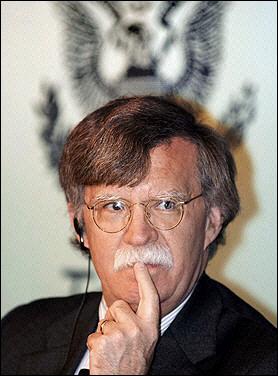
Bolton accuses Syria of organizing a Coup in Lebanon

David Seaton's News Links
The Gemayel assassination is very fishy coming at the moment it does. Who does it benefit? Certainly it puts obstacles in the way of the Iran/Syria summit and could scupper a number of peace initiatives in both Iraq and Palestine/Israel. But, when John Bolton appears, everything gets very, very odoriferous. The language for example: "The issue is not whether the United States will talk to Syria; the issue is whether Syria is going to listen." The idea being the USA does the talking and other people's job is to listen. Reality does not seem to be penetrating into their head, does it? DS
From the BBC: John Bolton, the American ambassador to the United Nations, said recent probes into political killings in Lebanon suggested Syrian involvement. He told the BBC that if Syria was deemed to have been involved, the implications were serious.(...) Mr Bolton said he did not want to pre-judge any investigation into Mr Gemayel's death, but proof of Syrian involvement would have serious consequences. "I think then you have a further clear piece of evidence that Syria is not just a supporter of terrorism but is a state actor in a terrorist fashion and I think the United States has to take that into account when it decides whether and to what extent to deal with a country like that. "We can talk to the Syrians, and do all the time. The issue is not whether the United States will talk to Syria; the issue is whether Syria is going to listen."

Monday, November 20, 2006

US and Britain are in denial over failed policy, says former envoy - Independent

David Seaton's News Links
"On the departure of troops, frankly in the UK and US most of the time people are talking about solving the US/UK problem, not solving the Iraqi problem"
... The United States and Britain have created a vortex in Iraq that may drag the entire Middle East into war, which of course would mean interrupting the flow of oil while they all kill each other and that would mean a worse energy crisis than the 1970s. On the other hand they might decide to save themselves and sit down and talk it out on a regional level, which will mean a solution not midwifed by the USA, which of course means the practical collapse of US power in the region. Certainly Ted Turner was not exaggerating when he compared Bush's decision to start a war of choice with Iraq with Hitler's similar decision to invade Russia. Both were catastrophic errors. Nothing in US history can compare with its far-reaching and disastrous effects. And of course, the most horrible thing is what the Iraqis who have never harmed the United States have had to suffer because of criminal stupidity. That is simply unforgivable. DS
Abstract: Iraq needs a new government to begin a process of national reconciliation leading to the withdrawal of foreign troops, because the US, Britain and Iraqi leaders are in a "state of denial" about their failed policy, a former UN envoy to the country says. "There is a refusal to accept that the so-called process is not working. It collapsed a long time ago. They should sit down and put something else up. What we need is a serious attempt at national reconciliation that has never taken place," said Lakhdar Brahimi, the Algerian diplomat who put together the first blueprint for the transfer of sovereignty to Iraqis after the overthrow of Saddam Hussein in 2003. Mr Brahimi, who has testified to the Iraq Study Group led by the former US secretary of state James Baker, emphasised that he was speaking in his personal capacity. "On the departure of troops, frankly in the UK and US most of the time people are talking about solving the US/UK problem, not solving the Iraqi problem,"(...) Mr Brahimi said the US and the UK should consult Iran and Syria on ending the violence in Iraq, but he warned that these two states alone do not hold a "miracle solution". All of Iraq's neighbours, including Turkey, Jordan and Saudi Arabia, as well as the Arab League, should be involved in a negotiated solution, he said. Asked whether the "window of opportunity" had already closed for Iraq, Mr Brahimi replied: "It's never totally closed. The thing is to know how to reopen it, but after how many thousands more are dead?" READ IT ALL

Monday, November 13, 2006

In New Middle East, Tests for an Old Friendship - New York Times

David Seaton's News Links
I have made an extremely long excerpt from this front page article of the New York Times and have taken the liberty of putting certain key phrases in bold face, because for a careful reader they spell out the clear message that the Israelis feel that they have only a narrowing window of opportunity to solve the Iran question to their satisfaction. The Republican "realists" led by James ("fuck the Jews") Baker are back. The only way for the USA to leave Iraq with even a shred of dignity is to make a deal with Iran. The only way to preserve US interests in the Middle East is to ensure the independence and safety of the Palestinian people. That means the Israelis would have to abandon the land they took in 1967. What comes after Bush? How much traction are Mearsheimer and Walt getting among American elites? The entire flow of the situation is going against Israeli interests. It is quite possible that before the new US Congress takes office that Israel will attack Iran and that the Democrats (Hillary Clinton is Senator from NY) will accuse Bush of "abandoning Israel". This may be the only chance the Israelis have of postponing the internationalization of Jerusalem for another few years. DS

Abstract: Even before the American elections, a certain wariness had crept into the intimate friendship between Israel and the United States. The summer war in Lebanon produced questions in Washington about the competence of Prime Minister Ehud Olmert. In Jerusalem, there were worries about the American approach to Iran and the Palestinians. (...) the Israelis balk at President Bush’s embrace of regional change through promotion of Arab democracy. They view his effort as naïve and counterproductive, (...) officials here have long focused on what they consider a much bigger concern: preventing Iran from gaining nuclear weapons. They say the American policies that have empowered Iranian-backed militias in Iraq have been counterproductive to Israel’s interests That concern is bound to be the subtext when Mr. Olmert goes to the White House on Monday. And now the Democratic sweep has created fresh concerns that the administration(...) will turn more to accommodation and compromise. President Bush has chosen as his next secretary of defense Robert M. Gates, who in the past has been highly critical of the administration’s refusal to engage in dialogue with Iran. The defeat for the party of Mr. Bush, “possibly the friendliest president we’ve ever had,” said Zalman Shoval, a former Israeli ambassador to Washington, “raises question marks regarding the administration’s ability to promote its diplomatic and security objectives.”(...) one senior Israeli official, who was not authorized to speak publicly, after long, recent discussions with top Bush administration officials. “Are they committed to keeping the Iranians from actually building a weapon? I think so. Are they committed to keeping them from putting together all the parts they need? I’m not sure.” The Israelis say Washington was disappointed in their performance against Hezbollah. They are right: inside the White House, said one senior official there, who agreed to speak about internal deliberations on condition of anonymity, “Bush and Cheney believed that this would be another Six-Day War, or on the outside, two weeks.” “They believed it because that’s what the Israelis said,” the official said For Israelis, this failure to deliver poses a risk that cannot be ignored, especially when Iran is on the table. “Most people in Israel are not satisfied by our performance in Lebanon,” said Moshe Arens, a former defense minister, foreign minister and ambassador to Washington. “So if Israel enjoys this preferred position as an ally of the U.S. and a valuable ally in the fight against terrorism and now is shown to be not that effective and maybe not even that valuable, and to some extent even disappointing, that could put something of a damper on what’s happening.(...) Itamar Rabinovich, a former Israeli ambassador to the United States who is president of Tel Aviv University, said that Israelis, no matter their appreciation for American support, could not hand over the problem of Iran to Washington. He said: “Can we rely on the United States alone and say we abdicate our responsibility for dealing with the matter, and let the United States do what it wants? No, by no means.”(...) In September, Israel was abuzz over a speech by an American official that got little coverage in the American news media. Philip D. Zelikow, counselor to Ms. Rice, had addressed the Washington Institute for Near East Policy, considered sympathetic to Israel’s interest(...) Mr. Zelikow, in the last of 10 points, suggested that to build a coalition to deal with Iran, the United States needed to make progress on solving the Arab-Israeli dispute. “For the Arab moderates and for the Europeans, some sense of progress and momentum on the Arab-Israeli dispute is just a sine qua non for their ability to cooperate actively with the United States on a lot of other things that we care about,” he said. The message seemed perfectly clear to Israelis: the Bush administration would demand Israeli concessions on the Palestinian issue to hold together an American-led coalition on Iran.(...) Mr. Zelikow’s close ties to Ms. Rice are well known, and the furor over his comments was amplified because they appeared to some to echo criticisms published in March in The London Review of Books by two American scholars, John J. Mearsheimer of the University of Chicago and Stephen M. Walt of the Kennedy School of Government at Harvard.They suggested that from the White House to Capitol Hill, Israel’s interests have been confused with America’s, that Israel is more of a security burden than an asset and that the “Israel lobby” in America, including Jewish policy makers, have an undue influence over American foreign policy. In late August, appearing in front of an Islamic group in Washington, Mr. Mearsheimer extended the argument to say that American support of the war in Lebanon had been another example of Israeli interests trumping American ones. The essay argued that without the Israel lobby the United States would not have gone to war in Iraq and implied that the same forces could drag the United States into another military confrontation on Israel’s behalf, with Iran. It urged more American pressure to solve the Palestinian question as the best cure for regional instability.(...) The Iran confrontation, Mr. Arens said, will bolster that partnership. “The president said that he sees a clear and present danger with Iran arming itself with nuclear weapons and it’s obvious that this is a clear and present danger for the state of Israel,” he said. “Although a small country, we are not a minor party. When people talk about the possibility of a military option, what are they talking about? The U.S. or maybe Israel to take that move, not the U.S. or Germany or France.” He acknowledged, however, “That inevitably will lead people who are critical of the position of the president to be critical of Israel, because we are seen as a partner in this campaign, and it is not a very big step to say that Israel is leading the U.S., or misleading the U.S., by the nose in this thing.”(...) No Israeli knows if the next American president will be as tough on Iran or as loyal to Israel as Mr. Bush. If Mr. Bush does not act, Israelis say, by the time the next president takes office, in January 2009, Iran will be well on its way to a bomb, and Washington may not back Israeli responses.(...) Mr. Alpher, the former Israeli negotiator, is concerned that if Mr. Bush ultimately negotiates with Iran, “we need to ensure that the United States doesn’t sell us down the river.” It is fine for Israel to say that Iran is the world’s problem, he said. “But if the world solves it diplomatically,” he added, “will it be at our expense?” The world looks different to nearly all Israelis across the political spectrum than it does to people in most other countries. “Unlike Bush, an Israeli leader looks at Iran through the prism of the Holocaust and his responsibility to the ongoing existence of the Jewish people,” Mr. Alpher said. “It may sound pompous, but at the end of the day it matters, and so we may be willing to do the strangest things.” (...) Despite the anxieties here over Lebanon, Iran and academic essays, opinion polls show that Americans are solidly in support of Israel, with new support coming from evangelical Christians. Mr. Arens, the former defense minister, said of the Europeans: “They don’t like us — what can we do? What else is new? We would like to be liked by everyone, of course, but it’s the relationship with the United States that really matters.” (emphasis mine) READ ALL