Showing posts with label daesh. Show all posts

Tuesday, December 08, 2015

ISIS: the Caliphate, what's in a name?

First, terrorism is a form of communication. It is an act that uses violence to convey a political message intended to shape public opinion or political debate on policy issues. Arie Perliger - New York Times
One of the principal difficulties in trying to analyze ISIS is that we concentrate our attention almost exclusively upon their identity as terrorists and we don't pay sufficient attention to their identity as a political movement with clear objectives: objectives which they pursue in a patient, methodical and even "sophisticated" manner.

Experience shows that a subversive movement with a social base, even a small one, can resist decades of intense pressure, both political and military. Groups without such a base, such as Italy's Red Brigades or Germany's Baader Meinhof are quickly extinguished, but organizations with a social base such as Peru's Shining Path or Spain's ETA can go on for decades.

An example from a modern, European country:

ETA, has killed over 800 people in Spain since the 1960s, they have been defeated militarily and they now solemnly abjure violence. Despite this, ETA can, even today, put thousands of their sympathizers onto Basque streets demanding amnesty for their imprisoned members. They could reorganize at the drop of a beret.

ISIS, more violent than any of the groups named above, has as its target a growing base of followers and potential sympathizers within a world-wide community of an estimated 1.3 billion Muslims. Someone once compared mass movements to a very fat lady in a very small canoe: any sudden movement of hers can tip over and sink the canoe. Terrorism itself pales in importance next to a potential mobilization of even a tiny fraction of the Muslim masses by ISIS.

We are just extras in ISIS's ad campaign

19th century Anarchists referred to their acts of terrorism as "propaganda of the deed". This still holds true:

Bottom line: The western victims of ISIS's beheadings, bombings and drive-by shootings are simply extras in ISIS's advertising campaign directed at that potential world-wide audience of 1.3 billion.

"We" (the prosperous westerners) are not ISIS's "audience"; we are simply tools to reach that audience.

Simply put: Our (over) reaction to their terrorist acts is meant to create a counter reaction favorable to ISIS in their target audience. This strategy is quite effective.                        
You are far likelier to die in a car crash, or even choke on a pretzel, than to fall victim to terrorism on US soil. But fear is not a statistical calculation. That is the point of terror.(...) With a presidential election now in full swing, the stage is set for further polarization that may play straight into the hands of Isis. Thirty-one Republican governors have said that they would deny sanctuary to any Syrian ­immigrants. (emphasis mine) Edward Luce - Financial Times 
Those who have to deal directly with the threat of local terrorism, the police, are not happy with this hysteria:
Counter-terrorism officials of the Los Angeles Police Department met on Thursday with Muslim-American leaders to reassure them and the community at large that they are not alone and that they are facing this challenge together. “Muslim communities are our strength — not our weakness,” Deputy Chief Michael Downing told The Times. “We can’t let this deteriorate our relationship or allow others to isolate or stigmatize the Muslim community.” Chief Downing said law enforcement needs the trust and cooperation of the majority of Muslims in the mainstream, those who can raise the alarm about the radicalized few.  Editorial New York Times
To translate the above into plain English: From time immemorial, more than using brilliant, Sherlock Holmes type deduction and state of the art laboratory work, efficient policeman-ship has, depended mostly on creating networks of tattling informers.

Obviously if panic merchants like Donald Trump create some sort of anti-Muslim Kristallnacht movement, the American Muslim community will naturally pull itself into its shell like a turtle and reliable sources of information will dry up.

Thought for the day: If we treat all 1.3B Muslims in the world as our enemies, eventually all 1.3B Muslims will become our enemies. Could anything be more stupid than that?   

Meanwhile, back in the Middle East

What are ISIS's objectives?

Names and titles are important, especially in a religious/political context, a Pope, for example, is not a bishop or a parish priest and a Pope is not really a Pope if he doesn't control the Vatican and with it the spiritual life of the world's Catholics... Thus, among Muslims,  ISIS's calling itself a caliphate and naming its leader the caliph is a clear declaration of its intentions.
A caliphate is a form of Islamic government led by a caliph, a person considered a political and religious successor to the Islamic prophet, and a leader of the entire Muslim community. Wikipedia
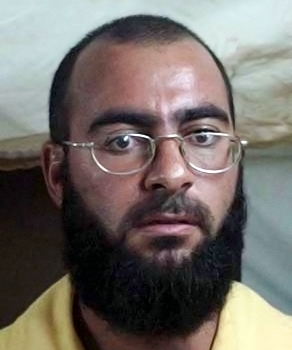
File:Mugshot of Abu Bakr al-Baghdadi, 2004.jpg
Abu Bakr al-Baghdadi - source Wikipedia
Here is the leader of ISIS and if he is killed they will simply name another because as long as there is a caliphate there will be a caliph.
Abu Bakr al-Baghdadi born 28 July 1971 as Ibrahim Awad Ibrahim al-Badri, is the leader of the Islamic State of Iraq and the Levant (ISIL) also known as ISIS or Daesh, an Islamic extremist group in western Iraq, Libya, northeast Nigeria, and Syria. He has been proclaimed by his followers to be a caliph. Wikipedia
As you can see the soi-disant caliph's real name is Ibrahim and he has changed it to Abu Bakr. What does that mean?

Who was the original Abu Bakr?
Abu Bakr was a senior companion and—through his daughter Aisha, the father-in-law of the Islamic prophet Muhammad. Abu Bakr became the first openly declared Muslim outside Muhammad's family.(...) he became the first Muslim Caliph following Muhammad's death. As caliph, Abu Bakr succeeded to the political and administrative functions previously exercised by Muhammad. Wikipedia
Again papal comparisons might be roughly useful; Just as the present Pope, born Jorge, has taken the name "Francis" as a declaration of the church's return to Franciscan poverty and simplicity, in similar fashion an aspiring caliph's taking the name Abu-Bakr is probably a declaration of a return to some mythical  origins of purity and simplicity.

As to where ISIS and its caliphate are headed, nothing could be clearer. Just as the Pope must occupy the Vatican, a caliph should live in or at least control the holy cities of Mecca and Medina, which are in Saudi Arabia, which is called thus, because it is controlled by the House of Saud.

And since ISIS's ideology and the official one of that kingdom are one and the same, the only real obstacle to Abu-Bakr taking up residence in Mecca is the Saudi Royal family.
The Saudi royals are caught in a perfect trap: Weakened by succession laws that encourage turnover, they cling to ancestral ties between king and preacher. The Saudi clergy produces Islamism, which both threatens the country and gives legitimacy to the regime. Kamel Daoud - New York Times
The royal house of Saud are perfectly aware of this trap:
(Former head of MI6, Sir Richard Dearlove) remembers the then head of Saudi General Intelligence "literally shouting at me across his office: '9/11 is a mere pinprick on the West. In the medium term, it is nothing more than a series of personal tragedies. What these terrorists want is to destroy the House of Saud and remake the Middle East.'" In the event, Saudi Arabia adopted both policies, encouraging the jihadis as a useful tool of Saudi anti-Shia influence abroad but suppressing them at home as a threat to the status quo. It is this dual policy that has fallen apart over the last year. The Independent
One of the reasons this "dual policy" is falling apart illustrates the contradictions that Saudi Arabia's present rulers have to deal with. They have been dumping oil on the market to try to break the American fracking industry by lowering prices and thus maintain their market share. This means that their cash reserves are being rapidly depleted and since basically the Saudi royal family holds onto power by subsidizing a largely unproductive population... they are in big and growing trouble.
Saudi Arabia is effectively beached. It relies on oil for 90pc of its budget revenues. There is no other industry to speak of, a full fifty years after the oil bonanza began. Citizens pay no tax on income, interest, or stock dividends. Subsidized petrol costs twelve cents a litre at the pump. Electricity is given away for 1.3 cents a kilowatt-hour. Spending on patronage exploded after the Arab Spring as the kingdom sought to smother dissent.(...) In hindsight, it was a strategic error to hold prices so high, for so long, allowing shale frackers - and the solar industry - to come of age. The genie cannot be put back in the bottle.(...) Social spending is the glue that holds together a medieval Wahhabi regime at a time of fermenting unrest among the Shia minority of the Eastern Province, pin-prick terrorist attacks from ISIS, and blowback from the invasion of Yemen. Diplomatic spending is what underpins the Saudi sphere of influence in a Middle East suffering its own version of Europe's Thirty Year War, and still reeling from the after-shocks of a crushed democratic revolt. Ambrose Evans-Pritchard - The Telegraph
It's obvious to me that in a few years the House of Saud will probably take up residence close to their billions on the shores of some frigid Swiss lake... Will this mean that Ibrahim Awad Ibrahim al-Badri, A.K.A, Abu Bakr al-Baghdadi finally gets his chance to be a real live caliph in Mecca? 

Probably not.... but it might very well be somebody even worse... so stay tuned.  DS

Tuesday, December 01, 2015

Tinfoil hat questions about ISIS, Saudi Arabia, Paris and climate change

Question one:

What country gives the most intellectual and perhaps financial aid to ISIS? 
Answer: Saudi Arabia


Question two:

What Middle Eastern country, totally dependent on selling oil, has the most to lose if the Paris climate change conference is a success and the use of oil is severely curtailed in the foreseeable future? 
Answer: Saudi Arabia


Question three:

Isn't it strange that there was a massive Jihadist attack on Paris shortly before the climate change meeting? 
Answer: I don't know, you tell me. 

DS

Sunday, November 22, 2015

Blood in Paris and beyond...

What follows is a sort of smorgasbord-compass that I have put together to help me, and hopefully others, get some idea of where this mess we now find ourselves in comes from and where it might lead us,

I hope the material quoted below might help to provide readers with a workmanlike framework for thinking about the new era we have entered into, with  ISIS' attacks on Paris...  a conflict which might be turning into the "Third Gulf War" or even WWIII.

We begin with what I would call the "mantra" to repeat constantly while reading, watching and hearing the news these days:
Multiculturalism is not a naive liberal aspiration — it is the reality of the modern world
This is simply reality:

With globalization and its new communication tools, we have all been thrown together brutally, helter skelter, in a worldwide, multinational-economy-mishmash, with no regard for history, culture, faiths or national idiosyncrasy, like having several different, large families, who don't even speak the same language, shut up together in the same small flat, sharing, bedrooms, kitchen... and bathroom. And somehow we are going to have to learn to live like this together in peace and harmony or else.

The French part of all of this not that new, the unrest among young French citizens of North-African origin has been growing for some time, it came to a head 10 years ago:
In October and November of 2005, a series of riots occurred in the suburbs of Paris and other French cities, involving the burning of cars and public buildings at night.  The unrest started on 27 October at Clichy-sous-Bois, where police were investigating a reported break-in at a building site, and a group of local youths scattered in order to avoid interrogation. Three of them hid in a power-station where two died from electrocution, resulting in a power blackout. (It was not established whether police had suspected these individuals or a different group, wanted on separate charges.) The incident ignited rising tensions about youth unemployment and police harassment in the poorer housing estates, and there followed three weeks of rioting throughout France. The rioters were the children of immigrants from North Africa and Sub-Saharan Africa for whom Islam was an inseparable component of their self-identity which strengthened their sense of solidarity, gave them the appearance of legitimacy and drew a line between them and the French. Wikipedia
Why are there so many  North-African Muslims living in France?

After WWII there was a literally wonderful period of never before experienced prosperity in France:
Les Trente Glorieuses (French pronunciation: ​[le tʁɑ̃t ɡlɔʁjøz], "The Glorious Thirty") refers to the thirty years from 1945 to 1975 following the end of the Second World War in France.(...) Over this thirty-year period, France's economy grew rapidly like economies of other developed countries within the framework of the Marshall Plan such as West Germany, Italy and Japan. These decades of economic prosperity combined high productivity with high average wages and high consumption, and were also characterized by a highly developed system of social benefits. Wikipedia
Because of this economic boom there was a tremendous need for low-paid manual labor, which the native French population couldn't satisfy and at the beginning of "The Glorious Thirty" most immigrants came from poorer southern European countries like Spain, Italy, Greece and Portugal... white and Christians.  Many of them became totally assimilated, took French nationality and have become quite successful. The mayoress of Paris was born in Spain and so was the present Prime Minister's father. However in the mid-1960s the economies of these southern European countries also began to boom and they dried up as a source of cheap labor for France.

At this point, still booming France turned to its former colonies in North Africa for the workers who would accept low pay doing the dirty jobs the French didn't want to do and southern Europeans didn't need to do anymore... And when in the 70s, the economy cooled off, the North Africans were left stranded in immigrant urban ghettos, and unlike the southern Europeans, they had nowhere to go back to, as things were even much worse in North Africa than in France.

So you could say that in some way, today the French are paying their imperial "karma":
Paris, November 20, 2005 - 'We're here because you were there'
Three Weeks of urban rioting by thousands of children and grandchildren of post-colonial migrants have finally forced France to grapple with the bitter fruits of its fallen empire. The lesson should not be lost on any Western nation. It is encapsulated in the slogan that activists have been employing throughout Western Europe for the past few decades: "We are here because you were there." Gregory Rodriguez - LaTimes
What has turned the secular urban riots of 2005 - rather similar to the "burn baby burn" riots in the USA during the Civil Rights period of the 1950s and 60s - into the militarily organized horror of ISIS' attacks in today's Paris?

The answer is simple: Ideology, that is to say, structure for action.

Wahhabite Islam is the specific ideology that is structuring the turbulence. You might say that Whahhabism is a sort of Muslim version of "ultra-Calvinism", iconoclastic: lunatic-fringe, but very, very well financed:
Wahhabism has been accused of being "a source of global terrorism", inspiring the ideology of the Islamic State of Iraq and the Levant (ISIL), and for causing disunity in Muslim communities by labeling Muslims who disagreed with the Wahhabi definition of monotheism as apostates (takfir), thus paving the way for their execution for apostasy. It has also been criticized for the destruction of historic mazaars, mausoleums, and other Muslim and non-Muslim buildings and artifacts. The "boundaries" of what make up Wahhabism have been called "difficult to pinpoint", but in contemporary usage, the terms Wahhabi and Salafi are often used interchangeably, and considered to be movements with different roots that have merged since the 1960s.But Wahhabism has also been called "a particular orientation within Salafism", or an ultra-conservative, Saudi brand of Salafism.
That's right, the center of this ideology is coming from the ancestral home of Osama bin Laden, straight from the world's filling station, Saudi Arabia.  Literally every time you fill up your gas tank you might be financing Al Qaeda or ISIS (Daesh):
Daesh has a mother: the invasion of Iraq. But it also has a father: Saudi Arabia and its religious-industrial complex. Until that point is understood, battles may be won, but the war will be lost. Jihadists will be killed, only to be reborn again in future generations and raised on the same books. Kamel Daoud - New York Times
I'll try to illustrate the center of the problem, past, present and future with this simple photo-montage:
Charlie Foxtrot
The the best caption I could find for these photos is...
Clusterfuck ‎(plural clusterfucks) (slang, vulgar) A chaotic situation where everything seems to go wrong. It is often caused by incompetence, communication failure, or a complex environment. Wiktionary
To be continued... DS

Tuesday, October 13, 2015

Putin's Question, Syria and the future of the Middle East

"Instead of the triumph of democracy and progress, we got violence, poverty and social disaster — and nobody cares a bit about human rights, including the right to life, I cannot help asking those who have forced that situation: Do you realize what you have done?" Vladimir Putin - UN


There is a general consensus in the "West" that Vladimir Putin is a thug: however, in a manner reminiscent of Vito Corleone, he is a thug whose plans and his way of carrying them out make sense. By making sense I mean that it is easy to understand what his goals are and his ways of achieving them. I think it is perfectly evident that for good or for bad, Putin "realizes what he is doing".

Many sour-grape-ish commentators say that Russia is entering a "quagmire" in Syria like the USA did in Vietnam and Iraq. I beg to disagree. Syria's army is nothing like the "client armies" of South Vietnam or Afghanistan. 

Assad's Alawite community, a minority which controls the Syrian army and state, are literally fighting for their lives, because if they lose to the radicals of the Sunni majority, they will, minimally, be ethnically cleansed and quite possibly, (if ISIS stays true to form) be literally "put to the sword"... So given superior (Russian/Iranian) leadership, air-support, equipment, intelligence etc, they can be counted on as a motivated, effective force. They are joined by Hezbollah, the only military force in the world that has ever defeated Israel on the battlefield and by elements of the crack Iranian Revolutionary Guard

I think that given this support, they and their allies should be able to quickly roll back the al-Nusra Front of Al-Qaeda favored by the Arab powers and the ragtag "moderates" that Washington favors... before turning their attention to the ISIS.

What has Putin achieved by this?
  • He has guaranteed the survival of his Mediterranean naval base in Tartus, the only military base that Russia has outside the former Soviet Union.
  • Russia is again the most influential foreign power in Iraq, just as it was in the day of Saddam Hussein.
  • Russia is now the most influential foreign power in Iran.
  • In short, in only a few, relatively inexpensive,  moves, Russia is now again a major player in the Middle East chessboard, just as it was during the height of the Cold War. What does this mean?
  • It means that Russia is now in position to put a lot of pressure on Saudi Arabia.
Why should they want to put pressure on Saudi Arabia?

Chercher le pétrole.
Putin – who, as a former member of the KGB, is a product of the Cold War – is today faced with the same dilemma as his Soviet forebears. The collapse in oil prices, which has been engineered by America’s major allies in the region – Saudi Arabia, the United Arab Emirates, Qatar and Kuwait – is crippling the Russian economy.(my emphasis) The Telegraph
It must be said that the initial reason for lowering oil prices by over-producing was to break the American fracking industry by making it unprofitable... it has had other, perhaps underestimated consequences:
Russia’s currency and economy, already squeezed by Western sanctions, have been sent into virtual free fall by slumping oil prices. The International Monetary Fund predicted in July that Russia’s economy would shrink 3.4% this year, the most of any major emerging market. Wall Street Journal

Chercher le pétrole
Thus, hoist by their own petard, low oil prices are also threatening the stability of the Saudi Monarchy.
The Saudi government has banned official purchases of cars and furniture and slashed travel budgets and infrastructure spending as it faces its gravest fiscal crisis for years because of low oil prices.(...)Saudi Arabia had been hit by the “unfortunate coincidence of a royal succession and a sudden precipitous decline in oil revenue”, Hertog said, adding that the cost of public-sector bonuses, the war in Yemen and aid to regional states such as Egypt had pushed up the estimated break-even oil price to $110 a barrel. The Guardian
To top it off, as you can see below, Saudi Arabia's oil and gas infrastructures are extremely vulnerable to any hostile action coming from Iraq, Iran or Syria, any of which would surely lead to a big jump in the world oil price, which would restart the Russian economy... and probably cause a recession everywhere else.
Saudi Arabia's vulnerable oil infrastructure 
Hat Danil Parker
Russia's pressure seems to be having some effect:
Oil prices are on course for one of the biggest weekly gains in six years as rising geopolitical tensions and signs of slowing output brought buyers back to the market. Financial Times

The greatest danger in all of this, would be that too much austerity and subsequent unrest in Saudi Arabia could easily lead to the fall of the Saudi monarchy, considered by most pious Muslims as a brood of degenerate libertines. This family, and certainly not the people of Saudi Arabia, are the ones who have a "special relationship" with the USA since the days of FDR. Their fall would certainly not lead to any "Arab Spring" with Saudi ladies ripping off their veils and donning miniskirts... quite the contrary. An "Islamic Republic of the Holy Places" would be the natural location for the Caliphate that ISIS dreams of, and if Daesh took over, the "Meccan in the Street", would hardly notice the difference.

Here is a sample of daily life in Saudi Arabia under the rule of our "special friends" there:
A young Saudi Arabian man is facing crucifixion after beheading for attending an anti-government protest in 2012, when he was 17. The Times
Decapitations are routine in Saudi Arabia, America’s closest Arab ally, for crimes including political dissent—and the international press hardly seems to notice. Newsweek
Saudi authorities have already carried out 90 executions since the beginning of 2015, more than the 88 for all of 2014. Forty-one of the ninety people executed since the start of 2015 were sentenced for non-violent drug offenses. Human Rights Watch - MintPress
And unfortunately, oil is not all Saudi Arabia exports:
Saudi Arabia remains perhaps the most prolific sponsor of international Islamist terrorism, allegedly supporting groups as disparate as the Afghanistan Taliban, Al-Quaeda, Lashkar-e-Taiba (LeT) and the Al-Nursa Front. Edward Clifford - Brown Political Review
Sunni clerics are mounting increasingly vociferous calls for Saudi Arabia and the Gulf states to take action on behalf of Syrian rebel groups targeted by Russian air strikes. The pan-Arab Muslim Brotherhood and a group of 55 Saudi clerics this week called for jihad against the Russians in Syria. Saudi Arabia’s highest religious body, the Council of Religious Scholars, has accused Moscow, along with Iran and its Shia Lebanese proxy, Hizbollah, of aiding the regime of Bashar al-Assad “in the killing of the Syrian people and the destruction of their country”. It called on the nation to do all it can to support the “oppressed and mujahideen” of Syria. The growing pressure for action leaves the Saudi ruling family facing a dilemma. Riyadh has long called for Mr Assad’s overthrow and has supported so-called moderate rebels in Syria. But it fears that the clerical calls for action could inflame young Saudis, thousands of whom have traveled to join the fighting in Syria. The Islamist militants Isis have already launched attacks on Saudi Arabia and the government is cracking down on those traveling abroad in an effort to crush the group’s cells in the country. Financial Times
Since America's staunchest allies in the Middle East are Saudi Arabia and Israel, (which unlike Riyadh has about 1,200,000 Russian inhabitants) all of this is rather bad news, to say the least.

Putin certainly went to the heart of the matter with his question, "Do you realize what you have done?".

It is a question I've often asked myself: do Americans really understand what American foreign policy has been doing all these years and its consequences for their prosperity and safety?

Like many of my generation I started wondering if the American  foreign policy establishment realized what it was doing during the war in Vietnam,.. with Pinochet, Iran-Contra, etc to follow.

Just a short list of things, going back some time, with lots left out, that apply to today's situation in the Middle East:

With the help of Saudi Arabian financing, the USA introduced fanatical Wahhabi Islam to Sufi Afghanistan and to nuclear weaponized Pakistan and then literally "invented" Osama Bin Laden. All this was done to bring down a government in Kabul where little girls were allowed/encouraged to go to school and their mothers could even go shopping (without wearing a tent). Then during the First Gulf War the USA stationed pork consuming, American, soldiers in Saudi Arabia, which led to Bin Laden's creating Al Qaeda... Then in the Second Gulf War the USA totally destabilized Iraq leading to the appearance of the ISIS.

I know it's bad form to quote oneself, but only a couple of postings ago I asked:
What is truly impressive, especially in the American case, is that despite being the richest, most powerful country in history, with the most massive military the world has ever seen, with a huge educational establishment boasting the world's most prestigious universities... a country literally overrun with "think tanks", despite all of this, the "indispensable nation" continuously gives the impression of being the Global Village idiot. How to explain this? 
In the case of the Middle East, I like to think it is pure stupidity, because any other explanation leads into the sinister, tinfoil-hat-land's house of mirrors where the great paranoiac conspiracies slither... A very, very, dark and humid, dangerous place, a place where I don't wish to go. DS