Showing posts with label European Union. Show all posts

Friday, June 24, 2016

Brexit or the wages of frivolous stupidity

What an irony it would be if the Leave vote led the U.K. to break up before the E.U. does. But after a remarkable night and morning, that didn’t seem beyond the bounds of possibility. Very little did. John Cassidy - The New Yorker
British Prime Minister, David Cameron's totally gratuitous decision to convoke a referendum on Britain's remaining in the European Union, Brexit, is a perfectly amazing example of the effects of frivolous stupidity. The rest of us are to be helpless witnesses and perhaps direct victims of his decision for years to come. 
David Cameron, the British prime minister, has no one to blame but himself. In 2013, besieged by the increasingly assertive anti-European Union wing of his own Conservative Party, Mr. Cameron made a promise intended to keep a short-term peace among the Tories before the 2015 general election: If re-elected, he would hold an in-or-out referendum on continued British membership in the bloc. But what seemed then like a relatively low-risk ploy to deal with a short-term political problem has metastasized into an issue that could badly damage Britain’s economy, influence the country’s direction for generations — and determine Mr. Cameron’s political fate.  New York Times
If you like reading history, you'll come across many examples of such frivolity and stupidity doing massive harm to millions of people.  George W. Bush's decision to invade Iraq is a textbook example. Millions of people have lost their homes or lives and one of the world's most critical regions is in the process of disintegrating.  

Could Cameron's Brexit have an effect in any way comparable to Bush's opening the gates of hell in the Middle East? 

Knock-on effects are about cascading disasters. The world's economy is still shaky after the crash of 2008 and in today's globalized finance everything is interconnected. How could Brexit set off a chain of disasters?

An example: UK capital, London, is today the world's most important financial center:
London has swapped places with New York to become the world’s leading financial centre, according to a detailed study of 86 cities. Financial Times
It is axiomatic that money hates uncertainty:
One of the only things we can say for sure after the Brexit decision is that the U.K. and Europe are entering a period of great uncertainty. The New Yorker 
It is easy to imagine the knock-on effects of a major disruption of the intricate and intertwined activities of a place where the good and the great of the entire world go to trade currencies, bonds, shares, privileged information, launder and store their money, you name it. 
One likely outcome of negotiations is that banks and financial firms in the City of London will be stripped of their lucrative EU “passports” that allow them to sell services to the rest of the EU. The Guardian
You can't imagine the knock-on effects of disrupting such a place? Think Lehman Brothers just for starters. If one major financial institution starts to unravel, the entire shaky recovery of the world economy could collapse.

Leaving Financial Armageddon behind, the ordinary human effects of  Britain's leaving Europe are worth describing: British young people will now find it difficult to reside or work in EU countries or study in their universities and talented young Europeans will find it difficult to do the same in the UK. This will have significantly negative effects on generations to come.

The future of  Britain's young people is finally the greatest victim of Brexit, but not just the young.

Here is an example of the sort of micro-tragedies that can befall elderly British people here in Spain, where I live. Thousands of British pensioners on retiring have sold their homes in grey and rainy Britain and with their life savings bought homes on the coasts of Sunny Spain, where as members (till now) of the EU, they have a right to residency, socialized medical care and even get to vote in municipal elections. Imagine their distress as they watch all of these rights disappear and even the value of their investment sink.

All this disruption because of what the President of the European Parliament Martin Schultz, calls "a whole continent (being) taken hostage because of an internal fight in the Tory party”. DS

Tuesday, May 21, 2013

My European Union Rant

David Seaton's News Links
Now it is the European Union itself that is in danger, mainly but not entirely because of the economic crisis inherited from Wall Street abuses. (...) A new Europe-wide report by correspondents of the Paris newspaper Le Figaro reveals mounting disillusionment with the European Union itself among the voters of its member states. (...) Britain has made the most news about possible withdrawal from the union since the country’s most recent local elections gave the United Kingdom Independence Party nearly as high a popular vote as the ruling Conservative Party, led by Prime Minister David Cameron. (...) There was an immediate rise in demand among Conservative Party members for a referendum on quitting the EU – which the Ukip promises. William Pfaff
The British are talking about leaving the European Union... to put this conversation in perspective, I would trot out the famous quote of Mahatma Gandhi's, who, when asked what he thought of western civilization replied, "It would be a good idea".

If we agree that the heartland of western civilization is comprised of the countries, including Britain, that make up the European Union and we then consider the millions of Europeans that have been killed (by each other) over centuries in Europe's countless wars, religious and otherwise, and its assorted genocides and the millions of its inhabitants that were forced to emigrate to the ends of the earth to escape poverty and tyranny, and then contemplate its record outside Europe of: slavery, exploitation of natural resources, ethnic cleansings and genocides of peoples of color and then consider that so recently having renounced killing one another and so recently, if reluctantly, also laid down the white man's burden, then it might be a tad early and a trifle frivolous to quibble about an institution which might loosely fit Gandhi's description of a "good idea", namely the European Union?

Really all this talk makes me think of a chain smoker, who having been diagnosed with advanced lung cancer and that after having had a lung removed and undergoing intense radiation and ghastly chemotherapy, upon being told that he is in remission goes out and buys a pack of cigarettes. DS

Monday, June 18, 2012

Angela Merkel and the hour of the Wolf

David Seaton's News Links
Angela Merkel in the DDR
Angie was 35 when the Berlin Wall fell. She grew up in Communist East Germany, was member of the Communist Party's youth group the Free German Youth (FDJ, from the German initials), graduated from Karl-Marx University in Leipzig, and worked as a physicist in East Germany. She was 35 when the wall fell. I've wondered if her outlook may have some basis in growing up in the Warsaw Pact.  Old Hickory's Weblog
Today I thought I'd write  you about this dream I had on the lines of "The Manchurian Candidate"...
(Distant Trombone - Dissolve)

Just before the fall of the Iron Curtain, Markus Wolf, the great, East German, spymaster, the one who ruined Willy Brandt, the model of John Le Carré's, "Karla", who upon seeing his system and his life's work falling  apart, in order to take revenge, created the "Doomsday Weapon", a deadly mole, a fatal poison, that he infiltrated from the dying DDR into the heart of the West German political apparatus in order to destroy the entire capitalist system... The mole's name.... Angela Merkel.…
At first I thought it was a joke, but now I'm not sure... DS

Thursday, February 16, 2012

Homage to the people of Greece - Αφιέρωμα στους ανθρώπους της Ελλάδα

David Seaton's News Links
Wolfgang Schäuble, German finance minister, on Wednesday went so far as to suggest Greece might postpone its elections and install a technocratic government free of all political parties, similar to Italy, to ensure that the bail-out programme is implemented. Financial Times
A visibly angry President Karolos Papoulias singled out Schaeuble after he appeared to suggest Greece might go bankrupt, and also attacked critics of his country in the Netherlands and Finland. "I cannot accept Mr Schaeuble insulting my country," said Papoulias, an 82-year-old veteran of Greece's resistance struggle against the Nazi occupation of World War Two. "Who is Mr Schaeuble to insult Greece? Who are the Dutch? Who are the Finnish?" he said in a speech at the Defense Ministry. Reuters
No further comment needed. DS

Sunday, November 22, 2009

The "Giant Switzerland" Fallacy

"Europe has shown it would rather be a super-sized Switzerland."
Simon Hix, professor of European politics at the London School of Economics


These are both monkeys.
A gorilla is a "super-sized" monkey.

Moral: size counts 

David Seaton's News Links
I think the idea is pretty clear, Why natter on? DS

Tuesday, November 17, 2009

Europe in the world of the "G-2"


"Living well is the best revenge"
George Herbert (1593 - 1633)
David Seaton's News Links
The Lisbon Treaty, the European Union's de facto constitution, is finally ready to roll out. For euroskeptics it is much too much and for many europhiles it is much too little. In my opinion it is just one more patient step toward European unity. All the phases of European Union dating back to the European Coal and Steel Community of 1951, have been such small, patient steps. Lets look at what has been done up till now:
The EU has developed a single market through a standardized system of laws which apply in all member states, ensuring the free movement of people, goods, services, and capital. It maintains common policies on trade, agriculture, fisheries and regional development. Sixteen member states have adopted a common currency, the euro, constituting the Eurozone. Wikipedia
The modern state is a European invention and the creation of the entities that became the states of Europe was far from instantaneous. The pooling of sovereignty, where powerful princes, wealthy cities and idiosyncratic regions, with all their traditional laws and privileges, submitted to be ruled by a single king didn't happen over night, or if it did it was usually accompanied by much blood; and even today there are quite a few regions in European states that feel restless. In  states such as Spain, France and the United Kingdom, the powerful centrifugal forces that were amply demonstrated in the disintegration of Yugoslavia are often active under the surface. So European unity is a work in progress... and always will be.

The Roman empire, created European unity and maintained it firmly under their sandals at sword point: until it finally fell apart. More recently both Napoleon and Hitler attempted to unify Europe at the point of a gun and both of them failed in rivers of blood. Today's unity is first and foremost about peace. Peace itself is the greatest conquest of all.

Europe has never before been such a peaceful place as it is today.

Europe has been the scene of the world's most horrific wars, both religious and mercantile and any euro-chauvinist would do well to remember what Mahatma Gandhi answered when asked his opinion of European civilization: "It would be a good idea", Churchill's "naked fakir" replied.

Today's European Union came into being in order to solve a specific problem: how to end the "Great European Civil War (1914-1945)" which had destroyed much of Europe, caused it to lose its foreign possessions and killed, mutilated and displaced countless millions of human beings. In 1945 Europe was what the Spanish call a "broken toy". That was the defining problem of Europe and it has been solved with enormous success. Until that problem had been solved, nothing else of importance could be done.

Although the combination of the words, "peace" and "process" have been devalued like a Wiemar Deutsch Mark in the Middle East, the European Union is, in fact, the result of a successful and ongoing, "peace process".  Those who are eager for the European Union to begin to act in the fashion of a classic nation state, super power or empire don't really understand this process, where it has come from and where it is headed.

The European Union is above all a stewardship, a husbanding of human resouces, of infrastructure, of culture, of wealth, health and perhaps above all an idea of the quality of human life... of what it means to live well in every sense: prosperity with social justice. That is a combination absent from every other part of the world... certainly absent from the "G-2", China and the USA.

There are many commentators that fear that Europe is going to become irrelevant as the USA and China divide up the world between them. Their fear of Europe's demise is premature. In fact, the EU may find itself "the last man standing".

China and America are entwined and tangled in an economic embrace that could damage both of them, if not beyond repair, enough to make them hardly recognizable for quite some time.
The Chimerican era is drawing to a close. Given the bursting of the debt and housing bubbles, Americans will have to kick their addiction to cheap money and easy credit. The Chinese authorities understand that heavily indebted American consumers cannot be relied on to return as buyers of Chinese goods on the scale of the period up to 2007. And they dislike their exposure to the American currency in the form of dollar-denominated reserve assets of close to $2 trillion. The Chinese authorities are “long” the dollar like no foreign power in history, and that makes them very nervous. Niall Ferguson and Moritz Schularick - NYT
So much for the intensely "relevant" USA and China.

It should not be forgotten that none of the great superpowers, not the USA, not China, nor Russia, is capable of building a decent automobile, something that Europe does splendidly, while simultaneously providing the workers who build the cars with a decent social net. Europe with its internal market of 450,000,000 people is still able to manufacture goods of a quality unmatchable anywhere except Japan and even Japan still cannot approach Europe in making high profit margin luxury goods: a Lexus, although a wonderful car, is not a Ferrari Testarossa.

The Americans now drown in debt, with deteriorating educational and transport systems, seemingly limited to what they apparently do best: killing people and blowing things up. The Chinese on the other hand, work day and night making cheap junk, without unions or health care and live like refugees from a Jacob Riis photograph.

All the while Europeans make top quality goods and protect their workers, maintain their infrastructure and health and education systems... and while the dollar and yuan race each other to the bottom, the Euro is a solid measure of value.

There is something of the fable of the ant and the grasshopper in all of this.

At the same time European regulations have become the world standard. The handiest example of this is the cell-phone, but this ability of the "faceless bureaucrats" of Brussels to define things like "butter" and "kilo" , or "plastic", or "bag", so that the entire world knows exactly what a kilo of butter or a cell phone or a plastic bag that can be sold to 450 million people consists of  is an achievement only rivaled by the law makers of ancient Rome. There is nothing irrelevant about this and certainly greater relevance is not gained by acting as the "tool kit" of an America struggling in the endless wars of its Götterdämmerung.

So Europe will continue its eternal round of boring committees, its purgatory of brain melting meetings that run into meetings and perhaps, someday, some dawn, the faceless bureaucrats of Brussels will stumble yawning out of another inconclusive meeting into the fresh air of a Belgian morning and suddenly realize that they have created the utopia that mankind has dreamt of since we trucked out of Eden. DS

Tuesday, June 09, 2009

The European elections

David Seaton's News Links
How should we read the European Parliament elections?

To begin with, elections to the European parliament are usually fought country by country as local referendums entirely on national issues and despite the growing power of the European parliament in the daily life of all EU citizens, its role is hardly mentioned in these campaigns, which therefore are extremely boring and so abstention is normally very high.

In Spain's European parliament elections, for example, it usually happens that the party in power is roundly defeated by the mobilized base of the opposition party who come out en masse because they see an easy win, this happens because the party in power's voter base, seeing nothing much at stake, leaves them hanging in the wind. This is what has happened this time too.

This particular victory of the Partido Popular has had the perverse effect of consolidating Spain's conservative leader, Mariano Rajoy, who is considered so unattractive that even most of his own party think he has no chance against president Zapatero in the general elections three years from now.

If Partido Popular had lost the elections, this would have probably led them to change their candidate for the general elections, and since they have several candidates that are more charismatic than Rajoy, this victory may cost them dearly. So as you can see that in a European-wide election it is hard to see the forest for the trees.


The disaster in waiting

Probably the most dangerous result of this election has been the literal collapse of Britain's Labour Party under the leadership of Gordon Brown, which came in third behind the ultra-right UK Independence party (UKIP). If this leads to an early election before the the Lisbon Treaty is ratified it might lead to the British either leaving the EU or actually being expelled from it. Here is how the Financial Times columnist, Phillip Stephens lays it out:
Hang on in there, Mr Brown. Europe needs you for a while yet. The alternative could be a Conservative prime minister leading Britain towards the European exit. Such are the whispered anxieties in continental capitals, and among pro-Europeans in Britain, as Gordon Brown’s troubles stir speculation about an early general election.(...) the leaders in Berlin, Paris and elsewhere have selfish reasons for hoping that the present British government can stagger on until next year. They have spent the best part of a decade designing, redesigning and patching up an agreement to remake the European Union’s institutions. Once it was called the European constitution; now it goes by the name of the Lisbon treaty. But, horror of horrors, with the end at last in sight, David Cameron’s Conservatives are threatening to wreck the project.(...) The timing of the government’s demise could mark the difference between a serious argument about Britain’s relationship with Brussels and a rupture that would set in train its eventual departure.(...) It is clear to all that Mr Cameron wants to derail the process of European integration. His decision to withdraw from the European People’s party, the European parliament’s mainstream centre-right group, is a step in that direction. By aligning with a hotchpotch of small far-right parties, Mr Cameron has downgraded his party’s relationship with its French and German cousins. To move Britain to the sidelines of influence is one thing. To threaten to blow up the Lisbon accord is another. This is what Mr Cameron proposes by pledging to campaign for its rejection in a British referendum. And this is where the timing of the general election really matters.(...) Mr Cameron might argue that earlier versions of the treaty were rejected in referendums in France, the Netherlands and Ireland. But these were not conscious acts of government. Withdrawal from the EPP is a Tory shot across the bows of European integrationists. Wrecking the Lisbon treaty would be a declaration of war.(...) One thing is certain: neither Britain nor Europe needs an autumn general election. Nor, unless he wants to sleepwalk towards Europe’s exit, does Mr Cameron.
So the British results are the only ones that might have direct and historic consequences.

What happened to the European Social Democrats?

Most of the left's classic battles have already been won in Europe, from strong labor unions, a sturdy social net and free health care, right down to even "free love": all of these have been adopted by the center right. What have the social democrats got left to sell?

Here is how columnist Henryk M. Broder described in in Der Spiegel
Germany, and a large part of Europe, has in recent decades incorporated vast swaths of social democratic values into their societies. The Social Democrats have lost their unique selling point. With the exception of the business-friendly Free Democrats, Germany's parliament is full of politicians who are, in some shade or another, adherents of the social democratic worldview. The Christian Social Union (the Bavarian sister party to Chancellor Angela Merkel's Christian Democratic Union) is to the left of the SPD on some issues. Merkel's CDU is sometimes greener than the Greens and the far-left Left Party continues to cozy up to Germany's mainstream parties. When almost all the parties on offer are center-left, there is no longer a compelling reason to vote SPD. On the contrary, there is nothing wrong with taking a look at those who offer something a bit different -- not unlike the way loyal Aldi shoppers take an occasional look at what rival supermarket chain Lidl is offering.
In general the problem right now with the European left is that they have not shown that they have a coherent critique of the system, which is what the voter of the left really wants from them. Until they produce that critique or the ultra-right makes more significant gains that frighten them sufficiently many left wing voters will simply abstain. It is interesting to note that the one figure of the left who did well in the elections was the French "Green", Daniel ("Danny the Red") Cohn-Bendit, who campaigned solely on European issues with a strong progressive message that would be far to the left of any mainstream American discourse.


An American reading (take care)

Americans may be tempted to see the European social democratic parties representing the same things as the Democratic Party of Barack Obama and the European center right taking the same positions as the Republican Party in the USA: this reading would be erroneous. For one thing, the Republican Party would be very far to the right of any mainstream party in Europe on economic and social issues and also foreign policy.

It is also important to clarify that the USA's Democrats are not really a party of the "left" in European terms. The reforms that the Democrats timidly put forward, like universal(?) health care and reasonably tight financial regulations are defended by European conservatives. The Democratic party is well to the right of the European center on most issues, most of the time.

You could say that the years of Thatcher-Reagan-Friedman have intellectually castrated the left. This is a problem in Europe, whereas the progressive voter in the USA is quite happy with neutered tom cats. DS

Wednesday, July 02, 2008

Europe and Europe's games

David Seaton's News Links
In the last few days we have been able to observe two visions of Europe, both of them real, yet vastly different one from the other.

One was the European Union’s post Irish referendum debate and the other was the European National Football Championships.

In one of these versions of Europe, there was endless bickering, insults and cries of foul play, while in the other all was civilized dialog, harmony and respect, truly fit to be set to the tune of Beethoven’s “Hymn to Joy”.

The civilized version was, of course, the football championships.

Who knows, perhaps having previously eliminated the English may have contributed to the peaceful, constructive atmosphere.

Certainly the beginning of the French presidency was quite another matter, it opened with French President Nicholas Sarkozy and European Trade Commissioner, Peter Mandelson trading insults.

The EU is gasping like a beached fish.

Poland’s president refuses to sign the Lisbon Treaty’s ratification after the Irish “no”and Vaclav Klaus, the conservative Czech president, says “the treaty is finished. There is no possibility of going on with it.”, while Roberto Calderoli, vice president of Italy’s Northern League and a minister in the Berlusconi government, said: “Every time the people have been consulted they have torpedoed to spectacular effect a model of Europe that seems far from what they want.”

But have Europe’s leaders ever really asked the Europeans what they actually “want,” beyond demanding their “yeses” and rejecting their “noes”?

The Economist quotes a Eurobarometer poll this week which finds that only 52% of EU citizens consider membership to be a good thing for their country; in France, the figure is just 48%.

Perhaps, in this context, the commission’s proposal of a 60 hour work week was a bit ill timed.

Among all the hand wringing over the consequences of the Irish “no” to the Lisbon treaty, the always sagacious William Pfaff thinks that Europe seems to be heading toward “the existing and enlarged Europe continuing as an integrated economy and trade zone, loosely associated with the United States in a subordinate role, but with no foreign policy or international personality of its own because of the conflicting interests and conceptions of its numerous members.”

Many feel that such a Europe would be “irrelevant”.

However, Gideon Rachman of the Financial Times wrote, “Irrelevance is not particularly dignified or noble. But it could still be the logical choice for Europe. Arguably, the EU has achieved a sort of nirvana. It is too strong to be attacked; and too weak to be asked to sort out the rest of the world’s problems. Europe has become a giant Switzerland.”

One could do a lot worse than being a "giant Switzerland".

If only the European Union could capture the spirit of European football, where, for example, Russia, Turkey and Croatia already form part of Europe and played beautifully. DS

Tuesday, April 15, 2008

EU, Russia and the USA: musical chairs... two chairs left

David Seaton's News Links
The natural synergies between Russia and the European Union are central facts in today's geopolitics.

Russia, underpopulated at 140 million and amazingly rich in natural resources and the 400 million inhabitants of the European Union, unrivaled for adding value to everything tangible that comes into their hands are an obvious match up.


If Russia and the European Union can ever come to some harmonious understanding, the result would be the most productive concentration of humanity and raw materials in history. The question would be how to handle the United States. because two is company and three is a crowd. What would they need the USA for? Except as a provider of entertainment, what would America's further role be in the "West"?

If Russia is no longer a military threat to Europe, what possible justification could there be for the USA to station soldiers in Europe?
Why should the Mediterranean be filled with US warships? How would this affect Israel?

If Europe with the euro and the world's largest economy finally creates it own unified defense force... in the face of fierce American opposition and ridicule, just like when the euro was created, what then could possibly justify an American role in European affairs. America would be next to irrelevant in Europe.

Therefore keeping Russia and the EU apart is evidently an American strategic goal of the first order.

In my opinion this obvious synergy between Russia and the European Union and the logical consequences that would flow from it are haunting American foreign policy today... much more than Iran, China or the "Global War on Terror".

It seems to me evident that the USA is doing all it can to create tension with Russia in order to prevent and interrupt the natural flow between Europe and Russia. Something like a fireman who sets fires in order to justify his role and create a demand for his services. DS

Thursday, April 10, 2008

Globalization: the right tool for the job


A Night at the Opera - The Marx Brothers (1935)
David Seaton's News Links
Much of today's financial crisis seems to have its origins in deregulation. Sadly, the financial sector is just like a big department store: when not watched closely, enough people inside the system will steal enough goods to put the store out of business.

However, despite all the messages of common sense and a garden variety knowledge of human nature, “deregulation” has become some kind of Anglo-Saxon religion. "freeing business from government interference" has become a jihad.

Faced with the present need to create robust regulations, the American establishment goes about it with all the distaste of a chef at the Riyadh Hilton forced to carve a Virginia ham.

Because of this distaste and the sunk costs of massive ideological indoctrination carried out in endless think tanks and classrooms going way back to the days of Barry Goldwater, Americans will probably not be able to gather their wits about them in time to write suitable regulations quickly enough to stabilize globalization.

This cultural inability to regulate may drain power from the USA even more dramatically then any other factor, including the war in Iraq or the rise of China.

Cultural inability to manage certain processes can carry a high cost: imagine the warlike Zulu facing the Maxim gun.

Robust, workable and well written regulations are needed soon if globalization is not going to turn into the Marx Brother's stateroom in "A Night at the Opera", with clouds of pickpockets taking the hardboiled eggs.

The only shop that produces regulations in quantity and quality and quickly enough is the European Union. Probably the most well known example of that regulatory superiority and its usefulness is the case of the creation and implantation of the GSM cell phone standard.

The “faceless bureaucrats” in Brussels believe in regulation and know how to write good ones; regulations that can fit a Bulgarian or a Dane a Romanian or a Swede.

The ability to create regulations that actually work has turned this fractious peninsula of Asia into the world's largest economy, while the United States today seems to only to be able to offer the world "one size fits all" military power for all occasions... but no practical solutions for governing the incipient day to day chaos of universal interconnection.

Here is how Wikipedia describes the process by which Europe has regulated itself into the universal standard of quality:
The EU has developed a single market through a standardized system of laws which apply in all member states, guaranteeing the freedom of movement of people, goods, services and capital. It maintains a common trade policy, agricultural and fisheries policies, and a regional development policy. Fifteen member states have adopted a common currency, the euro. It has developed a role in foreign policy, representing its members in the World Trade Organization, at G8 summits and at the United Nations. Twenty-one EU countries are members of NATO. It has developed a role in justice and home affairs, including the abolition of passport control between many member states under the Schengen Agreement.
Anyone dreaming about or dreading a world government only needs to examine how that part of the world, that until 1914 was the world, has organized itself in order to get an idea of what a "New World Order" would actually look like. No "black helicopters", just the Common Agricultural Policy.

I think that Europeans will be surprised by how much power is going to come their way in the next few months and years, for the simple reason that the EU exists to regulate and what the world needs most are workable standards, weights and measures. DS

Sunday, January 27, 2008

Parag Khanna in the NYT

David Seaton's News Links
This article by Parag Khanna in the New York Times that I have abstracted here is going to be a huge "conversation piece". I suggest you run off and read the whole thing now and then come back and read my comment, if you are so inclined.

Khanna's piece seems to be a "dark" view, but it ends on a note of wonky optimism that is beyond my ken. At this moment we are looking into a whirlpool.

Khanna sees all sorts of ways of “managing” the world situation, but, what I believe really defines the world situation is that it is no longer manageable. It’s un-manageability is its defining characteristic.

I also think that Khanna is wrong about Russia’s situation. We are going to be looking at a world of much armed conflict actual and threatened and the Russians have very good weapons for sale. In fact they are the only ones that provide antiaircraft systems of a quality that can neutralize the US air force’s superiority. Thus anyone who would like to be independent of US intimidation only has Russia as an alternative. Iran is an obvious case in point.

I would imagine that Russia’s population will increase as the oil and gas money continues to filter through their society. They also have a fair base in pure science as I recall and that is a real ace in the coming world, where science will have to solve so many hair raising problems. Anyway it is silly to write off any people that produced Leo Tolstoy and who drowned Adolph Hitler in their blood.

Really, what I worry most about is the effect this stomach floating drop in power, influence and ultimately standard of living, will have on the Americans themselves. There are certainly plenty of right wing demagogues around in the USA and I am worried by the idea of a “Wiemar - America”, with an apple pie version of “ve vass stabbed in der back” in the not too distant future. There may be American leaders waiting around the corner that could make Bush look good. DS


Waving Goodbye to Hegemony - New York Times
Abstract: Turn on the TV today, and you could be forgiven for thinking it’s 1999. Democrats and Republicans are bickering about where and how to intervene, whether to do it alone or with allies and what kind of world America should lead. Democrats believe they can hit a reset button, and Republicans believe muscular moralism is the way to go. It’s as if the first decade of the 21st century didn’t happen — and almost as if history itself doesn’t happen. But the distribution of power in the world has fundamentally altered over the two presidential terms of George W. Bush, both because of his policies and, more significant, despite them. Maybe the best way to understand how quickly history happens is to look just a bit ahead.

It is 2016, and the Hillary Clinton or John McCain or Barack Obama administration is nearing the end of its second term. America has pulled out of Iraq but has about 20,000 troops in the independent state of Kurdistan, as well as warships anchored at Bahrain and an Air Force presence in Qatar. Afghanistan is stable; Iran is nuclear. China has absorbed Taiwan and is steadily increasing its naval presence around the Pacific Rim and, from the Pakistani port of Gwadar, on the Arabian Sea. The European Union has expanded to well over 30 members and has secure oil and gas flows from North Africa, Russia and the Caspian Sea, as well as substantial nuclear energy. America’s standing in the world remains in steady decline.

Why? Weren’t we supposed to reconnect with the United Nations and reaffirm to the world that America can, and should, lead it to collective security and prosperity? Indeed, improvements to America’s image may or may not occur, but either way, they mean little. Condoleezza Rice has said America has no “permanent enemies,” but it has no permanent friends either. Many saw the invasions of Afghanistan and Iraq as the symbols of a global American imperialism; in fact, they were signs of imperial overstretch. Every expenditure has weakened America’s armed forces, and each assertion of power has awakened resistance in the form of terrorist networks, insurgent groups and “asymmetric” weapons like suicide bombers. America’s unipolar moment has inspired diplomatic and financial countermovements to block American bullying and construct an alternate world order. That new global order has arrived, and there is precious little Clinton or McCain or Obama could do to resist its growth. READ IT ALL

Tuesday, November 13, 2007

Balkan trap

David Seaton's News Links
It is a cliché of geopolitics that the Americans play poker and the Russians play chess. Chess is by far the more subtle game of course, objectives have to be thought out several moves in advance, traps are laid and sprung on the unwary, pawns are sacrificed to waylay a queen.

I get the feeling that Vladimir Putin's Russia has decided to use the issue of Kosovar independence to humiliate NATO, the European Union and the United States in one master stroke and take full revenge for the humiliation that Yeltsin's impotent Russia received in 1999, when they were helpless to save Serbian unity from the attacks of US led NATO... and also to use Kosovo and Bosnia as trading chips in forcing the withdrawal of America's planned missile shield from Poland and the Czech republic.

Russia will veto any UN resolution granting Kosovo independence and they are upping the ante by equating the independence of Kosovo with the breaking up of Bosnia, by encouraging the independence of the Bosnian Serb, Republika Srpska. If this happens fighting could easily break out again in the Balkans and there would be little that the "west" could do about it.

At this moment the US armed forces are stretched to a breaking point in Iraq and the NATO countries cannot find the political will to send more troops in Afghanistan. It would be impossible for either to smother a new outbreak of fighting in the Balkans without abandoning Iraq and Afghanistan.

As to the European Union, although Britain and France would join the United States in supporting a unilateral declaration of Kosovar independence, Orthodox Greece is firmly opposed and would veto any EU support for it. Spain, with its Basque and Catalonian separatist movements is certainly against encouraging national "self-determination" movements of any kind anywhere, much less in Europe itself. Romania, Cyprus, Slovakia and Cyprus; all with separatist problems of their own would probably veto any EU declaration of Kosovar independence too. Certainly any attempt to strong arm all these countries into line would set the European back considerably.

Renewed fighting between Orthodox Serbs and Muslim Bosnians and Kosovars would, of course, further aggravate the "war of civilizations" and give Bosnian Muslims further reasons to radicalize.

We are looking, in fact, at a rather perfect trap. DS

Again and Again in the Balkans - Editorial - New York Times
Abstract: The Albanians of Kosovo are woefully unprepared for the independence they demand. The European Commission reported recently that the Kosovo administration is plagued by graft, cronyism and organized crime. If that weren’t bad enough, Russia has thrown its weight behind the Serbs, and together they have goaded Bosnian Serbs into threatening to break up the Bosnian quasi-federation created by the Dayton accords should Kosovo become independent. This is the Balkan mess that the United States, Russia and the European Union confront when they next meet in the latest, and possibly last, round of talks with the Serbs and Kosovar Albanians. A unilateral declaration of independence by Kosovo, recognized by the United States and part of Europe but not by the United Nations, Russia or Serbia, would be unsatisfactory; a renewal of strife in Bosnia would be an outright disaster. READ IT ALL

Wednesday, October 03, 2007

Osama bin Laden and Fritz

David Seaton's News Links
Fritz G is a whitebread German who converted to Islam and was planning to plant a bomb. Here is the number one western security nightmare: suicide bombers who are not subject to "racial profiling".

Islam, like any other of the great world religions is in conflict with the values of capitalism: individualism and greed, and there is no reason that brown skin goes invariably with the Shahadah.

Where else could alienated and disaffected young people turn today if they are looking for a revolution? DS

Among the Believers - Die Zeit - Wall Street Journal
Abstract: It had to be Fritz. A name can't get much more German than that. And of all places it had to happen in Sauerland, a remote region in Germany that invokes about as much the specter of a "parallel society" as a gardening club. The amount of explosives 28-year-old Fritz G., 22-year-old Daniel S. and Adem Y., a 28-year-old Turkish-German, had prepared in an inconspicuous vacation home would have been many times more destructive than the Madrid and London bombs.(...) In comparison to Great Britain, Spain or France, Germany thought itself comparatively safe. First, because it was not involved in the Iraq war, it hoped al Qaeda would grant the country some sort of bonus. Second, because most of the roughly three million Muslims in Germany come from Turkey, where the separation of religion and politics is state doctrine. They were thus thought to be more or less inoculated against extremism. How different, one thought, from the U.K., where the majority of Muslims come from Pakistan, a country founded in religious conflict and an exporter of fundamentalism. Or France, which made its Muslims citoyens but whose Algeria war still preoccupies the minds of the present immigrant generation. Given the alarming fact that a son of Turkish immigrants was involved in the Sauerland plot, the inoculation can no longer be considered absolute. What's more, it looks as though the home-grown phenomenon has not only reached Germany, but has even skipped a developmental stage. Fritz G. and Daniel S. did not become extremists through cultural Islam. They took the direct route to political Islam. The phenomenon of extremist converts should worry us for it shows that Islam can be decoupled from its native religious and cultural background. Al Qaedism is becoming a universal, radical ideology of protest. Young Westerners in search for the most brutal anti-Western position find Osama bin Laden's ideas seductive because they are ethically hermetic.(...) (bin Landen) has very consciously begun fishing for supporters who share the backward concept of Islamism for non-religious reasons. The secular religions of climate rescue and globalization criticism meet bin Laden's doctrine of divine salvation. Disillusioned of the world, unite! "Wherever the believer happens to be, he is part of a virtual society, with which he shares the same set of norms," writes the French Islam expert Olivier Roy about the attraction of Islamism. "Only two radical protest movements in the West still claim to be internationalist: the anti-globalization movement and radical Islamists.... Al Qaeda has clearly occupied an existing space of anti-imperialism and protest.... Al-Qaeda is a successor to the ultra-left and third-world movements." READ IT ALL

Monday, September 17, 2007

Bill Gates out a billion bucks!

Ouch!
David Seaton's News Links
A 19th century Spanish political boss, the count of Romanones once said, "let others write the laws, leave the regulations to me."

While the USA goes around invading countries and killing people and other such he-manly activities. The European Union does all the girly-man stuff like socking it to Microsoft.

I suppose its just the crumminess of human nature that keeps so many of us from feeling Bill Gates's pain. DS

European Court Rejects Microsoft Antitrust Appeal - New York Times
Abstract:In a stinging rebuke to the world’s largest software maker, the second-highest European court rejected today a request by Microsoft to overturn a 2004 European Commission antitrust ruling that the company had abused its dominance in computer operating systems. The European Court of First Instance, in a starkly worded summary read to a courtroom of about 150 journalists and lawyers here, ordered Microsoft to obey a March 2004 commission order and upheld the €497.2 million, or $689.4 million, fine against the company. The court’s presiding judge, Bo Vesterdorf, reading a summary of the decision on his final day in office, said, “The court finds the commission did not err in assessing the gravity and duration of the infringement and did not err in setting the amount of the fine. Since the abuse of a dominant position is confirmed by the court, the amount of the fine remains unchanged.” “The court said the commission wins on virtually everything,” said Thomas Vinje, a partner at the law firm Clifford Chance and part of the legal team for the European Committee for Interoperable Systems, a coalition that includes Microsoft opponents like I.B.M. “The court has spoken. The commission was right.” In a one-line statement this morning, the European Commission said it welcomed the ruling on Microsoft, without giving any further details.(...) Microsoft has already been forced to pay nearly €1 billion in fines in the nine-year-old legal case, which has pitted the software maker based in Redmond, Wash., against the commission and a host of competitors, including I.B.M., Sun Microsystems, RealNetworks and Novell. READ IT All

Thursday, September 13, 2007

Afghanistan: love us or we'll kill you

David Seaton's News Links
Afghanistan is also a failure. It means a failure for the USA, but also for NATO and the EU... the West. Future historians, probably future Chinese historians, will mark these times.

There is a simple lesson here, you cannot invade a country and stay there and then expect the people to love you and appreciate you. My basic text for knowing this is what the Spanish call their "War of Independence", the fight against Napoleon. Here is what Wikipedia has to say:
"Spain's liberation struggle marked one of the first national wars and was among the first modern, large-scale guerrilla conflicts, from which the English language borrowed the word Its success was in part decided by the exploits of Spanish guerrillas and the inability of Napoleon Bonaparte's large armies to pacify the people of Spain: French units in Spain, forced to guard their vulnerable supply lines, were always in danger of being cut off and overwhelmed by the partisans, and proved unable to stamp out the Spanish army."
In many ways this was a tragedy for Spain, because Napoleon brought with him the modernizing ideas of the Enlightenment, which paved the way for the scientific and industrial revolutions. In Italy, for example, where Napoleon ruled, is today's modern, industrial north and where he didn't rule -- like the ring on a bathtub -- is the backward Mezzogiorno.

Because they were the ideas of the foreign invader, the Spanish people came to hate those ideas and clinging to their version of the ancien regime set the scene for a disastrous 19th and early 20th century.

This what is happening in Iraq and Afghanistan. DS

We're losing in Afghanistan too - Los Angeles Times
Abstract: In reality, Afghanistan -- former Taliban stronghold, Al Qaeda haven and warlord-cum-heroin-smuggler finishing school -- feels more and more like Sept. 10, 2001, than a victory in the U.S. war on terrorism. The country is, plain and simple, a mess. Al Qaeda and its Taliban allies have quietly regained territory, rendering wide swaths of the country off-limits to U.S. and Afghan forces, international aid workers and even journalists. Violent attacks against Western interests are routine. Even Kabul, which the White House has held up as a postcard for what is possible in Afghanistan, has become so dangerous that foreign embassies are in states of lockdown, diplomats do not leave their offices, and venturing beyond security perimeters requires daylight-only travel, armored vehicles, Kevlar and armed escorts.(...) Consider that an American Embassy staffer going to the U.S. Agency for International Development office across the street is required to use an underground tunnel that links the two compounds. Even though the street is closed to all traffic other than official U.S. or U.N. vehicles and is patrolled and guarded by armored personnel carriers, tanks and Kalashnikov-carrying security personnel with a safety perimeter of several blocks, the risk from snipers, mortars or grenades is ever present.(...) By some measures, Afghanistan should be a feel-good story by now -- the Taliban is, officially at least, out of power, Al Qaeda has been chased to the wilds of the Afghan-Pakistani border and U.S. forces are on hand to consolidate and solidify a peaceful new order. But the truth is very different. By any measure, this remains a "hot" war with a well-armed, motivated and organized enemy. Village by village, tribe by tribe and province by province, Al Qaeda is coming back, enforcing a form of Islamic life and faith rooted in the 12th century, intimidating reformers, exacting revenge and funding itself with dollars from massive poppy cultivation and heroin smuggling. As Al Qaeda reestablishes itself, Osama bin Laden remains free to send video messages and serve as an ideological beacon to jihadis worldwide. READ IT ALL

Sunday, September 09, 2007

It's not just Bush

Henrí Cartier-Bresson
The mainstream European view -- echoed by 46 percent of people polled -- is that the 2008 presidential election will have little impact on U.S.-European ties.

``Europeans are starting to wonder whether the factors that are driving the drift apart in relations are more enduring than personality,''
David Seaton's News Links
Bush is not the cause, Bush is a symptom. The question is not why Bush is the way he is, the question is why he was nominated in the first place and than "elected" and then -- most of all -- re-elected.

Bush does have a cardinal virtue, he is so inept and so (fill in any adjective you like) that he has made a growing number of people stop and start to think that something is fundamentally wrong and needs to be fixed. In my view, anyone who makes you stop and think about the basics and causes you to consider your faults and mend your ways, is owed a debt of gratitude.

So here is to you, George W. Bush, who by your (fill in any adjective you like) have broken through America's nearly impenetrable crust of earnest superficiality and planted the idea in many heads that America's greatest enemies are very close to home. And that this realization may finally lead to a movement to save the Republic: Skol and amen! DS

Europeans Oppose Attack on Iran, Tire of Afghan War, Poll Says Bloomberg
Europeans are overwhelmingly against a potential U.S. military attack to thwart Iran's nuclear ambitions and are tiring of the war against the Taliban in Afghanistan, a survey showed.

Americans are more willing to contemplate the use of force against Iran and remain in favor of the Afghan war, according to a poll released today by the German Marshall Fund of the United States and the Italian foundation Compagnia di San Paolo.

``Europeans are very skittish about the possibility of even maintaining the option of using military force,'' John K. Glenn, director of foreign policy at the German Marshall Fund, said in an interview from Washington.

While blaming President George W. Bush and the Iraq war for much of the foreign-policy discord between the U.S. and Europe, the survey's authors concluded that the gulf is likely to persist after Bush leaves the White House in 2009.

Europeans, led by Germans, are increasingly worried about terrorism and the menace of Islamic radicalism -- sharing many of the preoccupations Americans confronted in the wake of the Sept. 11 attacks.

Views diverge when it comes to dealing with threats. Only 18 percent of Europeans would back possible use of force against Iran in case diplomacy fails to dismantle the Islamic republic's nuclear program, compared to 47 percent of Americans.

Bush has refused to take the military option off the table, as the U.S. presses for stiffer United Nations sanctions to force Iran to halt uranium enrichment. The nuclear activities continue, though at a slower pace, the UN's International Atomic Energy Agency said last month.

European Skepticism

Europeans voiced skepticism about Afghanistan, where European and American forces are fighting side-by-side under NATO's mantle to beat back the resurgent Taliban, the radical Islamic movement chased from power by the U.S. in 2001.

U.S., British, Canadian and Dutch troops are doing the bulk of the North Atlantic Treaty Organization's fighting against the Taliban, which is relying increasingly on suicide attacks in population centers.

Only 31 percent of Europeans back the military campaign against the Taliban, with opposition highest in France, Germany, Italy and Spain -- four countries that are keeping their troops in quieter sectors of Afghanistan.

``What it shows is just how cautious the European publics are today, after the last four years, after what we've seen in Iraq, after what we've seen in Afghanistan,'' Glenn said.

Only Britain, with 6,500 troops in active combat in southern Afghanistan, generated a bare majority in favor of the war, with 51 percent approval. Support in the Netherlands, the second European country in a frontline role, was at 45 percent.

Broad U.S. Support

While Bush and Democrats in Congress clash over how long to keep American forces in Iraq, the U.S. role in Afghanistan commands broad public support. Some 68 percent of Americans back the fight against the Taliban. The U.S. has 23,000 troops in Afghanistan, out of total allied forces of close to 50,000.

Europeans warmed to the Afghan mission when asked whether they favored putting troops in a non-combat role. Sixty-six percent endorsed using the military to help with economic rebuilding.(....)

(...) Bush's foreign policy attracted disapproval ratings of 77 percent from Europeans and 60 percent of Americans. Some 34 percent of Europeans blamed Bush himself and 38 percent blamed the U.S. management of the Iraq war for the deterioration in the trans-Atlantic climate. Only 4 percent named the treatment of terrorism suspects at the U.S. prison in Guantanamo Bay, Cuba.

The mainstream European view -- echoed by 46 percent of people polled -- is that the 2008 presidential election will have little impact on U.S.-European ties.

``Europeans are starting to wonder whether the factors that are driving the drift apart in relations are more enduring than personality,'' Glenn said.

The survey of 13,000 people was conducted in the U.S., Germany, France, Britain, Italy, Poland, Turkey and six other European countries between June 4 and June 23. The margin of error is 3 percentage points. READ IT ALL

Tuesday, June 05, 2007

Europe's wonderful regulations

David Seaton's News Links
Europe's "superpower" secret weapon is its regulatory prowess. To create and enforce regulations that guarantee the quality, safety and healthfulness of an infinite number of products among 25 nations of disparate traditions is Europe's greatest gift to the contemporary world.

A friend of mine, a Spanish restaurateur, tells me that in his opinion the biggest effect of Spain's entry into the European Union has been the effect of EU regulations on the quality of common table wine and bulk olive oil. Before Spain's entry in the EU these products were produced in appalling sanitary conditions. And there was even a case of mass poisoning from tainted rape seed oil in 1981 which has caused the death of 3,000 people over the years and left 20,000 with permanently impaired health. The European Union's stringent regulatory apparatus that many find "interventionist" and anti-democratic with its "faceless bureaucrats in Brussels" has vastly improved the image of Spanish food and wines: especially the food and wine that average people consume daily.

In the USA thousands of pet owners are heart broken because their dogs and cats have died from eating tainted pet food "fillers" from China. In Panama dozens of people have died from brushing their teeth with poisoned, Chinese counterfeit, brand name toothpaste. A major mass poisoning of human beings in a developed country produced by fraudulent Chinese business practices could cast suspicion on all things Chinese and bring the Chinese economic "miracle" crashing to the ground.

In the maelstrom of globalization it is Europe's superior international regulatory capabilities that will ensure that millions will prefer products from the EU over all others.
DS

When Fakery Turns Fatal - New York Times

Abstract: They might be called China’s renegade businessmen, small entrepreneurs who are experts at counterfeiting and willing to go to extraordinary lengths to make a profit. But just how far out of the Chinese mainstream are they? Here in Wudi in eastern China, a few companies tried to save money by slipping the industrial chemical melamine into pet food ingredients as a cheap protein enhancer, helping incite one of the largest pet food recalls ever. In Taixing, a city far to the south, a small business cheated the system by substituting a cheap toxic chemical for pharmaceutical-grade syrup, leading to a mass poisoning in Panama. And in the eastern province of Anhui, a group of entrepreneurs concocted a fake baby-milk formula that eventually killed dozens of rural children. The incidents are the latest indications that cutting corners or producing fake goods is not just a legacy of China’s initial rush toward the free market three decades ago but still woven into the fabric of the nation’s thriving industrial economy. It is driven by entrepreneurs who are taking advantage of a weak legal system, lax regulations and a business culture where bribery and corruption are rampant.(...) Counterfeiting, of course, is not new to China. Since this country’s economic reforms began to take root in the 1980s, businesses have engineered countless ways to produce everything from fake car parts, cosmetics and brand name bags to counterfeit electrical cables and phony Viagra. Counterfeiting rings are broken nearly every week; nonetheless, the government seems to be waging a losing battle against the operations.(...) But the discovery of dangerous ingredients in foods and drugs has raised more serious questions.(...) But agricultural workers and experts in this region tell a different story. They say the practice of doctoring animal and fish feed with melamine and other ingredients is widespread in China. And Wudi, they say, has long been known as a center for such activity. “Wudi became famous for fake fish powder almost 10 years ago,” said Chen Baojiang, a professor of animal nutrition at the Agricultural University of Hebei. (Fish powder is used as a protein additive to animal feed, including fish feed.) “All kinds of fillers have been used. At the beginning it was vegetable protein, then urea. Now it’s feather powder.”(...) For decades, small entrepreneurs have started out counterfeiting in emerging industries in China, seeking an early advantage and their first pot of gold. Often, they try to get around regulations, or simply believe small-time cheating that involves adding cheap substitutes or low-grade ingredients will not cause much harm. “Basically, for entrepreneurs, if something is not explicitly banned — it’s not banned,” said Dali Yang, who teaches at the University of Chicago and has studied China’s food safety regulations. “As long as people are not sick or dying, it’s O.K.”Experts say counterfeiters are now moving to outlying areas of the country, where it is easier to evade regulation. The counterfeiters are also moving into food and agriculture, which are difficult to monitor because they involve small farmers and entrepreneurs. Small-time entrepreneurs have played the same game over and over with other products, experts say, adding cheap substitute chemicals to toothpaste; using lower-grade materials to produce car parts, batteries and cellphones; and creating factories that specialize in counterfeit goods. Last year, for instance, pirates were caught faking an entire company, setting up a “branch” of the NEC Corporation of Japan, including 18 factories and warehouses in China and Taiwan. “We have to bear in mind they probably don’t think about the consequences at all,” said Steve Tsang, a China specialist who teaches at Oxford University. “They’re probably only thinking of making a fast buck.” READ IT ALL

Tuesday, May 22, 2007

How we screwed it up with Russia... step by step

An offer she can't refuse
David Seaton's News Links
Normally the defeat of a country in war is first a military defeat, second a military occupation and third, through most of history, the defeated country is then pillaged and its unfortunate and impoverished inhabitants humiliated.

Let's go through that sequence again:
  1. Military defeat
  2. Military occupation
  3. Pillage
  4. Humiliate
People tend to resent steps three and four, but with steps one and two in place, there isn't much they can do about it... unless they are Arabs, of course. In the case of Russia's losing the Cold War, steps one and two were skipped and steps three and four were carried out au outrance. That, in essence, is what we are paying for now. Certainly after neglecting steps one and two, while effecting steps three and four, it was extremely imprudent to then allow oneself to become totally dependent on the defeated and resentful country's natural resources. DS

Gerhard Schröder: 'Change through Integration' - Der Spiegel
Abstract: Anyone who wishes to judge Russia fairly should first take a look at its history. The country had no democratic tradition. After centuries of czarist rule, even tyranny, a civilian government existed for the space of a few months in 1917. That was followed by 75 years of communist dictatorship, which also resulted in the oppression of Eastern European and East Germany after World War II. The period following the fall of the Iron Curtain in the 1990s still finds occasional praise in the Western media. But those who look at the issue more closely will quickly discover that alarming economic developments accompanied the decline of government power. President Putin's achievement since 1999 consists in having led Russia, following a decade of chaos, economically, as well as domestically and on the foreign stage, down a path of stability and consistency. This is especially the case because large segments of the country's economic and social policy were fundamentally reformed. These reforms have led Russia along a stable path of growth. The Russian economy has grown by between 5 and 10 percent annually since 1999. Efforts were launched to develop a constitutional state, which is still the prerequisite of democracy. No one disputes that there are deficits in Russia. Indeed, the country is only starting to develop in many areas. No one is more aware of this than the current Russian leadership. But we should also realize this: Where would the country be today if the chaos of the 1990s had spread, its ethnic and religious diversity had erupted into violent conflicts and Russia, a nuclear power, had become a "failed state" -- that is, a disintegrating, ungovernable country? None of this has happened. One could call it a stroke of luck. But it has more to do with political activity than with luck.(...) Germany is firmly anchored in a trans-Atlantic alliance, and we share a common system of values. But the interests of Europe and the United States diverge somewhat when it comes to Russian policy or "Ostpolitik." We will not achieve a reliable partnership with Russia unless we discuss these differences openly and act accordingly. The American strategy towards Russia is not in line with our European interests. The only thing that is clear is their understanding of their own future power-political and military role in the world. Great opportunities lie in a close cooperation with Russia. But we should not behave as if it is only the Russians who should be grateful to be allowed to be our partners. We are grateful for this partnership. READ IT ALL

Thursday, May 10, 2007

The Blair Enigma

David Seaton's News Links
It occurs to me that Tony Blair defines the era we live in... the only problem being, I can't define Tony Blair. He is an ignis fatuus, a will o' the wisp.

Blair is a man who has no equal in his understanding of the politics of today. A man who can play the system's virtual reality like a Bach organist's toccata and fugue, but who has been utterly ruined by reality/reality in its ageless shape of war.

Perhaps this tells us more about our system's divorce from reality than it tells us about Tony Blair. DS

A Player Who Never Found His Stage - New York Times
Abstract: A little over a decade after he came in as the young hope of a New Britain, Tony Blair, who is expected to announce his resignation date today, is a figure vilified and loathed by his own party and disliked by people in Britain at large. There is, however, one good legacy he bequeaths us, and we should not be ungenerous in recognizing it. That is peace in Ireland. Both sides in the Northern Irish dispute hate the English, and both have good reason to do so. This hatred was a substantial reason successive British prime ministers, many of them doing their very best to undo the mistakes of the past, got nowhere with the Irish.(...) Mr. Blair, however, is a boundlessly superficial person, and he was perfectly happy to swim about in the weird world of Irish politics where words could mean anything you liked. Most of his sentences would be untranslatable. They were even delivered in quite different accents, as though he was more than one person, which in a way he is. This multifaceted quality was very useful in Ireland. He is a naturally pleasant, polite person. And he has courage. These qualities have been an essential ingredient in the Irish peace process. They have led to the Alice in Wonderland situation we now have, in which the government of Northern Ireland has been placed in the hands of two sworn enemies — the extreme Protestant minister Ian Paisley and the former I.R.A. guerrilla Martin McGuinness.(...) Iraq has been a fiasco, but I think he got involved in the calamity because, once again, he is superficial, decent and brave. The superficiality made him think it would be a quick and easy operation, like the military action in 2000 in Sierra Leone, where the British Army nipped in and out to remove a rogue warlord. Alas, his disregard for truth — indeed it seems very unlikely he even quite knows what truth is in this case — led him to think it did not matter what reason he gave for sending in the troops. You have to concede that he has been brave in his unwavering support for the war, but not so brave as the many people who have died as a result of his and President Bush’s calamitous mistake. READ IT ALL

Tuesday, May 01, 2007

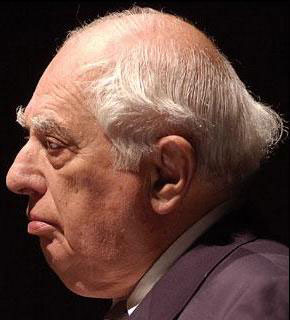
Bernard Lewis: the world view behind disaster

Bernard Lewis

David Seaton's News Links
The Turkish crisis is very complex and reveals as much or more about western contradictions in dealing with Islam as it does the Turkish or Muslim problems in dealing with the west.

Gideon Rachman of the Financial Times has written a very fine article about the present crisis which I've snipped for News Links. The part of Rachman's piece I most wanted to draw your attention to is Rachman's dissection of Bernard Lewis's view of Islam.

Possibly only Leo Strauss has had anywhere near Lewis's influence on the Neo-cons and probably Lewis has had a much more direct effect on the US Middle East policy disaster and the world view that drives it. This is the thinking behind where we find ourselves today. Understanding Lewis is essential and Rachman has "undressed" him in a half dozen lines. Brilliant. DS

Gideon Rachman: The Turkish paradox and the prophets of Eurabia - Financial Times
Abstract: Some of the same American conservatives who have argued passionately for Turkish membership of the EU are also now openly concerned that the character of western Europe is being changed by Muslim immigration. Europe, they shriek, is turning into "Eurabia". Yet one consequence of Turkish membership of the EU would be to grant 70m-plus Turks the right to emigrate anywhere they want in the EU. If you wanted radically to alter the demography of western Europe, admitting Turkey to the EU would be the best way of going about it. One of the world's leading experts on Turkish history is Bernard Lewis, a 90-year-old historian from Princeton University. But Mr Lewis is also a darling of the American neo-conservatives and perhaps the most eminent convert to the "Eurabia" thesis. Last month at the annual dinner of the American Enterprise Institute, an influential Washington think-tank, Mr Lewis accepted an award and gave a long, learned and rambling speech about the history of the "Muslim attack on Christendom". This, he argued, has gone through three phases and "the third wave of attack on Europe has clearly begun . . . This time it is taking different forms and two in particular: terror and migration." This is an extraordinary and dangerous argument. Mr Lewis was equating Osama bin Laden and Muslim immigrants. They are all part of the same attack on Europe. This seems a little rough on many of my neighbours in London. My local postman, hairdresser and convenience store owner are all Muslims. So are the schoolgirls who play football at my children's school - incongruously clad in headscarves and shorts. As far as I can tell, none of these people is intent on destroying western civilisation from within. The tell-tale danger sign in Mr Lewis's argument is that he constantly refers to Muslims in Europe as "they" - an undifferentiated mass. Near the end of his speech, he mused: "Is it third time lucky? It is not impossible. They have certain clear advantages. They have fervour and conviction, which in most western countries are either weak or lacking . . . " The problem with Mr Lewis's argument is that it fails to distinguish between a people and an ideology. Once you start thinking of the more than 15m Muslims living in Europe as a single, hostile bloc, you close the door to understanding and open the door to racism. Radical Islamism is a problem. Ordinary Muslims are not. READ IT ALL