 David Seaton's News LinksIn regard to the Iranian elections, I think it would be wise to pause before jumping on any bandwagon.The western media reaction is beginning to remind me a bit of all those "(choose color) Springs", that the CIA organizes here and there, from time to time.I am surprised at how much footage of police brutality is being freely filmed by western journalists and how freely they are allowed to beam this footage out of Iran. My experience of dictatorships tells me that this sort of thing is not typical of dictatorial behavior.
 (
check Burma etc)
If I was going to make a "dark" reading of all of this, I might come to a tentative conclusion: that if someone wanted to start a war with Iran, this media frenzy would be just the sort of agit-prop to prepare western public opinion for something "surgical".We lived through this same "Hitler of the month" thing with Bush and his neocons in the run up to the war in Iraq. This might be similar, only much better done this time.In short, I don't trust US corporate media, or its "opinion makers" any more now than I did then. DS
 David Seaton's News Links
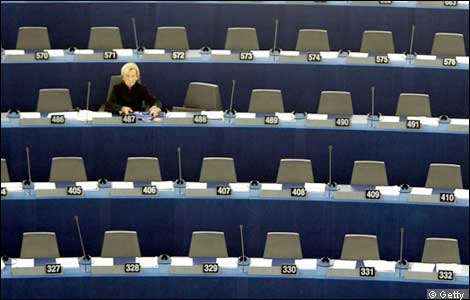
How should we read the European Parliament elections?To begin with, elections to the European parliament are usually fought country by country as local referendums entirely on national issues and despite the growing power of the European parliament in the daily life of all EU citizens, its role is hardly mentioned in these campaigns, which therefore are extremely boring and so abstention is normally very high.In Spain's European parliament elections, for example, it usually happens that the party in power is roundly defeated by the mobilized base of the opposition party who come out en masse because they see an easy win, this happens because the party in power's voter base, seeing nothing much at stake, leaves them hanging in the wind. This is what has happened this time too.This particular victory of the Partido Popular has had the perverse effect of consolidating Spain's conservative leader, Mariano Rajoy, who is considered so unattractive that even most of his own party think he has no chance against president Zapatero in the general elections three years from now.
If Partido Popular had lost the elections, this would have probably led them to change their candidate for the general elections, and since they have several candidates that are more charismatic than Rajoy, this victory may cost them dearly. So as you can see that in a European-wide election it is hard to see the forest for the trees.The disaster in waitingProbably the most dangerous result of this election has been the literal collapse of Britain's Labour Party under the leadership of Gordon Brown, which came in third behind the ultra-right UK Independence party (UKIP). If this leads to an early election before the the Lisbon Treaty is ratified it might lead to the British either leaving the EU or actually being expelled from it. Here is how the Financial Times columnist, Phillip Stephens lays it out: Hang on in there, Mr Brown. Europe needs you for a while yet. The alternative could be a Conservative prime minister leading Britain towards the European exit. Such are the whispered anxieties in continental capitals, and among pro-Europeans in Britain, as Gordon Brown’s troubles stir speculation about an early general election.(...) the leaders in Berlin, Paris and elsewhere have selfish reasons for hoping that the present British government can stagger on until next year. They have spent the best part of a decade designing, redesigning and patching up an agreement to remake the European Union’s institutions. Once it was called the European constitution; now it goes by the name of the Lisbon treaty. But, horror of horrors, with the end at last in sight, David Cameron’s Conservatives are threatening to wreck the project.(...) The timing of the government’s demise could mark the difference between a serious argument about Britain’s relationship with Brussels and a rupture that would set in train its eventual departure.(...) It is clear to all that Mr Cameron wants to derail the process of European integration. His decision to withdraw from the European People’s party, the European parliament’s mainstream centre-right group, is a step in that direction. By aligning with a hotchpotch of small far-right parties, Mr Cameron has downgraded his party’s relationship with its French and German cousins. To move Britain to the sidelines of influence is one thing. To threaten to blow up the Lisbon accord is another. This is what Mr Cameron proposes by pledging to campaign for its rejection in a British referendum. And this is where the timing of the general election really matters.(...) Mr Cameron might argue that earlier versions of the treaty were rejected in referendums in France, the Netherlands and Ireland. But these were not conscious acts of government. Withdrawal from the EPP is a Tory shot across the bows of European integrationists. Wrecking the Lisbon treaty would be a declaration of war.(...) One thing is certain: neither Britain nor Europe needs an autumn general election. Nor, unless he wants to sleepwalk towards Europe’s exit, does Mr Cameron.
So the British results are the only ones that might have direct and historic consequences. What happened to the European Social Democrats?Most of the left's classic battles have already been won in Europe, from strong labor unions, a sturdy social net and free health care, right down to even "free love": all of these have been adopted by the center right. What have the social democrats got left to sell?Here is how columnist Henryk M. Broder described in in Der SpiegelGermany, and a large part of Europe, has in recent decades incorporated vast swaths of social democratic values into their societies. The Social Democrats have lost their unique selling point. With the exception of the business-friendly Free Democrats, Germany's parliament is full of politicians who are, in some shade or another, adherents of the social democratic worldview. The Christian Social Union (the Bavarian sister party to Chancellor Angela Merkel's Christian Democratic Union) is to the left of the SPD on some issues. Merkel's CDU is sometimes greener than the Greens and the far-left Left Party continues to cozy up to Germany's mainstream parties. When almost all the parties on offer are center-left, there is no longer a compelling reason to vote SPD. On the contrary, there is nothing wrong with taking a look at those who offer something a bit different -- not unlike the way loyal Aldi shoppers take an occasional look at what rival supermarket chain Lidl is offering.
In general the problem right now with the European left is that they have not shown that they have a coherent critique of the system, which is what the voter of the left really wants from them. Until they produce that critique or the ultra-right makes more significant gains that frighten them sufficiently many left wing voters will simply abstain. It is interesting to note that the one figure of the left who did well in the elections was the French "Green", Daniel ("Danny the Red") Cohn-Bendit, who campaigned solely on European issues with a strong progressive message that would be far to the left of any mainstream American discourse.An American reading (take care)Americans may be tempted to see the European social democratic parties representing the same things as the Democratic Party of Barack Obama and the European center right taking the same positions as the Republican Party in the USA: this reading would be erroneous. For one thing, the Republican Party would be very far to the right of any mainstream party in Europe on economic and social issues and also foreign policy.It is also important to clarify that the USA's Democrats are not really a party of the "left" in European terms. The reforms that the Democrats timidly put forward, like universal(?) health care and reasonably tight financial regulations are defended by European conservatives. The Democratic party is well to the right of the European center on most issues, most of the time.You could say that the years of Thatcher-Reagan-Friedman have intellectually castrated the left. This is a problem in Europe, whereas the progressive voter in the USA is quite happy with neutered tom cats. DS
David Seaton's News Links
Today, instead of pontificating, I'd like to ask readers opinions and conclusions after perusing the maps that I've stuck on here below. They are a map of the 2008 election results, county by county, a map of "purple America" from 2004 and a map of American's median income from 1999 (I haven't found any more recent maps, but I imagine they wouldn't be dramatically different).
Please take a look: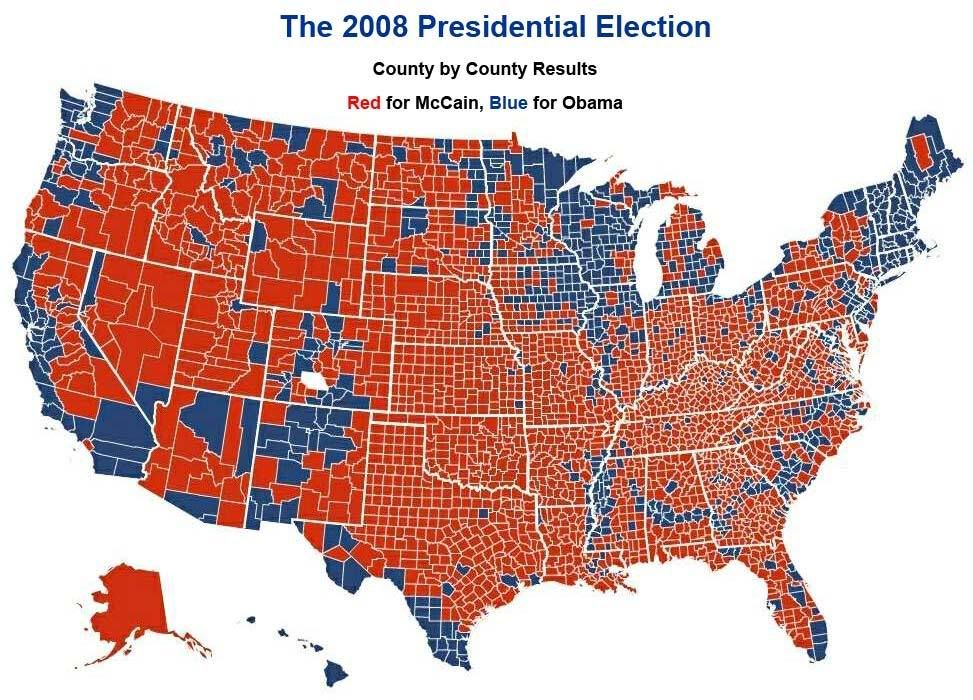 2008 election results - county by county
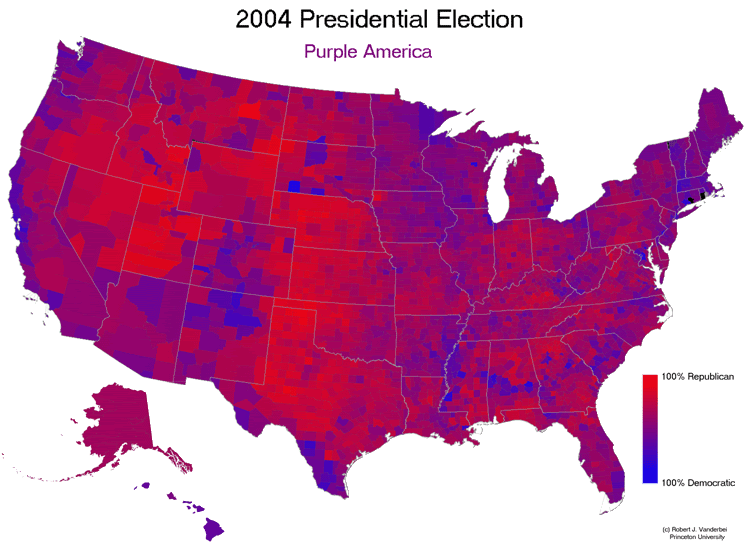 "Purple America" - 1999
 Median family income - 1999Right off the bat they look to me like a pre-war ethnic map of Bosnia, with the Serbs, Croats and Muslims all mixed up and only held together by Marshall Tito's iron hand.
Like this: My "start a bar fight" proposition would be that easy, subprime type credit has been America's answer to "Marshall Tito" and that stagnant or shrinking incomes, without access to that easy credit (something that will probably last long beyond the present crisis) will produce great tension in America's mosaic.
Personally I think the income distribution chart is more important than the others as it is much easier to change your vote than to change your income.
In that map we see islands of wealth and archipelagos of poverty in a sea of neither one nor the other. My working hypothesis is that the (permanent) loss of the kind of credit that produced the bubble will be like a painkiller wearing off of someone who has been in a terrible accident and this sudden lucidity and access to agony will produce enormous political tensions.
I would be grateful for all opinions and, of course, but especially for those that are fact-filled and wonky. DS

