Showing posts with label neoconservative. Show all posts

Wednesday, July 28, 2010

Some second thoughts about the Af-Pak Wikileaks


Julian Assange
From The Weekly Standard: One of the more interesting aspects of the WikiLeaks document dump is the persistence of intelligence reports indicating collusion between al Qaeda, al Qaeda-affiliated parties, and Iran. By itself, this should not be surprising. The 9/11 Commission, Clinton-era federal prosecutors, and many others have found evidence of such cooperation. Still, it is widely assumed that such an alliance is impossible due to theological differences between Sunni al Qaeda and the Shiite mullahs. The WikiLeaks documents demonstrate, once again, that the world does not abide by armchair assumptions. Our terrorist enemies are not mindless automatons. When it comes to confronting their common enemies, collusion is the order of the day.

"Think the worst and you'll be right" Spanish proverb
David Seaton's News Links
To start off with I love the idea of WikiLeaks: the dirty linen of the powerful on public view... irresistible. I was very impressed by the video of the murder of the Reuters journalists in Baghdad and I was eagerly waiting during the countdown for the 300,000 secret items that WikiLeaks handed over to the New York Times, The Guardian and Der Spiegel, which have been compared to Daniel Ellsberg's "Pentagon Papers" and initially I was very impressed by the breadth and depth of "linen" now on display. Certainly the futility of war  in Afghanistan was on full view for the world to see.

I began to have second thoughts on the flimsiest of motives: I was repelled by Julian Assange's face when I first saw it: the eyes, the mouth. I immediately thought, "wow, this guy sure could make a good  living playing petty thieves or perverts in police procedural films with a face like that". I looked him up in Wikipedia and saw that he had a pretty funky childhood and youth, more like Colton Harris-Moore the barefoot-bandit's than Daniel Ellsberg's but with the difference that I kind of like the barefoot-bandit's face. But hey, I thought, he who is without strange parents, let him cast the first stone. Live and let live.

However, you could say that my antenna were up and quivering already when I read the first items of the leaks that pointed to a connection between Al Qaeda and Iran. I thought, uh-oh, that sounds familiar, that is the same rap the neocons tried to hang on Saddam Hussein in the run up to the invasion of Iraq and there are still quite a few Americans who think that Saddam was involved in 9-11.  As it so happens that at this very moment the Israel lobby and the usual suspects are busy baying at the moon trying to drum up support for an attack on Iran -- as they always have been, "real men go to Tehran" --  isn't it convenient that this damning bit of evidence connecting Ahmadinejad with Osama bin Laden comes wrapped up conveniently in the most impeccably progressive of packages and just when America's politicians are looking for campaign donations?

Well, you might ask, doesn't this massive leakage damage the war effort in Afghanistan, and I would ask in return, when did the neocons ever give diddly squat about the war in Afghanistan, which they have always considered a distraction from more important affairs, like trashing Iraq and Iran? I mean, after all, what threat does Afghanistan pose to Israel?

So, could this enormous flood of leaks from WikiLeaks about the war in Afghanistan in reality be protective covering for a massive misinformation operation, one which kills two birds with one stone: weakens the distracting Af-Pak war effort and provides some sort of personal reason for Americans to want to attack Iran? Certainly, when I read the article in the neocon bible, Rupert Murdoch's, "The Weekly Standard", which I quote above, I began to get that old feeling: been there, done that, here we go again.

So I would say, whoa there, lets stop and go though all of this with a fine tooth comb and see where they want to take us with all of this: because I would agree with President Obama, when he says that Afghanistan is the "good war", in the sense that it is "good", if it keeps us too busy there to get into even worse trouble elsewhere... Kind of like methadone for American militarism. DS

Monday, April 28, 2008

Notes on hiding elephants

"Around the world, there is no shortage of nations who share our values, and are willing to defend them. These include countries like Australia, which sent troops to Iraq; Israel, which has been fighting Islamic terrorism almost since its founding; and Japan, which generally follows a more "Western" policy than most of Western Europe." Rupert Murdoch - WSJ

"The neoconservative vision(...) is essentially an affirmation of ideology. Not only does it declare war on Russia and China, it places the United States in active opposition to all nondemocracies. It proposes a League of Democracies, which would presumably play the role that the United Nations now does, except that all nondemocracies would be cast outside the pale. The approach lacks any strategic framework. What would be the gain from so alienating two great powers? How would the League of Democracies fight terrorism while excluding countries like Jordan, Morocco, Egypt and Singapore? What would be the gain to the average American to lessen our influence with Saudi Arabia, the central banker of oil, in a world in which we are still crucially dependent on that energy source?" Fareed Zakaria - Newsweek

"At first, Ms. Dowd's neocon list of last names included only Wolfowitz, Perle, Kristol, Libby and their "Likudnik friends," but later, as blogger "Silver Surfer" writes on IsraPundit.com, she amended the list to include Cheney, Woolsey and Gingrich. "In Ms. Dowd's view," he writes, "adding a few non-Jewish names to her 'neo-cons' list makes her conspiratorial story-line kosher. But it doesn't. The result is a classical portrait of 'neo-con' (read: Jewish) advisors, who drip poison in the ears of their hapless gentile bosses, while they advance their global plot to subvert true American interests and take over the world--and, as Ms. Dowd is always quick to point out . . . thereby 'advance the strategic goals of Israel.' " Julia Gorin - Wall Street Journal
David Seaton's News Links
It is said that if one wanted to hide an enormous elephant in the middle of the street in a big city, the best way to do that would be to organize a huge parade of circus elephants and hide one's elephant among them.

If we start with the premise (highly controversial) that one of the main interests,of the American policy makers known as "neocons" is to reinforce Israel's position vis a vis the Palestinians, than is is easy to see that in a world at peace, Israel's conflict with the Palestinian people stands out like a lonely elephant on a busy street.

Like some one smoothing a rumple in the covers while putting the final touches on making their bed, a world at peace, with diminishing American influence, would pressure Israel to comply with UN resolutions beginning with UN-242, or the Saudi peace plan. That would mean the end of the Zionist (both Christian and Jewish) right wing fundamentalist's dream of "Greater Israel", including Judea and Samaria. This would be a great relief to many Israelis themselves, but never enough for the neocons.

If however there is constant tension and confrontation between the "West" (including Japan) Russia and China, than Palestine and even Iran become very small elephants indeed.

The necons affirm their attachment to liberal principals. Robert Kagan, one of neoconservatism's most audible voices expresses it thusly:
Only the liberal creed grants the right, the belief that all men are created equal and have certain inalienable rights that must not be abridged by governments, that governments derive their power and legitimacy only from the consent of the governed and have a duty to protect their citizens’ right to life, liberty and property. To those who share this liberal faith, foreign policies and even wars that defend these principles, as in Kosovo, can be right even if established international law says they are wrong.
Somehow, of course, none of this seems to include the human rights of the Palestinian people to escape collective punishment. Here is the law:

No general penalty, pecuniary or otherwise, shall be inflicted upon the population on account of the acts of individuals for which they cannot be regarded as jointly and severally responsible.

Laws and Customs of War on Land (Hague IV); October 18, 1907, Article 50

No protected person may be punished for an offence he or she has not personally committed. Collective penalties and likewise all measures of intimidation or of terrorism are prohibited.

Pillage is prohibited.

Reprisals against protected persons and their property are prohibited.

Convention (IV) relative to the Protection of Civilian Persons in Time of War, Geneva, 12 August 1949, Part III : Status and treatment of protected persons, Section I : Provisions common to the territories of the parties to the conflict and to occupied territories, Article 33

Any destruction by the Occupying Power of real or personal property belonging individually or collectively to private persons, or to the State, or to other public authorities, or to social or cooperative organizations, is prohibited, except where such destruction is rendered absolutely necessary by military operations.

Convention (IV) relative to the Protection of Civilian Persons in Time of War, Geneva, 12 August 1949, Part III : Status and treatment of protected persons, Section III: Occupied Territories, Article 53

This oversight converts the liberal interventionism of the neocons in pure sophistry,: "a subtle, tricky, superficially plausible, but generally fallacious method of reasoning". Sophistry by any definition of the word.

That something so spurious, so baldly and cynically false should be mainstream discourse gives an idea of how the American political system has deteriorated.

For example, Rupert Murdoch's Wall Street Journal lends its pages to French neocon and philosopher(?) Bernard-Henri Levy, to vilifie former President and Nobel Peace Prize winner Jimmy Carter and simultaneously give us a Polaroid of Barack Obama :
"Is it the senility of a politician who has lost touch with reality and with his own party? Barack Obama, even more clearly than his rival, has just reminded us that it will not be possible to "sit down" with the leaders of Hamas unless they are prepared to "renounce terrorism, recognize Israel's right to exist, and respect past agreements." Could he be suffering from a variant of self-hatred, or in this case a hatred of his own past as the Great Peacemaker? All hypotheses are permitted. Whatever the reason, Mr. Carter has demonstrated an unusual capacity to transform a political error into a disastrous moral mistake".
Apparently in Levy's opinion, Obama's rival, Hillary, is not sufficiently clear in her rejection of former President Carter and only promises to "obliterate" Iran.

As to McClain, Fareed Zacharia, describes the ageing senator's position best:
I write this with sadness because I greatly admire John McCain, a man of intelligence, honor and enormous personal and political courage. I also agree with much of what else he said in that speech in Los Angeles. But in recent years, McCain has turned into a foreign-policy schizophrenic, alternating between neoconservative posturing and realist common sense. His speech reads like it was written by two very different people, each one given an allotment of a few paragraphs on every topic.
I have some (not very much) hope that McCain's neocon part is pure, cynical pandering in order to get into the White House. And when you pander to the neocons you cannot be tepid, you have to pull out all the stops. as is shown by Levy's rapping Hillary's knuckles.

If I were a neocon, however, I wouldn't trust McCain very far on this, all through his career, until he saw the presidency in his grasp, he has been a realist and an exponent of the Weinberger-Powell doctrine: once in the White House and because of his age and whether he likes it or not, he knows he would probably be a one-term President, so it's anybody's guess what he would do.

A slim hope indeed.

Probably nothing, not even the credit crisis and the collapse of the dollar, has exasperated America's friends, clients and allies and provoked more of their contempt than the supine helplessness of the American political system on this question. Certainly future Chinese historians will have fun with it. DS

Wednesday, May 09, 2007

The war in waiting

David Seaton's News Links
We may have been too busy watching the French elections or the US congress and the president haggling over the bill for Iraq to pay much attention to the possibility of war with Iran... The AIPAC and the neocons like professor Beres of Purdue (writing in the most moderate of newspapers) haven't lost their focus however.

People who might think that Bush, Cheney, the neocons and the Israeli right are incapable of doing anything worse, much, much worse than Iraq are intellectually challenged. DS


The case for strikes against Iran - Christian Science Monitor
Abstract: Iran's latest defiance of the International Atomic Energy Agency says it all: Further diplomacy has no chance of stopping Iran's nuclear program. Neither will UN sanctions have any effect. Unless there is a timely defensive first strike at pertinent elements of Iran's expanding nuclear infrastructures, it will acquire nuclear weapons. The consequences would be intolerable and unprecedented.(...) Ideally, a diplomatic settlement with Iran could be taken seriously. But in the real world, we must compare the price of prompt preemptive action against Iran with the costs of both: (1) inaction; and (2) delayed military action. To be sure, all available options are apt to be injurious. Iranian president Mahmoud Ahmadinejad maintains that his country's nuclear program is intended only to produce electricity, but there is no plausible argument or evidence to support this claim. Meanwhile, Mr. Ahmadinejad's genocidal intentions toward Israel are abundantly clear. Iran must be stopped immediately from acquiring atomic arms, and this can only be accomplished through "anticipatory self-defense." Precise defensive attacks against Iran's nuclear assets would be effective – and they would be entirely legal. They would be effective because the US has at its disposal the "McInerney Plan" (after Lt. Gen. Thomas McInerney, USAF/ret.). It calls, in part, for an immediate strike force to hit Iran's nuclear development facilities, command and control centers, integrated air defenses, selected Air Force and Navy units, and its Shahab-3 missiles, using more than 2,500 aim points. Operationally, the United States Air Force is best configured for such a complex task, but it would not necessarily be impossible for the Israeli Air Force to execute. It would be lawful because the US and/or Israel would be acting in appropriate self-defense. Both countries could act on behalf of the international community and could do so lawfully without wider approval. The right of self-defense by forestalling an attack has a long and authoritative history in international law. In the 1625 classic "On the Law of War and Peace," Hugo Grotius expresses the enduring principle: "It be lawful to kill him who is preparing to kill…." Today, some scholars say that Article 51 of the UN Charter overrides that right. But international law is not a suicide pact. READ IT ALL

Tuesday, May 01, 2007

Bernard Lewis: the world view behind disaster

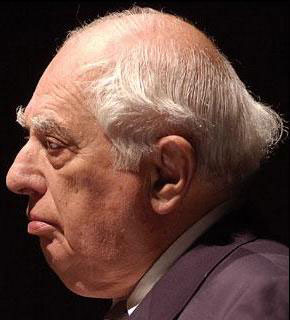
Bernard Lewis

David Seaton's News Links
The Turkish crisis is very complex and reveals as much or more about western contradictions in dealing with Islam as it does the Turkish or Muslim problems in dealing with the west.

Gideon Rachman of the Financial Times has written a very fine article about the present crisis which I've snipped for News Links. The part of Rachman's piece I most wanted to draw your attention to is Rachman's dissection of Bernard Lewis's view of Islam.

Possibly only Leo Strauss has had anywhere near Lewis's influence on the Neo-cons and probably Lewis has had a much more direct effect on the US Middle East policy disaster and the world view that drives it. This is the thinking behind where we find ourselves today. Understanding Lewis is essential and Rachman has "undressed" him in a half dozen lines. Brilliant. DS

Gideon Rachman: The Turkish paradox and the prophets of Eurabia - Financial Times
Abstract: Some of the same American conservatives who have argued passionately for Turkish membership of the EU are also now openly concerned that the character of western Europe is being changed by Muslim immigration. Europe, they shriek, is turning into "Eurabia". Yet one consequence of Turkish membership of the EU would be to grant 70m-plus Turks the right to emigrate anywhere they want in the EU. If you wanted radically to alter the demography of western Europe, admitting Turkey to the EU would be the best way of going about it. One of the world's leading experts on Turkish history is Bernard Lewis, a 90-year-old historian from Princeton University. But Mr Lewis is also a darling of the American neo-conservatives and perhaps the most eminent convert to the "Eurabia" thesis. Last month at the annual dinner of the American Enterprise Institute, an influential Washington think-tank, Mr Lewis accepted an award and gave a long, learned and rambling speech about the history of the "Muslim attack on Christendom". This, he argued, has gone through three phases and "the third wave of attack on Europe has clearly begun . . . This time it is taking different forms and two in particular: terror and migration." This is an extraordinary and dangerous argument. Mr Lewis was equating Osama bin Laden and Muslim immigrants. They are all part of the same attack on Europe. This seems a little rough on many of my neighbours in London. My local postman, hairdresser and convenience store owner are all Muslims. So are the schoolgirls who play football at my children's school - incongruously clad in headscarves and shorts. As far as I can tell, none of these people is intent on destroying western civilisation from within. The tell-tale danger sign in Mr Lewis's argument is that he constantly refers to Muslims in Europe as "they" - an undifferentiated mass. Near the end of his speech, he mused: "Is it third time lucky? It is not impossible. They have certain clear advantages. They have fervour and conviction, which in most western countries are either weak or lacking . . . " The problem with Mr Lewis's argument is that it fails to distinguish between a people and an ideology. Once you start thinking of the more than 15m Muslims living in Europe as a single, hostile bloc, you close the door to understanding and open the door to racism. Radical Islamism is a problem. Ordinary Muslims are not. READ IT ALL

Thursday, April 26, 2007

Wolfowitz: Up against the wall Paul

David Seaton's News Links
Paul Wolfowitz, whose every failure has been handsomely rewarded, is certainly the most visible, successful and symbolic of the neocons.

Over a half a million Iraqis have died, millions have been displaced. These are people who had never done any harm to the USA.

Their pain, their fear and their blood cry out for justice.

Thousands of Americans have been killed, maimed or crippled by this war, mistakenly believing in good faith that their sacrifice was in defense of their country and its flag when, in fact, they have been led to besmirch and desecrate them.


Their pain, their fear and their blood cry out for justice.


People are sent to prison everyday for stealing a car or a purse...

Until Wolfowitz and the others he represents are brought to trial for war crimes it will be impossible to begin to address the damage that has been done to America's central belief in the goodness of its own nature. DS

Andrew Cockburn: The puppet who cleared the way for Iraq's destruction - Guardian
Abstract: Among those relishing the exposure of World Bank president Paul Wolfowitz's manoeuvres on behalf of his girlfriend, Shaha Riza, in recent weeks was almost certainly the former US defence secretary, Donald Rumsfeld. Rumsfeld was driven from public life thanks to the catastrophe of Iraq, and for the moment at least lurks in obscurity. Wolfowitz, his deputy until 2005, contributed in almost equal measure to the debacle, yet managed to slide from the Pentagon into the presidency of a leading international institution with every chance to redeem himself. Blame for torture at Abu Ghraib and Guantánamo, bungling over troop levels, chaos in Iraq's reconstruction, and the general meltdown in Pentagon management has all too often been laid at Rumsfeld's door alone. However, Wolfowitz was an energetic enabler of these outrages and many other notorious initiatives.(...) Before we conclude that Wolfowitz was the original author of the policies that destroyed Iraq, we should note that his entire career, at least up through his Pentagon service, has been in the service and at the direction of others. His early work in Washington promoting the dubious merits of an anti-ballistic missile programme, for example, was sponsored by Paul Nitze, a powerful insider who devoted a lifetime of intrigue to boosting east-west tensions and US defence spending. Nitze served as godfather to the neoconservative movement in the 70s, correctly calculating that a fusion of the pro-Israel lobby with the military-industrial lobby would create an alliance of unstoppable power. Among the early and most potent recruits was an old friend of Wolfowitz's, Richard Perle, known and feared in Washington as "the Prince of Darkness" for his ruthless bureaucratic skills and commanding position in the neoconservative forces. The relationship flourished into Wolfowitz's sojourn in the Pentagon. Officials who worked closely with him remarked to me on the amount of time Perle, then a close associate of Conrad Black, spent closeted with the deputy secretary. They remained in constant touch, as Wolfowitz's phone logs attest. Other regular recipients of Wolfowitz calls included Lewis "Scooter" Libby, then chief of staff to Vice-President Cheney and now a convicted felon, and Robin Cleveland. Cleveland was in charge of national security programmes at the White House office of management and budget. From that powerful position, according to a former close colleague of Wolfowitz's, she "was one of the most important people in the group that gave us the Iraq war". Late last year Perle and other leading neoconservatives lashed out publicly at Rumsfeld, deriding his mismanagement of the Iraqi enterprise they had worked so hard to set in train. "Interesting they are not going after the puppet," the former colleague emailed me in reference to Wolfowitz's absence from his old friends' denunciations. Given recent sordid revelations, his role in shredding the reputation of the World Bank and the morale of its employees may be harder to obscure. READ IT ALL

Tuesday, February 27, 2007

From those wonderful folks who brought you Iraq

"In most professions, a record of failure counts against you. Architects whose buildings fall down and doctors who maim their patients tend to suffer some sort of consequence. The same rules should apply to people who advocate disastrous wars."
Gideon Rachman
David Seaton's News Links
Gideon Rachman has produced a rather perfect column attacking the neocon push for a war with Iran. Here follows a short abstract and the link. Don't miss it! DS

Gideon Rachman: From the guys who gave you the Iraq war, another fine idea - Financial Times
Abstract: The country is developing weapons of mass destruction; its leader is a new Hitler; he has connections with terrorists; time is running out; containment has failed; we must strike before it is too late. If you think you have heard it all before, you have. The arguments for an attack on Iran are almost exactly the same as the arguments that were made for an attack on Iraq. The people making the case have not changed either.It might be possible to make a convincing case for an air strike on Iran if you could somehow erase the memory of the disaster of Iraq. But such amnesia is neither possible nor desirable. There are valuable lessons to be learnt from Iraq. “Intelligence” is often highly unreliable. Talking about a “new Hitler” is a shopworn rhetorical trick that should be banned. Military actions that look straightforward when they are launched have a nasty habit of developing in unexpected ways. (The very fact that American and allied troops are on the ground in Iraq and Afghanistan increases the possibility of unpredictable escalation.) And America and its allies pay a huge price in political capital around the world every time they resort to force – particularly if the use of military power is “pre-emptive”. The fact that the neo-conservatives and their allies are unabashed by their failure in Iraq does not mean that the rest of the world should be so forgiving. After all, these people positively begged to be judged by the results of the Iraq war. In a notably smug editorial written on the eve of the war with Iraq, the editors of The Weekly Standard wrote: “The war itself will clarify who was right and who was wrong about weapons of mass destruction.” Well, indeed. And they ended with a flourish: “History and reality are about to weigh in and we are inclined simply to let them render their verdicts.” Well, the verdict’s coming in, chaps – and it is not looking good. In most professions, a record of failure counts against you. Architects whose buildings fall down and doctors who maim their patients tend to suffer some sort of consequence. The same rules should apply to people who advocate disastrous wars. Take a look at the people who are arguing for an attack on Iran, consider their records – and run a mile in the opposite direction. READ IT ALL

Strolling down memory lane with Dr George Friedman

David Seaton's News Links
While doing some research on the origins of the war in Iraq for a column I'm hacking away at, I stumbled on this treasure in my files. It is the summary of a conference call that Dr. George Frieman of Strategic Forecasting (Stratfor) made with Schroder Salomon. Smith Barney, shortly before the war. The summary below gives a perfect Polaroid of the neocon mentality and the garbage they used to take America to war.
Part of the enjoyment of reading the transcript and its amazing analysis, is the humid-handed prose of Dr. Friedman. They say that the true sexual organ of our species is the mind. That being true, my late grandmother would have hastened to warn Dr. Friedman that if he continued to analyze is this fashion he would be bound to go blind. DS

Iraq, The War, and the next 5 years - Strafor


An Analysis

This is a summary of a SSSB-organised Conference Call with Dr George Friedman, Chief Intelligence Office of a Geo-Milito-Political Consultancy firm in the US, called Stratfor. The call is from earlier this week. The following analysis should not be taken to be the opinion of the summariser, nor the view of SSSB.

Executive Summary
  • This is a war which is definitively going to happen
  • It will most likely commence between 27th February and March 2nd
  • It will be over by mid-April
  • Regime change is the objective
  • The US is committed to a major military presence in the area for the foreseeable future
  • The purpose of the war is to position the US in the heart of the region, so as to be able to bring to bear overwhelming pressure on surrounding States, so that they ruthlessly ‘deal with’ the Al Quaeda network in their countries … or else face the US
  • Ultimately, Pakistan is on the US agenda
  • India, as a consequence, is going to become a major US ally
  • China will acquiesce, as will Russia, in return for US recognition of their respective rights to ‘deal with’ ‘insurgency’ as they see fit
  • Iran, Syria, Saudi Arabia are the biggest losers …. and Iraq
  • The current international landscape is about to fundamentally change … war will become a permanent feature of the next 5-10 years

Prospects for war: Converging with the 20 century mean

The backdrop of Stratfor’s analysis:

1. We are re-entering ‘normality’, and that the 1990s were a period of abnormality
2. That stock markets have gone up and down during conflicts [Korea, Vietnam] and that war is neither extraordinary in terms of the 20 th century, nor is it inherently bad for market.
3. The Iraqi invasion itself is not about Al Quaeda being in Iraq

4. Nor is it about oil
5. The US is committed to a long-term presence in the region
  • It is about Iraq being the single-most strategically placed country in the Middle-East … having at its borders Syria, Iran, Jordan, Saudi Arabia, Turkey, and Kuwait.
The US rationale

To date, the US has always been an outsider when it has come to dealing with issues in the Middle East, and as direct consequence it has always needed alliances ….. this will change, definitively, when it becomes the dominant and overwhelming military power in the region. The whole dynamic of the Middle East will shift as a consequence.

What is the purpose of the war?
  • The purpose is to redefine the geopolitics of the region, in order to be able to bring direct and unavoidable pressure upon countries who are intentionally, or by default, are allowing Al Quaeda to operate
  • The driving logic is to create a new reality: that it is far worse not to co-operate with the US than it is to ignore Al Quaeda within their own countries, for fear of internal problems.

Nevertheless it is a scenario which these countries have recognised is increasingly likely to come to take place.

The opposition from Iran and Saudi Arabia has little to with Iraq, and everything to do with the wider implications of a long-term US presence in the Middle East.

Is it likely to take place?

War is a certainty [according to Stratfor]

  • The US administration is absolutely committed to going to war.
  • It does not want a UN ‘government’ in place
The immediate upshot of war:

  • Syria will be surrounded by hostile countries [Turkey, US/Iraq, Israel]
  • US naval dominance will provide overwhelming reach
  • Saudi Arabia will be surrounded by Yemen, Oman, Kuwait, US/Iraq, Qatar
  • Iran will be flanked by US-supporting Afghanistan on its East, and in the West by the US/Iraq, Kuwait
Fighting the war:

There are currently two opposing perceptions of the forthcoming war:

1. The US perception/assumption: The Iraqi army is incapable of fighting. As the US command views the situation, the predominant supposition is that the regular Iraqi army collapsed when the US took it on in Kuwait. The assumption in 1991 was that US casualties would be high: the US establishment feels that they over-estimated the Iraqi army. As a result, the theme now is that the Iraqi regular army cannot fight. Stratfor states that this shows a strange schizophrenia , in that the public are encouraged to believe that great sophistication is being shown by the Iraqi subterfuge and deceptions regarding the mobile chemical bio-chemical weapons which are being moved about the country at the moment, whilst little competence is accorded/transferred to the army.

2. The Iraqi perception/assumption: Saddam Hussein believes that he will win. This is based on the premise that the US does not want to suffer high casualties, as evidenced in the 1990s by Somalia, Beirut, and the1991 war. Far from being a massive defeat for Iraq, Hussein/Iraq views the Gulf War as, at best, a draw, and at worst as being defeat for the US. Why? Because the perception is that, beside being ejected form Kuwait, when the US met the Iraqi Republican Guard, the US gave up and gave in. Thus, now Iraq believes that just so long as they can inflict high casualties upon the US early on, and then have an urban battle in Baghdad, that the US will revert to type, and that a UN-based ceasefire will come into acceptance…..and that Saddam Hussein and his regime will continue to survive
So, we have two very different perceptions of the past, upon which the present is now predicated
When will War begin?
  • Between February 27th and March 2nd
Why then?
  • Because that, for the US, is the optimal period of the phases of the moon
  • The US wishes to commence the attack in darkness. Night darkness favours the US, because Stealth bombers can only be picked up opticially, and not by radar. Also, darkness will aid special forces going in under cover.
By when will it end?
  • The most likely deadline for the resolution of the war, from the perspective of the US, is mid-April. This is because should Iraq decide to use Chemical weapons against the US, the above-85 degree temperature will render the anti-chemical suits virtually inoperable, with US fighting basically ineffective.
  • It cannot wait until mid-autumn because the US currently has six army divisions around Iraq ….the ‘family jewels’ have now been committed. A force with overwhelming battle-strike potential is now in place. There is no way it will be held there indefinitely. This war will, and has to be, fought to conclusion.
Is there a possible earlier start date?
  • Yes: If Iraqi troops in the North and South, near the oilfields, and around Baghdad, were suddenly to be moved, then it is very possible that bombardment would begin
How will it be fought?
  • First: Complete surpression of Iraqi air-defences, using cruise missiles, Stealth bombers, and heavy strikes against all Iraqi command centres
  • Simultaneously, ground operations would begin early on
  • From the South the US would advance into the oilfields rapidly, in order to prevent their destruction. The purpose of this is two-fold: to secure the oilfields, for future usage; and to secure the road infrastructure leading up to the region, which will be critical for the successful follow-up of troops and armour.
  • Also of paramount importance: of the six bridges which cross the Euphrates river, three must be taken intact by the US, or else critical time will be lost in rebridgin
The First Military Objective:
  • The primary initial objective of the US forces is to seize the afore-mentioned bridges. Special forces will enter first, followed up by heavy armour.
  • Stratfor states that at this success is expected, due to the absolute excellence the US has at this sort of operation.
The Ultimate Military Objective:
  • To take Baghdad and effect ‘regime change’
  • Easier said than done…
  • Taking a major capital is a scale of task hitherto unattempted in US military history, and indeed only attempted successfully on a few occasions worldwide [Berlin by the Soviet Union was successful, but Stalingrad and Leningrad both were too much for Germany].
If Iraq can fight effectively from the outset [contrary to the US assumption, in Stratfor’s view] then there is a serious problem.

This will be a key point in the success of the overall campaign.

There are currently four brigades of the Republican Guard in Baghdad. The US has never yet encountered them in battle.
  • The key question is: Will the Replublican Guard fight?
  • The importance of morale on this point, within Iraq, is crucial.
  • If the Republican Guard can fight the US to a standstill/standoff, then it will have achieved its aim.
  • The reality here is that no-one, not the US, and not even Saddam Hussein, knows the answer to this question for sure.
In purely military terms, there is no question that the US can take Baghdad: the question is, however, at what price?

The US cannot afford to be seen to be targeting civilians – something which was not an issue in either Berlin or Stalingrad in WW2.

Thus the US hope that there may be one of three outcomes in Baghdad:

1. That the Special Republican Guard decides not to fight
2. That there is a coup within the Iraqi military high command and immediate surrender to the US. This is not something which should be dismissed as a possibility – certainly their loyalty has in the past by no means been assured: viz. the periodic purges of the military elite during the 1990s.
3. The US manages to win the city without excessive civilian casualties

What does this a successful US outcome do for geopolitical alliances in Europe?
  • That both Germany and France have made a major miscalculation.
  • The assumption that a united European response was not the natural corollary to the US position was wrong.
  • Too many European countries do not want a dominant Paris-Berlin coalition, according to Stratfor, for fear of ‘generational domination’. Hence the support of the Iberian Peninsula, most of Eastern Europe, Italy, and the Netherlands.
Of greater consequence is: What will happen to other states?
  • Saudia Arabia will be in difficulties
  • Syria will be under immense pressure in the future
  • Iran will be faced with a far more immediate challenge to its internal structure
  • India will benefit considerably both in terms of business and political relationships.
  • Why? Because, ultimately, after Iraq, dealing with Pakistan will the next overriding objective for the US.
The Oil Effect?
  • Stratfor assert that this is not about oil…
  • There will be a minimal effect on oil prices from the war
  • The Venezuelan effect will have had a bigger impact
  • There are already US contingency plans in play. The worst case situation is already in the price.
  • At worst, 1.5mm bbpd will be off the market, but not permanently.
Wider implications of the Iraqi war

  • War is going to be a permanent backdrop for the next 5-10 years
  • There will be a de facto ‘extension of an informal US empire’
  • Markets, will have to learn to live it, and they will do so
  • The Structural impact on the US economy will range between neutral to positive
  • There will be ‘considerably more friction between the US and other countries
Q & A Session in Conference Call

In 2003/4, post-Iraq, what priorities does the Bush administration have vis-à-vis the wider region?

  • The US view is that it cannot do anything about anti-Americanism.
  • It will not attempt to win the hearts and minds of people locally
  • It will attempt to ‘create a sense of fear and impotence’ within the region.
  • It will ensure that nation states are more afraid of not cooperating with the US than simply ignoring terrorism within their own countries.
  • This is where the Al Quaeda aspect will enter: the US will exert extremely heavy pressure on suspected countries, forcing them to deal with Al Quaeda effectively
  • … should cooperation be found wanting, the US will not baulk at launching covert operations and extreme pressure onto non-cooperating countries.
Why take this strategy?
  • Because the thinking is that Al Quaeda cannot afford to become a larger organisation, because - the theory asserts - the larger it becomes, the less secure it becomes.
  • Structurally highly-secure growth of Al Quaeda is of greater concern to the US
Impact/Implications for other countries

North Korea
  • North Korea, according to Stratfor, is little more than a side issue. It is merely playing the latest round in a decade-long game where it seeks to gain economic concessions from the US/Japan/South Korea in return for ratcheting down military rhetoric.
  • There is a ‘qualitative difference’ to the Korean threat; it is not likely that the US will get involved.

Russia
  • There have already been quiet talks between Washington and Moscow over Chechnya. There will be a change in US policy towards Chechnya, which will be the price of Russian co-operation.
  • The Russian administration will be ‘very happy’ with the new paradigm
  • They do not care excessively about Iraq: they will settle for an increased market share in Oil.

Iran
  • Iran will choose to close down internal debate as it steps up its security levels
  • Long-term, it knows it is in danger: the US-Iran issue will be a serious issue for the future.
  • There may well be considerable internal change further down the line.

France/Germany
  • France is not posturing for commercial reason, as some commentators are suggesting.
  • On the contrary, they have made a serious strategic miscalculation, and are now staring at an‘abyss’ in which they have alienated the US, and have caused considerable resentment within Europe for their current stance.
  • The German-French response to the US has as its overall purpose the creation of a European counterweight to US power.

Israel
  • The US, whilst ‘absolutely committed to the survival of Israel’, does not want to involved itself in the resolution of what it regards as an essentially, if not exclusively, internal issue.
  • The US would prefer to see a timely and equitable resolution to the Israel-Palestinian conflict; but the pressure it is likely to exert upon the Israeli administration will more probably focus on encouraging the Israeli administration to coming to an ‘accommodation’ with Hamas, with Arafat side-lined.
China

  • China is ‘delighted’ with the new situation. Why?
  • Pre-9/11 the focus of US strategy had decisively shifted towards worsening US-china relations. Now, the entire focus has shifted away from Asia.
  • US needs china diplomatically
  • … but China is also worried by improved and strengthened [in the medium-term] US-India relations
  • China also has its own internal issues – the price of cooperation with the US will be that the US does not interfere with its internal ‘security issues’
  • With poor US-China relations out of the way, there will be a new ‘lease of life’ towards improved commercial and political relations with the US.

India
  • India is going to be one of the main longer term beneficiaries of the new situation
  • Why? Because the US has decided that it has to deal with Pakistan’s linkages to Al Quaeda, and its non-cooperation, hitherto, in dealing with terror cells which the US allege are being given the official ‘blind eye’
  • The US will be keen to develop commercial links to solidify this relationship
Will Nato survive?
  • Difficult to say: whilst it is not the remit of this discussion …
  • Nato no longer has its raison d’etre [the Soviet Union]
  • The US does not want to involve itself with such a consensus-oriented institution
  • Where consensus is so evidently lacking, the US does not want to reveal military plans and secrets to an essentially un-trusted organisation
So what will emerge?
  • Whilst Nato may continue to exist in name, in effect a series of informal and formal alliances will [and indeed have] emerge in its place
  • For example: at the moment the Netherlands is supplying Kuwait with Patriot Missiles. Germany is supplying the Netherlands with these. This sort of accommodation will become the norm, as will a lack of formalisation of such alliances.
What are the key initial lead indicators of the possibility of military success 7-10 days in?
  • Are the six bridges over the Euphrates blown effectively by the Iraqi army?
  • If they are intact, then it will be assumed that the regular Iraqi army are ineffective.
  • Chemical weapons are most likely to be used in this area of the conflict.
  • Within the 1st 96 hrs as there should be a good picture emerging of Iraqi morale.
What does Iraq/Hussein want? Simply to survive through to mid-April?
  • Yes: Iraq wants to reach mid-April having inflicted thousands of casualties on the US, in the hope that this will erode US public opinion, forcing Bush to seek a UN ceasefire.
  • Iraq wants to make a big impact on the periphery of its borders early on, in order to shore up morale and support in the centre if Iraq, ie in Baghdad.

Is there going to be a major terrorist attack in the US during the next 6 weeks?
  • There will ‘certainly be attempts’.
  • But … Al Qaeda attacks when least expected: we know too little of their overall reach and capabilities to say anything else definitively.
What about the dangers posed by chemical weapons?
  • This is a key issue: one of the main reasons that the public is not being told of the whereabouts of Iraq’s chemical and biological weapons is because what the US fears most is that Iraq learns how much is known about them, and that as a consequence they move and hide the weapons before the US can react.
  • The US will already have covert troops targeting the sites they know of, and will hope to take them out early on
  • It is possible they might be used against Kuwait – it is likely against Turkey, and it is possible against Israel.
The Bigger Picture post-Iraq
  • Stratfor assert that the current Iraqi situation should be seen as a ‘campaign as part of a protracted wider war’ which will last for 5-10 years, and which will, by default, overwhelmingly dominate the international scene
Who will gain most?

  • The high-tech sectors
  • China
  • Russia
  • India

Monday, February 19, 2007

Pogo meets Iraq

David Seaton's News Links
There is a lot to chew over in this article from Foreign Policy Magazine. It makes some important points that provide a practical program for thinking about the disaster of Iraq.

Americans have a big problem accepting that other people(s) are really as different as they are, that their cultures and social structures are as intractable as they really are. That as William Faulkner, "the past isn't history, it isn't even past."

I suspect that behind a lot of this, there is a deep fear of how precarious the American identity has become as it has ceased to simply be WASP, with becoming WASP-like the measure of American-ness, while at the same time the "others" who were always invisible or comic relief have become visible: Visible and vocal. You might say that the WASP identity was the "Marshall Tito" to America's inner "balkanization".

Among the neocons, who midwifed the war in Iraq, that identity crisis
seems to be greater than for others. Neoconservatives seem to have a pressing need to believe that they, instead of being, in reality, a tiny minority with very special interests, are in fact "universal" in their beliefs and especially in their needs. In the druggy sixties this was known as forcing others to "take your trip". DS

What Iraq Tells Us About Ourselves - Foreign Policy
(hat tip to Teresa O'Neill)
Abstract: How did the highly educated, wealthy, and powerful American people make such a horrendous, catastrophic series of blunders? As Pogo, the cartoon opossum, once famously said, “We have met the enemy and he is us!” Yes, that’s right: We, the American people—not the Bush administration, nor the hapless Iraqis, nor the meddlesome Iranians (the new scapegoat)—are the root of the problem. It’s woven into our cultural DNA. Most Americans mistakenly believe that when we say that “all men are created equal,” it means that all people are the same. Behind the “cute” and “charming” native clothing, the “weird” marriage customs, and the “odd” food of other cultures, all humans are yearning for lifestyles and futures that will be increasingly unified as time and globalization progress. That is what Tom Friedman seems to have meant when he wrote that “the world is flat”—that technological and economic change are driving humankind toward a future of cultural sameness. In other words, whatever differences of custom and habit that still exist between peoples will pass away soon and be replaced by a world culture rather like that of the United States in the 21st century. To be blunt, our foreign policy tends to be predicated on the notion that everyone wants to be an American. In the months leading up to the start of the Iraq War, it was common to hear seemingly educated people say that the Arabs, particularly Iraqis, had no way of life worth saving and would be better off if all “that old stuff”—their traditions, social institutions, and values—were done away with, and soon. The U.S. Armed Forces and U.S. Agency for International Development would be the sharp swords of modernization in the Middle East. How did Americans come to believe that the entire world is embarked on the same voyage, and that we are the navigators showing the way to a bright future? Our own culture is a rich blend, brewed from such elements as enlightenment, optimism, Puritan utopianism, a Calvinist tendency to not forgive sinners, and the settler’s lack of respect for the weak and “native” peoples of the world. In the United States, such threads have pushed us to believe that we are all in a melting pot of common ideology. This belief system has been fed to us in the public schools, through Hollywood, and now in the endless prattle of 24-hour news networks. It has become secular religion, a religion so strong that any violation of its tenets brings instant and savage condemnation. So called “neoconservatism” isn’t some kind of alien ideology; it’s merely a self-aware manifestation of the widespread American belief that people are all the same. The repeated assertion by U.S. President George W. Bush that history is dominated by the existence of “universal values” is proof in the pudding.
By Col. W. Patrick Lang, Jr. READ IT ALL

Thursday, December 14, 2006

Jonah Goldberg wants a Pinochet for Iraq. Yecch.

David Seaton's News Links
Jonah Goldberg, syndicated neocon pundit, today recommends Augusto Pinochet for dictator of Iraq. Pinochet has only one outstanding qualification for the job: he is dead. Since the neocons, a vindictive, vengeful lot, were not received by the Iraqi people with "rice and sweets" as they expected, it has come to this. Pure hate. During Pinochet's reign of terror, many Chilean refugees came to Spain, I knew some and heard their stories. I find Goldberg's article too nauseating to quote, but I'll give you the (yechh) link. DS

Monday, December 11, 2006

Afghanistan: an ideology collapses

David Seaton's News Links
Today Paul Krugman, in a column about outsourcing says the following, "In Afghanistan, the job of training a new police force was outsourced to DynCorp International ... under very loose supervision: ... auditors couldn’t even find a copy of DynCorp’s contract... And $1.1 billion later, Afghanistan still doesn’t have an effective police training program." When "Real Existing Socialism" collapsed, it was assumed that this was somehow a vindication of capitalism.... Perhaps it was only a vindication of "collapse". All of the ideology that dresses up American power is being stripped away in Iraq and Afghanistan. Perhaps this is even more evident in Afghanistan, where the motives for the war are clearer and less prone to conspiracy theories than Iraq. Certainly we are seeing a crisis of the prevalent neo-liberal and neo-conservative, "end of history" thinking of the 1990s. The famous Chinese curse, "may you live in interesting times", could well be applied to our era. DS
Taliban and Allies Tighten Grip in North of Pakistan - New York Times
Abstract: Islamic militants are using a recent peace deal with the government to consolidate their hold in northern Pakistan, vastly expanding their training of suicide bombers and other recruits and fortifying alliances with Al Qaeda and foreign fighters, diplomats and intelligence officials from several nations say. The result, they say, is virtually a Taliban mini-state. The militants, the officials say, are openly flouting the terms of the September accord in North Waziristan, under which they agreed to end cross-border help for the Taliban insurgency that revived in Afghanistan with new force this year. The area is becoming a magnet for an influx of foreign fighters, who not only challenge government authority in the area, but are even wresting control from local tribes and spreading their influence to neighboring areas, according to several American and NATO officials and Pakistani and Afghan intelligence officials. This year more than 100 local leaders, government sympathizers or accused “American spies” have been killed, several of them in beheadings, as the militants have used a reign of terror to impose what President Pervez Musharraf of Pakistan calls a creeping “Talibanization.” Last year, at least 100 others were also killed.(...) The fundamentalists’ influence is seeping outward, with propaganda being spread on private radio stations, and through a widening network of religious schools and the distribution of CDs and DVDs. It can now be felt in neighboring tribal departments and the settled areas of the North-West Frontier Province. In recent months, Pakistani newspapers have reported incidents of music and barber shops being closed, television sets burned and girls’ schools threatened. The militants are more powerful than the military and the local tribal police, kill with impunity and shield criminals and fugitives. (...) the Taliban commanders and the Pakistani militants under them remain unswervingly loyal to jihad in Afghanistan and, despite the tensions, still enjoy local support for the cause, officials and local journalists say. The failed government military campaigns of recent years, which are seen as dictated by the United States, have further radicalized the local population, many in the region say. As a potential indicator of local support, the families of two suicide bombers sent to Afghanistan from Waziristan gained renown in the community, according to a local journalist.(...) Morale is high among the resurgent Taliban after their revival in Afghanistan this year, one Pakistani security official said. That will lead to still more recruitment and better organization and planning in the year ahead. READ IT ALL

Wednesday, December 06, 2006

On Iraq polls show: all the ducks in a row, except the lame duck

David Seaton's News Links
Rarely, if ever have American's been both so well informed and so much in common accord about any issue as they are today about what is to be done with Iraq. We have an elite group of "gray beards", the Baker-Hamilton Commission, and on the other, the vast majority of Mr. and Mrs. John Q. Public; in this case, all are pulling in the same direction. The verdict: get out quick and organize a huge regional peace conference to cover the retreat by settling all the major issues outstanding. A general peace in the Middle East, means a peace that saves the "moderate" regimes allied with Washington and that means solving the Israel/Palestine conundrum in such a way as to salvage the prestige of those moderates with the "Arab street". That means Israel returning to its 1967 borders and turning Jerusalem into an international city and all of this without much real guarantee that Iran will forsake its nuclear programs. This is the total defeat of the neocon, hard-wilsonian project. So now we are finally going to see if AIPAC is really as powerful as it is supposed to be. This is their big test. Do they have the influence to overcome such a consensus? DS
Abstract (tip of the hat to TomDispatch): A new poll by WorldPublicOpinion.org finds that three out of four Americans believe that in order to stabilize Iraq the United States should enter into talks with Iran and Syria, and eight in ten support an international conference on Iraq. A majority also opposes keeping U.S. forces in Iraq indefinitely and instead supports committing to a timetable for their withdrawal within two years or less.(...) 75 percent say that the United States should have talks with Iran and the exact same number say that the United States should have talks with Syria. This diplomatic approach is endorsed overwhelmingly by both parties: eight in ten Democrats and seven in ten Republicans endorse talking with both Iran and Syria. There is also strong bipartisan support for calling a major international conference where diplomats from the United States, Europe, the United Nations and the Arab world could meet Iraqi leaders to discuss how to stabilize Iraq and encourage economic growth there. Seventy-nine percent (Republicans 79%, Democrats 80%) say they support such a conference; only 18 percent believe that instead foreign leaders should “stay out of Iraq’s affairs.” On the issue of how long U.S. troops should remain in Iraq, a majority of Americans reject the current policy of keeping troops in the country indefinitely. Fifty-eight percent say troops should be withdrawn according to a timetable, while 38 percent say that U.S.-led forces should only be reduced “as the security situation improves.” There is substantial variation in the length of the timetable preferred: 18 percent prefer six months, 25 percent one year and 15 percent two years. There are partisan differences on this issue, however. While most Democrats (78%) think U.S. forces should be out within two-years or less, including 61 percent who favor a one-year or less, a majority of Republicans (64%) believe forces should be withdrawn only as security improves. Fifty-six percent of Independents also support withdrawal within two years. Support for withdrawal according to a timetable becomes stronger “if the majority of the Iraqi people say they want the U.S. to commit to withdraw U.S. forces according to a timeline of no more than a year.” Seventy-three percent say the United States should withdraw in a year or less if most Iraqis want them to, including 67 percent of Republicans and 82 percent of Democrats. Fifty-eight percent also believe that the majority of the Iraqi people want the US to commit to one-year timeline. A poll of the Iraqi public conducted by WorldPublicOpinion.org in September 2006 found that 71 percent want U.S.-led forces to commit to withdraw within a year.(...) This desire for a commitment to pull U.S. troops out within a year appears to arise from doubts about whether the U.S. presence helps or hurts stability in Iraq. Six in ten Americans (60%) believe that the United States’ military presence in Iraq is provoking more conflict than it is preventing. Only 35 percent believe U.S. troops are stabilizing the country. The belief that U.S. forces are provoking conflict has risen 5 points since March 2006 and 9 points since October 2004. READ THE ENTIRE POLL

Monday, December 04, 2006

Litvinenko and the neocons

David Seaton's News Links
In the absence of a 'smoking gun. it is beginning to look more and more as if the people behind the Litvinenko murder are those with most to lose if Putin is successful in rebuilding Russia's national sovereignty. Certainly it is hard to imagine that Putin would shoot himself in the foot this way. For me it also significant that all this comes at a time when Russia is delivering the Tor anti-aircraft system to Iran, which would effectively take the option of an Israeli/American attack off the bargaining table. As I said a few posts ago, it is instructive to get the license number of those who are quickest to implicate Putin and to check that against their first positions on the invasion of Iraq. As the following article in The Guardian states, "In the absence of genuine evidence of Russian state involvement in the killings of Litvinenko and Politkovskaya, we should be wary about jumping on a bandwagon orchestrated by the people who bought death and destruction to the streets of Baghdad, and whose aim is to neuter any counterweight to the most powerful empire ever seen." DS
Abstract: Three weeks on, we are still no closer to knowing who was responsible for the death of the former Russian agent Alexander Litvinenko. The use of polonium 210 as a murder weapon could point in entirely opposite directions. It might suggest that the killing was carried out on behalf of the Russian security service as a public warning to others who might think of betraying it. But it could also be read as an attempt by President Putin's rich and powerful enemies to discredit the Russian government internationally. Whatever the truth, it has been seized upon across Europe and the US to fuel a growing anti-Russian campaign.(...) those on the centre-left who have joined the current wave of Putin-bashing ought to consider whose cause they are serving. Long before the deaths of Litvinenko and the campaigning journalist Anna Politkovskaya, Russophobes in the US and their allies in Britain were doing all they could to discredit Putin's administration. These rightwing hawks are gunning for Putin not because of concern for human rights but because an independent Russia stands in the way of their plans for global hegemony. The neoconservative grand strategy was recorded in the leaked Wolfowitz memorandum, a secret 1990s Pentagon document that targeted Russia as the biggest future threat to US geostrategic ambitions and projected a US-Russian confrontation over Nato expansion. Even though Putin has acquiesced in the expansion of American influence in former Soviet republics, the limited steps the Russian president has taken to defend his country's interests have proved too much for Washington's empire builders. In 2003, Bruce P Jackson, the director of the Project for a New American Century, wrote that Putin's partial renationalisation of energy companies threatened the west's "democratic objectives" - and claimed Putin had established a "de facto cold war administration". Jackson's prognosis was simple: a new "soft war" against the Kremlin, a call to arms that has been enthusiastically followed in both the US and Britain.(...) As part of their strategy, Washington's hawks have been busy promoting Chechen separatism in furtherance of their anti-Putin campaign, as well as championing some of Russia's most notorious oligarchs. In the absence of genuine evidence of Russian state involvement in the killings of Litvinenko and Politkovskaya, we should be wary about jumping on a bandwagon orchestrated by the people who bought death and destruction to the streets of Baghdad, and whose aim is to neuter any counterweight to the most powerful empire ever seen. READ IT ALL

Saturday, December 02, 2006

Holistic solutions in the Middle East

David Seaton's News Links
If there is one thing that the Israelis really don't want it is a "global solution" to the Middle East. Well, that's not exactly true, the "Global War On Terrorism" (GWOT) and the invasion of Iraq as a prelude to the invasion of Syria and then the invasion of Iran, "real men go to Tehran", was the Israeli right's and their neocon Washington operative's first choice, but that isn't working out is it? If a global conference takes place, the Israelis will have to give up all the land they took in 1967, including Jerusalem. Now, there are many Israelis and even more American Jewish people who would be more than glad to sign that to get some peace, but as Americans have cause to know, right wing crazies often carry the day against all reason. Any "making nice" by the Olmert government at this point has to be taken with total skepticism: they are simply playing for time. This is not dumb: things are deteriorating so fast and Bush is so crazy, that they may finally escape from a peace conference without taking the blame for its failure. DS
Abstract - Middle East hot spots merging - Christian Science Monitor: After sitting down with President Bush and Iraqi Prime Minister Nouri al-Maliki in Jordan Thursday to seek solutions to Iraq's agony, Secretary of State Condoleezza Rice waded into the other conflict spreading bitterness throughout the region. Hoping to keep the Israeli-Palestinian cease-fire momentum alive, Ms. Rice went to the West Bank and Jerusalem Thursday to nudge the two sides toward concerted peacemaking. The two events underscore the gradually eroding boundaries between Middle East flash points - from Baghdad to Beirut to Gaza. Indeed, the Bush administration's visits come amid growing discussion about the need to find holistic solutions. A growing number of observers - most notably British Prime Minister Tony Blair and Jordan's King Abdullah - have advocated that solving the Israeli-Palestinian conflict would boost stability. But others say the rise of radical Islam, Iran's push to become a nuclear and regional power, and the US initiative to promote democracy have created a complex web of forces that contribute to conflicts around the Middle East. "Progress between Israel and Palestinians is good for efforts to deal with other conflicts in the Middle East. Undoubtedly they're all interlocked," says Yossi Alpher, the coeditor of the online Middle East journal Bitterlemons.org. "But I'm very wary of arguments which we increasingly hear, that the Israeli-Palestinian conflict is the key to everything. Nothing could be further from the truth. There are very extensive linkages that you didn't have in the past, but it goes both ways."(...) In September, Philip Zelikow, a senior adviser to Rice, called the Israeli-Palestinian problem "the essential glue that binds a lot of these problems together." Mohammed Dejani, a political science professor at Al Quds University, described the conflict as a "historic issue" in the Arab world. "A lot of the anger and resentment that's taking place regarding the policies of the US has been because of its stand on this issue," he says. "All radical regimes and movements are using this issue because among the masses in the Arab world there is a lot of sympathy regarding the suffering of the Palestinians."(...) The regional linkages are increasingly being recognized in Israel, which in the past has preferred bilateral negotiations as the only means to solving the conflicts with its neighbors. In his speech this week, Olmert said he planned to reach out to moderate Arab states to help advance the peace process and even praised a four-year-old Saudi Arabian peace plan. READ IT ALL

Tuesday, November 21, 2006

Virtual America/Virtual Iraq - William Pfaff - The Observer

David Seaton's News Links
For those people like William Pfaff, who have a clear strategic vision and well tuned ethical framework, Iraq is like a nightmare from an Ingmar Bergman film where they try to warn the autistic and the frivolous of the error of their ways, only to find blank faces staring back at them. DS
Abstract: In America, it's as though Bush, his inner cabinet, and the neocons have been playing a video game, with fictional characters and victims, virtual death and torture. Now the disc has suddenly finished, and it's time to shut down the player. This is not just a figure of speech. American policy has been running on images rather than evidence of real nations and people doing things for real human motives. It has been populated by abstractions: Global Terrorist Conspiracies, Rogue Nations, Fanatics Who Hate Our Freedoms, Generations of Terrorism and The Global Menace of Al-Qaeda. The US, where actual people live, has been turned into an abstraction: the Sole Superpower, which everyone in the world knows is a Righteous Nation, the Mars (in the neocon Robert Kagan's formulation) defending the fragile Venus which is Europe, the Straussian (Leo Strauss, the University of Chicago philosopher) Realist unflinchingly battling in a Hobbesian universe to protect Kantian Europeans, with their illusions of global parliaments and peace, from nameless horrors.(...) Is this Orwellian? Or is it just demagogy, politicians' lies, White House spin, journalistic laziness, formulations conceived to sell books? Or could it be cynical manipulation by apprentice dictators, energy industry and weapons-maker magnates, closet fascists? It is not Orwellian in that the neocon ideologues, George Bush and Tony Blair, certainly believe all this. They are not being manipulated. It is not Orwellian because the creators of this cartoon-like conceptual world have themselves become actors in the virtual universe their ideas and actions have made. They have left reality behind - or they simply ignore it, as they did in invading Iraq. We have passed from 1984 to 2006, into a post-Orwellian condition in which Big Brother has become a part of his creation. He is now imposing it on others by acting as though it were real, at whatever expense to others. READ IT ALL

Sunday, November 19, 2006

Embittered Insiders Turn Against Bush - Washington Post

David Seaton's News Links
This "discontent" is part of a campaign to force Bush to bomb Iran. Joshua Muravchik of the American Enterprise Institute, mentioned in this article, has an op-ed in the Los Angeles Times today entitled, "Bomb Iran". Subtle, nu? DS
Abstract: Most striking lately, though, has been the criticism from neoconservatives who provided the intellectual framework for Bush's presidency. Perle, Adelman and others advocated a robust use of U.S. power to advance the ideals of democracy and freedom, targeting Hussein's Iraq as a threat that could be turned into an opportunity. In an interview last week, Perle said the administration's big mistake was occupying the country rather than creating an interim Iraqi government led by a coalition of exile groups to take over after Hussein was toppled. "If I had known that the U.S. was going to essentially establish an occupation, then I'd say, 'Let's not do it,' " and instead find another way to target Hussein, Perle said. "It was a foolish thing to do." Perle, head of the Pentagon's Defense Policy Board at the time of the 2003 invasion, said he still believes the invasion was justified. But he resents being called "the architect of the Iraq war," because "my view was different from the administration's view from the very beginning" about how to conduct it. "I am not critical now of anything about which I was not critical before," he said. "I've said it more publicly."(...) "It seemed like nobody was getting it," Adelman said. "It seemed like everything was locked in. It seemed like everything was stuck." He agrees he bears blame as well. "I think that's fair. When you advocate a policy that turns bad, you do have some responsibility." Most troubling, he said, are his shattered ideals: "The whole philosophy of using American strength for good in the world, for a foreign policy that is really value-based instead of balanced-power-based, I don't think is disproven by Iraq. But it's certainly discredited." READ ALL

Saturday, November 18, 2006

Krauthammer blames it all on the Iraqis

David Seaton's News Links
I'm including this just in case you missed it yesterday. When I read it, it made me so angry and ashamed I nearly threw up. Charles Krauthammer is one of the major nonconservative pundits that led the people of the United States into invading a country whose people had never done anything to harm them. Now, as a result of that invasion the doors of hell have opened and the helpless people of Iraq are being swallowed in a terrible civil war that will surely lead to ethnic cleansing, the displacement of millions of people and probably the death of hundreds of thousands more... that is, if the war doesn't suck in the rest of the region and set the entire Middle East on fire... And now it turns out that the whole thing is the fault of the Iraqis. This miserable creature has the gall to throw a quote of Benjamin Franklin's, "A Republic if you can keep it" in the bloodied and humiliated face of the people of Iraq. I am really tempted to use one of George W. Bush's favorite words to describe Mr. Krauthammer, "evil". I can think of no other. Has he no shame? No pity? no mercy? Or even just enough sense to shut up and not reveal his vileness. DS
Abstract:(...) Are the Arabs intrinsically incapable of democracy, as the "realists" imply? True, there are political, historical, even religious reasons why Arabs are less prepared for democracy than, say, East Asians and Latin Americans who successfully democratized over the past several decades. But the problem here is Iraq's particular political culture, raped and ruined by 30 years of Hussein's totalitarianism.What was left in its wake was a social desert, a dearth of the trust and good will and sheer human capital required for democratic governance. All that was left for the individual Iraqi to attach himself to was the mosque or clan or militia. At this earliest stage of democratic development, Iraqi national consciousness is as yet too weak and the culture of compromise too undeveloped to produce an effective government enjoying broad allegiance. (...) s this America's fault? No. It is a result of Iraq's first democratic election. The United States was not going to replace Saddam Hussein with another tyrant. We were trying to plant democracy in the heart of the Middle East as the one conceivable antidote to extremism and terror -- and, in a country that is nearly two-thirds Shiite, that inevitably meant Shiite domination. It was never certain whether the long-oppressed Shiites would have enough sense of nation and sense of compromise to govern rather than rule. The answer is now clear: United in a dominating coalition, they do not. READ IT ALL (if you have a strong stomach)