Showing posts with label health care. Show all posts

Monday, January 28, 2013

Is middle class renewal in any way based on cheap shale gas?

David Seaton's News Links
fracking
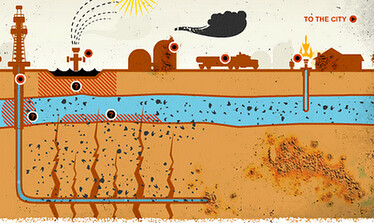
Fracking illustrated

It seems to me that the challenge of rebuilding the American middle class: bringing back the jobs, ensuring good public education, health care and decent pensions is now to a great extent predicated on a very controversial "energy revolution": the lowering the cost of energy by the method of hydraulic fracturing of gas and oil-bearing shale known as fracking.
Not only is this technique of breaking apart the shale with water mixed with chemicals supposed to lower the costs of energy for industry and reduce America's dependence on imported gas and oil, thus producing more taxable income for social programs, but also to allow the United States to reduce its armed "footprint", the billions of dollars in military resources with which we police the troubled areas of the world where much of the energy we now import comes from. The idea being that the money saved in this way would be the money used to pay off the national debt, while simultaneously guaranteeing entitlements, etc..
It may be just my fevered imagination, but since fracking appears to be extremely dangerous to both human health and the environment itself, we might be looking at a future train wreck between social democracy and green concerns. DS

Monday, March 22, 2010

Looking into the mirror of the healthcare battle

"A mountain had gone into labor and was groaning terribly. Such rumors excited great expectations all over the country. In the end, however, the mountain gave birth to a mouse." Aesop
David Seaton's News Links
There is this saying in Spanish, "did we need such big saddlebags for such a short ride?"

I'm have been having trouble getting deep into this health care battle. I live in  a rather typical European socialized medicine system and even the wildest of European conservatives, and believe me some of them are pretty wild, wouldn't ever dream of privatizing any of those systems down to the size of this "history making" American bill.

The need for a national health system in any developed country is so obvious that I have finally come to the conclusion that the extraordinarily vile opposition to this decaffeinated bill, (the "grass roots" opposition, not that of the insurance and pharma lobbies of course), is entirely racist.

I read this comment over on the BBC site that expressed all this very well:
For those of us who lived through the early days of the civil rights movement, survived busing, dealt with outbreaks of the Ku Klux Klan and the Black Panthers, sit-ins, be-ins and such,one can see the thinly veiled racism that drives the anti-Obama movement. The republican party vowed to destroy his presidency. This health care reform debate has NOTHING to do with health care, economics or anything reasonable. It is unfortunate, but the United States is a classist, racist, economically and socially backward and bigoted country. I am a white woman who is educated and lives in the South. Believe me, this is about our President's race, nothing else. And those who are so evil and bigoted should be ashamed of themselves, but they have neither the good sense, the moral fiber or the will to actually grow up and act like adults.
I'm afraid I have to agree with her. Anyone who could think this sorry little half-baked piece of legislation is "socialism", wouldn't know a socialist if he came up and bit them on the ass. I have to admit that the sole explanation for such incredibly vituperative virulence can only be racial bigotry.

I think the enormous battle to pass this innocuous bill holds up a very unflattering mirror for the American people to look into.

Rather than heralding a "post racial America", the Obama presidency may lead to America's PC "carpet" being finally pulled back and all the nasties that have been carefully swept under it all these years come crawling out, biting and stinging, into the light of day. This may turn out to be very healthy, but it sure wont be pretty. DS

Tuesday, September 08, 2009

The American right is world famous....


David Seaton's News Links
Here is something from The Guardian that I thought readers would enjoy. It's written by Simon Hoggart and it titled, "Why the American right make me sick".
Enjoy!
There are few tribes more loathsome than the American right, and their vicious use of the shortcomings in the NHS to attack Barack Obama's attempts at health reform are a useful reminder.

I was thinking of this during a visit to my 91-year-old dad who is still in an NHS hospital after three weeks, recovering from a broken hip. He has had fantastic care, including a new metal hip, blood transfusions, different antibiotics to match every aspect of his condition; all administered by nurses who remain cheerful even when asked to perform tasks on men - the lethal combination of pain and old age makes some in the ward exceedingly grumpy - that I would not want to do for £1,000 a time. If he was in an American hospital he'd be using up half his life savings to get that standard of care, and few ordinary Americans could afford the insurance that would provide it. (This is because health insurers spend a large part of their income on PR against the "socialised medicine" and on sending pro forma letters explaining why your policy doesn't cover actual illness.) All over the US there are people whose lives are being destroyed for lack of proper health care provision, and there is no sight more odious than the rich, powerful and arrogant trying to keep it that way.

Nice, huh?

Friday, September 04, 2009

When "yes we can" could become "we thought we could".

Reaching out
“If the president says, ‘Here is what I need in the bill,’ and it doesn’t include the public option, there will be no other way to interpret it than it was a retreat,” added Weiner. “I speak for a lot of members who are allies of the president. We are prepared to take our lumps to get this important policy done. But I don’t like this sense of us charging up the hill, and not only is the president not leading us, but he is not on the hill with us.” Politico

There was a lot of talk last year about how Barack Obama would be a “transformational” president — but true transformation, it turns out, requires a lot more than electing one telegenic leader. Actually turning this country around is going to take years of siege warfare against deeply entrenched interests, defending a deeply dysfunctional political system. Paul Krugman
David Seaton's News Links
As readers of my blog know, I've often been mercilessly skeptical of Barack Obama.

I have long feared that he was merely taking progressives for a ride in order to further his private agenda, in much the same way that Bush took the evangelicals for a ride, simply redirecting their energy and discipline in order to lower taxes for the rich.

Back in November I wrote:
The left is about ideas, about facing reality bravely with full unblinking consciousness. An opportunity for the left to rebuild itself arose in the unlikely shape of George W. Bush and now it is about to be wasted.

Now after lengthy labor pains, with much moaning and groaning, the mountain has given birth to a mouse.

What makes me sad and angry is that the consciousness that has been raised during the Bush years is going to be sanitized and neutered as we tell ourselves another soothing bedtime story about ourselves to ourselves.
When Obama addresses congress next week on public health I'll definitely know if I was right or wrong.

If he comes out strongly for a public option, which is as close as the USA could probably come to a real "national health" program, I will happily eat plate after plate of humble pie with a generous side order of crow.

If he dumps the public option -- which at this moment seems very likely -- I will feel that all my skepticism has been amply vindicated.

Eliminating the public option would be a tragic prevarication; a travesty and a betrayal of all those who have placed their faith in this man and who worked tirelessly to get him elected. They will know they have been used and discarded like a Kleenex in the futile search for a moderate center that no longer exists.

Because, one of the keys to understanding contemporary US politics is that, after Ronald Reagan's revolution (I put no quotes around the word "revolution"), the American center has been destroyed.

As Paul Krugman recently pointed out:

Moderate Republicans, the sort of people with whom one might have been able to negotiate a health care deal, have either been driven out of the party or intimidated into silence. Whom are Democrats supposed to reach out to, when Senator Chuck Grassley of Iowa, who was supposed to be the linchpin of any deal, helped feed the “death panel” lies?
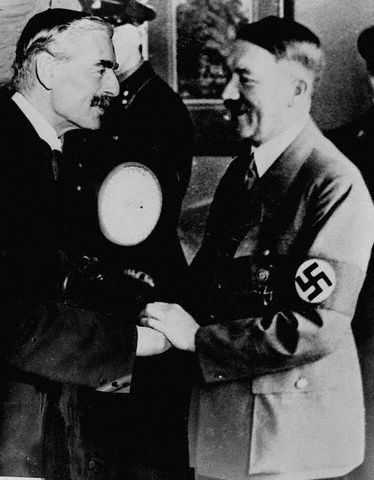
To use a favorite simile of the right, Obama is acting the part of Neville Chamberlain, thinking that he can cut deals with people who take no prisoners...

Obama has often been compared to Ronald Reagan, but except for their phenomenal communication skills, they have little or nothing in common.

Ronald Reagan was first and foremost an ideologue. Behind his amiable, folksy and slightly goofy exterior he was in his own way every bit as firmly entrenched in his extremist ideology as, say, Cambodia's Pol-Pot was in his... and as far removed from reality too.

Ronald Reagan was totally focused on moving the United States politics much farther to the right than its people actually were then, or are even today.

Reagan was able to redefine the parameters of American politics.

Barack Obama gives no sign of such focus or ambition of moving American back to where it was, much less of moving it to the left.

If Obama or anyone else really thinks that a Democratic president can "reach out" to the right and "unite", them behind him on anything, they are somewhere south of naive.

This a time to fight and this is good ground to fight on.

The chance to change American politics on a Reaganesque scale, to become the anti-Reagan, exists in the health care issue. Weakness here will cripple the Obama presidency: For all those that oppose him now or in the future will see the clear discontinuity between the hat and the cattle...

And make no mistake, Barack Obama's deadliest enemies are not in Tehran, the mountains of Afghanistan or Pakistan, much less in Beijing or Moscow, they are right there is Washington with him and they will show him no mercy if they are not brought to heel. DS

Monday, August 31, 2009

When crazy meets money

Ah f'krisesake
America is a better country in many ways than it was 35 years ago, but our political system’s ability to deal with real problems has been degraded to such an extent that I sometimes wonder whether the country is still governable. Paul Krugman - New York Times
David Seaton's News Links
So now we are being told that president Barack Obama is Adolph Hitler... just like Saddam Hussein, Ahmadinejad or (fill in name of whosoever the American right wants to bomb at the moment).

They want to talk about Hitler? Lets talk about Hitler.

According to John Tolund, who most experts consider Hitler's definitive biographer, as early as 1918 German army doctors had diagnosed Hitler as a "psychopath with hysterical symptoms".

How did someone literally insane go so far?

It happened because Germany's top industrial families were so terrified of the communists in the context of the then collapsing German economy that they thought that the the triumph of the weird and wacky Hitler, the failed watercolorist from Vienna with his campy brown shirts, would favor their interests.

You could say that their bet paid off: although Germany was burned to the ground in WWII and perhaps 8.5 million Germans died, most of the great German industrial fortunes of the 1930s are still great fortunes today. If the communists had carried the day in Weimar Germany, quite possibly today's Krupps and Thyssens might be bussing dishes on the Ku'damm and sleeping rough in the Tiergarten... an outcome they were naturally eager to avoid.

From Germany's industrial oligarchy's -- albeit minority -- point of view, backing Hitler and destroying Germany was a reasonable business decision.

Who knows, perhaps, America's "good and the great" may be taking similar decisions today in order to defend what they, quite correctly, see as their interests, which perhaps are not the same interests as those of most of the rest of us.

Is the "Obama = Hitler" really crazy stuff?

You betcha.

But the crazy part is not the real story because for historical reasons, due to its origins as a refuge for religious eccentrics, the United States has always had much more than its share of crazies. Sinclair Lewis and H. L. Mencken had endless fun exposing America's deep vein of primitive weirdos. America treasures its crazies, they make us unique. Crazy is not the story.

The story is the money.

The question today is to determine who is paying for this particular campaign of organized insanity aimed at leaving America without a health plan.

Way back in May of 2007 I posted about the opening of a "Creationist Museum" in Kentucky that cost a cool $27,000,000, I entitled the post "High Rolling Holy Rollers with a Big Bank Roll". This snippet from my old post is relative to today's story:
One of the essential roots of American culture from the earliest days has been religious nonconformity and even religious manias. (...) What distinguishes today's holy rollers is the money they are finding to express themselves with. Traditionally these people, by definition uneducated refugees from a Flannery O'Connor short story, have always been dirt poor and outside the system. The $27m that this creationist museum cost is the real novelty here. Where is all the dough coming from for this "know-nothing Disneyland"?
For sure this campaign against health care is costing a lot more than the creationism museum and it is doubtful that it is being financed by the "widow's mite" of those whom Chris Rock so pungently described as "Broke-ass white people, livin’ in a trailer home, eatin’ mayonnaise sandwiches, fucking their sister, listening to John Cougar Mellencamp records…”

So here is the real job for America's investigative journalists and political junkies: cherchez l'argent... follow the money. History hinges on the money trail. DS

Tuesday, July 28, 2009

What health care in America hinges on


We are in the midst of a great national debate about how to make health care affordable; almost nothing is more important to working-class Americans. “For the health of the nation, both physically and economically, we need a system with a public option,” Leo Gerard, president of the United Steelworkers, wrote recently in the Huffington Post. “And we need it now.”
But whether working families get it now depends to a large degree on Mr. Obama’s personal popularity. And now comes Gates-gate, this latest burst of fake populism from the right. Waving the banner of the long-suffering working class, the tax-cutting friends of the top 2% have managed to dent the president’s credibility, to momentarily halt his forward movement on the health-care issue. Thomas Frank - Wall Street Journal
David Seaton's News Links
In most situations there is one thing the whole business depends on or revolves around. I call that thing the "hinge".

In analysis, finding the hinge is the shortcut to the center of a mass of inchoate information.

In action, identifying the hinge is often finding the "fulcrum" with which to move the world and finding it can bring huge rewards with little input of effort.

The world's latest economic crisis, for example, was brought upon us by very clever people who had discovered that the "hinge" of our financial system was that there was really no meaningful relation between the actual value of assets and what you could charge for them if you transformed them to a gaseous state.

Despite the near collapse of the system they had gamed, many of these clever people are still laughing... because they had also discovered another hinge... the "too big to fail, if you have enough friends in Washington" hinge.

I have been meditating on the plight of America's left as universal health care, entangled in the pantomime of our checks and balances, is once again circling the drain.

I have been searching for the "hinge" of the absurd impotence of American progressives.


I think that I may have found said hinge in a simple technical phrase that keeps bouncing off my neural walls: "working poor".

The contradiction between working and simultaneously being poor in the world's richest country.

Here is how Wikipedia defines the term "working poor":
Working poor is a term used to describe individuals and families who maintain regular employment but remain in relative poverty due to low levels of pay and dependent expenses.
Barbara Ehrenreich, the writer who has probably done more than anyone to put a face on working poverty, has this to say in her book, "Nickel and Dimed":
When someone works for less pay than she can live on ... she has made a great sacrifice for you ... The "working poor" ... are in fact the major philanthropists of our society. They neglect their own children so that the children of others will be cared for; they live in substandard housing so that other homes will be shiny and perfect; they endure privation so that inflation will be low and stock prices high. To be a member of the working poor is to be an anonymous donor, a nameless benefactor, to everyone.
Here is what she wrote in the New York Times:
The human side of the recession, in the new media genre that’s been called “recession porn,” is the story of an incremental descent from excess to frugality, from ease to austerity. The super-rich give up their personal jets; the upper middle class cut back on private Pilates classes; the merely middle class forgo vacations and evenings at Applebee’s. In some accounts, the recession is even described as the “great leveler,” smudging the dizzying levels of inequality that characterized the last couple of decades and squeezing everyone into a single great class, the Nouveau Poor, in which we will all drive tiny fuel-efficient cars and grow tomatoes on our porches.

But the outlook is not so cozy when we look at the effects of the recession on a group generally omitted from all the vivid narratives of downward mobility — the already poor, the estimated 20 percent to 30 percent of the population who struggle to get by in the best of times. This demographic, the working poor, have already been living in an economic depression of their own. From their point of view “the economy,” as a shared condition, is a fiction.
So, where is the hinge to the sheer uselessness of American progressives?

The hinge is that, at its most critical moment, the entire debate about universal health care in America has been diluted, if not derailed, for over a week by an unpleasant, though bloodless, encounter that a Harvard professor had with a police officer.

All this, while millions of working Americans, both black and white, are being treated like shit every day of their lives.

"Treated like shit": surely an exaggeration?

Check this from the Guardian:
It was July 2007 and Potter, a senior executive at giant US healthcare firm Cigna, was visiting relatives in the poverty-ridden mountain districts of northeast Tennessee. He saw an advert in a local paper for a touring free medical clinic at a fairground just across the state border in Wise County, Virginia.

Potter, who had worked at Cigna for 15 years, decided to check it out. What he saw appalled him. Hundreds of desperate people, most without any medical insurance, descended on the clinic from out of the hills. People queued in long lines to have the most basic medical procedures carried out free of charge. Some had driven more than 200 miles from Georgia. Many were treated in the open air. Potter took pictures of patients lying on trolleys on rain-soaked pavements.

For Potter it was a dreadful realisation that healthcare in America had failed millions of poor, sick people and that he, and the industry he worked for, did not care about the human cost of their relentless search for profits. "It was over-powering. It was just more than I could possibly have imagined could be happening in America," he told the Observer.
Now, it appears that the policeman and the professor are going to the White House to have a beer with the President of the United States.

A nice chilled lager, a manly handshake, a photo opportunity, this, while, as the Canadian National Post newspaper writes:
The U. S. Congress, corrupted by a failure to impose campaign finance reform on special interests, from unions to wealthy entities, appears to be unable to pass laws to provide even a modicum of fair, universal health-care coverage for its populace.
So that is the "hinge" in American progressive politics: what passes for a left in the USA is obsessed with racial, gender, ecological and identity politics, while Americans, of all races and all possible sexual preferences, are mercilessly overworked and underpaid. They are being exploited and treated no better than excrement and left to the mercy of right wing demagogues, all while the President of the United States takes time off to soothe the ruffled feathers of a professor and a policeman.

Frivolity, corruption and decadence are the hinge. DS

Saturday, February 16, 2008

The Real Face of Change

Uppagenzdawallmuddahfuggah!
"Promises to transcend the conundrums of entitlement reform that require real and painful trade-offs and that have eluded solution for a generation. Promises to fund his other promises by a rapid withdrawal from an unpopular war" Charles Krauthammer
David Seaton's News Links
The quote above encapsulates the central political question of the United States and it is a question that will quite literally affect the entire world.

"Entitlement reform"... These two words are one of those American euphemisms like "collateral damage", which, in this case, is used to describe reducing pensions and health care for the aged.

The sad news is that there isn't enough money to pay for the empire and to pay the coming pensions of the "boomers". (full disclosure: I am not in the US pension system, I have been working in Spain and paying into its system. This is not about me). Chalmers Johnson describes the situation best:
"It is virtually impossible to overstate the profligacy of what our government spends on the military. The Department of Defense's planned expenditures for fiscal year 2008 are larger than all other nations' military budgets combined. The supplementary budget to pay for the current wars in Iraq and Afghanistan, not part of the official defense budget, is itself larger than the combined military budgets of Russia and China. Defense-related spending for fiscal 2008 will exceed $1 trillion for the first time in history. The United States has become the largest single salesman of arms and munitions to other nations on Earth. Leaving out of account President Bush's two on-going wars, defense spending has doubled since the mid-1990s. The defense budget for fiscal 2008 is the largest since World War II."
Something's got to give.

I doubt if it's going to be the old folks.

The codgers vote.

We have been hearing for years how selfish the boomers are. Get ready to see it in action. After all, we are talking about the "generation of '68".

One of the things that has irritated me most about Obama's "Children's Crusade" has been his supporters' criticism of the senior's lack of enthusiasm for his vaporous rhetoric, as if the elderly were holding back "progress".

As I read the tea leaves, the ones truly manning the ramparts in the battle against imperialism are America's elderly. The fight to pauperize America's elderly in order to pay for more missiles is the central political story of our time. DS

Tuesday, February 12, 2008

The Skinny, the Fudge and the Movement

Walking on water as she is really walked
David Seaton's News Links
In today's New York Times David Brooks lays out the cards face up:
"The new Democratic president would be faced with Bill Clinton’s Robert Rubin vs. Robert Reich choice: either scale back priorities for the sake of fiscal discipline or blow through all known deficit records for the sake of bigger programs. Choose the former, and the new president would further outrage the left. Choose the latter and lose the financial establishment and the political center. This is the debate that Democrats have been quietly rearguing during the entire Bush presidency. The left wing of the party is absolutely committed to winning it this time. It will likely demand the clean energy subsidies and the education spending, the expensive health care coverage and subsides to address middle-class anxiety. But no Democratic president can afford to offend independent voters with runaway spending. No president can easily ignore the think tank establishment, which is rightfully exercised about the nation’s long-term fiscal health. It would be another brutal choice."
A brutal choice indeed.

Brooks's bottom line is very simple,
"clean energy subsidies and the education spending, the expensive health care coverage and subsides to address middle-class anxiety"
must be sacrificed for military spending. Next will come Medicare, pensions and the "entitlements".

Spanish friends who travel regularly to the United States on business comment on the deterioration of America's infrastructure, roads, bridges, etcetera. There is no money for them either.
Here is Chalmers Johnson precise description:
"There are three broad aspects to our debt crisis. First, in the current fiscal year (2008) we are spending insane amounts of money on "defense" projects that bear no relationship to the national security of the United States. Simultaneously, we are keeping the income tax burdens on the richest segments of the American population at strikingly low levels.(...) in our devotion to militarism (despite our limited resources), we are failing to invest in our social infrastructure and other requirements for the long-term health of our country. These are what economists call "opportunity costs," things not done because we spent our money on something else. Our public education system has deteriorated alarmingly. We have failed to provide health care to all our citizens and neglected our responsibilities as the world's number one polluter. Most important, we have lost our competitiveness as a manufacturer for civilian needs -- an infinitely more efficient use of scarce resources than arms manufacturing.(...) Our excessive military expenditures did not occur over just a few short years or simply because of the Bush administration's policies. They have been going on for a very long time in accordance with a superficially plausible ideology and have now become entrenched in our democratic political system where they are starting to wreak havoc. This ideology I call "military Keynesianism" -- the determination to maintain a permanent war economy and to treat military output as an ordinary economic product, even though it makes no contribution to either production or consumption." Chalmers Johnson
When we talk about money for infrastructure and especially money for the education and for the health of children, we are talking about "seed corn". We are eating our seed corn. When it's gone, the real ride down the steep slope of decadence begins in earnest.

However Brooks in his inimitable, smarmy, sadistic, way is right. If elected, a Democratic president will be faced with all these choices. I have no doubt that be it Hillary or be it Obama, he or she will fudge... The "system", as Brooks points out, is the system. There has never been a system like it.

Both Hillary and Obama are dues paying, card carrying, members of that system.

The climb down would be less humiliating for Hillary as she could probably wheel and deal some kind of health care package in exchange for staying in Iraq and waltzing Kyoto... Hillary doesn't pretend to be a "movement". She is "Mrs. Possible".

However, at some point, Obama will be asked to prove his supernatural powers, to walk on water, to raise the dead and bring sight to the blind and when the fat, old thing just lies there looking at him, a lot of folks are going to be real disappointed.

And that, friends and neighbors, is when a real movement, one that actually moves, might get moving.

My human heart cringes, but my inner Lenin laughs and laughs. DS

David Brooks: When Reality Bites - New York Times
Abstract: When you think about it, the Democratic policy unity is a mirage. If the Democrats actually win the White House, the tensions would resurface with a vengeance. The first big rift would involve Iraq. Both Senators Hillary Clinton and Barack Obama have seductively hinted that they would withdraw almost all U.S. troops within 12 to 16 months. But if either of them actually did that, he or she would instantly make Iraq the consuming partisan fight of their presidency. There would be private but powerful opposition from Arab leaders, who would fear a return to 2006 chaos. There would be irate opposition from important sections of the military, who would feel that the U.S. was squandering the gains of the previous year. A Democratic president with few military credentials would confront outraged and highly photogenic colonels screaming betrayal. There would be important criticism from nonpartisan military experts. In his latest report, the much-cited Anthony Cordesman describes an improving Iraqi security situation that still requires “strategic patience” and another five years to become self-sustaining.(...) All dreams of changing the tone in Washington would be gone. All of Obama’s unity hopes would evaporate. And if the situation did deteriorate after a quick withdrawal, as the National Intelligence Estimate warns, the bloodshed would be on the new president’s head. Therefore, when a new Democratic administration considered all these possibilities, its members would part ways. A certain number of centrists would conclude that rapid withdrawal is a mistake. They would say that the situation had changed and would call for a strategic review. They’d recommend a long, slow conditions-based withdrawal — constant, small troop reductions, and a lot of regional diplomacy, while maintaining tens of thousands of troops in Iraq for the remainder of the term. The left wing of the party would go into immediate uproar. They’d scream: This was a central issue of the campaign! All the troops must get out now! The president would have to make a terrible decision. Which brings us to second looming Democratic divide: domestic spending. Both campaigns now promise fiscal discipline, as well as ambitious new programs. These kinds of have-your-cake-and-eat-it-too vows were merely laughable last year when the federal deficit was running at a manageable $163 billion a year. But the economic slowdown, the hangover from the Bush years and the growing bite of entitlements mean that the federal deficit will almost certainly top $400 billion by 2009. The accumulated national debt will be in shouting distance of the $10 trillion mark. With that much red ink, the primary-season spending plans are simply ridiculous. It’d be 1993 all over again. The new Democratic president would be faced with Bill Clinton’s Robert Rubin vs. Robert Reich choice: either scale back priorities for the sake of fiscal discipline or blow through all known deficit records for the sake of bigger programs. Choose the former, and the new president would further outrage the left. Choose the latter and lose the financial establishment and the political center. This is the debate that Democrats have been quietly rearguing during the entire Bush presidency. The left wing of the party is absolutely committed to winning it this time. It will likely demand the clean energy subsidies and the education spending, the expensive health care coverage and subsides to address middle-class anxiety. But no Democratic president can afford to offend independent voters with runaway spending. No president can easily ignore the think tank establishment, which is rightfully exercised about the nation’s long-term fiscal health. It would be another brutal choice. READ IT ALL

Wednesday, February 06, 2008

Not exactly an endorsement

David Seaton's News Links
If I finally end up voting for Hillary Clinton she'll have John Edwards to thank. She has taken over his health plan, which according to Paul Krugman is the only workable one out there.

My inner Lenin tells me that it would be great if the whole health thing festered until the masses stormed the Winter Palace, but elementary compassion leads me to support any workable plan for universal health care that would alleviate the suffering of so many millions of fellow human beings.

Right now I think the Democratic nomination is down to two horrible phonies. One an experienced and capable phony and the other a phony of unmitigated chutzpah and cynicism and totally unqualified for the job. If backed into a corner, holding my nose and gagging and retching, I will vote for the candidate that has some chance to heal the sick, not the one that promises to walk upon the water. DS

Sunday, February 03, 2008

Health: a Spanish lesson

The picture that concentrated Franco's mind so wonderfully
David Seaton's News Links
An American reader familiar with Spain asked me what possible relation there could be between the American situation and the Spanish one, where, as she pointed out, public health care predates Democracy. I thought it such an interesting question that I decided to answer her here.

Many years ago I worked on a project for a large American, family owned corporation with manufacturing facilities in Spain. They wanted to close a factory and they were amazed at the penalties they would have to pay to shut the thing down. They demanded a detailed history of Spanish social legislation, which I helped to research.

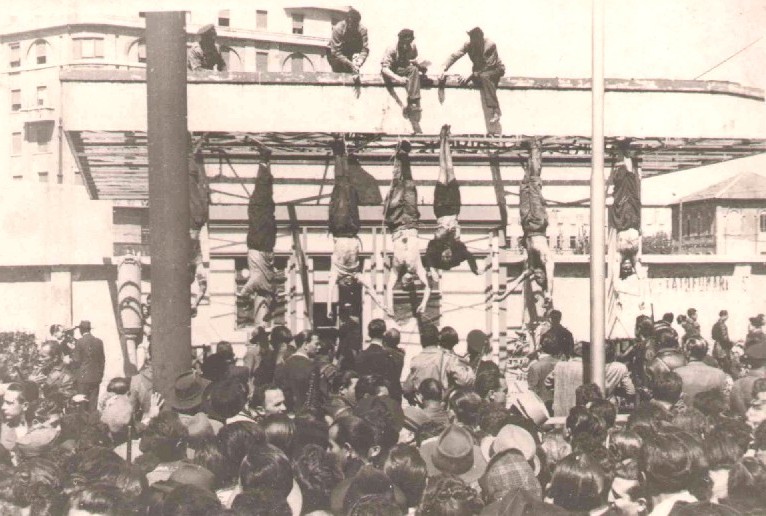
I speak from memory, but I seem to recall that we discovered that almost all the Spanish welfare state dated from when it became obvious that Hitler was going to lose the war. The idea of the victorious allies charging over the Pyrenees and Nuremberging him concentrated Franco’s mind wonderfully.

Franco, brutal victor in the recent civil war was always a practical and expedient fellow, so he threw the defeated working class a fish. Providing health care, protecting jobs and paying the summer and Christmas bonuses helped the police state keep control of the defeated working class during those black years before prosperity arrived, with the tourists, in the 1960s.

Basically then, Spain had some sort of health system under Franco because he was afraid of hanging by his feet in a gas station like Mussolini.

Until the Socialists reformed it in the 80s it was a very, very half hearted, half assed system indeed. And it was the fear of Spain going Communist after the death of Franco that allowed the reformist Socialist government of Felipe González which had been previously "restructured" under the guidance of Willy Brandt's SPD to finally take power and, once they agreed to stay in NATO, receive the blessings of the US as the lesser of many possible evils.

In a sense the entire European welfare system was put in place because the elites were afraid of the working class going with the Communists in the late 40s and early 50s. In the democracies the pressure was expressed in the ballot box, in Spain by police informers relaying the mood of the population. What is necessary today in America is to produce that same unease at the top of the American system. The civil rights struggle shows that this is as possible in the USA as in Europe.

If the Republican Party and the American conservatives in general were still more or less normal, like they were under Eisenhower or even Nixon, they would probably do like Franco and throw the fish. They showed that sort of pragmatism when confronted with the reality of "burn baby burn". But I think the Ayn Randies, the Norquististas, the Cato Instituters and assorted Reaganites, are a bunch of real Talibans and will fight this thing to the death and that will be the transformational struggle. Just like during the civil rights movement, there have to be people in the streets and a change or heightening of consciousness to bring about this transformation.

There would be two good things in this: one, the people would finally get health care and two, the struggle itself would change their consciousness. Thus, the unyielding resistance of the American Reaganite conservatives to any state health care system is fundamental to the final transformational effect. If any of them were half as intelligent as Franco was there would be no transformation.

As Democrats are not really people of the left they don’t seem to understand that politics like the rest of life is a constant, shifting, conflict of contradictory entities with contradicting interests and that these different interests struggle continuously among themselves and that this struggle produces what the Hindus call "Maya” or what the rest of us call “reality”: something of only apparent solidity, something which is constantly in flux.

To transform reality it is important first to understand the dynamics of these contradictions and to know when it best to push one place or to not push on another. This dialectical approach is very foreign to American politics. It would be easier for an American psychotherapist to understand the dynamics of transforming political reality and the value of the process of transformation than for the average American political commentator. A therapist easily understands that the process of becoming is as important as, or more important than the becoming itself, since in fact, everything only exists in the act of becoming and never really finally becomes, except, perhaps, when it dies.

Health care obviously wouldn’t be “transformational“ for Spanish politics because health care already exists in Spain. It was precisely Franco's readiness to concede it that kept it from becoming transformational. To create such a system in the USA would transform America because health care doesn’t exist and, given the rigid ideological stance of American conservatives, it probably would take a huge struggle to get it to exist. Since there are 40,000,000 people without coverage, this would constitute a formidable army in this battle. The struggle is just as important as the final result or to put it another way, the struggle is the result. DS
Monday, January 21, 2008

Are the Democrats the right tool for the job?

"The median American family is going into what looks like a recession owing more than 100 percent of its income."
Elizabeth Warren, Harvard law professor
David Seaton's News Links
Are the Democrats the right tool for the job? I ask such an unpleasant question at such an awkward time, because the only candidate for the Democratic presidential nomination that is talking about a real, universal health care scheme on European lines, John Edwards, seems to be going nowhere.

As to the front runners, Hillary had her chance at bringing health care once and failed so miserably that a decade was lost and Obama's idea of sitting around a table for a "friendly chat" about health care with the insurance and pharma crowd is well... Mike Huckabee might say that Barack is "constipated". After Obama's paeans to the Gipper, anyone who expects anything progressive from him is simply indulging in political onanism.

All of this tends to lend credit to Gore Vidal's idea that there is only one political party in the USA, the "Property Party" with a Democratic wing and a Republican wing. In short it looks like nothing much is really going to change very much at all and that is the basic idea of the system, that nothing much change. To say this is a crying shame is a screaming understatement.

As we see, by Elizabeth Warren's quote above, the median American family is heading into a major recession not only without any savings, but in debt as well. Thanks to the bursting housing bubble many people are also going to lose their homes. Obviously in such times, many who have some health insurance will have to cut back on it, or drop it all together. We are talking about a meltdown of the American middle class's self-image and its basic well being. Having abandoned the traditional virtues of thrift and prudence, they stand naked in a very cold breeze.

This presents a historic opportunity to create a progressive consciousness that cuts through racial, regional, sexual orientation, religous and ethnic divisions. Nobody wants to get sick and die unattended and no one wants to see their children get sick and die unattended either. The money is there, of course, but it will have to come out of the "defense" budget which, if my memory serves me, is greater than the military expenditures of the next fourteen countries on the list combined. This would mean the end of American militarism as we know it. With a defense budget only bigger than say the next five countries combined we could take care of everybody, right down to braces on little poor girls' teeth.

Most commentators ignore or pretend to ignore what a political sea change a federal, universal health care system would bring to the dynamics of American politics. For example: One of the greatest objections that "conservatives" have against a universal health scheme on European lines, is one they hardly talk about: unions. In Europe the health systems are unionized and the unions are powerful. Doctors, nurses, cleaners etc, are all in unions. So not only would socialized medicine save people from disease, death and humiliation, it would also help to rebuild America's unions that Reagan did so much to cripple.

Health, the end of militarism and the rebirth of the labor movement. Pretty heady stuff, nu? But that is what strategic opportunities are about: the "game changers". They don't come by very often and they are not to be missed. I don't say that most Democratic voters wouldn't like to see all this happen, but if they wait for their "leadership" to pull it off, they are worse than fools. How can I say this in a way that will sound good to the reticent progressive ear. How about, "these are the times that try person's souls"? Or, "Now is the time for all good persons to come to the aid of their country"? This the big one. DS

Roger Cohen: U.S. Soldiers and Shoppers Hit the Wall - New York Times
Abstract: Wars in Afghanistan and Iraq have pushed the U.S. armed forces to the limit. Many soldiers have scarcely seen their families in recent years. But a much larger American army, the one that's spent this century shopping, is even more overextended and its pain is now coming home to roost. Nobody ever made money exhorting people to save. But U.S. banks and financial institutions have spent huge amounts in recent years telling people debt is good and savings are dumb.(...) And here we are, with the rainy day our grandparents always droned on about appearing in the form of a deluge, and no savings stashed for it, and President George W. Bush, the debt-spender par excellence, conjuring up a $150-billion stimulus package that evokes the injection of steroids into a prone athlete wrecked by a marathon. This "shot in the arm," as Bush put it, may dampen a little pain. But this patient will be in intensive care for a long time. As Stephen Roach, the chairman of Morgan Stanley Asia, said to me: "The very low U.S. savings rate, and related huge balance of payments deficit to attract funds from overseas, are not sustainable things." The adjustment is likely to be long and painful. Think of it as getting the sacrifice of U.S. soldiers and the obliviousness of U.S. shoppers a little more in sync. The non-relation between expensive wars and exempt non-warriors, a mirage Bush has fostered, has become unsustainable. Roach estimated U.S. net national savings at a tiny 1.4 percent of national income and household debt at 133 percent of personal disposable income. That last figure means middle class families are tapping into home equity - borrowing against their homes - to buy their kids socks. And if they can't pay the resulting never-sleeping debt, they lose not a room or two, but the house. Headlines in recent weeks have focused on the international investors - from Japan to Kuwait - riding to the rescue of such American symbols as Citigroup and Merrill Lynch. The Asian financial crisis of the 1990s has gone into reverse. This turnabout has provided eloquent evidence of the Asian-tilted power shift of the past decade and of the way countries from Korea to Singapore have built up dollar war chests as the United States has plunged into debt.(...)As my colleague Floyd Norris has written of ballooning (and now plunging) property prices: "The only way prices got so high was that people who could not afford to buy those homes were given mortgages they could not hope to repay unless home prices kept rising." A staggering number of these mortgages were either interest-only or so-called "negative amortization" contracts that left the principal owed either unreduced or mounting after monthly payments. "The median American family is going into what looks like a recession owing more than 100 percent of its income," Harvard law professor, Elizabeth Warren said. No wonder Citigroup just set aside $4.1 billion to cover possible defaults on home-equity loans, credit cards and auto loans - shoes that have yet to drop. READ IT ALL

Friday, January 18, 2008

The health equation for change

David Seaton's News Links
I am convinced that struggle to bring forth a universal public health system in the United States on European lines is the decisive battle in reforming the whole US body politic from top to bottom.

For anything to ever really change in the USA, it is fruitless to wait for operatives of the American political system to bring about that change. The reason is simple and obvious: those who hold public office have been able to use the system as it is to their advantage. Why should they want to change it? They will finally rubber stamp the changes that society itself has created through consciousness and action.

Change comes from those who are dissatisfied with the status quo, the quantity of dissatisfaction multiplied by the number of the dissatisfied provides the energy for change. Health care is literally a question of life or death. What greater commitment to change can there ever be than to change the conditions that threaten one's life? It is said that some 40,000,000 Americans have no health coverage: exposed to illness, death and humiliation. Multiply the energy of those 40,000,000 by the desire of those 40,000,000 to live and you have a fulcrum and a lever with which to move the world.

Many who read this will never have experienced such a public health system and may think it an unrealistic utopia. Let me give you an example from the Spanish health care system that I heard about today. I was talking to an Englishman who works as a political analysts for one of Spain's largest, multinational banks. Despite being a young man he suffers from arthritis. Once a month he goes to the hospital where he is given medicine that costs 1000 euros ($1,462.34) a treatment. The system spends about $17,550 a year so that he won't live in constant pain. It costs him nothing. The Spanish economy is doing nicely,
Spain just passed Italy in per capita income, people dress well, live in nice houses and eat good food, this is not some "Marxist hell" like North Korea and the system manages to care for the health of all.

It would be interesting to do the math, but I imagine that you could pay for all treatments of all the Americans with acute arthritis forever and ever, world without end. Amen... for the cost of one stealth bomber. For the cost of one atomic powered aircraft carrier you could probably pay for all the generic medicine that all the ill of America could consume in a generation or more. Explain to someone that for the welfare and safety of the homeland he or she must wither away in agony and die unattended. The least they could do is send a Marine Corp bugler to play taps at the funeral of every pauper in America. Theirs is truly a sacrifice! Dulce et decorum est pro patria mori.

To sum up: there is critical mass for change in the American system. This critical mass is the urgent need for basic health care of many millions of people, who can vote, march, organize, go on strike, sit in, chain themselves to public buildings, block roads and do all the things the civil rights movement did in the 60s or for that matter what even Bolivian Indians do today when they want change. There are many teachers of the politics of change, beginning with Ghandi himself, for those who would like to take up the plow without looking behind them. DS

Monday, June 11, 2007

Throwing the book(s) at Hillary

David Seaton's News Links
Full disclosure: personally I think Hillary Clinton could be an even worse president than George W. Bush, but let not this be considered an anti-feminist position on my part. In my opinion her being a woman is one of her few redeeming features. I think she is simply a crummy example of our species. Her ego and ineptitude have caused millions of Americans to live without health care since the 1980s and thus she has caused or hastened the death of many of them and caused untold suffering to millions of her fellow citizens. I don't think even Bush has caused as much actual harm to Americans as she has... and she was only the president's wife! It would be insane to elect someone with her record. DS

Hillary Clinton: The Lady Vanishes - New Yorker
Abstract: The repeated failure to get at the “real” Hillary can itself be variously interpreted. It can be taken as a reason to abandon the project or, alternatively, to rethink the question. On the face of it, one would be hard pressed to maintain that the public doesn’t yet know enough of the relevant facts. By now, even those who have been only half paying attention possess more information—much of it intimate—about Hillary Clinton than they do about their neighbors, their co-workers, and, quite possibly, their parents. If many Americans, including many of Clinton’s biographers, still feel that they don’t know the real Hillary, then surely that must say something about who Hillary really is.(...) Bernstein makes several things clear about the health-care debacle, one of which is that it didn’t have to happen. As he reports the story, the first critical misstep was Bill’s. Many of the new President’s advisers, including Lloyd Bentsen, the Treasury Secretary, and Donna Shalala, the Secretary of Health and Human Services, opposed the choice of Hillary to lead what was formally known as the President’s Task Force on National Health Care Reform. They doubted her qualifications and advised the President to keep his distance. Shalala tells Bernstein that she warned the President, “You can’t run a major policy like this out of the White House. You’ve got to have some insulation from it, in case it falls on its face.” But he wouldn’t—or couldn’t—listen. As an anonymous deputy explains to Bernstein, it was a matter of politics in the most domestic sense. Hillary had “stood by him in the Gennifer Flowers mess. And he had to pay her back. This is what she wanted.”(...) Clinton’s biggest blunder, as Bernstein tells it, was to offend the very legislators whose support she needed most. At a retreat for Democratic senators in the spring of 1993, Clinton was asked whether it was realistic to pursue such an ambitious health-care program, given her husband’s many other legislative initiatives. She responded that the Administration was prepared to “demonize” those who opposed the task force’s recommendations. “That was it for me in terms of Hillary Clinton,” Senator Bill Bradley, of New Jersey, told Bernstein. “You don’t tell members of the Senate you are going to demonize them. It was obviously so basic to who she is. The arrogance. The assumption that people with questions are enemies. The disdain. The hypocrisy.”(...) “I find her to be among the most self-righteous people I’ve ever known in my life,” Bob Boorstin, the task force’s deputy for media relations, told Bernstein. “And it’s her great flaw, it’s what killed health care.” READ IT ALL