Showing posts with label health. Show all posts

Thursday, November 18, 2010

Haitian cholera: opening soon in theaters near you... not


Haitian Venus
A Collier County woman is Florida's first documented case of cholera imported from Haiti. The woman, who lives in southwest Florida, had been visiting family in the region of the earthquake-devastated nation that is at the center of its cholera epidemic.(...)"We really don't anticipate that we will see any sustained transmission caused by Haiti in Florida or anywhere else in the United States," Torok said. "The risk is so low because our water and sanitation systems really minimize the risk to folks." The cholera outbreak in Haiti, officially reported in late October, has claimed more than 1,000 lives, according to the World Health Organization. St. Petersburg Times
David Seaton's News Links
What is most obscene about the cholera outbreak in Haiti is that the woman lying naked and close to death on the pavement in the photo above, is only a short distance from the USA and that the highly contagious disease, one that is killing her and hundreds more like her, is not considered a major health risk in the USA, where a case has already been reported, because, "our water and sanitation systems really minimize the danger to folks".

I invite my readers to roll all that around in their minds for a while and consider the implications.
And the Lord said unto Cain, Where is Abel thy brother? And he said, I know not: Am I my brother's keeper?  And he [God] said, What hast thou done? the voice of thy brother's blood crieth unto me from the ground. -- Genesis 4: 9-10

Religion in the United States has a high adherence level, compared to other developed countries, and diversity in beliefs. Wikipedia
Go figure. DS

Friday, January 18, 2008

The health equation for change

David Seaton's News Links
I am convinced that struggle to bring forth a universal public health system in the United States on European lines is the decisive battle in reforming the whole US body politic from top to bottom.

For anything to ever really change in the USA, it is fruitless to wait for operatives of the American political system to bring about that change. The reason is simple and obvious: those who hold public office have been able to use the system as it is to their advantage. Why should they want to change it? They will finally rubber stamp the changes that society itself has created through consciousness and action.

Change comes from those who are dissatisfied with the status quo, the quantity of dissatisfaction multiplied by the number of the dissatisfied provides the energy for change. Health care is literally a question of life or death. What greater commitment to change can there ever be than to change the conditions that threaten one's life? It is said that some 40,000,000 Americans have no health coverage: exposed to illness, death and humiliation. Multiply the energy of those 40,000,000 by the desire of those 40,000,000 to live and you have a fulcrum and a lever with which to move the world.

Many who read this will never have experienced such a public health system and may think it an unrealistic utopia. Let me give you an example from the Spanish health care system that I heard about today. I was talking to an Englishman who works as a political analysts for one of Spain's largest, multinational banks. Despite being a young man he suffers from arthritis. Once a month he goes to the hospital where he is given medicine that costs 1000 euros ($1,462.34) a treatment. The system spends about $17,550 a year so that he won't live in constant pain. It costs him nothing. The Spanish economy is doing nicely,
Spain just passed Italy in per capita income, people dress well, live in nice houses and eat good food, this is not some "Marxist hell" like North Korea and the system manages to care for the health of all.

It would be interesting to do the math, but I imagine that you could pay for all treatments of all the Americans with acute arthritis forever and ever, world without end. Amen... for the cost of one stealth bomber. For the cost of one atomic powered aircraft carrier you could probably pay for all the generic medicine that all the ill of America could consume in a generation or more. Explain to someone that for the welfare and safety of the homeland he or she must wither away in agony and die unattended. The least they could do is send a Marine Corp bugler to play taps at the funeral of every pauper in America. Theirs is truly a sacrifice! Dulce et decorum est pro patria mori.

To sum up: there is critical mass for change in the American system. This critical mass is the urgent need for basic health care of many millions of people, who can vote, march, organize, go on strike, sit in, chain themselves to public buildings, block roads and do all the things the civil rights movement did in the 60s or for that matter what even Bolivian Indians do today when they want change. There are many teachers of the politics of change, beginning with Ghandi himself, for those who would like to take up the plow without looking behind them. DS

Wednesday, May 02, 2007

What you can buy with $500 billion

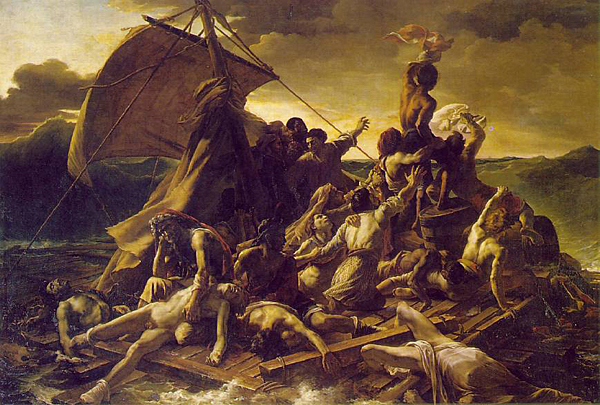
"The Raft of the Medusa" - Théodore Géricault

David Seaton's News Links
If anything good at all comes out of this war it will be people really beginning to ask the important political questions. Who are we? Where are we going? Is there any alternative to what we are doing? First asking themselves, then asking the system. DS

Price tag for war in Iraq on track to top $500 billion - McClatchy Abstract: Congressional Democrats and Bush agree that they cannot let their dispute over a withdrawal timetable block the latest cash installment for Iraq. Once that political fight is resolved, Congress can focus on the president's request for $116 billion more for the war in the fiscal year that starts on Sept. 1. The combined spending requests would push the total for Iraq to $564 billion, according to the nonpartisan Congressional Research Service. What could that kind of money buy? A college education - tuition, fees, room and board at a public university - for about half of the nation's 17 million high-school-age teenagers. Pre-school for every 3- and 4-year-old in the country for the next eight years. A year's stay in an assisted-living facility for about half of the 35 million Americans age 65 or older. Not surprisingly, opinions about the cost of the war track opinions about the war itself. "If it's really vital, then whatever it costs, we should pay it. If it isn't, whatever we pay is too much," said Robert Hormats, author of "The Price of Liberty," a newly published book that examines the financing of America's wars. Before the war, administration officials confidently predicted that the conflict would cost about $50 billion. White House economic adviser Lawrence Lindsey lost his job after he offered a $200 billion estimate - a prediction that drew scorn from his administration colleagues. "They had no concept of what they were getting into in terms of lives or cost," said Winslow Wheeler, who monitors defense spending for the Center for Defense Information, a nonpartisan research institute. READ IT ALL

Wednesday, April 04, 2007

Rebuilding the left - 3 - back to basics

When we see politics permeate every sector of life, we call it totalitarianism. When religion rules all, we call it theocracy. But when commerce dominates everything, we call it liberty. Benjamin R. Barber - Los Angeles Times
David Seaton's News Links
One of the most interesting things that Howard Dean has been pushing of late is the idea of the Democrats campaigning on "values": Not abandoning that field to the Republicans without a fight. That there could be some common ground between conservatives and liberals on what constitutes an optimum, human experience: A 'decent' life. I think that this is a powerful idea whose time has come.

In a previous post I had a clipping about a grade school in Louisiana where the dear little 5th graders fornicate on the classroom floor when teacher is absent. Here, for example is something people of both conservative and liberal views might find equally troubling and have a common, human, "catcher in the rye" impulse to do something to change. The welfare of children is a theme that unites and where there isn't a huge amount of daylight between parents of the entire political spectrum. Let's develop that theme in more detail:

Here is an interesting "values-driven" piece by Benjamin R. Barber from the Los Angeles Times, which gives a concentrated critique of today's capitalism.
The crises in subprime mortgages betrays a deeper predicament facing consumer capitalism triumphant: The "Protestant ethos" of hard work and deferred gratification has been replaced by an infantilist ethos of easy credit and impulsive consumption that puts democracy and the market system at risk.(...) Capitalism's success, however, has meant that core wants in the developed world are now mostly met and that too many goods are now chasing too few needs. Yet capitalism requires us to "need" all that it produces in order to survive. So it busies itself manufacturing needs for the wealthy while ignoring the wants of the truly needy. Global inequality means that while the wealthy have too few needs, the needy have too little wealth. Capitalism is stymied, courting long-term disaster. We still work hard, but only so that we can pay and play. In order to turn reluctant consumers with few unsatisfied core needs into permanent shoppers, producers must dumb down consumers, shape their wants, take over their life worlds, encourage impulse buying, cultivate shopoholism and invent new needs. At the same time, they empower kids as shoppers by legitimizing their unformed tastes and mercurial wants and detaching them from their gatekeeper mothers and fathers and teachers and pastors. The kids include toddlers who recognize brand logos before they can talk and commodity-minded baby Einsteins who learn to shop before they can walk. Consumerism needs this infantilist ethos because it favors laxity and leisure over discipline and denial, values childish impetuosity and juvenile narcissism over adult order and enlightened self-interest, and prefers consumption-directed play to spontaneous recreation. The ethos feeds a private-market logic ("What I want is what society needs!") and combats the public logic fashioned by democracy ("What society needs is what I want to want!").(...) Compare any traditional town square with a modern suburban mall. In the square, you'll find a school, town hall, library, general store, park, movie house, church, art gallery and homes — a true neighborhood exhibiting our human diversity as beings who do more than simply consume. But our new town malls are all shopping, all the time. When we see politics permeate every sector of life, we call it totalitarianism. When religion rules all, we call it theocracy. But when commerce dominates everything, we call it liberty. Can we redirect capitalism to its proper end: the satisfaction of real human needs? Well, why not? The world teems with elemental wants and is peopled by billions who are needy. They do not need iPods, but they do need potable water, not colas but inexpensive medicines, not MTV but their ABCs. They need mortgages they can afford, not funny-money easy credit. READ IT ALL
Barbour is basically saying that "all that is solid melts into air". The latest build of our economic system is destroying individuals, families, cultures, the environment and communities. We are living in a self-inflicted hell. In Barbour's article we can see that the issue of child welfare is linked to issues as diverse as public space and the Protestant ethos. He also points out the Achilles heel of our economic system, perhaps its principal contradiction: its over-productivity. The system just produces too much stuff and if it can't sell it all we suffer and if it does manage to sell it all we suffer even more. In producing so much useless stuff it destroys the environment too.

Howard Meyerson in the Washington Post writes about the great American multinational corporation's campaign to prevent the creation of labor unions in their Chinese workplaces. It is obvious that capitalism and political freedom are in no way connected and may well be arch antagonists.
Listen to the apostles of free trade, and you'll learn that once consumer choice comes to authoritarian regimes, democracy is sure to follow. Call it the Starbucks rule: Situate enough Starbucks around Shanghai, and the Communist Party's control will crumble like dunked biscotti. As a theory of revolution, the Starbucks rule leaves a lot to be desired. Shanghai is swimming in Starbucks, yet, as James Mann notes in "The China Fantasy," his new book on the non-democratization of China, the regime soldiers on. Conversely, the American farmers who made our revolution didn't have much in the way of consumer choice, yet they managed to free themselves from the British. In New England, however, they did have town meetings, which may be a surer guide to the coming of democratic change. It's a growing civil society -- a sphere where people can deliberate and decide on more than their coffee -- that more characteristically sounds the death knell of dictatorships. Which is why the conduct of America's corporate titans in China is so disquieting. There, since March of last year, the government has been considering a labor law that promises a smidgen of increase in workers' rights. And since March of last year, the American businesses so mightily invested in China have mightily fought it.(...) It's not as if Chinese unions would use these laws to run roughshod over employers. Chinese unions are not, strictly speaking, unions at all. They remain controlled by the Communist Party. Their locals can be and frequently are headed by plant managers, whether the workers want them or not. And yet, these changes proved too radical for America's leading corporations.(...) Andreas Lauff, a Hong Kong-based corporate attorney, wrote in the Jan. 30 Financial Times, "comments from the business community appear to have had an impact." The new draft "scaled back protections for employees and sharply curtailed the role of unions."(...) Admittedly, a few nettlesome issues remain. First, about one-fourth of the global labor force is in China. Opposing steps toward the formation of unions there suppresses the wages of so many workers that its effect is felt worldwide. Second, since authoritarian China remains an adversary of the United States and a backer of some genuinely dangerous authoritarian regimes, blocking even the most modest steps toward the development of a civil society and democratic rights there poses a threat to U.S. security interests. READ IT ALL
Some hoary old Marxist lounging on the ash heap of history might raise himself up on an elbow and be heard to croak something to the effect that the system had "entered into contradiction". Community, civil society, the family, the air and the water... and even or especially, independent thought are enemies of this version of "prosperity". Margaret Thatcher maintained that "society" doesn't "exist". Perhaps she was a prophetess. Certainly that is the direction we are taking.

Returning to the opening idea of common ground between progressives and the devout Christians. Certainly both have more in common with each other than with the economic system that we have been discussing.

The left as it was explained to me by word and example (unfortunately more of the former than the latter) is about, equality, austerity and the value of work and most of all about the brotherhood of those who work. The Catholic, "Blessed" (official title) Mother Teresa of Calcutta spoke of "the brotherhood of man under the fatherhood of God" and so, using the exact same words, do the thoroughly un-Catholic Freemasons. Even Confucius say, "The man of human-heartedness is one who desiring to sustain himself, sustains others, and desiring to develop himself, develops others; that may be called the way to practice human-heartedness."

So we might begin by dividing up people between the "human-hearted" and those who, while belonging to the species and living from it, are unconcerned for its welfare. The Spanish writer Ramón María del Valle Inclán, had a character named the "Marqués de Bradomin", who divided everything and everyone in the universe into two major categories:
the Marqués de Bradomin and everything else. How does this sort of personality develop? Richard Conniff writing in the New York Times has this to offer on the subject:
Let’s begin with what I call the “Cookie Monster Experiment,” devised to test the hypothesis that power makes people stupid and insensitive — or, as the scientists at the University of California at Berkeley put it, “disinhibited.” Researchers led by the psychologist Dacher Keltner took groups of three ordinary volunteers and randomly put one of them in charge. Each trio had a half-hour to work through a boring social survey. Then a researcher came in and left a plateful of precisely five cookies. Care to guess which volunteer typically grabbed an extra cookie? The volunteer who had randomly been assigned the power role was also more likely to eat it with his mouth open, spew crumbs on partners and get cookie detritus on his face and on the table. It reminded the researchers of powerful people they had known in real life. One of them, for instance, had attended meetings with a magazine mogul who ate raw onions and slugged vodka from the bottle, but failed to share these amuse-bouches with his guests. Another had been through an oral exam for his doctorate at which one faculty member not only picked his ear wax, but held it up to dandle lovingly in the light.(...) The researchers went on to theorize that getting power causes people to focus so keenly on the potential rewards, like money, sex, public acclaim or an extra chocolate-chip cookie — not necessarily in that order, or frankly, any order at all, but preferably all at once — that they become oblivious to the people around them. Indeed, the people around them may abet this process, since they are often subordinates intent on keeping the boss happy. So for the boss, it starts to look like a world in which the traffic lights are always green (and damn the pedestrians). Professor Keltner and his fellow researchers describe it as an instance of “approach/inhibition theory” in action: As power increases, it fires up the behavioral approach system and shuts down behavioral inhibition.(...) The bottom line: Without power, people tend to play it safe. Given power, even you and I would soon end up living large and acting like idiots. READ IT ALL
Liberty, Equality, Fraternity are the basic values.

Christians are given to asking themselves, "what would Jesus do?" and not even a hardened atheist would ever suggest that Jesus would act like any of the jerks described in Conniff's column. So it shouldn't be that difficult to get from "Am I my brother's keeper?", The Beatitudes, the parable of the Good Samaritan etc, etc to universal public health care plus decent public education.

So I think Howard Dean is really onto something of genuinely revolutionary potential. Something, that combined with political micro-financing and participatory democratic activism could reshape and humanize the face of America and American politics. DS

Tuesday, February 13, 2007

Notes on socialized medicine

David Seaton's News Links
As an American expatriate long living in Europe, the one thing I think most separates my experience here with that of living in the states is socialized medicine.

I have been spending most of the day the last few days in a large hospital here in Madrid, where my wife has had her second hip replacement operation in the space of a year. Each artificial joint is made of titanium and costs €6000. Add to that the surgeon's fees (she was operated on by the head of the hospital's orthopedic surgery department, one of the top specialists in all of Spain), then there's the anesthesiologist's fee, a week in hospital, nursing, transfusions, etc, etc and the total cost to me is.... nothing... zilch... nada de nada.

I worry about my wife, I worry about the operation, I worry about all kinds of stuff, but I don't worry at all about how I'm going to pay for her operation.... I don't have the fear constantly hanging over my head that our savings will be wiped out or that some private plan will nickel and dime us
literally to death and not give us the care we need when we really need it.

I know so many cases from home of friends of the family and relatives of mine who have worked hard all their lives, been successful in their professions, played by the rules, bought insurance and then have been humiliated by illness and left high and dry by the insurers. I am so grateful not to have worry about that, not even for a moment.

I think that experiencing socialized medicine is what changed me from being a "parlor pink" into really being a person of the left. For me a state that doesn't give its citizens health, education and culture is a fraud and to cut back on those things to spend the money thus "saved" on more and more weapon systems is simply (evil?). DS

Friday, December 15, 2006

Imperial shelf life: paying the cost to be the boss

David Seaton's News Links
The window of American imperialism, militarism and hegemony is closing for the simplest of reasons. After the Second World War the returning American soldiers fathered many children. This phenomenon was known as the "war baby boom" and its children have come to be know as the "boomers". This massive generation whose consumer habits have driven the US economy since they were teenagers will, thanks to that frantic consumption, soon reach retirement age practically without savings. If defense spending continues as at present or, as will probably be the case, rises and Bush's tax cuts for the super rich are maintained, there will be no money for pensions and health care for the doddering (but voting) boomers. At that point something will have to give. As another name for the boomers is the "ME generation", it is very easy to imagine their passive enthusiasm for living in abject poverty in order to finance America's military hegemony. DS
E.J. Dionne Jr: A War Bush Wouldn't Pay For - Washington Post
Abstract: Until recently President Bush's refusal to scale back any of his tax cuts was discussed as the question of shared sacrifice: How could we ask so much from a courageous group of Americans fighting in Iraq and Afghanistan but not ask even the wealthiest of their fellow citizens to part with a few extra dollars to support an endeavor supposedly central to our nation's security? On the contrary, even after we committed to war in Iraq, the administration pushed for yet more tax cuts in dividends and capital gains. Now we know that the decision to put the war on a credit card is not simply a moral question. The administration's failure to acknowledge the real costs of the war -- and to pay them -- has put it in a corner. The president's options in Iraq are severely constrained because our military is too small for the foreign policy he is pursuing. Sending more troops would place even more excruciating burdens on members of our armed forces and their families. And the brass fears that an extended new commitment could, quite simply, break the Army. Yet, instead of building up our military for a long engagement and levying the taxes to pay for such an enterprise, the administration kept issuing merry reports of progress in Iraq. Right through Election Day this year, the president continued to condemn anyone who dared suggest that maybe, just maybe, we should raise taxes to pay for this war.(...) By my back-of-the-envelope calculations, since 2001 we've offered $2 in tax cuts for every $1 we have spent on the wars in Iraq and Afghanistan. And conservatives wonder why we have deficits. At least the libertarians, who are against both high taxes and an interventionist foreign policy, have their philosophical story (and their numbers) straight. It has always been true that the administration and its allies couldn't have it both ways. Their illogic has finally caught up with them. They claimed to be against big government so they could justify big tax cuts. But they were also for a big, activist foreign policy, especially after Sept. 11, 2001, which required a big military, and -- sorry to break it to you, guys -- a big military is a big part of big government. They were not willing to pay for a large enough military, and so now we, and especially our armed forces, are paying for their deficit in logic and courage. READ IT ALL

Thursday, November 16, 2006

Senator Jim Webb - Class Struggle - Wall Street Journal

David Seaton's News Links
As Mohammad Ali says, "Hey, you aren't as dumb as you look". Tip of the hat to Billmon for locating this soul stirring opinion piece by Democratic, Senator-elect Jim Webb of Virginia.... In the Wall Street Journal!!! Play it again Sam. DS
Abstract: The most important--and unfortunately the least debated--issue in politics today is our society's steady drift toward a class-based system, the likes of which we have not seen since the 19th century. America's top tier has grown infinitely richer and more removed over the past 25 years. It is not unfair to say that they are literally living in a different country. Few among them send their children to public schools; fewer still send their loved ones to fight our wars. They own most of our stocks, making the stock market an unreliable indicator of the economic health of working people. The top 1% now takes in an astounding 16% of national income, up from 8% in 1980. The tax codes protect them, just as they protect corporate America, through a vast system of loopholes. Incestuous corporate boards regularly approve compensation packages for chief executives and others that are out of logic's range. As this newspaper has reported, the average CEO of a sizeable corporation makes more than $10 million a year, while the minimum wage for workers amounts to about $10,000 a year, and has not been raised in nearly a decade. When I graduated from college in the 1960s, the average CEO made 20 times what the average worker made. Today, that CEO makes 400 times as much. In the age of globalization and outsourcing, and with a vast underground labor pool from illegal immigration, the average American worker is seeing a different life and a troubling future. Trickle-down economics didn't happen. Despite the vaunted all-time highs of the stock market, wages and salaries are at all-time lows as a percentage of the national wealth. At the same time, medical costs have risen 73% in the last six years alone. Half of that increase comes from wage-earners' pockets rather than from insurance, and 47 million Americans have no medical insurance at all.(...) The politics of the Karl Rove era were designed to distract and divide the very people who would ordinarily be rebelling against the deterioration of their way of life. Working Americans have been repeatedly seduced at the polls by emotional issues such as the predictable mantra of "God, guns, gays, abortion and the flag" while their way of life shifted ineluctably beneath their feet. But this election cycle showed an electorate that intends to hold government leaders accountable for allowing every American a fair opportunity to succeed.