Showing posts with label polls. Show all posts

Wednesday, October 29, 2008

Poll axed

Henry Fuseli -The Nightmare
David Seaton's News Links
It will be interesting to see which pollster has called this thing correctly. There is such a huge difference between them. The differences seem to be between those who “weight” their samples using past precedents and those who, putting aside all skepticism, consider that many more young people and black people are going to actually take the trouble to vote than ever have before.

Another factor may be that their are so many pollsters calling so often that people are beginning to hang up on them and that these unpolled are McCain voters.

Another interesting idea is that to win Obama has to be over 50% in the polls because with Obama being black and in the lead the undecideds will all break for McCain. In short, the idea is to look at the polls of the key battleground states and if Obama is not over 50% (no matter what lead he has) than those states may very well go to McCain.

If this is true then McCain is not as inept as he seems.

By falling so far behind he has turned Obama, not Bush, into the “incumbent” and the focus is now on Obama and not Bush.

I expect that now, in the closing days and hours we will be seeing all the nasty material that the Republicans are said to have saved up on Obama.

We have already heard the “socialist” radio tape, now there is now supposed to be a “Palestinian video” which the Los Angeles Times is accused of suppressing, and also some sort of mysterious girlfriend, a certain Vera Baker, who seems to have disappeared from the face of the earth.

If the Reverend Wright is not encased in cement at the bottom of Lake Michigan by now, I wouldn’t be surprised if he turned up, say around Friday

The “low information voters” (LIVs) said to decide all close elections are just tuning into the election now and all they are hearing about is Obama.

At this point rumors about girl friends and wealth redistribution can really catch the attention of the LIVs. All this focus on Obama is a force multiplier for McCain’s meager dollars.


I think tonight’s massive info-ad is also a huge mistake. They are even putting the World Series on hold for it. This is like Obama’s Berlin speech, truly jumping the shark: overkill.

As improbable as it may seem right now it is totally possible that this thing may slip through Obama’s fingers at the last moment. DS

Thursday, October 18, 2007

The very merry un-president

Caught in the headlights of history

"The public mood is not just dark. What's darker than dark?" Zogby said. "The mood is getting ugly."

David Seaton's News Links
We are living in a very special time. What an alignment of the planets!

It should give us some comfort to see how basically unsinkable the USA is.... touch wood. DS

Bush, Congress at record low ratings: Reuters poll
President George W. Bush and the U.S. Congress registered record-low approval ratings in a Reuters/Zogby poll released on Wednesday, and a new monthly index measuring the mood of Americans dipped slightly on deepening worries about the economy.

Only 29 percent of Americans gave Bush a positive grade for his job performance, below his worst Zogby poll mark of 30 percent in March. A paltry 11 percent rated Congress positively, beating the previous low of 14 percent in July.

The Reuters/Zogby Index, a new measure of the mood of the country, dropped from 100 to 98.8 in the last month on worries about the economy and fears of a recession, pollster John Zogby said.

"Since the last time we polled we have had the mortgage crisis, and we are hearing the recession word a whole lot more than we've heard it in the past," Zogby said.

"There are things that happened in the September polling that drove the number down a bit, and they are mostly economic worries," he added.

The Index, which debuts this month, combines responses to 10 questions on Americans' views about their leaders, the direction of their country and their personal situations. Polling for the Index began in July, and that month's results provide the benchmark score of 100.

A score above 100 indicates the country's mood has improved since July. A score below 100, like the one recorded in September, shows the nation's mood getting worse. The RZI, which will be released the third Wednesday of each month, had remained at 100 in August.

"The public mood is not just dark. What's darker than dark?" Zogby said. "The mood is getting ugly."

The national survey of 1,011 likely voters, taken September 13 through September 16, found barely one-quarter of Americans, or 27 percent, believe the country is headed in the right direction. Nearly 62 percent think the country is on the wrong track.

About two-thirds of Americans think the value of their homes will stay the same or drop in the next year, and about one-third expect a recession in the next year amid a housing slump and credit crunch.

The poll also found little confidence in U.S. foreign or economic policy, with 68 percent of Americans rating economic policy as just fair or poor and 73 percent calling foreign policy either fair or poor.

Most of the polling was done after a speech by Bush and testimony to Congress by the top commander in Iraq, Gen. David Petraeus, indicating the United States would make some reductions but planned to keep high troop levels in Iraq for the foreseeable future.

Zogby said continuing uncertainty about Iraq contributed to the bad public mood and helped push down ratings for Bush and the Democratic-controlled Congress.

"I think we are seeing an anti-institution mood here," he said. "Post-Katrina, and now with Iraq and the economy getting worse, people just don't have faith that anybody is solving their problems."

Thursday, January 11, 2007

Surge me, Bushman? The reviews pour in

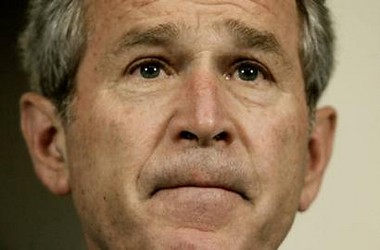
"I have never seen him, in public or private, look less convincing, less sure of himself, less cocky. With his knitted brow and stricken features, he looked, well, scared." Howard Fineman - Newsweek
David Seaton's News Links
The President of the United States (that used to have a real ring about it, didn't it?) announced his plan for victory. He laid an egg. It's easy to gloat, but this is probably the most dangerous moment in international affairs since the Cuban Missile Crisis. As I said yesterday, this man is the most empowered instrument of death in history. Genghis Khan, for example, did it all with bows and arrows; Bush really has WMDs. Bush is looking at a degree of public failure, repudiation and even universal public ridicule that perhaps no other human being has ever had to endure before. His entire life's work (being somebody) is crumbling before the eyes of every human being with access to a TV or the Internet. His reaction may very well be like some George Raft gangster in an old late night movie, "come and get me copper, you'll never take me alive!). I truly doubt that he will let himself be led away quietly. DS
The Real Disaster - Editorial - New York Times
Abstract: President Bush told Americans last night that failure in Iraq would be a disaster. The disaster is Mr. Bush’s war, and he has already failed. Last night was his chance to stop offering more fog and be honest with the nation, and he did not take it. Americans needed to hear a clear plan to extricate United States troops from the disaster that Mr. Bush created. What they got was more gauzy talk of victory in the war on terrorism and of creating a “young democracy” in Iraq. In other words, a way for this president to run out the clock and leave his mess for the next one. READ IT ALL

Mr. Bush's Strategy - Editorial - Washington Post
Abstract: The new plan for the war Mr. Bush outlined last night is very risky. It envisions new missions and dangers for U.S. troops and counts on unprecedented military and political steps by the Iraqi government. The plan is likely to cause a spike in U.S. casualties, while the chances that it will stabilize Iraq are far lower. Moreover, Mr. Bush appears prepared to embrace this approach despite strong opposition from Congress and the public -- setting up a conflict that in itself could hurt the war effort. READ IT ALL

Defiance and delusion - Editorial - The Guardian
Abstract: George Bush's announcement last night that he is going to pour more troops into Iraq was the last throw of the dice in a misconceived enterprise that has dragged his country, this country and the Middle East into a nightmare. The package includes 17,500 more combat troops for Baghdad and 4,000 more marines for Anbar province, the cockpit of the Sunni insurgency. Over $1bn will be spent in economic aid. In return the Iraqis are to promise to crackdown on insurgents, regardless of sect or religion. In opting for a troop surge, Mr Bush has ignored the message of the mid-term elections, the Iraq Study Group, Congress, his own top generals and most world opinion. US generals have difficulty enough maintaining current levels of combat-ready troops and are not convinced that more troops will make any difference. Rather than listen to them, Mr Bush has turned to the right, to those who argue that honour and the America's national interests require fighting on. One senses that "honour" is the more important of the two. READ IT ALL

"Warning Americans that 2007 would be another year of continued violence, bloodshed and American casualties, President Bush unveiled his "new way forward" on Iraq Wednesday evening. But the speech was as much a testament of failure as it was a blueprint for what to do next." Michael Duffy - Time

Poll: Most Americans Opposed to Bush's Iraq Plan - Washington Post
Abstract: A majority of Americans oppose sending additional troops to Iraq as outlined by President Bush in his nationally televised address Wednesday night, and just one-in-three Americans said the plan for more troops and a stepped up combat efforts by Iraqi forces make victory there more likely, according to a new Washington Post-ABC News poll. The findings of the survey, conducted after Bush's primetime speech, represent an initial rebuke to the White House goal of generating additional public support for the mission in Iraq. The poll found that 61 percent of Americans oppose sending more than 20,000 additional troops to Iraq, with 52 percent saying they strongly oppose the plan. Just 36 percent said they back the president's new proposal.(...) Only two in five (40 percent) said the war was worth fighting. While that is slightly better than the 36 percent figure recorded in a poll a month ago, it is consistent with polls dating back almost two years. Similarly, just 34 percent said they approve of Bush's handling of the war, another slight tick up from last month but a measure of the broad disapproval of the president's leadership that has been evident since 2005. Americans are even more pessimistic than before about the state of the conflict. In the new poll, 57 percent said the United States is not winning war, the highest yet recorded. That comes after even Bush acknowledged setbacks and mistakes and after he and new Defense Secretary Robert M. Gates have said they United States is not winning at this point. In December 2005, 56 percent of Americans said the United States was winning the war.(...) Fifty-six percent of men oppose the president's plan while 66 percent of women oppose it. Women also are more likely to support efforts in Congress to cut off funding, with 57 percent saying they would back Democratic moves to do so compared to 48 percent of men. Sixty percent of Americans between ages 18 and 39 support cutting off funding, compared to 51 percent of those between 40 and 59 and 43 percent of Americans over age 60. READ IT ALL

President George W. Bush's plan to boost U.S. forces in Iraq drew fire from Republican senators and from Joseph Biden, the Democratic chairman of the Senate Foreign Relations Committee, who called it ``a tragic mistake.'' The plan is ``the most dangerous foreign policy blunder in this country since Vietnam,'' Senator Chuck Hagel, a Republican of Nebraska, told Secretary of State Condoleezza Rice at a hearing of the committee today. Bloomberg

Surge towards debacle in Iraq and MidEast - Editorial - Financial Times
Abstract: George W. Bush’s new direction in Iraq is certainly not a strategy for victory, whatever that word, which is used ever more desperately by the US president, now means. It may be one last heave. It may be a cover for US withdrawal. But two things are quite clear. Right now, Mr Bush has the support of no more than one in four Americans for this so-called surge of an extra 20,000 or so troops. Very soon, as the already indecipherable ethnic and sectarian patchwork of Iraq is pulled further and even more bloodily to pieces, he will have none. Second, this policy will not succeed in fixing an Iraq traumatised by tyranny and war and then broken by invasion and occupation. But it may end with the US “surging” into Iran – and taking the Middle East to a new level of mayhem that will spill into nearby regions and western capitals. Mr Bush’s body language in the speech bespoke a chastened man. Yet, caught in a wilfully spun web of delusion and denial, he seems still unable to comprehend the depths of the debacle he has caused in Iraq.(...) like everything they have tried since, this is far too little, much too late.(...) It is hard, even for ardent democrats, to see this Iraq as a young democracy fighting for its life, as Mr Bush’s discourse of good guys against bad guys would have it. The invasion has solidified a system divided into sects and operating on the basis of patronage and intimidation. The composition of parliament is nearly two thirds Islamist. There are no institutions.(...) The only feasible way forward is the approach of the bipartisan Baker-Hamilton commission – which the new US Congress should embrace and insist on.(...) “Iran is providing material support for attacks on American troops” he said on Wednesday. “We will disrupt the attacks on our forces. We will interrupt the flow of support from Iran and Syria.” The Iraq surge is beginning to look like the Vietnam escalation, spilling over into Iran and Syria the way that one did into Cambodia and Laos. Mr Bush is right to argue that defeat in Iraq would be very serious. He is wrong in failing to recognise defeat is what he is staring at – and that this approach will help guarantee it. READ IT ALL

The speech reflects a profound misunderstanding of our era. America is acting like a colonial power in Iraq. But the age of colonialism is over. Waging a colonial war in the post-colonial age is self-defeating. That is the fatal flaw of Bush's policy.
Zbigniew Brzezinski - Washington Post
(To be continued)

Wednesday, December 06, 2006

On Iraq polls show: all the ducks in a row, except the lame duck

David Seaton's News Links
Rarely, if ever have American's been both so well informed and so much in common accord about any issue as they are today about what is to be done with Iraq. We have an elite group of "gray beards", the Baker-Hamilton Commission, and on the other, the vast majority of Mr. and Mrs. John Q. Public; in this case, all are pulling in the same direction. The verdict: get out quick and organize a huge regional peace conference to cover the retreat by settling all the major issues outstanding. A general peace in the Middle East, means a peace that saves the "moderate" regimes allied with Washington and that means solving the Israel/Palestine conundrum in such a way as to salvage the prestige of those moderates with the "Arab street". That means Israel returning to its 1967 borders and turning Jerusalem into an international city and all of this without much real guarantee that Iran will forsake its nuclear programs. This is the total defeat of the neocon, hard-wilsonian project. So now we are finally going to see if AIPAC is really as powerful as it is supposed to be. This is their big test. Do they have the influence to overcome such a consensus? DS
Abstract (tip of the hat to TomDispatch): A new poll by WorldPublicOpinion.org finds that three out of four Americans believe that in order to stabilize Iraq the United States should enter into talks with Iran and Syria, and eight in ten support an international conference on Iraq. A majority also opposes keeping U.S. forces in Iraq indefinitely and instead supports committing to a timetable for their withdrawal within two years or less.(...) 75 percent say that the United States should have talks with Iran and the exact same number say that the United States should have talks with Syria. This diplomatic approach is endorsed overwhelmingly by both parties: eight in ten Democrats and seven in ten Republicans endorse talking with both Iran and Syria. There is also strong bipartisan support for calling a major international conference where diplomats from the United States, Europe, the United Nations and the Arab world could meet Iraqi leaders to discuss how to stabilize Iraq and encourage economic growth there. Seventy-nine percent (Republicans 79%, Democrats 80%) say they support such a conference; only 18 percent believe that instead foreign leaders should “stay out of Iraq’s affairs.” On the issue of how long U.S. troops should remain in Iraq, a majority of Americans reject the current policy of keeping troops in the country indefinitely. Fifty-eight percent say troops should be withdrawn according to a timetable, while 38 percent say that U.S.-led forces should only be reduced “as the security situation improves.” There is substantial variation in the length of the timetable preferred: 18 percent prefer six months, 25 percent one year and 15 percent two years. There are partisan differences on this issue, however. While most Democrats (78%) think U.S. forces should be out within two-years or less, including 61 percent who favor a one-year or less, a majority of Republicans (64%) believe forces should be withdrawn only as security improves. Fifty-six percent of Independents also support withdrawal within two years. Support for withdrawal according to a timetable becomes stronger “if the majority of the Iraqi people say they want the U.S. to commit to withdraw U.S. forces according to a timeline of no more than a year.” Seventy-three percent say the United States should withdraw in a year or less if most Iraqis want them to, including 67 percent of Republicans and 82 percent of Democrats. Fifty-eight percent also believe that the majority of the Iraqi people want the US to commit to one-year timeline. A poll of the Iraqi public conducted by WorldPublicOpinion.org in September 2006 found that 71 percent want U.S.-led forces to commit to withdraw within a year.(...) This desire for a commitment to pull U.S. troops out within a year appears to arise from doubts about whether the U.S. presence helps or hurts stability in Iraq. Six in ten Americans (60%) believe that the United States’ military presence in Iraq is provoking more conflict than it is preventing. Only 35 percent believe U.S. troops are stabilizing the country. The belief that U.S. forces are provoking conflict has risen 5 points since March 2006 and 9 points since October 2004. READ THE ENTIRE POLL