Monday, April 27, 2009

British in need of reality check

David Seaton's News Links
The other day I went to a debate in a big Spanish bank about the EU and the “crisis”, which was held under the “Chatham House” rule so I can use the information, but I can’t reveal the names of the participants. I’ll just say that the star speaker was a very prominent British journalist, specializing in EU affairs. His greatest complaint was that the Germans no longer just signed the checks and silently nodded agreement to everything that the USA, Britain and France requested and that they had a strategic understanding with Russia due to energy.

Listening to him talk, I got the feeling that his reality was much more British weighted than reality itself is.

Germany is the most important country in Europe both economically and demographically and as the journalist pointed out they are no longer docilely following the traditional, "Russia out, America in and Germany down" script. And as the journalist also mentioned, if there is any bailing out to be done in countries like Greece or points east, it will be the Germans who do the bailing. It seems to me that this adds up to a very German slant to things in the near future. Who else is there, when you really come down to it?

Britain? France?

As the journalist also pointed out, the euro-skeptic Tories who detest the EU are set to win the next UK election and if we add to this that the British economy is now like some cratered giant Iceland and its financial industry disgraced (manufacturing left ages ago)... then except for Tommy Atkins, what else has Britain got left to sell, lease or rent?

As for the French, Sarkozy has tardo-Bush popularity levels and his enthusiasm for NATO and Afghanistan are not shared by the French people in any poll I've seen.

Except for the British government and Sarkozy does anybody anywhere in Europe in their right mind really want to see the Germans getting militarized ever again?

Since Af-Pak is going down the drain, at this very moment, the German reluctance to get any deeper involved in the coming debacle makes quite a bit of sense.

I would argue that the official German position fits EU public opinion better than either Britain's or France's.

So to sum up, the Germans are paying the piper and they are no longer reluctant to call the tunes. That for better or worse is the EU of today and tomorrow and the crisis is going to enhance that. They have the money, the population and their policies are more in tune with European public opinion... What could be more obvious? DS

Wednesday, April 22, 2009

Reality Wedge #2


What troubles some of us about President Obama isn't a single apology here or a single handshake there; it is evidence of a particular cast of mind. For Obama's foreign policy gambit to succeed, it isn't enough for him to "listen" and sit passively by as America is castigated by the Daniel Ortega's of the world. He also, and most importantly, needs to press reluctant allies and our enemies for concessions and actually get a few. Peter Wehner - Commentary

If, as we all suspect, (Obama) means to push the sides toward a deal, there is no obvious reason apply pressure privately. It is time he started talking more like John Foster Dulles and less like Oprah. Obama, in other words, has to start by imposing an agenda on Israel's conversation. He can win over Israelis eventually, but only if every front page story for the next six months is about whether or not Bibi and Lieberman are destroying relations with Washington. That is the only thing Israeli elites fear more than the loss of solidarity. Bernard Avishai
David Seaton's News Links
You may remember from my last post, that I refer to an area of agreement between people who can agree on very little, as the "Reality Wedge".

I would class Israeli peace activist Bernard Avishai and former Bush-II White House aide, Peter Wehner, writing in neocon haven Commentary Magazine as "people who can agree on very little", wouldn't you?

Nobody could be more in Barack Obama's corner than Eugene Robinson, who wrote in the Washington Post about the Trinidad Conference and the Chávez handshake:
My argument isn't that Obama should try to be someone he's not. It's that he's declining to use one of the tools at his disposal. As public anger over the U.S. bank bailouts was rising, a well-timed burst of presidential outrage might have allowed him to get out in front of it.
What these people are saying is that they are afraid that Barack Obama is a wimp.

Personally, I don't think he is.

JFK wasn't a wimp either, but Nikita Khrushchev thinking he was nearly started WWIII.

Khrushchev, had come up in a much more dangerous and difficult environment than JFK and misread him. Likewise, most leaders in the world's problem countries today have come up in very hard schools, much harder than "tough" old Chicago. They are not going to cut the USA any slack... They are simply waiting for "Obamamania" to run out of gas.

At the moment Obama is enjoying this incredible tailwind all over the world by simply not being George W. Bush... It is impossible to exaggerate how relieved the world feels that the most powerful (or at least the most dangerous) country on earth is no longer governed by a murderous idiot. But, at the same time, it would be most ingenious to confuse that relief with a massive urge on the part of the world to gulp down America's Kool-Aid.

Not being Bush is a wonderful thing but it isn't a solution, because Bush wasn't the problem itself, only an outward sign, a symbol of that problem. The problem is still there... with bells on.

American power was built around a healthy population, great manufacturing, good public education, solid money and a victorious military: all of which are simultaneously in crisis. America has created a web of world power well described by Chalmers Johnson and Noam Chomsky and many people around the world are eager to throw that yoke off. Now is their chance... be assured they will take it.

Obama is going to have to draw some clear red lines somewhere, sometime, but I think that is going to be difficult... it would be like Microsoft manufacturing airplanes... that is not how they got where they are.

My basic reading of Barack Obama and his problem remains more or less the same: he got where he is by appearing to be all things to all men. In this he is a genius... I have never ever seen such footwork before. Comparing Obama's powers of triangulation to Bill Clinton's or Tony Blair's is like comparing Einstein to Euclid. Finally, he is going to have to play the ball where it lies. To do that, however, would be to betray his very nature, his strategy of life, which is ambiguity.

He may find himself in a great war without really understanding how it happened to him. DS

Wednesday, April 15, 2009

The Reality Wedge

This is a cartoon from today's edition of the left wing Spanish daily, Público.

In it two GIs are taking to an Afghan peasant. They say, "President Obama has a plan to end the Afghan war." The peasant replies, "I'm going to give you an idea, we would really appreciate it if you just stopped bombing us and went home and took the money you saved and shared it out among us. In four days it would eliminate poverty, terrorism and the common cold. Everybody would be happy except for the people who manufacture bombs".

Neat, huh?
David Seaton's News Links
I am nothing if not a promiscuous reader. I cover the waterfront from left to right and I take special trouble to read carefully and extensively those with whom I agree very little, if at all. I am especially intrigued whenever I find myself agreeing with them on the facts stated, even if I disagree strongly with their reading of those facts. I am even more fascinated when I agree with both facts and reading. This narrow area of mutual agreement I call "the reality wedge".


One of those I read regularly and with whom I agree on practically nothing is Caroline Glick a Chicago-born, dual-national, American-Israeli journalist and the deputy managing editor of The Jerusalem Post. She is also a "Fellow" of the neocon organ called the "Center for Security Policy".

Ms. Glick is a sort of "by Tennessee Williams out of
Bud Schulberg" character, her columns often have a borderline hysteria of the paranoiac, Chicken Little, "sky is falling" variety. A sort of Daniel Pipes with hot flashes: a type of lady my Victorian granny would have called "high strung".

After eight years of Bush, I'm sure that few of my readers need to be brought up to speed on who neoconservatives are and what their agenda is. Suffice to say, it appears obvious that for Ms. Glick the USA, its people, their lives and their treasure are mere instruments whose sole purpose is to eternally pull Israel's chestnuts out of the fire.

The other day she wrote a column titled,
"Surviving in a post-American World". Here is an excerpt:
Like it or not, the United States of America is no longer the world's policeman. This was the message of Barack Obama's presidential journey to Britain, France, the Czech Republic, Turkey and Iraq this past week. Somewhere between apologizing for American history - both distant and recent; genuflecting before the unelected, bigoted king of Saudi Arabia; announcing that he will slash the US's nuclear arsenal, scrap much of America's missile defense programs and emasculate the US Navy; leaving Japan to face North Korea and China alone; telling the Czechs, Poles and their fellow former Soviet colonies, "Don't worry, be happy," as he leaves them to Moscow's tender mercies; humiliating Iraq's leaders while kowtowing to Iran; preparing for an open confrontation with Israel; and thanking Islam for its great contribution to American history, President Obama made clear to the world's aggressors that America will not be confronting them for the foreseeable future.
If Ms. Glick continues in this vein a few weeks longer I will find myself converting to high church Obamism. Anybody that draws this kind of fire from Caroline Glick must be doing something right.

I am of the opinion that instead of changing or creating "reality" what president Obama is doing is putting a "seal of approval" on reality. The reality we know as "Bush" is by now inescapable. I say "the reality we know as 'Bush'", because I believe that Bush is more a product of that reality than the primary cause of it. A more realistic term might be "moldy Reaganism". If we have to blame anybody for the straits that America and all who sail in her find themselves, I'd blame it on the Gipper. Following my reading, compared to Reagan, as a harmful influence, George W. Bush is just something that a 'right to life' fanatic fished out of a waste basket.

So Barack Obama is just making the best out of a bad job,
putting lipstick, false eyelashes and autologous fat transplants on a pig.

Here a distinguished voice of the left, sociologist, historical social scientist, and world-systems analyst Immanuel Wallerstein gives a reading of the G-20 parallel to Caroline Glick's:
(Obama's) interlocutors all said he took them seriously, listened to them attentively, admitted U.S. past errors and limitations, and seemed open to compromise solutions of diplomatic disputes - nothing of which they might have accused George W. Bush. But did this make any difference in achieving U.S. diplomatic objectives? It is hard to see in what way.(...) The French and the Germans seemed to use the London meeting more to demonstrate that the geopolitical commitments they refused to make for Bush they would continue to refuse to make for Obama. The German newspaper, Der Spiegel, was harsh in its judgment. It said the cause of the financial disaster is that George W. Bush had been a "poppy farmer" who had "flooded the entire world [with cheap dollars],...creating sham growth and causing a speculative bubble...." Worse still, "the change in government in Washington has not brought a return to self-restraint and solidity. On the contrary, it has led to further abandon." Its conclusion: "German Chancellor Angela Merkel is right. The West may very well be giving itself a fatal overdose." In the geopolitical arena, the Franco-German approach to Afghanistan is unchanged - verbal support for U.S. objectives but no more troops. Would they receive prisoners released from Guantanamo? Germany continues to say absolutely not. France magnanimously agreed to receive one - yes, one. Obama gave a major speech in Prague outlining a call for nuclear disarmament - presumably a big change from the Bush position. The French conservative newspaper, Le Figaro, reports that the diplomatic cell in Sarkozy's inner circle took a very "abrasive" view of the speech. Just public relations, they said, masking the fact that the negotiations of the United States with Russia on this question were getting nowhere. Furthermore, France was not about to take moral lectures from the Americans. So much for Obama's new diplomatic style appeasing the West Europeans. Elsewhere, it didn't seem to work too much better with the East-Central Europeans, where the outgoing conservative Prime Minister Mirek Topolanek of the Czech Republic denounced Obama's stimulus proposals as "a way to hell." Obama's speech to the Turkish parliament did get him great applause from all factions (except the proto-fascist right) for its concrete and modulated approach to Turkish questions. But observers noted that the language on Middle Eastern questions was both traditional and vague.
And yet all of this has given Caroline Glick a case of the shivering fits.

Where I think that Glick has a point (strictly from her point of view)
is that American power is greatly diminished and that this is going to
eventually leave Israel hanging out to dry. The role that the neocons and AIPAC have had in damaging US power seems, however, to escape Ms. Glick.

It is always interesting to remind people of the difference between a neoconservative and the paleoconservative variety. To round off our little tour of "the reality wedge" let us read from one of the most paleo of them all, Pat Buchanan, and see if you don't shock yourself by nodding affirmatively at some of his rant... at least this part:
Europeans had us figured out a long time ago.

They sense that we need them more than they need us.

While NATO provides Europe with a security blanket, it provides America with what she cannot live without: a mission, a cause, a meaning to life.

Were the United States, in exasperation, to tell Europe, "We are pulling out of NATO, shutting down our bases and bringing our troops home because we are weary of doing all the heavy lifting, all the fighting and dying for freedom," what would we do after we had departed and come home?

What would our foreign policy be?

What would be the need for our vaunted military-industrial complex, all those carriers, subs, tanks, and thousands of fighter planes and scores of bombers? What would happen to all the transatlantic conferences on NATO, all the think tanks here and in Europe devoted to allied security issues?

After the fall of the Berlin Wall, the withdrawal of the Red Army from Eastern Europe and the breakup of the Soviet Union, NATO's mission was accomplished. As Sen. Richard Lugar said, NATO must "go out of area or out of business."

NATO desperately did not want to go out of business. So, NATO went out of area, into Afghanistan. Now, with victory nowhere in sight, NATO is heading home. Will it go out of business?

Not likely. Too many rice bowls depend on keeping NATO alive.

You don't give up the March of Dimes headquarters and fund-raising machinery just because Drs. Salk and Sabin found a cure for polio.

Again, one recalls, in those old World War II movies, the invariable scene where two G.I.s are smoking and talking.

"What are you gonna do, Joe, when this is all over?" one would ask.

Years ago, we had the answer.

Joe stayed in the Army. He couldn't give it up. Soldiering is all he knew. Just like Uncle Sam. We can't give up NATO because, if we do, we would no longer be the "indispensable nation," the leader of the Free World.

And, if we're not that, then who are we? And what would we do?
To the extent that you recognize yourself in such widely different commentators as the left wing Spanish cartoonist Ferreres, or the left wing sociologist, professor Wallerstein or in paleoconservative Buchanan's text, to that extent the reality wedge exists and Caroline Glick's hysteria is justified and her instinct that the jig is up is correct. DS

Monday, April 06, 2009

Af-Pak, where Barack will need all his baracka


When Mr Obama won office, The Onion, a satirical magazine, greeted his victory with the headline “Black man given nation’s worst job”. Watching Mr Obama’s progress around Europe this week, this seemed a reasonable summary of the situation. The new American president faces an economic disaster at home, a stalemated war in Afghanistan, unpredictable adversaries in places such as North Korea, and largely unhelpful allies in Europe. This week Mr Obama cemented the impression that he is an unusually gifted and intelligent politician. But that does not mean he will succeed. It could just be that he is the right man at the wrong time. Gideon Rachman - Financial Times
David Seaton's News Links
There seems to be a sidereal distance between official statements about American objectives in Afghanistan and Pakistan and any reality based assessment on the possibility of achieving those objectives.

What is now called "Af-Pak"is in danger of becoming the mother of all tar babies, if it isn't already.

From the point of view of clear thinking, calling Iraq the "bad" war and Afghanistan the "good" war is on the order of "do you still beat your wife?" What could be said is that Iraq is Switzerland compared to Af-Pak and that even after being criminally mauled by the USA, before too many years have past Iraq will go back to being one of the most modern and prosperous countries in the Middle East. Af-Pak is the disaster that was waiting to happen... that happened.

At the heart of it all is America's refusal to give true value to history and culture... those of others and perhaps even of its own. As if history were like the film, "Groundhog Day", where every day was a totally fresh chance till you finally got it right. As those other Utopians the Soviets learned, Allah appears to have created Afghanistan specifically to humiliate those who have been eager to "take up the white man's burden".

A few days ago the veteran journalist H.D.S. Greenway wrote one of the most pithy illustrations of the mission's essential hopelessness entitled "Westernizing Afghanistan". Here are some excerpts:
Nearly 30 years ago I was taken to a refugee camp on Pakistan's Northwest frontier called "Kerala." It was named after an Afghan village whence most of the refugees had come.(...) An informer had told the Kabul government that the village was hiding insurgents, and when the government forces with their Russian advisers came many of the men of the village were lined up and shot. It was April 1979. Most of the villagers fled across the border to Pakistan. The Kerala incident interested me because of what the refugees said about their grievances against their government. What they objected to most was the government trying to force reforms on them - reforms such as secular institutions that the villagers saw as a threat to religion, and the education of girls. I thought to myself, how ironic. The Communists are trying to modernize the country much as we might do, but the people resist sudden change. I wrote in my notes: "The lesson seems to be, whether you are a Communist or the Shah of Iran, you force reforms and modernization down the throats of traditional and deeply religious peasants only at your peril." (...) Three decades have passed since then, and today it is the United States, not the Soviet Union, that is bogged down fighting Afghans who have a different vision of how society should be organized.(...) in a society so steeped in a contrary tradition, is it up to us to tell Afghans what customs they can or can't keep? Is the goal of westernizing Afghanistan sustainable? Is it realistic? Is it worth dying for?
The situation in Pakistan seems even nastier and more adhesive and, through American meddling, now is inseparable from the historically intractable swamp of Afghanistan.

Here is how the New York Times lays it out:
President Obama’s strategy of offering Pakistan a partnership to defeat the insurgency here calls for a virtual remaking of this nation’s institutions and even of the national psyche, an ambitious agenda that Pakistan’s politicians and people appear unprepared to take up. Officially, Pakistan’s government welcomed Mr. Obama’s strategy, with its hefty infusions of American money, hailing it as a “positive change.” But as the Obama administration tries to bring Pakistanis to its side, large parts of the public, the political class and the military have brushed off the plan, rebuffing the idea that the threat from Al Qaeda and the Taliban, which Washington calls a common enemy, is so urgent.(...) Some analysts here and in Washington are already putting forward apocalyptic timetables for the country. “We are running out of time to help Pakistan change its present course toward increasing economic and political instability, and even ultimate failure,” said a recent report by a task force of the Atlantic Council that was led by former Senator Chuck Hagel of Nebraska and Senator John Kerry of Massachusetts. The report, released in February, gave the Pakistani government 6 to 12 months before things went from bad to dangerous. A specialist in guerrilla warfare, David Kilcullen, who advised Gen. David H. Petraeus when General Petraeus was the American commander in Iraq, offered a more dire assessment. Pakistan could be facing internal collapse within six months, he said.
Immanuel Wallerstein wrote this about "Obama's war" a few days ago:
In short, the "clear and focused goal" that Obama proposes - "to disrupt, dismantle and defeat al Qaeda in Pakistan and Afghanistan, and to prevent their return to either country in the future" - will probably be further than ever from accomplishment. The question is what can Obama do then? He can "stay the course" (shades of Rumsfeld in Iraq), constantly escalate the troop commitment, while changing the local political leadership (shades of Kennedy/Johnson and Ngo Dinh Diem in Vietnam), or he can turn tail and pull out (as the United States finally did in Vietnam). He is not going to be cheered for any of these choices. I have the impression that Obama thinks that his speech left him some wiggle room. I think he will find out rather how few choices he will have that are palatable. I think therefore he made a big, probably irreparable, mistake.
What to do?

This is what I think.

I think the USA would actually do better with the Taliban themselves than with Karzai or any other leader that the USA could pull out of a hat. Let them run the country or at least the Pashtun part of it. In their fanatical narrow mindedness they seem not to steal as much as the "good" Afghans.

How could this possibly work?

First there should be clear, limited and hopefully achievable objectives with
believable carrots and believable sticks.

What could they be.

To begin with, convince the Taliban with sweet reasonableness not to allow foreign extremists to plan terror attacks against western targets from Afghan soil in exchange for not having their clans indiscriminately wiped out at leisure from the air. They have direct experience of this and they surely would like it to stop. This can be done without western soldiers on the ground. That would be the stick. I don't think any other would be needed.

What about the carrots?

Offer to build the gas pipelines across Afghanistan which are of major interest to NATO and the EU, pay the Taliban protection money for their cooperation and encourage them to wet their beaks in all the construction projects. Once completed the pipe lines will give the country a steady, legitimate income.

Create an international consortium with EU, Japan and China and including the IMF, the WHO and the WTO to purchase the entire annual opium crop of Afghanistan for worldwide, legal medical use. Create another consortium of the neighboring countries to supervise this legal trade. Let them wet their beaks in all the associated projects, so that they discourage smuggling of illegal opium across their frontiers. This will also give the Afghanistan a steady, legitimate income and cut off funding for mischief.

Prosperity might just make them all a bit less bloody minded.

Now for Pakistan.

The first thing to remember is that the Pakistan army, which basically runs the country still considers - and will always consider - India, not Afghanistan the major threat. Therefore if Pakistan's cooperation is desired don't let Afghanistan be a pawn in the struggle between India and Pakistan. Any India-weighted shift in America's foreign policy dooms any Af-Pak strategy to failure.

Settle the Kashmir question. Pressure India to allow the inhabitants of Kashmir to decide their future in a UN supervised referendum. Support the results.

America's efforts should not be directed toward the internal social questions of Pakistan, but should be directed toward bringing peaceful relations between the India and Pakistan

The US should not make any speculative alliances against any of the countries in the region and should not attempt to play India against Pakistan or China or any of them against Iran.

The object should be to defuse the entire area. Getting involved in local religious, geopolitical and social disputes is constantly re-lighting the fuse.

And of course, in order to make any progress at all in dealing with extremist Islam anywhere in the world, it is essential that the United States be more evenhanded in dealing with Israel and the Palestinians so that Muslims anywhere in the world who might be well disposed to the USA are not made to feel like damn fools or quislings. The United States should not allow Israel to drag it off a geopolitical cliff... if it hasn't been permanently dragged off it already.

Of course, any real prospect of peace with the Muslim world will set off all of AIPAC's alarm bells, with all that entails.

Do I think any of this will ever happen?

Perhaps but probably only when it is too late. DS

Friday, April 03, 2009

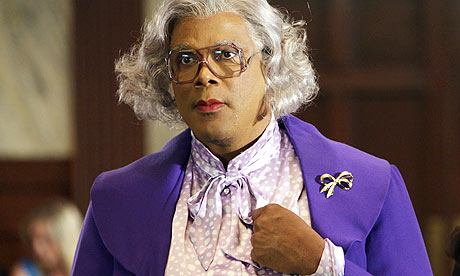
Tyler Perry, America's Auteur

David Seaton's News Links
I was perusing The Guardian the other morning looking for articles about the G-20 for a press dossier, when I stumbled On this about the American actor, writer and director Tyler Perry:
Why is the man ranked by the business magazine Forbes as the third top-earning black artist in America, with a personal income of $125m (£87m) a year, also described by Forbes as the "best kept secret in movie-making"? Why is he a virtual unknown outside America, while even within the US, he is regularly panned by critics or, worse, utterly ignored by them? Why, in return, has he turned his back on mainstream Hollywood, shunning the big studios, refusing to screen his films for critics, barely marketing them to wider audiences?
Why indeed?

Here are Perry's numbers from Entertainment Weekly:
Number of Tyler Perry Films: 7
Number of Films That Have Opened at No. 1 or No. 2: 6
Combined Domestic Gross: $356 mil
Living outside the states, Tyler Perry was completely off my radar, but I get the impression that he could also be completely off the radar of almost any white person actually living inside the United States today.

It seems that he is literally worshiped by working class African-Americans, but is a bit of an embarrassment for upwardly mobile members of that community.
Todd Boyd, an expert on race and popular culture at the University of Southern California, draws a connection between the stereotypes of black people perpetrated by Hollywood in the days of legal segregation and Perry's caricatures. "Black people were portrayed as slow and dumb; they scratched when they didn't itch, laughed when they weren't funny. They were buffoonish. "Tyler Perry has taken a number of those stereotypes and owned them - reinterpreting them for a new era. The difference is they used to be perpetrated by white Hollywood studio bosses. Now we have an African-American getting rich off them."
Of course the difference is that nowadays black people are doing the laughing, not white people, and black people are making Perry rich, not white people. Perry proves that African-Americans enjoy seeing themselves stereotyped by an African-American in ways that would not be acceptable in white hands. That is probably the biggest and certainly the most crucially important difference between Tyler Perry and say, Freeman Gosden and Charles Correll.

I watched some very crude, but very fresh and very funny Perry/Madea videos on Youtube and the first thing that came to my mind was that Perry's Madea was doing "Moms Mabley" with a pistol. Moms Mabley was a legendary comedienne, doyenne of the "chitlin circuit", the theaters and night clubs like Harlem's Apollo that catered exclusively to African-American audiences.

So much of America's exportable culture, its image, especially it's music, language, sports and fashion, or practically anything joyous it sends to the world, is of African-American origin
and there have always been an enormous number of hugely talented black performers that were unknown to white audiences. This was principally due of course to segregation, but even in those days white cognoscenti were constantly visiting the circuit eager to steal the routines and techniques of its stars like Bojangles Robinson, getting rich from it while the black artists often made very little themselves by comparison. The examples are countless

Again, what sets Tyler Perry apart today is the money he is making... and his independence.


For me the most interesting thing about Tyler Perry beyond his highlighting America's enduring racial-cultural divide is how through extremely viral marketing techniques he has managed to maintain total control of his work. There is no doubt in my mind that he is the most totally in control auteur in American cinema, perhaps in American cinema's history.

I also enjoy what many critics, both black and white, criticize, even detest about Perry's work, which is its crude, homemade, almost amateurish quality.

In the era of huge super productions filled with super heroes, superstars, special effects and 3D animation, it is wonderful to see films about ordinary people with ordinary problems; films with the production values of a high school play, giving a box-office drubbing to deracinated, polystyrene films with budgets that would dwarf the GDP of a small country.

Another very interesting facet of Perry's work is that his films begin as plays that go on tour all over the country, so that all the material has been amply tested in front of live audiences - his audience - before any camera ever rolls. As far as I know this hasn't happened since the days of the Marx Brothers, who also liked to test their new material with live audiences to see what worked and what didn't before they began to film.

Perry's whole approach to his audience reminds me of the "slow food" movement: maximum respect for the ingredients and maximum respect for those who consume them.

What makes me sad is that despite Obamania, the cultural divide between Americans is still so great that only five percent of the audience for such genuinely American films is white. DS

Wednesday, April 01, 2009

G-20 and the Jade Goody Super Power

As her performance on Big Brother made clear, her years of formal education had left Jade Goody with little knowledge. She thought that a ferret was a bird and abscess a green French drink; that Pistachio painted the Mona Lisa; that Sherlock Holmes invented the flush lavatory; that East Anglia ("East Angular" in Jade-speak) was abroad; and that Rio de Janeiro was "a bloke, innit?" Telegraph Obituary
David Seaton's News Links
To compare America's decline on view in London this week to the recent death watch of British reality television star Jade Goody is in bad taste and unfair... especially to the late Ms. Goody, whose losing and obscenely public battle with cancer was filled with a blithe pathos, cheerful fortitude and dignity that turned her from being simply a motormouth, 'poor cow' from hell, into some sort of patron saint of the tacky and underprivileged.

It's in poor taste to make the comparison, but Jade was all about poor taste, ignorance and huge sums of money paid for absolutely nothing and so, alas, very sadly for all concerned, is today's America.


Would we could go out with her class. DS

Saturday, March 28, 2009

An outer space laugh riot

Grapes of Wrath Redux?
Sacramento, California's jobless tent city
David Seaton's News Links
What is happening? Where are we headed?

Regular News Links readers may recall that I have always maintained that Bush was merely a symptom of a systemic problem, not really a cause.

Barack Obama, it is obvious to me, is a treatment of the symptoms and not any cure for the underlying causes. Simply the re-branding of a defective product.

Obama's apparent strategy in Afghanistan confirms my impression that he is the lampedusian, "change everything, so that nothing changes" figure I have always suspected.

Pakistan, not Afghanistan is the real problem. A stable, un-threatened and prosperous Pakistan would act like a Valium on the whole region.

Stabilizing Pakistan should be the first priority and this does not seem to be the case... far from it.

If the globalized, world economy were doing well, perhaps stabilizing Pakistan would be "doable", but with emerging nations taking the worst hit in this crisis, such an "unlikely lad" as Pakistan is probably not going to make it... in most part due to American meddling... With absolutely catastrophic consequences.

I am afraid that the Obama policy in Afghanistan/Pakistan is not only incorrect, it is frivolous. Not because Obama himself is particularly frivolous, but because the system itself within which he operates is.

I think that because it is so painful, we are taking all of this much more seriously then it deserves to be.

I imagine that if I were a Martian observing this situation from the comfort of my flying saucer I would be peeing my space suit with laughter.

Lucky Martians!

Because it is painful, because so many are suffering we imagine that those in charge are motivated by great or noble passions.

Perhaps all of this is much simpler that it might appear at first glance.

The Geithner plan only confirms that analysis/intuition for me.

Most independent observers both in the USA and abroad are of the opinion that the problem with US banks is not liquidity, but rather solvency. That is why Paul Krugman, for example, "despairs" of Geithner's plan.

The normal game plan for bringing insolvent banks back to health is well known and goes as follows:

  • Government takes over insolvent bank
  • Fires old management
  • Hires new managers
  • Shareholders are wiped out
  • Bank is restored to health and reprivatized often at a profit for taxpayers.
I think it is obvious that the shareholders of American banks are taking priority over the taxpayers. I seem to remember that one percent of the US population holds some forty percent of the shares traded on Wall Street.

Therefore it might be worthwhile to begin to investigate the relationship that Obama and his team have with said shareholders.

What if they were all in on the gag?

Think about three of the points of a bank restructuring that I made above:
  • Fires old management
  • Hires new managers
  • Shareholders are wiped out
What is the relation of Larry Summers, Robert Rubin and Tim Geitner to the "old management"? Would they or any of their family be "wiped out" in a normal nationalization/re-privatization process?

I think that these are serious questions that all nasty "populists" should be asking.

Finally:

What little comfort can we derive from this crisis?

Well, for one thing it puts paid to the idea of some sort of diabolically clever "capitalist-international" elite that guides mankind's destiny pulling strings from the shadows: the "Davos cum Bilderberg" thing.

Obviously any such group would have prevented this Wall Street, Madoff-make-off, which is threatening the whole system.

Nobody is minding the store, the American economy is simply a thieves' banquet.

We take our comfort where we can. DS

Wednesday, March 25, 2009

The American Black Hole of Value


David Seaton's News Links
Martin Wolf, chief economist of the Financial Times is worried about the Geithner plan, he writes:
The crisis has broken the American social contract: people were free to succeed and to fail, unassisted. Now, in the name of systemic risk, bail-outs have poured staggering sums into the failed institutions that brought the economy down. (...) If this scheme works, a number of the fund managers are going to make vast returns. I fear this is going to convince ordinary Americans that their government is a racket run for the benefit of Wall Street. Now imagine what happens if, after “stress tests” of the country’s biggest banks are completed, the government concludes – surprise, surprise! – that it needs to provide more capital. How will it persuade Congress to pay up? The danger is that this scheme will, at best, achieve something not particularly important – making past loans more liquid – at the cost of making harder something that is essential – recapitalising banks.
Nobel Prize winner, Joseph Stiglitz, was blunt:
"Quite frankly, this amounts to robbery of the American people. I don't think it's going to work because I think there'll be a lot of anger about putting the losses so much on the shoulder of the American taxpayer."
And of course that other Nobel, Krugman, blogged:
"What an awful mess."
In my opinion there was something much more important than Geithner's plan floated this week:
Are the Chinese just worried about the sagging value of the $1.4 trillion in U.S. Treasuries they hold or are they really on to something? That's the big question now that China's central banker, Zhou Xiaochuan, has called for the greenback to be jettisoned as the world's dominant currency and replaced by a new type of benchmark controlled by the International Monetary Fund. Zhou made his call in an essay that appeared on the website of People's Bank of China, China's central bank, on Monday. It was clearly timed to make a splash in the run-up to the G20 meeting that starts in London on April 2. Calling the use of the dollar as the world's benchmark currency "a rare special case in history," Zhou urged the "creative reform of the existing international monetary system towards an international reserve currency." Zhou said the reserve currency, managed by the IMF, should be "disconnected from individual nations and is able to remain stable in the long run." Talk about a vote of no confidence on the future of the U.S. economy! Washington Post
Of course the moment the US dollar ceases to be the world's reserve currency, the American economy will no longer be able to pay its debts with money it prints in its basement... The jig will up. Meatloaf will take the place of Camembert on many a formerly festive board from that day out.

Pushing aside all the epidemically anecdotal sound and fury, what has happened?


One of the world's most interesting and influential, even seminal, economists, the Peruvian, Hernando de Soto wrote the following article in the Wall Street Journal that gets right to the heart of the present situation:
Today's global crisis -- a loss on paper of more than $50 trillion in stocks, real estate, commodities and operational earnings within 15 months -- cannot be explained only by the default on a meager 7% of subprime mortgages (worth probably no more than $1 trillion) that triggered it. The real villain is the lack of trust in the paper on which they -- and all other assets -- are printed. If we don't restore trust in paper, the next default -- on credit cards or student loans -- will trigger another collapse in paper and bring the world economy to its knees.

If you think about it, everything of value we own travels on property paper. At the beginning of the decade there was about $100 trillion worth of property paper representing tangible goods such as land, buildings, and patents world-wide, and some $170 trillion representing ownership over such semiliquid assets as mortgages, stocks and bonds. Since then, however, aggressive financiers have manufactured what the Bank for International Settlements estimates to be $1 quadrillion worth of new derivatives (mortgage-backed securities, collateralized debt obligations, and credit default swaps) that have flooded the market.

These derivatives are the root of the credit crunch. Why? Unlike all other property paper, derivatives are not required by law to be recorded, continually tracked and tied to the assets they represent. Nobody knows precisely how many there are, where they are, and who is finally accountable for them. Thus, there is widespread fear that potential borrowers and recipients of capital with too many nonperforming derivatives will be unable to repay their loans. As trust in property paper breaks down it sets off a chain reaction, paralyzing credit and investment, which shrinks transactions and leads to a catastrophic drop in employment and in the value of everyone's property.
Something truly stupefying has occurred, something which has not yet been fully taken in. The United States of America, precisely at its moment of triumph and mastery, its moment of unique preeminence, has chosen to destroy the concept of value itself.

At the risk of offending Catholic readers everywhere, imagine this "parallel universe", a metaphorical, Saramago-like scenario by which I have chosen to describe through analogy the American financial sector's crisis and by extension the social crisis it brings with it:
One Sunday, all over the world, every Catholic, man woman and child, who takes Holy Communion develops a persistent diarrhea and an unsightly rash.... Health authorities discover that the pathogen causing these ailments is only found in consecrated communion wafers... unconsecrated wafers are found to be harmless, scientific tests determine that the transformation occurs precisely upon the Host's elevation and is not due to faulty storage procedures.

Priests all over the world try consecrating other forms of bread, but with the same result: anything any of them consecrates brings on the diarrhea and the rash. The diarrhea and rash are not fatal, but this universal outbreak brings into question all the sacraments of the Church, especially other vital ones of "deferred payment", such as baptism and the forgiveness of sins.

On one hand this rationally inexplicable crisis is taken as the definitive proof of a supreme being, one who actually and unmistakeably intervenes in human affairs, but on the other it also undoubtedly damages the Church's franchise as a credible representative of that being on earth.

Without a viable sacramental role, what would be the status then of the Pope? He would still have the trappings of the office, the "pope-mobile" and the stunning wardrobe, but what of his apostolic authority?

Having proven God's existence, while simultaneously demonstrating his disfavor, would this then lead to mass conversions to Islam or to Pentecostal sects?

What would be its effect on the Italian tourist industry?

The blow-back and knock-on effects of the proven or potential toxicity of the Church's most important assets, its sacraments, might be endless.
Business and the sanctity of property are and have always been America's religion.

In America's case read commercial paper and the dollar for "communion wafers" and POTUS for "Pope" and you get my drift.


America has in a sense committed suicide. Can its stomach be pumped out in time? DS

Wednesday, March 18, 2009

Up against the wall mother... of invention


John Rich singing "Shutting Detroit Down", (hat to Forensic Economist)

David Seaton's News Links
The American Dream is based on the extraordinary idea/fantasy/vision of an endless horizon, of unlimited possibility, of infinite social mobility, of ceaseless, all solving invention, a place where everyone has/had a chance at "the Diamond as Big as the Ritz".

This vision explains the unique phenomenon of a country where simultaneously the word "elitist" is an insult and the wealthy and the famous are worshiped.


However the dream has its cut-in-stone rules, its iron logic. Those rules, that logic are being violated.
My daddy taught me
In this county everyone's the same
You work hard for your dollar
And you never pass the blame
When it don't go your way

Now I see all these big shots
Whining on my evening news
About how their losing billions
And it's up to me and you
To come running to the rescue
"Shutting Detroit Down" - John Rich
There is hell to pay.

Running out of road, discovering limits, this is the nightmare of the right, that is why, for example, that they react so virulently, so insistently against the clear danger of climate change. Global warming means finding limits.

Ideally, America's vision of capitalism is like a version of musical chairs where new chairs are being added constantly. Everybody imagines that they'll finally get a seat.

However in a Global warming scenario the music stops and instead of a chair being added or one chair being taken away as in the classic game, most of the chairs are removed and unless the remaining chairs are shared fairly, most human beings will be left standing for eternity or rebel and take the chairs for themselves from the few who posses them.

For a long time, despite stagnant salaries and purchasing power, easy credit - mostly loaned to Americans by foreign savers - has allowed this peculiar game of musical chairs to continue. Now even the piano is being repossessed.

In a real sense the American Dream itself may be turning out to be a Madoff style
Ponzi scheme.

One of my favorite practices is to put quotes next to each other and see how they resonate, the same way that musical notes form a chord: the resulting sound is more than the sum of the parts.

Here are two, that juxtaposed, drip with zeitgeist, brim with the writing on the wall.
It has been odd, over the past six months, not to have the gospel of success as part of the normal background music of life. You go about your day, taking in the news and the new movies, books and songs, and only gradually do you become aware that there is an absence. There are no aspirational stories of rags-to-riches success floating around. There are no new how-to-get-rich enthusiasms. There are few magazine covers breathlessly telling readers that some new possibility — biotechnology, nanotechnology — is about to change everything. That part of American culture that stokes ambition and encourages risk has gone silent. We are now in an astonishingly noncommercial moment. Risk is out of favor. The financial world is abashed. Enterprise is suspended. The public culture is dominated by one downbeat story after another as members of the educated class explore and enjoy the humiliation of the capitalist vulgarians. David Brooks - New York Times

Socialism is an ideology founded on optimism - the hope that the world could be a better place if its relations are rooted in co-operation rather than competition, and solidarity rather than insularity. But for much of my adult life the opportunity to apply those principles has been rare. Gary Younge - Guardian
I suppose David Brooks would count John Rich, the author of "Shutting Detroit Down" among members of the educated class that "explore and enjoy the humiliation of the of the capitalist vulgarians".

What I don't see yet is how we get from Brooks to Younge.

What I don't see yet is a charismatic, working class politician in the line of a Huckabee or a Palin saying, like Gary Younge, that "the world could be a better place if its relations are rooted in co-operation rather than competition, and solidarity rather than insularity". I don't hear a down home voice like a Huckabee or a Palin talking, with the angry, Woody Guthrie-like passion of a John Rich, about nationalizing General Motors to save those jobs and pensions.

I opened with John Rich, so I'll close with Cole Porter,
"Use your mentality, wake up to reality"
The day that happens, the entire world will change overnight.

I am enough of an American exceptionalist to believe that, as America is the cutting edge, the vanguard of capitalism, it is "only in America" where capitalism will be finally tamed, if it ever is. DS

Wednesday, March 11, 2009

Mission improbable

Your mission, if you should choose to accept it is to save capitalism. This economy will self-destruct in 5 seconds
David Seaton's News Links
Universal health care, free university education for all, a more realistic foreign policy, freeing science from superstition... All of these Obama initiatives not only sound good, they sound wonderful, thrilling.

But somehow, at this moment, the new president and his government's lovely initiatives mostly remind me of the pediatricians and the nurses at a children's cancer ward organizing a big Christmas party... for the summer.

Aside from Santa Claus, the doctors don't know who else will still be around to decorate the tree, but at least thinking about the future goodies takes our minds off of our poor little, pale, bald heads.

For, truly, at this point it is not just "it's the economy, stupid", it is more like "it's the economy, dear Jesus".
Most Americans (53%) now think the United States is at least somewhat likely to enter a 1930’s-like depression within the next few years.(...) The most recent survey also found that half of all adults (49%) say today’s children will not be better off than their parents. Only 26% hold the more optimistic view, while another 25% are not sure. Rasmussen Reports
Even Obama-friendly commentators of impeccable professional qualifications like Paul Krugman are beginning to have serious doubts whether Obama and Geithner have the political will to do what it takes to save the economy from a depression.
Last month, in his big speech to Congress, President Obama argued for bold steps to fix America’s dysfunctional banks. “While the cost of action will be great,” he declared, “I can assure you that the cost of inaction will be far greater, for it could result in an economy that sputters along for not months or years, but perhaps a decade.” Many analysts agree. But among people I talk to there’s a growing sense of frustration, even panic, over Mr. Obama’s failure to match his words with deeds. The reality is that when it comes to dealing with the banks, the Obama administration is dithering. Paul Krugman: The Big Dither - New York Times
Here is how financial strategist David M. Smick put the cost of this "dithering" in the Washington Post:
Our present position is unsustainable. The longer we delay fixing the banks, the faster the economy deleverages, the more credit dries up, the further the stock market falls, the higher the ultimate bank bailout price tag for the American taxpayer, and the more we risk falling into a financial black hole from which escape could take decades.
Even Thomas Friedman chips in his two cents worth in his inimitable, "dwarf in the locker room" style.
Friends, this is not a test. Economically, this is the big one. This is August 1914. This is the morning after Pearl Harbor. This is 9/12. Yet, in too many ways, we seem to be playing politics as usual. Our country has congestive heart failure. Our heart, our banking system that pumps blood to our industrial muscles, is clogged and functioning far below capacity. Nothing else remotely compares in importance to the urgent need to heal our banks. Yet I read that we’re actually holding up dozens of key appointments at the Treasury Department because we are worried whether someone paid Social Security taxes on a nanny hired 20 years ago at $5 an hour. That’s insane. It’s as if our financial house is burning down but we won’t let the Fire Department open the hydrant until it assures us that there isn’t too much chlorine in the water.
It seems unanimous.
Treasury Secretary Timothy Geithner, who may be President Obama's biggest mistake, has not been able to inspire confidence or convince a frantically anxious public that he knows what he is doing. The man, whose TV personality is that of a slightly sneaky, know-it-all-ish technocrat, is overwhelmed and understaffed in what at the moment is the second-most-important job in the American government. Nicholas Von Hoffman - The Nation
None other than the great Roubini,
"also took issue with the $800 billion stimulus package, saying it's not enough. For one thing, there's only $200 billion upfront, and half of that is a tax cut, which Roubini calls "a waste of money" that is not going to make a difference."
The entire world is waiting, hoping and maybe some are still expecting that Barack Obama will wave a magic wand and everything will be alright. However it could very well be that Obama and his "good vibes" will be swept away by events. As Martin Wolf wrote in the Financial Times:
The ability of the west in general and the US in particular to influence the course of events will also be damaged. The collapse of the western financial system, while China’s flourishes, marks a humiliating end to the “uni-polar moment”. As western policymakers struggle, their credibility lies broken. Who still trusts the teachers?
The other night we had dinner with an old friend, an American lady, the widow of a Spanish architect, who works in the Spanish ministry of culture. Needless to say she is a passionate Democrat and an Obamite. She made an interesting observation about the financial crisis.

"Everything is so quiet..." she said, "In the run up to the war in Iraq, literally millions of angry Spanish people took to the streets to protest against the USA... but the war itself had little effect on the daily life of Spaniards. Now, in this economic crisis, which has its origins in America, it's as if the United States of America had personally dropped a bomb on every Spanish family... You'd think they'd be burning down the US embassy, but they aren't... not yet. It's kinda weird, when you think about it, isn't it?" she said. You betcha.


We have entered terra incognita.

Those of us who like to "think outside the box" are having trouble even
locating the box these days.

Reality has always been a moving target, but now it appears a moving hologram. The world may be so different in a year of two that its own mother wouldn't recognize it.

The only thing I'm sure of at the moment is that if things are ever going to get better they are going to have to get a helluva lot worse. Idols are falling, more must fall.

This crisis has radically changed the political landscape and the sudden loss of authority of what Martin Wolf calls "the teachers"
has opened the door for language and thinking to enter mainstream discourse, that only a few weeks ago would have been unthinkable.

"Populism" is a funny word. In the American media it usually has a pejorative connotation. But here is how Wikipedia defines it:
The word populism is derived from the Latin word populus, which means people in English (in the sense of "nation," as in: "The Roman People" (populus Romanus), not in the sense of "multiple individual persons" as in: "There are people visiting us today"). Therefore, populism espouses government by the people as a whole (that is to say, the masses). This is in contrast to elitism, aristocracy, synarchy or plutocracy, each of which is an ideology that espouse government by a small, privileged group above the masses.
Lula, the president of Brazil put it this way in no less than the Financial Times:
"I am not worried about the name to be given to the economic and social order that will come after the crisis, so long as its central concern is with human beings."
Nobel Prize winner, Amartya Sen went even a bit further in the New York Review of Books
The market economy has depended for its own working not only on maximizing profits but also on many other activities, such as maintaining public security and supplying public services—some of which have taken people well beyond an economy driven only by profit. The creditable performance of the so-called capitalist system, when things moved forward, drew on a combination of institutions—publicly funded education, medical care, and mass transportation are just a few of many—that went much beyond relying only on a profit-maximizing market economy and on personal entitlements confined to private ownership. Underlying this issue is a more basic question: whether capitalism is a term that is of particular use today. The idea of capitalism did in fact have an important role historically, but by now that usefulness may well be fairly exhausted.
A mainstream, Nobel Prize winning economist saying the usefulness of capitalism, "may well be exhausted"! The unspeakable is being spoken.

You, like me, may find this change of language and the new horizons it presents filled with hope, but you better believe
there are quite a few people who it is surely making terminally nervous.

As we noted last week, the people who stand to lose money, power and prestige through this sea change in the political mood are certainly not going to take these losses lying down.

I think that this is one of the lines they are going to take:
While the Obama administration seeks to improve America’s position vis-à-vis Iraq, Afghanistan, Israel-Palestine, Europe, and Asia, the most critical foreign-policy front of all – the home front—is looking brittle. This development is new, as for almost seven decades – ever since Pearl Harbor—policymakers have taken for granted that the homefront would cooperate with military missions and expenditures.(...) The fact that the public has docilely accepted this arrangement for so long does not mean that it will continue to do so. Despite the many new billions that President Obama’s budget allocates for jump-starting the economy, he intends to substantially cut the Pentagon’s money-line.(...) What I foresee is a more gradual siphoning of money away from vital programs over the next decade, even as China, India, and other countries enlarge their navies and other forces. This will not necessarily lead to a security dilemma for the U.S., but it will certainly lead to a multipolar world and the end of American dominance. The only development that could change this equation would be a new and sudden threat – and one other than mass-casualty terrorism."The Shrinking Superpower", Robert D. Kaplan, The Atlantic
Or this:
We are on the verge – within 10 years – of a major collapse of evangelical Christianity. This breakdown will follow the deterioration of the mainline Protestant world and it will fundamentally alter the religious and cultural environment in the West.(...) This collapse will herald the arrival of an anti-Christian chapter of the post-Christian West. Intolerance of Christianity will rise to levels many of us have not believed possible in our lifetimes, and public policy will become hostile toward evangelical Christianity, seeing it as the opponent of the common good. Michael Spencer - Christian Science Monitor
It is indeed a great blessing that the Soviet Union has disappeared. This disappearance at least makes true change possible. The presence of a rival superpower with an alternative economic system and ideology at this moment would mean that this crisis could only lead America farther to the right.

Seen this way the crisis couldn't have come at a better time.

As it is someday the United States may just be able to muddle its way through by sheer process of elimination into something more humane. DS

Wednesday, March 04, 2009

This is just starting...


David Seaton's News Links
The central issue in American politics now is whether the country should reverse a three-decade-long trend of rising inequality in incomes and wealth. E.J. Dionne Jr. - Washington Post

This budget says the Republicans had Mr Obama right all along. The draft contains no trace of compromise. It makes no gesture, however small, however costless to its larger agenda, of a bipartisan approach to the great questions it addresses. It is a liberal’s dream of a new New Deal. Clive Crook - Financial Times
President Obama proposes to raise the taxes of America's richest citizens, whose tax bill has been getting smaller and smaller for the last thirty years. This disagreeable prospect finds the political defenders of this wealthy minority, the Republican party, in a state of ideological collapse, with the prestige of the market economy and Reaganomics in tatters.

Now, in trying to forecast how this situation will play out I base a lot of my analysis on a assumption that many may find quite controversial or even unfair. This assumption, briefly stated, is as follows: that the possessors of huge amounts of money are, with many honorable exceptions, greedier and more ruthless in the acquisition and defense of their wealth than the average person is of his modest possessions and that they also have at their disposal many more tools to express these traits than the average person does.

As I say, many may find this characterization of the rich unfair, however if you take this assumption of mine as a given, it is safe to say that the wealthiest Americans are not going to take the prospect of paying more taxes lying down. They will fight hard and fight to win.

How will they fight?

Before continuing, I would like to make a short aside to remember something an old Spanish communist told me way back in the 1970s. He said, "David,
if the right ever called for a mass demonstration behind the slogan, 'Workers arise, defend the property of the wealthy!', nobody would come, maybe ten people might show up. So the wealthy have to call up mass movements to defend their interests behind the screen of, 'God and country' or even racial hatred".

How is that for teaching the ABCs?

For some thirty years, the American political conversation has been dominated by a strain of ideological conservatism that wields market fundamentalism as a sword and cultural populism as a shield. Hendrik Hertzberg - New Yorker
It is difficult to overstate the significance of this breakdown of faith in the market economy, because we are talking about transcendence. To have the economy collapse the way it is doing does not just mean material hardship, it is a "dark night of the soul" for many Americans.

It might sound like a crude joke, but for many Americans the line where capitalism ends and where Jesus begins has been steadily blurred and wrapped in the flag since the beginning of the "Cold War" and the "red scare" of the late 40s and early 50s. If you choose to consider that an accident or a coincidence, well it's a free country, isn't it?

Since the fall of the Berlin Wall this transformation of money making into a universal faith open to all, where everybody wins, has become worldwide. This can take paradoxical forms:
A couple of years ago, John Berger made a salient point apropos of a French publicity poster of the internet investment brokers' company Selftrade: under the image of a hammer and sickle cast in solid gold and embedded with diamonds, the caption reads "And if the stock market profited everybody?" The strategy of this poster is obvious: today, the stock market fulfils the egalitarian Communist criteria, everybody can participate in it. Slavoj Žižek - "The Undead Lenin"
For a long time not only have the wealthy had their money practically untouched, they have been admired and encouraged to flaunt it. That era has crashed and is burning.

I wrote this in June 2007:
Millions of middle-middle class people who have been living in a dream world, thinking that were somehow part of the same universe as Bill Gates, are going to have to make drastic decisions about allocating their resources if they are not to lose their homes. They are going to re-discover why there was ever a universal demand for good, free public schools and universities or (in the countries lucky enough to have gotten that far) first class, free public health care in the first place. They will rediscover the nearness of the abyss of destitution and humiliation that terrified their parents and grandparents who lived through the Great Depression. As much as an economic and political readjustment, it will be a cultural change, for never before in history have so many "normal" people identified with the wealthy and considered them harmless or even benevolent.
The "sword of market fundamentalism" is broken:
President Barack Obama enjoys widespread backing from a frightened American public for his ambitious, front-loaded agenda, a new poll indicates. He is more popular than ever, Americans are hopeful about his leadership, and opposition Republicans are getting drubbed in public opinion, the new Wall Street Journal/NBC News poll suggests. Wall Street Journal
That leaves the "shield of cultural populism" as untrammeled wealth's last line of political defense: Jesus, fear and the flag. The shield can be couched in calm, reasonable language:
Even though Obama’s audacious agenda might provide short-term relief to the economic and social challenges that now beset us, over the long term the Obama revolution is likely to erode first the religious and then the civic and moral fabric of the nation. Undoubtedly, this is not the change religious believers who put their faith in Obama last November are hoping for from this president. But if the European experiment with the welfare state tells us anything, it tells us that this is the change we can expect from a successful Obama revolution. W. Bradford Wilcox - Witherspoon Institute
Or it can be the red meat on display at the recent Conservative Political Action Conference :
In an address at CPAC, former Arkansas Gov. Mike Huckabee compared Obama and the Democrats' agenda to that of the former Soviet Union. "Lenin and Stalin would love this stuff," Huckabee said. Market Watch - Wall Street Journal
The rage is close to the surface:
"What is so strange about being honest and saying I want Barack Obama to fail, if his mission is to restructure and reform this country so that capitalism and individual liberty are not its foundation?" (Rush) Limbaugh said at the Conservative Political Action Conference. Boston Globe
Probably the only card left to play with the economy in meltdown is the fear card and it certainly wasn't expressed subtly at CPAC conference:
Former UN Ambassador John Bolton believes the security of the United States is at dire risk under the Obama administration. And before a gathering of conservatives in Washington on Thursday morning, he suggested, as something of a joke, that President Barack Obama might learn a needed lesson if Chicago were destroyed by a nuclear bomb. Mother Jones
That is crazy talk, but that gives us a clear idea of the present fantasies of the neocons and we have certainly learned though painful experience that they are not people who are readily satisfied with just fantasies: they tend to act out.

By now, after eight years of Bush, I take these people seriously. There are at this moment a group of very well funded, well organized people who would rejoice if the United State suffered a huge terrorist attack or was dragged into a major war.

Armageddon is probably the last, best chance that the "Conservative Revolution" has of surviving and the only chance the super rich of America have of not ending up paying, what for them would seem, Scandinavian scale taxes.

They have plenty of potential disasters to choose from, for today's world is a "target rich" environment.

Finally the success of president Obama's "revolution" may well depend on the goodwill of the Communist Party of China and their endless purchasing of US debt, the cooperation of Vladimir Putin in Afghanistan and beyond, the passivity of the Ayatollahs of the Islamic Republic of Iran, the good faith of the Israeli Likud, which itself depends on the support of neofascist, Avigdor Lieberman... and of course, last of all, but not least of all, the acquiescence and quiescence of Al Qaeda.


Have I left anybody out?

The major challenge of progressives in the months and years to come will be to keep America out of war. DS