Friday, February 07, 2014

Nuland and Pyett's tape

David Seaton's News Links
 
 “Clear communication expresses clear thinking, while muddled communication reflects muddled thinking” Writing Success Program at UCLA
(The English Language) becomes ugly and inaccurate because our thoughts are foolish, but the slovenliness of our language makes it easier for us to have foolish thoughts. George Orwell
You've probably heard or heard about this conversation between  US assistant secretary of state, Victoria Nuland, and Geoffrey Pyatt, US ambassador to Ukraine before reading this post. A couple of questions naturally come up, for example, how did the Russians get access to the conversation and is this a little sample of access they have acquired from Snowden or could they have done this before he arrived on the scene? 

My answer? I haven't a clue... all I can say is that Putin seems to be very, very, lucky these days.

What really brings me to write about it is the language these people use. By this I don't mean Victoria Nuland's, now famous, "fuck the EU", for me that is about the only really simple and declarative, proper English sentence in the entire recording. Here is a sample of what I mean:
Voice thought to be Pyatt's: I think we're in play. The Klitschko [Vitaly Klitschko, one of three main opposition leaders] piece is obviously the complicated electron here. Especially the announcement of him as deputy prime minister and you've seen some of my notes on the troubles in the marriage right now so we're trying to get a read really fast on where he is on this stuff. But I think your argument to him, which you'll need to make, I think that's the next phone call you want to set up, is exactly the one you made to Yats [Arseniy Yatseniuk, another opposition leader]. And I'm glad you sort of put him on the spot on where he fits in this scenario. And I'm very glad that he said what he said in response. BBC - Transcript
 Here is the quote that has grabbed the headlines and done the most damage:
Nuland: OK. He's now gotten both Serry and [UN Secretary General] Ban Ki-moon to agree that Serry could come in Monday or Tuesday. So that would be great, I think, to help glue this thing and to have the UN help glue it and, you know, Fuck the EU. BBC - Transcript
Refreshing clarity there... In the following snippet, Ambassador Pyatt outdoes himself in mixed, muddled and mangled metaphors.
Pyatt: No, exactly. And I think we've got to do something to make it stick together because you can be pretty sure that if it does start to gain altitude, that the Russians will be working behind the scenes to try to torpedo it. And again the fact that this is out there right now, I'm still trying to figure out in my mind why Yanukovych (garbled) that. In the meantime there's a Party of Regions faction meeting going on right now and I'm sure there's a lively argument going on in that group at this point. But anyway we could land jelly side up on this one if we move fast. So let me work on Klitschko and if you can just keep... we want to try to get somebody with an international personality to come out here and help to midwife this thing. The other issue is some kind of outreach to Yanukovych but we probably regroup on that tomorrow as we see how things start to fall into place. BBC - Transcript
I think it could be seriously maintained that many if not most of the endlessly repeated and disastrous failures of American diplomacy in recent (and not so recent) years can be explained by the mental activity, or lack of it, of people who produce language like this. DS


Friday, January 24, 2014

Inequality: a tale of two pyramids

David Seaton's News Links

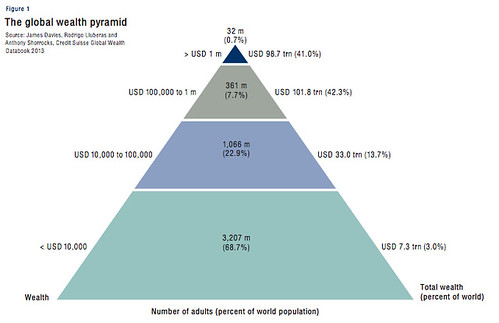
This pyramid appeared in the Washington Post.


Looking at it I was reminded of another pyramid in a classic poster from the 19th century, which could be a "poetic" rendering of the graph from the Post.


The signs are all around us, if you want to take a peek at the near future, have a look at the scheme Jeff Bezos has dreamed up over at Amazon. It is called "Mechanical Turk" and its goal is to turn clerical tasks that require education and specialized training into sweatshop piece work like making T-shirts in Bangladesh. I urge my readers take a very close look at it to see where their training and skills might be used and what pay they would receive for performing these tasks.

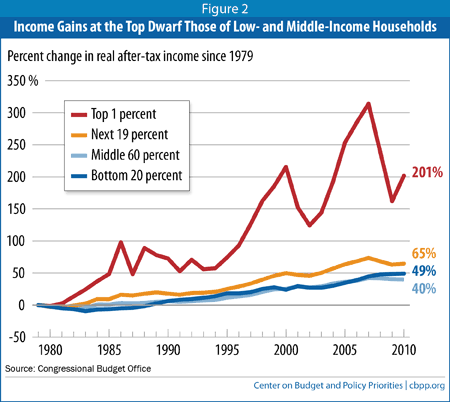
That is the story: in developed countries we are in the process of recreating the class differences and the ensuing class struggle of the 19th century, but this time in a world where consciousness, class or otherwise, with the new social networks, quickly becomes universal. The 1% are sitting on a powder keg. These graphs explain the Tea Party and the Koch brother's spending millions bankrolling it. The idea is to keep a person from thinking clearly and like the fellow said, avoid an individual being "at last compelled to face with sober senses his real conditions of life, and his relations with his kind."

If the problem of controlling the "powder keg" is one of consciousness, the system seems to be working rather well. It would appear that converting human beings into mental cripples is an enormous industry and they have to catch them rather young. The following is a sample of what a school teacher wrote Thomas Friedman, quoted in the New York Times.
We are dumbing down our classes.  It is an inexorable downward progression in which one day all a kid will need to pass is to have a blood pressure. The kids today are not different in ‘nature.’ ... The difference is that back then, although they didn’t want to, they would do the work. Today, they won’t. ... This is a real conversation I had with a failing student who was being quite sincere in her comments: ‘I know you’re a really good teacher, but you don’t seem to realize I have two hours a night of Facebook and over 4,000 text messages a month to deal with. How do you expect me to do all this work?’
Maybe Americans are finally waking up, but for the moment, from my perch on the other side of the Atlantic, the only one really talking any sense is Naquasia LeGrand. DS

Saturday, January 18, 2014

Explaining the virulence on the right... Social Democracy in America?

David Seaton's News Links
 Naquasia LeGrand... the right stuff
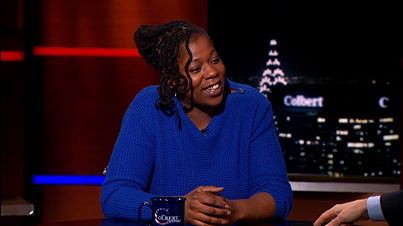
Naquasia LeGrand, the lady that tops this page, works at minimum wage shoveling fried chicken, for KFC. She is leading a fight to organize fast-food workers and raise America's minimum wage to $15. She is facing some of America's most powerful multinational corporations and an ideological set enshrined in think-tanks, PACs and mainstream media which has prevailed in the USA since the days of Ronald Reagan and... She looks like winning!

How could this happen? Not that complicated, really.

The price of elitist politics is that, in a democracy, or anything remotely resembling one, when issues become so simple and self-evident that "you don't need a weatherman to tell which way the wind blows": at that point the money's "gate-keeper" function no longer guarantees that numerically small, but powerful groups are able to achieve their desired outcomes. 

This is the sort of opposition that Ms. LeGrand is facing:
Koch-backed political coalition, designed to shield donors, raised $400 million in 2012 - Washington Post
The political network spearheaded by conservative billionaires Charles and David Koch has expanded into a far-reaching operation of unrivaled complexity, built around a maze of groups that cloaks its donors, according to an analysis of new tax returns and other documents. (...) The resources and the breadth of the organization make it singular in American politics: an operation conducted outside the campaign finance system, employing an array of groups aimed at stopping what its financiers view as government overreach. Members of the coalition target different constituencies but together have mounted attacks on the new health-care law, federal spending and environmental regulations.
They must think that it's worth the expense. 

How can a minimum wage worker like Naquasia LeGrand face anything like that, with even a ghost of a chance of succeeding?

The answer might be contained in an article about the right-wing political consultant, Frank Luntz, that I came upon in "The Atlantic".

Few people are as in touch with American public opinion as Luntz is, he has made a fortune crafting his clients' messages to suit or bend that opinion. And, according to the article, Luntz, who spends a fortune on focus groups and polls is in the depths of a black dog depression because of what he is hearing and seeing.

This what his fine-tuned nose is sniffing:
But what if the Real People are wrong? That is the possibility Luntz now grapples with. What if the things people want to hear from their leaders are ideas that would lead the country down a dangerous road? "You should not expect a handout," he tells me. "You should not even expect a safety net. When my house burns down, I should not go to the government to rebuild it. I should have the savings, and if I don't, my neighbors should pitch in for me, because I would do that for them." The entitlement he now hears from the focus groups he convenes amounts, in his view, to a permanent poisoning of the electorate—one that cannot be undone. "We have now created a sense of dependency and a sense of entitlement that is so great that you had, on the day that he was elected, women thinking that Obama was going to pay their mortgage payment, and that's why they voted for him," he says. "And that, to me, is the end of what made this country so great." The Agony of Frank Luntz - The Atlantic
Serendipity? Coincidence? On the same day I read the piece about Frank Luntz, I read the following rave review in Slate by Matthew Yglesias about a book called Social Democratic America.
It's too bad for Lane Kenworthy that his new book, Social Democratic America, was published on Jan. 3, 2014, because otherwise I'd be comfortable calling it the best public policy book of 2013. Matthew Yglesias - Slate
What is the author's social democratic menu-shopping list, agenda, for the USA

  1. Universal health insurance
  2. Universal system of one year of paid
    parental leave
  3. Universal early education
  4. Increased Child Tax Credit
  5. Universal sickness insurance
  6. Eased eligibility criteria for unemployment
    insurance
  7. Wage insurance for unexpected drops in
    income
  8. State-run supplemental defined-contribution
    pension plans with automatic enrollment
  9. Extensive, personalized job search and
    (re)training support
  10. Government as employer of last resort
  11. Minimum wage increased modestly and indexed
    to inflation
  12. Earned Income Tax Credit extended farther up
    the income ladder and indexed to average wages
    or GDP per capita
  13. Higher benefit level for social assistance
    (i.e. TANF-like programs)
  14. Reduced incarceration of low-level drug
    offenders
  15. Affirmative action shifted to focus on
    family background rather than race
  16. Expanded government investment in
    infrastructure and public spaces
  17. More paid holidays and vacation time
This policy list would be par for the course in say, Sweden, which is certainly not a "socialist" country and whose business community hosts many a billionaire. The billionaire business folk of Sweden have no problem with Kenworthy's list, but their American counterparts like the Koch brothers are spending a fortune to paralyze the country's political system to avoid what they consider "socialism", "communism" or worse.

People in the USA, certainly the Tea Party, often confuse social-democracy with "socialism", however they are very different. 

Socialism advocates state/public ownership of the means of production: for example, nationalizing the steel or automobile industry would be socialist. On the contrary, social-democracy is about "civilizing" capitalism. 

Social democracy is anything but revolutionary, FDR's New Deal was considered largely social-democratic and many felt that, by his measures, Roosevelt saved the capitalist system from destroying itself. For this very reason, the hard left, like Marxist-Leninists, consider social democrats "Judas goats" for the capitalist system. For them the harder the brand of capitalism, the easier it is to overturn; the Koch brothers are dream enemies for them.

If Frank Luntz is right about a sea change in American opinion, Naquasia LeGrand may win her fight and Kenworthy's list may be more than a pipe dream. DS

    Tuesday, December 31, 2013

    2014... and welcome to it

    David Seaton's News Links
    Prediction is very difficult, especially if it's about the future.
    Niels Bohr

    The future ain't what it used to be.
    Yogi Berra
    As luminaries such as Niels Bohr and Yogi Berra have pointed out, trying to predict the future is a mug's game... And at year's end political commentators are urged to enter a field best left to astrologers. We are almost always proved wrong, and yet every year we give it a try.

    My clearest reading of 2014's tea leaves is "instability": worldwide instability and in my opinion this instability has its origins at the heart of the most developed economies of the western world.

    The causes?

    We are undergoing a technological revolution and process of globalized outsourcing, combined with a reduction of the welfare state that is severely degrading the middle class in developed countries and converting them slowly, but surely into working-poor.

    Anyone who has read a bit of history could tell you how dangerous that is.
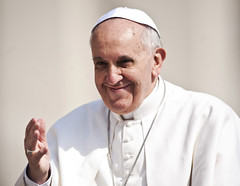
    To sustain a lifestyle which excludes others, or to sustain enthusiasm for that selfish ideal, a globalization of indifference has developed. Pope Francis - Washington Post

     Nouriel Roubini describes how this could play out:
    Over time, advanced economies will need to invest in human capital, skills and social safety nets to increase productivity and enable workers to compete, be flexible and thrive in a globalized economy. The alternative is – like in the 1930s - unending stagnation, depression, currency and trade wars, capital controls, financial crisis, sovereign insolvencies, and massive social and political instability. Nouriel Roubini - Project Syndicate
    Notice that Roubini puts emphasis on investing in "social safety nets", which is exactly the opposite of what is happening. Roubini says not doing this will lead to "massive social and political instability".

    People are fearful; helpless in the face of forces that they cannot control and it does not appear that the representatives that the people elect are able to control those forces... and meanwhile the suspicion grows among the people that said representatives are perhaps unwilling to try to control those forces and come to the aid of their voters, because the politicians are, in fact, merely the paid servants of an extractive, oligarchical, elite and not representing the people who voted for them at all.

    It might be pointed out that enough people coming to this conclusion would be dangerous for the smooth running of the system.

    This "democratic deficit" comes about at a moment when the traditional left: unions, socialists, social democrats and intellectuals of the left and such like seem to have abandoned any intention of producing a radical critique of the system,  a system which is devastating precisely those whom they came into being to protect...  Which came first in this case, the chicken or the egg, is something left for historians to work out, but if the organized left abstains from rising to the challenge, that leaves the field to fringe movements and to the ultra-right.

    What exactly is the left or what is it supposed to be? Aesop defined it thousands of years ago in the following fable:
    The Four Oxen and the Lion
    A Lion used to prowl about a field in which Four Oxen used to dwell. Many a time he tried to attack them; but whenever he came near they turned their tails to one another, so that whichever way he approached them he was met by the horns of one of them. At last, however, they fell a-quarrelling among themselves, and each went off to pasture alone in a separate corner of the field. Then the Lion attacked them one by one and soon made an end of all four. Moral: United we stand, divided we fall.
    The weak unite to protect themselves from the strong.  When, lured into complacency by their collective success, they come to value their individuality over their solidarity, the strong soon devour them (see graph above).

    Cutting to the chase, this dereliction of the organized left is leading inevitably to the rise of (shudder) "populism".

    What is populism?
    Populism [pŏpˈyə-lĭzˌəm]
    noun
    a. A political philosophy supporting the rights and power of the people in their struggle against the privileged elite.
    b. The movement organized around this philosophy.
    The American Heritage Dictionary of the English Language
    That is a pretty tame definition. Usually "populism" is a pejorative term indicating  a sham left: unscrupulous demagogues exciting ignorant mobs of fanatics, often ultra-nationalist, racist and xenophobic, and these demagogues who exploit fear and anger and their mobs are often manipulated and financed by the same "elites" they are purporting to attack. Hitler's being financed by German industrialists is one example, the Koch brothers financing the Tea Party is another.

    Trying to monitor and control a situation of inequality and massive downward mobility where the bonds of trust and solidarity between the people and those they have voted to guard, serve and protect them have been loosened or broken fosters the sort of mentality that leads to the abuses that Edward Snowden has recently uncovered: Jefferson versus Orwell, with Orwell way ahead on points.

    This degrading of many basic principals of the shared American identity and the resulting disunity and political paralysis produced by it, is a form of dry rot that has a way of spreading outwards into every corner of the globe where the USA was once a stabilizing factor, if not exactly a "force for good".

    In the more vulnerable areas the rot shows a violent and bloody face. Witness the chaos of the Middle East and much of Africa at this moment.

    But it is not just in the poor, disorganized countries of those unfortunate regions where the rot is visible.

    It should be noted that the prime ministers of two of the United States' closest allies Japan and Israel would both be classed as ultra-rightest demagogues or even fascists by the American media if instead of being close allies their countries were confronting the USA.
    Mission for the Western media:  Manage the cognitive dissonance between comforting myth and disturbing reality for the sake of its faithful readers. Peter Lee - Counterpunch
    Israel and Japan are not alone, Greece, Holland, Britain and France are also witnessing a rise of the racist, xenophobic, ultra-right.

    So I think it is safe to say that in 2014 we will see more effects of this growing instability, what exactly those effects will be is nearly impossible to predict, because there are too many players with too many variables that are too interconnected to forecast accurately how far the slide into chaos could take us.

    Situations like this have led to disasters in the past.

    Pessimists like to remind us that 2014 is the hundredth anniversary of World War One.

    Perhaps we can take comfort that, unlike the run up to the hecatomb of 1914, today we are certainly not living in any Belle Époque. DS

    Sunday, December 22, 2013

    2013: Vladimir Putin's year

    David Seaton's News Links
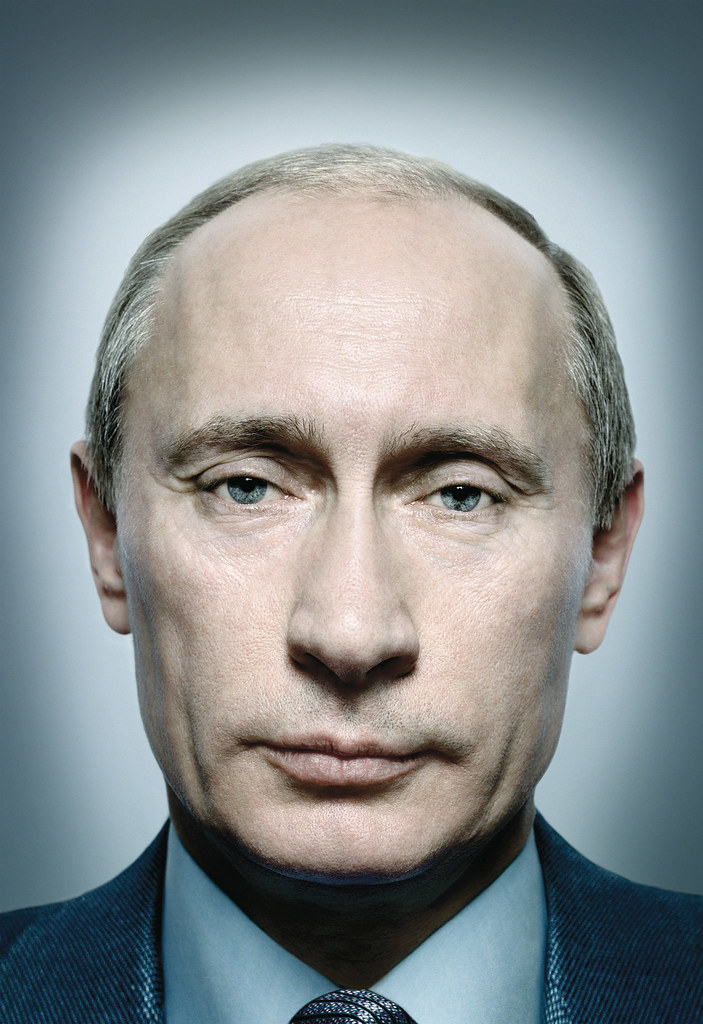
    By his own measure, Mr Putin has had a good year. The Russian president craves international respect. By stepping back from the world, the US ceded to Moscow space at the top table. Phillip Stephens - Financial Times
    Vladimir Putin has been eating the "West's" lunch: Syria, Iran, the Ukraine. He is the new villain du jour.

    There is an old Spanish saying, a quote from Don Quixote, "The dogs are barking Sancho, that means we are on horseback".

    All this noise means that Putin must be doing something right. 

    Really, what is brilliant is that Putin's Russia has turned the tables of the old USA versus USSR paradigm.

    Now it's the USA that wants to destroy national sovereignty (except its own, of course) and bring on a brave new world, where everyone, under America's guidance, will live happily ever after. And Russia is now the defender of national sovereignty and local elites against globalization. Also today's Russia is now the principal defender of traditional social values, which are held by the majority of the people of the world, probably even Americans (see the "Duck Dynasty" row in the USA).

    Putin is set to lead the populist backlash against globalization. 

    Like I say, brilliant playing of a weak hand. DS

    Thursday, December 12, 2013

    Mandela's funeral

    David Seaton's News Links

    Mahatma Gandhi was lucky to die when he did and avoid such a degrading celebrity circus... between the imperial selfies and the surreal sign language interpreter, all that was missing was to have Miley Cyrus perform "Nkosi Sikelel' iAfrika", with a massed choir. DS

    Thursday, November 28, 2013

    Pope Francis reminds me of Gorbachev

    David Seaton's News Links
    General Audience with Pope FrancisSome people continue to defend trickle-down theories which assume that economic growth, encouraged by a free market, will inevitably succeed in bringing about greater justice and inclusiveness in the world. This opinion, which has never been confirmed by the facts, expresses a crude and naïve trust in the goodness of those wielding economic power and in the sacralized workings of the prevailing economic system. Meanwhile, the excluded are still waiting. To sustain a lifestyle which excludes others, or to sustain enthusiasm for that selfish ideal, a globalization of indifference has developed. Pope Francis - Washington Post
    Pope Francis is beginning to remind me of Mikhail Gorbachev. the same noble intention to open up a very old, very secret, very bureaucratic, very vertical organization, and make it more transparent (Glasnost) and  reform it (Perestroika).

    When Gorbachev touched his organization it disintegrated like a termite-ridden, antique chest of drawers and everyone, everywhere thought it was wonderful... except the people that lived in it. Everyone, everywhere loves Gorbachev except the Russians, who hate and despise him. Francis will be fortunate indeed to escape the same fate as Gorby's.

    I don't think the Church's fussvolk ,the ones who really live there: the sour old ladies that take communion every day, the Opus Dei bankers, the Paul Ryans, the Antonin Scalias, the Pat Buchanans and the Rick Santorums are going to be very enthusiastic about Francis' intentions... it will those of us on the outside, lapsed and otherwise, that will be applauding the most.

    Now His Holiness in his own efforts toward Glasnost and Perestroika has hired the world renowned auditing firm of Ernst & Young to lift up all the rocks in the Vatican and see what scurries out from under them after centuries in the dark, and, (literally), God only knows what they will find.

    It can be said greatly in the Pope's favor and without any irony intended, that only someone with a truly deep faith in divine grace and the mysterious power of the Holy Spirit would take such chances.

    And shifting the paradigm a bit, the Church reminds me a lot of Kodak, another rich, near monopoly, which was bankrupted by a disruptive technology that they could neither absorb nor defeat. In the Church's case I don't think it will ever be able to adapt itself to the new role of women in developed societies: working, educated, with their own money and in control of their own bodies.

    The contradictions abound. For example,  if the Church is really serious about the gravity of abortion, which I think they are, perhaps they should consider making the ingestion of the birth control pill a sacrament, as it is probably the only effective form of preventing the "murder" of fetuses. That such a  tradeoff seems absurd is just an example of the mental sclerosis that Francis will be confronting in his Perestroika.

    Like Gorbachev, I find Pope Francis admirable for the truth he speaks and I hope he does not have to live Gorbachov's tragedy of watching those truths destroy the very thing that he loves the most. DS


    Tuesday, November 26, 2013

    The Iran deal

    David Seaton's News Links
    Things may unravel but at least there is hope. Perhaps this is what is most threatening to Netanyahu. He has never been willing to test the Palestinians in a serious way — test their good faith, test ending the humiliations of the occupation, test from strength the power of justice and peace. He has preferred domination, preferred the Palestinians down and under pressure. Obama and Kerry have invited Netanyahu to think again — and not just about Iran. Nothing, to judge by the hyperventilating Israeli rhetoric, could be more disconcerting. Roger Cohen - New York Times

    If a diplomatic solution to the Iran nuclear issue is blocked and war follows, Israel will be accused of dragging America into a conflict. But if Mr Netanyahu confronts the Obama administration through the US Congress – and loses – the fabled power of the Israel lobby may never be quite the same again. Gideon Rachman - Financial Times
    High political drama is in the offing, it appears that the President of the United States has (with appropriate deviousness) lured Israeli Prime Minister Binyamin Netanyahu into a decisive political battle on a battlefield of the president's choosing; with world political opinion on Obama's side and the American people recently having firmly signaled the US Congress their strongest reluctance to any more military involvement in the Middle East.

    Obama just might win this one.

    At this point what I find most truly interesting about the Iran deal as how secretly it was worked up... and that the Israelis apparently were kept in the dark... This is leading to a direct conflict between the United States and Israel... If Obama loses this test of strength, nothing much will have changed, every US president who has ever confronted them directly, has been defeated by the AIPAC or had their careers ruined, (with the exception of Eisenhower, when he pinned their ears back during the Suez crisis), but if Obama wins, that victory will mark a sea change in American politics. DS


    Monday, November 18, 2013

    Kennedy's Death

    David Seaton's News Links
    Writing up the 50th anniversary of Kennedy's assassination has become a momentary cottage industry and I have little that I wish to add and will spare my readers all my "where I was when I heard the news" drivel. However, I would only remark what I personally find the most important result of that magnicide: namely the sensation that Kennedy's death marks the moment when "everything began to go wrong".

    I would even date the origins of the rancor and hostility surrounding the recent "shutdown", if not the issues themselves, to the breakdown of trust and national unity that resulted from the widespread and still prevalent suspicion of a coverup that followed the enormous catharsis of emotion and grief of the flight back from Dallas and the funeral: the blood spattered widow, the pathetically saluting baby son.  

    All the unity of the shared experiences of the Great Depression, World War Two and the presidential funeral itself went up in smoke with the Warren Report... the fallout is too abundant and painful to enumerate here. DS

    Sunday, November 03, 2013

    USA: mature or overripe?

    David Seaton's News Links
    Apple
    Among the casualties of the Snowden stories are an embarrassed and chastened White House, an American technology sector which has seen its own government tarnish its business model of a global, open internet and the strong US relationships with allies such as Germany. Financial Times
    In English we make a clear difference between "mature" and "ripe".
    We also distinguish between ripe and too ripe, with the word, "overripe", which is common enough a concept to have one whole, unhyphenated word all to itself.
    ma·ture
    adjective \mə-ˈtu̇r, -ˈtyu̇r also -ˈchu̇r\

    : having or showing the mental and emotional qualities of an adult

    : having a fully grown or developed body : grown to full size

    : having reached a final or desired state
    Merriam Webster

    over·ripe
    adjective \ˌō-və(r)-ˈrīp\

    : grown or aged past the point of ripeness and beginning to decay : too ripe

    : not new or young

    : not fresh or original
    Merriam Webster
    We don't have a word for "over-mature", as being mature is thought to be good and it is hard to see how you can have too much of it, but ripe, which in itself is good, past a certain point can become bad.
    I would maintain that history's most advanced and developed version of capitalism, the American version, instead of being mature is overripe.
    The snippet from the Financial Times that tops this post reveals "the worm in the apple", the conflict or "contradiction" in the system, simple to identify, but whose resolution or synthesis is very difficult to predict.
    The most creative and innovative sector of the American economy, the sector that most represents a future prosperity for American business, is symbolized by Google, a huge organization, whose business model is based on the free flow of information and especially on obtaining the personal data of everyone on an interconnected, frontier-less planet, in order to anticipate and satisfy their every want and desire by knowing even their unconscious needs and motivations. This obviously requires enormous quantities of trust on anyone who uses Google... as users confide to Google, knowingly or unknowingly, things that they would never confide even to their dearest friend or most loved and trusted family member. Trust, friendliness, goodwill then, are the central, essential qualities of Google's business proposition.

    Google's antithesis is the NSA, who also wants access to the personal data of everyone and to know (and especially anticipate) their needs and desires, conscious and unconscious in order to dominate and control them. This organization's philosophy is not to trust anyone, not even ones closest friends. And whose process of knowledge to action might be symbolized by the drone strike. Certainly trust, friendliness, goodwill then, are NOT the central, essential qualities of NSA's "business proposition".

    However the two "business propositions" are deeply entwined. It is hard to imagine a "Swiss" Google or anything as all-encompassing as Google in any country that did not physically control the Internet and set and enforce the world's rules of commerce and supply the world with its reserve currency, while physically controlling the seas and air all over the world with the greatest accumulation of military power in the history of our planet. And conversely it is hard to imagine an intelligence agency as "penetrant" as the NSA without access to the resources of Google, Yahoo and Facebook.

    The same as mixing Clorox with gasoline will cause an explosion and it is vital to keep the two apart, so it is vital for America's new economy to keep the idea of the NSA as far away from the idea of Google as possible... I should say "was" because Snowden has let the cat out of the bag and like putting toothpaste back in the tube, all the king's horses and all the King's men will never put Humpty Dumpty back together again.

    With the wisdom of hindsight this Achilles's heel of American power was obvious, but Edward Snowden, or whoever (if anyone) runs him has fired a deadly torpedo directly under America's waterline.

    All that was needed was to find the right person at the right time and get him and his information where the United States could not prevent its dissemination.

    Like taking candy from a baby.

    Returning to the original metaphor, the connection NSA/new economy was (over) ripe for the plucking.

    Some would say that when our economic system reached it's full worldwide potential and maturity such a conflict was bound to arise, others have been hoping and praying for such an event since the 19th century... we are "fortunate" enough to be here to witness how it plays out. DS

    Tuesday, October 29, 2013

    A fairy tale as grim as Grimm could ever be (second reprint)

    I posted this first on December 8th, 2010, and this is the second time I have reprinted it, but with every passing year, the story seems even more relevant than it did back then. DS

    David Seaton's News Links
    Once upon a time in a far off and pleasant land, during the reign of King George the Idiot, there lived a young man who dreamed of fame and greatness.

    He yearned so long and so deeply, that the Good Fairy was moved by his constant pleading and praying and appeared before him in all her beauty and magic splendor.

    "Young man," she said, "because of the depth and especially because of the unusual insistence of your desires, I have decided to grant you three wishes. After each wish I shall disappear until the wish has been granted and then return to grant your next request. Now, think hard, what is the first boon that you wish for?"

    The young man thought for a moment and said, "Oh Good Fairy, I would like to write my life story and have everyone in the kingdom read it and think that I am wonderful."

    "Really?" asked the Good Fairy, "Since you are very young and haven't done very much, that will be a lot of work for me... Are you sure?"

    "Puhleeeeeeeeeeze!" the young man begged.

    "So be it!" said the Good Fairy, and disappeared.

    No sooner had the Good Fairy left then the young man sat down at his table where the few sheets of paper on it magically multiplied into hundreds, and soon a magic quill pen appeared out of thin air, and taking it in his hand he began to write well into the night, as if his hand had a life of its own, which indeed it had.

    He awoke the next morning to find that a thick manuscript sat on the table before him. As in a trance he took it in his arms and presented it to a publisher, who, as if hypnotized,  immediately ordered all other work in his print shop to stop and for all the printers to work at nothing else but printing the young man's life story.

    The very next day the freshly printed life story of the young man appeared in all the book shops of the land, and it sold out immediately. In no time at all the entire Kingdom could talk of little else than the young man's fascinating life story.

    He sat at home enjoying his new found fame, when the Good Fairy appeared for a second time.

    "It is time for your second wish." the beautiful Good Fairy said, "Have you thought of what you want to wish for?"

    "As a matter of fact I have." the young man replied, "I would like a golden tongue and the power of rhetoric, so that all who hear me will be enchanted by whatever I say, no matter how pompous and platitudinous it might be".

    "That won't be so difficult." the Good Fairy said, "Talk is cheap. Are you sure that is all you want?"

    "Puhleeeeeeeeeeeze!" the young man implored.

    "So be it!" said the Good Fairy, and disappeared.

    In a short time everyone in the entire kingdom sat in awe of the young man's marvelous speeches, their mouths dropping open, while visions of sugar-plums danced their heads, as they dreamed of the beautiful land of milk and honey that the young man's golden tongue evoked. Soon crowds followed him wherever he went hanging on his every word.

    The Good Fairy appeared for the third time.

    "Think carefully young man" she said slowly and gravely, "This is your last wish..." She paused, "Have you decided what you want now?"

    "Oh yes!" he cried out, "Old King George is abdicating... I want to be King!"

    The Good Fairy looked at him steadily and for a brief instant a cloud of melancholy crossed her charming features. "Are you absolutely sure, young man? George wanted the job as much as you do and look at what a horrible time he is having, all he wants to do now is to retire into the forest and cut brush like a common wood cutter. Are you absolutely sure?"

    "Puhleeeeeeeeeeeeeeeeeeeeeeeeeeeeze!" the young man wailed.

    She shrugged her pretty shoulders.

    "So be it!" said the Good Fairy and disappeared.

    No sooner than she had disappeared a great clamor rose up in the land and great cheering crowds appeared before the young man's home and he was carried on their shoulders though the gates of the palace and crowned king of the land with all pomp and splendor. Masses were sung and soldiers paraded and all was feasting and wassailing for days on end as the kingdom reveled in the joy of having such a splendid new ruler.

    And then...

    The magic spell wore off: the money lenders appeared with insatiable demands and the treasury was emptied by endless wars and sadness gripped the people. In the market place and in the countryside the peasants and nobles muttered and plotted against the new king. The adoring courtiers that once clustered around him, showering him with flattery, abandoned him to his fate and returned to their homes to write their memoirs.

    The young man tried to speak to the people as of old, but his tongue seemed glued to his palate and nothing but mumbling issued from his mouth.

    One night in the darkened palace, with his hair turned gray, he slumped on his throne in the empty throne room, abandoned by all, weeping disconsolately and ruing his fate.

    "Woe is me," he sobbed, "How did I ever get into this mess?"

    And then...

    The Good Fairy appeared for a fourth time.

    The young king fell on his knees and implored her, "Can you help me?" he groaned.

    "Sorry, you're on your own now, buster", she replied, a hardness he had never seen before was in her eyes and a coldness he had never heard before was in her voice... once so sweet, now metallic. Slowly her beauty vanished and before him stood a hideous hag.

    "You had your three wishes" the apparition said, "I gave you everything you asked for. You could have asked for wisdom, you could have asked for a long life and the gift of contentment, but this is what you wished for, so you have made this misery all by yourself."

    "I wish I had never seen you!" the young king shouted, "I wish you didn't exist!"

    "So be it." said the Good Fairy and disappeared for the last time.

    Moral: Everyone has their wants and their wishes but if a fairy asks, don't tell. DS

    Saturday, October 26, 2013

    Obama, the (socially challenged?) president?

    David Seaton's News Links
    Something that has always fascinated me is how Barack Obama ever got into politics in the first place. As we have seen on many occasions, but most clearly during the shutdown, he seems to be lacking the basic tools of  common and garden variety politics: he is totally unable to get close to people on a personal level and talk them into doing what he wants them to do.

    Sociability and politics go hand in hand in democracy, the knack for connecting with strangers on a human level is what democratic politics are all about and Obama seems to be lacking this basic skill most notably. 

    I can imagine a North Korean "dear leader", being a trifle distant, dictators don't schmooze much, Francisco Franco, the Spanish dictator, was famously frosty and aloof, but in democracy, an antisocial politician is a contradiction in terms, like a one-legged tap dancer or a tone deaf violinist.

    This tone deafness is extraordinary in any professional politician: even the most modestly endowed of them, down to a town alderman, usually possess an innate ability to connect with people. Even George W. Bush, America's worst president, was able to take a bullhorn, climb up on a pile of rubble, put his arm around a fireman's shoulder and be, if only for a moment, an inspiring leader on a personal, human level.

    Obama having so little natural talent for human contact, more than once has made me think that there was something "magic", truly supernatural, about his rise to power. The magic seems to have worn off nowadays, at least internationally, if the following snippets are any sample:
    The Democrat, who prefers to spend his evenings with his family or alone in front of his computer, has made it no secret in Washington that he does not want to make new friends. That maxim especially applies to his foreign diplomacy. Unlike his predecessor George W. Bush, Obama is loved by the people of the world, but much less by their heads of government. On the heels of recent revelations that US spy agencies might have monitored Chancellor Merkel's cell phone, the complaints about Merkel's "lost friend" Obama are misplaced. Obama doesn't want to be a friend. During a recent visit by a European head of government to Washington, the atmosphere was described as frosty by those in the entourage from Europe. Obama didn't find the time for even a little small talk, the sources said, and "it seemed to some like an appointment with a lawyer."(...) So much non-diplomacy is new among US presidents. Reagan wooed Margaret Thatcher. George H.W. Bush confided in Helmut Kohl as Bill Clinton did in Tony Blair. George W. Bush, who many thought was an isolationist, could count on a whole team of "buddies," such as the then-prime minister of Spain, José Aznar, and the Japanese Prime Minister Junichiro Koizumi. He even entertained them at his ranch in Texas. Merkel was also invited there, and in return Bush ate a dinner of wild boar in her German electoral district. The chancellor has from time to time said that she values such trans-Atlantic closeness. That is over. "Coolness has its price," Washington Post columnist Jackson Diehl wrote in 2010, adding that Obama appeared to have no genuine friend among world leaders. But what for? He has the NSA.  Der Spiegel
    In stark contrast to Mr Obama Merkel has a tendency to under-promise and over-deliver.(...) If the Americans really have been listening in, they might be able to confirm an interesting rumor – that Ms Merkel does not really rate President Obama and considers him to be something of a gasbag. Gideon Rachman - Financial Times
    This was all well defined by Obama's lovely wife Michelle, (the best First Lady I can remember) who described him perfectly when she said, "sometimes I think Barry was raised by wolves". "politician" and "introvert" are contradictory terms.

    Ironically he may go down in history as a good president for what he doesn't do, like going to war with Syria and Iran... Hillary Clinton would already be at war there if she had been elected president, not to mention either McCain or Romney. DS

    Thursday, October 17, 2013

    USA: the twerking hegemon

    Twerking: The act of moving/ shaking ones ass/buns/bottom/buttocks/bum-bum in a circular, up-and-down, and side-to-side motion. Urban Dictionary

    Congress capped off a tense and exhausting day Wednesday with back-to-back House and Senate votes on legislation to re-open the shuttered government through Jan. 15 and avert a catastrophic default on the country’s debt until at least Feb. 7. Talking Points Memo

    "Brevity is the soul of wit"

    Thursday, October 10, 2013

    Democracy without human beings?

    David Seaton's News Links
    I think we can be almost grateful for the idiotic crisis in Washington, which even with its possibility of a default which may do heavy damage to the world's economy, is giving us an ample warning of a far greater crisis looming in the foreseeable future, a crisis of democracy itself.
    Reading the snippets below in the order they appear will help give you the shape of what I am talking about:
    During the downturn, 78% of jobs lost were either mid-wage or high-wage jobs and, according to the Bureau of Labor Statistics (BLS), three out of five newly created jobs are part-time, low-wage jobs. A growing number of Americans are realizing that “good jobs” aren’t coming back, and that for things to get better, they’re going to have to fight to turn their McJobs into something better. Nicole Aschoff - Dollars and Sense

    W. Brian Arthur, a visiting researcher at the Xerox Palo Alto Research Center’s intelligence systems lab and a former economics professor at Stanford University, calls it the “autonomous economy.” W. Brian Arthur, a visiting researcher at the Xerox Palo Alto Research Center’s intelligence systems lab and a former economics professor at Stanford University, calls it the “autonomous economy.” It’s far more subtle than the idea of robots and automation doing human jobs, he says: it involves “digital processes talking to other digital processes and creating new processes,” enabling us to do many things with fewer people and making yet other human jobs obsolete. (...) And, he says, “digital versions of human intelligence” are increasingly replacing even those jobs once thought to require people. “It will change every profession in ways we have barely seen yet,” he warns. McAfee, associate director of the MIT Center for Digital Business at the Sloan School of Management(...) doesn’t see the recently vanished jobs coming back. The pressure on employment and the resulting inequality will only get worse, he suggests, as digital technologies—fueled with “enough computing power, data, and geeks”—continue their exponential advances over the next several decades. “I would like to be wrong,” he says, “but when all these science-fiction technologies are deployed, what will we need all the people for?” MIT Technology Review Magazine

    "Insecurity of employment is a new strategy and a tactic for increasing profits by reducing as much as possible the reliance on human labor or by paying employees less. In the modern capitalist economy, the only factor whose productivity cannot be easily increased and whose costs cannot easily be reduced is human beings. There is therefore enormous pressure to eliminate them from the production process. This would be true, whether or not there were global competition. It is more the case that this is the excuse by which this process is justified today." Eric Hobsbawm - "The New Century", pg128

    At the same time that Republicans want to increase the influence of the rich on our elections, they want to decrease the influence of the poor at the ballot box by passing a raft of new voter restrictions. This is a sinister, last-gasp move of gangsterism: when you’re losing the game, tilt the table. You must understand this larger plot to fully appreciate the Republicans’ current budget ploy. This is not so much about limiting government as it is about measuring power. Charles M. Blow - New York Times
    So simply put our economic system is fast reaching a point where it can run profitably with very little human input, or put more precisely, to run profitably it must reduce human input to a minimum. Logically this process will make more and more people increasingly unhappy as it unfolds. In a democracy of universal suffrage such unhappiness would naturally have far reaching consequences as it did during the Great Depression, when it led to Franklin Delano Roosevelt's "New Deal", which freed millions of Americans from despair and destitution.
    Avoiding the possibility of such a new New Deal is the fundamental raison d'être of the radical so called "conservatives", who go under the name, "tea party" and their "fellow travelers" in the US Supreme Court.
    The simple goal of those who fund all of this is to limit or neuter universal suffrage and to effectively return things to where they were in the early 19th century when only those who owned substantial property were allowed to exercise full citizenship.
    This is terrible but it could be worse. In the days of the Wiemar Republic of Germany (1919-1933) the German super-rich, to avoid any danger to their power, wealth and privilege, funded one Adolph Hitler, who blamed all Germany's problems on the Jews and led the country into a disastrous war, which left Germany in smoking ruins with many millions of Germans, Jew and Gentile, soldiers and civilians, dead. However it should be noted that those super-rich German families made money before the war, during the war and even after the war and today, are still the richest people in Germany.
    This goes to show that what could be a disaster for everyone else in the entire world would not necessarily be a bad outcome for the super-rich. DS

    Friday, October 04, 2013

    The magnificent quest for Shinola (updated)

    David Seaton's News Links
    This is a revised version of something I wrote a couple of years ago, which I felt that, with a few minor changes, would be more timely today than when I first wrote it.
    Shinola
    In American-Speak someone of little understanding is said to be unable to distinguish between excrement and shoe polish, we say then that he or she "can't tell shit from Shinola." It appears that in the Occupy Wall Street movement, a perhaps critical mass of Americans have taken it upon themselves to investigate the why and the how of the odor coming from the collective "shoe" and have set about to do something about it. Not a moment too soon if the the recent antics of the Republican House of Representatives are any sort of a leading olfactory indicator of the nation's mental health. One gets the feeling that the spirit of the republic is a little like the Bruce Willis character in The Sixth Sense, he's dead but doesn't know it yet and only one small boy seems to understand the situation. Perhaps the Occupy Wall Street movement is that "small boy."
    There is certainly a sense that something is terribly wrong, something mysterious, but I think it could be something quite simple, if intractable, that is afflicting the system. Like the Bruce Willis character, we really don't understand our true situation. In my opinion we are going through something similar to what the USSR went through only a little more than twenty years ago. Twenty years may seem a long time to someone under forty, but in historical terms it is nothing more than a blink of the eye. From the Versailles Peace Conference in 1919 to the outbreak of World War Two in 1939 is only twenty years.
    Absurd, you say, the two systems are totally different, like oil and water ... I would say that the similarities are more interesting than the differences and that America has simply been more efficient than the USSR was in resisting the same acids that are eating away at its structures in much the same way as they did at the Soviet's.
    Both the USSR and the USA have relied on huge government spending to propel their economies. The role of government funded research has been essential in almost every high tech area: computers, the Internet, aviation, etc, in all of them the input of the state has been paramount. Where the United States won hands down was in turning the sophisticated technology so expensively acquired into affordable consumer products and fomenting never-never credit to keep them affordable when salaries stagnated.
    "What about freedom?" you say, to which I would reply that the social control of the Soviet system was extraordinarily brutal and primitive compared to our system of social control, which is infinitely more sophisticated than theirs was. I never lived in the Soviet Union and my experience of how a well-oiled dictatorship controls public opinion comes from having lived in Franco's Spain. Franco lasted forty years and the Soviets lasted seventy. Although the USSR was communist and Spain's regime was authoritarian/fascist, the similarities in maintaining control would be great.
    Under Franco, all newspapers were of course owned by people approved of by the regime, however until very late into the dictatorship, all articles appearing in them were previously censored before publication, after that any violation of the regime's standards could be punished by imprisonment and fines. There was only one television channel to begin with, later two, both state owned and censored, as were all books, stage plays and films, which were previously dubbed into Spanish. There were private radio stations, but they all connected to the state radio for all their hourly news programs. Here is something that will give you an idea of how paranoiac such a regime can be: radio dispatched taxis came into use in the USA in the late 1940s, but they were still forbidden in Spain until well after the dictator's death, as they constituted an independent communication network outside state control. There is no way that the Franco regime could have ever tolerated the Internet, cell phones, SMS or social networks.
    Getting back to the Soviet Union I have read that you needed very high level permission to even have access to a photocopying machine. A system of social control cannot operate successfully in an environment of free movement of information.
    This is where the USA has always been more sophisticated and effective, however, like the mysterious intruder in Edgar Allen Poe's "The Masque of the Red Death," you can run, but you can't hide and the same forces that brought down the Soviets and would have made Franco's regime impossible, have morphed under the combination of US military technology, hooked to an insatiable consumer society and are now even eating away at the American system.
    As we observe in the political paralysis of today, the Founding Fathers of 18th century, WASP, America created a political structure that is not designed to reflect a society as complex and multicolored as contemporary America's has turned out to be.
    The centrifugal forces of a country as huge and diverse as America's have been kept more or less under control until recently by what Edward Bernays and Walter Lippmann called, "the management of consent," that is to say the American science of public relations applied to forming public opinion. Heretofore "freedom of the press" required the money to buy a press in the first place, therefore the creation of opinion was in the safe hands of people with enough money to pay to play. The major newspapers, radio and TV networks and of course Hollywood all worked together naturally to manufacture a national opinion leading to political consensus.
    Herein lies the importance of the OWS, with its 99% slogan: this is a self generating phenomenon, which has required minimal capital outlay to influence the opinion of millions of people, which is helping many millions to tell the shit from the Shinola. This is totally outside the control of those who have always manufactured consent until now. OWS is only the beginning, in a couple of years it will be looked back on tenderly like watching a home movie of a baby's first steps.
    However "our" system has been reacting to this danger its own technology and marketing have produced -- again with much more sophistication than the USSR or Franco could have ever have mustered -- and under the cover of the war on terrorism, or the protection of intellectual property, is putting mechanisms in place that only await a "national emergency" to tug on our leash.
    In short "shoe sniffing" is a fight that is never fully won, but never must be lost.
    A toast to Shinola! DS

    Tuesday, October 01, 2013

    Washington: insanity made simple

    David Seaton's News Links
    What is going on in Washington, why are the Republicans in Congress acting in what would appear to be such a suicidal fashion?
    I think I have found the answer in  Mark Leibovich's "This Town", a book which I have mentioned repeatedly in recent posts.
    Cutting directly to the chase: what Leibovich makes clear is that being a senator or congressman, instead of being the high point of person's career, is merely the necessary qualification, or apprenticeship, for moving up to become a millionaire lobbyist. Really it is that simple. It is called the "revolving door".
    In short, not to worry, if any elected representative should happen to commit political "suicide" in a way that pleases the money, he will soon reincarnate as a successful lobbyist.
    Why should the money want to paralyze the American Res Publica
    Because they want to corrupt and intimidate the democratic system in such a way as to put off, or preferably, avoid permanently, a series of changes which could cost them a lot of money and entangle them in endless re-regulation and permanently cramp their style no end.
    To get a handle on what is coming down the pipe that could cause the elected representatives of the people to intervene on behalf of the voters that elected them, I'm afraid gentle reader that you are going to have to take a deep breath and read carefully the following excerpts from an article in the MIT Technology Review.
    The pattern is clear: as businesses generated more value from their workers, the country as a whole became richer, which fueled more economic activity and created even more jobs. Then, beginning in 2000, the lines diverge; productivity continues to rise robustly, but employment suddenly wilts. By 2011, a significant gap appears between the two lines, showing economic growth with no parallel increase in job creation.(...) the same technologies making many jobs safer, easier, and more productive were also reducing the demand for many types of human workers. (...)
    A less dramatic change, but one with a potentially far larger impact on employment, is taking place in clerical work and professional services. Technologies like the Web, artificial intelligence, big data, and improved analytics—all made possible by the ever increasing availability of cheap computing power and storage capacity—are automating many routine tasks. Countless traditional white-collar jobs, such as many in the post office and in customer service, have disappeared. W. Brian Arthur, a visiting researcher at the Xerox Palo Alto Research Center’s intelligence systems lab and a former economics professor at Stanford University, calls it the “autonomous economy.” It’s far more subtle than the idea of robots and automation doing human jobs, he says: it involves “digital processes talking to other digital processes and creating new processes,” enabling us to do many things with fewer people and making yet other human jobs obsolete. It is this onslaught of digital processes, says Arthur, that primarily explains how productivity has grown without a significant increase in human labor. And, he says, “digital versions of human intelligence” are increasingly replacing even those jobs once thought to require people. “It will change every profession in ways we have barely seen yet,” he warns.
    McAfee, associate director of the MIT Center for Digital Business at the Sloan School of Management, (...)despite his obvious enthusiasm for the technologies,  doesn’t see the recently vanished jobs coming back. The pressure on employment and the resulting inequality will only get worse, he suggests, as digital technologies—fueled with “enough computing power, data, and geeks”—continue their exponential advances over the next several decades. “I would like to be wrong,” he says, “but when all these science-fiction technologies are deployed, what will we need all the people for?” (emphasis mine) MIT Technology Review Magazine
    In short, in the foreseeable future, or the United States of America is going to turn into a nightmare of human misery something like Calcutta, or a universal Detroit, or the elected representatives of the millions of "unneeded human beings" are going to have to fund the massive government expenditures that are going to have to be made in public education, social support, socialized medicine, day care centers and public "make work" projects of all kinds. The money is cool with the nightmare scenario and like a boxer tying up his opponent in a clinch, will happily finance every nutcase and corrupt politician they can find to avoid this future sacrifice of their power, wealth and privilege.

    That simple. DS

    Sunday, September 29, 2013

    Abandon hope all ye who enter here...?

    David Seaton's News Links
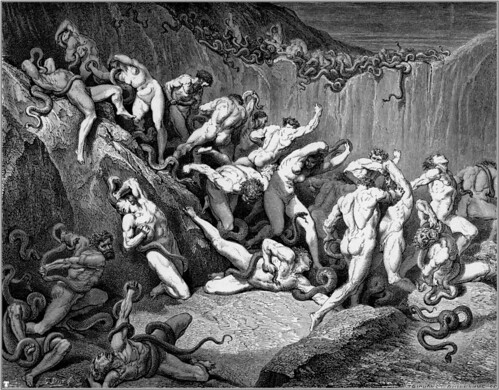
    Dante's Inferno - Thieves
    Dante's Inferno -  "The Thieves" - Gustavo Doré

    "Many decades from now, a historian looking at where America lost its way could use This Town as a primary source."—Fareed Zakaria

    And so we have arrived at the bizarre juncture where it makes more sense for Mr Obama to talk to the leader of Iran than to talk to Congress. Edward Luce - Financial Times

    I mentioned in an earlier post that I had been reading Mark Leibovich's book, "This Town", which is a tragicomic, insider's trek around the astounding frivolity of Washington's wall to wall corruption. An extraordinary book: not a don't know whether to laugh or to cry kind of book, but more like a don't know whether to laugh or to vomit kind of book.
    Since reading it, I have found myself facing some sort of "writer's block" when trying to comment on the day to day march of world affairs... this lack of enthusiasm is heightened daily while surveying the Tea Party led march to a budget Armageddon. This political "Dumb and Dumber" would be sad enough if it were occurring in today's Rome, for example (it is actually)  but in a place like Washington, which today wields more power than ancient Rome did, I'm reminded of Caligula making his horse a senator... actually I much more reminded of the corruption and dysfunction of the Gorbachev to Yeltsin period of  the dying USSR, where they proved out the ancient adage, "the bigger they are, the harder they fall".
    In many countries, the level of political dysfunction of the American system would produce a coup d' état, something which would appear unthinkable in such a huge, complex structure as America's... I don't say it is impossible because of the USA's democratic traditions or institutions, witness the activities of the NSA, Guantanamo and drone warfare... No, it just seems too big a place to pull something like that off.
    Really, the only hopeful sign I have seen lately that the USA might be able to regenerate itself has been the sudden, unexpected, spontaneous, all for one and one for all, mobilization of American public opinion, a people's revolt both on the left and on the right, over the heads of the lobbies, the heads of the gatekeepers and the heads of other managers of consensus, against any military involvement in Syria... perhaps such a wave of revulsion is building up around America's systemic political meltdown and the people will rise up as one to change it.
    Someone who believes in democracy has a right to hope that Americans can reboot their country from the ground up... it certainly is never going to happen from the top down. DS

    Monday, September 23, 2013

    Writing opinion in turbulent times

    David Seaton's News Links
    Hard times for a columnist with deadlines to meet. Everything is in the air, variables multiply dizzily.
    Handicapping the Middle East, more than ever, is mug's game. Years on, Obama is still an enigma wrapped in a candy bar wrapper, Putin... what does he want? Who is Angie Merkel really? She has destroyed the Liberals, will she now destroy the Greens?
    For me the two most significant things of the last few days, things that I think will be seen as turning points a few years from now, have been the American people's, grassroots (both the right and left's,) refusal to be stampeded into another war and the new Pope declaring that he never has been a "right-winger". DS