What an irony it would be if the Leave vote led the U.K. to break up
before the E.U. does. But after a remarkable night and morning, that
didn’t seem beyond the bounds of possibility. Very little did. John Cassidy - The New Yorker
British Prime Minister, David Cameron's totally gratuitous decision to convoke a referendum on Britain's remaining in the European Union, Brexit, is a perfectly amazing example of the effects of frivolous stupidity. The rest of us are to be helpless witnesses and perhaps direct victims of his decision for years to come.
David Cameron, the British prime minister, has no one to blame but himself. In 2013, besieged by the increasingly assertive anti-European Union
wing of his own Conservative Party, Mr. Cameron made a promise intended
to keep a short-term peace among the Tories before the 2015 general
election: If re-elected, he would hold an in-or-out referendum on
continued British membership in the bloc. But
what seemed then like a relatively low-risk ploy to deal with a
short-term political problem has metastasized into an issue that could
badly damage Britain’s economy, influence the country’s direction for generations — and determine Mr. Cameron’s political fate. New York Times
If you like reading history, you'll come across many examples of such frivolity and stupidity doing massive harm to millions of people. George W. Bush's decision to invade Iraq is a textbook example. Millions of people have lost their homes or lives and one of the world's most critical regions is in the process of disintegrating.
Could Cameron's Brexit have an effect in any way comparable to Bush's opening the gates of hell in the Middle East?
Knock-on effects are about cascading disasters. The world's economy is still shaky after the crash of 2008 and in today's globalized finance everything is interconnected. How could Brexit set off a chain of disasters?
An example: UK capital, London, is today the world's most important financial center:
One of the only things we can say for sure after the Brexit decision is that the U.K. and Europe are entering a period of great uncertainty. The New Yorker
It is easy to imagine the knock-on effects of a major disruption of the intricate and intertwined activities of a place where the good and the great of the entire world go to trade currencies, bonds, shares, privileged information, launder and store their money, you name it.
One likely outcome of negotiations is that banks and financial firms in
the City of London will be stripped of their lucrative EU “passports”
that allow them to sell services to the rest of the EU. The Guardian
You can't imagine the knock-on effects of disrupting such a place? Think Lehman Brothers just for starters. If one major financial institution starts to unravel, the entire shaky recovery of the world economy could collapse.
Leaving Financial Armageddon behind, the ordinary human effects of Britain's leaving Europe are worth describing: British young people will now find it difficult to reside or work in EU countries or study in their universities and talented young Europeans will find it difficult to do the same in the UK. This will have significantly negative effects on generations to come.
The future of Britain's young people is finally the greatest victim of Brexit, but not just the young.
Here is an example of the sort of micro-tragedies that can befall elderly British people here in Spain, where I live. Thousands of British pensioners on retiring have sold their homes in grey and rainy Britain and with their life savings bought homes on the coasts of Sunny Spain, where as members (till now) of the EU, they have a right to residency, socialized medical care and even get to vote in municipal elections. Imagine their distress as they watch all of these rights disappear and even the value of their investment sink.
All this disruption because of what the President of the European Parliament Martin Schultz, calls "a whole continent (being) taken hostage because of an internal fight in the Tory party”. DS
"Boxing is a lot of white men watching two black men beat each other up."
“They don’t look at fighters to have brains. They don’t look at fighters to be businessmen, or human, or intelligent. Fighters are just brutes that come to entertain the rich white people. Beat up on each other and break each other’s noses, and bleed, and show off like two little monkeys for the crowd, killing each other for the crowd. And half the crowd is white. We’re just like two slaves in that ring. The masters get two of us big old black slaves and let us fight it out while they bet: ‘My slave can whup your slave.’ That’s what I see when I see two black people fighting.”
"It's just a job. Grass grows, birds fly, waves pound the sand. I beat people up."
Muhammad Ali
What modern athlete, much less one at Ali’s level, has ever talked with such political complexity, ambiguity, or engagement? David Remnick - The New Yorker
Muhammad Ali, a symbol of how racism wastes human potential
If I had to find one example to illustrate how deep racism and social injustice is in America's culture, it would have to be that someone as highly intelligent, brave, resourceful, serious and charismatic, with such a massive power of communication as Muhammad Ali, had to end up semi-illiterate with his brains beaten out in the prize ring... while a second rate, B-picture actor like Ronald Reagan or an immature blockhead like George W. Bush could end up as presidents of the United States or that today someone as weird, mean-spirited and grotesque as Donald Trump could be seriously considered for that job.
"But things are much better today for young African-American men than they were when Ali was a boy growing up in Jim Crow Louisville Kentucky in the 1940s and 50s", you say. Are they? In the booming economy of the 1950s, Muhammad Ali like many young black people back then grew up in a stable two parent family, with a live-in father, where both parents worked, where his family lived in their own home in a safe, if segregated, neighborhood. How many young black men raised by a single mother in the ghetto neighborhoods of today's USA enjoy those privileges in our present leaky, creaky, drug and gun infested, economy. "But what about President Barack Obama?" you reply. To which I would humbly suggest that it is quite different to be raised in Hawaii, where there are practically no African-Americans, than to be raised in Jim-Crow Louisville; quite different to be raised in a prosperous, white, college educated, middle class family and attend an exclusive Hawaiian private school, than to attend a segregated school in Louisville Kentucky... or one on the South Side of Rahm Emanuel's Chicago today, for that matter. This is not a criticism of our president, he was fortunate of have his enormous potential recognized early and lovingly nurtured. When that happens, that is the result. Few Americans, white or black... certainly not many African-Americans had that opportunity then or have it now. Ideally, all children should receive that treatment In short, if you wanted to analyze the dysfunction, injustice and waste of America's human resources, you could begin by meditating upon and answering at length the following riddle.
Why could George W. Bush graduate with a C-average from Yale and a man who could say, "No Viet Cong ever called me nigger."”, someone who was that intelligent and amply talented enough, who under the right conditions, could have been or done anything, had to have his brains punched out of his head entertaining the "sports fans" he so lucidly described?
I think you know why, so do I, but today I'm just too sad to answer that question. DS
To begin with, I have come to believe that simply learning why Madrid is where it is, is the key to understanding thousands of things about Spain, the key to understanding the past, present and future of one of the European Union's most important countries, with deep ties, linguistic, cultural, political and financial to all of the United States of America's southern neighbors.
There are masses of "facts" about Spain on the Internet: just reading what Wikipedia has to say about it could keep you busy for quite awhile. I'm not going regurgitate all of that here. What I'd like to do, within my limited abilities, is to give you some sort of feel for the place, a point of view to take with you before you get immersed in all the multitude of facts and cliches about Spain's culture and history. So if and when you really do begin to study, all that you learn might fall more easily into place.
What do I mean by the "feel" of the place?
When Spanish people who are going to the States ask me what they should see or do there, I tell them that the USA is more or less like it appears in the movies (except there are no subtitles), that American food is the same junk you can get on practically any street corner of the world and that the only thing they can't get from the films or McDonald's is the feeling of America's unbelievable size and distances. What I tell them to do is to spend a week or two in a Greyhound bus crossing "fly over America". The fatigue in their back muscles and the pain in their nether regions, combined with the conversations they will have with their continuously changing and almost always chatty seat mates... while crossing the Great Plains, day after day, will teach them more about America than reading dozens of books, or more correctly, help them make some sense of all that they read.
This, their own private "road movie", will make them "feel" America.
Short of that sort of direct experience of Spain, my readers will have to make do with what follows:
Getting Started
In the first chapter of this series we looked at a map of the population density of Europe, where we saw that the greater part of Spain and nearly all of its center is as sparsely populated as the outback of Sweden or Finland or the forests and western Steppes of Russia... or the Alps. And we saw that floating in that emptiness, like an asteroid, is a city of over three million people with a population density comparable to London or Paris.
To put that emptiness into physical context, lets look at a relief map of Spain. Madrid being the tiny, red, dot in the middle of it all.
Relief map of Spain - Madrid, the Red Dot in the Middle
Looking at the relief map, the sparse population of the center of Spain makes sense, what is hard to understand is why there is this huge city in the middle of what looks like a moonscape.
Also going there by land is uphill all the way.
Examine this list of European cities by elevation over sea level.
Today's Spain is crisscrossed with modern superhighways and high speed trains, but this is a very, very recent development, even as late as the 1970s getting to Madrid from abroad or even from the Spanish periphery by car or even express train... any way except by air was a tedious ordeal.
Imagine during the centuries of Spain's imperial splendor, with no navigable river in sight, what it was like getting to Madrid on horseback, by stage coach or even on foot!
So then, the question arises: why is a city of over three million people and the political, cultural, communication and financial capital of a country of over forty million people and once the capital of one of history's largest empires, so high up in the middle of nowhere? DS (To be continued)
I'm so sick of writing about Donald Trump that I've decided to write about the country where I live, Spain. I usually don't do this in my English language blog, because what knowledge of Spain I may have achieved by now is very long learned and intensely personal, with plenty of "skin in the game", and I would be loathe to do a superficial, touristy travelogue for English speaking day trippers; coyly loaded with bulls and flamenco and tips on where to dine, etc. That sort of thing makes me squirm.
However, I can imagine that I might have some things to say about Spain that someone genuinely curious to learn about one of Europe's oldest and most historically rich and important countries might find useful.
To begin with, forget about all the classic cliches about Spain, from Bizet to Mérimée to Hemingway, and take a close look at this map:
European population density
You'll notice that most of the center of the Iberian Peninsula has a population density similar to the outback of Sweden or Finland or the forests and western Steppes of Russia... or the Alps... and you see that smack dab in the middle of that vast yellow emptiness on the map, floating like an asteroid, there is a blue star-shaped blob called Madrid (where I live). This is a city with a population of 3.165 million people.
According to the map's legend, the blue color of the blob shows that Madrid has a density of population similar to Paris or London. Spain has a total population of 46.77 million, while France has 66.03 million, Britain 64.1 million and Germany 81.1 million .
More or less one out of every 15 Spaniards lives in the blue blob in the middle of nowhere.
Madrid is not only the largest city in Spain, it is also the political, financial, cultural and communication capital of the country. To put this into an American context, try to imagine if Washington, New York and Los Angeles were all in one city... located somewhere in Montana.
If you now move your attention to the right toward the Mediterranean coast you'll see a large, long and narrow area with a brick-red color similar to most of Germany and the dynamic northern region of Italy around Milan.
At the top of the red patch sits Barcelona, the capital of the Catalonian region of Spain which produces some twenty percent of the Spanish GDP.
So without any knowledge of the history, culture and languages of the blue blob and red patch, separated as they are by a great expanse of yellow, it's easy to imagine the tension that might exist between the blob and the patch.
My next post on Spain will be about why the blue blob got to be where it is. DS
It would be practically impossible to imagine two more different human beings than President Obama and Donald Trump, but it occurred to me that they do have one thing important in common: they both chose to make their move and go for the presidency when their prime opponent was most probably going to be Hillary Rodham Clinton.
Clinton is now viewed unfavorably by 55 percent of the electorate, according to the HuffPost Pollster average, (...) Only 40.2 percent of people view her favorably, according to that average.(...) The historic comparisons are stark. At this point in the 2008 presidential cycle, then-Sen. Barack Obama (D-Ill.) was seen favorably by 62 percent of voters and unfavorably by just 33 percent. (...) In the most recent Gallup poll, released late last month, her unfavorable number was 53 percent versus only 42 percent who saw her favorably. The Hill
Most observers agree that however different they may be in every other way, one thing most successful people have in common is that eye for "the big chance", the instinct to catch an opportunity that perhaps only comes once in a lifetime, and I would argue that both Barack Obama and Donald Trump, if nothing else, share that instinct. Obama has been a successful president and his only stumbling block to having been an even better one has been his inability to deal with the catastrophic obstructionism of the Tea Party infected, Republican legislators. That was always going to be very difficult, but I would argue that Obama could have been even a more successful president if he had spent a few more years in the Senate, learning the ins and outs of how that institution works and building personal relationships with its key members. But if he had stayed, he probably would never have become president. The moment to run against Hillary would have passed. Donald Trump has been fondling the idea of being President of the United States for the longest time.
Establishment Republicans have watched the rise of Mr. Trump’s presidential bid this year with shock. And yet, Mr. Trump has been telegraphing his presidential ambitions for decades, including when the ever-confident businessman told Oprah Winfrey in 1988 that he would probably win the presidency if he ever competed for it. Wall Street Journal
Seeing an amazingly lackluster Republican field of what the British would call "odds and sods" and waiting for him and at the end of that rainbow... Hillary Rodham Clinton. Every fiber of his being must have shouted, "go for it". We can only hope that he will have less luck with it than Senator Barack Obama did. DS
The Trump voters' message to America and the world could possibly be contained in the two words: "Fuck + You", or then again their message might be described as "nihilism".
Nihilism: a doctrine or belief that conditions in the social organization are so bad as to make destruction desirable for its own sake independent of any constructive program or possibility. Merriam-Webster
I'm sure I'm not alone in not finding Trump interesting, but I have to admit that I am fascinated by the people who are fascinated by Trump.
Nate Silver, one of America's most insightful political analysts, who admits having constantly "misunderestimated" the Donald, in analyzing his own puzzlement, sums up the heart of Trump's success.
Trump’s main differentiator was doubling down on cultural grievance: grievances against immigrants, against Muslims, against political correctness, against the media, and sometimes against black people and women. And the strategy worked. Nate Silver - FiveThirtyEight
Who is moved by this? Who is it working for? Where will it lead?
I know I shouldn't quote myself, but a couple of months ago I wrote:
We are looking at exasperated,
paranoiac, xenophobic, racist nastiness, in short a fascistic mentality
of crippled personalities in reaction to changing mores and a failing
economy. All the unhappiness and frustration are searching for moral absolutes.
Moral absolutes are what allow people to kill each other... if only in
their imagination. All this hateful speech and dippy ideas are pregnant
with death, they are about to give birth to a monster, but the
Republicans are only the midwives... They are helpless in the face of
the spirits they have invoked from the country's inner darkness. It is
that darkness not any individual like Trump that should worry us,
something very, very nasty is cooking in it.
In short I'm saying that if Donald Trump is not the genuine old Nick, could he be some sort of dark mirror "John the Baptist" for the very Devil himself? That what is really important is not Trump himself but the forces he invokes.
But returning to the present, aside from Trump's aggressiveness his only other constant is "making deals". At this he is an acknowledged master.
Something that has been rolling around my mind for some time. Does he really want to be President of the United States or is he putting together the deal to end all deals?
For at this moment, for a deal maker, the Donald is in a very sweet if dangerous spot.
The Republican Party controls both houses of Congress... for the moment,
and a Supreme Court that could mark the ideological slant for a
generation is up for grabs.
If Trump runs as either the Republican candidate or as an independent,
all poll projections predict an Armageddon for the Republicans, with not
only the loss of the presidency, but loss of majorities in both houses of Congress, perhaps even in state houses too.
Has the moment finally come for doing a "deal"?
It seems to me that Donald Trump is now holding the family jewels of
some of the most powerful people in the world in his tiny warm hands and
is squeezing them rather hard. We are talking about a political party
that now controls both houses of Congress and represents the
interests of the top 0.01% of the American economy. What laws could they
write for him (which I'm sure Obama, as a patriot, would be quick to
sign)? Or how much would, say the Koch brothers, or all the conservative
super-PACs, be willing to cough up to kiss him goodbye
The shape of a deal?
What are the Republicans still in a position to offer Donald Trump
between now and the convention, something which would be more attractive
for him than losing the presidential race by a historic margin and
destroying the Republican Party in the process... in which case they
could give him nothing?
I should have said "in which case they could give him the same medicine as was given to Jimmy Hoffa".
Donald Trump has already made some of the most powerful people in America his blood enemies in exchange for what seems to be a slim chance of winning the White House.
Is he insane?
Is he not insane?
I admit I don't know which of the two is the worse alternative. DS
Is a dream a lie if it don't come true, or is itsomething worse?
"The River" - Bruce Springsteen
The failure of the economy to deliver real progress to middle-class and working-class Americans over the past 15 years is the most fundamental source of public anger and disaffection in the US. BBC News
Forty years of hurt has driven some people to answer Springsteen's question, that the American dream is something worse than a lie, and from that bleak answer they are looking for a political leader who echoes their anger. So my answer to presenters' questions whether Trump can win, is now and was before the primaries started: "Yes." Michael Goldfarb - BBC
As of Today
In this the strangest of presidential election years, a poorly flushed Donald Trump pops up out of the backed up drains of the American psyche and the only thing standing between him and the Republican nomination is Senator Ted Cruz, who could pass as Boris Karloff's baby brother.
Republican debate has now moved from the size of Mr Trump's penis to whether the evangelical Mr Cruz sleeps around. And this, far from hurting Trump, is fattening his lead in the polls
Mr Trump has succeeded in breaking down the boundaries of political debate. He has drained all civility from politics and licensed a discourse that elides bigotry with patriotism, is derisive of women, scornful of minorities and permissive of racism. The Republican primaries have become a contest in which it is acceptable to throw a punch at those who happen to disagree, to threaten to muzzle the freedom of the press and to make jokes about those with disabilities. Mr Trump has tossed overboard any idea that politics and public service can serve a moral purpose. Philip Stephens - Financial Times
If The Donald wins the nomination, which as of today, seems probable, he will, unless a kind providence intervenes, end up facing the most soiled politician in America... except for her husband, of course: Hillary Clinton.
For no one, not even Ronald Reagan or George W. Bush, has objectively done more to turn Bruce Springsteen's dream into a lie than the Clintons.
After the bursting of the dot-com bubble in 2000, the corporate scandals of the Enron period, and the collapse of the real estate racket, our view of the prosperous Nineties has changed quite a bit. Now we remember that it was Bill Clinton’s administration that deregulated derivatives, that deregulated telecom, and that put our country’s only strong banking laws in the grave. He’s the one who rammed the North American Free Trade Agreement (NAFTA) through Congress and who taught the world that the way you respond to a recession is by paying off the federal deficit. Mass incarceration and the repeal of welfare, two of Clinton’s other major achievements, are the pillars of the disciplinary state that has made life so miserable for Americans in the lower reaches of society. He would have put a huge dent in Social Security, too, had the Monica Lewinsky sex scandal not stopped him. If we take inequality as our measure, the Clinton administration looks not heroic but odious. Thomas Frank - Salon
The Skinny
Assuming, as now appears most likely, that Hillary Clinton will win the Democratic nomination and that either Donald Trump or Ted Cruz becomes the Republican nominee, the general-election ballot is set to feature a choice between two candidates more negatively viewed than any major-party nominee in the history of polling. Ruth Marcus - Washington Post
The only thing standing between such a nightmare choice for American voters is Bernie Sanders.
No two human beings could be more different than Bernie Sanders and Donald Trump and the most fundamental difference between them is that Trump is a very bad man and Bernie is a very good man,
However what they both have in common is that their campaigns are both propelled by the passionate anger that so many Americans feel at the failure of the "American Dream" and their mounting distrust of the "Establishment", Wall Street, the media and of course the government itself.
Hillary Clinton's basic problem is that no one incarnates that Establishment so much as she does.
If it's Hillary versus Trump, America and a watching world will be treated to probably the dirtiest, most depressing campaign imaginable and with the probable, massive abstention of grossed out voters of both the left and traditional conservatives too and therefore with a result infinitely more unpredictable than anyone can now imagine.
However if Bernie Sanders manages to pull off an upset and the race is between him and Trump, the world will be treated to an all-American, Hollywood-esque spectacle of good versus evil, Batman pitted against The Joker, Saint George kicking the dragon's ass.
Not only would it change America and the world, it would be tremendous fun.
Probably the most fascinating, indeed endearing thing about the USA is the "let it all hang out" transparency of such a huge beast. What is missing today, unfortunately, is someone like Upton Sinclair, Sinclair Lewis or Norman Mailer to write about all of this. DS
"Oppressed beneath the weight of their own corruption and of military violence, they for a long while preserved the sentiments, or at least the ideas of their free-born ancestors." Edward Gibbon, "The History of the Decline and Fall of the Roman Empire"
I think people are making a mistake if they treat the Republican primaries as serious politics. They obviously aren't, but at the same time it seems to me that they are a more than serious symptom of levels of unhappiness, frustration and confusion among the citizenry that border and frequently cross the border of collective insanity.
Under Richard Nixon's guidance the Republican party executed the "Southern Strategy" and took know-nothing, racist-populist America to its bosom and began to win majorities sufficient to implement policies that have led that same voter base of know-nothing, racist-populist Americans to even greater degradation.
Now the Republicans are trapped in a nut house of their own creation. Just as an exercise of political science fiction, try to imagine Dwight D. Eisenhower in the midst of these Republican primaries, try to imagine him on Fox news.
Impossible, right?
When I was a boy the Republicans that lived around me were mostly pallid, though vigorous, high church Episcopalians, solid, smug types who struggled mightily with golf and sedately clipped stock coupons. As to the younger ones, crew cuts and white bucks, energetically embalmed in stifling, Pat Booney squareness come immediately to mind.
I cannot think of a better bellwether of America's malaise then that of the party of the formerly priggish, self-contented, self-righteous, self-satisfied, conventional and sensible becoming the party of the paranoiac, the exasperated and the kooky
A century from now, the years between Eisenhower's and today's Republican party will seem a brief interlude and I'm sure that Chinese historians will puzzle over the swift deterioration of America and its institutions in that time frame.
I am neither Chinese nor a historian and I am puzzled as hell. I was a kid when Ike was president and I am an old man now... Blessed with an extremely good memory, I have trouble associating the America I was born into and the America that withers before my eyes today, as if it were being struck down by a wasting disease.
I would think it important to separate this new "conservatism" from the traditional variety. Remember the American vice is to use language to hide meaning.
One of the most disturbing things about America is the incoherence of American language, the endless euphemism-laden double talk. American terminology is confusing and perhaps the confusion is deliberate. For example, everywhere but in the USA, “red” is the color of the left, but in America, the term, “red state”, means one that is right-wing and “blue”, which is a color that in most countries is associated with the right, to ultra-right, in the US is used to label what Americans call “liberal”, which in the USA means the left, but which everywhere else is used to label the economic right-wing… These examples are just the tip of a semantic iceberg.
This brings us to the word, “conservative”.
The new conservative is, in plain English, in fact, a neo-fascist and the personality traits we observe on the American right these days are those of a fascist.
What is the difference?
If a person is born into a well to do, stable family, where the parents respect and perhaps even love each other and treat the child kindly and his/her exposure to traditional religion is benign. He/she is likely to accept the family’s traditions and values unquestioningly.
From that point his/her attitude will be one of prudence, of not spoiling (for him/her and his/her family) a good thing… and his/her attitude toward the less fortunate than himself/herself may even be benevolent and paternalistic and be expressed in contributions to charity and other good works.
What we are seeing in the Republicans now, has little or nothing to do with that kind of conservatism. We are looking at exasperated, paranoiac, xenophobic, racist nastiness, in short a fascistic mentality of crippled personalities in reaction to changing mores and a failing economy.
All the unhappiness and frustration are searching for moral absolutes. Moral absolutes are what allow people to kill each other... if only in their imagination. All this hateful speech and dippy ideas are pregnant with death, they are about to give birth to a monster, but the Republicans are only the midwives... They are helpless in the face of the spirits they have invoked from the country's inner darkness. It is that darkness not any individual like Trump that should worry us, something very, very nasty is cooking in it. DS
How did he survive all this?... Hint: watch what happens next
What makes Donny run?
He is known far and wide as a "deal-maker".
To most American ears this term "deal-maker" is both familiar and at the same time a bit exotic. In the USA 90+% of Americans go innocently through life paying the price marked on the product they are buying or "shopping around" for a better price and if the price seems correct, this is considered a "good deal". However if you had spent some time haggling over every tomato you bought in the market places of countries like India or Morocco, or visited other cities famous for their "bazaar mentality" where you must even bargain with a pharmacist for the price of a tube of toothpaste, with "and if I buy two?" or "if I pay in dollars?", you would have had to have learned how to make real deals or you would have been quickly skinned alive even by the street urchins,
We might say that Donald Trump could hold his own in some of those places, but he wouldn't stand out all that much.
Here is a review of that book, from the New York Times, by one of America's most prestigious literary critics:
He is proud to be at play in the fields of American free enterprise, looking for every loophole in the law and edge on his competitors he can possibly get.(...) He sounds disingenuous when he asserts that he never harassed the tenants of 100 Central Park South, but merely wanted to help the downtrodden when he threatened to move homeless people into the building's empty apartments. Christopher Lehmann-Haupt - NYT review of "The Art of the Deal"
Let Donald himself explain how it is done, which he did very thoroughly in his book:
“My style of deal-making is quite simple and straightforward. I aim very high, and then I just keep pushing and pushing and pushing to get what I’m after.” (...) “The point is that if you are a little different, or a little outrageous, or if you do things that are bold or controversial, the press is going to write about you.”(...) “good publicity is preferable to bad, but from a bottom-line perspective, bad publicity is sometimes better than no publicity at all. Controversy, in short, sells.”(...) The point is that you can't be too greedy.(...) “I discovered, for the first time but not the last, that politicians don’t care too much what things cost. It’s not their money"(emphasis mine)Donald Trump - Quotes from "The Art of the Deal"
Those are all quotes from his best selling book for the 1980s, The Republican Party are living those quotes in their own flesh at the moment.
U.S. Republicans in Washington are coming to grips with what many of them not long ago considered an unimaginable reality: Donald Trump is likely to be their presidential nominee and standard-bearer.(...) Trump has vowed to scrap U.S. trade deals, slap a tariff on imported goods and raise taxes on hedge-fund managers, as well as retain some sort of mandate to purchase health insurance - clashing with the free-market principles that have long underpinned Republican economic policy. Some Republicans in Congress, such as (...) Senator Lindsey Graham of South Carolina, said a Trump nomination would do enormous damage to the party and predicted a heavy election defeat in November to the eventual Democratic nominee. "I am like on the team that bought a ticket on the Titanic after we saw the movie,” said Graham, contending that Trump would be “slaughtered” in the general election. Money Market
Very big money is beginning to react:
A top adviser to the network of donors backed by billionaires Charles and David Koch is joining Republican Marco Rubio‘s presidential campaign, as the Florida senator seeks to rally establishment support.(...)The Kochs, who preside over a network of donors who plan to spend roughly $750 million influencing 2016 races, have said they don’t necessarily plan to endorse a candidate in the Republican primary race(...)a growing question for the Kochs is whether they will intervene to bolster the campaign of a Trump alternative. Mr. Rubio has addressed the network on several occasions. Wall Street Journal
Panic is setting in and Trump is ready and waiting for it.
The specter of Donald Trump as an elected nominee for president pushed his Republican opponents to desperate measures on Sunday, two days before a dozen states could vote to give the billionaire a huge lead in the 2016 contest.(...) Both Kasich and Rubio – who trails Trump in his Florida home – suggested their campaigns were ready for a brokered Republican convention in July, in order to keep the delegates Trump needs out of his hands. But that scenario would require a wholesale revolt against Trump by the Republican party, and the billionaire repeated hints that he is prepared to break his pledge not to run a third-party campaign.“If they have a problem, I’m going to have a big problem with that,” Trump said. “If they want to play that game, I can play it a lot better than they can.” (emphasis mine) The Guardian
Lets look at what's on the table.
The Republican Party controls both houses of Congress... for the moment, and a Supreme Court that could mark the ideological slant for a generation is up for grabs.
If Trump runs as either the Republican candidate or as an independent, all poll projections predict an Armageddon for the Republicans, with not only the loss of the presidency, but loss of majorities in both house of Congress, perhaps even in state houses too. Has the moment finally come for doing a "deal"?
It seems to me that Donald Trump is now holding the family jewels of some of the most powerful people in the world in his tiny warm hands and is squeezing them rather hard. We are talking about a political party that now controls both houses of Congress and represents the interests of the top 0.01% of the American economy. What laws could they write for him (which I'm sure Obama, as a patriot, would be quick to sign)? Or how much would, say the Koch brothers, or all the conservative super-PACs, be willing to cough up to kiss him goodbye
The shape of a deal?
What are the Republicans still in a position to offer Donald Trump between now and the convention, something which would be more attractive for him than losing the presidential race by a historic margin and destroying the Republican Party in the process... in which case they could give him nothing?
To answer that question we would have to know things that, for the moment, only Trump himself and possibly his lawyers, accountants and tax "planners" know, but which might become public (IRS-FBI) knowledge in a foreseeable future?
If you don't know him already, let me introduce you to the Oozlum Bird, probably the most useful metaphor possible for describing the world's economic/political situation today.
The oozlum bird, also spelt ouzelum, is a legendary creature found in Australian and British folk tales and legends. Some versions have it that, when startled, the bird will take off and fly around in ever-decreasing circles until it manages to fly up itself, disappearing completely, which adds to its rarity.(...) A variant of the oozlum, possibly a mutation, is the weejy weejy bird, which has only one wing which causes it to fly in tighter, faster, smaller circles, until it disappears up its own fundament. Wikipedia
Where are we now in in the Oozlum's flight plan?
Received wisdom has been upended. The fall from $100 a barrel in 2014 should have seen consuming nations throwing their hats in the air. Not a bit of it. Europe, beset by stagnation and overwhelmed by refugees, has other things on its mind. The US, now producer as much as consumer, is stuck with anaemic growth. China, the world’s thirstiest economy, has its own challenges. Global equity markets have tumbled in tandem with the oil price. Philip Stephens - Financial Times
Lets bring that up a bit closer, make it "real".
As the economy struggled to take off in the years after the financial crisis, Americans had at least one shining source of optimism: a booming stock market that not only helped rebuild shattered 401k plans, but suggested better times to come.(...) that silver lining is being threatened. The stock market is lurching downward after a flat 2015, and large banks are casting increasingly gloomy predictions about returns in the years to come. Some older workers say they’re now planning to push back retirement dates, bracing for a protracted bear market that shrinks their nest egg. (...) wages are flat and housing prices are only beginning to recover. (...)Bond yields are at basement-lows and savings accounts offer only fractional interest rates. Washington Post
Closer yet:
Older Americans are burdened with unprecedented debt loads as more and more baby boomers enter what are meant to be their retirement years owing far more on their houses, cars and even college loans than previous generations. The average 65-year-old borrower has 47% more mortgage debt and 29% more auto debt than 65-year-olds had in 2003, after adjusting for inflation, according to data from the Federal Reserve Bank of New York released Friday. Wall Street Journal
Of course in a globalized economy, what goes around, comes around.
Today's financial crisis, as in any oozlum-ish situation, has innumerable factors all of which play off each other in endless and unpredictable ways. One of the most ominous factors is the deteriorating geopolitical situation's effect on the price of oil and vice-versa; and the effect crashing oil prices have on the health of banks and investment and retirement funds.
Two years ago activists were pressuring investment funds etc, to divest from oil company shares. Most fund managers, even those most sympathetic to their pleas, found this nearly or totally impossible.
If you have your 401(k) or IRA invested in a diversified U.S. stock fund, there’s a good chance Exxon Mobiland Chevron are among your biggest individual stocks holdings. Those two oil giants alone represent 4% of the S&P 500 index, a standard market benchmark. Most professional fund managers think they simply have to hold energy stocks. Time Magazine (Sept 2014)
This reminds me somehow of the idea most people had before the crash of 2008, that real estate value was stable, that you could "bank on it", that prices would always go up, or at least never go down... and they woke up to discover that the house they lived in, their home, was worth much, much less than the mortgage debt they had contracted on it. And of course those investors holding mortgage backed securities (MBS) discovered that they were worthless.
We might call the crash of 2008 "Oozlum - I"
Knowing what an ironclad, "good as gold" storehouse of value oil has been for many years and extrapolating from the old Time article, the image of another punctured bubble arises and it would be essential to quickly know the exposure to oil shares of any bank or fund where your savings are.
RBS (Royal Bank of Scotland) has advised clients to brace for a “cataclysmic year” and a global deflationary crisis, warning that major stock markets could fall by a fifth and oil may plummet to $16 a barrel. The bank’s credit team said markets are flashing stress alerts akin to the turbulent months before the Lehman crisis in 2008. “Sell everything except high quality bonds. This is about return of capital, not return on capital. In a crowded hall, exit doors are small,” it said in a client note.(...) "All these people who are ‘long’ oil and mining companies thinking that the dividends are safe are going to discover that they’re not at all safe,” he said. (emphasis mine) Telegraph
How to proceed in the age of "Oozlum - II"?
One of the advantages of growing older is to still possess the living oral history of ones parents and grandparent's generations, which can often take you back well over a hundred years.
If like me, you are an American in your seventies, one, who as a child liked to listen to older people spin yarns, you may have heard many vivid stories about the bubble that led up to the crash of 1929 from people whose entire lives were marked by it and its aftermath.
Just on example from my family lore would be a relative who went from running a steel mill in '29 to selling shirts from door to door two years later and going to markets at closing time to buy cheap, unsold, vegetables. I heard endless stories like that as a boy. The idea that Wall Street was either corrupt or strictly for insiders was common to nearly everyone who lived through the depression,
The bottom line would be that my parent's and grandparent's generation would never dream of investing in stocks; and the only bonds they would buy would be US Savings Bonds... and that was good enough in the post war boom years of the 50s and 60s.
It is when middle class prosperity began to stutter and splutter in the 1970, and hard work and earnest saving became not enough to fully participate in the globalized cornucopia of consumerism: it was then that "simple folk" were lured back into speculation.
And now as we await the Oozlum's last plunge.
Just like we have seen so far – periodic inexplicable and what the heck moments as markets everywhere hunt for causes to explain away something very inconvenient. That the game has changed for financial markets – that there is no going back to the boom times – and that the world going forward is a much more boring, and much less finance friendly place, than the markets want to admit. Most of all to themselves. Mark Blyth - The Guardian
What to do? Where to go from here? Personally, I can't think of anything better than the video below. DS
What is the best reason for supporting Bernie Sanders?
How about: "the future of humanity is at stake"?
Exaggeration? Not really.
To get right to the point: in at most a generation, or perhaps much sooner, science, in the form of robotics and Artificial Intelligence, will have led humanity to a fork in the road. A clear choice between a dream utopia and utter dystopia lies before us... it reads like science fiction, but it isn't.
One path we could take holds the possibility of leading us to an amazing and paradisaical utopia of infinite possibilities for a full and enriched quality of life, an end to poverty and even alienation... for everyone... everywhere.
And the other path - the one we are traveling today - would eventually lead the immense majority of humanity, including most of today's middle class Americans, to live in conditions that would make the legendary slums of present day Calcutta look like Disneyland by comparison.
Here is how the situation stands now, with the present technology... in the opinion of none other than Martin Wolf, someone who nobody could consider "radical". Here the prestigious, chief economist of The Financial Times says.
(T)here is anxiety over rising inequality and economic insecurity. Perhaps the most fundamental cause is a growing sense that elites are corrupt, complacent and incompetent. Martin Wolf - Financial Times
And remember, that is with present technology.
Now meet Hod Lipson:
Hod Lipson (born 1967 in Haifa, Israel) is an American robotics engineer. He is the director of Cornell University's Creative Machines Lab (CCML), formerly known as Computational Synthesis Lab (CCSL), at the Sibley School of Mechanical and Aerospace Engineering. Lipson's work focuses on evolutionary robotics, design automation, rapid prototyping, artificial life, and creating machines that can demonstrate some aspects of human creativity. His publications have been cited close to 10,000 times, and he has an h-index of 50, as of November 8, 2015. Wikipedia
Professor Lipson is very worried.
Hod Lipson’s vision of the future is one in which machines and software possess abilities that were unthinkable until recently. But he has begun worrying about something else that would have been unimaginable to him a few years ago. Could the rapid advances in automation and digital technology provoke social upheaval by eliminating the livelihoods of many people, even as they produce great wealth for others? (...) Are we at the beginning of an economic transformation that is unique in history, wonderful for what it could do in bringing us better medicine, services, and products, but devastating for those not in a position to reap the financial benefits? Will robots and software replace most human workers?(...) A prevailing view among economists is that many people simply don’t have the training and education required for the increasing number of well-paying jobs requiring sophisticated technology skills. At the same time, software and digital technologies have displaced many types of jobs involving routine tasks such as those in accounting, payroll, and clerical work, forcing many of those workers to take more poorly paid positions or simply abandon the workforce. Add to that the increasing automation of manufacturing, which has eliminated many middle-class jobs over the past decades, and you begin to see why much of the workforce is feeling squeezed.(...) Whoever owns the capital will benefit as robots and AI inevitably replace many jobs. If the rewards of new technologies go largely to the very richest, as has been the trend in recent decades, then dystopian visions could become reality. (emphasis mine) - Who will own the Robots - MIT Technology Review
Newslinks Thought for the Day: If the word "democracy" has its origins in the Greek words demos, meaning "people," and kratia, meaning "power"; then what happens to democracy, when the demos don't "add value"?... "Not adding value" being a bland technicism that means people are not needed for much of anything anymore. Therefore power-less?
Some people and organizations who are paid to think are busy thinking about all this. One of them is the Brookings Institute.
The Brookings Institution is an American think tank based on Embassy Row in Washington, D.C., USA. One of Washington's oldest think tanks, Brookings conducts research and education in the social sciences, primarily in economics, metropolitan policy, governance, foreign policy, and global economy and development. In the University of Pennsylvania's 2014 Global Go To Think Tanks Report, Brookings is ranked the most influential think tank in the world
This is how they see the problem and possible practical solutions to it.
While emerging technologies can improve the speed, quality, and cost of available goods and services, they may also displace large numbers of workers. This possibility challenges the traditional benefits model of tying health care and retirement savings to jobs. In an economy that employs dramatically fewer workers, we need to think about how to deliver benefits to displaced workers.
Darrell M. West proposes striking economic changes in order to restructure how our society delivers on the social contract, such as:
Separating the dispersion of health care, disability, and pension benefits outside of employment, offering workers with limited skills social benefits on a universal basis.
Mandating a basic income guarantee for a reasonable standard of living to combat persistent unemployment or underemployment posed by the automation economy.
Revamping the Earned Income Tax Credit (EITC) to allow the benefit to support households in the grips of high unemployment.
Providing activity accounts for lifetime learning and job retraining to motivate the workforce to keep pace with innovation.
Offering incentives for volunteerism—beneficial for many people who in the future may not be able to provide for their families through regular employment but may still wish enrich their communities.
Encouraging corporate profit sharing to spread the benefits of improved productivity to the broader workforce.
Reforming the education curriculum to reflect the high premium STEM skills will offer employees in the future.
Expanding arts and culture for leisure time, ensuring that reduction in work will not eliminate chances for cultural pursuits.
"There needs to be ways for people to live fulfilling lives even if society needs relatively few workers," West writes. Taking steps now in anticipation of the exciting new future that awaits will help people adapt to new economic realities.(emphasis mine) "What happens if robots take the jobs?" - Darrell M. West
If West's agenda could be realized, what might it look like?
Software and digital technologies have displaced many types of jobs involving routine tasks such as those in accounting, payroll, and clerical work, forcing many of those workers to take more poorly paid positions or simply abandon the workforce.
The disappearance of paper pushing jobs doesn't have to be a tragedy. Read this from the philosopher,Erich Fromm:
Marx did not foresee the extent to which alienation was to become the fate of the vast majority of people, especially of the ever increasing segment of the population which manipulate symbols and men, rather than machines. If anything, the clerk, the salesman, the executive, are even more alienated today than the skilled manual worker. The latter's functioning still depends on the expression of certain personal qualities like skill, reliability, etc., and he is not forced to sell his "personality," his smile, his opinions in the bargain; the symbol manipulators are hired not only for their skill, but for all those personality qualities which make them "attractive personality packages," easy to handle and to manipulate.Erich Fromm
So if, thanks to AI and robots, it is no longer possible to "earn" a living, but the rights to "life itself, + liberty + the pursuit of happiness", are still maintained, then offering West's menu of "Incentives for volunteerism—beneficial for many people who in the future may not be able to provide for their families through regular employment but may still wish enrich their communities." or "Expanding arts and culture for leisure time, ensuring that reduction in work will not eliminate chances for cultural pursuits.", while making sure everyone, everywhere, has decent health care, education etc, would, in short, mean a recipe for heaven on earth.
Of course the money for all of this would have to come from taxing the only ones who would still have any money... the one-percent.
Now stop for a moment and think a bit... Can you imagine the "one-percent" buying into any of Darell West's agenda? For example: the Koch brothers... or Sheldon Adelson or the right-wing think tanks, like The Heritage Foundation, The American Enterprise Institute, Standford's Hoover Institution, etc, etc,etc, all the "greed is good" crowd, Ayn Rand'sObjectivists,
or any of their political errand boys: Cruz, Trump, Christie, Rubio,
Bush... and the endless lobbyists and their hordes of parasitical
congress-persons and assorted senators or governors. Can you imagine
them swallowing West's program without the assistance of a nationwide,
massive, political, "Great Awakening", to "help" them gag it down.
Facing
such hard, ruthless, well-funded and organized opposition, those who
call themselves "realists", those possibilists said to "living in the
real-world"; in other words, those settling for small "realistic", incremental gains, would be putty in the hands, of such brutal opponents .
It will be a long hard fight and very different from the old-fashioned labor battles... because with robots doing everything and the one-percent owning the robots... who could go on strike? In the meantime, until all the robots arrive, the one-percent is moving more and more manufacturing to China: a one-party dictatorship where strikes are illegal.
The fight
Below I have included a classic political fight song, "Which Side Are You On?", sung by the iconic folk singer, Pete Seeger, in social-democratic Sweden, in the no less iconic year, 1968. It's about a coal miner's strike in Kentucky.... It is a wonderful song, wonderfully sung, but coal's going out these days and so are strikes... so only the title makes much sense today... and one single phrase in the song... which sums up why I believe that anyone who thinks that Darell M. West's agenda is worth fighting for, should support Bernie Sanders.
The single phrase?
You guessed it! It's, "Us workers haven't got a chance, unless we organize." Recite that as a liberating mantra.
This brings us to Bernie
When Sanders says — as he does in every speech — that he’s seeking to build “a revolution,”
that’s not just rhetoric. What Sanders understands in his bones is
that every period of progressive reform in U.S. history has come as a
result of massive street heat, of energized movements that push
policymaking elites to the left. Abolitionists pressured the Lincoln
Republicans toward a policy of emancipation. Militant workers and a
socialist left, whose general strikes
shut down several major cities in 1934, prompted Franklin D.
Roosevelt’s Democrats to legalize collective bargaining and create
Social Security in 1935. The civil rights movement enabled the
Kennedy-Johnson Democrats to pass the landmark legislation of the ’60s.
Progressive reform doesn’t happen absent a large and vibrant left. Harold Meyerson - Washington Post
NowRobert Reich, the brilliantAtom Ant of left-wing, economists and agitators, describes how it was done before and how it could be done again.
Teddy Roosevelt got a progressive income tax, limits on corporate campaign contributions, regulation of foods and drugs, and the dissolution of giant trusts – not because he was a great dealmaker but because he added fuel to growing public demands for such changes.(...) "The real world we’re living in” right now won’t allow fundamental change of the sort we need. It takes a movement. Such a movement is at the heart of the Sanders campaign. The passion that’s fueling it isn’t really about Bernie Sanders. Had Elizabeth Warren run, the same passion would be there for her. It’s about standing up to the moneyed interests and restoring our democracy. It Takes a Movement, Like the One at the Heart of Bernie Sanders’ Campaign, to Change the World - Robert Reich
Reich makes a very, very important point... This is not really about Bernie himself, it is about the people themselves, the Demos and their Kratia.
Bernie Sanders is simply the only one who has had the guts to rise to the occasion. The only "mouse" brave enough to volunteer to "bell the cat"... Bernie Sanders + enough voters = Mighty Mouse
And finally Bernie speaks for himself:
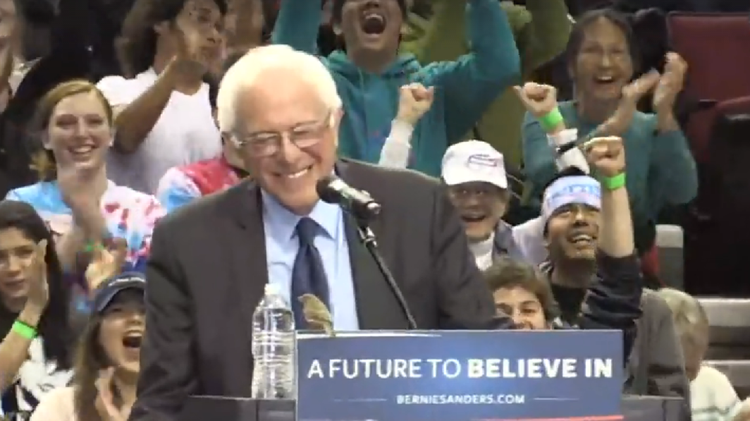
As he looked ahead to carrying on the fight in New Hampshire, he used many of his favorite lines. “It is just too late for establishment politics and establishment economics.” “We do not represent the interests of the billionaire class, Wall Street, or corporate America. We don’t want their money.” “The American people are saying no to a rigged economy.” “We are going to create an economy that works for working families, not just the billionaire class.” - Bernie Sanders Just Changed the Democratic Party - The New Yorker
You could say it louder, but it would be hard to say it more clearly.
Moral of the story: It has happened before and it can happen again and God help us if it doesn't. DS
PS: Here is the Brookings document in full to download:






.jpg)


