Thursday, July 07, 2016
November 2016... tick tock...tick tock
Friday, September 07, 2012
Democrats and the vanishing American middle class
Those who are cheerfully going about the work of dismantling the welfare state seem blissfully unaware that the welfare state was created by men as, or even more, conservative then themselves, (Bismark, for example) in order to avoid revolutionary social movements which would destabilize and jeopardize the entire economic system and society itself. This was a strategy that was so eminently successful that it has practically destroyed revolutionary praxis.
In my opinion dismantling the welfare state at this time is similar to a person who has successfully survived an operation for lung cancer and endured the ensuing chemotherapy and then, finding himself now in remission, decides that it is ok for him to go back to smoking, the very thing that caused his cancer in the first place: idiotic.
Like farming, manufacture is a messy, hands-on affair, filled with the sort of dangerous, dirty, intangible things that sentient beings produce that are difficult to quantify in numbers. This makes farming and manufacture unattractive for most Masters of Business Administration.
People don't feel right spending all those years at Harvard or Stanford, just to have to get a recalcitrant assembly line up and running or to stand up to their knees in manure in the middle of a freezing night holding a lantern for a vet himself up to his elbows performing a breech delivery on a struggling milch cow.
Truly though, I can't imagine Walt Whitman celebrating these new masters of the universe.
Monday, September 08, 2008
FT's Clive Crook explains Democrat''s genius for losing elections
This article is not the first to note the cultural contradiction in American liberalism, but just now the point bears restating. The election may turn on it. Democrats speak up for the less prosperous; they have well-intentioned policies to help them; they are disturbed by inequality, and want to do something about it. Their concern is real and admirable. The trouble is, they lack respect for the objects of their solicitude. Their sympathy comes mixed with disdain, and even contempt.It is ironic that, among leading Democrats the only one who seems to fully understand what Crook is driving at is the born aristocrat Howard Dean. DS
Democrats regard their policies as self-evidently in the interests of the US working and middle classes. Yet those wide segments of US society keep helping to elect Republican presidents. How is one to account for this? Are those people idiots? Frankly, yes – or so many liberals are driven to conclude.(...) Because it was so unexpected, Sarah Palin’s nomination for the vice-presidency jolted these attitudes to the surface. Ms Palin is a small-town American. It is said that she has only recently acquired a passport. Her husband is a fisherman and production worker. She represents a great slice of the country that the Democrats say they care about – yet her selection induced an apoplectic fit.
For days, the derision poured down from Democratic party talking heads and much of the media too. The idea that “this woman” might be vice-president or even president was literally incomprehensible. The popular liberal comedian Bill Maher, whose act is an endless sneer at the Republican party, noted that John McCain’s case for the presidency was that only he was capable of standing between the US and its enemies, but that should he die he had chosen “this stewardess” to take over. This joke was not – or not only – a complaint about lack of experience. It was also an expression of class disgust. I give Mr Maher credit for daring to say what many Democrats would only insinuate.(...) Voters in small towns and suburbs, forever mocked and condescended to by metropolitan liberals, are attuned to this disdain. Every four years, many take their revenge.(...) The Palin nomination could still misfire for Mr McCain, but the liberal reaction has made it a huge success so far. To avoid endlessly repeating this mistake, Democrats need to learn some respect.
Tuesday, June 17, 2008
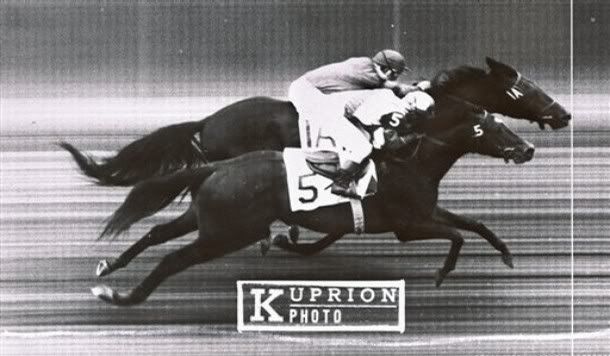
What exactly makes a horse race?
The "photo finish" above expresses all the excitement of horse racing. One horse is beating another by "a nose".
This excitement generates cash.
A tight race, with an exciting finish that brings the fans to their feet is what horse racing is all about.
The excitement and the doubt about which horse is going to win stimulates betting and fills the race course with regular, paying customers.
For those who organize horse races a photo finish like the one above is the preferred result in every single race. If the results of horse races were preordained, no one would ever broadcast them and no one would ever write about them in the newspapers. Therefore preordained horse race winners would generate no advertising revenues.
Since, unavoidably, some horses are much faster than others, something must be done to "even the odds": a horse racing term if ever there was one.
The track official in charge of doing this is called the "handicapper" and his profession is called "handicapping".
Many readers may have only heard the term, "handicapped" as the politically incorrect version of "physically challenged", the politically correct version takes longer to say, but actually means the same thing as the incorrect version.
In the handicapper's ideal race all the horses would cross the finish line at exactly the same time. To make this happen he "physically challenges" or "handicaps" them by putting lead weights in the faster horses's saddles to make them run more slowly. This is why you see pictures of the tiny jockeys being weighed along with their saddles before the race; to ensure that the total weight that was calculated by the official handicapper is what finally goes on the horse at the starting gate.
The prospective wagerer out to "have a flutter", seeing the handicappers handiwork thinks, "'Flying Dog Food' is by far the best horse today, he's won every race he's ever been entered in, but he's never carried this much weight before and besides, last night it rained and the track will be slow" and thus the punter takes more interest in the race... and maybe bets against 'Flying Dog Food". More action and more commissions for the bookies, excitement, photo finishes, money... Horse racing.
Which brings us to the coming election.
Professor Immanuel Wallerstein encapsulates most, if not all, of the present commentary when he writes:
Barack Obama(...) is going to sweep the elections with a large majority of the Electoral College and a considerable increase in Democratic strength in both houses of the Congress. (...) If one analyzes the situation in detail, state by state, the only state that voted Democratic in 2004 in which McCain seems to be competitive today is Michigan. The states that Bush won in 2004 in which Obama is competitive are numerous - Ohio, Indiana, Iowa, Missouri, New Mexico, Colorado, Virginia, and maybe Nevada, North Carolina, and Montana. He's even doing well enough in Mississippi that Republicans will have to invest money and time campaigning there. If Obama won all the competitive states except Michigan, he'd have 310-333 electoral votes. He needs 270.Not much of a race at this point, is it? All over but the shouting, don't you think? Wake me up when it's over, no?
If you compare the present race between Obama and McCain to Obama and Hillary's battle to the wire, or even McCain's home stretch gallop out of the crowded Republican pack, it all looks pretty boring, doesn't it? ... And it's only June! Finished before it began.
Think of how many people were glued to their TVs as Hillary battled on, how many advertisements those people had to sit through to hear all the pundit's expert drivel... The Obama vs. McCain race is not going to sell much stuff is it?
A real money loser, something that the media have to cover, but nobody much wants to watch.
Think how much more money everybody concerned would make if the two candidates raced neck and neck, through the summer and into the fall.
This race is begging to be handicapped.
A photo finish is the desired result. A cliff hanger all the way down to the wire with everybody glued to their TV sets till the break of dawn on election night... sitting through all those ads.
Remember, in handicapping, the fastest horse has to carry the heaviest weights.
Barack Obama has peaked way too soon. His superiority is beginning to bore. It looks more like a coronation than a race.
Or more like Jesus' Palm Sunday ride into Jerusalem on a donkey than the Kentucky Derby.
Without any particular malice aforethought the media is going to begin to pick Obama's story apart, just to keep the public's attention from drifting off. They really have nothing better to do.
They have to make a new story out of this.
In the next weeks we are going to see if Obama has what horse racing fans call "heart" or "class". DS
Saturday, June 07, 2008
Progressive Obamites... Sucker!
After all, he doesn't see the region much differently than President Bush does.David Seaton's News Links
In the heat of the Democratic primary campaign, some on the left were inspired to believe that Sen. Barack Obama (Ill.) offered a far-reaching transformation of U.S. foreign policy, "the most sweeping liberal foreign-policy critique we've heard from a serious presidential contender in decades," as one particularly breathless article in the American Prospect put it. Yet, when Mr. Obama opened his general election campaign this week with a major speech on Middle East policy, the substantive strategy he outlined was, in many respects, not very much different from that of the Bush administration -- or that of Republican Sen. John McCain (R-Ariz.). (emphasis mine)
Mr. Obama's Middle East - Editorial - Washington Post
I really can't understand how anyone can be a passionate Democrat... It's like being a devoted fan of one of those transient, itinerant American baseball and basketball teams like the Boston-Milwaukee-Atlanta Braves or the Utah "Jazz"... ("Utah"... "Jazz"?)... I've put the logo of the Brooklyn Dodgers as a symbol of betrayal... I don't think any team in the world, not even Real Madrid, Manchester United or FC-Barcelona -- to name some of the most fanatic -- ever had more loyal fans than the people of Brooklyn, but the management, flipped them the finger and moved to LA.
Like the man said,
"The bourgeoisie, wherever it has got the upper hand, has put an end to all feudal, patriarchal, idyllic relations. It ... has left remaining no other nexus between man and man than naked self-interest, than callous “cash payment”Nothing better than the story of the Dodgers to illustrate that paragraph.
Compared to the story of the Brooklyn Dodgers, I suppose Barack Obama's selling the Palestinian people downriver pales in comparison, but it does raise a few awkward questions about the brand, doesn't it?
"Coca Cola sells shoe polish"... the phrase jars on the ear doesn't it? A shoeshine is, or is not a "pause that refreshes"? A brand stands for something or it isn't a brand.
The Republicans are easy to figure out, the old British phrase sums up the underlying values perfectly.
Bugger you Jack, I'm alright!To be more inclusive, things like guns and God and "the right to life" (of fetuses, not actual people) are tacked on, but basically its about possession and stinginess. Certainly you know what you're in for with the GOP. If you are "alright" they offer a coherent program and a way forward.
But what in God's name do the Democrats stand for if not for collective masturbation. DS
Monday, May 05, 2008
An American left: mission impossible?
The racial divide that has opened up within the Democratic Party is almost certainly less problematic than the hurdles Mr. Obama could face attracting support outside the party in November should he win the nomination. It is, after all, the Republican Party that captured the allegiance of the whites most uneasy about the civil rights movement and its legacy. “It will be a challenge to win a general election with an African-American candidate,” said Larry Bartels, a professor of politics at Princeton. “The challenge has less to with internal tensions within the Democratic Party than with the resentments and racial misgivings of the general electorate.” The New York TimesDavid Seaton's News Links
You could say that the civil rights movement broke the left in the United States, but at the same time you would have to ask what good a left would be that was predicated on racial inequality.
If the previous sentence could be expressed as a neat mathematical formula, computers could solve the conundrum that has stumped the American left since the 1960s.
This endless conversation has left the poor of America with substandard public education and without decent health care, while what passes for "progressive" politics busies itself with ethnic and sexual identity questions instead of class divisions.
In this the United States not only fails itself, it fails the world. America is the only developed country without any serious social democratic movement and this gives endless comfort to right wing parties everywhere. Many European social democrats try to pretend that the Democrats are their American opposite numbers only to find them in reality corresponding to something similar to Christian Democrats.
And all of this because of America's race divisions. Here is a sample from Pennsylvania:
In the former mining and textile regions of northeastern Pennsylvania, places like Scranton and Wilkes- Barre, (Obama's pollsters) expected to lose by about 10 points. Instead they were defeated by better than 2-to-1. Likewise, in the industrial towns of western Pennsylvania, like Johnstown, home of U.S. Representative John Murtha, a powerful Clinton supporter, Obama lost not by the eight-point margin his team had anticipated, but by 46 points. BloombergWith the pundits sounding shrill alarms:
We are not as powerful as we used to be because over the past three decades, the Asian values of our parents’ generation — work hard, study, save, invest, live within your means — have given way to subprime values: “You can have the American dream — a house — with no money down and no payments for two years.” That’s why Donald Rumsfeld’s infamous defense of why he did not originally send more troops to Iraq is the mantra of our times: “You go to war with the army you have.” Hey, you march into the future with the country you have — not the one that you need, not the one you want, not the best you could have. Thomas Friedman - NYT
Americans are glum at the moment. No, I mean really glum. In April, a new poll revealed that 81 percent of the American people believe that the country is on the "wrong track." In the 25 years that pollsters have asked this question, last month's response was by far the most negative. Other polls, asking similar questions, found levels of gloom that were even more alarming, often at 30- and 40-year highs. Fareed Zacharia - NewsweekWhat we are talking about is decadence... It's been obvious for years, but it seems to finally be catching up with mainstream types like cheery chipmunk, Tom Friedman and the more realist, Fareed Zacharia.
If you wanted to understand what is happening in America, it would easier if you looked at it through the lens of a miniature, opera buffa version: Berlusconi's Italy.
Without getting into an exhaustive analysis, let us say that Silvio Berlusconi is a cartoon version of the US power structure. Silvio Berlusconi incarnates in his sole person the entire American establishment: business, press, television, even sports. The decadence of Italy is like a toy version of what is happening in the United States.
Now, after sixty years, Italy is moving back toward Fascism. (No kidding, the new mayor of Rome is a genuine, arm in air, viva il Duce, former street fascist). Is this where we are headed?
I'll be returning to the Italian example in future posts, if Italy is not currently on your radar screen, please get up to speed. When you do, I think you will agree that the comparisons are most helpful in illuminating of the problems America faces, but on a smaller, more accessible scale. The USA even in decline (especially in decline?) is too mind boggling to readily get your hands around. DS
Sunday, March 02, 2008
Washington: a White House is not a home
Let the poets pipe of love
in their childish ways
I know every type of love
better far than they.
If you want the thrill of love
I have been through the mill of love
old love
new love
every love but true love"Love for Sale" - Cole Porter
A long time reader of mine asked me why I slam Obama so hard... and so often. Good question.
The answer lies, I think, in his barefaced use of purposefully vague language that links emotion to spirit for personal gain. He uses words like "hope" and "change" and "we" too freely, he is using these words intentionally to manipulate the emotions of people, especially young people, he does it to further his ambition. In the end his supporters will be left with the words and if things continue as they have till now, Obama will be left with the power.
And let he that is without sin cast the first stone. An old Spanish Communist once told me, "David, if all the sons of prostitutes that there are on this planet had wings and could fly, they would so cover the heavens that the rays of the sun would never touch the earth again and all life would be extinguished." DS
Abstract: Some progressives are appalled by the direction their party seems to have taken: they wanted another F.D.R., yet feel that they’re getting an oratorically upgraded version of Michael Bloomberg instead. Others, however, insist that Mr. Obama’s message of hope and his personal charisma will yield an overwhelming electoral victory, and that he will implement a dramatically progressive agenda. The trouble is that faith in Mr. Obama’s transformational ability rests on surprisingly little evidence. Mr. Obama’s ability to attract wildly enthusiastic crowds to rallies is a good omen for the general election; so is his ability to raise large sums. But neither necessarily points to a landslide victory. Polling numbers aren’t much help: for now, at least, you can find polls telling you anything you want to hear, from the CBS News/New York Times poll giving Mr. Obama a 12-point national advantage over John McCain to the Mason-Dixon poll showing Mr. McCain winning Florida by 10 points. What we do know is that Mr. Obama has never faced a serious Republican opponent — and that he has not yet faced the hostile media treatment doled out to every Democratic presidential candidate since 1988.(...) If Mr. Obama does make it to the White House, will he actually deliver the transformational politics he promises? Like the faith that he can win an overwhelming electoral victory, the faith that he can overcome bitter conservative opposition to progressive legislation rests on very little evidence — one productive year in the Illinois State Senate, after the Democrats swept the state, and not much else.(...) All in all, the Democrats are in a place few expected a year ago. The 2008 campaign, it seems, will be waged on the basis of personality, not political philosophy. If the magic works, all will be forgiven. But if it doesn’t, the recriminations could tear the party apart. READ IT ALL
Sunday, February 03, 2008
Health: a Spanish lesson
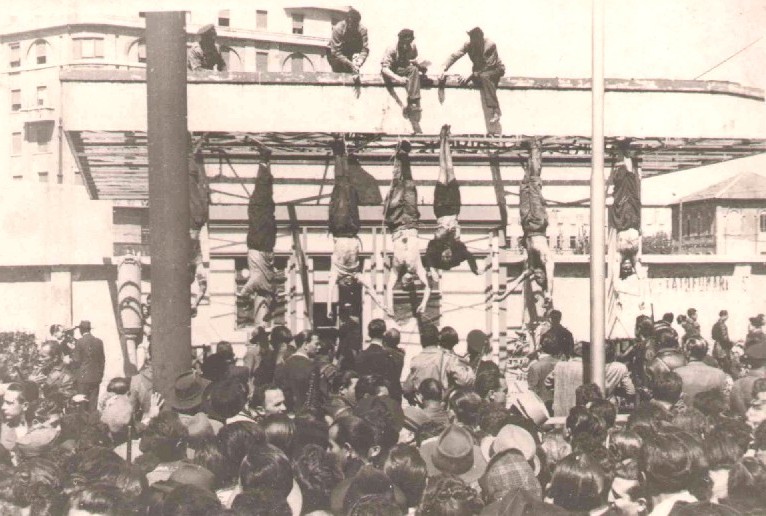
The picture that concentrated Franco's mind so wonderfully
An American reader familiar with Spain asked me what possible relation there could be between the American situation and the Spanish one, where, as she pointed out, public health care predates Democracy. I thought it such an interesting question that I decided to answer her here.
Many years ago I worked on a project for a large American, family owned corporation with manufacturing facilities in Spain. They wanted to close a factory and they were amazed at the penalties they would have to pay to shut the thing down. They demanded a detailed history of Spanish social legislation, which I helped to research.
I speak from memory, but I seem to recall that we discovered that almost all the Spanish welfare state dated from when it became obvious that Hitler was going to lose the war. The idea of the victorious allies charging over the Pyrenees and Nuremberging him concentrated Franco’s mind wonderfully.
Franco, brutal victor in the recent civil war was always a practical and expedient fellow, so he threw the defeated working class a fish. Providing health care, protecting jobs and paying the summer and Christmas bonuses helped the police state keep control of the defeated working class during those black years before prosperity arrived, with the tourists, in the 1960s.
Basically then, Spain had some sort of health system under Franco because he was afraid of hanging by his feet in a gas station like Mussolini.
Until the Socialists reformed it in the 80s it was a very, very half hearted, half assed system indeed. And it was the fear of Spain going Communist after the death of Franco that allowed the reformist Socialist government of Felipe González which had been previously "restructured" under the guidance of Willy Brandt's SPD to finally take power and, once they agreed to stay in NATO, receive the blessings of the US as the lesser of many possible evils.
In a sense the entire European welfare system was put in place because the elites were afraid of the working class going with the Communists in the late 40s and early 50s. In the democracies the pressure was expressed in the ballot box, in Spain by police informers relaying the mood of the population. What is necessary today in America is to produce that same unease at the top of the American system. The civil rights struggle shows that this is as possible in the USA as in Europe.
If the Republican Party and the American conservatives in general were still more or less normal, like they were under Eisenhower or even Nixon, they would probably do like Franco and throw the fish. They showed that sort of pragmatism when confronted with the reality of "burn baby burn". But I think the Ayn Randies, the Norquististas, the Cato Instituters and assorted Reaganites, are a bunch of real Talibans and will fight this thing to the death and that will be the transformational struggle. Just like during the civil rights movement, there have to be people in the streets and a change or heightening of consciousness to bring about this transformation.
There would be two good things in this: one, the people would finally get health care and two, the struggle itself would change their consciousness. Thus, the unyielding resistance of the American Reaganite conservatives to any state health care system is fundamental to the final transformational effect. If any of them were half as intelligent as Franco was there would be no transformation.
As Democrats are not really people of the left they don’t seem to understand that politics like the rest of life is a constant, shifting, conflict of contradictory entities with contradicting interests and that these different interests struggle continuously among themselves and that this struggle produces what the Hindus call "Maya” or what the rest of us call “reality”: something of only apparent solidity, something which is constantly in flux.
To transform reality it is important first to understand the dynamics of these contradictions and to know when it best to push one place or to not push on another. This dialectical approach is very foreign to American politics. It would be easier for an American psychotherapist to understand the dynamics of transforming political reality and the value of the process of transformation than for the average American political commentator. A therapist easily understands that the process of becoming is as important as, or more important than the becoming itself, since in fact, everything only exists in the act of becoming and never really finally becomes, except, perhaps, when it dies.
Health care obviously wouldn’t be “transformational“ for Spanish politics because health care already exists in Spain. It was precisely Franco's readiness to concede it that kept it from becoming transformational. To create such a system in the USA would transform America because health care doesn’t exist and, given the rigid ideological stance of American conservatives, it probably would take a huge struggle to get it to exist. Since there are 40,000,000 people without coverage, this would constitute a formidable army in this battle. The struggle is just as important as the final result or to put it another way, the struggle is the result. DS
Monday, January 21, 2008
Are the Democrats the right tool for the job?
"The median American family is going into what looks like a recession owing more than 100 percent of its income."
Elizabeth Warren, Harvard law professor
Are the Democrats the right tool for the job? I ask such an unpleasant question at such an awkward time, because the only candidate for the Democratic presidential nomination that is talking about a real, universal health care scheme on European lines, John Edwards, seems to be going nowhere.
As to the front runners, Hillary had her chance at bringing health care once and failed so miserably that a decade was lost and Obama's idea of sitting around a table for a "friendly chat" about health care with the insurance and pharma crowd is well... Mike Huckabee might say that Barack is "constipated". After Obama's paeans to the Gipper, anyone who expects anything progressive from him is simply indulging in political onanism.
All of this tends to lend credit to Gore Vidal's idea that there is only one political party in the USA, the "Property Party" with a Democratic wing and a Republican wing. In short it looks like nothing much is really going to change very much at all and that is the basic idea of the system, that nothing much change. To say this is a crying shame is a screaming understatement.
As we see, by Elizabeth Warren's quote above, the median American family is heading into a major recession not only without any savings, but in debt as well. Thanks to the bursting housing bubble many people are also going to lose their homes. Obviously in such times, many who have some health insurance will have to cut back on it, or drop it all together. We are talking about a meltdown of the American middle class's self-image and its basic well being. Having abandoned the traditional virtues of thrift and prudence, they stand naked in a very cold breeze.
This presents a historic opportunity to create a progressive consciousness that cuts through racial, regional, sexual orientation, religous and ethnic divisions. Nobody wants to get sick and die unattended and no one wants to see their children get sick and die unattended either. The money is there, of course, but it will have to come out of the "defense" budget which, if my memory serves me, is greater than the military expenditures of the next fourteen countries on the list combined. This would mean the end of American militarism as we know it. With a defense budget only bigger than say the next five countries combined we could take care of everybody, right down to braces on little poor girls' teeth.
Most commentators ignore or pretend to ignore what a political sea change a federal, universal health care system would bring to the dynamics of American politics. For example: One of the greatest objections that "conservatives" have against a universal health scheme on European lines, is one they hardly talk about: unions. In Europe the health systems are unionized and the unions are powerful. Doctors, nurses, cleaners etc, are all in unions. So not only would socialized medicine save people from disease, death and humiliation, it would also help to rebuild America's unions that Reagan did so much to cripple.
Health, the end of militarism and the rebirth of the labor movement. Pretty heady stuff, nu? But that is what strategic opportunities are about: the "game changers". They don't come by very often and they are not to be missed. I don't say that most Democratic voters wouldn't like to see all this happen, but if they wait for their "leadership" to pull it off, they are worse than fools. How can I say this in a way that will sound good to the reticent progressive ear. How about, "these are the times that try person's souls"? Or, "Now is the time for all good persons to come to the aid of their country"? This the big one. DS
Roger Cohen: U.S. Soldiers and Shoppers Hit the Wall - New York Times
Abstract: Wars in Afghanistan and Iraq have pushed the U.S. armed forces to the limit. Many soldiers have scarcely seen their families in recent years. But a much larger American army, the one that's spent this century shopping, is even more overextended and its pain is now coming home to roost. Nobody ever made money exhorting people to save. But U.S. banks and financial institutions have spent huge amounts in recent years telling people debt is good and savings are dumb.(...) And here we are, with the rainy day our grandparents always droned on about appearing in the form of a deluge, and no savings stashed for it, and President George W. Bush, the debt-spender par excellence, conjuring up a $150-billion stimulus package that evokes the injection of steroids into a prone athlete wrecked by a marathon. This "shot in the arm," as Bush put it, may dampen a little pain. But this patient will be in intensive care for a long time. As Stephen Roach, the chairman of Morgan Stanley Asia, said to me: "The very low U.S. savings rate, and related huge balance of payments deficit to attract funds from overseas, are not sustainable things." The adjustment is likely to be long and painful. Think of it as getting the sacrifice of U.S. soldiers and the obliviousness of U.S. shoppers a little more in sync. The non-relation between expensive wars and exempt non-warriors, a mirage Bush has fostered, has become unsustainable. Roach estimated U.S. net national savings at a tiny 1.4 percent of national income and household debt at 133 percent of personal disposable income. That last figure means middle class families are tapping into home equity - borrowing against their homes - to buy their kids socks. And if they can't pay the resulting never-sleeping debt, they lose not a room or two, but the house. Headlines in recent weeks have focused on the international investors - from Japan to Kuwait - riding to the rescue of such American symbols as Citigroup and Merrill Lynch. The Asian financial crisis of the 1990s has gone into reverse. This turnabout has provided eloquent evidence of the Asian-tilted power shift of the past decade and of the way countries from Korea to Singapore have built up dollar war chests as the United States has plunged into debt.(...)As my colleague Floyd Norris has written of ballooning (and now plunging) property prices: "The only way prices got so high was that people who could not afford to buy those homes were given mortgages they could not hope to repay unless home prices kept rising." A staggering number of these mortgages were either interest-only or so-called "negative amortization" contracts that left the principal owed either unreduced or mounting after monthly payments. "The median American family is going into what looks like a recession owing more than 100 percent of its income," Harvard law professor, Elizabeth Warren said. No wonder Citigroup just set aside $4.1 billion to cover possible defaults on home-equity loans, credit cards and auto loans - shoes that have yet to drop. READ IT ALL
Monday, January 14, 2008
Notes on the donkey as the symbol of the Democrats
This was to be the election that the Democrats couldn't lose... Just watch them do it.
They seem to be in the process of simultaneously alienating both women and blacks, both fundamental constituencies to any Democratic victory. You have to see it to believe it, as they say, "you can't make this stuff up".
Certainly if Obama continues to play the race card he can expect a white backlash in November and normally Hillary could expect a very enthusiastic black turnout if she won the nomination, but if she succeeds in trashing Obama much of the African-American vote may go fishing too. The Republicans must be laughing themselves sick, simply peeing themselves with mirth.
I am beginning to think that the Democratic Party is a figment of Karl Rove's imagination. DS
LAS VEGAS (AP) - Hillary Rodham Clinton and Barack Obama have become embroiled in racially tinged disputes as large numbers of black voters prepare to get their first say in the Democratic presidential campaign.
The candidates and their surrogates are heating up their rhetoric, and it could prove to be combustible beyond South Carolina's Jan. 26 primary.
Clinton, on defense over comments that she and her husband made regarding Martin Luther King Jr.'s legacy and Obama's fitness for the White House, tried to turn the tables on her top primary rival. She accused his campaign of looking to score political points by distorting their words.
Hillary Clinton had said King's dream of racial equality was realized only when President Lyndon B. Johnson signed the Civil Rights Act of while Bill Clinton said Illinois Sen. Obama was telling a "fairy tale" about his opposition to the Iraq war. Black leaders have criticized their comments, and Obama said Sunday her comment about King was "ill-advised."
"I think it offended some folks who felt that somehow diminished King's role in bringing about the Civil Rights Act," he told reporters on a conference call. "She is free to explain that, but the notion that somehow this is our doing is ludicrous."
As evidence the Obama campaign had pushed the story, Clinton advisers pointed to a memo written by an Obama staffer compiling examples of comments by Clinton and her surrogates that could be construed as racially insensitive. The memo later surfaced on some political Web sites.
"This is an unfortunate story line the Obama campaign has pushed very successfully," the former first lady said Sunday on NBC's "Meet the Press." "I don't think this campaign is about gender, and I sure hope it's not about race."
Clinton taped the show before appearances in South Carolina, where at least half the primary voters are expected to be black. On Monday, she planned to attend a union event honoring King's legacy in New York City.
But no sooner had Clinton said she hoped the campaign would not be about race than it got even more heated. A prominent black Clinton supporter, Black Entertainment Television founder Bob Johnson, criticized Obama and seemed to refer to his acknowledged teenage drug use while introducing Clinton at her next event.
"To me, as an African-American, I am frankly insulted the Obama campaign would imply that we are so stupid that we would think Hillary and Bill Clinton, who have been deeply and emotionally involved in black issues—when Barack Obama was doing something in the neighborhood; I won't say what he was doing, but he said it in his book—when they have been involved," Johnson said.
Obama wrote about his youthful drug use—marijuana, alcohol and sometimes cocaine—in his memoir, "Dreams from My Father."
Johnson later said in a statement released by the Clinton campaign that his comments referred to Obama's work as a community organizer in Chicago "and nothing else. Any other suggestion is simply irresponsible and incorrect."
Another Clinton campaign official, Bill Shaheen, resigned last month after suggesting Democrats should be wary of nominating Obama because his past drug use could be used against him in the campaign.
Obama, campaigning in Las Vegas, declined to respond to Johnson.
"I'm not going to spend all my time running down the other candidates, which seems to be what Senator Clinton has been obsessed with for the last month," Obama said.
His strategist, however, didn't spare Johnson or Clinton.
"I don't see why this is so much different from what Billy Shaheen did in New Hampshire," David Axelrod said. "Senator Clinton apologized for that. It's bewildering why, since she was standing there, she had nothing to say about this."
Clinton was not yet on stage when Johnson made his statements and she did not mention them when she emerged.
Meanwhile, in Atlanta, Obama's wife rose to his defense over Bill Clinton's "fairy tale" comment. Michelle Obama said some blacks might be skeptical that white America will elect her husband, but advised them to look to his win in Iowa.
"Ain't no black people in Iowa," she said during a speech at the Trumpet Awards, an event celebrating black achievement. "Something big, something new is happening. Let's build the future we all know is possible. Let's show our kids that America is ready for Barack Obama right now."
John Edwards, a third candidate in the Democratic primary, waded into the dispute Sunday.
"I must say I was troubled recently to see a suggestion that real change came not through the Rev. Dr. Martin Luther King but through a Washington politician. I fundamentally disagree with that," Edwards told more than 200 people gathered at a predominantly black Baptist church in Sumter, S.C.
Monday, December 03, 2007
Notes for a blog piece
In following the presidential nominating campaign I am struck once again by how entertaining, full bodied and variegated the US right and ultra-right are, and how decaffeinated, watered down and mealymouthed those that pass for the American left are.
What a cast of characters the Republicans have! From libertarian eccentrics like Ron Paul right through to neofascist Rudy Giuliani, stirred in with folksy, guitar strumming, creationist, Mike Huckabee who sounds like the one-eyed Mullah Omar if he were reworked by Walt Disney.
In short they have a genuine culture. From center-right to far out, wacky right... no holds barred, in your face, what you see is what you get, pure reactionaries... A real spectrum, in fact a veritable monkey's ass of a party.
While, at the same time the American left is the sin that dare not speak its name.
Because don't kid yourself, neither Hillary or Obama would even qualify for the rightwing of the British Labor Party. On the continent they might just make it as Christian Democrats, but just barely... Anything like a sober, Swedish Social Democrat would be treated like Hugo Chávez on LSD with genital herpes by the US media.
It looks like the USA is heading into a nasty recession that is going to cause great pain to the "little guy": where even the middle class is going to discover that they have been shafted and there is no political organization prepared to pick up that ball and run with it. We can see that by the way a congress voted in to end the Iraq war just lies there.
Somebody (nobody but the American people) has to put together a grass roots movement to change all of this because the two party system is never going to deliver anything but more right wing (choose noun), because that is where the juice and the sincerity and the culture are.
Who could ever be the American Gandhi? DS
Tuesday, March 27, 2007
Howard Zinn: just like ringing a bell
We who protest the war are not politicians. We are citizens. Whatever politicians may do, let them first feel the full force of citizens who speak for what is right, not for what is winnable, in a shamefully timorous Congress. Howard Zinn
David Seaton's News Links
There is nothing I can add to this wonderful article by the author of, "A People's History of the United States," except to praise its clarity... especially its moral clarity. We are living in a potentially great moment in history... if we choose to make it great. DS
Howard Zinn: Are We Politicians or Citizens? - The Progressive
By Howard Zinn
May 2007 Issue
As I write this, Congress is debating timetables for withdrawal from Iraq. In response to the Bush Administration’s “surge” of troops, and the Republicans’ refusal to limit our occupation, the Democrats are behaving with their customary timidity, proposing withdrawal, but only after a year, or eighteen months. And it seems they expect the anti-war movement to support them.
That was suggested in a recent message from MoveOn, which polled its members on the Democrat proposal, saying that progressives in Congress, “like many of us, don’t think the bill goes far enough, but see it as the first concrete step to ending the war.”
Ironically, and shockingly, the same bill appropriates $124 billion in more funds to carry the war. It’s as if, before the Civil War, abolitionists agreed to postpone the emancipation of the slaves for a year, or two years, or five years, and coupled this with an appropriation of funds to enforce the Fugitive Slave Act.
When a social movement adopts the compromises of legislators, it has forgotten its role, which is to push and challenge the politicians, not to fall in meekly behind them.
We who protest the war are not politicians. We are citizens. Whatever politicians may do, let them first feel the full force of citizens who speak for what is right, not for what is winnable, in a shamefully timorous Congress.
Timetables for withdrawal are not only morally reprehensible in the case of a brutal occupation (would you give a thug who invaded your house, smashed everything in sight, and terrorized your children a timetable for withdrawal?) but logically nonsensical. If our troops are preventing civil war, helping people, controlling violence, then why withdraw at all? If they are in fact doing the opposite—provoking civil war, hurting people, perpetuating violence—they should withdraw as quickly as ships and planes can carry them home.
It is four years since the United States invaded Iraq with a ferocious bombardment, with “shock and awe.” That is enough time to decide if the presence of our troops is making the lives of the Iraqis better or worse. The evidence is overwhelming. Since the invasion, hundreds of thousands of Iraqis have died, and, according to the UN High Commissioner for Refugees, about two million Iraqis have left the country, and an almost equal number are internal refugees, forced out of their homes, seeking shelter elsewhere in the country.
Yes, Saddam Hussein was a brutal tyrant. But his capture and death have not made the lives of Iraqis better, as the U.S. occupation has created chaos: no clean water, rising rates of hunger, 50 percent unemployment, shortages of food, electricity, and fuel, a rise in child malnutrition and infant deaths. Has the U.S. presence diminished violence? On the contrary, by January 2007 the number of insurgent attacks has increased dramatically to 180 a day.
The response of the Bush Administration to four years of failure is to send more troops. To add more troops matches the definition of fanaticism: If you find you’re going in the wrong direction, redouble your speed. It reminds me of the physician in Europe in the early nineteenth century who decided that bloodletting would cure pneumonia. When that didn’t work, he concluded that not enough blood had been let.
The Congressional Democrats’ proposal is to give more funds to the war, and to set a timetable that will let the bloodletting go on for another year or more. It is necessary, they say, to compromise, and some anti-war people have been willing to go along. However, it is one thing to compromise when you are immediately given part of what you are demanding, if that can then be a springboard for getting more in the future. That is the situation described in the recent movie The Wind That Shakes The Barley, in which the Irish rebels against British rule are given a compromise solution—to have part of Ireland free, as the Irish Free State. In the movie, Irish brother fights against brother over whether to accept this compromise. But at least the acceptance of that compromise, however short of justice, created the Irish Free State. The withdrawal timetable proposed by the Democrats gets nothing tangible, only a promise, and leaves the fulfillment of that promise in the hands of the Bush Administration.
There have been similar dilemmas for the labor movement. Indeed, it is a common occurrence that unions, fighting for a new contract, must decide if they will accept an offer that gives them only part of what they have demanded. It’s always a difficult decision, but in almost all cases, whether the compromise can be considered a victory or a defeat, the workers have been given some thing palpable, improving their condition to some degree. If they were offered only a promise of something in the future, while continuing an unbearable situation in the present, it would not be considered a compromise, but a sellout. A union leader who said, “Take this, it’s the best we can get” (which is what the MoveOn people are saying about the Democrats’ resolution) would be hooted off the platform.
I am reminded of the situation at the 1964 Democratic National Convention in Atlantic City, when the black delegation from Mississippi asked to be seated, to represent the 40 percent black population of that state. They were offered a “compromise”—two nonvoting seats. “This is the best we can get,” some black leaders said. The Mississippians, led by Fannie Lou Hamer and Bob Moses, turned it down, and thus held on to their fighting spirit, which later brought them what they had asked for. That mantra—“the best we can get”—is a recipe for corruption.
It is not easy, in the corrupting atmosphere of Washington, D.C., to hold on firmly to the truth, to resist the temptation of capitulation that presents itself as compromise. A few manage to do so. I think of Barbara Lee, the one person in the House of Representatives who, in the hysterical atmosphere of the days following 9/11, voted against the resolution authorizing Bush to invade Afghanistan. Today, she is one of the few who refuse to fund the Iraq War, insist on a prompt end to the war, reject the dishonesty of a false compromise.
Except for the rare few, like Barbara Lee, Maxine Waters, Lynn Woolsey, and John Lewis, our representatives are politicians, and will surrender their integrity, claiming to be “realistic.”
We are not politicians, but citizens. We have no office to hold on to, only our consciences, which insist on telling the truth. That, history suggests, is the most realistic thing a citizen can do.
Howard Zinn is the author, most recently, of “A Power Governments Cannot Suppress.”