It seems that the Democrats have had the
modicum of mother wit to make the middle class the framework and theme of their
2012 campaign. We know that the Democrats can't really walk the walk, but it is
nice to hear somebody at least talk the talk for a change. For the sad truth is
that the American middle class is on its way to join the buggy whip and
whalebone corsets as a charming relic of America's past.
Historically, such a middle class is totally
exceptional; the norm over ages, and in much of the world still today, is a
small group of very rich people, who own everything and a great mass of people,
uneducated and unhealthy, whose life is "solitary, poor, nasty, brutish
and short", and whose role is to serve the rich and powerful as soldiers,
policemen, domestics, nannies and sex workers.
The European middle class was created as a
bulwark of social stability, basically to prevent the masses from taking the
"winter palace" and stringing up the super rich. The American middle
class as we know it really came into being when Henry Ford decided to pay his
workers enough to buy the cars they made. It made Ford rich and led to turning America
into a land of mass prosperity.
The American middle class is perhaps the United
States' greatest social achievement, an enormous mass of prosperous, educated
and healthy citizens which has been the envy of all the world for nearly a
hundred years, and the not so secret weapon that destroyed the Soviet Union and
reoriented China.
Simplifying to the extreme you could say that the
modern, American middle class was created by Henry Ford and literally saved
from extinction, (the first time) by Franklin Delano Roosevelt. The whole story
is in that reductio ad absurdum.
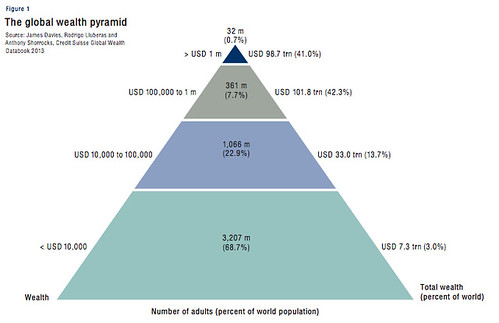
What most Americans, except for the one-percent
perhaps, don't seem to understand is that the American middle class is in
reality a totally artificial construction, which if not carefully nurtured will
dry up and die like an un-watered house plant. The super-rich are quite
comfortable with its disappearance, as they think that they no longer depend on
its prosperity for their own prosperity or even for their own physical safety.
I would argue that if the middle class is
devastated then all the problems it was created to solve, all the dangers that
it was meant to allay would reappear, just like uncut grass grows on the lawn
of a foreclosed house.
What is this middle class really?
The middle class that most Americans believe
they belong to is a transitory place on a voyage from some place harder and
more difficult than the present to someplace softer and less difficult. It is
place of anxiety, what it is not, or what it could be, is often more important than what it actually is:
any loss of momentum may have disastrous and dreaded results. Without an
adequate social net most middle class Americans are only a serious illness or a
layoff away from traveling downward. Examples of that voyage surround them
everywhere they look... if they dare to look.
Those who are cheerfully going about the work of
dismantling the welfare state seem blissfully unaware that the welfare state
was created by men as, or even more, conservative then themselves, (Bismark,
for example) in order to avoid revolutionary social movements which would
destabilize and jeopardize the entire economic system and society itself. This
was a strategy that was so eminently successful that it has practically destroyed
revolutionary praxis.
In my opinion dismantling the welfare state at this
time is similar to a person who has successfully survived an operation for lung
cancer and endured the ensuing chemotherapy and then, finding himself now
in remission, decides that it is ok for him to go back to smoking, the
very thing that caused his cancer in the first place: idiotic.
It occurs to me that this tunnel vision, expressed in
the obsession of placating the financial markets, which ignores
popular anger, is the result of the rise and predominance of the FIRE (finance,
insurance, real estate) economy and the diminishing influence of manufacturing
and agriculture.
The financial sector works with platonic mathematical
models: money in the abstract moves with the speed of light. Fortunes that buy
admiration, sex and luxury are made by simply tapping the key of a computer in
a cubicle or on a trading floor. All very clean and a bit autistic.
Reality, unfortunately, in as much as it touches
living organisms, is never that clean and neat.
Thus farmers and manufacturers understand how the
world of living creatures works better than financiers do.
They understand better, because both farmers and
manufacturers exploit living creatures for profit and, leaving ethical question
aside, to do this they need to have what farmers call "stock sense":
an understanding of the animal off of which they make their living.
Take pigs for example.
A pig lives on death row from the day he is born.
Few animals are as reviled as the pig, the very word
"pig" is an insult... and yet, perhaps no other animal on earth is
eaten with such relish as the pig. Thus there is a lot of money to be made
raising pigs
Very few of those who live off of pigs like them
personally, however pig raisers make sure that their pigs get plenty to eat,
clean water to drink and clean air to breathe and they make sure that their
charge's excrement is removed at timely intervals... They also provide them
with free veterinary care. The farmers don't do this for love of the pig or
from the goodness of their hearts, but simply because if pigs aren't treated
like this, they won't get fat soon enough or their flesh pass health inspection
after they are slaughtered.
Pigs are not alone.
The short time that chickens pass among the living is
also accompanied by a careful attention to their health and diet, as commodity
chickens are terribly vulnerable to contagious diseases: plagues that can wipe
out a farmer's investment in only a few days or sometimes hours.
Dairy cows have a bit better time of it than most food
producers, live longer lives and often get special treatment, as it has been
shown that not only clean food and air and lack of stress improves the quantity
and quality of the milk they produce, even playing classical music for the cows
helps increase milk production. To get the most and the best milk from a cow a
farmer will even play Mozart for her.
So, if not properly cared for hens don't lay, pigs
don't get fat and cows don't give milk.
In short, farmers know that to make decent a profit
from their animals they must treat them carefully and that signs such as wet
noses, shiny fur, neat feathers, bright eyes and a good appetite and the
quantity and quality of their droppings, all must be watched closely if a good
business is to be made from them.
In manufacture everything we have said about pigs,
chickens and cows goes in spades for people too.
Manufacturers know as much about the human
beings they exploit as farmers know about pigs, chickens and cows and for
much the same reasons: their livelihood depends on getting as much work, both
in quantity and quality that they can with the smallest cash outlay possible.
As an example of how the techniques of animal
husbandry can be advantageously applied to humans, soccer became the British
working class passion par exellence, because 19th century factory owners
encouraged their workers to play football in order to keep them healthy and
productive in the miserable conditions of the industrial revolution.
Exploiting human animals is a dicey business however.
We are talking about a very bad monkey here, one who
can sabotage a factory, go slow, work to rule, go on strike: an animal that to
be most profitable requires much training and re-training and much
"motivation".
Like farming, manufacture is a messy, hands-on affair, filled with the sort of dangerous,
dirty, intangible things that sentient beings produce that are difficult to
quantify in numbers. This makes farming and manufacture unattractive for
most Masters of Business Administration.
People don't feel right spending all those years at Harvard or Stanford, just
to have to get a recalcitrant assembly line up and running or to stand up to
their knees in manure in the middle of a freezing night holding a lantern for a
vet himself up to his elbows performing a breech delivery on a struggling milch
cow.
To leave the farm, to leave the factory floor and then
move to a quiet office to follow numbers that flit across a screen, and while
doing it make millions of dollars more than ever would be possible in either
the factory or on the farm is a no-brainer.
Managing filthy pigs or cantankerous people with
grease on their hands is not an attractive career choice for a good student
today. Pigs are a drag. So are people.
Truly though, I can't imagine Walt Whitman celebrating these new masters of the
universe.
A curious thing: if nobody ate pigs or eggs or
chickens or drank milk, there would be no cows, pigs or chickens: nobody keeps
them for pets. That's the way things work.
Here is an example: right up until the 1970s Spain
used to be filled with donkeys, an emblematic animal, Sancho Panza rode one,
they had a million uses... now there are hardly any donkeys left... The modern
world doesn't need donkeys and donkeys can't do anything about it.
In many developed countries it appears that what goes
for donkeys goes for human beings too. Their messy needs and wants get in the
way of the beautiful numbers. Let us then move all the messy things far away
and leave ourselves to contemplate our exquisite numbers as they shimmer
and dance on the screen and fill our bank accounts.
Of course we are talking about human beings, not pigs,
chickens and donkeys, so putting numbers aside, we begin to talk about the
brotherhood of man in the fatherhood of God and other ancient, creaky concepts
that Darwinist, number-crunchers would consider sentimental twaddle.
And so in love are the crunchers with their platonic
models and their markets, that they blithely assume that those whose lives they
disrupt and futures they jeopardize will simply oblige them by just shriveling
up and blowing away.
Students have been traditionally involved in all
serious movements for change.
The Occupy and Indignados movements show that that could
still be true today.
Up till now the children of the credit bubble have had
little to rebel against, all the things that the 1968 generation fought for,
especially sexual freedom, this generation have had in abundance. While they
enjoyed their freedom or became bored with it they became proficient with
computers, cell phone messaging and social nets, all valuable skills for
potential agitators. Now the battle is not just about personal freedom and against
being drafted to get killed or maimed in imperialist wars, as it was back then,
today it is about health, education and welfare: the basics.
Now as politicians like Mitt Romney and Paul Ryan are
attacking their future education, future jobs and even their future pensions,
today's youth have something more challenging than "Grand Theft Auto"
to test their skills against. And perhaps they will be able to do
something that the students of 1968 couldn't do in those times of prosperity
and full employment, make common cause with working people and the older
generations. If all those segments of society came together for once, things
might change.
Because, unlike donkeys, human beings, before they
disappear, can do much nastier things than just bray and kick. DS