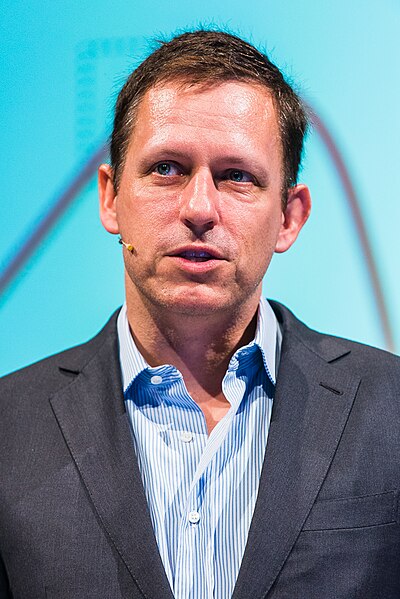
Peter Thiel is the creator of PayPal, also the first major investor in Facebook and he sits on the Facebook board.
Peter Thiel Wikipedia
Peter Thiel wrote, on April 13, 2009, in the Libertarian 'Cato Unbound' blog, “Most importantly, I no longer believe that freedom and democracy are compatible.” In the same article, he also wrote, "Since 1920, the vast increase in welfare beneficiaries and the extension of the franchise to women — two constituencies that are notoriously tough for libertarians — have rendered the notion of “capitalist democracy” into an oxymoron. (emphasis mine)Wikipedia
How does Thiel define "freedom"?
"I remain committed to the faith of my teenage years: to authentic human freedom as a precondition for the highest good. I stand against confiscatory taxes, totalitarian collectives” Peter Thiel - The Education of a Libertarian
Thiel thinks his freedom is incompatible with democracy. How is democracy normally defined?
Where and how is Democracy incompatible with Peter Thiel's freedom?
It's all quite simple, let Bernie Sanders explain:
This is an economic model developed by the economic elite to benefit the economic elite. We need real change.(...) We need to end the international scandal in which large corporations and the wealthy avoid paying trillions of dollars in taxes to their national governments. Bernie Sanders - New York Times
McAfee, associate director of the MIT Center for Digital Business at the Sloan School of Management, (...)despite his obvious enthusiasm for the technologies, doesn’t see the recently vanished jobs coming back. The pressure on employment and the resulting inequality will only get worse, he suggests, as digital technologies—fueled with “enough computing power, data, and geeks”—continue their exponential advances over the next several decades. “I would like to be wrong,” he says, “but when all these science-fiction technologies are deployed, what will we need all the people for?” (emphasis mine) MIT Technology Review Magazine
Obviously. from Peter Thiel's personal point of view, democracy and his freedom are incompatible.
In Thiel's defense we should be grateful for his forthrightness, because Peter Thiel is rather innocent in his sincerity. The crafty Koch
Brothers, for example, would never come right out and express themselves
so frankly, but everything they actually do expresses the same view of democracy
as Thiel's.
And they are not just sitting on their hands, they are up and doing something about it.
The House approved a bill Tuesday that would bar the IRS from collecting
the names of donors to tax-exempt groups, prompting warnings from
campaign-finance watchdogs that it could lead to foreign interests
illegally infiltrating American elections. USA Today
USA Today’s Fredreka Schouten reported that the bill is openly supported by Charles Koch,
the older of the two “Koch Brothers,” fossil fuel billionaires whose
deep pockets hold a notoriously outsized influence on American politics. Kit O'Connell - Mint Press
This is nothing new. The democratic state, (government of the people, by the people, for the people) has always been the only possible defense of "the People" facing the powerful, who wish to dominate and exploit them.
Again, knowing who the Thiels and the Kochs of this world are, who are "the People"?
How long has this struggle between the "Thiels and Kochs" and "the People" been going on?
Aesop: A Lion used to prowl about a field in which Four Oxen used to dwell. Many a time he tried to attack them; but whenever he came near they turned their tails to one another, so that whichever way he approached them he was met by the horns of one of them. At last, however, they fell a-quarreling among themselves, and each went off to pasture alone in a separate corner of the field. Then the Lion attacked them one by one and soon made an end of all four. Moral: United we stand, divided we fall.
What is the best reason for supporting Bernie Sanders?
How about: "the future of humanity is at stake"?
Exaggeration? Not really.
To get right to the point: in at most a generation, or perhaps much sooner, science, in the form of robotics and Artificial Intelligence, will have led humanity to a fork in the road. A clear choice between a dream utopia and utter dystopia lies before us... it reads like science fiction, but it isn't.
One path we could take holds the possibility of leading us to an amazing and paradisaical utopia of infinite possibilities for a full and enriched quality of life, an end to poverty and even alienation... for everyone... everywhere.
And the other path - the one we are traveling today - would eventually lead the immense majority of humanity, including most of today's middle class Americans, to live in conditions that would make the legendary slums of present day Calcutta look like Disneyland by comparison.
Here is how the situation stands now, with the present technology... in the opinion of none other than Martin Wolf, someone who nobody could consider "radical". Here the prestigious, chief economist of The Financial Times says.
(T)here is anxiety over rising inequality and economic insecurity. Perhaps the most fundamental cause is a growing sense that elites are corrupt, complacent and incompetent. Martin Wolf - Financial Times
And remember, that is with present technology.
Now meet Hod Lipson:
Hod Lipson (born 1967 in Haifa, Israel) is an American robotics engineer. He is the director of Cornell University's Creative Machines Lab (CCML), formerly known as Computational Synthesis Lab (CCSL), at the Sibley School of Mechanical and Aerospace Engineering. Lipson's work focuses on evolutionary robotics, design automation, rapid prototyping, artificial life, and creating machines that can demonstrate some aspects of human creativity. His publications have been cited close to 10,000 times, and he has an h-index of 50, as of November 8, 2015. Wikipedia
Professor Lipson is very worried.
Hod Lipson’s vision of the future is one in which machines and software possess abilities that were unthinkable until recently. But he has begun worrying about something else that would have been unimaginable to him a few years ago. Could the rapid advances in automation and digital technology provoke social upheaval by eliminating the livelihoods of many people, even as they produce great wealth for others? (...) Are we at the beginning of an economic transformation that is unique in history, wonderful for what it could do in bringing us better medicine, services, and products, but devastating for those not in a position to reap the financial benefits? Will robots and software replace most human workers?(...) A prevailing view among economists is that many people simply don’t have the training and education required for the increasing number of well-paying jobs requiring sophisticated technology skills. At the same time, software and digital technologies have displaced many types of jobs involving routine tasks such as those in accounting, payroll, and clerical work, forcing many of those workers to take more poorly paid positions or simply abandon the workforce. Add to that the increasing automation of manufacturing, which has eliminated many middle-class jobs over the past decades, and you begin to see why much of the workforce is feeling squeezed.(...) Whoever owns the capital will benefit as robots and AI inevitably replace many jobs. If the rewards of new technologies go largely to the very richest, as has been the trend in recent decades, then dystopian visions could become reality. (emphasis mine) - Who will own the Robots - MIT Technology Review
Newslinks Thought for the Day: If the word "democracy" has its origins in the Greek words demos, meaning "people," and kratia, meaning "power"; then what happens to democracy, when the demos don't "add value"?... "Not adding value" being a bland technicism that means people are not needed for much of anything anymore. Therefore power-less?
Some people and organizations who are paid to think are busy thinking about all this. One of them is the Brookings Institute.
The Brookings Institution is an American think tank based on Embassy Row in Washington, D.C., USA. One of Washington's oldest think tanks, Brookings conducts research and education in the social sciences, primarily in economics, metropolitan policy, governance, foreign policy, and global economy and development. In the University of Pennsylvania's 2014 Global Go To Think Tanks Report, Brookings is ranked the most influential think tank in the world
This is how they see the problem and possible practical solutions to it.
While emerging technologies can improve the speed, quality, and cost of available goods and services, they may also displace large numbers of workers. This possibility challenges the traditional benefits model of tying health care and retirement savings to jobs. In an economy that employs dramatically fewer workers, we need to think about how to deliver benefits to displaced workers.
Darrell M. West proposes striking economic changes in order to restructure how our society delivers on the social contract, such as:
Separating the dispersion of health care, disability, and pension benefits outside of employment, offering workers with limited skills social benefits on a universal basis.
Mandating a basic income guarantee for a reasonable standard of living to combat persistent unemployment or underemployment posed by the automation economy.
Revamping the Earned Income Tax Credit (EITC) to allow the benefit to support households in the grips of high unemployment.
Providing activity accounts for lifetime learning and job retraining to motivate the workforce to keep pace with innovation.
Offering incentives for volunteerism—beneficial for many people who in the future may not be able to provide for their families through regular employment but may still wish enrich their communities.
Encouraging corporate profit sharing to spread the benefits of improved productivity to the broader workforce.
Reforming the education curriculum to reflect the high premium STEM skills will offer employees in the future.
Expanding arts and culture for leisure time, ensuring that reduction in work will not eliminate chances for cultural pursuits.
"There needs to be ways for people to live fulfilling lives even if society needs relatively few workers," West writes. Taking steps now in anticipation of the exciting new future that awaits will help people adapt to new economic realities.(emphasis mine) "What happens if robots take the jobs?" - Darrell M. West
If West's agenda could be realized, what might it look like?
Software and digital technologies have displaced many types of jobs involving routine tasks such as those in accounting, payroll, and clerical work, forcing many of those workers to take more poorly paid positions or simply abandon the workforce.
The disappearance of paper pushing jobs doesn't have to be a tragedy. Read this from the philosopher,Erich Fromm:
Marx did not foresee the extent to which alienation was to become the fate of the vast majority of people, especially of the ever increasing segment of the population which manipulate symbols and men, rather than machines. If anything, the clerk, the salesman, the executive, are even more alienated today than the skilled manual worker. The latter's functioning still depends on the expression of certain personal qualities like skill, reliability, etc., and he is not forced to sell his "personality," his smile, his opinions in the bargain; the symbol manipulators are hired not only for their skill, but for all those personality qualities which make them "attractive personality packages," easy to handle and to manipulate.Erich Fromm
So if, thanks to AI and robots, it is no longer possible to "earn" a living, but the rights to "life itself, + liberty + the pursuit of happiness", are still maintained, then offering West's menu of "Incentives for volunteerism—beneficial for many people who in the future may not be able to provide for their families through regular employment but may still wish enrich their communities." or "Expanding arts and culture for leisure time, ensuring that reduction in work will not eliminate chances for cultural pursuits.", while making sure everyone, everywhere, has decent health care, education etc, would, in short, mean a recipe for heaven on earth.
Of course the money for all of this would have to come from taxing the only ones who would still have any money... the one-percent.
Now stop for a moment and think a bit... Can you imagine the "one-percent" buying into any of Darell West's agenda? For example: the Koch brothers... or Sheldon Adelson or the right-wing think tanks, like The Heritage Foundation, The American Enterprise Institute, Standford's Hoover Institution, etc, etc,etc, all the "greed is good" crowd, Ayn Rand'sObjectivists,
or any of their political errand boys: Cruz, Trump, Christie, Rubio,
Bush... and the endless lobbyists and their hordes of parasitical
congress-persons and assorted senators or governors. Can you imagine
them swallowing West's program without the assistance of a nationwide,
massive, political, "Great Awakening", to "help" them gag it down.
Facing
such hard, ruthless, well-funded and organized opposition, those who
call themselves "realists", those possibilists said to "living in the
real-world"; in other words, those settling for small "realistic", incremental gains, would be putty in the hands, of such brutal opponents .
It will be a long hard fight and very different from the old-fashioned labor battles... because with robots doing everything and the one-percent owning the robots... who could go on strike? In the meantime, until all the robots arrive, the one-percent is moving more and more manufacturing to China: a one-party dictatorship where strikes are illegal.
The fight
Below I have included a classic political fight song, "Which Side Are You On?", sung by the iconic folk singer, Pete Seeger, in social-democratic Sweden, in the no less iconic year, 1968. It's about a coal miner's strike in Kentucky.... It is a wonderful song, wonderfully sung, but coal's going out these days and so are strikes... so only the title makes much sense today... and one single phrase in the song... which sums up why I believe that anyone who thinks that Darell M. West's agenda is worth fighting for, should support Bernie Sanders.
The single phrase?
You guessed it! It's, "Us workers haven't got a chance, unless we organize." Recite that as a liberating mantra.
This brings us to Bernie
When Sanders says — as he does in every speech — that he’s seeking to build “a revolution,”
that’s not just rhetoric. What Sanders understands in his bones is
that every period of progressive reform in U.S. history has come as a
result of massive street heat, of energized movements that push
policymaking elites to the left. Abolitionists pressured the Lincoln
Republicans toward a policy of emancipation. Militant workers and a
socialist left, whose general strikes
shut down several major cities in 1934, prompted Franklin D.
Roosevelt’s Democrats to legalize collective bargaining and create
Social Security in 1935. The civil rights movement enabled the
Kennedy-Johnson Democrats to pass the landmark legislation of the ’60s.
Progressive reform doesn’t happen absent a large and vibrant left. Harold Meyerson - Washington Post
NowRobert Reich, the brilliantAtom Ant of left-wing, economists and agitators, describes how it was done before and how it could be done again.
Teddy Roosevelt got a progressive income tax, limits on corporate campaign contributions, regulation of foods and drugs, and the dissolution of giant trusts – not because he was a great dealmaker but because he added fuel to growing public demands for such changes.(...) "The real world we’re living in” right now won’t allow fundamental change of the sort we need. It takes a movement. Such a movement is at the heart of the Sanders campaign. The passion that’s fueling it isn’t really about Bernie Sanders. Had Elizabeth Warren run, the same passion would be there for her. It’s about standing up to the moneyed interests and restoring our democracy. It Takes a Movement, Like the One at the Heart of Bernie Sanders’ Campaign, to Change the World - Robert Reich
Reich makes a very, very important point... This is not really about Bernie himself, it is about the people themselves, the Demos and their Kratia.
Bernie Sanders is simply the only one who has had the guts to rise to the occasion. The only "mouse" brave enough to volunteer to "bell the cat"... Bernie Sanders + enough voters = Mighty Mouse
And finally Bernie speaks for himself:
As he looked ahead to carrying on the fight in New Hampshire, he used many of his favorite lines. “It is just too late for establishment politics and establishment economics.” “We do not represent the interests of the billionaire class, Wall Street, or corporate America. We don’t want their money.” “The American people are saying no to a rigged economy.” “We are going to create an economy that works for working families, not just the billionaire class.” - Bernie Sanders Just Changed the Democratic Party - The New Yorker
You could say it louder, but it would be hard to say it more clearly.
Moral of the story: It has happened before and it can happen again and God help us if it doesn't. DS
PS: Here is the Brookings document in full to download:
David Seaton's News Links
China is an authoritarian state, run in Leninist fashion by a communist party and at the same time a vital player, perhaps, alongside the United States, the key player in the international capitalist system.
We wish it were more democratic.
Perhaps we should be careful what we wish for.
Many who know China feel that the Chinese Communist Party is a moderating force on Chinese nationalism. That if China had something like a US system, they would be the plaything of fascist demagogues... It seems that reading their blog traffic etc, bears this out.
Let us take then, as given, that across the political spectrum, the Chinese are nationalist-chauvinist-revanchist. Then let us consider the situation they faced when the Soviet Union began to implode and it was no longer possible to play two superpowers off against each other.
China, a poor country, was left standing alone against what is commonly considered the greatest, most powerful, military, economic and cultural hegemon in the history of the world.
To use Maoist terminology the "primary contradiction" of the PCC was to maintain China's sovereignty at all costs: other priorities such as "building socialism" (whatever that might be) would have to be postponed in the greatest national emergency since the Japanese invasion, but facing the USA, open war would be suicidal.
What has happened in the past twenty years?
The best battle, Sun Tzu says, is the battle that is won without being fought.
After only two decades the United States economy and her currency are entirely dependent on China, that is to say, in many ways firmly in the grasp of the Chinese Communist Party. And now it seems entirely possible the Chinese People's Army's cyber-warfare capabilities could paralyze American infrastructure, again without firing a shot.
Let us assume that China's situation is that of a nation at war for its survival as a sovereign state... again, Sun Tzu:
"For to win one hundred victories in one hundred battles is not the acme of skill. To subdue the enemy without fighting is the acme of skill."
People with a deep understanding of China have said that is a very fruitful exercise to study how Taoist thought (Sun Tzu is the greatest "applied" Taoist) found the dialectical thought of Hegel (as against Kant or Plato) the most congenial and useful of western philosophies and that Hegel led them directly to Marx.
If you take Marx as lucid analyst of the weaknesses of the capitalist system, especially the system's bottomless greed, and then knowing those weaknesses you take advantage of them in the manner of Sun Tzu, you might have a workmanlike description of what the Chinese have done.
If this is seen as a war, as a "national liberation struggle", which the Chinese are winning without firing a shot, then the sacrifices of the Chinese people in today's struggle are nothing compared to what they suffered to rid themselves of the Japanese, and instead of the smoking ruins that battle left behind it, today they have high speed trains.
And as for us, who think that by "converting" the Chinese to capitalism, we have won a famous victory. The famous Spanish mystic, Saint Teresa of Avila, said that there are more tears shed over answered prayers than over unanswered prayers.
Again, perhaps we should be more careful what we wish for. DS
Low genetic variation can make a species less resilient to changes in its environment, and place it at increased risk of extinction. BBC News
Ecologists say that when the gene-pool of a species is reduced beyond a certain point that species is in danger of extinction because it may not have enough alternative genes to recover from a negative event such as a plague etc.
Could this concept be applied to our new globalized economy and even to our educational resources?
When I saw the documentary "Food Inc", I was surprised to learn that less than half a dozen corporations control almost all of American agriculture and food production.
I was talking to someone on the far left the other day who said that economic power has become so concentrated in the USA that if you nationalized some 20 corporations, then, in one blow, you would have created a de facto, ad hoc, "real existent socialism". He gave Walmart as an example of a perfect "planned economy". Maybe he is on to something.
Most economists today don’t ask who rules the global economy, visualizing it as a decentralized competitive market that cannot be ruled. Yet new evidence suggests that global economic clout is highly concentrated among large interlocking transnational companies. Three Swiss experts on complex network analysis have recently examined the architecture of international ownership, analyzing a large database of transnational corporations. They concluded that a large portion of control resides with a relatively small core of financial institutions, with about 147 tightly knit companies controlling about 40 percent of the total wealth in the network. Their analysis draws heavily on network topology, a methodology that biologists use to good effect. An article in the British magazine New Scientist describes the research as evidence of a global financial oligarchy. The technical details of economic network analysis are daunting, but the metaphors evoke a “Star Trek” episode: the network is described as a bow-tie shaped “super entity” of concentrated corporate ownership. One cannot help but worry about threats to the safety of the starship Enterprise. In recent years, research on industrial organization has focused more on corporate strategy than on social consequences. A recent article in the socialist journal Monthly Review, by John Bellamy Foster, Robert W. McChesney and R. Jamil Janna, criticizes both mainstream and left-wing economists for their lack of attention to monopoly power. Focusing on the United States, they note that the percentage of manufacturing industries in which the largest four companies account for at least 50 percent of shipping value has increased to almost 40 percent, up from about 25 percent in 1987. Nancy Folbre- New York Times
Increasingly top management has been educated worldwide in practically identical MBA programs so that their responses to any new problems tend to be identical. This too responds to the metaphor of gene-pool depletion.
Universities themselves instead of being citadels of intellectual integrity, are increasingly becoming mere training camps for this corporate concentration:
Most universities before 1945, and even before 1970, were state institutions. The one significant exception was the United States, which had a large number of non-state institutions, most of which had evolved from religiously-based institutions. But even in these U.S. private institutions, the universities were run as non-profit structures. What privatization began to mean throughout the world was several things: One, there began to be institutions of higher education that were established as businesses for profit. Two, public institutions began to seek and obtain money from corporate donors, which began to intrude in the internal governance of the universities. And three, universities began to seek patents for work that researchers at the university had discovered or invented, and thereupon entered as operators in the economy, that is, as businesses. In a situation in which money was scarce, or at least seemed scarce, universities began to transform themselves into more business-like institutions. This could be seen in two major ways. The top administrative positions of universities and their faculties, which had traditionally been occupied by academics, now began to be occupied by persons whose background was in business and not university life. They raised the money, but they also began to set the criteria of allocation of the money. There began to be evaluations of whole universities and of departments within universities in terms of their output for the money invested. This might be measured by how many students wished to pursue particular studies, or how esteemed was the research output of given universities or departments. Intellectual life was being judged by pseudo-market criteria. Even student recruitment was being measured by how much money was brought in via alternative methods of recruitment. Immanuel Wallerstein
Maybe we are fooling ourselves and the rest of the world when we think we live in a democratic, free market economy. In reality we may be immersed in some sort of Mussolini cum Disney corporate statism.
Or maybe the world economic power has conveniently gathered itself together in a sort of virtual "Winter Palace" that could be taken over in one bold revolutionary movement.
Or both.
Whether seen from the point of view of someone who believes in the connection between democracy and the free market or a disciple of Lenin who sees a world of unlimited future opportunities to make a revolution... Whatever it might be, such a power concentration, with its attendant group-think and its economic and intellectual "gene depletion" carries with it very special dangers, dangers which we will all face together, rich and poor alike.DS
Decontent: Auto industry term for removing features from upcoming model years, usually to save money. Urban Dictionary
There is a very dangerous mood about. Simple contempt for the political representatives, the media and the giants of finance, abounds. This is an inflammable mass, like gasoline vapors, just waiting for a spark. So much contempt for others always contains much self-contempt, which is perhaps humanity's most murderous emotion.
America has the good fortune to possess noble, time-tested, institutions, but institutions without people to color in the lines are only historical curiosities to be studied in libraries. Society and institutions are not one and the same thing. Great institutions, of themselves, are not enough; the society that inhabits them counts for much more. Institutions and societies can be hollowed out and the process is mysterious to all who live through it. We must also include our new technologies in the mix; they lend the speed of light to man's natural cupidity and stupidity and make our era look even more sordidly tacky than it would if all we had were the steam engine and the telegraph to magnify our will and transmit our desires.
We have come to a point where, with this alignment of the planets, in many countries around the world anything could happen. Only our long democratic history and our constitutional traditions reassure us that all will finally be well.
However, if we say that Guantanamo is twenty first century America's answer to habeas corpus, FISA, twenty first century America's answer to English common law, the Republican primary debates twenty first century America's answer to Abraham Lincoln and the bailout of the banks, twenty first century America's answer to free market capitalism; then how much of all that is really left?
A global village is bound to have a global village idiot. DS
"There are forces at work in any society, and particularly one that is facing these kinds of challenges, that will try to derail or overtake the process to pursue their own specific agenda.... [That is] why I think it is important to support the transition process announced by the Egyptian government, actually headed by now Vice-President Omar Suleiman." - Hillary Clinton, US Secretary of State
When will Washington learn that you cannot simultaneously proclaim your commitment to democracy and freedom and then insist on dictating who is allowed to win? - Stephen Walt
It's worth remembering what has led to the rise of Islamic extremism and anti-American rage in the Middle East. Arabs see Washington as having supported brutal dictatorships that suppress their people. They believe that it ignored this suppression as long as the regimes toed the line on American foreign policy. If Washington is now perceived as brokering a deal that keeps a military dictatorship in power in Egypt, de jure or de facto, the result will be deep disappointment and frustration on the streets of Cairo. Over time, it will make opposition to the regime and to the United States more hard-line, more religious and more violent. - Fareed Zakaria
"In this world, it is often dangerous to be an enemy of the United States, but to be a friend is fatal." - Henry Kissinger
David Seaton's News Links
It would appear that not only is Israel the Middle East's sole vibrant democracy, the United States is sparing no effort, leaving no stone unturned, to keep it that way.
Seeing how the US administration is handling the grassroots rebellion in Egypt (it is much too early to call it a "revolution"), it would appear that except for supporting the region's necklace of military dictatorships and their mukhabarat state security forces, the USA has no role in the Middle East other than to assist Israel in killing people and blowing things up.
American pronouncements about democracy, its institutions and the rule of law sound more and more like the following video:
At this point the conflict of interests between America's realpolitik-geopolitical-superpower necessity to dominate and control the world's access to the oil reserves of the Middle East and the purely domestic, but no less plumbean, imperative to defend à outrance Israel's right to maintain an atomic-apartheid, Club Mediterranee in the midst of such spectacular and oil-soaked misery, seemingly has the United States paralyzed in its hypocrisy. DS
I wrote the text below way back in November of 2006, forgive me for quoting myself, but I find it just as pertinent today... especially when I survey the three candidates that have risen to the top of no less than 300,000,000 people and have the nerve to offer to lead them in times like these.
This is what I mean when I say that Bush is not a cause, only a symptom.
History gives innumerable examples of fools and knaves, physical and mental degenerates, who find themselves ruling hereditary monarchies or inheriting a dictatorship from a murderous and suddenly deceased parent. This is not supposed to happen in a democracy or at least not happen twice: as the saying goes, "Fool me once, shame on -- shame on you. Fool me -- you can't get fooled again."
What is truly terrible and simply shameful and hopefully inexplicable is how a nation of 300M people, with strong democratic traditions, filled with universities and libraries, of legendary wealth and possibilities, could freely choose from among their enormous number a sinister, mean spirited fool and then seeing how he led them from disaster to disaster, choose him again.
The problem isn't Bush. The world is filled with knaves and fools. The question is how Bush got where he is and how got there again.
This is just as interesting a question as how an Austrian clochard and failed watercolorist once became the leader of Europe's most powerful country, the home of philosophers, poets, musicians and scientists.
It is a question that must be answered. So let's stop blaming Bush for being Bush and begin to blame the real culprits.
Who are the real culprits? If this is a democracy, we ourselves are, obviously. DS
David Seaton's News Links There is a movement afoot in the world's Muslim community, sometimes violent, sometimes democratic, at its center it is "anti-imperialist".
"Imperialism" here is taken to mean the domination of non-Christian, non-European peoples, by European or Euro-American-Christians (since roughly the 1950s the Jewish people of the United States under the neologism, "Judeo-Christian" have been given the status of "honorary Christians", in much the same way that the Japanese were considered "honorary whites" under the former apartheid regime of South Africa). Certainly for the inhabitants of Muslim countries the distinction between Zionists (read Jews) and "crusaders" (read Christians) has become rather blurred over time.
At first the political tools used by "third world" countries to resist this domination were nationalism (emphasizing local sovereignty, UN seat, nationalized-socialized economy, etc.) and in many cases simultaneous alignment with the Soviet block in "national liberation struggles". In order to weaken the allure of left-wing nationalism the United States and her allies often encouraged Islamic fundamentalism and encouraged the growth of movements such as the Taliban, Hamas and Hizbullah. With the fall of the Soviet Union and the advent of globalization, secular nationalism and socialism lost practically all their usefulness as tools for loosening the grip of aliens on the economies, lives and customs of non-"European" peoples.
However, by now, many Muslims have discovered that, for better or worse, Islam is the one idea, culture and "way of life" that cannot be dissolved or co-opted by the omnivorous powers of synthesis and the economic and military hegemony of the "New World Order". Thus, as day follows night, with nowhere else to turn, "Islam is the Answer" has now become the default slogan of anti-imperialism among Muslims and may, who knows, begin to resonate among disaffected, heretofore non-Muslims, that find themselves helpless victims of American-led globalization. DS
Democracy, not terror, is the engine of political Islam - Guardian Abstract: Six years after 9/11, throughout the Muslim world political Islam is on the march; the surprise is that its rise is happening democratically - not through the bomb, but the ballot box. Democracy is not the antidote to the Islamists the neocons once fondly believed it would be. Since the US invaded Afghanistan and Iraq, there has been a consistent response from voters wherever Muslims have had the right to vote. In Lebanon, Iran, Iraq, Palestine, Pakistan, Egypt, Turkey and Algeria they have voted en masse for religious parties in a way they have never done before. Where governments have been most closely linked to the US, political Islam's rise has been most marked.(...) in concentrating on the violent jihadi fringe, we may have missed the main story. For if the imminent Islamist takeover of western Europe is a myth, the same cannot be said for the Islamic world. Clumsy and brutal US policies in the Middle East have generated revolutionary changes, radicalising even the most moderate opinion, with the result that the status quo in place since the 1950s has been broken. Egypt is typical: at the last election in 2005 members of the nominally banned Muslim Brotherhood, standing as independents, saw their representation rise from 17 seats to 88 in the 444-seat people's assembly - a five-fold increase, despite reports of vote-rigging by President Mubarak's ruling National Democratic Alliance. The Brothers, who have long abjured violence, are now the main opposition. The figures in Pakistan are strikingly similar. Traditionally, the religious parties there have won only a fraction of the vote. That began to change after the US invasion of Afghanistan. In October 2002 a rightwing alliance of religious parties - the Muttahida Majlis Amal or MMA - won 11.6% of the vote, more than doubling its share, and sweeping the polls in the two provinces bordering Afghanistan - Baluchistan and the North West Frontier Province - where it formed ultra-conservative and pro-Islamist provincial governments. If the last election turned the MMA into a serious electoral force, there are now fears that it could yet be the principle beneficiary of the current standoff in Pakistan. The Bush administration proclaimed in 2004 that the promotion of democracy in the Middle East would be a major foreign policy theme in its second term. It has been widely perceived, not least in Washington, that this policy has failed. Yet in many ways US foreign policy has succeeded in turning Muslim opinion against the corrupt monarchies and decaying nationalist parties who have ruled the region for 50 years. The irony is that rather than turning to liberal secular parties, as the neocons assumed, Muslims have lined up behind parties most clearly seen to stand up against aggressive US intervention.(...) the religious parties tend to be seen by the poor, rightly or wrongly, as representing justice, integrity and equitable distribution of resources. Hence the strong showing, for example, of Hamas against the blatantly corrupt Fatah in the 2006 elections in Palestine. Equally, the dramatic rise of Hizbullah in Lebanon has not been because of a sudden fondness for sharia law, but because of the status of Hassan Nasrallah, Hizbullah's leader, as the man who gave the Israelis a bloody nose, and who provides medical and social services for the people of South Lebanon, just as Hamas does in Gaza. READ IT
"After a debacle such as Iraq, you might expect some of the fundamental assumptions underpinning American foreign policy to be questioned. On the evidence of the presidential election, you would be disappointed." Gideon Rachman
David Seaton's News Links For me, finding American democracy a hollow shell is the most disturbing aspect of the war and its aftermath. "Political autism" is the name I give it. It is as if the American political system had set out to illustrate the theories of Herbert Marcuse.
The only positive aspect of the war has been the awakening it is bringing about. The system has been failing the people it is supposed to represent in every area imaginable. Only a micro-financed, grassroots movement that converted the citizens into a pressure group -- which in fact is what democracy is supposed to be -- can ever correct this rot. DS
Gideon Rachman: Many contenders but just one voice - Financial Times Abstract: On a whole range of issues that remain very controversial even among close American allies in Europe and Asia, there is a broad American consensus. This spans Barack Obama, Hillary Clinton and John Edwards on the Democratic side to Rudolph Giuliani, Mitt Romney, John McCain and Fred Thompson among the Republicans. All of the main candidates want to build up the American military rather than shrink it. (Senator Clinton wants to add 80,000 troops to the army). They all agree that the US has the right to take pre-emptive military action in the “war on terror”. They all still argue that the US should be promoting democracy around the world. None would accept the idea that the UN could ever constrain America, if vital national interests were at stake. They are all strong supporters of Israel. And they are all talking tough on Iran.Even on Iraq – despite the bitter rhetoric – the mainstream Democratic and Republican positions are closer than either side would care to acknowledge. President George W. Bush announced last week that troops will start withdrawing later this year. The “surge” is over. But none of the main Democratic candidates endorses the anti-war left’s call for an immediate and complete pull-out. So the debate comes down to an argument about the scale and pace of troop withdrawals. This is not an insignificant question. The answers range from Senator Obama’s ambition to get most American troops out by the end of 2008 while retaining a “residual force” to attack al-Qaeda, to Senator McCain’s suggestion that some US troops may stay in a pacified Iraq for decades. But all the candidates are responding to the public desire to wind the war down, in as “responsible” a fashion as possible. The fact that the candidates’ rhetoric and positions are converging does not, however, mean they would govern identically. While everybody says it is unacceptable for Iran to acquire nuclear weapons, the candidates have different instincts. All of the Democrats and Mr Romney on the Republican side are disinclined to bomb; but Messrs Giuliani and McCain might well seek to “take out” Iranian nuclear facilities, if Mr Bush has not got there first. And despite the many areas of bipartisan consensus, there are a few important differences between Republicans and Democrats. All of the Democrats talk a lot about global warming. The Republicans – with the exception of Mr McCain – do not seem too bothered. And while all of the candidates have to sound sceptical of the UN, the Republicans are much warier of international institutions and treaties. But, as an outsider, it is still the broad agreement among the candidates that is more striking than their disagreements. After a debacle such as Iraq, you might expect some of the fundamental assumptions underpinning American foreign policy to be questioned. On the evidence of the presidential election, you would be disappointed. READ IT ALL
David Seaton's News Links This article from the New York Times is chock full of paradoxes if you follow the Bernard Lewis, neocon reading of Islam.
The neocon nightmare is that democracy might mean Islam in the Muslim universe. Certainly if Turkey becomes a democracy by becoming more rather than less Muslim, it will shoot a million holes in the neocon narrative. It will also mean that no matter how moderate an Islamist Turkish government is, a government not run by the army and more responsive to the people's opinion will certainly be more pro-Palestinian and less hand in glove with Israel than the "secular" governments have been to date.
In short, Sunday's elections in Turkey may change the face of the Mediterranean and the Middle East... and beyond. DS
Turkey’s Election May Prove a Watershed - New York Times Abstract: For 84 years, modern Turkey has been defined by a holy trinity — the army, the republic and its founder, Mustafa Kemal Ataturk. Each was linked inextricably to the others and all were beyond reproach. But a deep transformation is under way in this nation of 73 million and elections this Sunday may prove a watershed: liberal Turks, once the principal political supporters of the nation’s ruling secular elite, are turning their backs on it and pledging their votes to religious politicians as well as a broad new array of independents. They say they are fed up with attempts by the elite to use religion to divide Turks and that Turkey, a predominantly Muslim democracy with a rapidly growing economy, needs to relax its controlling approach towards its own citizens in order to become a modern democracy. “This election is a power struggle between those who want change and those who don’t,” said Zafer Uskul, a prominent constitutional lawyer and human rights advocate who is running from Prime Minister Recep Tayyip Erdogan’s Islamic-inspired party in southern Turkey. “Religion is just an excuse.”(...) Now, as the election approaches, unleashing a power struggle between the nation’s secular elite and a group of religious politicians who draw their support from Turkey’s lower and middle classes, a vocal new civil society may just tip the balance, and help offset the danger of rising nationalism. The number of independent candidates running have more than tripled compared to the last election, many of them members of smaller parties that would not clear a 10 percent hurdle. “You heat water to 99 degrees, and it’s still water,” said Baskin Oran, an opinionated political science professor running as an independent candidate in Istanbul. “You heat it one more degree and it’s not water any more. This one degree is the year 2007.”(...) Inherent in Turkey’s progress was a strange contradiction. The state excluded religion from public life, and looked down upon religious, traditional Turks as backward — yet when those people became more integrated in public life, it condemned them as enemies of the state. “Secular urban forces headed by the army look at these people as if they were aliens from outer space,” said Dogu Ergil, a sociology professor at Ankara University. “But they are the products of the very regime that left them out.” READ IT ALL
Is Al Gore America's last serious politician? Can any other major American politician ask the questions he asks in this Time article... in this manner... with a straight face?
Will America be finally forced to choose between Rudy Giuliani and Hillary Clinton?
Will history record that America's democracy died of terminal silliness? DS
Al Gore: The Assault on Reason - Time Magazine Abstract: Not long before our nation launched the invasion of Iraq, our longest-serving Senator, Robert Byrd of West Virginia, stood on the Senate floor and said: "This chamber is, for the most part, silent—ominously, dreadfully silent. There is no debate, no discussion, no attempt to lay out for the nation the pros and cons of this particular war. There is nothing. We stand passively mute in the United States Senate." Why was the Senate silent? In describing the empty chamber the way he did, Byrd invited a specific version of the same general question millions of us have been asking: "Why do reason, logic and truth seem to play a sharply diminished role in the way America now makes important decisions?" The persistent and sustained reliance on falsehoods as the basis of policy, even in the face of massive and well-understood evidence to the contrary, seems to many Americans to have reached levels that were previously unimaginable. A large and growing number of Americans are asking out loud: "What has happened to our country?" People are trying to figure out what has gone wrong in our democracy, and how we can fix it. To take another example, for the first time in American history, the Executive Branch of our government has not only condoned but actively promoted the treatment of captives in wartime that clearly involves torture, thus overturning a prohibition established by General George Washington during the Revolutionary War. It is too easy—and too partisan—to simply place the blame on the policies of President George W. Bush. We are all responsible for the decisions our country makes. We have a Congress. We have an independent judiciary. We have checks and balances. We are a nation of laws. We have free speech. We have a free press. Have they all failed us? Why has America's public discourse become less focused and clear, less reasoned? Faith in the power of reason—the belief that free citizens can govern themselves wisely and fairly by resorting to logical debate on the basis of the best evidence available, instead of raw power—remains the central premise of American democracy. This premise is now under assault. READ IT ALL
It is amazing how normal all this is beginning to seem. These people start wars that fail miserably, they fail at everything they touch, they lie, they steal, people die, but little or nothing happens to them beyond being moved to other well paid jobs. Sometimes they get medals too.
The behavior of Bush and Bush's people is like that of officials in a dictatorship. In a dictatorship, the dictator and his coterie enjoy full impunity. So seemingly do Bush and the bushies, but at the same time they are having their dirty linen being constantly washed in public, something that never happens in a dictatorship, except when someone is being deliberately disgraced, on orders of the dictator. In the Bush regime everything is revealed, but precious little happens.
I lived the Spain of Franco and rumors of all sorts of malfeasance of the Wolfowitz type flew among insiders, but none of it ever showed up in the media, of course. Nobody was particularly shocked either, nepotism, favoritism and the like were the heart of the system. Dictators become dictators to facilitate themselves and their friends. However, one of the reasons that many Spanish conservatives were longing for democracy was to introduce accountability into the system in the interest of efficiency, if for no other reason. At that time even those of the far left, who abhorred much about the United States, frankly admired how Watergate was carried out and how Nixon was removed. The United States was a model of sorts for both left and right at that time.
I wonder if Franco were dying now, would the United States be considered any sort of model for an aspiring Spanish democrat of any political color? DS
Wolfowitz Dictated Girlfriend's Pay Deal - Washington Post Abstract: according to documents released by the bank's executive board yesterday.(...) Wolfowitz joined the bank in 2005 after working at the Pentagon, where as deputy defense secretary he was a principal architect of the Iraq war. This made him a controversial figure at the bank, where he fostered resentment among its member nations and 7,000 Washington employees. World Bank President Paul D. Wolfowitz personally dictated the terms under which the bank gave what it called his "domestic partner" substantial pay raises and promotions in exchange for temporarily leaving her job there during his tenure,A number of the bank's leading donor nations, including Britain, expressed public concern about aspects of his leadership long before the current uproar over his girlfriend, Shaha Riza, which began when details of her pay package were publicly revealed last month. As bank staffers and development activist groups continued to call for Wolfowitz's resignation, White House spokeswoman Dana Perino said that he has President Bush's "full confidence" and that "we expect him to remain as World Bank president." Defenders also surfaced from other quarters. The Wall Street Journal said in an editorial that "the forces of the World Bank's status quo," angered by Wolfowitz's efforts to fight "corruption-as-usual" and institute more accountability in the institution's lending practices, had seized on a trivial issue to bring him down. One former bank staffer said that "some of the countries who failed to block his election are trying to set him up, and he walked into that trap really well." But while few knowledgeable observers were prepared to predict Wolfowitz's departure, many expressed concern that the turmoil is threatening to undermine the work and credibility of the bank. "The issue now, as far as many of us are concerned, is a matter of corporate governance," said a senior bank staffer who spoke on the condition of anonymity for fear of reprisal. "The Europeans want him out. The U.S. remains silent, and the board is divided." Others expressed concern about the effect that the controversy could have on this year's negotiations to finance the International Development Association, the bank's lending vehicle for the world's poorest countries. Europe contributes 60 percent of the IDA's funding, and the United States and Japan together give about 26 percent. U.S. contributions and pledges to the current three-year program total about $3 billion.(...) In a memo to the bank's vice president for human resources dated Aug. 11, 2005, Wolfowitz wrote, "I now direct you to agree to a proposal which includes the following terms and conditions." Riza was to be "detailed to an outside institution of her choosing while retaining Bank salary and benefits." She was to receive an immediate raise with approximate annual increases of 8 percent. By 2010, when Wolfowitz's five-year term expired, she would reach a salary of $244,960, significantly above the maximum of $226,650 allowable for her pay grade. On her return to the bank, she would be automatically promoted to the level of senior country director; if her return were delayed another five years by a second Wolfowitz term, she would be elevated to the level of bank vice president.
David Seaton's News Links The Hillary video is making such waves because it is absolutely perfect. Hillary Clinton is by far the most accomplished practitioner of pre-Internet, pre-YouTube politics, where everything is measured, controlled and predictable. The YouTube, "1984" video is a revolt against all that.
The medium for exposing the unbelievable phoniness of Hillary Clinton is perfect, the economy of means, perfect too. A jewel! DS
YouTube Revolt - Investor's Business Daily Abstract: Politics: Candidates with big money and early leads in the polls would like nothing better than to lock up their nominations a few weeks after Christmas. But they may be done in by a few good downloads.(...) Conventional wisdom says late entrants have no chance. If you're not a Clinton, Giuliani or McCain, it suddenly looks too late to raise the zillions needed for California media buys. Campaign finance law also seems designed to help front-runners stay that way. Ever since Watergate, Congress has been making it harder for presidential hopefuls to raise large amounts of cash from small numbers of people. This hurts upstarts most — except for billionaires who are free to spend their own money. A law such as McCain-Feingold, which limits political speech by capping campaign contributions, is a boon to the well-known and well-heeled.So if all goes according to plan, the past week's little political whodunit over the Hillary Clinton-as-Big Brother video may signify nothing in the long run. But we wonder. It was so easy, and most of all cheap, to craft a parody of Apple's '1984' ad, aim it straight at the front-runner and make it available to millions.(...) Videos like this are simple to produce and a snap to distribute. It takes easily learned technical skills to do a mashup. No skill at all is needed to record a cell phone video clip and post it on YouTube, where it can embarrass a politician before the whole world. We don't know if the 'Big Brother' spot will hurt Clinton, help Obama or change the mind of even one voter. But we're sure it has added a welcome touch of randomness to politics. It boosts freedom and weakens control. And whatever our views on the candidates involved, we can't help but salute this effort to get around the rules that stifle political speech. READ IT ALL
David Seaton's News Links Anyone who knows and loves India is always impressed by the intelligence and talent of her people, but often at the same time skeptical of their steadiness. They have an explosive addiction to overdecorating everything, even their hopes and fears. They seem to be all full of the joy of expression, of fantasy and imagination.... even down to their bookkeepers.
They have little of the down to earth, "eat, drink, man, woman", pragmatism of the Chinese. And they have not done enough to educate and elevate their masses. They depend too much on a tiny elite of scientists and engineers, which is in contradiction with their being "the world's largest democracy". The enormous, illiterate, voting, masses of India are resentful and restless. The new middle class could turn out to finally be the "new British". DS
Philip Bowring: A closer look at India - International Herald TribuneAbstract: I've been bullish on India for the past 17 years, but now I'm nervous. One does not need to be in the country to be deluged by "India rising" triumphalism. The BBC World Service is providing an endlessly repeated series on the subject. Morgan Stanley's star economist Stephen Roach has followed the crowd and returned from the subcontinent with "great enthusiasm" for the "magic of its entrepreneurial spirit." Fortune magazine advises us to look out for more multibillion-dollar acquisitions by globalizing Indian companies.(...) there are too many signs of an overconfidence that looks more and more like hubris. If suddenly deflated it could undercut the basis on which Indian optimism is built — that India can compete in a globalizing world and one day equal China in economic weight. The hype about ethnic Indian talent is a reminder that a decade ago much the same thing was being said of ethnic Chinese. Back then, the world was caught up in the "miracle" of Southeast Asian growth, fueled, it was said, by the business skills and networks of overseas Chinese. Success was attributed to the culture of Confucius, who believed in a hierarchical society directed by a wise elite. "Asian values" were equated with Confucian ones. The "global Chinese" story — while not a myth — was overblown and finally punctured by the Asian economic crisis. There are other reasons to worry now about the India hype. It is all very well for Indians to express racial pride over the success of Mittal in gaining control of European Arcelor to become the world's biggest steelmaker. But why, it might be asked, has the Indian-born, London-dwelling Lakshmi Mittal invested so little in India itself? And where would India be if its markets were as open as those of Europe, an openness which enabled Mittal to buy Arcelor?(...) Indian companies are investing more overseas than foreigners are investing in India. Of course some acquisitions are in fields where India does lead — software and generic pharmaceuticals. Some are driven by business logic. But others do more to swell Indian pride than boost the Indian economy. At home, Indian investors have been helped by an unsustainable rate of growth in bank credit — 20 percent last year. The fact is that India remains a capital-short country. The growth of its gross domestic product has been stimulated by a rise in the investment rate from around 25 percent of GDP to 30 percent. But even more is needed to sustain growth, and even the present rate may prove hard to maintain when global conditions become tighter. As it is, India's private-sector savings surplus has fallen sharply while the public-sector deficit remains very high. The serious deterioration now occurring in the current account will probably crimp India's growth, push interest rates back up and prick the stock bubble. READ IT ALL
David Seaton's News Links Perhaps we are being misled by what we consider reality, perhaps the deaths, the suffering, the destruction of cities, either by bombs or by storms, cloud our minds. Perhaps these tragedies are simply incidents, static in the narration of the true story.
There are two articles, one by Paul Krugman and the other by Gideon Rachman, which if read side by side, indicate the true state of the world.
What we consider "democracy" is in fact an elaborate charade, run for the benefit of a very few. This is nothing new, but it was never called "democracy" before.
Until political parties are micro-financed from the base up, on the principal of "the widow's mite" this state of affairs will only get worse. As far as I know the only one taking any practical steps in this direction is Democratic Party Chairman Howard Dean. If he is successful he will have executed a true coup d' etat. Much ridicule is heaped upon his head. DS