Showing posts with label politics. Show all posts

Saturday, February 14, 2015

21rst Century Populism: the New "Us" Against the Same Old "Them"

Mark Bittman published a very important article last week in the New York Times, entitled, "What is the Purpose of Society?".  Important, because in just a few words he gets to the very heart of political action.

He begins with the most basic problem imaginable: food:
The world of food and agriculture symbolizes most of what’s gone wrong in the United States. But because food is plentiful for most people, and the damage that conventional agriculture does isn’t readily evident to everyone, it’s important that we look deeper, beyond food, to the structure that underlies most decisions: the political economy.(...) Think about it this way: There are two kinds of operating systems, hard and soft. A clock is a hard system. We know what it’s for, we know when it isn’t working, and we know that 10 clock experts would agree on how to fix it — and could do so. Soft systems, like agriculture and economics, are more complex. We don’t all agree on goals, and we don’t agree on whether things are working or in need of repair. For example, is contemporary American agriculture a system for nourishing people and providing a livelihood for farmers? Or is it one for denuding the nation’s topsoil while poisoning land, water, workers and consumers and enriching corporations? Our collective actions would indicate that our principles favor the latter; that has to change. Mark Bittman - New York Times
Toward the end of his article comes a paragraph which, in my opinion  could be the political strategy that "connects the dots" between many heterogeneous groups and issues in a way that might finally articulate a serious progressive challenge to today's floundering "conservative revolution".
It’s clear to most everyone, regardless of politics, that the big issues — labor, race, food, immigration, education and so on — must be “fixed,” and that fixing any one of these will help with the others. But this kind of change must begin with an agreement about principles, specifically principles of human rights and well-being rather than principles of making a favorable business climate.
I find this striking because it connects with what Podemos, the wildly successful, out of the blue, political movement that is shaking the foundations of Spain's establishment is saying these days.
Podemos originated in the aftermath of the 2011–12 Spanish protests against inequality and corruption. It is a left-wing populist party that seeks to address the problems of inequality, unemployment and economic malaise that followed in the wake of the European debt crisis. (...) Podemos is currently the 2nd largest Spanish party by number of members; it became the 3rd largest party within the first 20 days it allowed membership, with 100,000 signing up in that period, and currently has more than 344,000 members. Wikipedia 
Basically their message is that today's problems are not so much a question of "left versus right", but more a question of "up versus down"; "down" being defined as "la gente", a less political buzzword for the people than "el pueblo". This is a demographic smorgasbord that ranges all over the political system but who are united, perhaps unknowingly, in their mutual suffering, the common adversary of all of them being "La casta" (the "caste"), defined as a tiny minority of amazingly wealthy and powerful corporations and individuals who control and manipulate the financial, political and mainstream information systems to their benefit and to the detriment of the vast majority of their fellow citizens.

Finally we are talking about finding a common denominator shared throughout most of the population. Those suffering could include anyone from a civil servant trying to fix the climate or guarantee the purity of what Americans eat or a small, "main street" businessman smothered by the "big boxes", all the way to someone flipping burgers in McDonald's, and every imaginable minority: all could feel oppressed by the system as it stands.

The "casta", then, is the common adversary of all "la gente", the people, that is to say, everybody that is not super-rich and powerful.

In American terms it would sound something like "everybody against the one percent".

What sort of mentality are "we the people" facing? Let's ask Bloomberg:
It's not necessarily natural to act selfishly. Decades of research suggest that humans are hard-wired to reciprocate kind deeds because doing so offers an evolutionary advantage. Yet being at work seems to strip people of a desire to help people. "Organizations are more future-oriented," Pfeffer says. "They emphasize calculation, rather than morality and duty." He and Belmi cite prior research showing how companies have increasingly walked back promised pension benefits, cut retirees' medical insurance benefits, and laid off staff in the absence of financial strains. Even though research suggests the obvious—that being stingy about reciprocation can make employees less productive and more likely to quit—companies still seem to have no qualms about screwing over workers. Bloomberg Business
Clearly then, contrary to much that "they" would like "us" to believe, (understatement warning) the corporate model cannot serve the well being of the community as a whole.

As Mark Bittman says,
Shouldn’t adequate shelter, clothing, food and health care be universal? Isn’t everyone owed a society that works toward guaranteeing the well-being of its citizens? Shouldn’t we prioritize avoiding self-destruction?
You could say it louder perhaps, but I doubt if you could say it more clearly. DS

Wednesday, October 06, 2010

Lenny Bruce, Picasso, Christine O’Donnell and the gates of hell


Picasso: (Children don't try this at home)


Lenny Bruce: (Children don't try this at home)
Once upon a time a  proud samurai of legendary ferocity approached an elderly zen master famous for his wisdom and asked him if heaven and hell existed.

The ancient monk looked at the warrior with withering contempt written all over his wizened face and sneered, "How dare an ignorant dolt like you waste my time with idiotic questions like that?" The offended Samurai, blind with rage, began to draw out his great katana from its scabbard, fully intent on killing the impertinent monk.

On hearing the sound of metal on metal as the sword was being drawn, the monk calmly said, "Listen, I hear the sound of the gates of hell being opened", whereupon, the samurai, finding enlightenment, bowed humbly before the master and returned his sword to its scabbard.

On hearing the sound of metal on metal as the sword was being sheathed, the monk smiled and softly said, "Listen, I hear the sound of the gates of heaven being opened"
Classic Zen Tale (Children don't try this at home)
David Seaton's News Links
The other day I followed a link and found myself watching a chain of something like 20 stand up comedy routines with a lot of funny people like George Carlin, Chris Rock, Greg Giraldo, Sarah Silverman, and a hugely talented Korean-American, named Margaret Cho, that I'd never seen before... and in the middle of them all was a short monologue by Lenny Bruce. It was obvious to me and probably to the person who stuck the whole series together, that these performers were all the artistic children of Lenny Bruce.

With all their talent, however, these comedians reminded me of the painters that tried to follow or be influenced by Pablo Picasso.  But Picasso had  "squeezed the lemons" of western figurative painting so dry, that all that there was left for other painters to do after he got finished with painting was abstract expressionism and pop-art. He revolutionized painting and sucked all the air out of it.  The law of diminishing returns has set in for stand up comedy too. Après Lenny le déluge.

Bruce suffered like a romantic poet from the 19th century, to see him or to hear him was to participate in that suffering, with his humor as the catharsis. I could say, without moving a muscle in my face, that Lenny Bruce "died for our sins". His comedy sent him to jail, he broke all the rules because he could, because he had heart, and because there were rules that could be broken.

However, it was one thing to say "fuck" on stage in the 1950s and go to jail for it and quite another thing to say it today, when even little children use the word. There is no liberation in the word anymore, only something of the monotony of soldier-speak. How could anybody get the sort of reaction today that Lenny Bruce got in the 1950s. It's hard to imagine something having that effect today: to  have riots break out, videos pulled from Youtube and a performer banned from TV and thus becoming a viral, forbidden fruit. Except for Youtube, that was what happened with Lenny Bruce.

Lenny Bruce was enriching, but I think there is too much comedy today. Finally all the edgy irony is deadening not enriching. Bruce was enriching because, not in spite, of the intensely square atmosphere of the period. Too many people act "hip" today... a bit like Thomas Frank's "Conquest of Cool", there is something shallow and phoney about it. Bruce was deep, in part because of the hostility he faced so bravely.

Probably the only thing that would shock people today like Bruce shocked people in the 50s and 60s would be if a lightening-witted, beautiful,  deep america, white woman did routines about black people etc, similar to Chris Rock's. To say out loud, with the same cutting edge of a Carlin, Cho and Silverman, the sort of things that Sarah Palin only says in code. I think the Tea Party is searching for something like this, but the closest they've come till now is Christine O’Donnell. If ever they find the real thing, listen, and you'll hear the gates of hell opening. DS

Monday, December 01, 2008

"Change" also means "to switch"

David Seaton's News Links
I have always suspected that instead of "change", Barack Obama's real mission is to keep America's emetic reaction to clumsy, ugly, tongue tied, George W. Bush and all his works from derailing globalization and all those who profit from it.

As The One is careful to point out,
he is the change, as for the rest, aside from his morphology, plus ça change, plus c’est la même chose.

Moises Naím is a Venezuelan born, American resident who is the director of Foreign Policy Magazine and a very perspicacious and well connected observer of America's (both north and south's) political scene indeed.

Among Naím's many activities he writes a column in his native Spanish in the Madrid daily, El País. On Sunday
he wrote a very interesting piece that I have not found published anywhere in English called "The 23rd of January Brigade" referring to those who will be disillusioned with Obama before he has been in office more than three days.

In it he writes:
"One of the most complicated battles that Obama must face is one he hasn't inherited from Bush, nor is it a domestic crisis, nor international; it is the conflictual relationship he and his government will have with the US Congress. This will surprise those who suppose that just because the presidency and the congress are in the hands of the same party implies that the initiatives of the senators and congressmen will be in tune with Obama's policies and vice versa. It won't be like that. Obama and his team will be to the right of the Congress. Obama's statements, but more important all his nominees, show clearly that the next government of the United States will have a center-right orientation.(...) However the Congress will be quite another thing. The senators and congressmen represent a population that is furious, afraid and very wounded. The feelings in the US are to lynch the "thieves of Wall Street" and to reject the "immigrants that take away our jobs, the multinationals that export our jobs to India and the rich who pay few taxes". Also the rejection of long wars.

It is with this in mind that Congress will evaluate Obama's proposals on free trade treaties, tax or health reform, foreign policy and financial regulation. Centrist pragmatism will systematically come into conflict with the indignation of a population that will demand of its representatives solutions that are much more drastic than the White House will consider desirable.
As Naím could be described as "center right" himself, it might be useful to contrast what he has written for Spanish consumption with what someone of the American left has written for American consumption. David Sirota wrote the following in Salon and I have taken the liberty to put certain of his phrases into boldface:
Despite the election's progressive mandate, Obama is not what Ronald Reagan was to conservatives -- he is not as much the product of a movement as he is a movement unto himself. He figured out that because many "progressive" institutions are merely Democratic Party appendages and not ideological movement forces, he could build his own movement. He succeeded in that endeavor thanks to the nation's Bush-inspired desire for change, his own skills and a celebrity-obsessed culture.

Though many Obama supporters feel strongly about particular issues, and though polling shows the country moving left, the Obama movement undeniably revolves around the president-elect's individual stardom -- and specifically, the faith that he will make good decisions, whatever those decisions are. With that kind of following, Obama likely feels little obligation to hire staff intimately involved in non-Obama movements -- especially those who might challenge a Washington ruling class he may not want to antagonize.

This is the mythic "independence" we're supposed to crave -- a czar who doesn't owe anyone. It is the foreseeable result of the Dear Leader-ism prevalent in foreign autocracies but never paramount in America until now -- and it will have its benefits and drawbacks.

Wielding his campaign's massive e-mail list, the new president could mobilize supporters to press Congress for a new New Deal. Or, he could mobilize that army to blunt pressure on his government for a new New Deal. The point is that Obama alone gets to choose -- that for all the talk of "bottom-up" politics, his movement's structure grants him a top-down power that no previous president had.

For better or worse, that leaves us relying more than ever on our Dear Leader's impulses. Sure, we should be thankful when Dear Leader's whims serve the people -- but also unsurprised when they don't.
Some readers may feel that all this is very exaggerated and that globalization is in no real danger and does not require what amounts to a dictatorship to save it, but America is the absolute cutting edge of capitalism and I have always been convinced that, finally the most meaningful attacks on it will come from America itself.

Real political change has always come about everywhere when articulate, educated and informed intellectual workers feel themselves in the same boat as "the hewers of wood and drawers of water". This alliance of mass and vanguard is what creates change, whether you believe it or not.

Up till now the victims of globalization have been mostly the poorly educated, who having no unionized manufacturing jobs anymore are flipping hamburgers and tending Wal-Mart at minimum or close to minimum wages. But now the pain is moving up into the ranks of the educated and skillful knowledge workers. These two groups discovering their common interests is literally political dynamite and if you don't think America's movers and shakers can figure this out and move to cut it off at the pass, then you inhabit the 1998 classic, "The Truman Show".

Maureen Dowd, the daughter of a Washington DC cop, who with her wit and moxie has made it to the top of her profession has felt the chill wind herself. In her Sunday column Dowd has written what may prove a funeral oration for globalization. When someone on the level of a top columnist is worried about the future of her industry and experiences the "there but for the grace of God go I" gestalt, then you know that something significant is afoot.

Here are some choice bits:
The newspaper business is not only crumpling up, James Macpherson informed me here, it is probably holding “a one-way ticket to Bangalore.” Macpherson — bow-tied and white-haired but boyish-looking at 53 — should know. He pioneered “glocal” news — outsourcing Pasadena coverage to India at Pasadena Now, his daily online “newspaperless,” as he likes to call it. Indians are writing about everything from the Pasadena Christmas tree-lighting ceremony to kitchen remodeling to city debates about eliminating plastic shopping bags.(...) I wondered how long it would be before some guy in Bangalore was writing my column about President Obama. “In brutal terms,” said Macpherson, whose father was a typesetter, printer and photographer, “it’s going to get to the point where saving the industry may require some people losing their jobs. The newspaper industry is coming to a General Motors moment — except there’s no one to bail them out.” He said it would be “irresponsible” for newspapers not to explore offshoring options.(...) So, he thought, “Where can I get people who can write the word for less?” In a move that sounded so preposterous it became a Stephen Colbert skit, he put an ad on Craigslist for Indian reporters and got a flood of responses. He fired his seven Pasadena staffers — including five reporters — who were making $600 to $800 a week, and now he and his wife direct six employees all over India on how to write news and features, using telephones, e-mail, press releases, Web harvesting and live video streaming from a cellphone at City Hall. “I pay per piece, just the way it was in the garment business,” he says. “A thousand words pays $7.50.” A penny for your thoughts? Now I knew my days were numbered. I checked in with one of his workers in Mysore City in southern India, 40-year-old G. Sreejayanthi, who puts together Pasadena events listings. She said she had a full-time job in India and didn’t think of herself as a journalist. “I try to do my best, which need not necessarily be correct always,” she wrote back. “Regarding Rose Bowl, my first thought was it was related to some food event but then found that is related to Sports field.”
Reading Dowd, I would say that if I were Karl Marx I would best make sure that my suit was back in time from the cleaners and that I got myself a good haircut: because it's showtime. DS

Saturday, September 06, 2008

Why so many Americans are so religious

David Seaton's News Links
If we were looking for ways of defining the United States of America, one of the first things that would strike us would be the paradox of its deeply rooted institutions inhabited by constantly uprooted people.

America's constitutional government has provided its citizens with perhaps the longest lasting, least questioned and most stable political environment the world has ever experienced. And it is inhabited by surely the world's most deracinated, rootless, and often unhappy human beings.

What is rooted?

I remember the case of a small village in England, where they discovered an abandoned medieval cemetery with no burials later than 800 years ago. They took DNA samples of the skeletons unearthed and than compared them to those of the contemporary villagers and it turned out that the village schoolteacher was a perfect match for half the graveyard! "Identity" is just something you are born with in most of the world; wars, revolutions, the changing of frontiers or a string of constitutions don't affect it.


That is what our ancestors left behind when they emmigrated to America. Americans often seem obsessed with researching their family trees and so a lucrative business has grown up around
the search for "roots". A Spanish friend, who had lived in the states, once remarked, "I can see they might be interested, but in my case, my family has always farmed in the same valley in Asturias and if you went to the parish church, I suppose you would find that Pérezes have been marrying Gómezes and Gómezes marrying Pérezes and baptizing the little Pérez-Gómezes for the last 500 years... What a bore!" Perhaps the Byrds of Virginia could relate to that, but most Americans cannot. It has been 300 years of "so long it's been good to know ya". People uproot and move across the continent for a better job and familiar landmarks disappear with no other thought than for their cash value. Schumpeter calls "creative destruction" what Joni Mitchell calls "they tore down paradise and put up a parking lot".

If we add to that the American divorce rate, the amount of single parent homes and the mobility of the population, then the number of comforting and familiar points of reference -- outside of the Contitution -- surrounding the average American are precious few.

This takes us to the how the economy works.. I have read that something like seventy percent of the US economy is based on consumer spending. To move all that stuff, people have to be made dissatisfied with what they all ready have or who they are. Making people dissatisfied is called "marketing", a science which Americans invented and which they practice more successfully than anyone. I'll quote my standard rant on this:
The entire American economy is based on making people feel bad about themselves, making them feel poor, ugly, sick, helpless, stupid, inadequate and then offering to sell them something to relieve the pain of rejection and failure.
Americans are hardly ever away from a voice that tells them that they don't measure up to some impossible standard of perfection. The message is like the song by The Who, "all in all you're just another brick in the wall" ...unless you buy what the voice is selling.

This takes us to religion. The basic message of Christianity, especially the Evangelical variety, is that Jesus died in great agony on the cross to redeem those who believe in him, out of pure love for each of them, one at a time, although they have done nothing in particular to deserve this, the most precious of rewards.... and it's free... an "unlimited offer".

This means that a person who has been "born again", no matter if they are fat or have bad breath or don't have a high pay grade are beloved and unique in the eyes
of the central figure of Western civilization. Some may not think this is so special but they might admit that it is a culturally more grounded reason to feel special than because the brand of underwear they have on reflects their "unique lifestyle".

That is why, despite much of the grotesque tackiness and fanaticsm of some of it, that, at the risk of sounding condescending, I find the Evangelical movement filled with such promise, because it alone, even without knowing it, is the only serious rebellion against the "unhappiness principal" that drives American capitalism. Joy can be found for free... this is positively "un-American".

That is why I think that some sort of "liberation theology" is finally going to the only idea or movement that is going to change America. I'm sure that most of the Evengelicals that were attending the Republican convention would be horrified to know that British Socialism has its deepest roots in the Baptist and Methodist chapels of Wales and the industrial north of England. But there is no reason to believe that someone who drove the money changers out of the temple is a fan of Ayn Rand's.

I think that America's deeply rooted institutions are now in conflict with out modern globalized economy or as Joe Sleeper says:
obeisance to every whim of global capital, which is abandoning Palin's small-town America and Obama's urban America, a capital whose injustices and consumer palliatives are subverting our republican institutions and character.
There has to be found or be created, an overlap between American progressives and the Evangelicals. That is why I say that we need a new William Jennings Bryant.

Why American religion, which was often populist and defended the poor and the oppressed, has become so right wing is something to take up in future posts. DS

Tuesday, April 22, 2008

The middle class


Income inequality in the US is at its highest since that most doom-laden of years: 1929. Throughout the main English-speaking economies, earnings disparities have reached extremes not seen since the age of The Great Gatsby.(...) From a political perspective the notable feature of the inegalitarian, free-market era that began in the 1980s is how little backlash there has been against the stagnation of ordinary people's earnings in such a large portion of the developed world economy. Yet there are signs that the mix of policies and economic circumstances that gave a protracted laisser-passer to the rich and to business is coming to an end. This is potentially dangerous territory. For as Bill Gross, managing director of Pimco, the world's biggest bond fund, has argued: "When the fruits of society's labour become maldistributed, when the rich get richer and the middle and lower classes struggle to keep their heads above water as is clearly the case today, then the system ultimately breaks down; boats do not rise equally with the tide; the centre cannot hold."
John Plender - Financial Times

David Seaton's News Links
The center of American politics is its "middle class". Most observers would not have any problem agreeing that
America's greatest contribution to the world's political discourse has been the creation of a large, satisfied, middle class: all of America's social stability depends on that class's satisfaction.

We use the words "middle class" all the time and most American's would define themselves as middle class. What is "middle class", really?

First, lets get clear what upper middle class is. In my definition these are people who have layers of property, relatives other than their parents die and leave them things. They own income producing properties other than the home they live in. They can educate their children out of their current income, without giving up anything, etcetera, etcetera. It is as if their blood had a high helium content and they never quite touched the ground. This is not the middle class I am talking about.

The middle class that most Americans believe they belong to is a transitory place
on a voyage from some place harder and more difficult than the present to someplace softer and less difficult. It is place of anxiety, what it is not, or what it could be, is often more important than what it actually is: a loss of momentum may have disastrous and dreaded results. Without an adequate social net most middle class Americans are only a serious illness or a layoff away from traveling downward. Examples of that voyage surround them everywhere they look... if they dare to look.

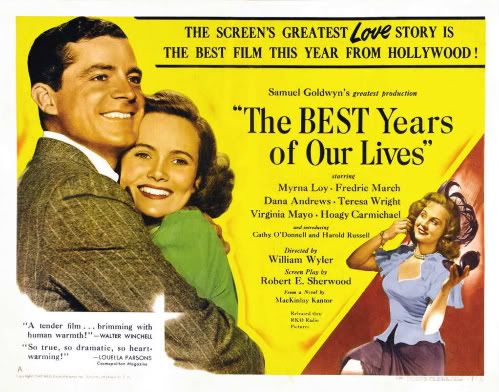
Perhaps the most self-satisfied, self-portrait of America's middle class in the history of cinema is William Wyler's 1946 classic, "The Best Years of Our Lives", whose poster tops these lines. It is accurate in its portrayal of American's mental image of themselves as they returned from the war and looked forward to peace and the end of the hard times that all had known before the war. There is nothing smug about the film: the characters and the action show "normal" people living their lives.

The film won seven Oscars, including "best film". It was a huge success.

Americans paid money, laughed and cried in pleasure to see themselves being themselves.
"The Best Years of Our Lives" was a love song to ourselves that we sung to ourselves.

I can't think of any such self-celebration possible today.

Below the classic poster from 1946, I have put together a mash up of some of the figures from contemporary films who take the place of Myrna Loy, Frederic March and Dana Andrews, populating the dreams of today's movie goers.

It would seem that to engage their fantasy and prosper, you would have to be a magician, or have special powers... or be a robot.

Without getting too far off into cocktail party sociology. Americans today do not appear to see a clear and hopeful path to travel without a cloak of invisibility or the power to levitate.

In my opinion either laissez faire globalization will destroy America's "The Best Years of Our Lives", middle class -- if it hasn't already -- or
America's surviving middle class will destroy laissez faire globalization. It's anybody's guess who will win. DS

Wednesday, March 26, 2008

A timely reprint


David Seaton's News Links
I wrote the text below way back in November of 2006, forgive me for quoting myself, but I find it just as pertinent today... especially when I survey the three candidates that have risen to the top of no less than 300,000,000 people and have the nerve to offer to lead them in times like these.

This is what I mean when I say that Bush is not a cause, only a symptom.


History gives innumerable examples of fools and knaves, physical and mental degenerates, who find themselves ruling hereditary monarchies or inheriting a dictatorship from a murderous and suddenly deceased parent. This is not supposed to happen in a democracy or at least not happen twice: as the saying goes, "Fool me once, shame on -- shame on you. Fool me -- you can't get fooled again."

What is truly terrible and simply shameful and hopefully inexplicable is how a nation of 300M people, with strong democratic traditions, filled with universities and libraries, of legendary wealth and possibilities, could freely choose from among their enormous number a sinister, mean spirited fool and then seeing how he led them from disaster to disaster, choose him again.

The problem isn't Bush. The world is filled with knaves and fools. The question is how Bush got where he is and how got there again.

This is just as interesting a question as how an Austrian clochard and failed watercolorist once became the leader of Europe's most powerful country, the home of philosophers, poets, musicians and scientists.

It is a question that must be answered. So let's stop blaming Bush for being Bush and begin to blame the real culprits.


Who are the real culprits? If this is a democracy, we ourselves are, obviously. DS

Tuesday, March 25, 2008

Image makeover?

The proverbial lipsticked (stuck?) pig
"What does (Obama) offer? First and foremost: his face. Think of it as the most effective potential re-branding of the United States since Reagan. Such a re-branding is not trivial—it’s central to an effective war strategy." Andrew Sullivan, Atlantic

"Last year, there was no question at all about the way Wall Street’s financial contributions to the new Democratic majority in Congress helped preserve, at least for now, the tax loophole that lets hedge fund managers pay a lower tax rate than their secretaries. Now, the securities and investment industry is pouring money into both Mr. Obama’s and Mrs. Clinton’s coffers. And these donors surely believe that they’re buying something in return. Let’s hope they’re wrong." Paul Krugman. New York Times
David Seaton's News Links
Although my readers may have long since wearied, I never tire of repeating that George W. Bush is a symptom of America's decline, not its cause. When a major country becomes decadent, defined as "marked by excessive self-indulgence and moral decay", the reasons are very complex, their roots are hard to trace. The society produces the leaders, not the other way around.

My favorite example of this complexity is the theory that Rome’s decline was brought about by the lead pipe plumbing of the Roman patricians that caused their women to become infertile, thus leaving the empire without leadership cadres.

Following the Roman model, Bush is Caligula’s horse.

Finding the reasons for America’s decline is something that will provide doctoral thesis material for generations of Chinese historians: at his moment, however, we are simply caught in the middle of it.

We have practically no control, or no control at all, over the general situation. In the midst of decadence, anything we can realistically demand, we can only demand of ourselves: stoic lucidity and a human heart. These are times for not only the "inner Lenin", but also the "inner Seneca".

The idiotic Democratic primary race seems to have drained what little seriousness the disastrous Bush presidency had provoked among progressive minded Americans. At this moment the possible knock on effects of the financial sector's meltdown and the Middle East quagmire are certainly more important than the "super delegate" count... Sufficient unto the day is the evil thereof. But those who had begun to read Noam Chomsky, Tony Judt, Chalmers Johnson, Andrew Bacevich, Jimmy Carter, Mearsheimer & Walt, etcetera in record numbers now seem solely concerned with the ruined and creaking structures of Franklin Roosevelt's coalition's smoking debris. The result of all of it will be simply another layer of lipstick on the pig.

Are citizens asking the correct questions?
  • Does anyone really believe that any topflight, professional, national politician, with what national campaigns cost these days, is ever going to confront or bring down a major source of funding like Wall Street?
  • Does the deregulation of the financial sector that has brought about the present meltdown have anything to do with that sector's campaign contributions to both political parties?
  • Does Dolly Parton sleep on her back?
  • Does anyone really believe that any professional American politician of national stature is ever going to apply enough pressure on Israel to insure compliance of UN-242? ...And speaking of Israel and American politicians: where is the little bird brave enough to push that cuckoo's egg out of America's nest?
Is there any solution to any of this?

Good news, bad news.

The good news? Yes there is.

The bad news?

It will take a long time... about twenty years if we start right now.

I believe the possible solution lies in local politics and in the US House of Representatives: politicians that are near to the actual people who vote for them and whose every move can be watched closely by local progressive activists interconnected nationally through countless Internet forums. Politicians whose campaigns would get cheaper as their local reputations grew.

Congresspersons in this movement should be politicians whose greatest ambition is to rise by seniority (that means getting reelected from their district many times) to sit on and to eventually chair the powerful key House committees. Here is power that could be truly controlled by the voters if they kept their elected representatives under a powerful magnifying glass. This movement could be independent of both the Republicans and the Democrats and a President or Senator of either party that defied these powerful Congresspersons would do so at his or her peril. In this way a practical progressive agenda could be pushed forward without submitting itself to the national corporate media circus.

To my mind this is probably the only way real progressive change can ever occur in our present system. DS

Monday, March 24, 2008

Intuition and analysis

David Seaton's News Links
What role does intuition play in analysis?

That all depends, of course, on the analyst.

In my opinion intuition or "gut feelings" only have value in cases where you have immersed yourself in a subject, where concentration has been sufficiently intense for the saturated subconscious to surrender a shortcut to the goal.

The best explanation I can ever remember reading of this selectivity of intuition came from some Indian sage who remarked that the Virgin Mary doesn't appear to devotees of Krishna, nor Govinda to the little shepherd girls of Fatima.

Intuition of this sort has to be subjected in its turn to the same process of concentration and rumination that produced it in the first place. Then, of course, a certain rigor as to the accuracy of the intuitions or "keeping score" has to be in place. This is where the Spanish expression that "the Devil knows more because he is so old than because he is the Devil", comes into play.

I learned the practical aspects of this dialectic of input/feedback/synthesis in a way that is probably not common to most political analysts. For a decade of what many (not me) would consider the best years of their lives, I was a painter (artiste peintre not house). I made a serious attempt at this and managed to show in good galleries and sell enough of my work to live. How I recycled myself into political analysis is another story. Suffice to say here that I never cease to be surprised at how useful the methods developed in painting have been in studying anything else.

What did I learn as a painter besides never to trust an art dealer or buy cheap paint?

In no particular order: that it is fundamental to study the entire space you are working on all the time; that the smallest change in one place changes everything else; that the space around an object is as, or more important than, the object itself; that in every situation, there is a center, perhaps hidden, around which everything in the situation revolves; that, for the clear mind, objectivity and subjectivity are two faces of the same coin... and so on and so on.

Then there are two maxims of Picasso's that go back to the relationship between effort and intuition.
"inspiration exists, but it has to find us working" and of course, "I do not seek. I find" and then too, at least in my particular case, "I am always doing things I can't do, that's how I get to do them".

This all came up because in a previous post I said that I had a feeling of foreboding about Barack Obama and a reader, quite reasonably, inquired, "yeah, well, did you have any intuitions about Bush in 1999?" and funny enough, I did at the time.

I had supported Al Gore during the campaign and he is still my favorite for president today, but in '99, at the time of the election limbo, of "hanging chadsville"... I got this very strong intuitive impression that Dubya's presidency would be "transformational"... as indeed it has been.

Did I have any "foreboding"?

No, just the strong feeling in those sunny, pre-9/11 times that the Bush restoration would bring great change.

Has Bush been terrible?

You bet!

Does that have an upside? Ask Picasso.

"Every act of creation is first of all an act of destruction."

Seen from that point of view the Bush presidency has been very productive.


Here, what I call my "inner Lenin" comes into play. If most of the planet considers, in poll after poll, that US hegemony is the most dangerous and destabilizing element in the world today, then the sooner it ends, the better for everyone and if the cost of maintaining this hegemony absorbs so much of the nation's resources that it is depriving the American people of essentials like health, education and ultimately, old age pensions, the sooner it ends, the better for the American people.

Again Picasso:
"I don't believe in accidents. There are only encounters in history. There are no accidents."

And best of all for closing: "
You mustn't always believe what I say. Questions tempt you to tell lies, particularly when there is no answer." DS

Saturday, March 15, 2008

Race and gender politics are killing the American left

David Seaton's News Links
The American left, which is afraid to touch "class politics" has gotten lost in issues of race and gender.

The real problems of the United States are not about race or sex: it is about social class.

Race and gender are issues that cloud the vision and divide disadvantaged people from their common problems. This is part of the "genius" of the American system, its talent for endlessly dividing, co-opting and distracting dissent.

Being poor is what marks Americans, their children and grandchildren for failure and desperate lives, not sex of gender. American women of color like Michelle Obama or Oprah Winfrey are firmly entrenched in the upper-middle class despite being "victims" of both racism and sexism.


The real victims of the American system are the poor (especially the children) of all colors and sexes. Unlike most other developed countries, in the USA it is almost impossible for them to escape from that condition. Adequate resources are simply not being spent on health and education.

The following analysis of the Obama-Hillary bloodletting by über-neocon, Charles Krauthammer is very insightful. I am certainly not a fan of his; I would consider him what the English used to call, "a nasty piece of work", but, a trained psychiatrist, he is very intelligent and perceptive. DS


Krauthammer: Adventures In Identity Politics - Washington Post
Elections can be about policy, personality or identity. The race between Barack Obama and Hillary Clinton is surely not about policy. The differences between the two are microscopic. It did not start out that way. Last year, when Hillary was headed toward a coronation, she deliberately ran to the center. (...) When she began taking heat for those positions from the other candidates and the Democratic Party's activist core, and as her early lead began to erode, she quickly tacked left and found herself inhabiting precisely the same ideological space as Obama. With no substantive policy differences left, the Obama-Clinton campaign was reduced to personality and identity. Not advantageous ground for Hillary. In a personality contest with the charismatic young phenom, she loses in a landslide.(....) If you cannot successfully pretty yourself, dirty the other guy. Hence the relentless attacks designed to redefine Obama and take him down to the level of ordinary mortals, i.e., Hillary's. Thus the contrived shock on the part of the Clinton campaign that an Obama economic adviser would tell the Canadians not to pay too much attention to Obama's anti-NAFTA populism or that Samantha Power would tell the BBC not to pay too much attention to Obama's current withdrawal plans for Iraq. The attack line writes itself: Says one thing and means another. So much for the man of new politics. Just an ordinary politician -- like Hillary. Power, the maladroit Obama foreign policy adviser, is caught calling Hillary a "monster." A resignation demand nicely calls attention to the fact that the Obama campaign -- surprise! -- hurls invective. And a strategic mention of Tony Rezko, the Chicago fixer who was once Obama's patron, nicely attaches to Obama a whiff of corruption by association. These attacks have a cumulative effect. Obama mania is be What to do? First, adjust your own persona.(...) Did Bill Clinton deliberately encourage racial polarization by saying before South Carolina that one expects women to vote for Hillary and blacks for Obama? Or, after the primary, by dismissing Obama's victory with: "Jesse Jackson won South Carolina twice"? With Bill Clinton, you never know. And there is no proving cause and effect, but the chronology is striking. Two weeks before the South Carolina primary, Obama was leading Hillary among blacks by only 53 percent to 30 percent. Ten days later, Obama was ahead 59 to 25. On voting day, he got 78 percent of the black vote. By the time the campaign trail reached Mississippi on Tuesday, Obama was getting 92 percent of the black vote. And only 26 percent of the white vote. The pillars of American liberalism -- the Democratic Party, the universities and the mass media -- are obsessed with biological markers, most particularly race and gender. They have insisted, moreover, that pedagogy and culture and politics be just as seized with the primacy of these distinctions and with the resulting "privileging" that allegedly haunts every aspect of our social relations. They have gotten their wish. This primary campaign represents the full flowering of identity politics. It's not a pretty picture.(...) The optimist will say that when this is over, we will look back on the Clinton-Obama contest, and its looming ugly endgame, as the low point of identity politics and the beginning of a turning away. The pessimist will just vote Republican. READ IT ALL

Wednesday, January 02, 2008

Iowa on my mind

David Seaton's News Links
Awhile back I wrote:
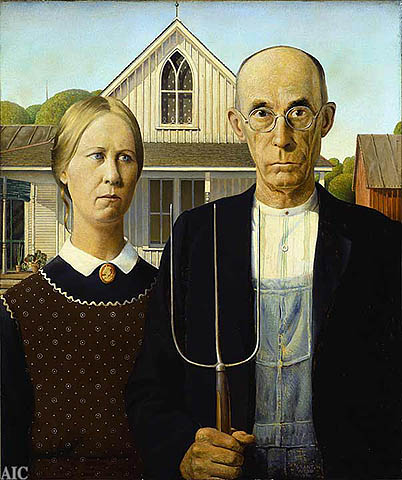
My grandfather was an Iowa farmer who lived on a farm almost exactly like the one in Grant Wood's famous painting and wore Levi bib overalls just like the ones in the picture and pitchforked the same stuff that the farmer in the picture presumably pitchforked with his pitchfork and...
Iowa is deep in my subconscious, I went out there hundreds of times when I was a boy to visit my grandmother who had sold the family farm and moved into Burlington
when my granddad died a couple of years before I was born. They're both buried out there and so is my dad... and so are all of my paternal relatives going back to before Iowa was a state. Great, great uncles and grandfathers of mine served in the Iowa regiments during the Civil War.

My father used to take me out to visit the farm, which was owned by then by the son of a family friend and we used to take the farm tractor and cruise around the fields while my dad told me stories about their life on the farm. The cold (which I have experienced) of the winters without central heating (which I haven't) and the steam heat of the summers near the big muddy. What it's like to plow with a blind Percheron named Jimmy and to clean the shit out from under forty cows at five o'clock on a minus ten morning, before walking through snow drifts to a little red school house.

The last time we went out there, the farm had been sold to an agribusiness and my dad could only locate the place where he was born with a compass taking his bearings from the CB&Q tracks which bordered the property. Nothing was left, not a tree, not a stone, nothing. This is the sort of thing that Europeans only experience because of war and even then they lovingly reconstruct the ruins, but I think most Americans over the age of fifty have a story like this... I've never been back... but I'd like to before I die.

I can live a million years in Europe, learn languages, work on the economy etc, marry a German girl (which is very traditionally middle western thing to do, come to think of it) and still be American down to the ground because of those Iowa roots (ruts). It is a place that leaves fingerprints that just never wash (warsh) off.

It makes me happy that every four years all the men and women who would like to be president have to traipse around Iowa's endless plains and talk to its citizens one by one and drag all the cameramen and journalists cursing the cold behind them. I'm proud that the ground that holds the bones of so much of my DNA is chosen to influence so mightily the history of the world. DS

Tuesday, September 11, 2007

Democratic "kidney failure"

David Seaton's News Links
The center of the problem that Mearsheimer and Walt describe in their book, "The Israel Lobby and U.S. Foreign Policy ", is how politics is financed in the USA. Perhaps you remember this quote from M&W (taken from the Sunday Times):

They quote the experience of a Senate candidate who was invited to visit AIPAC early in his campaign for “discussions”. Harry Lonsdale described what followed as “an experience I will never forget. It wasn’t enough that I was pro-Israel. I was given a list of vital topics and quizzed (read grilled) for my specific opinion on each. Actually, I was told what my opinion must be . . . Shortly after that . . . I was sent a list of American supporters of Israel . . . that I was free to call for campaign contributions. I called; they gave from Florida to Alaska”.

That is really the nub of it, Lonsdale, who was running for the Senate in Oregon received donations from "Florida to Alaska". If people from all over the USA can contribute to local elections in other states, than that opens the door for special interest groups to control America's policies. Senators and congressmen are not representing the people they are said to represent... They can't, and they cannot reform the system either, because all the lobbies would gang together to save the system as it is.

This is a failure of the system and I think it is similar to kidney failure, the body poisons itself and all the other organs fail... and the patient dies.

This "democratic kidney failure" is why Americans are not only joined to Israel at the hip, it is why they have no universal health coverage and it is why the nation is awash is pistols and assault rifles... etcetera, etcetera, etcetera.

Except for a massive, grassroots citizen's movement to reform campaign financing we are literally and without exaggeration looking at multiorganic failure and the death of American democracy. DS

Thursday, May 17, 2007

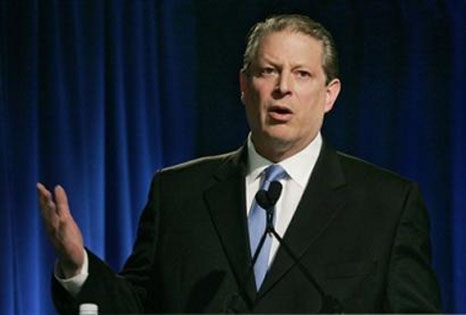
Is Al Gore America's last serious politician?

David Seaton's News Links
Is Al Gore America's last serious politician? Can any other major American politician ask the questions he asks in this Time article... in this manner... with a straight face?

Will America be finally forced to choose between Rudy Giuliani and Hillary Clinton?

Will history record that America's democracy died of terminal silliness? DS

Al Gore: The Assault on Reason - Time Magazine
Abstract: Not long before our nation launched the invasion of Iraq, our longest-serving Senator, Robert Byrd of West Virginia, stood on the Senate floor and said: "This chamber is, for the most part, silent—ominously, dreadfully silent. There is no debate, no discussion, no attempt to lay out for the nation the pros and cons of this particular war. There is nothing. We stand passively mute in the United States Senate." Why was the Senate silent? In describing the empty chamber the way he did, Byrd invited a specific version of the same general question millions of us have been asking: "Why do reason, logic and truth seem to play a sharply diminished role in the way America now makes important decisions?" The persistent and sustained reliance on falsehoods as the basis of policy, even in the face of massive and well-understood evidence to the contrary, seems to many Americans to have reached levels that were previously unimaginable. A large and growing number of Americans are asking out loud: "What has happened to our country?" People are trying to figure out what has gone wrong in our democracy, and how we can fix it. To take another example, for the first time in American history, the Executive Branch of our government has not only condoned but actively promoted the treatment of captives in wartime that clearly involves torture, thus overturning a prohibition established by General George Washington during the Revolutionary War. It is too easy—and too partisan—to simply place the blame on the policies of President George W. Bush. We are all responsible for the decisions our country makes. We have a Congress. We have an independent judiciary. We have checks and balances. We are a nation of laws. We have free speech. We have a free press. Have they all failed us? Why has America's public discourse become less focused and clear, less reasoned? Faith in the power of reason—the belief that free citizens can govern themselves wisely and fairly by resorting to logical debate on the basis of the best evidence available, instead of raw power—remains the central premise of American democracy. This premise is now under assault. READ IT ALL

Thursday, December 14, 2006

Barack Obama: too much, too soon... much too soon

David Seaton's News Links
Barack Obama says all the right things. I even believe he believes what he says; in other words he seems to be a real liberal and not a "brown Blair". It also appears that he has got the brains and even the "world view" necessary to be fabulous President of the United States... but not yet. Just like in boxing, in government, bringing along a hot, young prospect too quickly can ruin them. If elected in 2008 he would become president having even less administrative experience in government then George W. Bush did in the year 2000. Bush, after all, had been the governor of complex, major state. It would be better for Obama to finish his term in the US Senate, which establishes his voting record on all the major national issues and then get elected governor of Illinois and to run that complex state, with its mixture of urban and rural problems and huge budget successfully for two terms. Then Obamamania would not be some self-indulgent, American, "feel good" fad, but a serious, transformational political movement. He might actually make a great president. Running him now would be like taking the young Muhammad Ali straight from his gold medal win in the 1960 Rome Olympics and feeding him directly to Sonny Liston. George Will, an extraordinarily intelligent, well read, paleo-conservative pundit, who opposes everything Obama stands for and has everything to fear if he succeeds, is urging him to run. Obviously Will finds Obama a liberal nightmare and wants him to fail and to disappear. That should be a clear enough signal. DS

Phil Weiss over at New York Observer has some very perceptive things to say about the 'Obama fever', which I've taken the liberty to underline:

"The Obama boom is the American way of turning the corner. The hero-worship Barack Obama experienced in N.H. and the endless references to JFK are, as the senator said, not about him, they're about us. It's a spiritual reclamation. Americans like to think of themselves as idealists, yet our country has been dragged in the moral mud for years by this filthy war. The neocons can talk forever about the necessity to knock off Middle East heads of state as a sniper takes out a hostage-taker (Perle & Frum); but Americans don't like to think of themselves as the authors of assassination, devastation, disease, emigration, etc. They want to think of the world in more hopeful ways. That's what Obama is all about, reimagining the U.S. as a country that embraces progress and idealism. More power to him. READ IT ALL