Showing posts with label Lenin. Show all posts

Thursday, January 12, 2012

Why do they suddenly quote Marx and Gramisci in the Financial Times?

David Seaton's News Links
All of a sudden Karl Marx and Marxist thought are being talked about in the most unlikely places... like the Financial Times. Here is a sample that I identify a lot with from Gideon Rachman, the FT's chief foreign affairs commentator. Like Rachman, when I was a student I couldn't make any sense of Marx either.
"The old is dying and the new cannot be born: in the interregnum a great variety of morbid symptoms will appear.” That statement from the Prison Notebooks of the Italian communist Antonio Gramsci was a favourite of student Marxists when I was at university in the 1980s. Back then it struck me as portentous nonsense. But Gramsci’s observation does resonate now – in an age of ideological confusion. Gideon Rachman - Financial Times
It is a little like what Mark Twain said,
"When I was a boy of 14, my father was so ignorant I could hardly stand to have the old man around. But when I got to be 21, I was astonished at how much the old man had learned in seven years."
Commenting on Gideon's Gramsci quote, I would counter-quote with what Marx himself said on the transition from one historical period to another, something which so many of us feel is happening right now
No social order ever perishes before all the productive forces for which there is room in it have developed; and new, higher relations of production never appear before the material conditions of their existence have matured in the womb of the old society itself.
Quite naturally, there are many people who believe that Marx's thinking is valueless because the Soviet Union collapsed in ruin and that Marx was to blame for it. They forget that Marx didn't create the Soviet Union, Lenin did that, using Marx as an intellectual tool. Where Marx said, not before "material conditions have matured in the womb of the old society itself", Lenin believed that the "new social order" could be delivered by Caesarian section. He was wrong and instead of the the moneyless, classless society that Marx vaguely predicted would succeed our system, Lenin gave birth to a sort of state capitalism, whose definition might have been the old soviet joke, "they pretend to pay us and we pretend to work".
Having said that, it is doubtful if the czarist regime could have ever industrialized Russia, defeated Nazi Germany and put the first man in space as Lenin's creation did. The irony of course being that the USSR's collapse made a perfect example of what Marx had said, that "new, higher relations of production never appear before the material conditions of their existence have matured in the womb of the old society itself." Lenin's C-section revolution produced a rigid, dogmatic system that couldn't adapt to the post-industrial, information society trends. They were the ones that were "old". In the end they were brought down because their brand of "capitalism" was more fragile than ours, which as we are discovering now, doesn't mean that our system isn't also fragile.
In a sense we may be about to die of success, we may be spinning off the road, like a car in an ice storm. We like to think that our system is about "freedom" and democracy, but it is probably about consumption. We produce more and more stuff with fewer and fewer people; pay is stagnant for the mass of consumers, who can only stay in the game with credit, which has dried up. But it was grand while it lasted. That is what the soviet block never managed to do.
Here is a classic joke from the now defunct German Democratic Republic.
A man is walking home from work, when he sees a long line forming in front of a government store, he asks the people what they are in line for and they tell him "lemons"... Frantically he runs home, arriving much earlier than normal, and finds his wife in bed with his next door neighbor, confronting them furiously he shouts:
What are you doing here, don't you know that today they are selling lemons?
What brought the GDR down and the rest of Really Existing Socialism, including the USSR along with it, was not really people's chaffing under the repression of totalitarianism, but rather our system's miraculous ability to produce and distribute an infinite variety of affordable consumer goods, which their godless, planned economy couldn't. Free health care, social equality, guaranteed employment, good schools (Angela Merkel graduated from the University of Leipzig) and guaranteed housing couldn't compete with our cornucopia.
The essence of our system is a quite recent -- and never before in history achieved -- endless variety of things, many of them amazingly cheap, to choose from.  Think about it, you wander into a shopping mall looking to buy some deodorant and you'll be forced to choose between dozens of different brands at many different prices until you find exactly the one that suits your pocketbook or your "unique lifestyle" and image. You can eat your favorite fruit at any time of the year, flown in from the other side of the planet. This is freedom!
However it appears that we produce more and more with fewer  and fewer people and the majority's earning power has stagnated to the point where the newly impoverished would-be consumers can only pay to play by going deeply into debt. And now credit has dried up.
So Marx's idea expressed in "Preface of A Contribution to the Critique of Political Economy", was that when our system reached its full potential, its inner conflicts would cause it to collapse.
What would that "full potential" look like?
Maybe it would be interesting to look into the opinion of venture capitalists, after all they risk their money on predicting that future. I recently stumbled on an interesting one, Steve Jurvetson, who is a partner at Draper Fisher Jurvetson a firm with affiliate offices in more than 30 cities around the world and over $7 billion in capital commitments. The video I am featuring below comes from the Stanford Center for Professional Devopment, and in it Jurvetson speaks about the future. He is a very effective communicator and allthough a lot of what he says sounds like pure science fiction, it most certainly isn't. 
Jurvetson gave the lecture in the video below at Stanford back in 2009 and although it is an hour long, I think that anyone interested in where the world is heading should watch it carefully.  Even stop the video and go back and watch and listen to some parts more than once.


This is the Kurszweil chart that Jurvetson uses in his presentation.  I am putting here so that you can study it it in detail. DS


Wednesday, May 14, 2008

West Virginia and the babushkas


Social engineering is a concept in political science that refers to efforts to influence popular attitudes and social behavior on a large scale, whether by governments or private groups.(...) The most effective way for "social engineering" is through mass media and especially television.(...) Political conservatives in the United States have accused their opponents of social engineering through the promotion of political correctness, insofar as it may change social attitudes by defining "acceptable" and "unacceptable" language or acts. Wikipedia
___________

"The word god is for me nothing more than the expression and product of human weaknesses, the Bible a collection of honorable, but still primitive legends which are nevertheless pretty childish. No interpretation no matter how subtle can (for me) change this." Albert Einstein

"Religion is the opium of the people: this saying of Marx is the cornerstone of the entire ideology of Marxism about religion. All modern religions and churches, all and of every kind of religious organizations are always considered by Marxism as the organs of bourgeois reaction, "
V.I. Lenin
Marxism-Leninism has consistently advocated the control, suppression, and, ultimately, the elimination of religious beliefs. Within about a year of the revolution the state expropriated all church property, including the churches themselves, and in the period from 1922 to 1926, 28 Russian Orthodox bishops and more than 1,200 priests were killed (a much greater number was subjected to persecution). In the 1920s and 1930s, such organizations as the League of the Militant Godless ridiculed all religions and harassed believers. Atheism was propagated through schools, communist organizations (such as the Young Pioneer Organization), and the media. Wikipedia
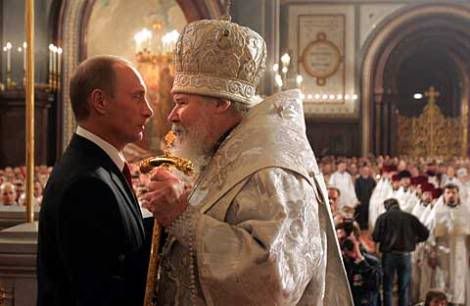
Twenty years ago, any KGB officer found practicing religion would have been promptly sacked. Now, according to the “committed Christian” and Russian leader Vladimir Putin, religion “has a big place” in 21st-century Russia. That place has stretched deep into Russian Intelligence. As a former KGB foreign intelligence officer, Putin has more direct control of intelligence than any Russian leader since Joseph Stalin. One of the distinguishing characteristics of the KGB was its militant atheism. In March 2002, however, the FSB (Putin’s domestic security and intelligence service) at last found God. The Times
_________________________________
"The profound mistake of Reverend Wright's sermons is not that he spoke about racism in our society. It's that he spoke as if our society was static; as if no progress has been made; as if this country - a country that has made it possible for one of his own members to run for the highest office in the land and build a coalition of white and black; Latino and Asian, rich and poor, young and old -- is still irrevocably bound to a tragic past. But what we know -- what we have seen - is that America can change. That is the true genius of this nation. What we have already achieved gives us hope - the audacity to hope - for what we can and must achieve tomorrow." Barack Obama

Victoria Switzer, a retired social studies teacher, was on phone-bank duty one night during the Pennsylvania primary campaign. One night was all she could take: "It wasn't pretty." She made 60 calls to prospective voters in Susquehanna County, her home county, which is 98 percent white. The responses were dispiriting. One caller, Switzer remembers, said he couldn't possibly vote for Obama and concluded: "Hang that darky from a tree!"
Washington Post
David Seaton's News Links
To avoid confusion, I'll put what I think is the moral of this story right up front.
It is important to fight for change, because in the process of fighting you may change yourself, but changing others even for the their own and for the general good may have unforeseen consequences... for them and for you.
Cultures change over time, but it is difficult to intervene in them to change them. It is like a neurosurgeon operating on a deadly brain tumor, a little slip and "oops! There go the piano lessons."

I started out this post with four photos and a slew of quotes about the Soviet Union's effort to eradicate religion. Contrary to what most people in America would think, this was not done out of "evil" intent, but rather with the best intentions imaginable.

Scientific opinion was largely that expressed in Einstein's recently discovered letter: religion was, "primitive and childish". Czarist Russia was a primitive, superstitious and priest-ridden society, well symbolized by the photo of the "mystic" at the top, Rasputin. Therefore Lenin's view was logical: religion existed solely for the "protection of the exploitation and the stupefaction of the working class" and Lenin was the man of action par excellence: Vladimir Ilyich was mister "see snake, kill snake".

The third quote from Wikipedia's article on Soviet atheism, gives a brief outline of the logical measures he and his successors took to effectively rid Russia of such a plague of ignorance and alienation.

Or so it seemed.

During the years of glasnost, before the collapse of the USSR, I was much surprised to learn from Spanish friends who were dealing on a daily basis with Soviet officials that all these loyal Communist apparatchiks confessed that they had been baptized and indoctrinated in the forbidden Christian practices from childhood.

I think that was when I first realized that the Soviet system's goose was really cooked.

This is where the lady in the third photo comes in: the eternal Russian granny, the "babushka".

The babushkas had kept religion alive in Russia.

Now as we see in the last photo, as far as Vladimir Putin, a former KGB colonel, is concerned, "that old time religion" is good enough for him.

All of this just goes to prove that Barack Obama is not the only one with a granny that makes her grandsons cringe.

Over the last 50 years or so, American institutions, especially the armed forces and Hollywood, have moved heaven and earth to change American racial attitudes root and branch, but like with religion in Soviet Russia, I'm afraid that in the USA too, the babushkas have it.

That there is and has been a racist backlash against the effort to eradicate such ignorant and hateful injustice is no secret. Barack Obama himself analyzed it very well in his historic, 'A More Perfect Union' speech.
"(...) these resentments aren't always expressed in polite company. But they have helped shape the political landscape for at least a generation. Anger over welfare and affirmative action helped forge the Reagan Coalition." Barack Obama
And all of this anger has been directed heretofore against surrogates: the Jimmy Carters, the Ted Kennedys, the Walter Mondales, the Dukakises, the Gores and the Kerrys; and all the racism was disguised in euphemisms like "state's rights" or "liberal" or "elitist" or "un-American".

Now for the first time the Reagan Democrats are going to get the chance to actually vote against a real black man who incarnates all the euphemisms, instead of a surrogate.

It won't even need any Rovian sulphur and brimstone, all the thing will have to do is sit there and be: the babushkas have already taken care of it.

I think McCain is going to win this thing if he doesn't have a stroke or a heart attack during the campaign.

That is the bad news.

The good news is that I think that there is going to be a massive splitting of ballots and that the Democrats are going to get comfortable majorities in both houses despite losing the White House. If they had run Al Gore, I think the Democrats might have had their biggest victory since Roosevelt, but being post-60s Democrats they had to blow it. DS

Tuesday, September 18, 2007

One man's Mao is another man's Washington

David Seaton's News Links
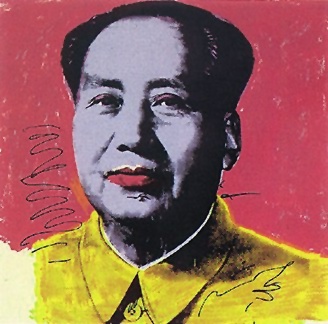
It is interesting that in Russia, both Lenin and even Stalin are still revered and that in China Mao Tse-Tung remains the symbol of the nation, its power and its unity.

Book after book has appeared in the west, year after year denouncing Lenin, Stalin and Mao: their crimes, sexual perversions and even in Mao's case the subject of his personal hygiene (the "great helmsman" was apparently allergic to soap and water), but still the people that suffered them most still revere their memory.

Americans refer to other nation's patriotism as "nationalism" and see that as a bad thing. Great American patriots and founders of the nation like Washington and Jefferson owned slaves and Jefferson's only descendants are black because he sexually exploited the slave girls at his mercy. Revisionist historians are now trying to prove that Abraham Lincoln was gay. Still Americans revere them for the same reason this article in the Los Angeles Times says that the Chinese revere Mao: because "he won the civil war and united China" and "he is remembered for uniting China and setting it on a course for prosperity". The lesson would be that, if you treasure your identity, with a little imagination you will understand that others treasure theirs too... even Iraqis. DS


Mao marches on - Los Angeles Times

Abstract: During a recent visit to Beijing, I was looking at the sky on a clear night when I was startled to see the ghost of Mao Tse-tung staring down at me. The legendary tyrant's mellow, moon-like visage sparkled above a spanking-new shopping center while a hidden PA system amplified his high-pitched Hunan accent: "The Chinese people have stood up!"(...) Mao's space at The Place is both ironic and dead serious. Mao, who branded China with a sharp and cutting anti-capitalist philosophy, is now a brand name in his own right, bestowed with the pride of place in an opulent urban mall, occupying center stage in a slick piece of visual propaganda drawn from archival footage. The Mao show, exalting the lineage of China's Communist Party leadership as an important party congress approaches, is sure to stir a flutter of reflexive pride in the casual passerby, well-heeled shopper and barefoot rag-picker alike. Deng Xiaoping, the late strongman who overturned Mao's legacy and put the workers' paradise on the road to being a shoppers' paradise, is conspicuous by his absence.(...) By and large, the Mao statues that were once so ubiquitous in Beijing are gone, but Mao never really went away. In fact, one can hardly make a purchase in China without seeing his dreamy visage, especially on the 100-yuan bill, the bill of all bills at a time when making money is truly the lifeblood of China.(...) There have been periodic bouts of nostalgia for Mao before, none more potent than the spontaneous popular uprising at Tiananmen in 1989. The demonstrators, despite their media-pleasing democratic rhetoric, had a decidedly Maoist cast. No one understood this better than Deng, the man who ordered the crackdown in fear of being deposed in a second Cultural Revolution. Both Jiang Zemin and Hu Jintao, though anointed by Deng for succession, have done much to stabilize and secure Mao's reputation, in no small part to bolster their own communistic legitimacy while freeing themselves from the Dengist straitjacket. Mao might have been a tyrant, as aloof as an emperor, but he won the civil war and united China, not unlike a ruthless predecessor he was said to admire. China's founding emperor, Qin Shihuangdi, was not a nice man by any reckoning, but he is remembered for uniting China and setting it on a course for prosperity. Every time we utter the word China -- "land of Qin" -- we inadvertently invoke the tyrant's legacy. And so too will Mao's legacy be invoked again and again, rough edges gradually smoothed out over time, reduced to a rounded pebble in a turbulent, ever-changing stream. READ IT ALL

Sunday, July 15, 2007

Islam versus Marxist-Leninism


David Seaton's News Links
What makes the situation today more explosive than the cold war in the difference in ideological potency between Islam and Marxist-Leninism. Marxist-Leninism had a great attraction for young, nationalist intellectual elites in the third world and gave them an organizational structure, international connections and financing for forming a revolutionary vanguard and cadres.

However Marxism never had much attraction in itself for the masses in Muslim countries (or any other for that matter) and neither did proletarian internationalism. A traditional "ultra-nationalist-international" is a contradiction in terms. But, Islam squares that circle: Islam works on the level of the most militant, nationalist chauvinism, while at the same time being totally international constantly searching for common denominators among Muslims everywhere.

In the cold war equation there was no wild card factor like Israel, which at the same time stimulates nationalist and internationalist feelings among the masses and elites alike in Muslim countries. This is what makes political Islam so revolutionary... Really, all that was necessary was to add modern communications (Internet and Satellite TV) and the Israel/Palestinian/Iraq conflict to the waiting Umma to get critical mass. DS