Showing posts with label Mao Tse-tung. Show all posts

Thursday, October 21, 2010

China’s next president: Xi Jinping

China’s next president: Xi Jinping
Xi is China's heir-apparent, in line to succeed Hu Jintao in 2012 as China's top leader. This 56-year-old "princeling"—his father was former Vice-Premier Xi Zhongxun—earned a doctorate in Marxist theory from Tsinghua University but now has a reputation as a supporter of rapid economic reform. Bloomberg - Businessweek

In Chinese politics, loyalty and administrative competence are valued high above personality and principles. The Communist Party stresses its collective leadership, which encourages the rise of leaders like Mr. Xi who are careful consensus builders. A unifying figure at the top is seen as vital to balance a dizzying array of interest groups.
Wall Street Journal
David Seaton's News Links
The Chinese Communist Party fascinates me. I am impressed by how they have managed to avoid the fate of the Communist Party of the USSR or the CPs of  the Soviet's European colonies, whose "revolutions" were the product of a military invasion similar to America's installing "democracy" in Iraq.

The Chinese, who were the last major communist regime standing at the end of the Cold War were left alone facing the lone superpower, the USA at "the end of history"; and not only has the Chinese Communist Party not collapsed: in a sensational exercise of political and economic judo, they have  managed to use the very system of the west in order to increase their power over China and the power of China in the world a hundred fold.

Unlike the corrupt nomenklatura of the Soviet Union, the CCP seems to be a self-renewing meritocracy made up of politically savvy technocrats, people who are well informed about China's "street" and are sensitive to any indication of popular dissatisfaction or unrest.

What I find rather amazing is how little importance is being given to the fact that Xi Jinping has earned a doctorate in Marxist theory and I find a little more amazing still that so many people in positions of responsibility in the west seem to think that the Chinese Communist Party still defining itself as Marxist-Leninist and still revering the figure and the thought of Mao Tse Tung is just a quaint and harmless example of chinoiserie such as calling a stir-fry of chicken, pork, shrimp and veggies a "happy family".

The only excuse I can think of for such frivolity is supine ignorance of all three: Marx, Lenin and Mao.

There have probably never been two more lucid, if unsympathetic, analysts of the capitalistic system than Marx and Lenin and few political strategists in history as insightful and clever as Mao Tse Tung. Anyone who has studied them as living thought and not as simple articles of faith, is armed with very formidable tools of analysis and strategic principals forged in action. And all of this without mentioning the traditional Chinese strategic thinking of the exquisitely subtle, Sun Tzu, who Mao often took as his model.

If more western observers had ever read Lenin's definition of Communism as "Soviet power plus the electrification of the whole country", they might note, that with a little tweaking, that phrase combined with Deng Xiaoping's "black cat, white cat, as long as it catches mice it is a good cat", could be a very workmanlike description of what the Chinese Communist Party is doing right now. And if they gave a few moments to studying Lenin's "New Economic Policy" (NEP), they might find themselves staring at a rough, primitive and tiny model of the survival strategy the Chinese Communist Party is applying today.

And if they read just a little more and studied Mao Tse Tung's essay "On Contradiction" and even more specifically his definitive, "On the Correct Handling of Contradictions Among the People", they might get some idea of what they are looking at.

To get some taste of the subtlety of Mao's strategic thinking, the following paragraph from the latter text might suffice.
In our country, the contradiction between the working class and the national bourgeoisie comes under the category of contradictions among the people. By and large, the class struggle between the two is a class struggle within the ranks of the people, because the Chinese national bourgeoisie has a dual character. In the period of the bourgeois-democratic revolution, it had both a revolutionary and a conciliationist side to its character. In the period of the socialist revolution, exploitation of the working class for profit constitutes one side of the character of the national bourgeoisie, while its support of the Constitution and its willingness to accept socialist transformation constitute the other. The national bourgeoisie differs from the imperialists, the landlords and the bureaucrat-capitalists. The contradiction between the national bourgeoisie and the working class is one between exploiter and exploited, and is by nature antagonistic. But in the concrete conditions of China, this antagonistic contradiction between the two classes, if properly handled, can be transformed into a non-antagonistic one and be resolved by peaceful methods. However, the contradiction between the working class and the national bourgeoisie will change into a contradiction between ourselves and the enemy if we do not handle it properly and do not follow the policy of uniting with, criticizing and educating the national bourgeoisie, or if the national bourgeoisie does not accept this policy of ours.
Careful reading would allow observers to understand that the Communist Party's "embrace" of capitalism is pragmatic and strategic and not some sort of Reaganesque epiphany. That the best path between two points is not necessarily a straight line

And they would be wise to understand that if some sort of crisis in the capitalist system provoked sufficient tensions and "contradictions among the people", China's new millionaires could soon find themselves milking cows and shoveling manure in "reeducation camps",  that is unless their kidneys, livers and corneas weren't already being sold on the world market for organ transplants. DS

Thursday, September 04, 2008

Sarah Palin and the primary contradiction


David Seaton's News Links
Jim Sleeper, over at TPM, has written a very fine post on the Palin effect.

In it he touches on some points that have interested me for some time and which I often write about. In this post I would like to quote Mr. Sleeper and riff on some of his themes.

To begin with he says:
(...) if you didn't sense last night how deeply Sarah Palin channeled some of the country's deepest, most powerful currents of pent-up indignation and yearning, you don't sense the trouble we Democrats are in. (...) Rhetorically, she was the anti-Obama,. She was stirring precisely because she was so artless, matter-of fact, and "American" -- with no cadences or grand, historic resonances, but with plenty of mother wit and shrewdness. Credit her as much as the speechwriters.. The two currents she tapped (...) were riptides of deeply wounded pride and groping loyalty, a yearning for vindication of something that is not to be disparaged at all.

The first such riptide was unleashed by Palin's and Giuliani's accounts of John McCain's career-threatening commitment, a year ago, when his campaign was hopeless, to an American military victory in Iraq, Right or wrong -- and I think it was wrong -- it was a commitment grounded in an uncommon courage that will be dismissed as stupidity only by smart-asses who really want to lose this election.

The second current was tapped by Palin's own grounded, calm confidence that "ordinary people's" common sense - her kind, and a lot of other people's - is what it takes to pull this country through its converging crises.

(...) For some reason, courage and generosity never showed McCain what they showed Dwight Eisenhower in the 1950s -- the true dangers of our military-industrial juggernaut in a world where corporations are more powerful and corrupting than states and where the biggest threats to liberty are no longer taxes-taxes-taxes, and the strongest defense of liberty is no longer what now passes for "national security."

Trapped into making war for laissez faire, conservatives such as McCain and Palin can't reconcile their yearning for a sacred, ordered liberty with their obeisance to every whim of global capital, which is abandoning Palin's small-town America and Obama's urban America, a capital whose injustices and consumer palliatives are subverting our republican institutions and character.

About all this, they haven't a clue. To find one, their folksy common-sense, defiant courage, and religious faith are more necessary than some of us acknowledge or even understand, and therefore we may lose the election.
I think Sleeper's mention of Eisenhower is especially fine. To underline that reference, let me quote from Eisenhower's well known speech before the American Society of Newspaper Editors on April 16, 1953:
Every gun that is made, every warship launched, every rocket fired signifies, in the final sense, a theft from those who hunger and are not fed, those who are cold and not clothed. This world in arms is not spending money alone. It is spending the sweat of its laborers, the genius of its scientists, the hopes of its children. This is not a way of life at all in any true sense. Under the cloud of threatening war, it is humanity hanging from a cross of iron.
Today the situation is much worse, but can you imagine any major American political figure, either Republican or Democrat daring to use such language?

Let us have another look at this wonderful paragraph from Sleeper's post:
Trapped into making war for laissez faire, conservatives such as McCain and Palin can't reconcile their yearning for a sacred, ordered liberty with their obeisance to every whim of global capital, which is abandoning Palin's small-town America and Obama's urban America, a capital whose injustices and consumer palliatives are subverting our republican institutions and character.
This is the center of the whole question, but Sleeper fails to note that neither Obama or Biden or any other major American politician will confront this truth head on or even obliquely. The Democrats are as much a part of the problem, warp and woof, as the Republicans are or ever were.

If Sleeper's paragraph is a masterful summing up of America's central problem. The left should obviously ask "what to do?", which is the question that the left exists to ask.

Obviously the answer is that we should try to change the reality described in the paragraph. The devil, of course, is in the details. Where to begin?

When you organize your days activities, for example, you might make a "to do" list and put the items in order of importance.

One the most useful tools for a political strategist is Mao Tse-Tung's "On Contradiction". Before you laugh and turn away. I suggest you read this quotation from Professor Kishore Mahbubani, the dean of the Lee Kuan Yew School of Public Policy (National University of Singapore), writing about the errors of American foreign policy in the Financial Times:
Mao Zedong, for all his flaws, was a great strategic thinker. He said China always had to deal with its primary contradiction and compromise with its secondary contradiction. When the Soviet Union became the primary contradiction, Mao settled with the US, even though it involved the humiliation of dealing with a power that then recognised Chiang Kai-shek as the legitimate ruler. The west must emulate Mao’s pragmatism and focus on its primary contradiction.
Therefore, if America's domestic "primary contradiction" is what Sleeper calls:
obeisance to every whim of global capital, which is abandoning Palin's small-town America and Obama's urban America, a capital whose injustices and consumer palliatives are subverting our republican institutions and character.
And Eisenhower defines as:
this is not a way of life at all in any true sense. Under the cloud of threatening war, it is humanity hanging from a cross of iron.
Then it follows that following Mao's pragmatic logic, the American left much seek allies on the right in order to confront the primary contradiction. The issue of American jobs being outsourced abroad, for example, is something that could find a broad base of agreement among many Democrats and Republicans.

"Compromising on the secondary contradictions" is very painful, it involves leaving cherished principals waiting at the door while the primary contradiction is being attended to. If American militrism and the military industrial complex are seen as the primary contradiction, than something as dear to the hearts of Democrats as Roe Vs. Wade might have to be sacrificed in order to fight it.
(Full disclosure: I personally am in favor of women's freedom to choose. As a man, however, I think my opinion is, in fact, irrelevant.

While we are at it, I would ask, why are so many working class and lower middle class Americans so fired up about abortion?

Some commentators in the press have criticized Governor Palin for carrying her youngest son to term when she had been informed that he would be born with Down's Syndrome and at the same time, giving birth to such a child is a strong selling point for Palin throughout much of that America that once voted Democratic. This is an issue where people feel deeply on both sides.

My own theory of this relatively recent impassioned interest in the "right ot life", in a country that approves of the death penalty, ties it directly to the new economy.

The argument for aborting a fetus with Down's Syndrome would be that he or she could not live a useful and productive existance and would thus be a burden on its parents and society.

Do you think that if you were a small town American with just a high school education or only a couple of years in a community college, that you might possibly have cause to identify with such a child? Could we say that great masses of what were America's most productive citizens today might be classed as having "special needs" or being a burden on society?

One of the most interesting things that Mike Huckabee said in his campaign, that showed that interesting things are moving under the surface of American Evangelicalism, was that many "right to life" people only seem interested in children before they are born, once they arrive than it's devil take the hindmost. I consider that one of the most important things any politician of the right has said in a long time. There is some important common ground here.

Let's close with another quote from Jim Sleeper's wonderful post:
their folksy common-sense, defiant courage, and religious faith are more necessary than some of us acknowledge or even understand.
Amen. DS

Thursday, May 22, 2008

Maolisa

The rapid reaction by China's government to the earthquake, along with media -- much of it state-run -- that has spotlighted the best aspects of that response to a newly unified public, have all helped enhance the central government's image as responsive and effective. The strong world-wide expression of sympathy, meanwhile, has quieted -- at least for now -- criticism of Beijing's policies in Tibet and elsewhere that had threatened to overshadow its hosting of the Summer Olympics in August.(...) overall, the government's response appears likely to give a meaningful, and potentially lasting, boost in support for China's leadership, analysts said. That is a stark contrast to the Bush administration's handling of Hurricane Katrina in 2005, which was widely criticized in the U.S. as slow and ineffective. The resulting public backlash helped send President Bush's approval ratings, already suffering from economic concerns and the war in Iraq, to their current lows. In China's response last week, the most visible figure was Premier Wen, who has become a populist hero as a result of his actions. While Mr. Bush waited until two days after Katrina made landfall to travel to stricken New Orleans -- and then flew over it without landing -- Mr. Wen arrived in quake-battered Sichuan province within hours after the quake struck on May 12. He spent the next four days traveling from one devastated town to the next, often by helicopter when roads were blocked, comforting the victims and promising more help. Wall Street Journal
David Seaton's News Links
I think it's time to give some serious study and analysis as to what exactly the Communist Party of China really is.

The recent earthquake is China put this huge organization to a brutal test, it responded
humanely, with efficiency, flexibility and imagination in taking care of the victims and simultaneously getting the maximum political benefit from the catastrophe both at home and abroad.

Many people, all over the world, have drawn unfavorable comparisons with the American government's handling of Katrina, a far less damaging crisis, where government at all levels: local, state and federal, showed a bumbling, autistic indifference to the suffering of their fellow countrymen. The much vaunted private sector certainly didn't "step up",
not one leader emerged from that crisis, from the President on down... This in a country that prides itself as no other on the quality of its management science, techniques that are exported to every corner of the earth, to MBA students who learn them and recite them with the devotion of little Muslim boys in a madrassa.

As a management team, the Communist Party of China is obviously agile, responsive and intelligent. Anyone with experience in large collective endeavors knows how difficult it is for such a massive organization to embody any of those qualities. I truly wish that Peter Drucker was still with us to analyze this dancing elephant!

We are looking at something truly formidable: massive and yet flexible. A listening organization and a learning organization.

How does it work? How are decisions taken?
How does it collect information and process it? How does information move within it?

Everything that I read about this organization is colored by politics. What I am interested in is understanding a triumph of management practice, that has taken a feudal country, overrun by foreigners, gained its independence and sovereignty, unified a thousand million people, organized them, and then has shown supreme, pragmatic, flexibility in transforming Really Existing Socialism into dizzyingly successful capitalism.... all without losing control.

What philosophy has remained constant in all of this? Certainly I am going to be looking for books to read this summer, but I don't think I'll find anything written from the angle that interests me. If any of my readers know of any text that would enlighten me I would be very grateful. DS

Friday, November 30, 2007

China : on getting rich with the "little red book"

David Seaton's News Links
If you study modern China, its Communist Party and the Chinese people even a little, you will see that their obsession, with or without Marxism, is to maintain China's unity, sovereignty and independence.


It is not difficult to imagine the unease of the Chinese leadership at the prospect of facing the United States alone in its role as "sole superpower" at the fall of the USSR and its "really existing socialism" and the subsequent "color revolutions" instigated by the USA.

Obviously something had to be done to keep China from returning to its pre-Mao status of client and near-colony of the west and obviously... something has been done.


Reading Mao Tse-Tung's 1957 speech, "On the Correct Handling of Contradictions Among the People", when he talks about joining forces with China's middle class to defeat the Japanese will make this clearer:
"To understand these two different types of contradictions correctly, we must first be clear on what is meant by "the people" and what is meant by "the enemy". The concept of "the people" varies in content in different countries and in different periods of history in a given country. Take our own country for example. During the War of Resistance Against Japan, all those classes, strata and social groups opposing Japanese aggression came within the category of the people, while the Japanese imperialists, their Chinese collaborators and the pro-Japanese elements were all enemies of the people."
That phrase is the key. The Chinese Communists (who still control China) waited to defeat the Japanese before continuing "class struggle": for the Chinese Communist Party the "primary contradiction" was the struggle against the Japanese.

Reading what Mao wrote you will see what is happening now has a long pedigree.

You would have to go back to the "Long March" of 1934 to find the equivalent of China's entry into the global economy. A long retreat, a regrouping, a devastating counter-attack. With its entry sui generis into globalization, China has neatly turned the tables on the United States, firmly entrapping the Americans in their own free trade ideology. DS

Philip Stephens: Global response needed to the shifting world order - Financial Times
Abstract: I was looking the other day at some statistics gathered by my colleague Martin Wolf. A little under 200 years ago, in 1820, China produced about a third of world output and India 16 per cent. The big four European countries accounted for 17 per cent and the US less than 2 per cent. By 1950, the US share had risen to 27 per cent, China’s had fallen to 5 per cent and India’s to 4 per cent. The European Big Four claimed 19 per cent. Now consider the projections, measured at purchasing power parity, for 2015. At 20 per cent, China’s output will match that of the US. These figures may prove inexact but the direction is clear. By some calculations China will easily overtake the US before 2025. (...) after almost two centuries of retreat China has already rediscovered geopolitics. As for India, as a senior US official told me recently, its “soft” power is already felt almost everywhere. The onward march of globalisation is, of course, not ineluctable. At a seminar in Washington recently I heard another official in the high ranks of the US administration remark that he was no longer sure that globalisation was “politically sustainable” in the US. The free trade majority in the Congress had fractured and the impact, as much perceived as real, of outsourcing on middle-class jobs had fanned the flames of protectionism. To this had now been added the strategic, as well as economic, fears generated by the hundreds of billions of dollars in sovereign wealth funds sloshing around in search of assets. It does not help that there are plenty in Washington who believe that strategic conflict with China is inevitable – and better sooner than later. You can detect the same economic anxieties in Europe – and not just in France. Peter Mandelson, the European Union’s trade commissioner, is a champion of open economies. Visiting Beijing this week, however, he added his voice to the criticism of China’s disregard for intellectual property rights and product standards. China’s manipulation of its currency prompts similar ire. Behind the specific complaints lies the deeper concern, felt particularly acutely in Washington. In the aftermath of the fall of the Berlin Wall, globalisation belonged to the developed economies. The opening of goods and financial markets was framed by the so-called Washington consensus. The technology was provided by Silicon Valley. Suddenly it seems as if it belongs to Asia. Globalisation was something the rich countries did to the rest of the world – for the good of all, of course. Now it is beginning to feel like something someone else is doing to them. It does not help, again especially in Washington, that the principal “do-er” is China. The protectionist impulses are overlaid with the strategic fears. Yet it is hard to see how the forces of globalisation could be reversed. (...) It would take a crash to stop it. One possibility would be a sequence in which the world economy slips into recession and weakening world trade provokes the beggar-thy-neighbour protectionism that then turns recession into depression. Another would be a major geopolitical clash between the US and China, perhaps over Taiwan. READ IT ALL

Thursday, November 22, 2007

Thought for Thanksgiving

David Seaton's New Links
I find it curious that the fate of the US dollar now appears to be in the hands of China, which is ruled by the direct heirs of Mao Tse-Tung.

John Lennon sang mockingly in "Revolution",
"But if you go carrying pictures of Chairman Mao, you ain't gonna make it with anyone anyhow".
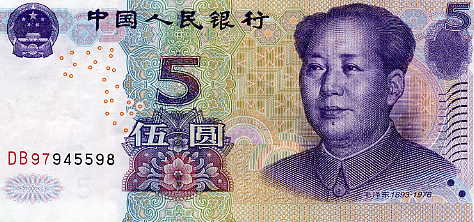
However, if you look carefully you'll find that Mao's picture is on all the Chinese money right at this very moment, so I guess that makes about a billion people "carrying pictures of Chairman Mao".

The idea always was that the opposing internal forces in capitalism, called the "contradictions" would bring it down eventually. The problem is that millenarians, being only human after all, always expect (demand) the millennium in their own lifetime. You could say that all revolutions to date have been impatient "cesareans", producing preemies.

Perhaps the revolution will come finally with a whimper instead of a bang. The big question for Americans in this millenarian, end of capitalism scenario is whether we will be "raptured" or will we be "left behind"? DS

China voices alarm at dollar weakness - Financial Times
Abstract: China on Monday expressed concern at the decline in the dollar, joining a growing chorus of global policymakers alarmed by the weakness in the world’s main reserve currency. Wen Jiabao, the premier, told a business audience in Singapore it was becoming difficult to manage China’s $1,430bn foreign exchange reserves, saying their value was under unprecedented pressure. “We have never been experiencing such big pressure,” Mr Wen said, according to Reuters. “We are worried about how to preserve the value of our reserves.” China keeps the currency composition of its reserves a state secret, but some analysts believe that more than two-thirds are probably still held in dollars. The dollar has dropped 16 per cent this year against a basket of major currencies.(...) Russell Jones, head of currency strategy at RBC, said: “Any respite in the dollar’s weakness is likely to be temporary. The dollar isn’t a safe haven at the moment, because most of the problems facing the world economy are coming out of the US.” Ashraf Laidi, currency strategist at CMC Markets, said “the power in influencing the fate of the dollar lies increasingly with the oil producers as they struggle with a falling dollar.” Mr Wen’s remarks are likely to fuel market speculation that Beijing might move to reduce the proportion of its reserves held in the US currency. READ IT ALL

Tuesday, September 18, 2007

One man's Mao is another man's Washington

David Seaton's News Links
It is interesting that in Russia, both Lenin and even Stalin are still revered and that in China Mao Tse-Tung remains the symbol of the nation, its power and its unity.

Book after book has appeared in the west, year after year denouncing Lenin, Stalin and Mao: their crimes, sexual perversions and even in Mao's case the subject of his personal hygiene (the "great helmsman" was apparently allergic to soap and water), but still the people that suffered them most still revere their memory.

Americans refer to other nation's patriotism as "nationalism" and see that as a bad thing. Great American patriots and founders of the nation like Washington and Jefferson owned slaves and Jefferson's only descendants are black because he sexually exploited the slave girls at his mercy. Revisionist historians are now trying to prove that Abraham Lincoln was gay. Still Americans revere them for the same reason this article in the Los Angeles Times says that the Chinese revere Mao: because "he won the civil war and united China" and "he is remembered for uniting China and setting it on a course for prosperity". The lesson would be that, if you treasure your identity, with a little imagination you will understand that others treasure theirs too... even Iraqis. DS


Mao marches on - Los Angeles Times

Abstract: During a recent visit to Beijing, I was looking at the sky on a clear night when I was startled to see the ghost of Mao Tse-tung staring down at me. The legendary tyrant's mellow, moon-like visage sparkled above a spanking-new shopping center while a hidden PA system amplified his high-pitched Hunan accent: "The Chinese people have stood up!"(...) Mao's space at The Place is both ironic and dead serious. Mao, who branded China with a sharp and cutting anti-capitalist philosophy, is now a brand name in his own right, bestowed with the pride of place in an opulent urban mall, occupying center stage in a slick piece of visual propaganda drawn from archival footage. The Mao show, exalting the lineage of China's Communist Party leadership as an important party congress approaches, is sure to stir a flutter of reflexive pride in the casual passerby, well-heeled shopper and barefoot rag-picker alike. Deng Xiaoping, the late strongman who overturned Mao's legacy and put the workers' paradise on the road to being a shoppers' paradise, is conspicuous by his absence.(...) By and large, the Mao statues that were once so ubiquitous in Beijing are gone, but Mao never really went away. In fact, one can hardly make a purchase in China without seeing his dreamy visage, especially on the 100-yuan bill, the bill of all bills at a time when making money is truly the lifeblood of China.(...) There have been periodic bouts of nostalgia for Mao before, none more potent than the spontaneous popular uprising at Tiananmen in 1989. The demonstrators, despite their media-pleasing democratic rhetoric, had a decidedly Maoist cast. No one understood this better than Deng, the man who ordered the crackdown in fear of being deposed in a second Cultural Revolution. Both Jiang Zemin and Hu Jintao, though anointed by Deng for succession, have done much to stabilize and secure Mao's reputation, in no small part to bolster their own communistic legitimacy while freeing themselves from the Dengist straitjacket. Mao might have been a tyrant, as aloof as an emperor, but he won the civil war and united China, not unlike a ruthless predecessor he was said to admire. China's founding emperor, Qin Shihuangdi, was not a nice man by any reckoning, but he is remembered for uniting China and setting it on a course for prosperity. Every time we utter the word China -- "land of Qin" -- we inadvertently invoke the tyrant's legacy. And so too will Mao's legacy be invoked again and again, rough edges gradually smoothed out over time, reduced to a rounded pebble in a turbulent, ever-changing stream. READ IT ALL