Showing posts with label civil war. Show all posts

Sunday, March 27, 2011

The Neo-Imperialism of a Future Failed State


David Seaton's News Links
After World War Two, Europe's far-flung empires all collapsed within a few years. This was not because Britain, France and the Netherlands had suddenly lost their taste for their colonial possessions, far from it. Their empires collapsed because they could no longer afford to police them. The United States of America, drowning in debt, is looking at a similar dilemma today. 

The USA can simply not afford to continue in its role as "the world's policeman", if it does, there is a serious possibility that the country will go broke. The choice is between standing by watching helplessly as much of the the Third World runs amok or standing by watching helplessly as much of the USA itself runs amok.
The war to get rid of Moammar Gadhafi, the Libyan fashion plate wreck, is already running $100 million a day. (...) But what's $1 billion when we owe China $1.3 trillion -- and the national debt meter keeps running at the rate of $4.12 billion a day, for a current total of almost $15 trillion. Federal spending is up to $3.5 trillion this year with a deficit of $1.3 trillion.  Arnaud De Borchgrave

So here we are pouring shiploads of cash into yet another war, this time in Libya, while simultaneously demolishing school budgets, closing libraries, laying off teachers and police officers, and generally letting the bottom fall out of the quality of life here at home. Bob Herbert's last column in the New York Times

In short, for the first time since the end of World War II, no country or strong alliance of countries has the political will and economic leverage to secure its goals on the global stage.  Nouriel Roubini

It would be a serious blow to western credibility if, having set out to remove Col Gaddafi, the allies failed to do so. But even success in achieving this will represent only a starting point for a voyage into the unknown.  Max Hastings - Financial Times
In today's globalized world, individual states, even powerful and democratic ones, are losing the ability to control events within their borders. Their citizens find themselves helpless, just like the inhabitants of the impoverished, anarchist-hells called "failed states". The term "failed state" is thrown around a lot these days, but how might we define it?

My definition is quite broad.

First I would say that the "state" exists to protect the lives and property of its citizens and to foster their well-being, so any state -- to the degree that it fails to fulfill that assignment -- is a "failed state".

The Oscar winning documentary, "Inside Job" whose trailer tops this page, is a portrait of what appears to be a rich man's "Somalia".  One is surprised by the degree of corruption at the highest level of American government both past and present and even a surprising level (for me at least) of corruption in the intellectual elite of America's most prestigious universities.

Could America ever become a failed state or is that something that only happens to the backward and the primitive?

Many readers will automatically think of  pirate-ridden Somalia, when the words "failed state" flash upon the screen, but "Wiemar Germany", might be a more relevant example of the dangers America and others in the developed world, might be facing going forward.

When studying  the rise of Nazism in the Wiemar Republic, people often attribute it to some diabolic genius on Adolf Hitler's part, genius being by definition exceptional, unrepeatable and therefore inexplicable. On the contrary, I think that what makes studying the Nazi period useful and interesting is that Hitler was anything but a genius.
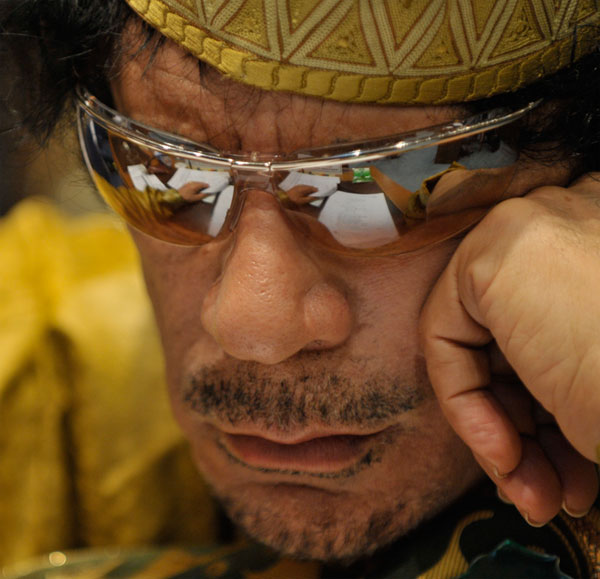
Qaddafi, the new "Hitler du Jour"
I think that instead of being a genius, Hitler was a fool. What other word than "fool" could be used to describe somebody who would declare war simultaneously on both the USSR and the USA, when even a drooling idiot would know that to defeat one of them you would have to be an ally of the other. No, Adolf Hitler was no genius and I would maintain that the world is crawling with people like him:  strutting narcissists, filled with delusions of grandeur, creeps, who if all it took was to simply press a button, would kill millions of their fellow men and women several times a day with intense pleasure.

So, when the drums are beating for war and  the drummers compare Saddam Hussein, Ahmadinejad, Qaddafi, or whomsoever it is this week, to Hitler, in a sense they are right, but the important thing is not in the similarities of their criminal bestiality to Hitler's or to a serial killer of prostitutes for that matter, but the dissimilarities between their tinpot countries and an intellectual, economic and cultural powerhouse like Germany.

The real question for me about Hitler's rise has always been: what objective social and economic conditions were required for a people who had produced Johann Sebastian Bach,  Dürer, Meister Ekhart, Goethe, Kant, Hegel and dozens of others of similar stature, to entrust their lives, fortunes and futures to a bizarre, chaplinesque, psychotic; a failed painter of watercolors: a foreigner from Vienna. In short, if it could happen in a country like that it could happen anywhere given similar conditions of collapse.

My view of this is that only some sort of  political Acute Immune Deficiency Syndrome could open the door to such a man as Hitler in such a country as Germany. It is that form of political AIDS that we have to worry about today, not the individuals who appear when the syndrome is rampant or even the precise ideology they profess when they appear. As I say, the streets are full of bizarre people with vicious fantasies, just as in the same way that our bodies are all infested with a myriad of exotic viruses and germs, which only our healthy immune systems manage to keep at bay. Even in the best of times America produces some very crazy people, so if the bottom ever falls out of the dollar... We are playing with fire.

The lesson of Nazi Germany is not the lesson of appeasement at Munich, but the lesson that every country, no matter how cultured or developed, nurtures its own "inner Somalia" and that when a state fails to protect and nurture its citizens any obscenity is possible. Protecting and nourishing its own citizens, so they don't do something crazy, could be America's fundamental contribution to world peace.

Does this mean that we can do nothing to stop violence around the world? No it doesn't.
There are two fundamental  and relatively economical things we could do that could help eliminate untold misery and violence.

Just as 19th century Britain outlawed the slave trade, we could outlaw the conventional military arms trade and just as they did, we could could use our power and influence to convince other countries to help enforce that ban around the world. That would be cheaper and simpler than firing cruise missiles to destroy those weapons later.

The next thing that America could do to make the world a safer, more law abiding place, would be to close all the tax shelters around the world, where the money from the drug and arm trades is laundered and where money goes to avoid the taxes to pay for public goods such as schools, hospitals and other vital infrastructure. I have often thought that instead of invading Grenada or Iraq, the USA should have invaded the Cayman Islands.

I am sure that just these two measures would remove more threats to peace than all the money poured down the drain in military expense over the last twenty years. DS

Wednesday, November 07, 2007

Born under a bad sign

Born under a bad sign.
Ive been down since I began to crawl.
If it wasnt for bad luck,
I wouldnt have no luck.
If it wasnt for real bad luck,
I wouldnt have no luck at all.
Booker T. Jones and William Bell
David Seaton's News Links
In the same week that oil pushed toward a hundred dollars a barrel, the financial News agency Bloomberg reported that, “The dollar fell to a record low against the euro on speculation financial-company losses from U.S. subprime-mortgage defaults will grow.” New York University economics professor, the always clairvoyant Nouriel Roubini, added, “the ongoing credit crunch will get much worse in the year ahead and its fallout spread from the US to Europe and throughout Asia and the globe. (...) The first crisis of financial globalization and securitization is thus only at its beginning stage.” At precisely this moment Pakistan took another step toward the abyss.

The veteran analyst Arnaud de Borchgrave wrote, “One of the world’s eight nuclear powers, Pakistan is now a failing state out of control where Taliban, al-Qaida and their supporters have secured their privileged sanctuaries in the tribal areas on the Afghan border; reoccupied the Red Mosque in the center of Islamabad; launched suicide bombers in widely scattered parts of this Muslim country of 160 million. More than any other country in the world, Pakistan is the breeding ground of Islamic terrorism.” The New York Times editorialized, “The United States is increasingly left with bad options. Cutting off aid would only make it harder to enlist Pakistan’s military in the anti-extremist fight and renew doubts about America’s reliability as an ally.” The Guardian’s editorial stated it even more baldly, “Gen Musharraf has called Washington and London's bluff, knowing they have no option but to back him. The general has exposed the impotence of the US and Britain to control a key ally with nuclear weapons.” The Pakistani army is the true center of power: all that holds a geographically and ethnically divided Pakistan together and the generals are not about to give up that role. If Musharraf falls, another general will be there to take his place... perhaps one who attends more to his prayers.

A sailor would touch wood and call this the approach of the perfect storm, an astrologer looking at the ephemeris would speak of an inauspicious aligning of the planets, a master of Diamat could speak of contradiction, of quantity becoming quality and a Hindu might simply smile and speak of the "Dance of Shiva". The fact is that the bad news is beginning to accumulate in a most alarming way: catastrophe: war, terrorism, inflation and now the possible collapse of major banks. Any one of these things would itself be a painful blow, taken together they begin to define our time. DS

Monday, March 19, 2007

US in Iraq: Karma watch

David Seaton's News Links
The most important thing to remember about America's invasion and subsequent occupation of Iraq is that it is an unprovoked, criminal, act.

The people who perpetrated it, and especially those who ordered this slow torture and decimation of the people of Iraq are simply criminals and the citizens and institutions who supported them are no less than accessories to horrible crimes.

And unlike Hitler's Germany, no American can ever say that they didn't know all this was or is happening.... America, after all, is a "free country".

All this is not just wet, liberal, "hand wringing", it is simply an understanding of the fundamental sources of America's wealth and power and even what keeps the whole complex beast "airborne".

For unlike Hitler's Germany, one of the pillars of America's power is its commitment to habeas corpus, human rights and the rule of law. America is not an ethnic group, it is an agreement taken freely by people who have come from all over the world to live together in peace and prosperity and to materialize the ideas and hopes of the Enlightenment. Without those ideas, the United States of America is little more than a parking lot... Wal-Mart would be a more appropriate symbol of America than Abraham Lincoln.

Even Joseph Nye's insightful idea of America's "Soft Power," pales into trivial "truthiness" when speaking of presuming to be the embodiment of some of the greatest ideas of Western civilization: freedom, justice, democracy... and then gratuitously violating all those self-proclaimed standards in a "war of choice": attacking a country which had never harmed America, destroying its state, killing, torturing and humiliating the men, raping the women, terrorizing the children and scattering the priceless treasures of timeless antiquity to the winds

The only way for America to recover its prestige -- it would be pretentious to say recover its "soul" -- would be to hand
over all those responsible, beginning with Bush and Cheney, to the International War Crimes Tribunals, where they could be judged in Nuremberg fashion. Sadly, unlike Hitler's Germany, America has not been defeated by a foreign power and its alien ideology... America has defeated itself. DS

Anthony Arnove
- Billboarding the Iraqi Disaster - TomDispatch Abstract: Here is a short rundown of some of what George Bush's war and occupation has wrought: Nowhere on Earth is there a worse refugee crisis than in Iraq today. According to the United Nations High Commissioner for Refugees, some two million Iraqis have fled their country and are now scattered from Jordan, Syria, Turkey, and Iran to London and Paris. (Almost none have made it to the United States, which has done nothing to address the refugee crisis it created.) Another 1.9 million are estimated to be internally displaced persons, driven from their homes and neighborhoods by the U.S. occupation and the vicious civil war it has sparked. Add those figures up – and they're getting worse by the day – and you have close to 16% of the Iraqi population uprooted. Add the dead to the displaced, and that figure rises to nearly one in five Iraqis. Let that sink in for a moment. Basic foods and necessities, which even Saddam Hussein's brutal regime managed to provide, are now increasingly beyond the reach of ordinary Iraqis, thanks to soaring inflation unleashed by the occupation's destruction of the already shaky Iraqi economy, cuts to state subsidies encouraged by the International Monetary Fund and the Coalition Provisional Authority, and the disruption of the oil industry. Prices of vegetables, eggs, tea, cooking and heating oil, gasoline, and electricity have skyrocketed. Unemployment is regularly estimated at somewhere between 50-70%. One measure of the impact of all this has been a significant rise in child malnutrition, registered by the United Nations and other organizations.(...) In those same years, according to the best estimate available, the British medical journal The Lancet's door-to-door study of Iraqi deaths, approximately 655,000 Iraqis had died in war, occupation, and civil strife between March 2003 and June 2006. (The study offers a low-end possible figure on deaths of 392,000 and a high-end figure of 943,000.) But you could travel coast to coast without seeing the equivalents of the billboards, subway placards, full-page newspaper ads, or the like for the Iraqi dead. And you certainly won't see, as in the case of Darfur, celebrities on Good Morning America talking about their commitment to stopping "genocide" in Iraq. Why is it that we are counting and thinking about the Sudanese dead as part of a high-profile, celebrity-driven campaign to "Save Darfur," yet Iraqi deaths still go effectively uncounted, and rarely seem to provoke moral outrage, let alone public campaigns to end the killing?(....) There is a general agreement across much of the political spectrum that we can blame Iraqis for the problems they face. In a much-lauded speech to the Chicago Council on Global Affairs, Sen. Barack Obama couched his criticism of Bush administration policy in a call for "no more coddling" of the Iraqi government: The United States, he insisted, "is not going to hold together this country indefinitely." Richard Perle, one of the neoconservative architects of the invasion of Iraq, now says he "underestimated the depravity" of the Iraqis. Sen. Hillary Clinton, Democratic frontrunner in the 2008 presidential election, recently asked, "How much are we willing to sacrifice [for the Iraqis]?" As if the Iraqis asked us to invade their country and make their world a living hell and are now letting us down. This is what happens when the imperial burden gets too heavy. The natives come in for a lashing. READ IT ALL

Tuesday, January 30, 2007

The Saban Center weighs in on Iran

Haim Saban (right)

David Seaton's News Links
Since involving the United States in an open war with Iran is a primary objective of the Israeli Likud party and the Israel Lobby in the United States, this report from the Saban Center of the Brookings Institute should be read with extra care.

If the objective were really to stabilize Iraq than it seems obvious that the cooperation of Iran, would be essential. That, in fact was exactly the conclusion of the Baker/Hamilton report.

It is only fair to remember that Iran did not invade Iraq or seek to have Iraq invaded and if it is deriving any advantage from the situation, that is simply due to the criminal idiocy of American policies in the Middle East. DS

US must abandon Iraqi cities or face nightmare scenario- Independent
Abstract: The US must draw up plans to deal with an all-out Iraqi civil war that would kill hundreds of thousands, create millions of refugees, and could spill over into a regional catastrophe, disrupting oil supplies and setting up a direct confrontation between Washington and Iran.(...) The unremittingly bleak document, drawing on the experience of civil wars in Lebanon, the former Yugoslavia, Congo and Afghanistan, also offers a remarkably stark assessment of Iraq's "spill-over" potential across the Persian Gulf region. It warns of radicalisation and possible secession movements in adjacent countries, an upsurge in terrorism, and of intervention by Iran, Turkey and Saudi Arabia. Ending an all-out civil war, the report says, would require a force of 450,000 - three times the present US deployment even after the 21,500 "surge" ordered by President Bush this month. Everywhere looms the shadow of Iran. In a "war game" testing US options, the Saban Centre for Middle East Policy at the Brookings Institution found that, as the descent into civil war gathered pace, confrontation between the US and Iran intensified, and Washington's leverage on Tehran diminished. Civil war in Iraq would turn Iran into "the unambiguous adversary" of the US. (emphasis mine. DS) READ IT ALL

Wednesday, January 17, 2007

Fattening frogs for snakes: the US in Iraq... a homely parable

David Seaton's News Links
Bush in Iraq reminds me of a story I once heard about a very drunk self-made millionaire showing off his new mansion to visitors. "See, this house? It's a French château, brought it here stone by numbered stone from the Loire valley... Cost me ahunner million bucks! S' mine! See this carved bronze door with gold inlays, same as in the Vatican? S' mine! See this chandelier, over a thousand pieces, Bohemian crystal? S' mine!" The millionaire led his visitors up the winding stairs. "See, these stairs, Carrera marble, brought specially from Italy? Mine! Old master, genuine oil paintings, Rembrandt, Vermeer? Mine!" He took them into the master bedroom. "See this canopied bed, mahogany, inlaid with ivory, belonged to Louis XIV? Now s' mine!." He peered down at the bed and proudly declaimed, "See this beautiful, blond, young woman sleeping naked in my bed? S' my wife, she's mine!" Through his inebriated fog, he took a closer look at the bed, did a double take, gulped, turned to his visitors and triumphantly said, "See this handsome, athletic young man, sleeping naked in my wife's arms? ... That's me!" DS
The Missing Partner in Iraq - Editorial - New York Times
Abstract: The one crucial assumption behind everything President Bush proposed on Iraq last week was that Washington would have the wholehearted support of Prime Minister Nuri Kamal al-Maliki. None of Mr. Bush’s ideas — his plan to send more American soldiers to fight alongside Iraqi units in Baghdad, his program for jump-starting the Iraqi economy, his hope of reconciling rival sectarian communities and heading off civil war — can possibly succeed without the full cooperation of the Iraqi government.(...) Any hope that this campaign will prove more effective than past failed efforts depends on soldiers’ being able to finally move against Shiite militias. If General Qanbar and Mr. Maliki plan to continue shielding militias like the Mahdi Army, this new drive will be doomed before it begins.(...) Consider also the grisly decapitation over the weekend of Barzan Ibrahim al-Tikriti, Saddam Hussein’s co-defendant and half brother. Two weeks of watching how the lynch mob atmosphere of Mr. Hussein’s execution instantly turned a monster into a martyr throughout the Sunni Arab world should have put Mr. Maliki on notice to get this one right. But whether deliberately or through breathtaking incompetence, the Iraqi government did not get it right, once again fanning sectarian flames. Unless President Bush insists that Mr. Maliki accept specific and enforceable policy benchmarks and timelines — starting with the disarming of sectarian militias — the United States will remain hostage to the Iraqi prime minister and his radical Shiite agenda. READ IT ALL

Tuesday, January 16, 2007

Iran's gallows humor

"In pressing for Saddam’s execution, Iran appears to have reached over America’s head and graphically demonstrated that it is now the preeminent political force inside Iraq." Conflicts Forum
David Seaton's News Links
The grotesque hangings in Iraq of Saddam Hussein and his half brother are diplomatic and even strategic disasters for the United States. They demonstrate that the United States cannot control events to its benefit even where it has had its soldiers on the ground for several years. The bouncing head of Barzan al Tikriti sends a stronger message about American power in the Middle East than the arrival of yet another aircraft carrier battle group to the Persian Gulf. With their non-existent historical memory many Americans may not be picking up the message as clearly as the people in the Middle East do. The Iran/Iraq war that lasted from 1980 till 1988 and where a million human beings perished, has probably been forgotten by most Americans except Elliot Abrahms and Oliver North. It certainly hasn't been forgotten by the Iranians. I have just finished reading the chapters on the Iraq/Iran war in Robert Fisk's wonderful "Great War for Civilization, which should be required reading for anyone trying to understand today's headlines. Reading the book, it is obvious that as William Faulkner said, "the past isn't history, it isn't even past". The Iranians call that war, "The Imposed War" and in it they probably suffered more than any country has suffered since Russia in WWII. The United States supplied Saddam Hussein with poison gas and the permission to use it to keep Iran from winning a war they hadn't begun. There is then, quite a bit of poetic justice in Iran's winning this war in Iraq and in doing so humiliating the United States. If you find what I'm saying in any way exaggerated, I invite you to read Fisk's fine book. DS

Iraq: Beyond the Gallows - Conflicts Forum
Abstract:
Many observers have assumed that Saddam Hussein’s execution was yet another Iraqi “milestone” timed to serve the needs of a struggling American president. Milestone it was, but indications now suggest that this was, on the contrary, a marker that Washington was desperate to forestall. And for good reason: in pressing for Saddam’s execution, Iran appears to have reached over America’s head and graphically demonstrated that it is now the preeminent political force inside Iraq. The Bush administration’s provocative posture towards Iran in recent days could thus say more about what has already happened than about what is yet to come. From the vantage point of the Oval Office, raising the specter of a military confrontation with Iran may in fact seem preferable to facing the greatest humiliation of all: the acknowledgment of an Iranian victory in Iraq. Yet it now appears that Saddam’s ignominious end was exactly that: victor’s justice — Iranian victor’s justice. It is a message from Iran to Iraq’s Sunnis that it is Iran, and not the U.S, that is now the dominant force in Iraq. Iran may have been diplomatic enough to call Saddam’s execution a “victory for the Iraqi people,” but the blunt message heard across the region is that Iran will not relent in asserting its title as the region’s leading power.(...) Another hint of Iran’s role in the execution comes from a recent BBC report, stating that the execution took place “at an especially constructed gallows at a compound that once served as the military intelligence headquarters of the former regime. This was the building where those accused of aiding Iraq’s former foe, Iran, were brought during the Sunni ascendancy.” The message for the Bush Administration should be clear: shifts in military strategy cannot undo the fact that the political struggle for Iraq has already been lost. READ IT ALL

Monday, January 15, 2007

Blue helmets in Iraq: the Marxist Grouchist solution

Rufus T. Firefly (Groucho): Awfully decent of you to drop in today. Do you realize our army is facing disastrous defeat? What do you intend to do about it?

Chicolini (Chico): I've done it already.

Rufus T. Firefly: You've done what?

Chicolini: I've changed to the other side.

Rufus T. Firefly: So you're on the other side, eh? Well, what are you doing over here?

Chicolini: Well, the food is better over here.

"Duck Soup" - Marx Brothers (1933)
David Seaton's News Links
I can't think of a more pitiful admission of total failure than Niall Ferguson's "Marxist-Grouchist" solution for the tragedy of Iraq. Niall Ferguson is a professor of history at Harvard and formerly a great believer in America's imperial 'mission'. Where are the blue helmets supposed to come from? Muslim countries? Okay. Sunni or Shiite? Non-Muslim countries from outside the region? Okay. Who is going to risk the lives of their young people to pull America's chestnuts out of the fire? Who has enough ground troops available even if they wanted to send them? Russia? China? Don't they back Iran? This reminds me of another dialog from "Duck Soup": "Chicolini: You no unnerstan? Firefly: Of course I understand. This is so simple that an eight could understand it... Quick, get me an eight year old child!" DS
Niall Ferguson: Blue-helmet time in Iraq - Los Angeles Times
Abstract: The flaws in Bush's new plan are real enough. But they are not the flaws the Democrats want to name. The most obvious one, articulated (bravely, in view of his presidential hopes) by Sen. John McCain, is that 21,500 extra troops will not be enough. In 1920, when they crushed an insurgency, the British had about one soldier for every 23 Iraqis. Even with the projected "surge," the ratio of Iraqis to Americans will be 174 to 1. Yet even if the president were in a position to send in 215,000 extra men, I doubt they would suffice to halt the civil war. Why? Because, having been the war makers who precipitated Baghdad's descent into anarchy, U.S. forces now lack the legitimacy to be regarded as peacemakers. Bush's medium-term goal of handing over responsibility for law and order to the Iraqi security forces is also fatally flawed. Left to their own devices, those forces will become at best ineffective and at worst active participants in the civil war. For these reasons, I see only one credible alternative to Bush's strategy: U.S. forces should hand over responsibility for Iraq's security not to the Iraqis but to a new force provided by the United Nations. READ IT ALL

Thursday, January 11, 2007

Surge me, Bushman? The reviews pour in

"I have never seen him, in public or private, look less convincing, less sure of himself, less cocky. With his knitted brow and stricken features, he looked, well, scared." Howard Fineman - Newsweek
David Seaton's News Links
The President of the United States (that used to have a real ring about it, didn't it?) announced his plan for victory. He laid an egg. It's easy to gloat, but this is probably the most dangerous moment in international affairs since the Cuban Missile Crisis. As I said yesterday, this man is the most empowered instrument of death in history. Genghis Khan, for example, did it all with bows and arrows; Bush really has WMDs. Bush is looking at a degree of public failure, repudiation and even universal public ridicule that perhaps no other human being has ever had to endure before. His entire life's work (being somebody) is crumbling before the eyes of every human being with access to a TV or the Internet. His reaction may very well be like some George Raft gangster in an old late night movie, "come and get me copper, you'll never take me alive!). I truly doubt that he will let himself be led away quietly. DS
The Real Disaster - Editorial - New York Times
Abstract: President Bush told Americans last night that failure in Iraq would be a disaster. The disaster is Mr. Bush’s war, and he has already failed. Last night was his chance to stop offering more fog and be honest with the nation, and he did not take it. Americans needed to hear a clear plan to extricate United States troops from the disaster that Mr. Bush created. What they got was more gauzy talk of victory in the war on terrorism and of creating a “young democracy” in Iraq. In other words, a way for this president to run out the clock and leave his mess for the next one. READ IT ALL

Mr. Bush's Strategy - Editorial - Washington Post
Abstract: The new plan for the war Mr. Bush outlined last night is very risky. It envisions new missions and dangers for U.S. troops and counts on unprecedented military and political steps by the Iraqi government. The plan is likely to cause a spike in U.S. casualties, while the chances that it will stabilize Iraq are far lower. Moreover, Mr. Bush appears prepared to embrace this approach despite strong opposition from Congress and the public -- setting up a conflict that in itself could hurt the war effort. READ IT ALL

Defiance and delusion - Editorial - The Guardian
Abstract: George Bush's announcement last night that he is going to pour more troops into Iraq was the last throw of the dice in a misconceived enterprise that has dragged his country, this country and the Middle East into a nightmare. The package includes 17,500 more combat troops for Baghdad and 4,000 more marines for Anbar province, the cockpit of the Sunni insurgency. Over $1bn will be spent in economic aid. In return the Iraqis are to promise to crackdown on insurgents, regardless of sect or religion. In opting for a troop surge, Mr Bush has ignored the message of the mid-term elections, the Iraq Study Group, Congress, his own top generals and most world opinion. US generals have difficulty enough maintaining current levels of combat-ready troops and are not convinced that more troops will make any difference. Rather than listen to them, Mr Bush has turned to the right, to those who argue that honour and the America's national interests require fighting on. One senses that "honour" is the more important of the two. READ IT ALL

"Warning Americans that 2007 would be another year of continued violence, bloodshed and American casualties, President Bush unveiled his "new way forward" on Iraq Wednesday evening. But the speech was as much a testament of failure as it was a blueprint for what to do next." Michael Duffy - Time

Poll: Most Americans Opposed to Bush's Iraq Plan - Washington Post
Abstract: A majority of Americans oppose sending additional troops to Iraq as outlined by President Bush in his nationally televised address Wednesday night, and just one-in-three Americans said the plan for more troops and a stepped up combat efforts by Iraqi forces make victory there more likely, according to a new Washington Post-ABC News poll. The findings of the survey, conducted after Bush's primetime speech, represent an initial rebuke to the White House goal of generating additional public support for the mission in Iraq. The poll found that 61 percent of Americans oppose sending more than 20,000 additional troops to Iraq, with 52 percent saying they strongly oppose the plan. Just 36 percent said they back the president's new proposal.(...) Only two in five (40 percent) said the war was worth fighting. While that is slightly better than the 36 percent figure recorded in a poll a month ago, it is consistent with polls dating back almost two years. Similarly, just 34 percent said they approve of Bush's handling of the war, another slight tick up from last month but a measure of the broad disapproval of the president's leadership that has been evident since 2005. Americans are even more pessimistic than before about the state of the conflict. In the new poll, 57 percent said the United States is not winning war, the highest yet recorded. That comes after even Bush acknowledged setbacks and mistakes and after he and new Defense Secretary Robert M. Gates have said they United States is not winning at this point. In December 2005, 56 percent of Americans said the United States was winning the war.(...) Fifty-six percent of men oppose the president's plan while 66 percent of women oppose it. Women also are more likely to support efforts in Congress to cut off funding, with 57 percent saying they would back Democratic moves to do so compared to 48 percent of men. Sixty percent of Americans between ages 18 and 39 support cutting off funding, compared to 51 percent of those between 40 and 59 and 43 percent of Americans over age 60. READ IT ALL

President George W. Bush's plan to boost U.S. forces in Iraq drew fire from Republican senators and from Joseph Biden, the Democratic chairman of the Senate Foreign Relations Committee, who called it ``a tragic mistake.'' The plan is ``the most dangerous foreign policy blunder in this country since Vietnam,'' Senator Chuck Hagel, a Republican of Nebraska, told Secretary of State Condoleezza Rice at a hearing of the committee today. Bloomberg

Surge towards debacle in Iraq and MidEast - Editorial - Financial Times
Abstract: George W. Bush’s new direction in Iraq is certainly not a strategy for victory, whatever that word, which is used ever more desperately by the US president, now means. It may be one last heave. It may be a cover for US withdrawal. But two things are quite clear. Right now, Mr Bush has the support of no more than one in four Americans for this so-called surge of an extra 20,000 or so troops. Very soon, as the already indecipherable ethnic and sectarian patchwork of Iraq is pulled further and even more bloodily to pieces, he will have none. Second, this policy will not succeed in fixing an Iraq traumatised by tyranny and war and then broken by invasion and occupation. But it may end with the US “surging” into Iran – and taking the Middle East to a new level of mayhem that will spill into nearby regions and western capitals. Mr Bush’s body language in the speech bespoke a chastened man. Yet, caught in a wilfully spun web of delusion and denial, he seems still unable to comprehend the depths of the debacle he has caused in Iraq.(...) like everything they have tried since, this is far too little, much too late.(...) It is hard, even for ardent democrats, to see this Iraq as a young democracy fighting for its life, as Mr Bush’s discourse of good guys against bad guys would have it. The invasion has solidified a system divided into sects and operating on the basis of patronage and intimidation. The composition of parliament is nearly two thirds Islamist. There are no institutions.(...) The only feasible way forward is the approach of the bipartisan Baker-Hamilton commission – which the new US Congress should embrace and insist on.(...) “Iran is providing material support for attacks on American troops” he said on Wednesday. “We will disrupt the attacks on our forces. We will interrupt the flow of support from Iran and Syria.” The Iraq surge is beginning to look like the Vietnam escalation, spilling over into Iran and Syria the way that one did into Cambodia and Laos. Mr Bush is right to argue that defeat in Iraq would be very serious. He is wrong in failing to recognise defeat is what he is staring at – and that this approach will help guarantee it. READ IT ALL

The speech reflects a profound misunderstanding of our era. America is acting like a colonial power in Iraq. But the age of colonialism is over. Waging a colonial war in the post-colonial age is self-defeating. That is the fatal flaw of Bush's policy.
Zbigniew Brzezinski - Washington Post
(To be continued)

Tuesday, January 09, 2007

Opening the gates of hell - Wall Street Journal

David Seaton's News Links
When "Bush41", James Baker and Brent Scowcroft decided not to go all the way to Baghdad at the end of the First Gulf War it was because they knew that the possibilities of exactly the sort of catastrophe facing "Bush43" today were high. This was not because these men were especially clairvoyant or were "speaking in tongues", but because that was the opinion of most people with deep knowledge of the region. The potential for disaster in Mesopotamia has been evident from the days of T.E. Lawrence and Gertrude Bell. In other words the idea that Iraq could fall apart and take with it the entire jerrybuilt construction that Sykes and Picot had cobbled together out of the ruins of the Ottoman Empire was not exactly "rocket science", but in reality the opinion of most reputable experts at the time. Therefore, if only as hypothesis, I think we might begin to contemplate the idea that this disaster has been deliberately provoked. By whom?

The "usual suspects" in all the popular conspiracy theories surrounding the invasion of Iraq have always been "Oil and Israel". What could this "dynamic duo" possibly gain from such a hecatomb and horror? To begin with, if all the Muslims begin to fight with each other everywhere, the pressure on Israel to evacuate "Judea and Samaria" would lessen dramatically. What about the price of oil rocketing over $100 a barrel? Well, that would mean some huge profits for oil companies and remember that if Texas were an independent republic it would be a major member of OPEC... after all,
Texas was the first "Saudi Arabia". Sound nutty? You bet it does! Nuttier than the great "democratic renaissance" of the Middle East? "May you live in interesting times," is a famous Chinese curse. DS
Allies See 'Nightmare' In Iraq - Wall Street Journal - pg A1
Abstract: As President Bush prepares to unveil his latest Iraq strategy, Arab allies are worried about what might happen if the plan fails: that worsening strife could engulf the entire region, sparking a wider war in the middle of the world's largest oil patch. The potential of a much larger regional conflict that pits Sunnis against Shiites is increasingly on the minds of both Arab leaders and U.S. military planners, according to regional diplomats and U.S. officials. Some are calling such a possible outcome the "nightmare scenario." A wider conflict appears more plausible now because, even as Iraq is separating along sectarian lines, regional dynamics are shoving neighboring nations into two rival camps. On one side is a Shiite-led arc running from Iran into central Iraq, through Syria and into Lebanon. On the other side lie American allies Saudi Arabia, Jordan and Egypt, along with Persian Gulf states such as Qatar and the United Arab Emirates. These Sunni regimes are horrified at the emerging, increasingly radicalized Shiite bloc, largely financed and inspired by Iran, Arab diplomats say.(...) The Saudis have warned the Bush administration that they are prepared to aid the Sunni militias in Iraq if the Sunni population there becomes imperiled, a Saudi diplomat said. Jordanian officials have told the Pentagon that they may move troops into Iraq's uninhabited western desert as a buffer if events there spiral out of control, according to U.S. military officials. Turkish officials, who are grappling with a separatist Kurdish movement in their country, say they would oppose the creation of an independent Kurdistan in northern Iraq. They also say they are prepared to defend Iraq's Turkmen population, who share a common ethnicity with Turkey's majority population, should it come under attack. Even Syria, which the U.S. alleges has been abetting the conflict, is expressing alarm over the potential fracturing of Iraq.(...) The U.S. is also pushing a wide-ranging strategy to persuade its Sunni allies that it is serious about counteracting the rise of Iran -- in exchange for Arab help in Iraq and the Palestinian territories. Key to the effort is the continued promise to keep U.S. forces in Iraq for as long as necessary. But the U.S. is also beefing up U.S. forces in the Persian Gulf and plans to deepen security cooperation with Gulf allies. The Pentagon has proposed sending a second carrier battle group to the Gulf region. There are also advanced plans under way to knit together the air-defense systems of the six smaller Gulf states, including Qatar, Oman and the United Arab Emirates, and to build a U.S.-administered missile-defense system. Similarly, the Air Force is laying plans to step up exercises with Arab allies in the region. One proposal calls for the U.S. to hold combined air exercises with Oman and the UAE.(...) Under one scenario, sketched by Mr. White of the Iraq Study Group, Iraq's Shiites would launch an extensive campaign to drive the Sunnis out of large areas of central Iraq. Fearing a rout of the Sunni population, Saudi Arabia would finance a large-scale counteroffensive, funneling aid to former Iraqi military officers through Jordan, which has longstanding ties to Iraq's Sunni military class. Egypt would do its part by providing guns, munitions, artillery and vehicles. "What people forget is that the Sunnis comprise nearly the entire top brass of the former Iraqi army and nearly all of the old Republican Guard," says Mr. White. "You give them the guns and proper equipment and they will become a formidable force against the Shiite militias." The possibility of a full-blown civil war in Iraq dissolving into a regional conflict "is a scenario that nearly everyone was rejecting just a few months ago," he says. "Not anymore." READ IT ALL (subscription)

Thursday, January 04, 2007

The Neocons can't please anybody it seems

David Seaton's News Links
In Spain there is a description of ultra-Catholics as "mas papista que el Papa", "more papist than the Pope". You could say that America's right wing Jews are "more Zionist than the Israelis". Israel has to be experienced to be understood: you'll never find so many nuances in such a small space, anywhere. Certainly nothing there, where the blood is daily on the floor, is as simple as it might appear to the Perles, Foxmans, Krauthammers and Krystols, busy working out their damp fantasies of violence in the banal suburbs of the USA. DS
Israeli Experts Say Middle East Was Safer With Saddam in Iraq - The Forward
Abstract: Although few tears were shed in Israel over Saddam Hussein’s death last week, a small but growing chorus — including government officials, academics and Iraqi émigrés — is warning that Israel could find itself in more danger with him gone, and that it might even regret having welcomed his toppling. “If I knew then what I know today, I would not have recommended going to war, because Saddam was far less dangerous than I thought,” said Haifa University political scientist Amatzia Baram, one of Israel’s leading Iraq experts.(...) “Retrospectively, justice has been done,” Deputy Defense Minister Ephraim Sneh told Israel Radio this week. Still, he cautioned, Israel must now be concerned “about what is liable to happen in the future.” Saddam’s death, Sneh warned, could lead to “a reinforcement of Iranian influence in Iraq.” He said that Iraq had turned into a “volcano of terror” following the war, with “destructive energies” that could spill over into Jordan and Israel. Such misgivings, though rarely aired publicly for fear of offending Washington, reach high into Israel’s security establishment. Yuval Diskin, director of the Shin Bet security service, told a group of students in a military preparatory program last May that Israel might come to regret its support for the American-led invasion in March 2003. “When you dismantle a system in which there is a despot who controls his people by force, you have chaos,” Diskin said, unaware that the meeting was secretly recorded. “I’m not sure we won’t miss Saddam.” The tape was later broadcast on Israeli television.(...) “Saddam’s regime was preferable — not only for us but for all the states in the region, except for maybe the Iranians,” Barak said. “Saddam held together a divided, tribal, hostile state of Sunnis, Shi’ites and Kurds. He was a single man who made all decisions, and he was a rational leader. The moment he was gone, everything fell apart.” READ IT ALL

Wednesday, January 03, 2007

Iraq: hard questions

David Seaton's News Links
Is the descent into civil war and anarchy in Iraq, and the Sunni/Shiite split that is developing there, really what was planned in the first place? Is this conflict, which may soon engulf the world's entire Islamic community, the real objective of the invasion of Iraq? As the disaster unfolds, we can see that Iraq with its mixture of oil and ethnic tensions, which was artificially cobbled together at the end of WWI, is a center of gravity of the Middle East and by extension much of the Muslim universe. By destroying the Iraqi state apparatus, have the props been knocked out from underneath the entire jerry-built edifice that the British and French constructed from the remains of the Ottoman empire? Were the doubts that kept George H.W. Bush, James Baker and Brent Snowcroft from pushing on to Baghdad in the First Gulf War, precisely the germ of the strategy for the present conflict? In other words: is what, up till now, has appeared to be only the effects of colossal ignorance, stupidity and poor organization, in fact a deliberate strategy of breathtaking cruelty and malice? Have the neocons, with their links to the Israeli ultra-right, maneuvered the United States into provoking a worldwide civil war among Muslims? DS

Tuesday, January 02, 2007

Iraqi refugees... yet more shame

David Seaton's News Links
Don't you wish you could read some news from Iraq that didn't make you feel deeply ashamed? DS


US criticized for limiting Iraqi refugee intake to 500 - Guardian

Abstract: Humanitarian groups have criticised the United States administration for failing to pull its weight in providing for up to 3 million Iraqis displaced from their homes, with the official quota for the number of Iraqi refugees to be allowed into the US this year standing at just 500. Aid organisations report a rapidly mounting crisis of refugees inside Iraq and in neighbouring countries as thousands flee sectarian violence every day. The United Nations estimates that more than 1.5 million Iraqis are displaced within the country and a similar number are living as refugees in Jordan, Syria and elsewhere. The US administration laid down the quota of 500 Iraqi refugees for 2007 last September. It has a further 20,000 refugee places that are unspecified and could be allocated to Iraqis, but the administration has failed to provide funds even to meet its identified programme of 50,000 refugees from specific regions in 2007. So far, only 41,000 places have been funded. Robert Carey, head of resettlement at the New York-based International Rescue Committee, said a long-term refugee crisis was being created, with many of those fleeing so traumatised that they had vowed never to return to Iraq. "The need is extraordinary. From what we have heard and seen, the situation in Iraq and neighbouring countries is rapidly degrading and could destabilise the entire region. The need goes far beyond what is being offered, and only real leadership and commitment within the administration will change that," Mr Carey said. READ IT ALL

Tuesday, December 12, 2006

Wise words on war - George F. Kennan

David Seaton's News Links
Mark Danner has a fine article on Iraq in the New York Review of Books. In it he quotes George F. Kennan, who with Dean Acheson was perhaps the greatest American diplomat of the 20th century. In the fall of 2002, at the age of 98, he is quoted saying one of the wisest and most succinct things I've ever read about war or conflict in general... even to level of harsh words. Let me share it with you. DS
"Anyone who has ever studied the history of American diplomacy, especially military diplomacy, knows that you might start in a war with certain things on your mind as a purpose of what you are doing, but in the end, you found yourself fighting for entirely different things that you had never thought of before. In other words, war has a momentum of its own and it carries you away from all thoughtful intentions when you get into it."
George F. Kennan -October 2002

Monday, December 04, 2006

Tipping point: Coming to grips with failure in the Middle East

David Seaton's News Links
Today, UN Secretary General Kofi Annan said, "If I were an average Iraqi, obviously I would make the same comparison, that they had a dictator who was brutal but they had their streets, they could go out, their kids could go to school and come back home without a mother or father worrying: 'Am I going to see my child again?' The society needs security and a secure environment for it to get on. Without security, not much can be done - not recovery or reconstruction." There is a moment when failure becomes 'official', a moment when Paul Krugman asks, "How do you ask a man to be the last to die for a bully’s ego?" This moment is called the "tipping point", when people start running for the doors. Many Americans have trouble realizing how bad things really are at this moment; the American managerial class, mostly lives cocooned in the comfortable banality of the suburbs, . But in the Middle East, where rich and poor... they are all of them staring death and chaos straight in the face, every day... for them, all this is all very real. At bottom I think both Americans and the people of the Middle East thought the USA was much more powerful than it really is. All of us still lived with the image of the omnipotent America of the 1950s and 1960 in our heads and together we are having to face the truth. Only facing that truth is a much more serious business in the Middle East than in an American suburb. DS
Mideast allies near a state of panic - Los Angeles Times
Abstract: Instead of flaunting stronger ties and steadfast American influence, the president's journey found friends both old and new near a state of panic. Mideast leaders expressed soaring concern over upheavals across the region that the United States helped ignite through its invasion of Iraq and push for democracy — and fear that the Bush administration may make things worse. President Bush's summit in Jordan with the Iraqi prime minister proved an awkward encounter that deepened doubts about the relationship. Vice President Dick Cheney's stop in Riyadh, the Saudi capital, yielded a blunt warning from the kingdom's leaders. And Secretary of State Condoleezza Rice's swing through the West Bank and Israel, intended to build Arab support by showing a new U.S. push for peace, found little to work with. In all, visits designed to show the American team in charge ended instead in diplomatic embarrassment and disappointment, with U.S. leaders rebuked and lectured by Arab counterparts. The trips demonstrated that U.S. allies in the region were struggling to understand what to make of the difficult relationship, and to figure whether, with a new Democratic majority taking over Congress, Bush even had control over his nation's Mideast policy. Arabs are "trying to figure out what the Americans are going to do, and trying develop their own plans," said Sen. Jack Reed (D-R.I.), one of his party's point men on Iraq. "They're trying to figure out their Plan B." The allies' predicament was described by Jordan's King Abdullah II last week, before Bush arrived in Amman, the capital. Abdullah, one of America's steadiest friends in the region, warned that the Mideast faced the threat of three simultaneous civil wars — in Iraq, Lebanon and the Palestinian territories. And he made clear that the burden of dealing with it rested largely with the United States. "Something dramatic" needed to come out of Bush's meetings with Iraqi Prime Minister Nouri Maliki to defuse the three-way threat, Abdullah said, because "I don't think we're in a position where we can come back and visit the problem in early 2007."(...) Expressing deeper unhappiness with the United States, leaders from Jordan, Egypt and Persian Gulf countries told Rice during her trip to an economic development conference in Jordan on Friday that the U.S. had a responsibility to solve the Israeli-Palestinian conflict, which they and many analysts viewed as the key to regional stability. Amr Moussa, secretary-general of the Arab League, urged greater U.S. action, warning that the Middle East was becoming "an abyss…. The region is facing real failure." READ IT ALL

Bush the great surrealist - Niall Ferguson - Los Angeles Times

premonitions of civil war - Salvador Dali

David Seaton's News Links
Niall Ferguson is an unapologetic imperialist and certainly very conservative, closer to a 'vieux-con' than a neocon. He is however a man of interesting insights such as the following, "The great category error of our time is to equate radical Islamism with fascism. If you actually read what Osama bin Laden says, it's clearly Lenin plus the Koran. It's internationalist, revolutionary, and anticapitalist-rhetoric far more of the left than of the right. And radical Islamism is good at recruiting within our society, within western society generally. In western Europe, to an extent people underestimate here, the appeal of radical Islamism extends beyond Muslim communities.", which is one of the most intelligent things I've ever read about bin Laden and Islam's future in the west. For his unabashed advocation of imperialism, Ferguson, a professor at Harvard and Cambridge, was once a favorite of the neocons. One can see in this article from the Los Angeles Times, that he is washing his hands of them and all who sail in them. He also takes the lead in discovering the Surrealist vein of Bush.The idea is beginning to take hold that Bush like Captain Queeg in "The Caine Mutiny" is not in his right mind, is a danger to the ship and must be relieved of command. Those Americans who have always laughed patronizingly at Latin America's military coups are in a position to finally understand how their seeds take root when systemic, political, decadence reigns. DS
Abstract: In Kurt Vonnegut's "Slaughterhouse-Five," the hero has a hallucination — or, perhaps, a vision. A veteran of the strategic bombing of Germany, he turns on his television to be confronted by the uncanny spectacle of history played in reverse. American planes fly backward over Germany, sucking the bombs upward and miraculously extinguishing the flames sweeping through Dresden.(...) I wonder if a similar vision has flickered tantalizingly through the mind of the Iraq Study Group's James A. Baker III: a vision of the Iraq war in reverse. American soldiers, some dead, some maimed, would pick themselves up from the dust of Mesopotamia. Iraqi insurgents would suck the rocket-propelled grenades out of the American Humvees and allow them to reverse all the way back to their bases. Saddam Hussein would be freed from jail, then taken to a hole in the ground where his beard would withdraw back into his chin. After a while, all the Americans would gather in Baghdad and cheer as a statue of Hussein was put back on a plinth. Symbolically, a Stars and Stripes flag would be used to unveil it. As a parting act of philanthropy, U.S. planes would suck dangerous explosives out of Iraqi power stations, ridding the country of the only weapons of mass destruction that were ever there. Unfortunately, time's arrow travels in only one direction, though its precise arc can never be predicted. We are where we are, and there is no going back.(...) On Thursday, Bush struck again. "This business about graceful exit," he told reporters, "just simply has no realism to it at all." Yes, to hell with realism. As for talking to the Iranians (another study group priority). to hell with that too. "Iraqis are plenty capable of running their own business," the president declared, "and they don't need foreign interference from neighbors that will be destabilizing the country." Just in case Baker missed that, the president threatened Tehran with "isolation" if it does not abandon its nuclear program. Only one man in the world can outdo Bush when he is in this kind of Dali-esque form — Iranian President Mahmoud Ahmadinejad. Connoisseurs of his surrealist style were given a treat last week in the form of a letter from Ahmadinejad "To the American People."(...) When confronted with such master practitioners of the politics of surrealism, it's hard to know how far back you'd have to go to sort this whole mess out. To find a credible Iraqi prime minister, I'd say you'd need to rewind the tape to 2004, when the opportunity was missed to crush Sadr's Mahdi army. To get to the last credible American president, you'd need to get to 2000. and give the election to Gore. But to find an Iranian leader who wasn't a dangerous fanatic? All the way back to 1979, before the revolution, I fear. Yes, it's been a pretty long road to this slaughterhouse. But, as Vonnegut says, so it goes. READ IT ALL

Thursday, November 30, 2006

Laundry list of failure, with no benchmark to measure it

David Seaton's News Links
In the clip below, Robert Scheer compiles a laundry list of failure in Iraq. We are looking at a disaster that dwarfs Vietnam by a magnitude. The Vietnam war was a terrible thing for the USA and especially for South East Asia, but it went no farther than that. The possible knock on effects of the collapse into anarchy of the Middle East are impossible to calculate. I don't think there is any precedent of such a complete disaster in US history which would give people some perspective. If you say to a German or a Russian, even if they are young, "WWII"... They know what that means from Grandma's table talk. If you talk to an American about "civil war" it conjures up visions of blues and grays, Matthew Brady and "Gone with the Wind"... If you say "civil war" to a Spanish kid it means grandpa buried in a mass grave in a ditch outside the village. Americans just don't have any benchmark to realize how deep in the shit they are. The Baker Commission is said to be recommending a withdrawal, but Bush still talks about "finishing the job". Amazing days are ahead. We may yet see Nancy Pelosi as president... Cheney has a heart attack and Bush is led off drunk in a strait jacket. DS
Robert Scheer - Abstract: Having idiotically dug ourselves a terribly deep hole in Iraq -- remember when protesters against the war were mocked for using the word "quagmire"? -- Bush is now forced to beg Syria and Iran to throw us a rope. As the Bush-appointed and James Baker-led Iraq Study Group has telegraphed, the cooperation of these two pariah states is essential to an effective exit strategy. In reality, this is not so much a change in policy as it is an acknowledgement of a truth-on-the-ground that has been clear since the invasion 44 months ago: Our sworn enemies were the biggest beneficiaries of our overthrow of Iraq's secular dictatorship.(...) And don't expect Tehran's theocrats to be magnanimous in victory. The key message from Ayatollah Khamenei on Tuesday was, as the BBC headline put it, "U.S. troops must leave Iraq if security is to be restored."(...) So it is that Iraqi President Jalal Talabani was so desperate in his pleas to the ayatollah, admitting that, "We are in dire need of Iran's help in establishing security and stability in Iraq." Of course he is, because six years of Bush's foreign policy has had the presumably unintended consequences of elevating radicals and theocrats into positions of dominance throughout the region, from Iraq, Lebanon, the West Bank and even, this past week, to the oil emirate Bahrain, where Shiite and Sunni radical Islamists split elections in an upset. "It looks like our parliament will be dominated by people who see themselves only as Sunnis or Shiites," said Fowad Shihab, a political science professor at Bahrain University. "These are the same Islamists that are gaining control across the Arab world." Simply put, the neoconservative geniuses who believed invading Iraq would bolster both U.S. and Israeli interests in fact have accomplished the exact opposite -- handing both military and public-relations victories to their sworn enemies. Similarly, the international movement to restrain the proliferation of nuclear weapons has been struck a possible death blow as a desperate United States may be forced to accommodate Iran's nuclear ambitions, just as it did those of Pakistan. READ IT ALL

Wednesday, November 29, 2006

It's all the Iraqi's fault, really.... yechh!

David Seaton's News Links
All my life I've been hearing about the dangers of "isolationism": how if America minded its own business the world would go to hell in a hand basket. Obviously the complete opposite is true: if America doesn't mind its own business the world will go (is going) to hell in a hand basket. Corrupt institutions, including the press and a gullible people fed on lies and manipulation have visited death and desolation on another people who had done them no harm and then, failing miserably, blame the resultant catastrophe on the victims. Truly such inept and incompetent Americans should retire to what is now known in Newspeak as the "Homeland" and devote themselves to that one activity in which they are universally acknowledged as supreme: shopping. Come to think of it, isn't that what Bush advised the American people to do after 9-11? Didn't Alice in Wonderland, in the Disney version, sing, "I give myself such very good advice"? DS

As Iraq Deteriorates, Iraqis Get More Blame - Washington Post
Abstract: From troops on the ground to members of Congress, Americans increasingly blame the continuing violence and destruction in Iraq on the people most affected by it: the Iraqis.(...) This marks a shift in tone from earlier debate about the responsibility of the United States to restore order after the 2003 invasion, and it seemed to gain currency in October, when sectarian violence surged. Some see the talk of blame as the beginning of the end of U.S. involvement. "It is the first manifestation of a 'Who lost Iraq?' argument that will likely rage for years to come," said Bruce Hoffman, a Georgetown University expert on terrorism who has worked as a U.S. government consultant in Iraq. Americans and Iraqis are increasingly seeing the situation in different terms, said retired Army Col. Jeffrey D. McCausland , who recently returned from a visit to Iraq. "We're just talking past each other," he said, adding that Americans are psychologically edging toward the door that leads to disengagement. "We're arguing about 'cut and run' versus 'cut and jog.' "(...) The blame game has also been playing out somewhat divisively within the secretive Iraq Study Group. (...) "I'm tired of nit-picking over how we should bully the Iraqis into becoming better citizens of their own country," former CIA Middle East expert Ray Close wrote in an e-mail to the other advisers to the study group. Several other experts of various political stripes said this tendency to dump on Baghdad feels like a preamble to withdrawal. "It's their fault, and by implication not ours, is clearly a theme that's in the air," said retired Army Col. Andrew J. Bacevich, a Vietnam veteran and longtime skeptic of the war in Iraq. (...) "People never understood the culture and the challenges that we faced in trying to build a new Iraq," a senior U.S. intelligence official said. "There's incredible frustration . . . but it also shows a great deal of ignorance." "Definitely," said Paul Rieckhoff, who served in Iraq as an Army officer in 2003-2004 and went on to found a veterans group critical of the conduct of the war. "It is growing into an angry, scolding tone." He said he finds it "sad" -- "especially after all the talk of our mission to 'save the Iraqis.' " The long-term effect of blaming Iraqis also could be poisonous, said Juan Cole, a University of Michigan specialist in Middle Eastern issues. He predicted that it will "infuriate the Iraqis and worsen further the future relationship of the two countries."(...) During a surprise visit to Baghdad on Oct. 5, Rice said with uncharacteristic bluntness that the security situation was not helped by "political inaction."(...) "Our role is not to resolve those issues for them," Rice told reporters last month after pressing Maliki to be bolder about disbanding militias and reconciling sectarian differences. "They are going to have to resolve those issues among themselves." READ IT ALL

Monday, November 27, 2006

A Modest Proposal: Bring Back Saddam - LAT

David Seaton's News Links
This article from the Los Angeles Times is a bit like Swift's "A Modest Proposal". Briefly, The author of "Gulliver's Travels" proposed that, since the Irish had so many children and so little to eat they should eat their children or sell them to be eaten. The question in Iraq always was, "did Iraq create Saddam or did Saddam create Iraq?". The answer now is obvious. DS
Abstract: The debate about Iraq has moved past the question of whether it was a mistake (everybody knows it was) to the more depressing question of whether it is possible to avert total disaster. Every self-respecting foreign policy analyst has his own plan for Iraq. The trouble is that these tracts are inevitably unconvincing, except when they argue why all the other plans would fail. It's all terribly grim. So allow me to propose the unthinkable: Maybe, just maybe, our best option is to restore Saddam Hussein to power. Yes, I know. Hussein is a psychotic mass murderer. Under his rule, Iraqis were shot, tortured and lived in constant fear. Bringing the dictator back would sound cruel if it weren't for the fact that all those things are also happening now, probably on a wider scale.(...) Restoring the expectation of order in Iraq will take some kind of large-scale psychological shock. The Iraqi elections were expected to offer that shock, but they didn't. The return of Saddam Hussein — a man every Iraqi knows, and whom many of them fear — would do the trick. The disadvantages of reinstalling Hussein are obvious, but consider some of the upside. He would not allow the country to be dominated by Iran, which is the United States' major regional enemy, a sponsor of terrorism and an instigator of warfare between Lebanon and Israel. Hussein was extremely difficult to deal with before the war, in large part because he apparently believed that he could defeat any U.S. invasion if it came to that. Now he knows he can't. And he'd probably be amenable because his alternative is death by hanging. I know why restoring a brutal tyrant to power is a bad idea. Somebody explain to me why it's worse than all the others. READ IT ALL