Friday, August 03, 2012

Bibi Netanyahu and Israel's primal fallacy

David Seaton's News Links

Bibi-1
(David Grossman) said he feared that Netanyahu and Barak would bomb Iran partly out of a perceived strategic need to back up their threats with action, but also because of what he sees as Netanyahu’s sense of historic responsibility to save the “people of eternity.” “He has this idea that we are the people of eternity, am ha’netzach from the Bible, and our negotiations, as he sees it, are with eternity, with the primal currents of history and mankind, while the United States, with all due respect, is just another superpower like Rome or Athens or Babylon, and we’ve survived them all,” said Grossman. “I’m afraid that this way of thinking might encourage Netanyahu to take the step” of attacking Iran. The Nation
David Grossman, along with Amos Oz, is Israel's most prestigious writer and considered by many Israelis as the "conscience of the country". He has given an interview in The Nation on Israeli prime minister Benjamin Netanyahu's rush to war with Iran which is terrifying. I find Grossman's insight into Bibi's mind endlessly frightening and disturbing, Up til now I had thought that Netanyahu was a common and garden variety thug... now I think he might be seriously insane
If Grossman is right, that Netanyahu's believes that Israelis are "the people of eternity", and that Israel's negotiations can only be with "eternity", (whatever that is) this means that Israel is governed right now by someone who is crazier than any Ayatollah in Iran... Frankly that idea of negotiating with the "primal currents of history and mankind" has a certain weird, Nietzschean-Wagnerean ring to it: the distilled, national-mystical, vapors of fascism.
So Israel, so small and vulnerable, is now apparently ruled by a madman.
This takes me to what I call "Israel's primal fallacy".
That fallacy is the proposition that the Jewish people will only be safe when they are gathered together in a land where they are the sole inhabitants and depend entirely on their own power to defend themselves and  that land must be in the tiny, biblical Israel.
I think if you proposed to the Jewish people's greatest enemy in history, the idea that half the Jewish people in the world should gather together in a very small area, a territory where they could be utterly annihilated in the space of a couple of hours, that monster would think it a brilliant idea: such a time saver.
Any infantryman will tell you that soldiers under fire should never bunch up, but rather spread out... that is a soldier's rule one. Not having crazy officers might be rule two.
Israel is breaking both rules.
My opinion is that the two greatest defenses ever possessed by the Jewish people, going all the way back to the days when Moses led them out of bondage in Egypt, are:
One: The United States Constitution, whose rules seem to be holding up better than the Bible's in the years since it was written.
and
Two: America's immense spaces.
In short I believe that the "promised land" of the Jews is the United States of America, where Jews can be as Jewish as they want (see Brooklyn's Hasidim) or as assimilated (see Noam Chomsky) as they wish and participate, à la carte, in  the mainstream of an amazingly varied human tapestry (see Walt Whitman) ... all in perfect safety.
Even the West Bank settlers (most of whom seem to already be US citizens) could make a pilgrimage to what I would call "eretz yiArizona", where they could keep their guns and try their luck at hassling Mexicans... America has something for everytbody... if you don't see what you want just ask.
Not only that, perhaps most importantly of all, the United States of America is probably the only country in the world that truly loves Jewish people, where they have actually created much of what the world knows and loves of America. What I am afraid of is that disasters flowing from the "people of eternity" mysticism could in any way sour that "promised land". DS

Thursday, August 02, 2012

Thomas Friedman attacks Adelson, Netanyahu, AIPAC and the Israeli hard right

David Seaton's News Links
Certain people have more credibility than others when talking about certain subjects. For example, if Warren Buffet says that rich people should pay more taxes, nobody would accuse him of fomenting "class warfare". 
That is because he will be the one that ends up paying all those taxes and he will have to endure the frosty reception from his fellow billionaires at social functions. In short he is credible when he speaks about rich people and their duties to society.
This brings me to a recent column of Thomas Friedman's in the New York Times, entitled, "Why Not in Vegas?", where he attacks with unusual ferocity, Israel's prime minister, Benjamin Netanyahu, the Israeli hard right, the casino magnate, Sheldon Adelson, who is bankrolling Mitt Romney, and AIPAC itself.
First Buffetwise, let us set out Thomas Friedman's credentials in making this attack. Here is an excerpt from his Wikipedia entry:
Friedman is Jewish. He attended Hebrew school five days a week until his Bar Mitzvah(...) He became enamored of Israel after a visit there in December 1968, and he spent all three of his high school summers living on Kibbutz Hahotrim, near Haifa. He has characterized his high school years as "one big celebration of Israel's victory in the Six-Day War." Friedman studied at the University of Minnesota for two years, but later transferred to Brandeis University and graduated summa cum laude in 1975 with a degree in Mediterranean studies. (...) After Brandeis he attended St Antony's College at the University of Oxford on a Marshall scholarship, earning an M.Phil. in Middle Eastern studies.(...) Friedman joined the London bureau of United Press International after completing his Master's degree. He was dispatched a year later to Beirut, where he lived from June 1979 to May 1981 while covering the civil war there. He was hired by The New York Times as a reporter in 1981, and redispatched to Beirut at the start of the 1982 Israeli invasion of Lebanon. His coverage of the war, particularly the Sabra and Shatila massacre, won him the Pulitzer Prize for International Reporting (shared with Loren Jenkins of The Washington Post).(...) In June 1984, Friedman was transferred to Jerusalem, where he served as the Times Jerusalem Bureau Chief until February 1988. That year he received a second Pulitzer Prize for International Reporting, which cited his coverage of the First Palestinian Intifada.
So, not only is Thomas Friedman Jewish, but he has studied the Middle East in depth, lived there, speaks the languages and can be considered knowledgeable and committed by any standard I can imagine.  Whether you agree with him or not, (I rarely find myself reading off the same page as he does, especially on globalization) he is someone fully qualified to speak about the relations between Israel and the USA. 
Here is a snippet of what he wrote in the New York Times:
I have one question and one observation about Mitt Romney’s visit to Israel. The question is this: Since the whole trip was not about learning anything but about how to satisfy the political whims of the right-wing, super pro-Bibi Netanyahu, American Jewish casino magnate Sheldon Adelson, why didn’t they just do the whole thing in Las Vegas? I mean, it was all about money anyway — how much Romney would abase himself by saying whatever the Israeli right wanted to hear and how big a jackpot of donations Adelson would shower on the Romney campaign in return. Really, Vegas would have been so much more appropriate than Jerusalem. They could have constructed a plastic Wailing Wall and saved so much on gas.(...) So how about all you U.S. politicians — Republicans and Democrats — stop feeding off this conflict for political gain. Stop using this conflict as a backdrop for campaign photo-ops and fund-raisers. Stop making things even worse by telling the most hard-line Israelis everything that they want to hear, just to grovel for Jewish votes and money, while blatantly ignoring the other side. There are real lives at stake out there. If you’re not going to do something constructive, stay away. They can make enough trouble for themselves on their own. 
This is not the first such attack. In December of 2011 he wrote the following about the Israeli prime minister Netanyahu's appearance before the US Congress in the New York Times:
I’d never claim to speak for American Jews, but I’m certain there are many out there like me, who strongly believe in the right of the Jewish people to a state, who understand that Israel lives in a dangerous neighborhood yet remains a democracy, but who are deeply worried about where Israel is going today. My guess is we’re the minority when it comes to secular American Jews. We still care. Many other Jews are just drifting away. I sure hope that Israel’s prime minister, Benjamin Netanyahu, understands that the standing ovation he got in Congress this year was not for his politics. That ovation was bought and paid for by the Israel lobby. The real test is what would happen if Bibi tried to speak at, let’s say, the University of Wisconsin. My guess is that many students would boycott him and many Jewish students would stay away, not because they are hostile but because they are confused. 
Many gentile readers will say to themselves that Friedman can get away with saying such things and using such unvarnished language because he is Jewish. That isn't so.  Exactly the opposite really. Many Jewish people, especially older ones, seem convinced that all gentiles are latent antisemites, just waiting to turn and rend them, so Friedman's attack would be considered just par for the course if it came from a gentile. From a Jewish person it stings.
The Jewish people have a long and perfectly justifiable reluctance to wash their community's dirty linen before strangers. Thomas Friedman, is not a secular Jew in the sense that Noam Chomsky is, Friedman is an observant Jew who participates actively in the life of his synagog and by speaking out so forcefully against the government of Israel and AIPAC, he is drawing a moral line in the sand which he may well suffer in defending, even among, or especially among, people close to him. It is necessary to understand this in order to properly value his stand.
Here is how his earlier article was treated in Commentary Magazine:
(...) let’s address one of the primary slanders at the heart of his piece: that the standing ovations Israeli Prime Minister Benjamin Netanyahu received last spring were “bought and paid for by the Israel lobby.” Rather, they were the result of the fact that the overwhelming majority of Americans–Jew and non-Jew alike–think of Israel as a friend and ally.(...) The notion that the only reason politicians support Israel is because of Jewish money is a central myth of a new form of anti-Semitism which masquerades as a defense of American foreign policy against the depredations of a venal Israel lobby. This canard not only feeds off of the traditional themes of Jew-hatred, it also requires Friedman to ignore the deep roots of American backing for Zionism in our history and culture.
Why are Jewish Americans like Thomas Friedman and Peter Beinart,  exposing themselves to such abuse?
In my opinion this is because, in the world's most ancient prophetic tradition, Friedman and others like him, can see a nightmare scenario about to unfold in the Middle East, a war that may spread unpredictably throughout that entire region and even beyond, perhaps sucking in great powers on opposing sides, a war with a domino effect that may well push the entire world economy off the edge and into a full blown great depression, with unforeseeably sinister social consequences; a disaster that will affect the lives of every American, especially the most vulnerable, and will bring the curse of all humanity on the heads of those seen to have caused it. 
Someone credible has to speak out.
I consider Thomas Friedman a brave and patriotic American and I salute him. DS

Tuesday, July 24, 2012

The pain in Spain and America's iron jaw

David Seaton's News Links
This remobilisation of Spanish society, lulled into comfort and complacency during the boom years, in some senses recalls the fevered political and street activity of the transition to democracy after the death of the dictator Francisco Franco in 1975. Yet it is more amorphous and experimental, bypassing politics and Spain’s increasingly tarnished institutions.(...) A salient feature of the present crisis – beyond the immediate drama of Spain’s cost of borrowing and the broader eurozone crisis – is the extent to which Spain’s institutions, the linchpins of the vibrant democracy Spaniards painstakingly built after Franco, have been battered. Financial Times
I don't usually like to blog here about Spain, where I live, because I would have to spend too much time explaining the context of a very complex reality to the majority of my readers, who probably come to that reality burdened with a multitude of cliches about Spain, cliches that I find too boring to clear away. I write about politics, I'm not a travel writer.
I'll make a bit of an exception now in order to explore the advantages that come wrapped in Spain's weakness and the disadvantages for the American people inherent in America's enormous natural strength.
Spain, unlike the USA, is by nature poor, with few natural resources, with practically no rivers of any commercial use, a dry, rocky, challenging terrain that has always made communication between its regions difficult. It is also an extraordinarily beautiful land, but as any farmer of Iowa's flat, boring landscape will tell you, "pretty land is bad land to farm". 
It is a landscape that breeds hardy, fibrous and energetic men and women. This ungenerous, hardscrabble, land is what drove the conquistadors to discover and conquer the Americas take its gold, and create what was then the world's largest empire.
When that empire fell apart Spain languished until Europe's post war prosperity lifted all the boats and finally provided Spain with the capital necessary to modernize its infrastructure and give opportunity for the Spanish people, called "the Prussians of the south", to express again their native energy by building Europe's fourth largest economy.
Today Spain is trying to dig itself out of the debris of an enormous real estate bubble created out of the euphoria of finally finding low interest money in their pockets after centuries of privation.
As the snippet from the Financial Times above indicates this has led to a massive questioning of the basic construction of the Spanish state. In other words, in the midst of disaster the Spanish people are discovering, in the words of Marx and Engels that,
"All that is solid melts into air, all that is holy is profaned, and man is at last compelled to face with sober senses, his real conditions of life, and his relations with his kind."
And I would maintain that such a facing with sober senses the real conditions of one's life and the relations with one's kind, is one of the most beneficial exercises a human being could undertake in the short time he or she is given to live. I think it was Socrates that said that an unexamined life wasn't worth living. And it is trying to imagine the American people en masse ever waking up to the extent that Spanish people are waking up now, that leads me to meditate on the advantages of weakness and the deadening, sluggish, tyranny of strength.
I have observed over the years that those who can drink large quantities of alcohol without showing its effects are the ones who die of cirrhosis, that the boxers that can't be knocked down, no matter how hard they are hit, are the ones that end up punchy and I wonder if this also applies to the living flesh of the common people of a country whose elites are the most wealthy and powerful and self satisfied in the history of our species.
The United States of America is so big, so populated, so rich, with such a smug and layered plutocracy, so tyrannized by endless interest groups that I cannot imagine the American people ever taking to the streets in a general strike or even more tragically, I cannot imagine that it would ever make any difference at all to their reality if they did. DS


Monday, July 23, 2012

James Holmes: a budding neuroscientist runs amok

David Seaton's News Links
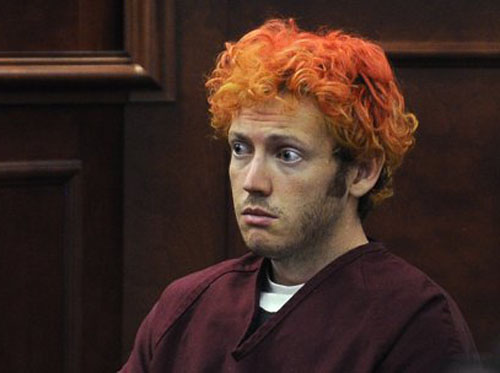
James Holmes
So this is just what one of America's many faces is going to be a bitterly divided, hatefully cynical country where insane people have easy access to semi-automatic weapons, and occasionally use them to commit senseless atrocities. We will continue to see more and more of this sort of thing, and there's nothing we can realistically do about it. The Economist
You have to be away from America for awhile to fully realize what a stone-crazy place it is.
I'm beginning to get interested in James Holmes' story, so many of the elements don't fit together
He was a brilliant, scholarship student, with no history of mental illness (a bit of a loner, which is normal in a person of high intelligence) but invariably described as "nice", even "sweet", with no problems of concentration, no history of weirdness, or "inappropriate behavior", safe around children, going for his doctorate in neuroscience...
Suddenly, out of nowhere, he drops out of school and acts out the standard, American as apple pie, run-amok: collecting guns and ammunition and shooting up an apparently random crowd of innocents... With his hair dyed red like a clown, after booby trapping his apartment.
A budding neuroscientist?
Didn't his neuroscience teachers notice anything?
What triggered all this?
I get the feeling there is a story here worthy of Truman Capote... any thoughts? DS

Tuesday, July 17, 2012

What exactly is the USA?

David Seaton's News Links
Right now the question would have to be: what exactly is the USA??

The people?

The system?

The economy?

Whose economy?

What exactly is the USA?

This is really important in America's case, more so than in other countries, because "American" isn't an ethnic group or a religion or even a language and shared history; people move around a lot and are not deeply rooted and to top it off the family structure isn't very strong. All of these factors are what normally make up a "nationality". So the question, "what exactly is the USA" is something every new generation of Americans has to answer... and I believe it is getting more difficult.
When, back in the 50s "Engine Charley" Wilson enunciated his famous formula: "what is good for General Motors is good for the USA and vice versa", he was probably right, or it least  the phase made  some sense at that time. Today, could you say something like that about General Motors or substitute any other American corporation's name for GM's? Would it still make any sense? Try it with "Goldman Sachs".
Right now, we are looking at the possibility that the economy may "recover", but that its "recovery" will not mean any jobs. So we have to go back to the original question, The people? The system? The economy? Whose economy?  What exactly is the USA?
I think that the difficulty in answering this question, "what exactly is the USA", is what makes the situation much more worrisome today than the crisis of the 70s or even the 1930s. DS

Wednesday, July 11, 2012

Globalization: King and country

David Seaton's News Links
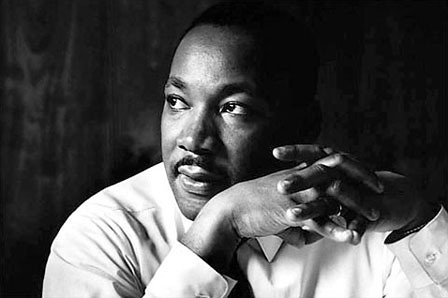
Martin Luther King
We are white mice participating in a great historical experiment.
The idea of completely untrammeled, frictionless capitalism has only been a theoretical construct till now, but we are almost there today.
There are basically two -- untried -- theories of how this would play out.
On one hand the free market liberals believe that, if not interfered with, the markets will bring mankind an endless cornucopia of good things that will lift all boats.

On the other hand Marx believed that left to its own devices, the system would tear itself apart.

Us white mice have front row seats at this experiment, rather like crab lice at the birth of Jesus.

All over the world and increasingly in developed countries like the USA, this metastasizing process of anarcho-capitalism that I call "stateless-imperialism" is producing a hardening mass of misery, which in America is known as the "working poor": an intractable class of unemployed, or underemployed human beings, or if they have work (often needing several jobs to get by) they are invariably overworked, over exploited, always underpaid, socially excluded and in general, politically inert. These are America's untermenschen, living in what is said to be the richest, most powerful country in the history of the world. A place which fills its mouth with phrases like, "all men are created equal" and washes it down with the greatest levels of inequality on the planet... even greater than in India.

Once again Indian metaphors arise, and this is because the Indians have been working on codifying this social stratification for thousands of years. So looking at their caste system will give us a clearer idea of where we are headed.
Everybody has heard of "untouchables", but many people that are unfamiliar with the workings of India's ancient caste system are probably unaware that there are categories way below the untouchables called the "unapproachables" and the "un-seeables". That is to say human beings you cannot share open space with and other human beings you cannot even lay eyes upon without being polluted.These last two categories are most applicable to today's gated-community, America.
"We've got the message. But my college kid, the babysitters, the nails ladies -- everybody who's got the right to vote -- they don't understand what's going on. I just feel like if you're lower income -- one, you're not as educated, two, they don't get how it works." guest at a Romney Hamptons fundraiser (hat doonesbury)
And paradoxically, America's affluent usually choose members of this underclass to take care of their children and cook their food.  However, except for that strange intimacy, the wealthy have put as much mental and physical space as they can between themselves and this mass of suffering humanity, denying them even a decent education and healthcare... This in the richest and most powerful country in the history of the world. No high caste Indian could be colder or crueler then then America's wealthy, not even get close. India is our future, nearly our present, not some exotic oddity.
Martin Luther King, America's most successful social activist's greatest influence was Mahatma Gandhi, so, not so indirectly, Gandhi may be one of America's most influential thinkers
King took as his model Gandhi's tactics and more importantly, perhaps, Gandhi's seamless infusion of political activism  with a spirituality that allowed King to connect on a deeply emotional plane with Americans of all colors and creeds just as Gandhi did with Indians.
Today, in great part thanks to Martin Luther King, America's "untouchables" are no longer so rigorously color coded, however these days, many who once sat comfortably at America's groaning table now have become familiar with the humiliation of un-aproachibility and invisibility, to add to their precarious hardscrabble existence without adequate healthcare or education.
In many ways Dr. King was more successful than Gandhi, that an African-American sits in the Oval Office today is the living proof of his success.
Today what is missing from the left is the emotional energy that came from MLK's Gandhian infusing of activism with spirituality.
In his 2008 campaign Barack Obama showed that Americans are still moved by the beauty of our English language when it invokes social justice... That there was little practical follow up to the "soaring rhetoric" in no way invalidates the revelation that many Americans are hungry for another social leader like Martin Luther King. For me that is the challenge that faces the American left in defending what should be its natural constituency, America's working poor. DS

Monday, July 09, 2012

The World Economy: into the Wild Blue Yonder

David Seaton's News Links
 Jet
It would be comforting for many to imagine that our globalized economy is a conspiracy,  a murky cabal, directed from the shadows by some Bilderberger-ish, ecumenical-protocol, of sinister "elders", who are pulling all the strings.
I say comforting because presumably, if sufficiently intimidated, the people who got us into this mess could easily pull their strings and get us out.
However, I am afraid that instead of being something so tidy, there are no identifiable human hands on the controls of our world and the whole thing is simply on automatic pilot...
How does that work?
I could illustrate that with an old joke I recall.
An airliner takes off full of people and a metallic voice comes over the speaker system:
"Welcome aboard Acme Airlines flight 505 to London, the first totally automatic flight in aviation history, this is your computerized control system speaking, totally free from any possibility of human error, there is no pilot on board,. We hope you enjoy your flight. We will be flying at an altitude of 30,000 feet, 30,000 feet, 30,000 feet, 30,000 feet, 30,000 feet, 30,000 feet, 30,000 feet, 30,000 feet, 30,000 feet, 30,000 feet, 30,000 feet, 30,000 feet, 30,000 feet, 30,000 feet, 30,000 feet, 30,000 feet, 30,000 feet, 30,000 feet,  30,000 feet....
That is where I think we are right now. No one is in charge: the system itself has taken over and has no idea of the future but to grow endlessly.
In globalization, the deregulated system expresses itself freely qua-system and even the famous buttinsky billionaires like Sheldon Adelson or the Koch Brothers and their Tea Party accolytes are mere puppets, reacting like Pavlovian pooches to the stimuli produced by the unshackled world mishagoss, as are those politicians they use their billions to influence (buy, bribe).
I call this system "stateless-imperialism".
Classical state imperialism could be illustrated by the 19th century British empire's destruction of India's native textile industry and forcing Indians to buy cheap, industrially produced, cloth from Britain's satanic mills. This captive market made Britain rich and caused many an Indian weaver to literally starve to death and sucked commercial life out of India's villages.
In short imperialism was generally good for the British, but generally bad for the Indians and the distinction between being British and being Indian was clearly marked with indelible ink.
Stateless imperialism is quite similar in its effects, but the lines of winners and losers has little reference to state boundaries, color or creed.
A roughly hypothetical example might go something like this. The prices on the world cotton market, chock a block with subsidies, but without significant tariff barriers, fall dramatically and this allows the reborn Indian textile industry to turn out a lot of cloth cheaply and allows the many brown and nimble fingers of sweatshop ladies in India and other Asian countries to turn out attractive clothing at near-slave wages; clothing which is to be sold by multinationals in expensive boutiques all over the developed world and after being worn there, turns up second hand in the street markets of Africa thereby putting native African industry out of business.
Meanwhile, thousands of Indian cotton farmers, with the collapse of world cotton prices, finding themselves drowning in debts they are unable to pay, commit suicide, leaving their widows and orphaned children to sell themselves into indentured servitude to eventually pay those debts.
Of course in this environment the British textile industry disappeared ages ago and its descendents loiter on street corners wearing hoodies.
All of this is logical, cause and effect. Just business... unchained business.
The suffering is the same as in state-imperialism, but in stateless-imperialism there is no "king and country" and no "viceroy" and certainly no one lining up to "bear the white man's burden". In classic state-imperialism, identifiable robber barons, celebrated in song and story, controlled entire industries. Today there are no Henry Ford or John D. Rockefeller figures, once upon a time there was a man actually named J. P. Morgan, God only knows what or who J. P. Morgan really is today. Now, like "flight 505 to London", the world economy is flying itself... look ma, no hands.
When I say this world system is on automatic-pilot, I'm not saying that are no human beings involved in running these mechanisms, only that these humans are merely hired managers with stock options, whose only assignment is to maximize shareholder value, if they don't do so they will soon be replaced by their board of directors, men and women who themselves represent only a tiny fraction of the total, largely faceless, equity. In short, faceless men and women create "value" for faceless often momentary shareholders in mastodonic enterprises of no clear national or personal affiliation and whose only horizon is the quarterly report.
Many have ridden this impersonal process to wealth, but none control it and the fallen lie all about us and the walking wounded crowd the roads. DS

Wednesday, June 27, 2012

Ayn Rand's India holds up a mirror for the American right to see itself


  "Evil requires the sanction of the victim." Ayn Rand"
 David Seaton's News Links
The other day in my perusings I stumbled upon this troubling jewel
Not only do Indians perform more Google searches for (Ayn) Rand than citizens of any country in the world except the United States, but Penguin Books India has sold an impressive number of copies -- as many as 50,000 of Atlas Shrugged and The Fountainhead each since 2005, a number comparable to sales there by global best-seller John Grisham. And that's not counting the ubiquitous pirated copies of her works that are hawked at rickety street stalls, sidewalk piles, and bus stations -- an honor that Rand, a fierce defender of intellectual property rights, probably would not have appreciated. Foreign Policy
To put this information into some perspective I would ask you to read a paragraph from Wikipedia:
The World Bank estimates that 456 million Indians (42% of the total Indian population) now live under the global poverty line of $1.25 per day (PPP). This means that a third of the global poor now reside in India.(...) India has a higher rate of malnutrition among children under the age of three (46% in year 2007) than any other country in the world.
Now into that context, to see what Indians are so eagerly googling, let's mix in the following sayings of Ayn Rand, which though few, hopefully give the full flavor of her "Objectivist" philosophy:
"Evil requires the sanction of the victim."

"If any civilization is to survive, it is the morality of altruism that men have to reject."

"I swear, by my life and my love of it, that I will never live for the sake of another man, nor ask another man to live for mine."

"Civilization is the progress toward a society of privacy. The savage's whole existence is public, ruled by the laws of his tribe. Civilization is the process of setting man free from men."

"It only stands to reason that where there's sacrifice, there's someone collecting the sacrificial offerings. Where there's service, there is someone being served. The man who speaks to you of sacrifice is speaking of slaves and masters, and intends to be the master."

"Money is the barometer of a society's virtue. "
Now you may ask yourself, what possible attraction could this sort of  paean to sociopathic selfishness have for the countrymen of that paragon of selflessness, Mahatma Gandhi? How can you revere one and also revere the other?

You can't. Rand is in, Gandhi is out.

How is this put together?

Again from Wikipedia:
A disproportionally large share of poor are lower caste Hindus. According to S. M. Michael, Dalits constitute the bulk of poor and unemployed. Many see Hinduism and its subsidiary called caste system as a system of exploitation of poor low-ranking groups by more prosperous high-ranking groups. In many parts of India, land is largely held by high-ranking property owners of the dominant castes that economically exploit low-ranking landless labourers and poor artisans, all the while degrading them with ritual emphases on their so-called god-given inferior status.
"Dalit" is a politically correct term for "untouchable"; to put this into clearer focus, let's hear from Mahatma Gandhi on the subject:
Removal of untouchability means love for, and service of, the whole world and thus merges into Ahimsa. Removal of untouchability spells the breaking down of barriers between man and man and between the various orders of Being."
Now it is obvious that the Dalits (untouchables) and the rest of India's 456 million poor, living on less than $1.25 a day, are not the ones who are googling Ayn Rand, are they? It would be safe to assume, I imagine, that the googlers belong to what the paragraph above calls the "more prosperous high-ranking groups".

The mechanism at work here is also obvious. The  extreme poverty of India  has always been a great embarrassment to Indian yuppies when speaking to foreigners and the cruelty of its ancient caste systems is universally condemned throughout the world by all the other belief systems. Till now untouchability and  the extreme poverty of India have been intellectually indefensible. How to rephrase them for the globalized world, a place where India's elites are hot to trot?

At this point, along comes a prestigious  American, a major cult-figure,  Ayn Rand, the guru of Sri Alan Greenspan no less, someone who with her  indifference to suffering, with the clockwork logic of her exposition and the elaborate intellectual edifice constructed around what boils down to, "bugger you, I'm alright Jack", justifies their system in all its time-hardened egotistical racism.

Not only do they have the absolution of their ancient religious traditions, they now have the apostolic blessing of one of the guiding lights of ultra-modern, western, anarcho-capitalism.

Gotta be a hit.

Something that is fun and often productive is to run things backwards and see what turns up. Let's try that on Ayn Rand in India.

Here is the scenario: Ayn Rand is a big hit with high-caste Indians, who would like to ignore India's racism and justify their indifference to its poverty, but long before she made it in India, she was a big hit in the USA: could it be for the same reasons?

Could Ayn Rand's popularity in India hold the key to her popularity in the United States?

Could India be holding up a mirror for us to contemplate ourselves?

Are we looking to Ayn Rand for the same absolution she gives the Indians?

If you stop to think about, since South Africa abandoned apartheid, what other large, densely populated country besides India has such a history of race problems or where the poor are so abandoned to their fate as the USA?

It is curious to observe the relation Rand's "thinking" and her followers to our present predicaments.
"If any civilization is to survive, it is the morality of altruism that men have to reject."   Ayn Rand
"You can spend your own money on yourself. When you do that, why then you really watch out what you’re doing, and you try to get the most for your money. Then you can spend your own money on somebody else. For example, I buy a birthday present for someone. Well, then I’m not so careful about the content of the present, but I’m very careful about the cost." Milton Friedman
"Left to their own devices, it is alleged, businessmen would attempt to sell unsafe food and drugs, fraudulent securities, and shoddy buildings. Thus, it is argued, the Pure Food and Drug Administration, the Securities and Exchange Commission, and the numerous building regulatory agencies are indispensable if the consumer is to be protected from the `greed' of the businessman. But it is precisely the `greed' of the businessman or, more appropriately, his profit-seeking, which is the unexcelled protector of the consumer." Alan Greenspan in a 1963 article, ``The Assault on Integrity'' for  "The Objectivist" magazine - quoted by Ayn Rand in her 1967 book, "Capitalism: The Unknown Ideal''
One of the upsides of our present predicament has been the defenistration of luminaries like Milton Friedman, Alan Greenspan and fellow travelers. This from the Financial Times:
The Washington Consensus, the organizing idea behind the global advance of laisser faire economics, has been unceremoniously buried.(...) The crisis has restored the legitimacy of the state: bankers have been dethroned, Alan Greenspan defrocked and economists exposed. Regulation is no longer a term of abuse. Adam Smith has made way for John Maynard Keynes as fiscal policy has been rehabilitated as a tool of economic management. Phillip Stephens - Financial Times
Or this from BusinessWeek:
The cost included a Hobbesian view of business -- nasty, brutish and every man for himself -- and a rejection of the idea that ultimately we're all in this together. Which is precisely what we do not need at this time of increasing global interdependence. (...) In this worldview, "business ethics" is an oxymoron, not because of bad behavior but because ethics can't even exist apart from some notion of a "relationship" to something or someone else. Subordinating everything to shareholder value is, literally, anti-ethical. Charles H. Green - BusinessWeek
Here, Charles Green, an MBA from Harvard, has gone straight to the heart of the whole matter when he says, "ethics can't even exist apart from some notion of a "relationship" to something or someone else".
That is really what human life is all about. Nothing is more defenseless and miserable than an isolated human being.
Our terror of being the only human on earth is the romance of Robinson Crusoe. Crusoe's joy at encountering Friday, saving his life and becoming his friend is one of the most powerful metaphors in literature.
The human being is a social anthropoid, whose phenomenal success as a species is due to its unique capacity for empathy, altruism and sacrifice for the common good. If selfishness were such a survival plus, then the common house cat would be the "master of the universe" and not human beings.
Since we wandered over the African savanna in small groups of hunter-gatherers, naked, without even fire, in fear of lions and hyenas, a sprained ankle or a broken bone, during those hundreds of thousands of years, the "common good" existed. If humans hadn't recognized it and sacrificed for it we wouldn't be here today.
Over most of our history that was our life, only of late have we taken a sinister detour. wandering togetherness is what our brains, inhabiting spirits and digestive tract are built for and look where we are now.
Over a relatively few millennia we have woven ourselves into hell.
Selfishness is precisely the least human of our traits and that it has become a driving force in our world is perhaps the central problem we face... our paradox: humans that dehumanize themselves.
Certainly, unless we can recreate the essence of our cooperative origins on a mass scale within our present technological development, there seems to be no solution in sight to this hell we have created.
Ayn Rand is probably (with Milton Friedman) the most profoundly immoral and destructive thinker that America has ever produced.  Milton Friedman believed that greed was humanity's sole motivator and Rand believed that selfishness was. Both considered what western civilization has traditionally marked as deadly sins as virtues not defects. Their followers are legion and we live among the wreckage they and their "virtues" have created. DS

Monday, June 25, 2012

When the American left lost its way

David Seaton's News Links


On April 4th, 1968, the day when Martin Luther King Jr. was shot down in Memphis Tennessee, the American left lost its way. Less than a year before he was murdered, King set out to channel the energy and power of the Civil Rights movement toward ending poverty among all the races in the world's richest country. This metamorphosis of the civil rights struggle was called the "Poor People's Campaign".
Income and housing were the main goals of the Poor People’s Campaign. The campaign would help the poor by dramatizing their needs, uniting all races under the commonality of hardship and presenting a plan to start to a solution. Under the "economic bill of rights," the Poor People's Campaign asked for the federal government to prioritize helping the poor with a $30 billion anti-poverty package that included a commitment to full employment, a guaranteed annual income measure and more low-income housing. The Poor People’s Campaign was part of the second phase of the civil rights movement. Wikipedia
It is difficult not to believe that his murder was a direct result of this change of course. Certainly no movement has arisen since to replace or replicate the Poor People's Campaign. And it certainly is not for any lack of poor people:
Another 2.6 million people slipped into poverty in the United States last year, the Census Bureau reported Tuesday, and the number of Americans living below the official poverty line, 46.2 million people, was the highest number in the 52 years the bureau has been publishing figures on it. New York Times -09/15/2011
What Dr. King was initiating was an evangelical "Liberation Theology" and if allowed to continue it could have electrified the United States. If begun again it could electrify it today.
America's first Nobel prize for literature, Sinclair Lewis once said that, "when fascism comes to America, it will come wrapped in the flag and carrying the cross". I would go a bit farther and say that any rebellion in the USA would have those characteristics to begin with.
To paraphrase the demon Rumsfeld, you have to go with the working class you have and not the one you might like to have.
Many progressives have problems with all of this, they are repelled by what they consider the gross superstition of creationism, for example. As to evolution, however, if progressives ever hope to win over working class white people and black people, they had better not put evolution at the center of their program. Poor people never have liked Darwinism very much... think about it. What does "survival of the fittest" hold for them? What is their role in "the devil take the hindmost"?
Why are so many of the poor of America, white and black, socially conservative?
Because without a welfare state, the only institutions that offer any comfort or protection are the church and the family. The family is the first welfare state. In the USA there is no welfare state and the family is also under heavy pressure from the system. Single parent families are increasingly common, The United States has the highest percentage of single-parent families (34% in 1998) among developed countries. The United States has one of the highest divorce rates in the world, twice that of Denmark, Canada, or the United Kingdom. The divorce rate is highest among lower income couples. With reason, poor people in America are terrified: frightened people take comfort where they can. A divorced waitress with two kids who has to take them to an emergency room to treat their asthma can't be criticized for being a "Left Behind" enthusiast: she and her kids fly up to heaven and the stingy tippers go to hell.
She and her children will be saved, taken directly up to heaven and all the people who have ever treated them so shabbily here on earth will suffer indescribable torment and humiliation, which the chosen will be able to watch from heaven. This is a form of sedition... it goes against everything that the Tea Party, the Cato Institute and the Club for Growth stand for.
Imagine how the following text would sit with Ayn Rand or the Koch Brothers, in fact, can you imagine it being spoken at a Tea Party event?
'Depart from me, you who are cursed, into the eternal fire prepared for the devil and his angels. For I was hungry and you gave me nothing to eat, I was thirsty and you gave me nothing to drink, I was a stranger and you did not invite me in, I needed clothes and you did not clothe me, I was sick and in prison and you did not look after me.' They also will answer, 'Lord, when did we see you hungry or thirsty or a stranger or needing clothes or sick or in prison, and did not help you?' He will reply, 'I tell you the truth, whatever you did not do for one of the least among you, you did not do for me.' Matthew 25:41-45
Trying to make the Teabaggers square their program with the Holy Bible might short circuit the whole business. A text like this, and others like them from the world's great religions, are the earliest expressions of the universal human hatred of oppression and thirst for social justice. As such they help give shape and a common, deeply rooted, electrifying language to express a growing consciousness that things are not as they should be. That is the language with which Dr. King chose to clothe his message and this is how Martin Luther King wished to be remembered:
I'd like somebody to mention that day that Martin Luther King Jr. tried to give his life serving others. I'd like for somebody to say that day that Martin Luther King Jr. tried to love somebody. I want you to say that day that I tried to be right on the war question. I want you to be able to say that day that I did try to feed the hungry. I want you to be able to say that day that I did try in my life to clothe those who were naked. I want you to say on that day that I did try in my life to visit those who were in prison. And I want you to say that I tried to love and serve humanity. Wikipedia
All of this is about building consciousness and directing it into positive and effective channels. That is the political task facing progressives today. I am not totally pessimistic that this is impossible because all the materials are there ready to be taken up and put to use, however the only political figure in America that ever brought all the positive threads of American culture and its ancient roots together in one package was Dr. King and surely that is why they took his life.
Dr. King's legacy is why I think that some sort of "liberation theology" which makes full resonant use of the American people's most powerful cultural baggage, is finally going to be the only idea or movement that is going to truly change America. We have to take up the struggle precisely where Martin Luther King Jr. was on April 4th, 1968. DS

Tuesday, June 19, 2012

Why is the American left so useless?

David Seaton's News Links
Ill fares the land, to hastening ills a prey,
Where wealth accumulates and men decay
Oliver Goldsmith - The Deserted Village

Throughout the Great Recession and the not-so-great recovery, the most commonly discussed measure of misery has been unemployment. But many middle-class and working-class people who are fortunate enough to have work are struggling as well. New York Times
In most situations there is one thing the whole construct depends on or revolves around. I call that thing the "hinge".
In analysis, finding the hinge is the shortcut to the center of a mass of inchoate information causing its elements to render some coherence.
In action, identifying the hinge is often finding the "fulcrum" with which to move the world and finding it can bring huge rewards with little input of effort.
The world's latest economic crisis, for example, was brought upon us by very clever people who had discovered that the "hinge" of our financial system was that there was really no meaningful relation between the actual value of assets and what you could charge for them if you transformed them into a gaseous state.
I have been searching for the "hinge" of the absurd impotence of American progressives. Finding it hasn't been that difficult.
Historically, the left has concerned itself with the suffering and the exploitation of workers. "Workers" being roughly defined as those with nothing to sell but their labor.
The American left has strayed far from that traditional role and has put much more emphasis on issues that only gain importance after the most basic needs of sustenance have been fulfilled. What passes for a left in the USA is obsessed with racial, gender, ecological and identity politics, seemingly oblivious to the fact that a great number of Americans, of all races and all possible sexual preferences, are mercilessly overworked and underpaid. They are being exploited and treated no better than excrement and left to the mercy of right wing demagogues.
The American left appears unable to make any meaningful contact with those who suffer the most from our economic system. It appears unable to unite them, organize them or even create a consciousness among them that transcends questions of class, race or gender.
USDA data released this week shows that the number of Americans receiving food aid from the Supplemental Nutrional Assistance Program (SNAP) hit another all-time high in August. 45.8 million people -- almost 15% of the country -- were enrolled in the program, which replaced Food Stamps in 2008. This is only a slight increase from July, when 45.3 million Americans were receiving SNAP help -- but a massive 31% jump since June 2009, when the National Bureau of Economic Research declared the most recent recession over. Huffington Post
I think that I may have found said hinge contemplating a simple technical phrase that keeps bouncing off my neural walls: "working poor". The contradiction between working and simultaneously being poor in the world's richest country.
Here is how Wikipedia defines the term "working poor":
Working poor is a term used to describe individuals and families who maintain regular employment but remain in relative poverty due to low levels of pay and dependent expenses.
Barbara Ehrenreich, the writer who has probably done more than anyone to put a face on working poverty, has this to say in her book, "Nickel and Dimed":
When someone works for less pay than she can live on ... she has made a great sacrifice for you ... The "working poor" ... are in fact the major philanthropists of our society. They neglect their own children so that the children of others will be cared for; they live in substandard housing so that other homes will be shiny and perfect; they endure privation so that inflation will be low and stock prices high. To be a member of the working poor is to be an anonymous donor, a nameless benefactor, to everyone.
The reality is that millions of working Americans, both black and white, men and women, gay and straight, are being treated like shit every day of their lives and being treated like shit plays a greater part in their suffering than their race, gender or sexual preferences.
"Treated like shit": surely an exaggeration?
Check this from the Guardian:
It was July 2007 and Potter, a senior executive at giant US healthcare firm Cigna, was visiting relatives in the poverty-ridden mountain districts of northeast Tennessee. He saw an advert in a local paper for a touring free medical clinic at a fairground just across the state border in Wise County, Virginia.

Potter, who had worked at Cigna for 15 years, decided to check it out. What he saw appalled him. Hundreds of desperate people, most without any medical insurance, descended on the clinic from out of the hills. People queued in long lines to have the most basic medical procedures carried out free of charge. Some had driven more than 200 miles from Georgia. Many were treated in the open air. Potter took pictures of patients lying on trolleys on rain-soaked pavements.

For Potter it was a dreadful realization that healthcare in America had failed millions of poor, sick people and that he, and the industry he worked for, did not care about the human cost of their relentless search for profits. "It was over-powering. It was just more than I could possibly have imagined could be happening in America," he told the Observer.
The Canadian National Post newspaper writes:
The U. S. Congress, corrupted by a failure to impose campaign finance reform on special interests, from unions to wealthy entities, appears to be unable to pass laws to provide even a modicum of fair, universal health-care coverage for its populace.
In short: the American left has spent several generations merely rearranging the deck chairs on the Titanic, while the band plays requests. DS

Monday, June 18, 2012

Angela Merkel and the hour of the Wolf

David Seaton's News Links
Angela Merkel in the DDR
Angie was 35 when the Berlin Wall fell. She grew up in Communist East Germany, was member of the Communist Party's youth group the Free German Youth (FDJ, from the German initials), graduated from Karl-Marx University in Leipzig, and worked as a physicist in East Germany. She was 35 when the wall fell. I've wondered if her outlook may have some basis in growing up in the Warsaw Pact.  Old Hickory's Weblog
Today I thought I'd write  you about this dream I had on the lines of "The Manchurian Candidate"...
(Distant Trombone - Dissolve)

Just before the fall of the Iron Curtain, Markus Wolf, the great, East German, spymaster, the one who ruined Willy Brandt, the model of John Le Carré's, "Karla", who upon seeing his system and his life's work falling  apart, in order to take revenge, created the "Doomsday Weapon", a deadly mole, a fatal poison, that he infiltrated from the dying DDR into the heart of the West German political apparatus in order to destroy the entire capitalist system... The mole's name.... Angela Merkel.…
At first I thought it was a joke, but now I'm not sure... DS

Sunday, June 10, 2012

American Karma: Obama and Free Floating Paranoia

David Seaton's News Links
I remember once reading an Indian guru, who said that if the water buffalo had a god, it would probably look like a very large water buffalo. He believed that there is only one god, formless and all pervading, but that he/she/it responds to intense worship by taking on the form that most pleases his/her/its devotees depending on their temperament and station in life.
 
I am beginning to think that the goddess of paranoia pursues a similar strategy: she appears to the crunchy granola/ruccola crowd as global warming and to the deep fried Mars Bar set as black helicopters.
 
To each of her myriad of devotees she appears in the form most guaranteed to seduce and charm them, but at bottom, there is no paranoia but paranoia and the media is her witness.
 
I was reminded of an incident from the darkest days of the Second World War, a time with millions of human beings freshly dead, or about to die, with European civilization ground to dust or burned to ashes, when there, deep in his bomb proof bunker, Winston Churchill sent a pudding back to the kitchen, complaining that it had "no theme".
 
That, I think is problem with America's free floating paranoia: like Winnie's dessert, the paranoia pudding that Americans are collectively pulling, has no "theme".
 
Sensing this themelessness and needing a theme himself, President Barack Obama turned this up in one of his State of the Union speeches:
Grasping to sum up the country’s perilous position, the US president said the country was facing its “Sputnik moment”, a reference to the alarm felt in 1957 when the former Soviet Union launched the first orbiting satellite. “We need to out-innovate, out-educate and out-build the rest of the world,” he said. - Financial Times
The president is too young to have lived the first "Sputnik moment", but it was one of the turning points of my life and on hearing the word "Sputnik", the goddess of paranoia walked over my grave.
 
For any American child alive then who was principally interested in the humanities: art, literature, history, as I was, it was a terrible moment. The Soviet Union, may she rest in peace, put up the first hunk of the endless rubbish that now tirelessly circles our planet, something about the size of a grapefruit that sailed the heavens in earth orbit going "beep, beep, beep", soon to be followed by an unfortunate dog named Laika, the first warmblooded creature to die out there. From one day to the next, there was a political-ideological science hysteria that prioritized everything that I am not interested in: math, chemistry etc, to the detriment of everything I love. I think it was then that I vowed to myself that I would someday live in Europe, as far away as I could get from such barren, Sputnik induced, philistinism. Without the first "Sputnik moment" I might never have left.
 
But my private paranoia is just another face of the hydra-headed goddess of American paranoia. And the president would be kidding himself if he thought that America's decline is the mother of all our paranoia. He did touch briefly on what I do believe is the goddess's true form.
We are part of the American family. We believe that in a country where every race and faith and point of view can be found, we are still bound together as one people; that we share common hopes and a common creed; that the dreams of a little girl in Tucson are not so different than those of our own children, and that they all deserve the chance to be fulfilled. That, too, is what sets us apart as a nation. - President Barack Obama
I disagree, I think the opposite is precisely the truth and that is what "sets us apart as a nation".... And I can prove it with a few simple graphs:

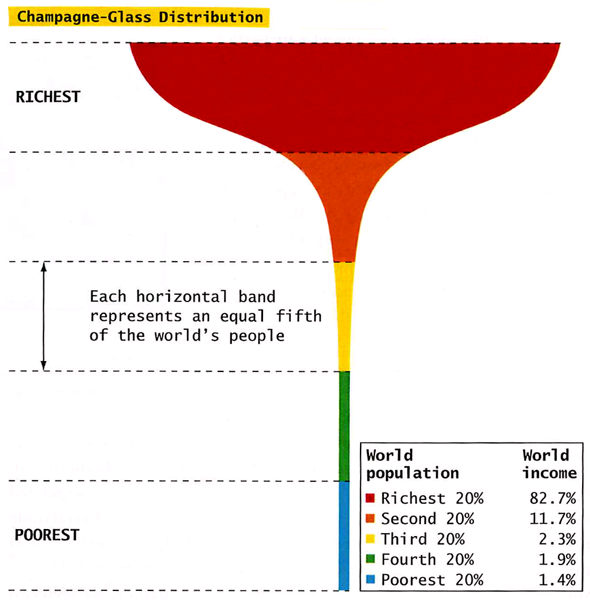
Actually this is exactly what  doesn't set us apart, here is the entire world's estimated distribution of wealth:

So as you can see, if anything sets us apart it is that the distribution of wealth in the USA is much more unequal than the world average.
 

The previous illustrations are examples of what is called the "Champagne Glass Graph", let's look at this simple pie-chart to get a clearer idea of what is going on.

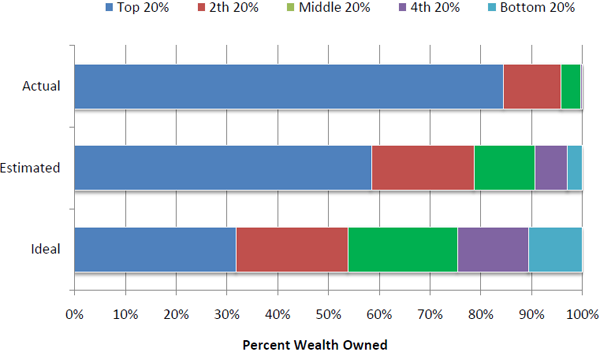
So if there is one thing the American people are not is a  "family" with "common goals". One percent of the population controls thirty five percent of the net worth. Twenty percent of the population controls eighty five percent of that wealth. That leaves no less than eighty percent of the population to divide up the remaining fifteen percent of the wealth left over.
 
This is a reality that Americans don't face easily. Here is the reality contrasted with what people think that realty is and with what they think that reality should be:


How does that sort of wealth distribution play out in real life? Here is a reading of America's mood from Pew Research:
The survey finds that a majority of the public (57%) says it is very difficult or difficult to afford things they really want. About the same percentage said this two years ago (55%). And for many Americans, affording basic necessities remains a struggle – 51% say it is difficult to afford health care, 48% say the same about their home heating and electric bills, and 29% say it is difficult to afford food. - Pew Research Center
In the richest country in world nearly thirty percent of the population have trouble earning enough money to eat. Fifty one percent say it is difficult to afford health care and another forty eight percent can't afford to heat their homes.
 
Now having read that you wonder how Obama could say the following with a straight face:
We are part of the American family. We believe that in a country where every race and faith and point of view can be found, we are still bound together as one people
So here is how the paranoia thing works:
 
The one percent  of the population that controls forty three percent of the financial wealth and the next four percent that controls twenty nine percent, plus those who control the next twenty one percent are justifiably paranoiac thinking what would happen if the eighty percent of the population left with only seven percent of the financial wealth ever woke up and decided to change the percentages around, if only by democratically using income taxes to redistribute that wealth.
 
So the major cultural, legal and ideological industry of the USA is to keep that eighty percent, the peasantry,  from actually discovering who is making them so miserable and how they do it and then getting together and changing the situation... as has so often happened throughout history. With ninety three percent of America's money at their disposal there is no lack of funds for the one percenters to do the job.
 
And that boys and girls explains why so many Americans are worried about Islam and abortion and black helicopters and climate change and transgenic food and whether Barack Obama was born in the USA and polar bears. Anything but the 800 pound gorilla in the room... identifying the fucker and the fuckee.
 
Paranoia is what "binds us together as one people"... the paranoia of the haves, fearing that the have nots will someday dispossess them and the have nots with whatever paranoia du jour  that the media, owned by that one percent, chooses to feed them and that "suits their temperament and station in life". DS

Monday, May 28, 2012

Why vote for Obama? Let me count the whys – 4

David Seaton's News Links

Why vote for Obama? 
Why indeed.
Cutting to the chase: it is important that, barring incompetence passing that of his twice-elected predecessor, which is certainly not his case, the first African-American president in the history of the United States should not be defeated in his bid for a second term by someone who once led a gang to torment a homosexual. The United States doesn't need that stain added to its already spotted history.
During the Democratic primaries in 2008 presidential I thought it frivolous that an inexperienced freshman senator should offer himself for something as transcendental as being the first African-American president in the history of the United States. The idea of the first African-American president failing and thus probably becoming the last African-American president was simply too bitter to bear.  It seemed to me that only a figure of proven leadership qualities, vast experience and who was universally admired, such as Colin Powell, should take that historic burden on his shoulders.
But just as he spoiled almost everything else he touched, George W. Bush spoiled Colin Powell too. 
So Barack Obama is the first man of color to govern one of the world's most racist countries and after four years leading the United States during what may be the most difficult period since the Second World War, I think it is fair to say that to replace him now with someone of such dubious merit as Mitt Romney, would be simply tragic. DS

Tuesday, May 22, 2012

Why vote for Obama? Let me count the whys – 3

David Seaton's News Links
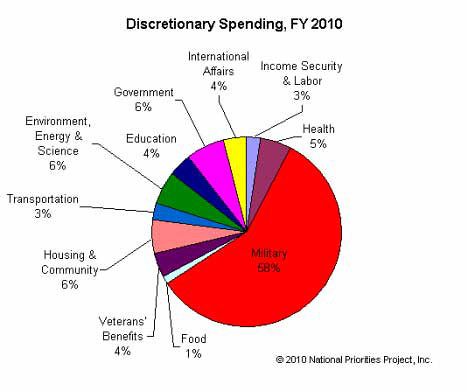
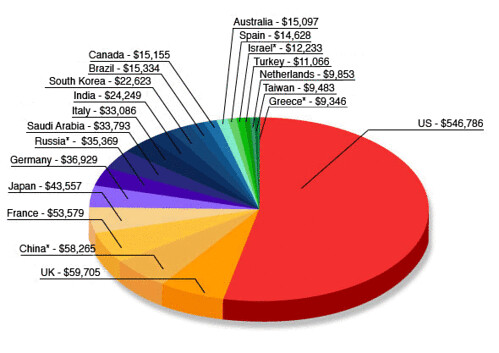
Military sShare of US Budgetmilitary-cost-pie
Mr. Obama concluded in his first year that the Bush-era dream of remaking Afghanistan was a fantasy, and that the far greater threat to the United States was an unstable, nuclear-armed Pakistan. So he narrowed the goals in Afghanistan, and narrowed them again, until he could make the case that America had achieved limited objectives in a war that was, in any traditional sense, unwinnable. (...) Out of the experience emerged Mr. Obama’s “light footprint” strategy, in which the United States strikes from a distance but does not engage in years-long, enervating occupations. .(...) Faced with an economic crisis at home and a fiscal crisis that Mr. Obama knew would eventually require deep limits on Pentagon spending, he was also shocked, they said, by what the war’s cost would be if the generals’ counterinsurgency plan were left on autopilot — $1 trillion over 10 years.  New York Times
His steep learning curve, basically, is "why" number three. The president seems to have quickly learned an important lesson that other presidents have taken much longer to learn or have never learned at all, that is: the Pentagon has the knack of spending endless money, while achieving little or no results, over unlimited time. In fact that process: (endless x little or no x unlimited) would seem to be the object of their existence.
Over the decades since the end of the Second World War, much of American policy has evolved into "killing people and blowing things up", which is essentially the job description of the armed forces and America has the largest, most powerful, armed forces in the history of the world. Many careers have flourished, uncountable dollars have changed hands, hundreds of thousands of people have died and millions have been displaced in a chain of military disasters.  The United States famously spends more on its military than the next seventeen nations combined: if it could cut that down to say, more than the next five combined, then perhaps, while also raising taxes on the one percenters, the US economy, its infrastructure, its public schools and its safety net could be restored to health.
Obama is the first president to fully realize that most of this mayhem could be executed just as well, (with less casualties on either side, and much more cost-effectively), simply by using toy airplanes instead of thousands of over fed soldiers at the end of infinitely complex, wasteful, frightfully expensive and vulnerable supply lines.
Is all this blowing things up and killing people, even with toy airplanes necessary? The unpleasant truth is that "yes" it is. Why?
In its desire to micromanage the universe the USA has made many enemies over the decades, but the last batch they have made are the first to have ever hit the American "homeland" (sinisterly Teutonic term) and it turns out that although the USA packs the world's hardest punch, its jaw is made of glass.
No sooner did Al Qaeda manage to kill 3000 Americans in territorial USA, than the citizens of the United States were willing to lock the Bill of Rights in a drawer and misplace the key... nothing could be more cost effective than to make the Americans scrap their centuries old, "inalienable rights" using only 19 young Arabs carrying box cutters. The asymmetry between the cost and its effect means that it will be attempted again and again. Sooner or later one of these attempts is bound to succeed, it is just a matter of time
The reality is that any successful, new attack on US soil will spark a fresh wave of hysteria, which would probably destroy the presidency of whoever happened to be in the White House when it occurred. The steps the president has taken to keep another 9/11 from happening on his watch have probably taken more bloom off his rose than anything else. However that is the reality, politicians deal in reality and Obama is a politician.
The Financial Times compares Obama to Facebook's IPO:
Mr Obama’s frothy initial valuation offers parallels. Having marketed himself as the man who would transcend Washington’s cynical ways, Mr Obama’s brand was quickly tarnished. It was one thing to promise and fail to close Guantánamo Bay. It was quite another to produce a new rationale for indefinite detention without trial.
Without defusing the Middle East and with it the world of Islam, it is certain that American civil liberties will continue to be degraded, with this or any other administration.
As Al Qaeda draws much of its support and recruiting from America's tacit connivance with Israel's continuing oppression of the Palestinian people, no plan to end the threat of Al Qaeda to the USA can have any hope of success without solving the Palestinian question. Although it may not be enough, giving the Palestinians a state of their own, thus defining Israel's borders permanently, would do more to "drain the swamp" than having the Pentagon endlessly trying to re-engineer ancient cultures into American suburbs.
Solving the Palestinian question would require putting considerable pressure on the Israeli government. It is fair to doubt whether any US administration would have the chops to do that. Would Obama? I really don't know.  What I do know is that Mitt Romney is a close friend of Bibi Netanyahu and would consult him before doing anything in the Middle East...   So far, I hear nothing from the Republicans but attacking Iran, increasing military spending, cutting entitlements, supporting the Israeli right à outrance and lowering taxes for the wealthy.
So retuning to my leitmotiv of this "count the whys" series, I have no trouble at all imagining a better president than Barack Obama, but I cannot imagine that Mitt Romney, who is the only candidate with any chance of replacing him, would be that president. DS