Thursday, February 14, 2008

What does, "inner Lenin" mean?

David Seaton's News Links
A reader asked me exactly what I meant by my "inner Lenin".

Wasn't he a terrible monster, she wrote.

I would answer the way Zhou Enlai did when asked his opinion of the French Revolution, "It's too early to tell."

Lenin created the Soviet Union and without him, Stalin who was surely a monster, would never have existed, but without the Soviet Union or Joseph Stalin, Hitler would have probably won the Second World War. Would Hitler have ever come to power if Germany's elites were not so afraid of a Communist revolution in Germany? History chases its tail like a puppy.

The Soviet Union no longer exists and Lenin is a wax puppet in Moscow. What could the word "Lenin" still mean?

In a sense "Lenin" means the same thing as Nike's "swoosh"... "Just do it!" or the Adidas slogan, "Impossible is Nothing". People are throwing the word "change" around a lot these days, "Lenin" really means change.

He was one of the most unsentimental readers of reality that has ever existed. His cold analysis of reality as a means to action and his fearlessness in executing his analysis are unequaled to this day.

He despised sentiment as "petite bourgeois", but he was not a cold man: my favorite Lenin quote comes from when he once walked out of a concert saying, "If I keep listening to Beethoven's Appassionata, I won't be able to finish the revolution." That is what I mean when I speak humorously of my "inner Lenin". As a mental exercise I try to imagine how America could be changed as radically as Lenin changed tsarist Russia, but I can't stop listening to "
Beethoven's Appassionata".

There are contradictions boiling up in and around America and its society that could bring down the entire system if they are not correctly addressed. My inner Lenin views that with cool detachment, but my "inner Beethoven" cringes at the
human cost. DS

Wednesday, February 13, 2008

Exactly who is Barack Obama?

David Seaton's News Links
The question is still, who is Barack Obama?

What do we really know about him from direct observation and not what he chooses to tell us? Or that we choose to imagine about him

Both Hillary Clinton and John McCain, warts and all, are people who have been in the public eye for a long time, they have had their successes and their failures in public. If we like them or dislike them it is because we actually know them. They are personalities that certainly do not encourage fantasizing.

We are moving into very dark and troubled waters and the rhythmic stroking of platitudes will not be enough to see the nation through them.

I think it says volumes about the present, desperate state of the American psyche that content-less speeches, well delivered by someone with such a tiny CV, could sweep all before them.

Most of what any politician anywhere says has a high bullshit content. It's not entirely their fault, there are many traps waiting for the plain and incautious public speaker ... However when they have been around a long time, it is possible to use our experience of how what they say relates to what they actually end up doing, to evaluate correctly the distance between their words and their actions.

Lets look at the recent case of Mitt Romney... There were a lot of actions as a governor and a lot of words as a candidate. Republicans were able to measure the distance between the two and make a decision based on observable facts.

Being President of the United States of America is the country's top job, it is the crowning achievement of a lifetime of service, eight years is as long as you can hold the job, after that you are supposed to fade into the wallpaper. Look at all the shit Bill Clinton is taking for not fading into the wallpaper. The only ex-president that has done anything interesting is Jimmy Carter. Being president is the end of a career, not the beginning of one... Unless you envision a lifetime of decades of after dinner speaking stretching out before you.

How does someone in his 40s with almost no CV have the nerve to present himself for such an important office? JFK was young you say?

John Fitzgerald Kennedy was a war hero, who had been something like fourteen years in the Congress and the Senate and had won a Pulitzer Prize (not about his search for his "identity" BTW) before he put himself forward. And today he is not considered to have been a successful president, only a tragic and much loved one.

Look, the USA is broke, losing two wars, entering a recession that might even turn into a depression. I am really worried by Barack Obama's chutzpah, I see a boundless ego, untested by reality, standing before 300,000,000 people in a time of crisis and saying. "I am the best person among all of you to lead you!"

Getting starry eyed about Obama is like someone who has lost his job, taking his last savings and buying a lottery ticket... Hope. I don't know who is crazier, Obama or the people who cry at his speeches. DS

Tuesday, February 12, 2008

The Skinny, the Fudge and the Movement

Walking on water as she is really walked
David Seaton's News Links
In today's New York Times David Brooks lays out the cards face up:
"The new Democratic president would be faced with Bill Clinton’s Robert Rubin vs. Robert Reich choice: either scale back priorities for the sake of fiscal discipline or blow through all known deficit records for the sake of bigger programs. Choose the former, and the new president would further outrage the left. Choose the latter and lose the financial establishment and the political center. This is the debate that Democrats have been quietly rearguing during the entire Bush presidency. The left wing of the party is absolutely committed to winning it this time. It will likely demand the clean energy subsidies and the education spending, the expensive health care coverage and subsides to address middle-class anxiety. But no Democratic president can afford to offend independent voters with runaway spending. No president can easily ignore the think tank establishment, which is rightfully exercised about the nation’s long-term fiscal health. It would be another brutal choice."
A brutal choice indeed.

Brooks's bottom line is very simple,
"clean energy subsidies and the education spending, the expensive health care coverage and subsides to address middle-class anxiety"
must be sacrificed for military spending. Next will come Medicare, pensions and the "entitlements".

Spanish friends who travel regularly to the United States on business comment on the deterioration of America's infrastructure, roads, bridges, etcetera. There is no money for them either.
Here is Chalmers Johnson precise description:
"There are three broad aspects to our debt crisis. First, in the current fiscal year (2008) we are spending insane amounts of money on "defense" projects that bear no relationship to the national security of the United States. Simultaneously, we are keeping the income tax burdens on the richest segments of the American population at strikingly low levels.(...) in our devotion to militarism (despite our limited resources), we are failing to invest in our social infrastructure and other requirements for the long-term health of our country. These are what economists call "opportunity costs," things not done because we spent our money on something else. Our public education system has deteriorated alarmingly. We have failed to provide health care to all our citizens and neglected our responsibilities as the world's number one polluter. Most important, we have lost our competitiveness as a manufacturer for civilian needs -- an infinitely more efficient use of scarce resources than arms manufacturing.(...) Our excessive military expenditures did not occur over just a few short years or simply because of the Bush administration's policies. They have been going on for a very long time in accordance with a superficially plausible ideology and have now become entrenched in our democratic political system where they are starting to wreak havoc. This ideology I call "military Keynesianism" -- the determination to maintain a permanent war economy and to treat military output as an ordinary economic product, even though it makes no contribution to either production or consumption." Chalmers Johnson
When we talk about money for infrastructure and especially money for the education and for the health of children, we are talking about "seed corn". We are eating our seed corn. When it's gone, the real ride down the steep slope of decadence begins in earnest.

However Brooks in his inimitable, smarmy, sadistic, way is right. If elected, a Democratic president will be faced with all these choices. I have no doubt that be it Hillary or be it Obama, he or she will fudge... The "system", as Brooks points out, is the system. There has never been a system like it.

Both Hillary and Obama are dues paying, card carrying, members of that system.

The climb down would be less humiliating for Hillary as she could probably wheel and deal some kind of health care package in exchange for staying in Iraq and waltzing Kyoto... Hillary doesn't pretend to be a "movement". She is "Mrs. Possible".

However, at some point, Obama will be asked to prove his supernatural powers, to walk on water, to raise the dead and bring sight to the blind and when the fat, old thing just lies there looking at him, a lot of folks are going to be real disappointed.

And that, friends and neighbors, is when a real movement, one that actually moves, might get moving.

My human heart cringes, but my inner Lenin laughs and laughs. DS

David Brooks: When Reality Bites - New York Times
Abstract: When you think about it, the Democratic policy unity is a mirage. If the Democrats actually win the White House, the tensions would resurface with a vengeance. The first big rift would involve Iraq. Both Senators Hillary Clinton and Barack Obama have seductively hinted that they would withdraw almost all U.S. troops within 12 to 16 months. But if either of them actually did that, he or she would instantly make Iraq the consuming partisan fight of their presidency. There would be private but powerful opposition from Arab leaders, who would fear a return to 2006 chaos. There would be irate opposition from important sections of the military, who would feel that the U.S. was squandering the gains of the previous year. A Democratic president with few military credentials would confront outraged and highly photogenic colonels screaming betrayal. There would be important criticism from nonpartisan military experts. In his latest report, the much-cited Anthony Cordesman describes an improving Iraqi security situation that still requires “strategic patience” and another five years to become self-sustaining.(...) All dreams of changing the tone in Washington would be gone. All of Obama’s unity hopes would evaporate. And if the situation did deteriorate after a quick withdrawal, as the National Intelligence Estimate warns, the bloodshed would be on the new president’s head. Therefore, when a new Democratic administration considered all these possibilities, its members would part ways. A certain number of centrists would conclude that rapid withdrawal is a mistake. They would say that the situation had changed and would call for a strategic review. They’d recommend a long, slow conditions-based withdrawal — constant, small troop reductions, and a lot of regional diplomacy, while maintaining tens of thousands of troops in Iraq for the remainder of the term. The left wing of the party would go into immediate uproar. They’d scream: This was a central issue of the campaign! All the troops must get out now! The president would have to make a terrible decision. Which brings us to second looming Democratic divide: domestic spending. Both campaigns now promise fiscal discipline, as well as ambitious new programs. These kinds of have-your-cake-and-eat-it-too vows were merely laughable last year when the federal deficit was running at a manageable $163 billion a year. But the economic slowdown, the hangover from the Bush years and the growing bite of entitlements mean that the federal deficit will almost certainly top $400 billion by 2009. The accumulated national debt will be in shouting distance of the $10 trillion mark. With that much red ink, the primary-season spending plans are simply ridiculous. It’d be 1993 all over again. The new Democratic president would be faced with Bill Clinton’s Robert Rubin vs. Robert Reich choice: either scale back priorities for the sake of fiscal discipline or blow through all known deficit records for the sake of bigger programs. Choose the former, and the new president would further outrage the left. Choose the latter and lose the financial establishment and the political center. This is the debate that Democrats have been quietly rearguing during the entire Bush presidency. The left wing of the party is absolutely committed to winning it this time. It will likely demand the clean energy subsidies and the education spending, the expensive health care coverage and subsides to address middle-class anxiety. But no Democratic president can afford to offend independent voters with runaway spending. No president can easily ignore the think tank establishment, which is rightfully exercised about the nation’s long-term fiscal health. It would be another brutal choice. READ IT ALL

Monday, February 11, 2008

No Country for Old Common Sense

"Here and there one could see women crying and some men wiping away tears too.(...) When 16,000 people, without prompting, start shouting some of his keynote phrases as he delivers them, you know something special is going on. The atmosphere at his events is such that one wonders if Obama is about to walk out with a basket with some loaves and fishes to feed the thousands." Geoff Elliott - The Australian
"There was something just a wee bit creepy about the mass messiahnism" Joe Klein - Time

"Democracy is the theory that the common people know what they want and deserve to get it good and hard."
H. L. Mencken

"It is one thing to preach and quite another to give people bread." Spanish saying
David Seaton's News Links
Australians are famous for their plain spoken common sense, as Americans once were... a very long time ago. Geoff Elliott, The Australian's Washington correspondent asks some awkward questions about the prospective emperor's new wardrobe.
How does a cult figure, in the eyes of some something akin to a messiah, make the transition to a political frontrunner - president even - where disappointment will soon crush what seemed to be a journey to a promised land? (...) If he gets the Democratic Party's nomination another test begins anew: how to turn the narrative which is all about striving for what is possible, to one where people are suddenly asking how are you actually going to do it?
Certainly, it appears that many Americans are desperately clutching at straws, filled with powerful, inchoate, emotions as Barack Obama rhythmically strokes his platitudes. Students of American history will be reminded of "The Second Great Awakening", which of course was closely followed by "The Great Disappointment".

Many observers draw parallels between Obama and Jesus, but there are significant differences between the two. Obama, although visible has no clear program, whereas Jesus, although invisible, has a fairly clear program, briefly put: to feed the hungry, give drink to the thirsty, clothe the naked, harbor the harborless, visit the sick, ransom the captive, bury the dead, instruct the ignorant, counsel the doubtful, admonish sinners, bear wrongs patiently, forgive offenses willingly, comfort the afflicted and to pray for the living and the dead.

Although, as far as I know this program has never been put into effect anywhere at any time, many people still find it attractive and would willingly vote for it if they could. However, its superficial resemblance to Socialism might make it subject to controversy, if seriously put forward by a presidential candidate.

Changing the subject a bit, I find it curious that Hillary Clinton, who has some serious proposals about health care, child care and the like, only receives contributions from big donors, that is to say rich people; whereas Obama, who offers little or nothing that could be of any assistance to the poor or oppressed, has managed to perfect the Howard Dean techniques of small donations through the Internet. I think Hillary should take Ron Paul and Mike Huckabee lessons as soon as possible if she it to have any hope of surviving. DS

Geoff Elliott: Obama's first coming - The Australian
Abstract: It was early 1994 when Nelson Mandela gave a speech in a slum outside Cape Town and spoke in grand terms of a new beginning and how when he was elected president every household would have a washing machine. People took him literally. A few months later he became South Africa's first black president. That's when clerks in department stores in Cape Town had to turn people away demanding their free washer and dryer. Having spent some time as a reporter in South Africa watching the Mandela presidency I was reminded of that story this week when I travelled with Democratic presidential candidate Barack Obama on the campaign trail.(...) How does a cult figure, in the eyes of some something akin to a messiah, make the transition to a political frontrunner - president even - where disappointment will soon crush what seemed to be a journey to a promised land? Looking into the faces of a more than 16,000-strong crowd in a basketball stadium in Hartford, Connecticut this week, the Mandela magic I'd seen before was there too. Black and white, and the youth; they appeared in a state close to rapture watching Obama speak. Here and there one could see women crying and some men wiping away tears too.(...) In this man they are projecting a new course - one that he says he will lead - where the US buries the culture wars, charts a new course in bipartisan politics and heralds a new dawn for America. After more than seven years of the Bush administration and when 70 per cent of the populace think America is on the wrong course, there's little wonder that the hunger for something new is real and fertile ground to till for a politician. But Obama is part politician, part cult. Supporters wearing T-shirts with an Andy Warhol like pop-art image of his face testify to that. But then they - him - were once easy to dismiss until people realised Obama's charisma was being matched by one of the most sophisticated ground operations ever seen. It is one that is outsmarting the Clinton machine. He's marrying inspiration and cult with old-fashioned political grunt. One would have to have a heart of stone not to be moved by Obama on the stump. It's not so much by what he says but it's the way the crowds respond to his words. When 16,000 people, without prompting, start shouting some of his keynote phrases as he delivers them, you know something special is going on. The atmosphere at his events is such that one wonders if Obama is about to walk out with a basket with some loaves and fishes to feed the thousands. And therein lays the danger for Obama. The Obama shuttle has made it into orbit but at some point he's going to have to land this thing back on Earth.(...) Well known political journalist Joe Klein of Time magazine, who was travelling on the campaign plane this week with Obama, too, wrote of a nagging concern about this kind of rhetoric of inspiration over substance, noting "there was something just a wee bit creepy about the mass messiahnism". In his Super Tuesday speech Obama said "we are the ones we've been waiting for", attempting to make the case the time was now to get some "change" in Washington: a post-partisan world where politicians reach across the aisle for the common good. "This time can be different because this campaign for the presidency of the United States of America is different," he said. "It's different not because of me. It's different because of you." As Klein notes, this is "not just maddeningly vague but also disingenuous: the campaign is entirely about Obama and his ability to inspire. "Rather than focusing on any specific issue or cause - other than an amorphous desire for change - the message is becoming dangerously self-referential. The Obama campaign all too often is about how wonderful the Obama campaign is."(...) I'd venture to call him a favourite in this race now. The next nine statewide contests through February are, given the demographics, likely to go Obama's way. He may well build an unstoppable momentum. And then the giddiness might evaporate and be replaced with something else. In marketing they call it post-purchase disappointment. If he gets the Democratic Party's nomination another test begins anew: how to turn the narrative which is all about striving for what is possible, to one where people are suddenly asking how are you actually going to do it? READ IT ALL

Sunday, February 10, 2008

Leaving Iraq is like leaving "Sonny's Bar"


David Seaton's News Links
Jim Hoagland has an insightful article in today's Washington Post. He makes these points:
Hillary Clinton and Barack Obama share a problem as they move deeper into the primary season: They have both issued promises to withdraw from Iraq that are impossibly vague, unrealistic or worse. They must now rectify this -- for the good of their campaigns and the nation. The Democratic candidates repeat fundamental errors already made in Iraq by President Bush. They ignore the important role that Iraqis must play in deciding the fate of their nation if there is to be any stability during and after a U.S. withdrawal.(...) Like Bush, Obama and Clinton pretend they can implement neat solutions to that torn country's complex problems. That is, to borrow a phrase from this campaign, a fairy tale.(...) Obama's effort to impeach Clinton's credibility through a backward-looking debate on Iraq -- pitting her 2002 vote vs. his 2002 speech -- has not been decisive because he has yet to show that the difference will lead to an authentically different approach to getting U.S. combat troops out of Iraq. Yes, Obama has promised to withdraw all combat troops within 16 months. Clinton promises to begin withdrawals within 60 days of her inauguration. Most significant, each has promised a hedge: to keep unspecified numbers of soldiers behind to fight terrorists or train Iraqis and, in Clinton's case, to protect the Kurds and deter Iranian aggression. But neither has been pressed in debates or news conferences as to how these residual troops would be left behind. It strains credulity to think that the Iraqis would -- after being told that they are not worth protecting or working with -- allow U.S. troops to stay on and hunt al-Qaeda & Co. or protect the huge U.S. Embassy in Baghdad. What carrots do the two Democrats propose to keep this permanently dissed ally on board instead of making any U.S. retreat a hell on Earth? Kennedy and other Democrats pillory Bush administration officials for trying to negotiate a status-of-forces agreement with the Iraqi government to replace the expiring U.N. mandate that governs the presence of foreign troops. Bush's fault is that he has waited far too long to recognize that Iraqis want to exercise sovereign rights inside their own country. He is not rushing to tie a Democratic president's hands. He responds to long-standing pressures from the Iraqis and the United Nations that he has previously ignored. Bush's cavalier rejection of the provisional Iraqi government created immediately after the U.S.-led invasion -- in favor of installing proconsul L. Paul Bremer III and a long occupation -- pushed U.S. policy onto its slope of disasters. Surviving Republican candidates overshoot the runway in the other direction, attributing to recent U.S. gains a permanence that has still to be established. The Democrats clearly will not repeat that mistake. They must also reject Bush's habit of ignoring Iraqi realities and responsibilities and pretending that the United States alone has the power to impose its will as the end point of this conflict.
In fact, thanks to Bush's immeasurable incompetence, leaving Iraq has become like the famous scene in Robert De Niro's film, "A Bronx Story", (see above) where an improbable group of Hell's Angels invade a Mafia-owned bar in the Bronx and after being politely asked to leave, begin to spray beer and insult the patrons. Chazz Palminteri the local capo mafiosi locks the door and tells them, "Now yez can't leave", whereupon every Italian extra in Hollywood comes out the back room with baseball bats and beats the bikers to a pulp.

This is more or less the position the United States finds itself in today. I think that when the American people really wake up to the fact that, with Republicans or Democrats, by now Iraq is so screwed up that "yez can't leave", they will gladly extradite Bush to The Hague to have him tried as a war criminal. DS

Gore solution or gore solution

David Seaton's News Links
I am beginning to think the battle between Hillary and Obama is going to get so rough and so ugly and end up in a tie running into a brokered convention, so foul and so sordid, that both candidates will be on life support by then as far as the general public is concerned.

At that time something will have to done to put that fight to an end and bury all the bodies, which will stink by August.

Probably the only solution would be a movement to draft Al Gore. In contrast to either Hillary or Obama I think he could defeat McCain handily. A Gore-Edwards ticket would certainly have my vote and I'm sure it would make America forget the Democratic primaries. DS

Friday, February 08, 2008

Why do Peggy Noonan, George Will and David Brooks favor Obama?


David Seaton's News Links
Peggy Noonan, who wrote some of Reagan's best speeches, is the right wing's Maureen Dowd: Irish, beautiful, witty, subtle and dangerous. In today's Wall Street Journal, she joins such arch-conservative pundits as George Will and David Brooks in praising Barack Obama and favoring him for the Democratic nomination.
"(Obama) is the un-Edwards and un-Huckabee -- an adult aiming to reform the real world rather than an adolescent fantasizing mock-heroic "fights" against fictitious villains in a left-wing cartoon version of this country." George Will

"The Kennedys and Obama hit the same contrasts again and again in their speeches: the high road versus the low road; inspiration versus calculation; future versus the past; and most of all, service versus selfishness." David Brooks
I don't think it takes a rocket scientist to smell a rat here.

To me it's perfectly obvious that the right wing is licking their chops in anticipation at facing Obama. Read this from Noonan's piece:
"He will be hard to get at, hard to address. There are many reasons, but a primary one is that the fact of his race will freeze them. No one, no candidate, no party, no heavy-breathing consultant, will want to cross any line--lines that have never been drawn, that are sure to be shifting and not always visible--in approaching the first major-party African-American nominee for president of the United States. He is the brilliant young black man as American dream. No consultant, no matter how opportunistic and hungry, will think it easy--or professionally desirable--to take him down in a low manner."
Now, obviously it would be absurd to apply this criteria to Karl Rove or any of his understudies and acolytes
... If you know how to read Noonan, she is calling in the hit. That is going to be the campaign. I think it would be childlike to believe that Karl Rove hasn't done his homework already.. They are drooling in anticipation.

Why do they "like" Obama so much?

Because they are terrified of Hillary Clinton, that's why.

Here is how Peggy Noonnan describes her:
"One part of the Clinton mystique maintains: Deep down journalists think she's a political Rasputin who will not be dispatched. Prince Yusupov served him cupcakes laced with cyanide, emptied a revolver, clubbed him, tied him up and threw him in a frozen river. When he floated to the surface they found he'd tried to claw his way from under the ice. That is how reporters see Hillary.And that is a grim and over-the-top analogy, which I must withdraw. What I really mean is they see her as the Glenn Close character in "Fatal Attraction": "I won't be ignored, Dan!"
It is this simple: in recent decades the Clintons are the only Democrats that win elections against Republicans... They don't want to ever face them again, no more complicated than that.

As soon as Barack Obama is declared the official candidate of the Democratic party the voters will be treated to something similar to the old TV show, "This is your Life"... Here is how Wikipedia describes the experience:
"The format of the show was simple: the host would surprise someone (usually a celebrity or public figure, occasionally an ordinary citizen) and, consulting his "red book," conduct a biography of the subject in a television studio. The subject would be presented with family members and old friends, reunited with old acquaintances, and often shed a tear when a personal tragedy was recounted."
Peggy may be right and Hillary will do Karl's work for him. This is a high stakes affair after all. DS

Thursday, February 07, 2008

Farewell Mitt Romney

David Seaton's News Links
I don't have anything visceral against Republicans in general (well, not very much) and even have family members in that party. I like both John McCain and Mike Huckabee as people although I don't agree with them on very much, but Romney, I confess, I loathe.

Something in his facial expression makes me angry. His positions are hard to nail down, but I have never gotten that far... the face is enough.

Anyway, after having been made a fool of by Mike Huckabee who spent one tenth of what he did, he is calling it quits. Thinking about that gives me a nice warm feeling inside. With time you learn to take pleasure when and where you can. DS

Wednesday, February 06, 2008

Not exactly an endorsement

David Seaton's News Links
If I finally end up voting for Hillary Clinton she'll have John Edwards to thank. She has taken over his health plan, which according to Paul Krugman is the only workable one out there.

My inner Lenin tells me that it would be great if the whole health thing festered until the masses stormed the Winter Palace, but elementary compassion leads me to support any workable plan for universal health care that would alleviate the suffering of so many millions of fellow human beings.

Right now I think the Democratic nomination is down to two horrible phonies. One an experienced and capable phony and the other a phony of unmitigated chutzpah and cynicism and totally unqualified for the job. If backed into a corner, holding my nose and gagging and retching, I will vote for the candidate that has some chance to heal the sick, not the one that promises to walk upon the water. DS

Tuesday, February 05, 2008

Obama: America's Lady Di?

"Instead of a hyperactive debutante who had ricocheted around the scene with a series of ill-chosen but well-born or well-heeled boyfriends, alighting here on an astrologer, there on an aromatherapist and there again on a signature charity, we were presented with a Lady Bountiful or Fairy Godmother, without whose luminous presence the poor of the world were left unfriended, untended and alone." Christopher Hitchens, on the death of Diana - Salon

"Only Clinton derangement syndrome can explain the alliance of so many otherwise thoughtful people of both parties who speak well of the candidacy of a man with scant knowledge of the world who has never been tested and has never run anything larger than a senatorial office. The question that we need to ask is whether this man—who candidly admits, “I’m not a manager”—can manage the vast apparatus of the federal government. Will packaging be enough to deal with our problems?" Fred Siegel - City Journal
David Seaton's News Links
After seven years of Bush, it is obvious that a significant portion of the American population is simply grasping at straws.

If anything were ever obvious it is that, although he is an intelligent, interesting person, Barack Obama is totally unqualified to be the President of the United States.

He is a junior senator with three years experience in Washington, he was a brilliant law student and did some community work in Chicago's South Side, then, as a state legislator in Illinois, he did little more than show up to vote "present". He has written a clever book and gives speeches with practically no content, but delivered in a momentous, ringing style.

The comparison with Princess Diana is wonderful. I think the Republicans are licking their chops, hoping that Obama will be the Democratic candidate in November. DS


Obama: The New Princess Diana? - James Kirchick - Commentary
Abstract: This was Christopher Hitchens’s question a year after the death of Princess Diana, which brought forth a “frightful binging and gorging of sentimentality” from the British populace, odd in a nation stoic by reputation. (...) As a 24 year-old male — just the sort of demographic he has solidly won over — I should probably hide while admitting this, but I feel the same away about the Barack Obama phenomenon as Hitchens did about the mourning of Princess Diana. And I’ll risk sounding a little self-satisfied by predicting that should Obama not be the one sworn into office come January 2009, the country will look back on this current presidential campaign feeling a similar sort of collective embarrassment that the British felt about their mourning of “The People’s Princess.” We may even be asking ourselves “What the hell was that all about?” should Obama actually win the presidency, a year or so into his tenure when his unpreparedness becomes manifest.(...) It’s long past time that we pause, take a deep breath, and evaluate the presidential candidates using concrete criteria as opposed to vague pronouncements that this or that candidate can “unite” the country or “transcend” this or that division, whether it be racial or political or what have you. It may be that Barack Obama is the best candidate at this moment in time; ultimately, of course, that’s a purely subjective question. But I fear about the emotional baggage that people have invested in his candidacy, and what his most fervent supporters will believe about American democracy should he lose. The country will, in short, become irredeemable. Given the unchecked passion already on display, it may already be too late to save this election from becoming marked, like the decade-old death of a blond divorcée, for its “bogus emotion and mass credulity.” READ IT ALL

Monday, February 04, 2008

"Jive": the forbidden word


"If Mrs. Clinton gets the Democratic nomination, there is some chance — nobody knows how big — that we’ll get universal health care in the next administration. If Mr. Obama gets the nomination, it just won’t happen."
Paul Krugman, NYT

"A President Obama could no more magically transcend America's '60s-born divisions than McCarthy, Kennedy, Nixon or McGovern could, for the simple reason that our society is defined as much by its arguments as by its agreements. Over the meaning of "family," on sexual morality, on questions of race and gender and war and peace and order and disorder and North and South and a dozen other areas, we remain divided in ways that first arose after the assassination of President John F. Kennedy in 1963." Rick Perlstein, WP
David Seaton's News Links
America owes much more to African-Americans than gratitude and shame for centuries of unpaid labor. Theirs is 90% of the magic of American identity, substance and style. Without Black America the United States would be some sort of Australia run amok. Among the infinity of cultural gifts that America has received from African-America is a richness of language that other English speakers do not possess and one of the most valuable words of this legacy is the word, "Jive", which Webster defines as, "glib, deceptive, or foolish talk".

I realize that for a white person to apply this marvelous word to any person of color breaks all the rules of political correctness, but as I believe that nurture is more important than nature and as Barack Obama was raised in a white home by white people in places, (Hawaii and Indonesia) where no African-American models existed, I consider that he is culturally as white as or whiter than I am and I have no compunction in admitting that I have never seen such a positively "jive-assed" politician in all my life.


Readers of this blog will know that I consider universal health care the single most important issue in US politics, the game changer. I would prefer that the Republicans keep the White House and that the pressure for something meaningful continue to build, than that a Democratic president pass something half baked that leaves millions of Americans without health care, but takes the pressure off. What I called in the last post, "throwing a fish".

As Paul Krugman points out, that is exactly the result we can expect if Obama is elected president.

I admit that I am becoming more than a little impatient with Barack Obama. The idea that the divisions and contradictions in America, which are real, serious and reality based, can be "healed" by the honeyed words of a few good speeches is an insult -- perhaps well deserved -- to American intelligence. DS

Rcik Perlstein - Getting Past the '60s? It's Not Going to Happen - Washington Post
Abstract: One of the most fascinating notions raised by the current presidential campaign is the idea that the United States can and must finally overcome the divisions of the 1960s. It's most often associated with the ascendancy of Sen. Barack Obama, who has been known to entertain it himself. Its most gauzy champion is pundit Andrew Sullivan, who argued in a cover article in the December Atlantic Monthly that, "If you are an American who yearns to finally get beyond the symbolic battles of the Boomer generation and face today's actual problems, Obama may be your man." No offense to either Obama or Sullivan, but: No he isn't. No one is.(...) I realized it again when I saw the online ad produced by Sen. John McCain's campaign, arguing that Sen. Hillary Rodham Clinton didn't deserve the presidency because she earmarked one-millionth of the federal budget ($1 million) for a museum commemorating the rock festival Woodstock. I realized it, too, when Bill Clinton accused Obama of leaving the role of Lyndon B. Johnson out of the civil rights story, and when Sen. John Kerry announced his endorsement of Obama with a quotation from the Rev. Martin Luther King Jr. -- and both set off a strange bout of opinion-journalism shadowboxing over which camp, Clinton's or Obama's, better grasped the historical legacy of the civil rights movement. I realize it anew just about every day of this presidential campaign -- most recently when a bevy of Kennedys stood behind Obama last week and spoke of reviving the spirit of Camelot, and when the conservative New York Times columnist David Brooks responded by making fine distinctions between "the idealism of the generation that marched in jacket and ties" -- the "early-60s," which he took Obama to represent -- and the "late-60s," defined "by drug use and self-indulgence," of which the Clintons are the supposed avatars. The fact is, the '60s are still with us, and will remain so for the imaginable future. We are all like Zhou Enlai, who, asked what he thought about the French Revolution, answered, "It is too early to tell." When and how will the cultural and political battle lines the baby boomers bequeathed us dissolve? It is, well and truly, still too early to tell. We can't yet "overcome" the '60s because we still don't even know what the '60s were -- not even close.(...) A President Obama could no more magically transcend America's '60s-born divisions than McCarthy, Kennedy, Nixon or McGovern could, for the simple reason that our society is defined as much by its arguments as by its agreements. Over the meaning of "family," on sexual morality, on questions of race and gender and war and peace and order and disorder and North and South and a dozen other areas, we remain divided in ways that first arose after the assassination of President John F. Kennedy in 1963. What Andrew Sullivan dismisses as "the symbolic battles of the Boomer generation" do not separate us from our "actual problems"; they define us, as much as the Great War defined France in the 1920s, '30s, '40s and beyond. Pretending otherwise simply isn't healthy. It's repression -- the kind of thing that shrinks say causes neurosis. At least there's some comfort in knowing that our divisions aren't what they once were. Heck, in the 1860s, half the nation was devoted in body, mind and spirit to killing the other half; in the early 1930s, many sage observers presumed the nation to be poised on the verge of open, violent class warfare. We'll manage to muddle through again -- even burdened with mere flesh and blood human beings, not magical healing shamans, as our leaders. READ IT ALL

Sunday, February 03, 2008

Health: a Spanish lesson

The picture that concentrated Franco's mind so wonderfully
David Seaton's News Links
An American reader familiar with Spain asked me what possible relation there could be between the American situation and the Spanish one, where, as she pointed out, public health care predates Democracy. I thought it such an interesting question that I decided to answer her here.

Many years ago I worked on a project for a large American, family owned corporation with manufacturing facilities in Spain. They wanted to close a factory and they were amazed at the penalties they would have to pay to shut the thing down. They demanded a detailed history of Spanish social legislation, which I helped to research.

I speak from memory, but I seem to recall that we discovered that almost all the Spanish welfare state dated from when it became obvious that Hitler was going to lose the war. The idea of the victorious allies charging over the Pyrenees and Nuremberging him concentrated Franco’s mind wonderfully.

Franco, brutal victor in the recent civil war was always a practical and expedient fellow, so he threw the defeated working class a fish. Providing health care, protecting jobs and paying the summer and Christmas bonuses helped the police state keep control of the defeated working class during those black years before prosperity arrived, with the tourists, in the 1960s.

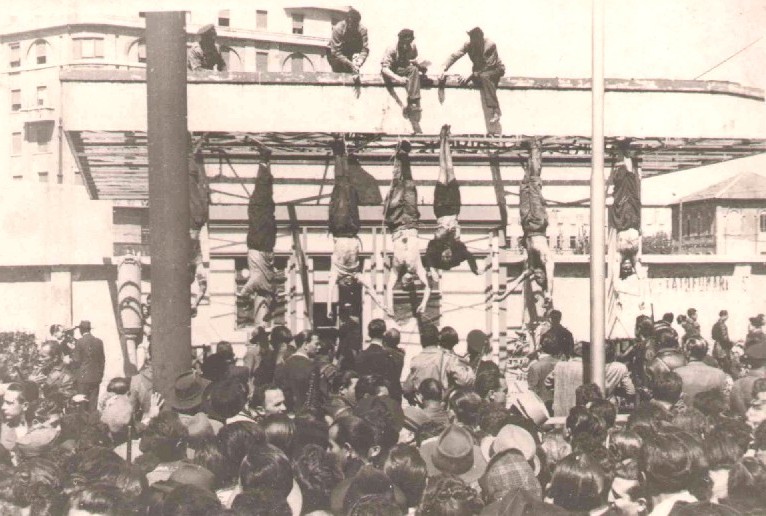
Basically then, Spain had some sort of health system under Franco because he was afraid of hanging by his feet in a gas station like Mussolini.

Until the Socialists reformed it in the 80s it was a very, very half hearted, half assed system indeed. And it was the fear of Spain going Communist after the death of Franco that allowed the reformist Socialist government of Felipe González which had been previously "restructured" under the guidance of Willy Brandt's SPD to finally take power and, once they agreed to stay in NATO, receive the blessings of the US as the lesser of many possible evils.

In a sense the entire European welfare system was put in place because the elites were afraid of the working class going with the Communists in the late 40s and early 50s. In the democracies the pressure was expressed in the ballot box, in Spain by police informers relaying the mood of the population. What is necessary today in America is to produce that same unease at the top of the American system. The civil rights struggle shows that this is as possible in the USA as in Europe.

If the Republican Party and the American conservatives in general were still more or less normal, like they were under Eisenhower or even Nixon, they would probably do like Franco and throw the fish. They showed that sort of pragmatism when confronted with the reality of "burn baby burn". But I think the Ayn Randies, the Norquististas, the Cato Instituters and assorted Reaganites, are a bunch of real Talibans and will fight this thing to the death and that will be the transformational struggle. Just like during the civil rights movement, there have to be people in the streets and a change or heightening of consciousness to bring about this transformation.

There would be two good things in this: one, the people would finally get health care and two, the struggle itself would change their consciousness. Thus, the unyielding resistance of the American Reaganite conservatives to any state health care system is fundamental to the final transformational effect. If any of them were half as intelligent as Franco was there would be no transformation.

As Democrats are not really people of the left they don’t seem to understand that politics like the rest of life is a constant, shifting, conflict of contradictory entities with contradicting interests and that these different interests struggle continuously among themselves and that this struggle produces what the Hindus call "Maya” or what the rest of us call “reality”: something of only apparent solidity, something which is constantly in flux.

To transform reality it is important first to understand the dynamics of these contradictions and to know when it best to push one place or to not push on another. This dialectical approach is very foreign to American politics. It would be easier for an American psychotherapist to understand the dynamics of transforming political reality and the value of the process of transformation than for the average American political commentator. A therapist easily understands that the process of becoming is as important as, or more important than the becoming itself, since in fact, everything only exists in the act of becoming and never really finally becomes, except, perhaps, when it dies.

Health care obviously wouldn’t be “transformational“ for Spanish politics because health care already exists in Spain. It was precisely Franco's readiness to concede it that kept it from becoming transformational. To create such a system in the USA would transform America because health care doesn’t exist and, given the rigid ideological stance of American conservatives, it probably would take a huge struggle to get it to exist. Since there are 40,000,000 people without coverage, this would constitute a formidable army in this battle. The struggle is just as important as the final result or to put it another way, the struggle is the result. DS

Friday, February 01, 2008

Vive la France! ...and forget about Billary-Bama

There are only two pictures of Jérôme (this is the other one)
David Seaton's News Links
Just to tear ourselves away from the day's round of horrors in Iraq and Kenia and the boredom of Billary-'Bama, here is an article from the Wall Street Journal which describes how Jérôme Kerviel is turning into a national hero in France, the "Che Guevara of finance".

I love the French attitude to this whole business. This is how the women eat what they want and don't get fat: it's all in the mind! What the French still have to teach Americans is the idea of le petit bonheur, the happiness of small things. When the Americans catch on to it they will no longer have to "pursue" happiness, they will find it all around them.

Here is a prediction: there is going to be a film of this (of course) and the star who plays Jérôme Kerviel will be, Gad Elmaleh. (it will probably be Tom Cruise or Shia LaBeouf but it should be Gad Elmaleh).


Gad Elmaleh is a hilarious, enormously talented, Moroccan-Jewish comedian who works out of Paris. I recently saw him in a delicious comedy with Audrey Tatou called, "Hors de Prix", which sounds sort of racy, if you can't read French or spel so gud. DS

In a French Twist, Jérôme Kerviel Gets Hero Treatment - Wall Street Journal
Abstract: Société Générale says wayward trader Jérôme Kerviel lost the bank $7.2 billion. But that was last week. He's now on his way to cult celebrity -- and he still hasn't lost his job. Société Générale has stopped paying Mr. Kerviel and told him not to come to the office, but it hasn't managed to formally fire him. French law stipulates that to do that, the bank must first call him in for a sit-down meeting and explain its dissatisfaction. He has the right to bring along a trade-union official, a lawyer or anyone else he'd like. (...) Reviled by Société Générale as a malevolent fraudster and "mutating virus," Mr. Kerviel, 31 years old, is now being hailed by a growing band of fans as "Robin Hood," "the Che Guevara of Finance" and even a genius worthy of the Nobel Prize in economics. "Let's be honest: No one likes banks...and people like the rich to get cheated," says Christophe Rocancourt, a celebrated French con man who swindled wealthy Americans in the 1990s by masquerading as a French member of the Rockefeller family, a film producer and various other people. Edward Yardeni, an American economist who runs an investment-strategy consulting firm, credits Mr. Kerviel with helping save the U.S. from recession. "Merci beaucoup, Jérôme," says Mr. Yardeni, a former chief economist at Deutsche Bank. Société Générale's unwinding of Mr. Kerviel's bad bets, he says, accelerated a market slide that prodded the Fed to slash interest rates. Mr. Yardeni says French courts will have to decide whether Mr. Kerviel belongs in prison, but "we owe Jérôme quite a few thanks," and he "certainly deserves a footnote in American economic history."(...) When the news of Mr. Kerviel's disastrously bad bets first broke, he seemed destined for infamy and shame. Even trade unions, usually quick to rally to the defense of employees targeted for dismissal, showed little sympathy or solidarity. But the tide is now turning as questions mount about the bank management's own missteps and a change in Mr. Kerviel's public image from recklessly greedy master-of-the-universe to luckless little guy struggling to get ahead. Unlike Société Générale's executives, mostly upper-crust graduates of elite colleges, Mr. Kerviel grew up in a small provincial town in a family of modest means. Lacking the academic credentials and connections of the bank's highfliers, he struggled to get his feet on the lowest rung of the trading ladder. A Web site set up to chart the saga, jeromekerviel.com, has started polling visitors about whether the trader is to blame: According to one of the site's founders, 65% say no. Facebook, the social-networking site, now has dozens of pages devoted to various Jérôme Kerviel support groups, including one that wants to "fight for Jérôme Kerviel's reintegration in Société Générale." An American outfit is hawking "Jérôme Kerviel Is a Hero" T-shirts, and a British oddsmaker Ladbrokes has opened betting on who will play Jérôme Kerviel in a likely future film. Mr. Kerviel's biggest fan base is at home in France, which often has a soft spot for cheeky rogues, particularly when their victims are well-to-do. Mr. Rocancourt, the former Rockefeller impostor, has written three books about his exploits and says his own life story is being made into a movie. After doing jail time in the U.S. and Canada, he now lives in Paris with a former Miss France. Mr. Rocancourt urges Mr. Kerviel to take full advantage of his current notoriety. "People always like a Robin Hood, a guy who steals from the rich." READ IT ALL

Wednesday, January 30, 2008

My take on McCain


"I say very mildly, we have only one political party in the United States, the Property Party, with two right wings, Republican and Democrat." Gore Vidal
David Seaton's News Links
The other day there was an interview (in Spanish) in my Newspaper with the emminent historian and director of the Remarque Institute of NYU, Tony Judt. They asked him, a fire-tested progressive, about the presidential elections in the USA.

His opinion was that if Hillary Clinton were elected and re-elected president it would mean that two families, the Bushs and the Clintons, would have dominated American politics for over thirty years and that wasn't acceptable in a serious Republic. As to Barack Obama, Judt found him simply too inexperienced for serious consideration.

Judt said that the only interesting candidate was John McCain, although, "I don't agree with almost anything he says." I am glad that Tony Judt said it first.

I opened this post with a quote from Gore Vidal to which I subscribe fully. I would that the Republicans aren't fooling anyone, which is why they win elections and the Democrats are trying to fool people into thinking that they are a 'progressive' party, which is why they lose elections... Not enough people are fooled.

I find myself against almost everything that the Republicans stand for, but at least they seem to truly stand for what they say they stand for (although many evangelicals doubt this). I respect that quality, even in a jerk like Bush... He defends his people (the very, very rich) to the bone. But the Democratic Party to use highly technical language, really, really, sucks: with few exceptions, a herd of Judas Goats leading the poor to slaughter, bells a tingling.

Full disclosure: I wish there was a party of the left in the USA like the German Socialist Party, although if I were a German voter, I would probably vote for Die Linke (to keep the SPD honest).

Now to McCain.

The next few years are going to be truly, truly, rough. Nobody knows what is really happening nowadays or why it is happening, or even how it is happening, much less what is going to happen tomorrow. This is the time for a man or woman that has really been tested by life. Knows exactly who they really are and how they will react when the caca hits the fan. That is certainly McCain's case, I have to admit that I am really impressed that he spent five years in prison being tortured in Vietnam because he refused to be given special treatment as an Admiral's son and take an early release. Anyone who has lived through that has to have seen deep into himself,all the way to the bottom. A karma yogi.

I would be happier if the Democrats were running Teddy Kennedy or Al Gore than Hillary or Obama, both Teddy and Al have had some hard knocks, have shown that they have got real fiber. I would vote for either of them before McCain on the issues... better half a loaf than no loaf at all.

The real and in my mind most serious objection to McCain is Iraq and his seeming willingness to attack Iran. I am fairly sanguine on this. It seems to me that if the United States has not attacked Iran yet it is simply because it can't, if it could, Bush and Cheney would have. That simple. The next president will probably have even less options than Bush has right now. What I don't think McCain would do is to put American military personnel in harm's way frivolously. Or bomb people just to prove he is "tough". He is not going to be living out some macho fantasy as to war. In this I think he would be as judicious as Colin Powell would be.
"It's a difficult thing to say. But now that I've seen what the bombs and the napalm did to the people on our ship, I'm not so sure that I want to drop any more of that stuff on North Vietnam." John McCain to NYT reporter R. W. Apple, Jr. Saigon 1967
As to Iraq, if he comes to think its time to leave, again I don't think he would lose any sleep about people calling him a wimp. Basically, with Democrats or Republicans, the USA will finally leave Iraq because it will not be able to afford to stay a moment longer.

What really make me sad it that now that John Edwards has dropped out of the race, nothing is really ever going to happen on health care for America's working poor. Gore Vidal will have to explain it to them. DS

Tuesday, January 29, 2008

Karl and the Boaters out to out Africa


David Seaton's News Links
I hate to be a party pooper, but it seems that everybody has forgotten that if Obama finally wins the nomination he will be facing the Karl Rove filth machine and Swiftboaterdom.

Now since most Americans don't follow events beyond their shores closely, disaster from afar usually tends to catch them with their trousers at half mast. It seems left to me to bring up an awkward bit of business.

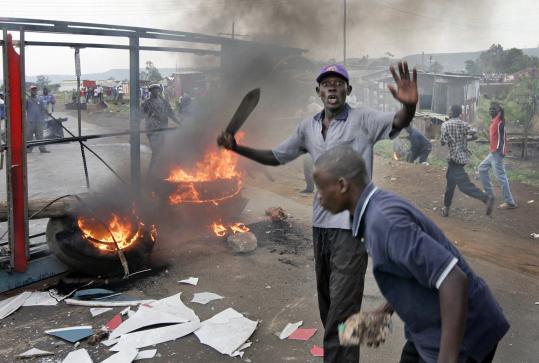
One of the most charming parts of what Bill Clinton calls Obama's "fairy tale" takes place in Kenya, which for most readers probably summons up visions of Meryl Streep out hunting with Robert Redford, however recently Kenya has exploded in Rwanda-like ethnic violence, with people being locked in churches and burned alive and folks being hacked to bits with machetes. Here is a Google News search link to bring you up to speed.

I read "Dreams From My Father" a couple of years ago and don't have it at hand at the moment, but I seem to recall that the Senator from Illinois has quite a few aunts and uncles and cousins by the dozens in that country and that his father was some sort of a civil servant. I can't remember what tribe they belong to and I have no idea what, if any, might be their participation in today's situation, but you can be sure that Karl and the Boaters are already on the case.

This is a potential can of worms unlike anything heretofore imagined in American political mudslinging and the faster this gets talked about and cleared up the better. DS

Monday, January 28, 2008

Kennedy to Bush to Clinton to Bush to Clinton or Kennedy surrogate?

"The election of a Progressive like Clinton or Obama would deprive conservatives of power. The election of a Progressive like McCain would deprive conservatives of both the government and the means to resist Progressivism. Which is the lesser evil?" Cato Institute
David Seaton's News Links
With all the old Kennedys being trotted out, I really begin to think the Democrats are going to do the impossible: lose the next election. And after reading the above quote from the Cato Institute's libertarian crazies, I'm not so sure it would be such a bad thing.

Cato aren't the only ones. On the other side of the ultra right spectrum, here is what America's favorite fascist, Pat Buchanan has to say about McCain,
"Where President Bush has been bravest, on taxes and judges, McCain has been his nemesis. Not only did McCain vote against the Bush tax cuts twice, he colluded to sell out the most conservative of the Bush nominees to the courts.

In 1993, McCain voted to confirm ACLU liberal and pro-abortion Ruth Bader Ginsburg. But when Bush set out to restore constitutionalism, McCain colluded with Democrats who wanted to retain power to kill Bush's most conservative nominees.

McCain helped form the Gang of 14, including seven Democrats, who agreed to block a GOP Senate from using the "nuclear option" -- allowing a simple GOP majority to break a Democrat filibuster of judicial nominees -- unless the seven Democrats approved. McCain thus conspired with liberals to put at risk the most courageous conservatives nominees of President Bush.

With his record of voting for liberal justices Ginsburg and Stephen Breyer, and of colluding with Democrats in their campaign to kill the most conservative Bush nominees, what guarantee is there a President McCain will nominate and fight for the fifth jurist who would vote to overturn Roe v. Wade?

In the battle over campaign finance reform, McCain colluded again. The McCain-Feingold law denies to gun folks and right-to-lifers their basic First Amendment right to name friends and foes in ads run before elections."
With enemies like that, the man must be doing something right. Where is the progressive vote here? To a Clinton or a Kennedy restoration? The only Democratic candidate talking seriously about the issues is John Edwards and he is being treated by the media like he had genital herpes. Look, if we have to vote for a dynastic candidate, aren't there any living relations of LBJ interested in the job? At least he was a real progressive on labor, race, pensions, health and education. DS
McCain Gaining Among Republicans - Cato Institute
"Mr. McCain, who has delighted in sticking his thumb in the eye of mainstream Republicans throughout his political career, is now accumulating a base of support among party regulars who see him as the strongest general election candidate in the remaining Republican field," reports . "The latest evidence came Saturday night with the endorsement of Florida's popular Republican governor, Charlie Crist, which surprised even Mr. McCain. That state holds primary elections on Tuesday."

In "McCain vs. Madison," John Samples, director of Cato's Center for Representative Government, writes: "President McCain -- and yes, the words make me shudder even subjunctively -- would pursue endless 'reform' of campaign finance. He would do so in part for political reasons. Such restrictions on speech will quicken his transformation of the Republican Party away from its Reaganite past and toward a Rooseveltian future. But 'reform' is more than a political tactic for McCain. For him, the First Amendment is a philosophical mistake that limits our true calling to national greatness. It is a mistake that might be corrected by proper laws and compliant courts.

"The election of a Progressive like Clinton or Obama would deprive conservatives of power. The election of a Progressive like McCain would deprive conservatives of both the government and the means to resist Progressivism. Which is the lesser evil?"

Sunday, January 27, 2008

Parag Khanna in the NYT

David Seaton's News Links
This article by Parag Khanna in the New York Times that I have abstracted here is going to be a huge "conversation piece". I suggest you run off and read the whole thing now and then come back and read my comment, if you are so inclined.

Khanna's piece seems to be a "dark" view, but it ends on a note of wonky optimism that is beyond my ken. At this moment we are looking into a whirlpool.

Khanna sees all sorts of ways of “managing” the world situation, but, what I believe really defines the world situation is that it is no longer manageable. It’s un-manageability is its defining characteristic.

I also think that Khanna is wrong about Russia’s situation. We are going to be looking at a world of much armed conflict actual and threatened and the Russians have very good weapons for sale. In fact they are the only ones that provide antiaircraft systems of a quality that can neutralize the US air force’s superiority. Thus anyone who would like to be independent of US intimidation only has Russia as an alternative. Iran is an obvious case in point.

I would imagine that Russia’s population will increase as the oil and gas money continues to filter through their society. They also have a fair base in pure science as I recall and that is a real ace in the coming world, where science will have to solve so many hair raising problems. Anyway it is silly to write off any people that produced Leo Tolstoy and who drowned Adolph Hitler in their blood.

Really, what I worry most about is the effect this stomach floating drop in power, influence and ultimately standard of living, will have on the Americans themselves. There are certainly plenty of right wing demagogues around in the USA and I am worried by the idea of a “Wiemar - America”, with an apple pie version of “ve vass stabbed in der back” in the not too distant future. There may be American leaders waiting around the corner that could make Bush look good. DS


Waving Goodbye to Hegemony - New York Times
Abstract: Turn on the TV today, and you could be forgiven for thinking it’s 1999. Democrats and Republicans are bickering about where and how to intervene, whether to do it alone or with allies and what kind of world America should lead. Democrats believe they can hit a reset button, and Republicans believe muscular moralism is the way to go. It’s as if the first decade of the 21st century didn’t happen — and almost as if history itself doesn’t happen. But the distribution of power in the world has fundamentally altered over the two presidential terms of George W. Bush, both because of his policies and, more significant, despite them. Maybe the best way to understand how quickly history happens is to look just a bit ahead.

It is 2016, and the Hillary Clinton or John McCain or Barack Obama administration is nearing the end of its second term. America has pulled out of Iraq but has about 20,000 troops in the independent state of Kurdistan, as well as warships anchored at Bahrain and an Air Force presence in Qatar. Afghanistan is stable; Iran is nuclear. China has absorbed Taiwan and is steadily increasing its naval presence around the Pacific Rim and, from the Pakistani port of Gwadar, on the Arabian Sea. The European Union has expanded to well over 30 members and has secure oil and gas flows from North Africa, Russia and the Caspian Sea, as well as substantial nuclear energy. America’s standing in the world remains in steady decline.

Why? Weren’t we supposed to reconnect with the United Nations and reaffirm to the world that America can, and should, lead it to collective security and prosperity? Indeed, improvements to America’s image may or may not occur, but either way, they mean little. Condoleezza Rice has said America has no “permanent enemies,” but it has no permanent friends either. Many saw the invasions of Afghanistan and Iraq as the symbols of a global American imperialism; in fact, they were signs of imperial overstretch. Every expenditure has weakened America’s armed forces, and each assertion of power has awakened resistance in the form of terrorist networks, insurgent groups and “asymmetric” weapons like suicide bombers. America’s unipolar moment has inspired diplomatic and financial countermovements to block American bullying and construct an alternate world order. That new global order has arrived, and there is precious little Clinton or McCain or Obama could do to resist its growth. READ IT ALL

Saturday, January 26, 2008

Enjoy Bush while he lasts

David Seaton's News Links
I'm taking some well deserved rest today, so I thought I'd goof off and just show y'all a film.

I made this thing over a year ago as a mashup. Had fun and worked off my agressions. Looking at it today, I got to thinking that a meatball like Bush is a one off. I think we'll see much worse than Bush, someone just as rotten but much more competent. A heart as worm eaten as his, but velvet tongued. So lets enjoy this scum ball while we can. We shall not live to see his like again. DS

Thursday, January 24, 2008

William Pfaff: The Coup d'Etat against Bush


David Seaton's News Links
I can't think of a more important topic than this. This is not the rant of some blogger in pajamas. William Pfaff is one of the most respected political commentators writing today in the English language.

Careful readers will notice a thick forest of nuances in everything he says here. DS


William Pfaff: The Coup d'Etat against Bush
Abstract: The conspicuous irrelevance of George W. Bush’s tour of the Middle East to any of the real forces and interests of the region, as well as the spooky irrelevance of nearly everything he said there about the alleged menace of Iran, Israel-Palestine peace, his fancied notions of Iraq’s democratic development, and even about oil prices and the American economy, embarrassed his Arab hosts as well as the American officials and press accompanying him. The tour – his farewell to the Middle East? -- lent weight to the judgement many abroad have already reached, that he no longer governs the United States, and indeed does not even understand its present foreign relationships. It is widely felt that what amounts to a coup d’etat has taken place in the United States, removing George Bush, without his even recognizing this (or at least admitting that it has occurred) from control over the principal issues of war and peace. This coup has taken the form of what amounts to a mutiny of the professional foreign policy services of the U.S. government, acquiesced in by the new Secretary of Defense, the service chiefs, and Director of Central Intelligence Bush has himself appointed.(...) The pathetic and pusillanimous refusal of recent American Congresses – and we are not simply speaking about the Congress now in office, but of practically every Congress since the beginning of the cold war – to fulfill their constitutional responsibilities with respect to the declaration and financing of wars, has now generated its own rebuke from within the executive branch of government. Leaders in the executive branch are unwilling to act on presidential orders that do not carry with them the constitutionally mandated authority of the representative branch of government.(...) I am perhaps taking a romantic and unjustified view of what has happened. I hope not. I believe that only grave malfeasance in government and unconstitutional conduct justify an executive ‘coup d’etat’ – however ‘postmodern’ the form that it assumes, and however elevated its motives. However I would suggest that the present election campaign demonstrates that powerful forces in the Washington political and foreign policy communities, reinforced by financial and industrial interests, are committed to suppressing all challenge to policies that already have altered the political character of the United States. The American form of government itself needs to be defended. READ IT ALL

Wednesday, January 23, 2008

Every so often something beautiful happens


David Seaton's News Links
Every so often something beautiful happens that makes your heart swell with human feelings of empathy and solidarity.

A wall falling and people behind it flowing out just to buy ice cream, to see their friends they haven't seem for years, or to get married and start a family like the couple in the story below.

The down side? This could blow Egypt apart. American aid has neutralized Egypt, but Egypt is the most important country in the Middle East.

If the Mubarak regime is seen collaborating with the Israelis to put the Palestinians back in their cage it might bring the Egyptian people out into the streets. If the Israeli army enters Gaza and Hamas puts up a real fight then the Egyptian army (captains, majors and colonels) might stage a coup d'etat and a general war might break out in the Middle East. Something much bigger and harder to control than the Yom Kippur war of 1973. Because when people's hearts swell with human feelings of empathy and solidarity it generates an amazing force that politicians oppose at their peril. DS


Wedding bells to ring after fall of Rafah wall - Reuters
While other Palestinians lugged food and fuel from Egypt into the Gaza Strip on Wednesday, Omran Lubbab took advantage of the fall of Gaza's Rafah wall to bring his future bride home.

"No more delays," said Lubbab, a 34-year-old Gaza cameraman, vowing to marry fiance Heba al-Qadi in two weeks' time.

Lubbab was reunited with Qadi, a Palestinian who lives on the Egyptian side of the divided town of Rafah, after stepping through one of the gaps Hamas fighters blew in the border wall dividing the town.

"We have been engaged for two years but our wedding has been delayed because of the closure of the border crossing," said Qadi, who carried two suitcases filled with new dresses into the Gaza Strip to begin her new life.

Israel and Egypt have largely kept the Rafah passage sealed since Hamas Islamists violently took over the Gaza Strip from forces loyal to Palestinian President Mahmoud Abbas in June.

In a declared bid to stop Palestinian rocket attacks from the Gaza Strip, Israel shut the territory's other crossing points on Friday but eased restrictions on Tuesday after an international outcry over shortages of fuel and other goods.

Qadi will be staying with relatives in Gaza until the wedding.

Her mother, Buthaina al-Qadi, was all smiles as she watched the couple chatting about their wedding reception.

"I am very happy. My daughter is finally going to start a new life and a family," she said.

Palestinian police estimated that more than 100,000 people had crossed into the Egyptian side of Rafah.

"People need to breathe. People need to bring food to their children. It is the revolution of hunger," said one policemen who declined to give his name.

Tuesday, January 22, 2008

Congo to Wall Street: Hey, things are tough all over.

David Seaton's News Links
I imagine that quite a few of my readers are watching the Dow Jones with trepidation these days or struggling with their mortgage or credit card payments and I thought a little news from Africa might make them stop and count their blessings.

There is this war in the Congo, you see, and it's been going on for ever so long. I'll let Wikipedia bring you up to speed:
The largest war in modern African history, one of the deadliest conflicts since World War II, it directly involved eight African nations, as well as about 25 armed groups. 5.4 million people died, mostly from starvation and disease. Millions more were displaced from their homes or sought asylum in neighboring countries. Despite a formal end to the war in July 2003 and an agreement by the former belligerents to create a government of national unity, 1,000 people died daily in 2004 from easily preventable cases of malnutrition and disease. A United Nations human rights expert reported in July 2007 that sexual atrocities against Congolese women go 'far beyond rape' and include sexual slavery, forced incest, and cannibalism.
So you can see that although we haven't been following it very closely, it has managed quite well without us. DS

Congo conflict causes 45,000 deaths a month: study - Guardian
Abstract: The effects of a decade of fighting in the Democratic Republic of Congo is continuing to kill about 45,000 people each month - half of them small children - in the deadliest conflict since the second world war, according to a new survey. The International Rescue Committee said preventable diseases and starvation aggravated by conflict had claimed 5.4m lives since the beginning of the second Congo war in 1998, equivalent to the population of Denmark. Although the war officially ended in 2002, malaria, diarrhoea, pneumonia and malnutrition have continued to claim enormous numbers of lives in part because fighting continues in the east of the country. The study of 14,000 households across Congo between January 2006 and April 2007 found that nearly half of all the deaths were of children under the age of five, who make up only 19% of the population.(...) "When war destroys a country's economy and infrastructure, there's no quick fix," said Dr. Richard Brennan, one of the survey's authors. "Significant improvement in Congo's health and mortality will require years of unwavering commitment from the government and the international community and substantial financial investment. Sadly, the humanitarian crisis in Congo continues to be overlooked and funding remains disproportionate to the enormity of need." READ IT ALL