Thursday, June 13, 2013

Edward Snowdon, China's American dissident

David Seaton's News Links
Hong-Kong-judges
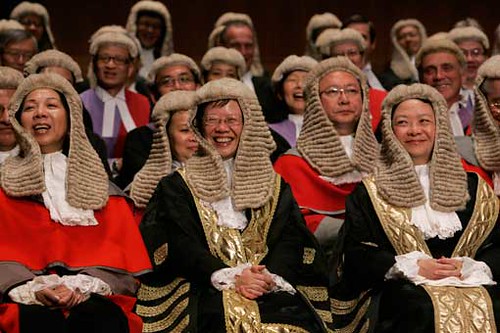
Snowdon's Hong Kong Judges
The real risk to our democracy is what this situation does to potential dissenters, whistle-blowers, investigative journalists, and anyone else who thinks that some aspect of government policy might be boneheaded, unethical, or maybe even illegal. If you are one of those people -- even on just a single issue -- and you decide to go public with your concerns, there's a possibility that someone who doesn't like what you are doing will decide to see what they can find out about you.(...) Unless you've lived an absolutely pristine online and cellular life, you might wake up to discover that some regrettable moment from your past is suddenly being plastered all over the blogosphere or discussed in the New York Times. Stephen Walt
The more we learn about PRISM, the more it seems like something dreamed up by Glenn Beck mainlining speedballs after dropping acid. And I'm sure that what we know now is only the proverbial tip of the iceberg, or the proverbial drop in the proverbial bucket or the other shoe waiting to be proverbially dropped. And for me what is coming down the proverbial pipe explains what for many is a mystery: why Snowdon has gone to ground in Hong Kong.
It appears that Hong Kong's English-legacy legal system is very robust, with a lot of guarantees that Snowdon will get a full hearing of his case. If he wants all the information he has in his possession heard in an open court filled with journalists and all in the English language, he has gone to the right place. This and not escaping from American justice seems to be his apparent goal.
It may be a very shrewd strategy... The more we know about the nuts and bolts of "Big Brother" the more sympathy and gratitude Snowdon may garner. President Obama will be wondering, "world hero... profitable to martyr?"
Many commentators are saying that the Chinese will surely want to hand him over quietly to the USA to avoid "souring" relations...Why should they do that? Think about it... How would the US treat a famous Chinese "dissident" that appeared on its shores, if China demanded his extradition? Think about how much space the American media devote to any Chinese protest or dissident.
I imagine that the Chinese must be pissing themselves with laughter! Rubbing their hands together with glee. Especially when the US has recently been accusing them of all sorts of cyber crimes. I'm sure that having the Americans hoist by their own petard having their dirtiest laundry washed in English in China will prove irresistible to the Chinese. What will the Chinese man in the street think of it all? This is not for internal Chinese consumption, but rather to erode America's "moral" authority world wide, another reason for it to play out in Hong Kong.
So I think the Chinese are going to allow Snowdon to drag the US over the coals in Hong Kong courts and expose what for the Chinese must be America's endless hypocrisy. Also the US might do a deal... drop all charges against Snowdon in exchange for him not revealing all he knows in an open court. However I think Snowdon wants to reveal all and have the transcripts of his hearing available for the whole world to read public and online. That is why he got into this mess in the first place.
Being a hero is his best life-insurance policy, but just in case, I also imagine Snowdon has placed a copy of his information somewhere safe where it will all come out if something "nasty" happens to him.
Interesting character Edward Snowdon, I'd like to learn more about him. DS

Sunday, June 09, 2013

NSA scandal... I got algorithm

David Seaton's News Links
When separate streams of data are integrated into large databases — matching, for example, time and location data from cellphones with credit card purchases or E-ZPass use — intelligence analysts are given a mosaic of a person’s life that would never be available from simply listening to their conversations. Just four data points about the location and time of a mobile phone call, a study published in Nature found, make it possible to identify the caller 95 percent of the time. “We can find all sorts of correlations and patterns,” said one government computer scientist. New York Times

If the search for those planning terror attacks is like looking for a needle in a haystack, however, then first thing one needs is a haystack. Haaretz

Now that we are envisioning some guy in a National Security Agency warehouse in Fort Meade, Md., going through billions of cat videos and drunk-dialing records of teenagers, can the Ministries of Love and Truth be far behind? Maureen Dowd - NYT
Reading Jason Lanier's important new book, "Who Owns the Future", shortly before the NSA scandal broke, helped me to get a better understanding of what has happened.  Lanier says that we are giving away very valuable marketing information (data) about ourselves, our tastes, our ideas, our location from moment to moment, in exchange for free email, and places to meet others of similar tastes, etc. This is the significance of "Big Data", the masses of personal information that Amazon, Google and Facebook gather from their users, which allows them to place an ad on the page you are reading, like the CIA places a Hellfire rocket from a drone.
And Lanier maintains that the most powerful individuals and companies in the near future will be the ones with the biggest servers, "Siren-Servers", he calls them, those that amass and can process more data about their customer's (just about everyone's) lives. What the NSA has been doing naturally follows from that: the US government owns the biggest servers and they are milking the "Siren-Servers" like a herd of milch cows.
You thought that in the new Internet world that maybe Sergey Brin and Mark Zuckerberg were going to be bigger swinging dicks than the head of the CIA? Think again.
What the NSA appears to be doing is to correlate almost all the big social data that American firms possess. I don't know if at that point we really have a reason to complain, as Lanier points out in his book, we are giving all that valuable information about ourselves away for free to people like "don't be evil", Google, in exchange for "free" email, cloud space, etc.
If you took the trouble (which nobody ever does) to read the lengthy texts that come above the "AGREE" button that we eagerly click on in order to get all the free stuff, you would probably find buried in it some lawyerly little clause where you agree to let them share it with the government. Therefore this marketing and location information (not the contents of the emails) probably IS public domain.
What we really have to investigate is how the government correlates what Haaretz calls the "haystack", what are the algorithms that the NSA is using, how are threats defined, what the correlations might be. One thing is Amazon figuring out what books you might enjoy or Facebook thinking you might be interested in deep-dish pizza and quite another thing is the FBI thinking you are a threat to national security. In short we need to know how the system works, what criteria the government agencies are employing in processing all this data that we have given away for free.
What sort of results has it produced? What plots have been foiled? Whose lives have been saved? This information is essential for the public in a democracy to evaluate the tradeoffs involved. The resulting "safety" may not justify the loss of trust in those sworn to protect us.
It seems to me, with the meager information I possess, that this kind of data correlating might easily lead to discovering a network of child pornographers or cannibals, but I'm a bit skeptical about the value of what they are collecting if it is for catching serious terrorists, spies and criminals. The really serious ones are not that generous with their data. 
Back at the turn of the century, I remember reading the legendary East German spymaster, Markus Wolf's fascinating autobiography, "Man Without A Face". Way back then, Wolf laughed at anyone who would digitize any serious information so that a "schoolboy in Kansas" could access it from his bedroom and he wrote that he kept the names of his agents in his head and didn't even commit them to paper. We also know from our readings that capo mafiosi and Sea Org Scientologists do all their phoning from payphones and have masses of quarters on hand for this purpose. And who can forget that the greatest terrorist in history, Osama bin Laden probably managed to survive as long as he did after 9-11 because he only communicated using couriers.
So just to recap, we had better hurry and check to see that if "in a fit of absent mindedness " we haven't actually happily given Facebook and Google permission to give all our "secrets" to the security state. And then we should demand to know in detail what criteria are used in determining what minute flotsam in this endless ocean of data might cause any individual (presumed innocent till proven guilty) to be singled out for intense surveillance by the security forces of a democracy. DS

Wednesday, June 05, 2013

A new angle on fracking

David Seaton's News Links
I had an interesting conversation about fracking today with a very knowledgeable Spanish executive in the energy sector.
We weren't asking ourselves about the ecological questions that arise with fracking, but more about the geopolitical-strategic factors of this technology.
This person remarked that there seemed to be a contradiction between fracking being a sort of silver bullet that was going to make the USA totally independent in energy and reduce the influence of the major producers of natural gas, which just happen to be Russia and Iran and the curious fact that most of this business is being carried out by smaller companies.
Contradictory, this person said, because energy is economically, politically and militarily strategic and if fracking is going to be the key technology in the sector, it is going to have to be tightly regulated and the government wants to have a very clear idea of who to call for quick action in an emergency: chief executive officers, associations, lobbyists, etc. This means big, multinationals, not a multitude of middle and small size outfits.
I asked what this might mean.
The executive replied that it might mean that fracking as America's "secret weapon" was all some sort of bubble created for propaganda purposes for dealing with Iran and Russia and the rapid disintegration of America's influence in the Middle East. 

In this person's opinion that would explain the multitude of small companies... because they are not "too big to fail", and when the crisis abates the government can pull the plug on them and send them crashing with none of the consequences of doing something like that to the "majors", whose leaders and shareholders would have the scalp of any politician that caused them to lose serious money in a geostrategic ploy.
This argument made a lot of sense to me and I thought I would pass it on to my readers. DS

Sunday, May 26, 2013

Israel: the fiddler fiddles while the roof burns

David Seaton's News Links
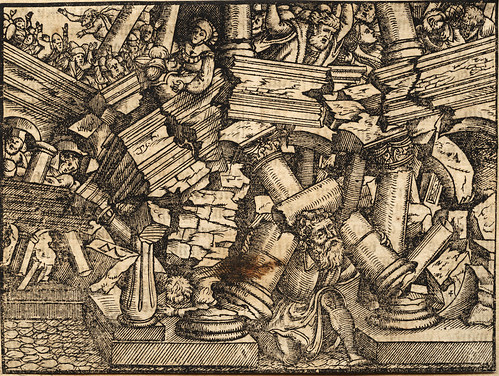
Samson pulls down the temple (in Gaza, no less)

Henry Kissinger famously wished that the Bible had been written in Uganda...
Israel has never been richer, safer, more culturally productive or more dynamic. Terrorism is on the wane. Yet the occupation grinds on next door with little attention to its consequences. Moreover, as the power balance has shifted from the European elite, Israel has never felt more Middle Eastern in its popular culture, music and public displays of religion. Yet it is increasingly cut off from its region, which despises it perhaps more than ever.(...) Some have likened Israel to the deck of the Titanic. That may not be right, but you can’t help wondering about that next iceberg. EthanBronner - New York Times
In this post I simply want to note my sense of foreboding, which this snippet from the New York Times encapsulates.
Readers of my blog will remember that I spent a very formative year of my youth working, living and loving in Israel... Henry Kissinger's wish that Israel had been established anywhere but the Middle East fits my sentiments exactly. What a wonderful country it could have been if it had truly been "a land without people, for a people without land" instead of the result of an ethnic cleansing and ongoing repression and humiliation whose ensuing rage has awakened the world of Islam from its slumbers and united millions of disparate peoples in their thirst for revenge.
The energy, the vivaciousness, the creativity of a people central to the narrative of civilization, are day by day creating a massive tragedy for themselves and the rest of humanity.
Here is how the American Heritage Dictionary defines "tragedy"
A drama or literary work in which the main character is brought to ruin or suffers extreme sorrow, especially as a consequence of a tragic flaw, moral weakness, or inability to cope with unfavorable circumstances.
The NYT article gives a perfect description of the curious, Club Med world of its own, where the Israelis contemplate their navels in the shadows of a sun kissed "Götterdämmerung", a word which Merriam Webster defines as:
A collapse (as of a society or regime) marked by catastrophic violence and disorder
I believe that it will be impossible for the world to assimilate or process what is about to unfold. It is difficult for me to express the heaviness of my heart. DS

Tuesday, May 21, 2013

My European Union Rant

David Seaton's News Links
Now it is the European Union itself that is in danger, mainly but not entirely because of the economic crisis inherited from Wall Street abuses. (...) A new Europe-wide report by correspondents of the Paris newspaper Le Figaro reveals mounting disillusionment with the European Union itself among the voters of its member states. (...) Britain has made the most news about possible withdrawal from the union since the country’s most recent local elections gave the United Kingdom Independence Party nearly as high a popular vote as the ruling Conservative Party, led by Prime Minister David Cameron. (...) There was an immediate rise in demand among Conservative Party members for a referendum on quitting the EU – which the Ukip promises. William Pfaff
The British are talking about leaving the European Union... to put this conversation in perspective, I would trot out the famous quote of Mahatma Gandhi's, who, when asked what he thought of western civilization replied, "It would be a good idea".

If we agree that the heartland of western civilization is comprised of the countries, including Britain, that make up the European Union and we then consider the millions of Europeans that have been killed (by each other) over centuries in Europe's countless wars, religious and otherwise, and its assorted genocides and the millions of its inhabitants that were forced to emigrate to the ends of the earth to escape poverty and tyranny, and then contemplate its record outside Europe of: slavery, exploitation of natural resources, ethnic cleansings and genocides of peoples of color and then consider that so recently having renounced killing one another and so recently, if reluctantly, also laid down the white man's burden, then it might be a tad early and a trifle frivolous to quibble about an institution which might loosely fit Gandhi's description of a "good idea", namely the European Union?

Really all this talk makes me think of a chain smoker, who having been diagnosed with advanced lung cancer and that after having had a lung removed and undergoing intense radiation and ghastly chemotherapy, upon being told that he is in remission goes out and buys a pack of cigarettes. DS

Thursday, May 09, 2013

The military sexual abuse scandal

David Seaton's News Links
It would seem to me that the current, quite justified uproar about sexual violence in the US armed forces sheds a very bright light on the cognitive dissonance produced by America's view of itself as a democratic, enlightened and inclusive society that serves as a model for the world to emulate, which contrasts with the reality of a worldwide empire which is maintained by the most powerful military establishment in history and that has been at war continuously for over ten years with no positive results.
Transforming the military’s entrenched culture of sexual violence will require new approaches and a much stronger effort than what the Pentagon has done so far. That is the depressing truth of a Defense Department study released on Tuesday estimating that about 26,000 people in the military were sexually assaulted in the 2012 fiscal year, up from about 19,000 in the same period a year before. Those who thought that the crisis could not get any worse have been proved wrong. As in other years, only a small fraction of assaults were reported — 3,374 in 2012 compared with 3,192 in 2011. The study, based on anonymous surveys, suggests that the great majority of sexual assault victims do not report the attacks for fear of retribution or lack of faith that the military will prosecute these crimes. Just two days before the report’s release, the officer in charge of sexual assault prevention programs for the Air Force, Lt. Col. Jeffrey Krusinski, was arrested in Arlington County, Va., and charged with sexual battery, compounding the sense that the military is incapable of addressing this crisis. Editorial - New York Times
I would suggest that the sexual violence should be viewed in the same context as the suicide epidemic in the US armed forces:
A 2009 U.S. Army report indicates military veterans have double the suicide rate of non-veterans, and more active-duty soldiers are dying from suicide than in combat in the Iraq War (2003-2011) and War in Afghanistan (2001–present). Colonel Carl Castro, director of military operational medical research for the Army noted "there needs to be a cultural shift in the military to get people to focus more on mental health and fitness. Wikipedia

An astonishing 6,500 former military personnel (...) killed themselves in 2012, roughly equivalent to one every 80 minutes.(...) Contrary to widely held assumptions, it is not the fear and the terror that service members endure in the battlefield that inflicts most psychological damage, Nash has concluded, but feelings of shame and guilt related to the moral injuries they suffer. The Guardian
What is our armed force's job, what do they do?
Simply put, they kill people and blow things up.
What is the object of our armed forces killing people and blowing things up?
The object of war is to force an adversary by violence or threat of violence to do something they would otherwise not wish to do except to avoid that violence: in short to violently bend the will of the adversary to suit our interests.
Let us now look at a rough and ready definition of "rape", from Wordnet:
  1. rape, colza, Brassica napus -- (Eurasian plant cultivated for its seed and as a forage crop)
  2. rape, rapine -- (the act of despoiling a country in warfare)
  3. rape, violation, assault, ravishment -- (the crime of forcing a woman to submit to sexual intercourse against her will)
I think, then, that without forcing the metaphor, you could say that the United States armed forces have, for example, "raped", Iraq, Panama and Vietnam in recent memory (all for their own good of course).
Now, who are the soldiers?
For hundreds, for thousands, of years soldiers have been very young men, brimming with testosterone, horny as chimpanzees, taught to kill people and blow things up, who spend most of their time bored to death and short periods frightened to death, and often just plain dead.
General William Tecumseh Sherman famously said that "war is hell". 
Here is picture of what he meant.
Marines pee on dead taliban
This is a famous picture, but what is on view is nothing that extraordinary in the context of war, simply that latter-Afghanistan is the first war in history where soldiers carry cellphones with cameras that can upload pictures to Internet... imagine if somebody had had a cellphone at the My-Lai massacre.
Now use your imagination and try to visualize American women soldiers urinating on dead Taliban and you get an idea of how complicated it is to fit women into this culture... as much physically as anything else. Awkward to say the least. You would ask yourself why any women in her right mind would want to be there and do that. To which a feminist could quite rightly ask in turn why any man in his right mind would want to either. Why indeed?
Which brings to one of the sorest points in the entire business: in the increasingly immobile American class structure, practically the only way a young person from a poor family can access to higher education or first class vocational training is to join the armed forces. In most developed countries all these things can be obtained for free without having to risk death or physical and mental mutilation. DS

Wednesday, May 01, 2013

The First of May... mayday, mayday

David Seaton's News Links
May Day - Margaret Scott
"Don't waste any time in mourning. Organize..."

The first of May, commemorating bloody labor unrest in Chicago, is celebrated all over the world as the universal holiday of labor... except in the USA of course.
The same USA where "red", the eternally universal color of the world's left, is now, unlike the days of Joseph McCarthy, the color of the Tea Party driven, ultra-conservative, Republican party... Often America's love of deceptive language and euphemism is beyond parody.  
It's no wonder then that many Americans are more than a little confused by now about what the left is actually about and have it confused with many worthy, but traversal, social issues.
In case anybody is interested, the left is really about worker's rights and worker's needs: everything else follows from that.
Most men and women in this world spend most of their lives working, if they can find work, and have little or nothing but their labor to exchange for the necessities of life, therefore: unemployment or bad working conditions + poor pay = a bad life for most people in the world. The left was born to change that equation.
Since the industrial revolution began, working men and women have joined together to force the owners of industry to give them better pay and working conditions, better schools for their children, affordable housing, medical care and pensions. Almost all betterment of working conditions, pay, pensions and all the rest come from that joining together and pressuring, often at the cost of blood. Little or none of it was ever given up gladly by those with the power to grant it.
This joining together and applying pressure is called "the Left". This struggle for better conditions is really what separates the "Left" from the "Right". Other things, however worthy, are mostly extraneous to this division.
For example: if you quizzed many wealthy followers of Ayn Rand or libertarians such as Rand Paul, I'm sure that you would find most of them either supportive or indifferent to gender and racial equality, to gay marriage and legalizing marijuana, but totally opposed to raising the minimum wage, regulating industries and the financial sector or raising the taxes of the one-percenters: and very much in favor of "right to work" laws.
One of the best encapsulations of  this confusion as to what the left is and what it is not was in a marvelous, near-poetic rant; one that touches all the main points in a few lines, posted by the blogger, Kurt Sperry the other day in Firedoglake under the title, "Dear Left, Enjoy Your Pot and Gay Marriage Because That’s All You’re Getting".
The establishment right has pretty much come around to the position that you may get gay married or smoke some pot without government interference, but at the same time we’ll steal your retirement, move your job to China, see that the bank can illegally foreclose you out of your home, give all your tax money away to criminal fraudsters who by the way are also our largest campaign contributors, oh and you’ll be put under microscopic total government surveillance and imprisoned or even killed without trial if that’s what we really want in the new police state we’ve created because dark Muslims booga booga. Kurt Sperry - Firedoglake
Today labor unions are weak and much of the new economy appears difficult to organize and millions of jobs have gone overseas, to previously non-industrialized, non-union, rural areas. This movement actually had begun quite some time before the jobs finally left America. 
Way back in the 1960s, the company my father worked for, a Philadelphia carpet manufacturer, moved most of their production from mills in Pennsylvania, buildings that had been in constant occupation for over a hundred years,  all the way down to north Georgia, to the foothills of the Blue Ridge Mountains.

These "runaway factories" were looking for tax breaks and unskilled, rural workers, men and women without unions willing to work for much less than the union men and women of Pennsylvania. This was before the worldwide deregulation of globalization, which you might call the "Capitalist International" made moves farther afield possible or even imaginable.

That move to Georgia was a sample of the beginning of a process that has led from American north to the American south, later to Mexico and then to Asia.

The process is just beginning to give the first signs that it might finally be running out of planet.

An event occurred a little over a hundred years ago that was a key for the American left and America's workers achieving many of the improvements in pay and working conditions that the right is doing its best to take away from them to this very day.
The fire at the Triangle Waist Company in New York City, which claimed the lives of 146 young immigrant workers, is one of the worst disasters since the beginning of the Industrial Revolution. This incident has had great significance to this day because it highlights the inhumane working conditions to which industrial workers can be subjected. To many, its horrors epitomize the extremes of industrialism. The tragedy still dwells in the collective memory of the nation and of the international labor movement. The victims of the tragedy are still celebrated as martyrs at the hands of industrial greed. Cornell University
One hundred and forty six worker died, most of them young Italian and eastern European Jewish immigrant women, many of whom jumped to their deaths to avoid being burned alive.
Let's put that tragedy into perspective by comparing to a similar tragedy unfolding as this post is being written: the Rana Plaza disaster of Bangladesh.
The collapse of the building, the Rana Plaza, is considered the deadliest accident in the history of the garment industry. It is known to have claimed at least 377 lives, and hundreds more workers are thought to be missing still, buried in the rubble. The Rana Plaza building contained five garment factories, employing more than 3,000 workers, who were making clothing for European and American consumers. New York Times
Emergency workers hauling large concrete slabs from a collapsed 8-story building said Tuesday they expect to find many dead bodies when they reach the ground floor, indicating the death toll will be far more than the official 386. One estimate said it could be as high as 1,400. The illegally constructed Rana Plaza collapsed on the morning of April 24, bringing down the five garment factories inside.  AP - April 30th
One hundred and forty six to possibly ten times that number. You can see the hundred year trajectory of the international garment industry, from importing impoverished cheap labor to work in New York to exporting production to where poor people are a seemingly inexhaustible resource. 
The Triangle Fire awakened the conscience of most Americans that possessed such a thing and showed them that something was terribly wrong and that the clothes on their backs were drenched in blood and ashes. The immigrant girls of New York were no less foreign to the average American of that time than the workers of Bangladesh are today. It wasn't about "us" and "them". Being human beings was all that was needed to be "us".

Perhaps with today's communications, the video, the photographs, the access to their English language newspapers, mean that the Bengali workers  are even closer to us than the Southern Italian and Eastern European Triangle girls were for the Americans of 1911... We did this to them: the inexpensive clothes on our backs are still drenched in blood and ashes.
(T)he retailers of our RMG products in the USA and Europe cannot shirk their part of responsibility in the deaths due primarily to lack of appropriate working conditions and lax safety arrangements. For example, a year and a half before the Tazreen factory fire, the Wal-Mart shareholders had rejected by 50-1 vote a proposal that required the suppliers to report annually on the safety measures of their factories on the grounds that it would ultimately lead to consumers paying higher cost for the product. And some of the buyers have held their retailers squarely responsible for the deaths in Savar.  Editorial - Daily Star - Dhaka, Bangladesh
I said before that the "runaway factory" process is just beginning to give the first signs that it might finally be running out of planet. The workers wise up, their learning curve gets steeper and steeper, even where it is forbidden they organize   Let us see how this is playing out.
China incomes are on the rise, but the pay scale at some professional jobs in China may surprise the average American. Based on 2011 salaries, some Chinese workers are earning as much as their American counterparts. As U.S. wages go down, China wages are going up.(...) Blue collar wages in major cities are all on the rise. Salaries for skilled management positions are approaching or equal to that of developed country wages for similar positions. This will be exacerbated in the near term by the shrinking size of the working-age population. Population growth rates are expected to turn negative before the end of this decade. Forbes

The May Cheong Group, the plant’s owner, plans to cut its headcount from 12,000 a few years ago to 8,500 by the end of the year. At the same time, it is seeking to retain older workers by offering accommodation for married staff and a crèche for their children. In one room, a machine that looks as though it houses a rotating silver Christmas tree undertakes tasks that would once have required 60 workers. Instead, just two people monitor the machine as it spray-paints the chassis of hundreds of little cars. The future of manufacturing in China may well lie in factories such as this. Financial Times

Double-digit wage increases in China and a shortage of labour for factory work have prompted several companies to move to cheaper countries such as Vietnam, Bangladesh and Indonesia(...) As work moves from China to places such as Bangladesh and Cambodia, where wages rise as a result, consumers in the west will have to get used to higher prices for garments and shoes.  Financial Times
This increase in wages and living standards will mean that the Chinese instead of merely being sweated workers will become consumers and the volume of what they could consume is mind boggling. If workers in Bangladesh and Cambodia, aided by American and European consumer and labor organizations fight for their rights, something has got to give and their living standards rise. Perhaps the famous "next historical phase" is staring us right in the face.
What happens as the "runaway factories" run out of planet? As we can see from the May Cheong plant, the answer is robotization... but robots don't consume anything but electricity and not having pockets don't spend anything on clothes or recreation.

Summing up: The Left is about worker's right and needs. Nothing was ever gained without struggle. The front line of today's labor struggle is in the factories of China, Cambodia, Vietnam and Bangladesh and in the shopping malls of America and Europe. 

What should be done? 

Committed individuals and organizations in America and Europe should make every use possible of the new technologies to aid the workers of today's runaway factories to organize and fight for their rights and also to agitate to raise the consciousness of consumers. 

If that is successful and workers in Asia begin to earn decent wages they too will consume. In the countries that the factories ran away from the jobs will begin to return to where the customers with money to spend are and with good jobs those customers will spend more. 

A beneficent circle or an inflationary hell?

Stay tuned, the revolution will be tweeted. DS
Thursday, April 25, 2013

Hats off, It's Ella Fitzgerald's birthday

The greatest singer of the Great American Song Book was born on the 25th of April 1917

With Count Basie

Gershwin by God

One Note Samba ... Delirium

Monday, April 22, 2013

Boston and the dilemma of "homegrown" terrorism

David Seaton's News Links
As the Spanish and British can attest since the Madrid and London attacks of 2004 and 2005, homegrown terrorism is tougher to anticipate than plots from outside. Edward Luce - Financial Times
The word "homegrown" is not really applicable to Islamic terrorism. Islam even in its most benign manifestations is always "homegrown": a simple, universally applicable, multinational, text-based, hierarchy-less, easy to understand, ideology that governs every aspect of life.
When, finally the worldwide Muslim community or Uma, using the essential, cheap and ubiquitous, communication tools of the Internet comes to a simple consensus as to who their enemies are, and there exist simple devices like pressure cookers filled with black powder for expressing their anger, no hierarchy in the shadows is needed. We can expect many individual actions similar to 19th century anarchism to follow.
What Americans need to pray for is that the millions of alienated, American born, young,black, men, who overflow their prison system, do not turn to Islam to express their anger and sense of oppression. DS

Sunday, April 21, 2013

The bombs and bombers of Boston

David Seaton's News Links
Federal investigators are hurrying to review a visit that one of the suspected bombers made to Chechnya and Dagestan, predominantly Muslim republics in the north Caucasus region of Russia. Both have active militant separatist movements. Members of Congress expressed concern about the F.B.I.’s handling of a request from Russia before the trip to examine the man’s possible links to extremist groups in the region. New York Times
It looks like this bombing was organized from Chechnya.
Why in Boston?
Because of their previous successes, planting a bomb in Moscow is very hard for the Chechens to pull off anymore and even if they are successful, killing dozens of Russians, as they often have before: that doesn't even rate more than a line or two in the world press.
But set off a homemade Chechen bomb in the USA, where nobody is expecting it, one that only kills three people... and suddenly it will dominate the world media for many days on end, with exhaustive coverage, something which, in effect, puts Chechnya and the Chechen cause right back on the map.
Was this organized by Chechen extremists?
Probably... but it also could have been just as easily organized by Russian intelligence, who, tired of being ignored, used agents provocateurs posing as Chechen extremists to recruit Tamarlan Tsarnaev, who in turn recruited his little brother.
Why would Russian intelligence do something like that?
Because Chechen nationalism is a very big problem for the Russians, but hardly on America's radar. Now instead of just being another tool for the Americans to potentially weaken Putin with, it has suddenly become a common enemy demanding intense cooperation with Putin. The Tsarnaev brothers would have been the last ones to know.
We will probably never know the truth either. DS

Tuesday, April 16, 2013

Bombs in Boston

I live in Madrid, Spain, and at this moment we are enjoying a (momentary?) respite from nearly 40 years of constant terrorist attacks, mostly by Basque separatists, with the one monumental attack by Al Qaeda in March 2004 with nearly 200 dead.
I remember once, many, many years ago, being in an office meeting and hearing through the open window a very close by, "ratatatatat" followed by a "boom", followed by the most total of silences, followed minutes later by sirens, which was the machine gun burst and grenade chaser that killed a Spanish admiral, the direct descendent of Christopher Columbus and his chauffeur, a poor recruit.
The daughter of a friend of ours lost an eye in an Eta bomb attack... she was just passing by.
The only consolation I can give the people of Boston is that if it goes on long enough, you finally get used to it... almost. DS

Friday, April 12, 2013

Thoughts on the New technology and privacy in the "Global Village"

David Seaton's News Links
facebook privacy

When I was a child, back in the 1950s, I spent many a summer in my grandmother's tiny village about 1/2 hour's drive from Hannibal Missouri on the Illinois side of the Big Muddy.
Neighbors would come into your house without knocking... they'd suddenly be there without any warning... there was no privacy and you had to be very careful what you were seen doing and what you said to anyone about anything... in no time at all all your doings and sayings would be all over town. The telephone was even a "party line", so there was no privacy there either....
We seem to be recreating this scenario with the new technology.
Is this what Marshall McLuhan meant by the "Global Village"?

... Complete with global "old wives"? DS

Thursday, April 11, 2013

Maggie

David Seaton's News Links
Margaret Thatcher
My private theory of Margaret Thatcher is not as kind as most of the opinions expressed in the media. Cutting to the chase. I believe that British industry (Britain "invented" industry and was once the "workshop of the world") if properly reformed and restructured could have easily rivaled Germany's and Japan's, giving Britain a powerful and balanced economy. And I believe that this was not done because Thatcher's primary objective in creating a financial and services economy was in fact to destroy the labor unions and that she did that not out of any rational calculation of the benefits that this would bring Britain, but rather out of the primitive, visceral, petit bourgeois, class hatred of a small shopkeeper's daughter.


Whew... That's better out than in. DS

Thursday, April 04, 2013

A collection of press snippets

David Seaton's News Links
I began my journalistic endeavors by simply juxtaposing snippets from the press in an electronic collage, hoping that in the end result the total effect would be more than just the sum of the separate clippings. With the quotes below I return to my origins...
According to the Foundation for the Benefit of Holocaust Victims in Israel, 87 percent of Holocaust survivors who request financial aid live on less than NIS 5,000 a month, while 58 percent live on NIS 3,000 or less. Meanwhile, 70 percent of survivors who turn to the foundation cannot afford dental care, and 18 percent need financial aid to pay for eyeglasses. Haaretz

One of every five Holocaust survivors said that he or she had skipped a meal at least once over the past year for financial reasons, and five percent of the survivors said they skipped meals often for that reason. One of every eight Holocaust survivors cited financial difficulty as the reason they had gone without medication at least once over the past year.(...)  Commemorations for Holocaust Martyrs and Heroes Day, or Yom Hashoah Vehagvurah, will begin next Sunday night April 7. Haaretz

As soon as next year, the U.S. Holocaust Memorial Museum in Washington, D.C., could feature holograms of elderly Holocaust survivors that answer questions from visitors.(...) When the holograms are ready for the museum, each one will be accompanied by a voice-recognition program that researchers, led by the University of Southern California, are developing. The program will recognize what museum-goers ask and provide answers, a bit like Siri does on the iPhone, except that all the answers must come from the person the hologram represents.(...) For Holocaust survivors, whose estimated average age is 79, this may be taxing work. So far, however, no one has declined to work with the project, the Associated Press reported. The technology team wants to preserve Holocaust survivors' memories and experiences for future generations, hopefully long after the survivors are gone. Tech News Daily
There is little that I could add to the total effect of the above except to say that I am sure that for the price of one (maybe two?) Cruise missiles or the cost of one museum, every single Holocaust survivor in the world could be housed for the rest of their lives in five star hotels, with full board and a personal nurse in 7/24 attendance. In fact I think that the sufferings of a group of poor, old people, who have had the hardest of lives is being “pimped” by a very cynical clique of political manipulators in order to justify apartheid and ethnic cleansing and through them the tragedy of the Jewish people is being turned into Disneyland. DS

Monday, April 01, 2013

My solution to the North Korean crisis


David Seaton's News Links

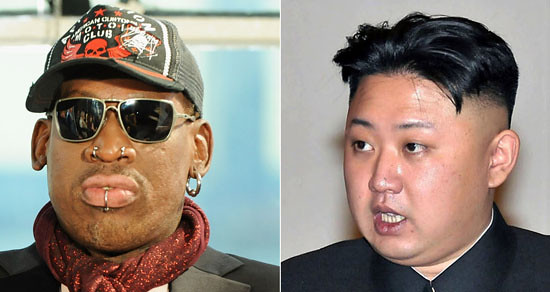
rodman+kim

This is all much simpler than it looks.
Dennis Rodman has shown us the way!
Here is the secret: Kim Jong Un is secretly in love with the USA and all things American.
You'd really have to be madly in love with the idea of America to invite a freak like Dennis Rodman to your country and hang out with him... But the young dictator needs to be taught the ways of my people at first hand.
The poor people of North Korea are skinny and starving… This is NOT the American way!
In America, the poor people are fat and have diabetes… We must Americanize North Korea, not bomb them.
I don’t think North Korea should be “taken out”, that is a strategy that in the process might very well tip the entire world economy into depression… Quite the contrary, I think they should be “taken in”, they should be given more food than they can possibly eat, if possible containing lots of corn syrup. Kim Jong Un should be invited to Hollywood, visit Disneyland, have his picture taken with Mickey Mouse, see a Laker’s game and eat a hamburger in the company of Barack Obama and Michael Jordan… let him party with the cheerleaders… the works.
I’m perfectly serious… I really think that it might be that simple with this kid. My reading is that his grandfather fought the Japanese and created North Korea and started the Korean war, Kim Jong Un’s father lived all that and the consolidation of the regime as a young man. These were serious grown ups, but Kim Jong Un is probably a spoiled brat with no idea of anything, living in a dream world… Make his dreams come true!
So, cutting to the chase, my plan is to treat Kim and his people like our own: we idiotize the North Koreans with video games, Bruce Willis films and smartphones and wind up by giving them free dialysis for diabetes-2 related kidney failure induced from ingesting massive quantities of our junk food… then we’ve got them hooked... eating out of our hands so to speak... easy, like feeding super size Cokes to a baby. DS

Saturday, March 30, 2013

North Korea puts its armed forces on a war footing

David Seaton's News Links
"As we have learnt again and again in this long period of turmoil, the impossible can become inevitable without even passing through improbable." Anatole Kaletsky - The Times
We seem to be immersed in a period of cumulative disasters, rather similar to the astrological idea of the inauspicious conjunction of certain planets.
This is not how the "age of Aquarius" was supposed to turn out!
This feeling that everything is happening at once colors my reading of the Korean story. Certainly the world's tinder is very dry and any spark could set the whole thing alight. Sarajevo was such an unlikely place to start the Great War, wasn't it? Sometimes, events do pile up in a sinisterly random way, which is where the astrological metaphor of the inauspicious alignment of the planets has at least a poetically descriptive value.
There is this wonderful Spanish saying to describe such a situation, "there already were too many of us and then grandmother had a baby". As if we didn't have enough to worry about, suddenly North Korea looks like starting a war.
The first thing you notice when looking at this unexpected affair is that it couldn't have come at a worse time.
Perhaps that is the key to it all.
I really don't think anybody, not even the Chinese, has much of an idea of what North Korea is up to. The whole "selling point" of North Korea is its mystery. That is their major card in any conflict: nobody understands them.
The USA is bogged down in Afghanistan and AIPAC and Israel are pressuring them to start another one with Iran. The world economy seems to be entering into multiple organ dysfunction syndrome, as Angela Merkel becomes the "incredible shrinking German chancellor" bent on destroying the European Union ...a war with North Korea right now could have sensational knock-on effects.
Although we assume they would be defeated in short order, I understand that North Korea has enough concentrated artillery to destroy Seoul and decimate the token American forces in South Korea. Probably the American ground forces are too overstretched in Afghanistan to react effectively with conventional means and this might lead to the use of atomic weapons. Certainly even a minor war ending in a mushroom cloud could be enough to sink the world's leaking economy.
This knowledge that they hold the world's economy in their hands is probably what is causing North Korea to take these chances.
No country is more precarious than North Korea and if it collapsed, China would have huge problems with refugees, South Korea would have to somehow absorb the dysfunctional north like West Germany did with the East... and the German Democratic Republic was Switzerland compared to North Korea. it would suck all the life out of the south's vibrant economy. Asia would be in turmoil for quite some time.
Just as a sailor uses the wind to navigate, but doesn't create the wind, anybody, who has grown up reading Sun Tzu and Lenin, might see opportunities in the chaotic world situation. I think that we live in a world which is overly exposed to random events, that nobody is really "in charge" and to quote another wonderful Spanish saying, "troubled waters make for good fishing". Perhaps, the fact that so many disasters are happening at once and leaders are so distracted by the specter of financial collapse has led the the North Koreans to think they may be able to win something in this confusion.
So my guess is that the North Koreans want money, food, relaxation of sanctions, you name it. However they might miscalculate, or any of the other players could too.
Of course all these calculations of mine could be way off. There is always a chance that the North Korean leaders are simply bat-guano crazy. That doubt is their secret weapon.

PS: The Dennis Rodman, "I don't want to do war, Dennis" interview after visiting Kim Jong Un, is one of the most frightening things I’ve ever encountered…
North Korean insanity meets American insanity… Since all of this has found me reading “Going Clear” about Scientology, I have no illusions about how crazy Americans can get… Lord preserve us. DS

PPS: I imagine that many strange things are going on in the North Korean capital today… if you can imagine a film of the Cuban Missile Crisis with the key roles played by the Three Stooges, you could get some idea of the climate there. Kim Jong Un must be nuts or trying to convince the entire world that he is nuts, to use Rodman as his messenger.

My reading is that the grandfather fought the Japanese and created North Korea and started the Korean war, Kim Jong Un’s father lived all that and the consolidation of the regime as a young man. Kim Jong Un is probably a spoiled brat with no idea of anything, living in a dream world… Maybe if Obama invited him to Disneyland and ate a hamburger with him in the company of Kobe Bryant we could solve the whole business.

Tuesday, March 26, 2013

Obama's triumphal entry into Jerusalem... yada yada yada

David Seaton's News Links
The US is hoping that Obama's positive first trip will reinvigorate peace efforts, though most settlers are not worried. They see the composition of the new Israeli cabinet as a reassurance that Israeli policy will move away from peace negotiations. Christian Science Monitor
Obama's visit to Israel was strictly for domestic American consumption, because unless the president and Netanyahu took a decision on when to attack or not attack Iran or intervene in Syria's civil war, which they could have done by telephone, his trip was strictly a public relations exercise, certainly it wont affect the "Peace Process" or lead to Palestinian statehood.
The much talked about "Two State Solution" is not stalled or even dead, it never existed: it and the "Peace Process" said to be leading to the founding of a "viable, contiguous, Palestinian state",  or even a Bantustan, was never more than a way of stalling, killing time, running out the clock. Israel has been waiting for a moment that now appears to be fast approaching: the disintegration of the Middle East as the west has known it since the end of World War One. In a short time all of the borders that were designed during the First World War by Britain and France  to suit western interests, will now probably become undefined, fluid if not gaseous... just as Israel's own borders are.
You may not have noticed, but Israel's frontiers have been undefined since 1967. The objective of the Israelis in avoiding the "Two State Solution" is  to not define them "prematurely", before all the pieces on board start to move.  In times like these, the last thing the Israelis want is to be the only ones with firmly drawn frontiers when all other borders in the Middle East are going to be negotiable. The settlers are not an "obstacle to peace", they are merely an excuse for Israel not to define those frontiers.
This Middle Eastern disintegration has been a long time coming and perfectly foreseeable by anyone as cool headed and long headed as the Israelis. The neocon led invasion of Iraq with its "real men go to Tehran" leitmotif, was itself a desperate, Hail Mary pass, attempt to control the events that are now taking place with that certain spontaneity of what looks like a historically driven process.
"What we're seeing here is, in a sense, the growing—the birth pangs of a new Middle East, and whatever we do, we have to be certain that we're pushing forward to the new Middle East, not going back to the old Middle East". Condoleezza Rice - 2006
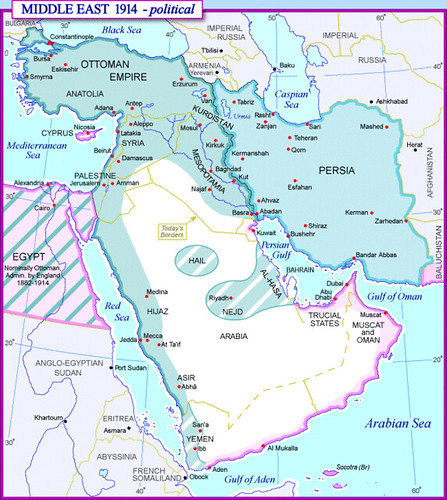
Just in case you don't know what the "old Middle East" looked like, check this map... As you can see, it's mostly about Turkey and Iran... Not many borders visible except theirs and Britain's protectorates and today the British, who used to control Egypt, are no longer players... and as you may have noticed lately, America's once smothering grip on the area is fading fast.
Map-ME-1914
At this moment Syria is literally disintegrating, spewing nearly half a million refugees into tiny, neighboring  Jordan, where the Palestinian majority is permanently restless and the influence of the Muslim brotherhood is growing. The Muslim Brotherhood controls Egypt and Hamas in Gaza is an offshoot of the Brotherhood; and then there is always Al Qaeda which is growing exponentially in the Syrian conflict. So much for the Sunnis
As to the Shiites: Iran besides working diligently on developing atomic capabilities is fighting a proxy war alongside Assad in Syria, is the major power influence in Iraq and is heavily arming  Shiite Hezbollah on Israel's Lebanese border...
What could the Israelis expect to achieve as all this comes unraveled and the shooting starts?
Simple: they could ethnically cleanse Judea, Samaria, Gaza (and maybe Israel itself too while they are at it) all in the midst of the confusion of a military free for all.  Chaos with thousands of refugees simultaneously in movement everywhere... and when the dust settles, let the Palestinians establish their "viable and contiguous state" on the ruins of the Jordanian monarchy as a Sunni buffer between Israel and Shiite Iraq... if they so desire.
Who thought all this up? Ariel Sharon, I should imagine, who else? DS

Friday, March 15, 2013

What is the new Pope about?

David Seaton's News Links
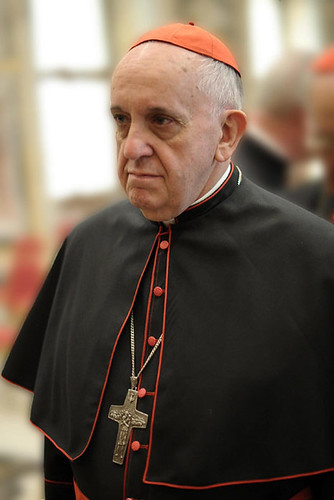
Jorge Mario Bergoglio en El Vaticano
His Holiness Pope Francis
Francis is no liberal. He had no truck with liberation theology, the popular movement in Latin America and elsewhere which links the church’s work to radical social change, even though many of its supporters have been Jesuits. Not Francis: he is close to the conservative Communion and Liberation movement. The Economist
Latin America is the breadbasket and center of gravity of the Roman Catholic Church today, both in number of faithful and number of vocations. But there are storm clouds on the horizon;  two movements have the Church worried in Latin America and the problems they cause are interconnected: on one hand the revolutionary movements of the Bolivarian variety, which threaten the position of the propertied classes and on the other the growing, US financed, Evangelical Protestant penetration in the continent.
Though as socially conservative as the Catholics, the Evangelicals are ultra-conservatives on economic issues following the US model and very much part of the reactionary culture of the American south. The problem for the Catholic Church is that if they cannot stop the left wing revolutionaries from making inroads in the Catholic population, the rich criollo's money in South America will begin to flow toward the Evangelicals to see if they can do the job, thus leaving the Church without cash and vocations.
Don't expect any loosening of Church doctrine under the new pope, Jorge Mario Bergoglio. Karol Wojtyla and his enforcer Josef Ratzinger, systematically carried out  a 35 year long purge of all "green shoots" of John XXIII, Paul VI and Vatican II. This has been deep and thorough and every trace of progressive thought has been exhaustively eradicated from the Church aparat. Bergoglio is a product of that purge and a collaborator in carrying it out. The Jesuit order was once a hotbed of left wing liberation theology, Bergoglio made his bones helping to stamp that out.
There is a lot of disturbing news about the new pope coming out of Argentina.  He is accused of operating hand in glove with the Videla regime... it might be a good idea to moderate our enthusiasm for this "Franciscan" simplicity of his till all that is cleared up. DS

Thursday, March 07, 2013

Whither post-Chávez Venezuela

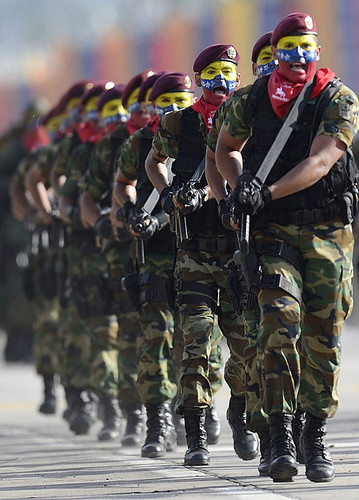
VENEZUELA-INDEPENDENCE DAY-PARADETo put the entire subject of Venezuela into perspective from a yanqui point of view, I suggest reading the following snippet by Matthew Yglesias.
The late Hugo Chavez is controversial because of American aspirations to global military hegemony. People who vocally oppose those aspirations find themselves subjected to a massive amount of scrutiny of their human rights record that leaders who support it manage to completely avoid. Thus Chavez is an authoritarian strongman while King Abdullah II of Jordan does cameos on Star Trek Voyager. And since American aspirations to global military hegemony are uncontroversial inside the United States, critics of said aspirations develop an outsized level of emotional affiliation with foreign leaders who are subjected to this kind of hypocritical scrutiny. Matthew Yglesias - Slate
That quote more or less gives us the parameters of an American discussion of Hugo Chávez and the future of his movement, revolution or regime, whichever you prefer.
Cutting to the chase: in my opinion, if the Venezuelan army and Venezuela's poor hang together and the bottom doesn't totally drop out of oil market, Chavismo will survive, either as a potent force for change in Venezuela, Latin America and the Third World in general or in a degenerate form like Argentinian Peronism, with Chávez in the role of Evita. Whatever happens, the poor people of Venezuela will never forget him and will always worship his memory, in some ways he is more powerful dead than alive.
First the army. To really have any idea of Venezuela's future you would have to be a fly on the wall in a Venezuelan army junior officer's mess. One of the USA's problems south of the border nowadays is that they no longer train and network most of Latin America's army officers like they used to in Cold War days, and neither are they the exclusive suppliers of those country's weapon systems anymore. That is why the US backed coup against Hugo Chavez failed: only the older, Yankee trained officers were behind it, the young officers, the ones who make successful coups, backed Chávez.
As to oil, I would imagine that Russia, China, Iran would be quite willing to supply the necessary expertise to help restructure Venezuela's limping oil industry in order to dilute American influence.
For me the question is whether what follows Chávez will be a serious revolution or simply a demagogic fraud like Peronism has become. A revolution means a total change in the social and economic relations of a country. Many observers, who don't sympathize with Chávez's goals predict that his regime will quickly disintegrate without his hand on the helm. I'm not at all sure they are right.
We should take into account that Chavez didn't just suddenly drop dead of a heart attack.... the regime has had plenty of time to prepare... also we should take into account that the revolutionary infrastructure and revolutionary "consulting" services available to Venezuela come from the Castro brothers, who are the world's most successful revolutionaries, and if nothing else, certainly brilliant survivors.
An example of the brothers' ingenious handiwork is using the Cuban model of turning the ranchito (favela) "comadres" (gossipy, neighborhood, old wives and general busybodies) into the eyes and ears of the regime with cost-effective neighborhood "committees". The Cubans are supplying the type of know how that the CIA, the State Department and the USIA used to supply to South America's right wing dictators. The survival of the Castro brother's life's work may depend on Venezuelan oil and I wouldn't want to be standing between the Castro brothers and survival, it could be hazardous to ones health
Certainly the regimes of Cuba and Venezuela are mutually dependent and the Castros are very hard, intelligent and experienced men and will not let everything they have built up over decades just slip through their fingers only because Chavez has died.
So those are the elements: the army, the oil and the Cubans and most of all, the poor people of Venezuela, who for the first time in their history are playing a leading role in the drama of their lives. DS

Wednesday, March 06, 2013

On the death of Hugo Chávez


Crying for Hugo

A little old lady interviewed by El País in a mourning crowd of Venezuelans gave the most insightful analysis of Hugo Chávez and his probable legacy: "He gave us an identity!". 
Latin America is filled with people like that old lady, they are the overwhelming majority: poor, brown, left out and despised by the white, Criollo minority that has ruled the continent since colonial times. Chávez has given them an identity, an icon and marked a path. How attractive that identity, that Icon and that path are in South America can be judged by the reaction of Brazil's moderate president, Dilma Roussef, quoted in The Guardian, "The loss is irreparable. He was a great leader and friend of Brazil. President Chávez will live on in the empty space that he filled in the heart of history and the struggle of Latin America."
Paradoxically the conditions that brought forth Hugo Chávez in South America, obscene wealth and inequality in the midst of poverty, squalor and injustice, are being replicated right now in the developed world. Chávez's death coincides with the Dow Jones index hitting "all time highs", while, as John Gapper writes in the Financial Times, with unemployment hanging over their heads, the working poor and even university educated, middle class Americans are being encouraged to work longer hours at lower pay.... and in Europe? Much of its south is busy looking for their Hugo Chávez.
Hugo Chávez is/was not a freak accident, he is a leading indicator of the United State's loosening grip in the midst of the most important systemic crisis since the Great Depression. DS