Monday, January 21, 2008

Are the Democrats the right tool for the job?

"The median American family is going into what looks like a recession owing more than 100 percent of its income."
Elizabeth Warren, Harvard law professor
David Seaton's News Links
Are the Democrats the right tool for the job? I ask such an unpleasant question at such an awkward time, because the only candidate for the Democratic presidential nomination that is talking about a real, universal health care scheme on European lines, John Edwards, seems to be going nowhere.

As to the front runners, Hillary had her chance at bringing health care once and failed so miserably that a decade was lost and Obama's idea of sitting around a table for a "friendly chat" about health care with the insurance and pharma crowd is well... Mike Huckabee might say that Barack is "constipated". After Obama's paeans to the Gipper, anyone who expects anything progressive from him is simply indulging in political onanism.

All of this tends to lend credit to Gore Vidal's idea that there is only one political party in the USA, the "Property Party" with a Democratic wing and a Republican wing. In short it looks like nothing much is really going to change very much at all and that is the basic idea of the system, that nothing much change. To say this is a crying shame is a screaming understatement.

As we see, by Elizabeth Warren's quote above, the median American family is heading into a major recession not only without any savings, but in debt as well. Thanks to the bursting housing bubble many people are also going to lose their homes. Obviously in such times, many who have some health insurance will have to cut back on it, or drop it all together. We are talking about a meltdown of the American middle class's self-image and its basic well being. Having abandoned the traditional virtues of thrift and prudence, they stand naked in a very cold breeze.

This presents a historic opportunity to create a progressive consciousness that cuts through racial, regional, sexual orientation, religous and ethnic divisions. Nobody wants to get sick and die unattended and no one wants to see their children get sick and die unattended either. The money is there, of course, but it will have to come out of the "defense" budget which, if my memory serves me, is greater than the military expenditures of the next fourteen countries on the list combined. This would mean the end of American militarism as we know it. With a defense budget only bigger than say the next five countries combined we could take care of everybody, right down to braces on little poor girls' teeth.

Most commentators ignore or pretend to ignore what a political sea change a federal, universal health care system would bring to the dynamics of American politics. For example: One of the greatest objections that "conservatives" have against a universal health scheme on European lines, is one they hardly talk about: unions. In Europe the health systems are unionized and the unions are powerful. Doctors, nurses, cleaners etc, are all in unions. So not only would socialized medicine save people from disease, death and humiliation, it would also help to rebuild America's unions that Reagan did so much to cripple.

Health, the end of militarism and the rebirth of the labor movement. Pretty heady stuff, nu? But that is what strategic opportunities are about: the "game changers". They don't come by very often and they are not to be missed. I don't say that most Democratic voters wouldn't like to see all this happen, but if they wait for their "leadership" to pull it off, they are worse than fools. How can I say this in a way that will sound good to the reticent progressive ear. How about, "these are the times that try person's souls"? Or, "Now is the time for all good persons to come to the aid of their country"? This the big one. DS

Roger Cohen: U.S. Soldiers and Shoppers Hit the Wall - New York Times
Abstract: Wars in Afghanistan and Iraq have pushed the U.S. armed forces to the limit. Many soldiers have scarcely seen their families in recent years. But a much larger American army, the one that's spent this century shopping, is even more overextended and its pain is now coming home to roost. Nobody ever made money exhorting people to save. But U.S. banks and financial institutions have spent huge amounts in recent years telling people debt is good and savings are dumb.(...) And here we are, with the rainy day our grandparents always droned on about appearing in the form of a deluge, and no savings stashed for it, and President George W. Bush, the debt-spender par excellence, conjuring up a $150-billion stimulus package that evokes the injection of steroids into a prone athlete wrecked by a marathon. This "shot in the arm," as Bush put it, may dampen a little pain. But this patient will be in intensive care for a long time. As Stephen Roach, the chairman of Morgan Stanley Asia, said to me: "The very low U.S. savings rate, and related huge balance of payments deficit to attract funds from overseas, are not sustainable things." The adjustment is likely to be long and painful. Think of it as getting the sacrifice of U.S. soldiers and the obliviousness of U.S. shoppers a little more in sync. The non-relation between expensive wars and exempt non-warriors, a mirage Bush has fostered, has become unsustainable. Roach estimated U.S. net national savings at a tiny 1.4 percent of national income and household debt at 133 percent of personal disposable income. That last figure means middle class families are tapping into home equity - borrowing against their homes - to buy their kids socks. And if they can't pay the resulting never-sleeping debt, they lose not a room or two, but the house. Headlines in recent weeks have focused on the international investors - from Japan to Kuwait - riding to the rescue of such American symbols as Citigroup and Merrill Lynch. The Asian financial crisis of the 1990s has gone into reverse. This turnabout has provided eloquent evidence of the Asian-tilted power shift of the past decade and of the way countries from Korea to Singapore have built up dollar war chests as the United States has plunged into debt.(...)As my colleague Floyd Norris has written of ballooning (and now plunging) property prices: "The only way prices got so high was that people who could not afford to buy those homes were given mortgages they could not hope to repay unless home prices kept rising." A staggering number of these mortgages were either interest-only or so-called "negative amortization" contracts that left the principal owed either unreduced or mounting after monthly payments. "The median American family is going into what looks like a recession owing more than 100 percent of its income," Harvard law professor, Elizabeth Warren said. No wonder Citigroup just set aside $4.1 billion to cover possible defaults on home-equity loans, credit cards and auto loans - shoes that have yet to drop. READ IT ALL

Friday, January 18, 2008

The health equation for change

David Seaton's News Links
I am convinced that struggle to bring forth a universal public health system in the United States on European lines is the decisive battle in reforming the whole US body politic from top to bottom.

For anything to ever really change in the USA, it is fruitless to wait for operatives of the American political system to bring about that change. The reason is simple and obvious: those who hold public office have been able to use the system as it is to their advantage. Why should they want to change it? They will finally rubber stamp the changes that society itself has created through consciousness and action.

Change comes from those who are dissatisfied with the status quo, the quantity of dissatisfaction multiplied by the number of the dissatisfied provides the energy for change. Health care is literally a question of life or death. What greater commitment to change can there ever be than to change the conditions that threaten one's life? It is said that some 40,000,000 Americans have no health coverage: exposed to illness, death and humiliation. Multiply the energy of those 40,000,000 by the desire of those 40,000,000 to live and you have a fulcrum and a lever with which to move the world.

Many who read this will never have experienced such a public health system and may think it an unrealistic utopia. Let me give you an example from the Spanish health care system that I heard about today. I was talking to an Englishman who works as a political analysts for one of Spain's largest, multinational banks. Despite being a young man he suffers from arthritis. Once a month he goes to the hospital where he is given medicine that costs 1000 euros ($1,462.34) a treatment. The system spends about $17,550 a year so that he won't live in constant pain. It costs him nothing. The Spanish economy is doing nicely,
Spain just passed Italy in per capita income, people dress well, live in nice houses and eat good food, this is not some "Marxist hell" like North Korea and the system manages to care for the health of all.

It would be interesting to do the math, but I imagine that you could pay for all treatments of all the Americans with acute arthritis forever and ever, world without end. Amen... for the cost of one stealth bomber. For the cost of one atomic powered aircraft carrier you could probably pay for all the generic medicine that all the ill of America could consume in a generation or more. Explain to someone that for the welfare and safety of the homeland he or she must wither away in agony and die unattended. The least they could do is send a Marine Corp bugler to play taps at the funeral of every pauper in America. Theirs is truly a sacrifice! Dulce et decorum est pro patria mori.

To sum up: there is critical mass for change in the American system. This critical mass is the urgent need for basic health care of many millions of people, who can vote, march, organize, go on strike, sit in, chain themselves to public buildings, block roads and do all the things the civil rights movement did in the 60s or for that matter what even Bolivian Indians do today when they want change. There are many teachers of the politics of change, beginning with Ghandi himself, for those who would like to take up the plow without looking behind them. DS

Thursday, January 17, 2008

George Washington (1732-1799)

David Seaton's News Links
Spanish newspapers are famous for including all sorts of inducements included with the paper: DVDs, books, games etc; free or nearly free. My paper, El Mundo is running a series of booklets with speeches by famous statesmen. One of them is a collection of speeches by George Washington, and they have asked me to write an introduction to it... Which I have done. I usually do something like this first in English and then rewrite it in Spanish.

I thought I would post the first English language draft to News Links. Here it is. DS

George Washington (1732-1799)

“First in peace, first in war, first in the hearts of his countrymen.”
General Henry Lee (father of General Robert E. Lee), “The funeral eulogy of George Washington”

George Washington, the first President of the United States, the “Father of his Country”, is the great American icon par excellence. The unfinished “Athenaeum” portrait of Washington by Gilbert Stuart, which adorns the ubiquitous dollar bill, is the same painting whose endlessly reproduced image has hung on millions of school classroom walls in the United States for generations. What American schoolboy has not sat squirming under the unblinkingly steady, stern, imperious, but not unkindly, gaze of Stuart’s Washington? The broad, intelligent forehead, the powerful nose, the granite jaw, the lips pressed firmly against his famous, wooden false teeth, are powerfully imprinted on the American subconscious.

In American legend Washington symbolizes perfect honesty and almost superhuman integrity. An enduring part of American folklore is the totally apocryphal story of “George Washington and the Cherry Tree” about the supposedly angelic, infant Washington, who at the age of six was given a little hatchet and promptly chopped down his father’s favorite cherry tree. This is how the famous story goes:
"George,'' said his father, "do you know who has killed my beautiful little cherry tree in the garden?"

I cannot tell a lie, father, you know I cannot tell a lie! I did cut it with my little hatchet.''

The anger died out of his father's face, and taking the boy tenderly in his arms, he said"My son, that you should not be afraid to tell the truth is more to me than a thousand trees! Yes - though they were blossomed with silver and had leaves of the purest gold!''
Although he never actually said it and though it has, in our cynical age of irony, become little more than a joke, "I cannot tell a lie, father, you know I cannot tell a lie! “, is probably Washington’s most famous quote. Si non e vero e ben trovato, because Washington’s honesty was, in fact, proverbial. In his first inaugural address on assuming the presidency in 1789 he referred to his salary in the following way:
“When I was first honored with a call into the service of my country, then on the eve of an arduous struggle for its liberties, the light in which I contemplated my duty required that I should renounce every pecuniary compensation. From this resolution I have in no instance departed; and being still under the impressions which produced it, I must decline as inapplicable to myself any share in the personal emoluments which may be indispensably included in a permanent provision for the executive department, and must accordingly pray that the pecuniary estimates for the station in which I am placed may during my continuance in it be limited to such actual expenditures as the public good may be thought to require.”
In an age when most former presidents and prime ministers make fortunes with their memoirs, speeches or consulting fees, Washington’s refusing to accept any pay for governing the United States of America sounds as fantastic and improbable as any myth of the Hindu god Rama or an inhabitant of the Greek Olympus.

By far Washington most famous speech is his “Farewell Address” on the 17th of September of 1796 after refusing a third term in power. For many Americans today, much of what Washington said then sounds startlingly prophetic, as if some benevolent ghost had suddenly appeared to warn his loved ones among the living of disaster.

Looking at the hole in the New York Skyline where the Twin Towers once stood, observing the hecatomb of Iraq and wondering at the seeming helplessness of the United State in solving the dispute between Israelis and Palestinians, these following lines seem positively uncanny:

“A passionate attachment of one Nation for another produces a variety of evils. Sympathy for the favorite Nation, facilitating the illusion of an imaginary common interest, in cases where no real common interest exists, and infusing into one the enmities of the other, betrays the former into a participation in the quarrels and wars of the latter, without adequate inducement or justification. It leads also to concessions to the favorite Nation of privileges denied to others, which is apt doubly to injure the Nation making the concessions; by unnecessarily parting with what ought to have been retained; and by exciting jealousy, ill-will, and a disposition to retaliate, in the parties from whom equal privileges are withheld. And it gives to ambitious, corrupted, or deluded citizens, (who devote themselves to the favorite nation,) facility to betray or sacrifice the interests of their own country, without odium, sometimes even with popularity; gilding, with the appearances of a virtuous sense of obligation, a commendable deference for public opinion, or a laudable zeal for public good, the base or foolish compliances of ambition, corruption, or infatuation."
Obviously, talking this way, George Washington would not have an easy time getting elected President of the United States today or anything else in Washington.


Sitting there stiffly and solemnly in his powdered wig gazing out from the much devalued dollar bill, as he stoically gets passed from hand to hand, it is difficult not to feel certain tenderness for the specter that speaks across the centuries in this manner.
"In offering to you, my countrymen, these counsels of an old and affectionate friend, I dare not hope they will make the strong and lasting impression I could wish; that they will control the usual current of the passions, or prevent our nation from running the course, which has hitherto marked the destiny of nations. But, if I may even flatter myself, that they may be productive of some partial benefit, some occasional good; that they may now and then recur to moderate the fury of party spirit, to warn against the mischiefs of foreign intrigue, to guard against the impostures of pretended patriotism; this hope will be a full recompense for the solicitude for your welfare, by which they have been dictated."


Tuesday, January 15, 2008

Obama eats the cheese

"Mr Obama’s problem, as the candidate of unity and change, is that spats over seemingly innocuous racial remarks remind white voters of the type of divisive politics more usually found on college campuses.(...) It will be unfortunate for the Democrats if television reports from Michigan focus on outraged blacks wondering why they cannot vote for Mr Obama." The Economist
David Seaton's News Links
Hillary is playing this race thing smarter than most people think.
Hillary knows that nothing makes American white people, especially the liberal type, more nervous than easily offended black people. White, American, liberals live in terror of offending "touchy" blacks and at the same time they resent having to eternally walk on eggshells and there is much suspicion among them that this fear of giving offense is being used to manipulate and dominate them.

Hillary's remarks about Doctor King were unoffensive to white ears, but the Clintons know better than anyone the finest shades of tonality and nuance needed to set off black "rage".

Thus she is seen to be enduring the American white liberal's great nightmare: to, inadvertently, with the best will in the world, have said something that has offended African-American sensitivity.

Of course, Hillary is subtly introducing a subliminal theme here.

Imagine:
Obama gets elected president, but he turns out, like so many have been, to be a perfectly awful president.

The question:
  • Could we insult Obama the same way we insult Bush?
  • Wouldn't that be taken as racism by African-Americans?
  • Wouldn't that be rather inhibiting?

What Hillary has done is to temporarily lose some black support that, if she is finally the candidate, Bill will retrieve for her. In return she has caused ultra-sensitive black people (or professionally ultra-sensitive leaders) to rally to him in such a way as to make Obama seem much more black than he has up till now wished to appear. This will probably cause a lot of white people to vote for Hillary in the primaries. I think we'll see this cynical tactic pay off for her on Super Tuesday. Hillary may be "unlikable", but she is plenty smart.

Of course, all this mess really only comes about because until now American "identity" politics was always played with surrogates: WASP men wearing masks.

Thus Bill Clinton was "America's first black president". The whatever WASP whose turn it was to woo Latinos, would eat tacos and say "juntos podemos" with an atrocious accent etc, etc. Candidates would attempt to show that they were "sensitive" to the feminist agenda and so on. Absolutely de rigueur for all white, male and protestant presidentiables was a photo at Yad Vashem sporting a yomulka. This all came with the turf like kissing babies. It was a game.

The problems start when the Democrats decided to use "originals" instead of the traditional, "ballo in maschera". The whole charade begins to fall apart without the WASP surrogates.
DS

Monday, January 14, 2008

Notes on the donkey as the symbol of the Democrats

A pair of jackasses.

David Seaton's News Links
This was to be the election that the Democrats couldn't lose... Just watch them do it.

They seem to be in the process of simultaneously alienating both women and blacks, both fundamental constituencies to any Democratic victory. You have to see it to believe it, as they say, "you can't make this stuff up".

Certainly if Obama continues to play the race card he can expect a white backlash in November and
normally Hillary could expect a very enthusiastic black turnout if she won the nomination, but if she succeeds in trashing Obama much of the African-American vote may go fishing too. The Republicans must be laughing themselves sick, simply peeing themselves with mirth.

I am beginning to think that the Democratic Party is a figment of Karl Rove's imagination. DS

Clinton, Obama Clash Over Race Issue - Associated Press
LAS VEGAS (AP) - Hillary Rodham Clinton and Barack Obama have become embroiled in racially tinged disputes as large numbers of black voters prepare to get their first say in the Democratic presidential campaign.

The candidates and their surrogates are heating up their rhetoric, and it could prove to be combustible beyond South Carolina's Jan. 26 primary.

Clinton, on defense over comments that she and her husband made regarding Martin Luther King Jr.'s legacy and Obama's fitness for the White House, tried to turn the tables on her top primary rival. She accused his campaign of looking to score political points by distorting their words.

Hillary Clinton had said King's dream of racial equality was realized only when President Lyndon B. Johnson signed the Civil Rights Act of while Bill Clinton said Illinois Sen. Obama was telling a "fairy tale" about his opposition to the Iraq war. Black leaders have criticized their comments, and Obama said Sunday her comment about King was "ill-advised."

"I think it offended some folks who felt that somehow diminished King's role in bringing about the Civil Rights Act," he told reporters on a conference call. "She is free to explain that, but the notion that somehow this is our doing is ludicrous."

As evidence the Obama campaign had pushed the story, Clinton advisers pointed to a memo written by an Obama staffer compiling examples of comments by Clinton and her surrogates that could be construed as racially insensitive. The memo later surfaced on some political Web sites.

"This is an unfortunate story line the Obama campaign has pushed very successfully," the former first lady said Sunday on NBC's "Meet the Press." "I don't think this campaign is about gender, and I sure hope it's not about race."

Clinton taped the show before appearances in South Carolina, where at least half the primary voters are expected to be black. On Monday, she planned to attend a union event honoring King's legacy in New York City.

But no sooner had Clinton said she hoped the campaign would not be about race than it got even more heated. A prominent black Clinton supporter, Black Entertainment Television founder Bob Johnson, criticized Obama and seemed to refer to his acknowledged teenage drug use while introducing Clinton at her next event.

"To me, as an African-American, I am frankly insulted the Obama campaign would imply that we are so stupid that we would think Hillary and Bill Clinton, who have been deeply and emotionally involved in black issues—when Barack Obama was doing something in the neighborhood; I won't say what he was doing, but he said it in his book—when they have been involved," Johnson said.

Obama wrote about his youthful drug use—marijuana, alcohol and sometimes cocaine—in his memoir, "Dreams from My Father."

Johnson later said in a statement released by the Clinton campaign that his comments referred to Obama's work as a community organizer in Chicago "and nothing else. Any other suggestion is simply irresponsible and incorrect."

Another Clinton campaign official, Bill Shaheen, resigned last month after suggesting Democrats should be wary of nominating Obama because his past drug use could be used against him in the campaign.

Obama, campaigning in Las Vegas, declined to respond to Johnson.

"I'm not going to spend all my time running down the other candidates, which seems to be what Senator Clinton has been obsessed with for the last month," Obama said.

His strategist, however, didn't spare Johnson or Clinton.

"I don't see why this is so much different from what Billy Shaheen did in New Hampshire," David Axelrod said. "Senator Clinton apologized for that. It's bewildering why, since she was standing there, she had nothing to say about this."

Clinton was not yet on stage when Johnson made his statements and she did not mention them when she emerged.

Meanwhile, in Atlanta, Obama's wife rose to his defense over Bill Clinton's "fairy tale" comment. Michelle Obama said some blacks might be skeptical that white America will elect her husband, but advised them to look to his win in Iowa.

"Ain't no black people in Iowa," she said during a speech at the Trumpet Awards, an event celebrating black achievement. "Something big, something new is happening. Let's build the future we all know is possible. Let's show our kids that America is ready for Barack Obama right now."

John Edwards, a third candidate in the Democratic primary, waded into the dispute Sunday.

"I must say I was troubled recently to see a suggestion that real change came not through the Rev. Dr. Martin Luther King but through a Washington politician. I fundamentally disagree with that," Edwards told more than 200 people gathered at a predominantly black Baptist church in Sumter, S.C.

Thursday, January 10, 2008

Health is a "civil right"

"What European countries definitely haven’t done is dismantle their strong social safety nets. Universal health care is a given. So are a variety of programs that support families in trouble, helping protect Europeans from the extreme poverty all too common in this country.(...) the next time a politician tries to scare you with the European bogeyman, bear this in mind: Europe’s economy is actually doing O.K. these days, despite a level of taxing and spending beyond the wildest ambitions of American progressives."
Paul Krugman - NYT
David Seaton's News Links
Health is a civil right, like the right to life or the right to vote.

I live in Europe, where we have socialized medicine. This means that the major hospitals are owned by the state. During at least half the day most doctors, even eminent specialists, are state employees. Medicines, even the most expensive, are heavily subsidized or totally free. Here the suffering of poor people in America without medical care, or the anxiety of the American middle class worrying about losing their jobs and thus losing their coverage is unthinkable. I read the "plans" the different American political "leaders" have to solve this suffering and humiliation and they remind me of the cynical and patronizing "separate but equal" justifications of the Jim Crow south.

The more I explore this painful and festering sore of scores of millions of Americans of all colors without adequate medical care, the more I am reminded of the political climate before the civil rights battles of the 50s and 60s. What seems totally missing, however, is the Martin Luther King or the Malcolm X to give it shape and words. Polar bears and glaciers have their Al Gore, but who is to lead a citizen's revolt against pain, sickness, humiliation and death?

You could say that the idea of some 40,000,000 Americans many of them of color, condemned to death and disease is even worse than the injustice of segregation, but the comparison is one of hope. The civil rights movement's successes means that even within the American system profound change is possible when enough people stand up and say, "this far, no farther." It can be done, it's been done before.

For someone who has no memory of what America was like before the civil rights movement, let me explain as quickly and brutally as I can what America would be like today if that movement had never existed:

  • Colin Powell would be a retired army sergeant.
  • Barack Obama's mother would be a pariah.
  • Barack Obama would be somebody's butler.
  • Clarance Thomas would be working in somebody's yard.
  • Condoleezza Rice would be teaching in a segregated grammar school.
  • Oprah Winfrey would be cleaning some white lady's house.
That America is so different today, that the lives of the above mentioned have turned out so differently, was not engineered by benevolent politicians, it was a conquest of the American people in the streets. It was all about marches, sit ins and riots. It cost pain, blood, jail time and lives. Cities burned and soldier's patrolled the streets, men were lynched. It was a movement. The politicians came trailing after making laws to recognize the facts created on the ground.

The result is that the America of today is barely recognizable to someone born into the America that was before. This means that things can be changed by people who won't accept "no" for an answer.

But make no mistake, this battle could be even harder and crueler. The battle against prejudice and discrimination was only really about customs and habits, it was fought in the context of the cold war where the Soviet Union used the plight of black people in the USA to its advantage in Europe and the Third World. Law makers knew that social inertia was the only real obstacle to dramatically improving America's self-image and its image around the world as a champion of freedom. It was simply good for business. For America's rich and the powerful little was really changed by allowing African-Americans full civil rights.

The battle for the right to health, however is about money, lots of money: higher taxes for the rich, much higher... like in Sweden. And the limits beyond which the wealthy of America will not go
in defense of their money, has yet to be discovered.

The money invested in the ideology necessary to fight socialized medicine in America is also limitless. This ideological task force that the oligarchy has deployed has even made the very words "
socialized medicine" taboo. Thus the successful system of countries like Britain, Canada, France and Germany is made to sound like something inefficient and subversive.

Politicians require huge amounts of money to get elected and those who sign the big checks don't want to pay the taxes necessary to pay for a health system similar to Europe's. I don't think anything meaningful will ever occur led by the men and women who owe their existence to our present system of campaign financing.

To get something like this done only a movement will suffice and I doubt if even a million uninsured children marching on Washington would be enough to melt the hearts of those weaned on a diet of Ayn Rand. It might take a general strike, the shutting down of America's huge transport system for a few days,
to bring it off.

This more than any other is work for grassroots activists and organizers: free health care for all is the true catalyst for change in the USA. Those who begin to organize this from the ground up are today's equivalent of the Freedom Riders that opened up the American south and ennobled an entire generation. DS

Paul Krugman: The Comeback Continent - NYT
Abstract: Why should Americans care about Europe’s economy? Well, for one thing, it’s big. The G.D.P. of the European Union is roughly comparable to that of the United States; the euro is almost as important a global currency as the dollar; and the governance of the world financial system is, for practical purposes, equally shared by the European Central Bank and the Federal Reserve. But there’s another thing: it’s important to get the facts about Europe’s economy right because the alleged woes of that economy play an important role in American political discourse, usually as an excuse for the insecurities and injustices of our own society. For example, does Hillary Clinton have a plan to cover the millions of Americans who lack health insurance? “She takes her inspiration from European bureaucracies,” sneers Mitt Romney. Or are top U.S. executives grossly overpaid? According to a Times report, Michael Jensen, a professor emeritus at Harvard’s Graduate School of Business whose theories helped pave the way for gigantic paychecks, considers executive excess “an acceptable price to pay for an American economy that he believes has outstripped Japan and Europe in growth and prosperity.” In fact, however, tales of a moribund Europe are greatly exaggerated.(...) Since 2000, employment has actually grown a bit faster in Europe than in the United States — and since Europe has a lower rate of population growth, this has translated into a substantial rise in the percentage of working-age Europeans with jobs, even as America’s employment-population ratio has declined. In particular, in the prime working years, from 25 to 54, the big gap between European and U.S. employment rates that existed a decade ago has been largely eliminated. If you think Europe is a place where lots of able-bodied adults just sit at home collecting welfare checks, think again. Meanwhile, Europe’s Internet lag is a thing of the past. The dial-up Internet of the 1990s was dominated by the United States. But as dial-up has given way to broadband, Europe has more than kept up. The number of broadband connections per 100 people in the 15 countries that were members of the European Union before it was enlarged in 2004, is slightly higher than in the U.S. — and Europe’s connections are both substantially faster and substantially cheaper than ours. I don’t want to exaggerate the good news. Europe continues to have many economic problems. But who doesn’t? The fact is that Europe’s economy looks a lot better now — both in absolute terms and compared with our economy — than it did a decade ago. What’s behind Europe’s comeback? It’s a complicated story, probably involving a combination of deregulation (which has expanded job opportunities) and smart regulation. One of the keys to Europe’s broadband success is that unlike U.S. regulators, many European governments have promoted competition, preventing phone and cable companies from monopolizing broadband access. What European countries definitely haven’t done is dismantle their strong social safety nets. Universal health care is a given. So are a variety of programs that support families in trouble, helping protect Europeans from the extreme poverty all too common in this country. All of this costs money — even though European countries spend far less on health care than we do — and European taxes are very high by U.S. standards.(...) According to the anti-government ideology that dominates much U.S. political discussion, low taxes and a weak social safety net are essential to prosperity. Try to make the lives of Americans even slightly more secure, we’re told, and the economy will shrivel up — the same way it supposedly has in Europe. But the next time a politician tries to scare you with the European bogeyman, bear this in mind: Europe’s economy is actually doing O.K. these days, despite a level of taxing and spending beyond the wildest ambitions of American progressives. READ IT ALL

Wednesday, January 09, 2008

Feeling good about Barack

"Right now, he's a national Rorschach test, with voters reading into him their fondest hopes for what America can do and be."
Mort Kondracke - Roll Call
David Seaton's News Links
The problem with Obama is that we are not talking about Obama himself very much at all.

The fact is that instead of talking about Barack Obama, we are talking about how good Obama makes us feel about ourselves. We also are talking about how good it would make us look, if he were the next president

We are probably talking more about ourselves than about Obama,
because he hasn't really been around that long or done that much and except for what he tells us about himself we know next to nothing about him... so there isn't that much to talk about.

Obama, who has been in the US Senate for barely two years certainly has the thinnest presidential CV I can ever remember, even Dubya had been the governor of one of America's most important states. If Obama were a successful two term governor of Illinois, which is a very complex state with a huge budget, this would be a much more serious conversation. If Obama had ever done anything outstanding in "private life", like most of the other candidates (Hillary excepted) have done, it would give us something solid to hang on to. As far as I can see, he has written a book about his search for who he "is" and given a couple of good speeches and that is about it.

The campaign(s) are going to be long and brutal and the question is going to be: will our own self-flattery finally be enough to carry the entire country behind it? DS

What happened to Hillary?

David Seaton's News Links
What happened to Hillary?

How about this?

Hollywood doesn't write any good parts for middle aged, American women... Hollywood's message to them is "drop dead" and in today's world of corporate concentration and infotainment, Hollywood and the news media are of one flesh.

However, look around you, there are many middle aged American women with a few extra lines around their eyes, with some furrows in their pucker, with a bit of sag in the chin, and with a little "rope" in the neck muscles, but who, somehow -- malgré Hollywood -- don't want to drop dead, just yet... and they can vote.

I have spent my whole life trying enthusiastically, but none too successfully, to understand women, but what little I have managed to learn tells me that it would be very difficult for a middle aged woman to join in publicly ridiculing and humiliating another middle aged woman... the empathy would be just too strong. That humiliation and ridicule are always just beneath the surface in too many places, even in their own homes, available to them all.

And beyond middle age,
despite all the talk of a "youth crusade" around Obama, the old folks are the ones that really vote. Women live longer than men, so that among the elderly, women outnumber men, that means more women voting in the group with the highest voter participation.

So Hillary has been saved by her sisters, they rode to her rescue like the 7th cavalry in an old western... "Joan Wayne" saved Hillary Clinton in New Hampshire. DS

Monday, January 07, 2008

To die of success

"The greatest challenge to the world is not US$100 oil; it's getting enough food so that the new middle class can eat the way our middle class does, and that means we've got to expand food output dramatically(...)That will be done with more fertilizer, with genetically modified seeds, and with advanced machinery and technology". BMO strategist Donald Coxe

The latest generation of Chinese-Americans, many of whom grew up in the restaurants their parents worked in, are increasingly choosing legal and medical careers over the kitchen. As a result, Chinese restaurants have been relying even more on imports from Hong Kong, Taiwan or mainland China.

But the sizzling economy in China has raised the incomes and profiles of the best chefs, who now find it less desirable to leave their families and friends halfway around the world.

Several major restaurant owners in the city said salaries for Chinese executive chefs range from $42,000 to $50,000, depending on the size of the business, a 30% rise in the past five years. In China, top chefs are getting close to those amounts, while the cost of living in cities like Beijing and Shanghai is still a lot lower. New York Daily News
David Seaton's News Links
When I was a little boy, oh so long ago, my grandmother, who followed in the great culinary traditions of Scotland and Ireland, used to encourage me whenever I refused to eat some little horror that she had dished up, by saying, "think of all the starving millions in China!". Think indeed.

It is true that in the last two hundred years countless millions of Chinese have starved to death in many famines that swept that country. The same of course was true of the other Asiatic giant, India. Both countries were synonymous with dramatic poverty or at the best a picturesque, austere simplicity. Certainly western imperialism had much to do with the poverty of countries that had been prosperous for thousands of years before the industrial revolution.

Globalization has changed all that, instead of simply providing
raw materials and captive markets for our manufactures China and India, and the rest of Asia, have become seamlessly integrated into our economies and hundreds of millions of their citizens are now part of a global middle class with middle class aspirations. Naturally the new middle classes of China and India want to eat the same food as the American and European middle classes eat -- they probably always did -- but now they can pay for it.
I stood in Zhang Meidi's cabbage patch, kicking the dirt with my boots.(...) This is China's bread basket. Wheat has been grown here for thousands of years. But Zhang Meidi has given up on it(...) The prices in the market were good these days, she said, but not for wheat.(...) She started by giving me a lesson on China's food chain. First, she explained, people in China now had more money so they wanted to eat better things, more meat and more fruit and vegetables. That is why she is growing cabbages. Her little handkerchief of land would grow enough wheat to earn about £200 ($395) but, by planting cabbages, she had almost trebled her earnings. And, in the summer, she would grow tomatoes and earn almost £700 ($1,300).(...) Zhang Meidi and her neighbours were being swallowed up by the city. Urbanisation and the creeping desert in the north mean that China is losing 25 million acres (10m hectares) of farmland a year. And just as the amount of land is shrinking, the demand for food is getting greater. When she was younger, Zhang Meidi explained, her family would only have meat on special occasions. Pork would be served when guests arrived or during China's big national holidays. Now it was on their dinner table two or three times a week.(...) Over the next 12 years, an estimated 320 million people will move to cities. As one analyst put it, a country larger than the United States will be created by new urban Chinese by 2020. And when they come to the cities, these new arrivals - almost instantly - start eating more protein. Now that they no longer grown their own food, and with more wages in their pocket, their diet changes. So Chinese people are eating less wheat and fewer grains in general because they are upgrading to meats, especially pork. But that pork comes from hungry pigs who consume a lot more grain.(...) And other crops will follow. The days of food self-sufficiency in China are numbered. So, like the rest of us, China will turn to Australia, Africa and South America to fill its belly. It is small wonder that food prices are climbing everywhere, not just here in China. BBC News
And it isn't just food.
Virtually every automaker on earth will keep a close eye on the Indian Auto Show in New Delhi, where Tata plans to introduce what it's calling the People's Car on Jan. 10. The industry is looking to emerging markets for growth, and many companies are gearing up to build cars that can be sold at rock-bottom prices—in both developing countries and more established markets. Toyota and Volkswagen's Skoda subsidiary are planning small cars for India. Suzuki says it will soon cut the price of its cheapest model in India. And Renault-Nissan has teamed up with Indian motorcycle maker Bajaj Auto to launch a $3,000 car next year. "If Tata can do it, we can do it," says Renault-Nissan Chairman Carlos Ghosn. BusinessWeek
Is there enough oil on earth to fuel an India with as many cars per capita as the USA or Europe? Is there enough air in the world to breathe after those cars pour their exhaust fumes into it. Is there enough grain in the world to feed all the pigs that the Chinese could eat? Is there enough water to water that grain? Are we about to run into the theories of Karl Marx like a speeding truck running into a wall of cement?
The need of a constantly expanding market for its products chases the bourgeoisie over the whole surface of the globe. It must nestle everywhere, settle everywhere, establish connections everywhere. The bourgeoisie has through its exploitation of the world market given a cosmopolitan character to production and consumption in every country.... It compels all nations, on pain of extinction, to adopt the bourgeois mode of production; it compels them to introduce what it calls civilisation into their midst, i.e., to become bourgeois themselves. In one word, it creates a world after its own image.
It took along time, but that prophesy has finally been fulfilled. We are very, very close to finding out now whether or not our immense well being has always been predicated on the misery of others. And we are also close to finding out whether or not the whole thing will come crashing down around our ears if the others come to live as well as we do or even dream of doing so. DS

Saturday, January 05, 2008

No glamor please, don't break my heart

"People are lining up to believe in him. He has the easy demeanor (in a long, lanky frame) of someone who’s comfortable with himself. Even when he fires up a crowd, he doesn’t get too hot. He has the cadences that remind you of King but the cool that reminds you of Kennedy — John, not Robert." Bob Herbert - NYT
David Seaton's News Links
"People are lining up to believe in him."

"Lining up to believe". I read this by Bob Herbert and I became very sad.

Now they are comparing Barack Obama with JFK. I'm sad that young people put that kind of enthusiasm, place so much hope, in a politician again. Most of all it makes me sad to see them "fall in love" with a political leader. I been there, I done that. It still hurts.

When I was a kid in high school I worked for the Cook County Democratic Party's campaign for JFK in 1960. I worked the telephones, I ran the mimeograph machine, I made coffee, stuffed envelopes. The night he won was one of the happiest moments of my life.

I remember before the Democratic convention, former President Truman going on national television to warn that JFK was too inexperienced to lead the country. I felt betrayed by Harry S. Truman.

Now most historians think Truman was right, that Kennedy's presidency was failing when he died. Many say that if he hadn't been killed he would have been a one term president. That instead of being vigorous he was desperately ill, that instead of Jackie and he being the ideal couple... why go on? We had "lined up to believe" and by God we believed.

The day Kennedy died was for me, like for most young Americans of the time, one of the saddest days of my life and no revisionist can ever touch that. It seems to me that nothing has really gone right for America since that day.


Time has passed and the kids are lining up again.

Nobody is going to "bring Americans together" with stirring speeches.
"Let every nation know, whether it wishes us well or ill, that we shall pay any price, bear any burden, meet any hardship, support any friend, oppose any foe, in order to assure the survival and the success of liberty. This much we pledge—and more."
How hollow that all sounds today, at least to anyone who lived through the sixties and seventies. The problems we have today, at home and around the world, have been brewing for a long time and no president is going to fix them, much less "heal" us, with wonderful speeches. In fact, sadly enough, America like most other countries, no longer can set a course for itself and hope to sail it against the wind and the tide. No words no matter how "healing" are going to change that. The changes have to come from the society itself, not from the leaders.

Frankly, I don't think any of the candidates this year are very impressive, but after eight years of Bush, the bar isn't very high. I would be amazed if any of those running could do a worse job than he has. I would also be amazed if any were too successful either. It is no longer in their hands to be so.

But please, please, don't let the children fall in love with a politician again, the disillusionment is not worth the enthusiasm and does terrible damage to an entire generation. DS

Friday, January 04, 2008

"Huckenfreude" and "Huckaboom? How about "Huckafucked"?

"Huckabee understands how middle-class anxiety is really lived. Democrats talk about wages. But real middle-class families have more to fear economically from divorce than from a free trade pact. A person’s lifetime prospects will be threatened more by single parenting than by outsourcing. Huckabee understands that economic well-being is fused with social and moral well-being, and he talks about the inter-relationship in a way no other candidate has. In that sense, Huckabee’s victory is not a step into the past. It opens up the way for a new coalition." David Brooks - NYT

"I think sometimes the reason that our campaign is catching fire," Huckabee said in Burlington, "is because people had rather elect a president who reminds him of the guy they work with — not the guy that laid them off." USA Today
David Seaton's News Links
What impresses me about the Huckabee win is that the Huckabee campaign has come out of nowhere with no money. This is not the American Way (version - 2008). Hillary and Romney really have no message, only money and organization. Hillary, Obama and Romney are all bankrolled to the max, they are basically representing the money that grooms them. Money and organization have taken them this far. They have had to share the limelight with Huckabee, who up till now had nothing but message and personality.


Obama himself is his own message, a mixture of skin color and classy optimism: brown, upper middle-class. Both class and color could be winning advantages or crippling disadvantages; class could hurt him more than color if the economy continues to slide. Also, there is something not quite real about him, too perfect, too Sidney Poitier, and in a long campaign, reality has a nasty way of intruding.

Huckabee has come this far without money, only on message and personality. Having won Iowa this convincingly, Huckabee should start seeing some serious money. His campaign is being managed by the legendary Ed Rollins, National Campaign Director to Ronald Reagan in the 1984 presidential election where Reagan won 49 states, so that means that when he gets the money it will be well spent and the up till now activist based organization will get professionalized in a flash.

Many Democrats think that Huckabee would be a pushover in the final run for President. They are dead wrong. These are people that thought Kerry was "electable". In fact, they are living in a country that has repeatedly voted Ronald Reagan and George W. Bush into office.

Short of of something cosmic and message destroying like marital infidelity or a pedophilia scandal, Huckabee, with a bit more momentum and a lot more money, would be practically impossible to stop. People are really that fed up with the status quo.

A lot of commentators have fun making up new words, riffing on "Huckabee", like "Huckenfreud" and "Huckaboom, etc, How about "Huckafucked" for a neologism? DS


For Republicans, What a Difference Five Days Might Make - Washington Post
Abstract: As the presidential race shifts to New Hampshire, the Democratic candidates are continuing the intensive organizational battle that defined their race in Iowa. But the Republican candidates find themselves confronted with what amounts to an entirely different race, with a different slate of top contenders, a new set of issues and only five days to sort it all out. The Iowa GOP contest became, in effect, a two-person race between former Massachusetts governor Mitt Romney and former Arkansas governor Mike Huckabee, with Huckabee in the end overcoming his severe financial disadvantage to win easily. The race was dominated by the issue of immigration and the spectacle of a Baptist minister taking on a Mormon in a state with a large population of evangelical Christians. New Hampshire, however, presents a different two-man Republican showdown, this one between Romney and Sen. John McCain (Ariz.), who has focused most of his efforts in the state where he upset George W. Bush in 2000.(...) Obama, coming off a strong victory in Iowa, has not spent nearly as much time in New Hampshire, but his campaign has not stinted on its organization here. He has more than a dozen field offices, over 100 paid staffers, and a captain for every town and city ward. Obama has attempted innovative efforts to spread interest in a candidate that few in New Hampshire knew much about before he arrived in the state a year ago. The campaign organized book clubs for residents to discuss Obama's 1995 memoir and set up a statewide three-on-three basketball tournament in which residents could participate if they agreed to volunteer. The campaign also set up small groups of supporters organized not only by geography but by profession or interest -- lawyers, doctors, environmentalists -- and sent relevant surrogates to address them. Recently, the campaign has held meetings to train local volunteers on getting out the vote, and has been encouraged by the big turnouts in small towns. Added to this group will be a crush of out-of-state volunteers, including many students on break. Former senator John Edwards (N.C.), who in 2004 saw his campaign fade here, has invested more resources this time. He has 80 organizers in the state, but lacks the momentum he was hoping to build with an Iowa victory. Obama will be up against Sen. Hillary Rodham Clinton's rock-solid organization, which benefits from widespread support across much of the state's Democratic leadership, as well as from the ties that the Clintons formed here in the 1990s. READ IT ALL

Wednesday, January 02, 2008

Iowa on my mind

David Seaton's News Links
Awhile back I wrote:
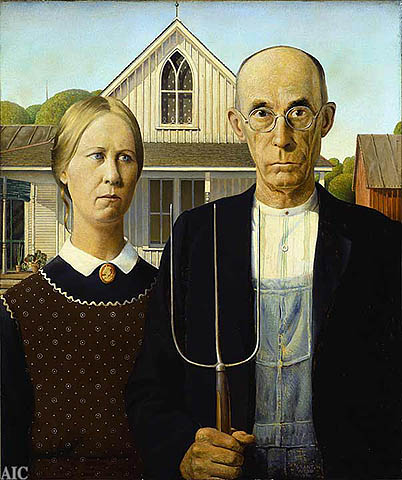
My grandfather was an Iowa farmer who lived on a farm almost exactly like the one in Grant Wood's famous painting and wore Levi bib overalls just like the ones in the picture and pitchforked the same stuff that the farmer in the picture presumably pitchforked with his pitchfork and...
Iowa is deep in my subconscious, I went out there hundreds of times when I was a boy to visit my grandmother who had sold the family farm and moved into Burlington
when my granddad died a couple of years before I was born. They're both buried out there and so is my dad... and so are all of my paternal relatives going back to before Iowa was a state. Great, great uncles and grandfathers of mine served in the Iowa regiments during the Civil War.

My father used to take me out to visit the farm, which was owned by then by the son of a family friend and we used to take the farm tractor and cruise around the fields while my dad told me stories about their life on the farm. The cold (which I have experienced) of the winters without central heating (which I haven't) and the steam heat of the summers near the big muddy. What it's like to plow with a blind Percheron named Jimmy and to clean the shit out from under forty cows at five o'clock on a minus ten morning, before walking through snow drifts to a little red school house.

The last time we went out there, the farm had been sold to an agribusiness and my dad could only locate the place where he was born with a compass taking his bearings from the CB&Q tracks which bordered the property. Nothing was left, not a tree, not a stone, nothing. This is the sort of thing that Europeans only experience because of war and even then they lovingly reconstruct the ruins, but I think most Americans over the age of fifty have a story like this... I've never been back... but I'd like to before I die.

I can live a million years in Europe, learn languages, work on the economy etc, marry a German girl (which is very traditionally middle western thing to do, come to think of it) and still be American down to the ground because of those Iowa roots (ruts). It is a place that leaves fingerprints that just never wash (warsh) off.

It makes me happy that every four years all the men and women who would like to be president have to traipse around Iowa's endless plains and talk to its citizens one by one and drag all the cameramen and journalists cursing the cold behind them. I'm proud that the ground that holds the bones of so much of my DNA is chosen to influence so mightily the history of the world. DS

Monday, December 31, 2007

Pakistan, 2008: the beckoning abyss

David Seaton's News Links
In common speech, "nightmarish" often means to clearly see what is tragic and dreaded coming and not be able to do anything stop it or to even soften its effects. In nightmares the dreamer sees the unnameable approach, rustling and twittering in the dark of bedroom night and tries to escape, dragging impossibly leaden feet. The relentless pull of gravity toward the object of dread is the stuff of nightmares.

As we enter the inauspicious year of 2008 the situation in Pakistan could be fairly called "nightmarish". We are being daily drawn deeper into a cauldron of molten misery and an abattoir of hemorrhaging violence: a civil war in a country where there are atom bombs and where the men who broke the skyline of New York live and work.

Benazir Bhutto's death, in itself, is not in any way the end of the world. Corrupt and intriguing, she was no Joan of Arc... or the real solution to anything. What is significant about her assassination is the will to chaos that it manifests and the casual ease with which it was carried out. That will to chaos and its clockwork precision of execution is certainly not going to stop at eliminating one politician. In the butchering of Benazir Bhutto we begin to see the tragic and futile waste of lives, political capital and military power of invading and occupying Iraq. Now when they might be needed desperately, that capital, those lives, that power and the will to use them may no longer be at hand.

Because at some point a decision is going to have to be taken... Pakistan with its atomic bombs, home away from home for Osama bin Laden, cannot be allowed to turn into a "failed state"... I use the passive tense "cannot be allowed", but somebody is finally going to have to bell the cat and that cannot be done in the passive tense. If the situation continues to deteriorate, and who imagines it won't, "surgical strikes" and "special forces" are not going to be enough, it would require a multinational force of hundreds of thousands of men to take, occupy and literally smother anarchy and rebuild a collapsed state of many millions of citizens. This would surely require a return to universal military service in both the USA and NATO in order to pull off. At this point I feel I am writing political fiction. After Iraq an effort of such magnitude is unthinkable.

As I write these words, I can feel how even the language necessary to describe the action which may finally be inevitable, may have become impossible to use through the neocon-speak travesty of Iraq. All the sophistries and bad faith used to needlessly invade Iraq and to unjustifiably try to start a war with Iran have emptied the credibility from American speech so that every statement coming from Washington rings with the sinister cynicism of "arbeit macht frei". If someday 9-11 becomes little more than a curious footnote to much greater tragedies, the men and women who gutted the language and credibility of power will be responsible for every drop of blood shed. DS

Al-Qaeda aims at Pakistan's heart - Asia Times
Abstract: Following the killing of Bhutto - considered by her al-Qaeda killers to be an "American asset" - al-Qaeda can be expected to launch more suicide attackers on those considered a part of the United States plan to establish a broad coalition government comprising secular and liberal elements that would change the political and social dynamics of the country and the region. At stake is the very soul of the country and how it should be governed. On the one side are US-backed President Pervez Musharraf and political parties such as Bhutto's Pakistan People's Party (now headed by her 19-year-old son Bilawal) and Nawaz Sharif's Pakistan Muslim League. Against them are al-Qaeda ideologues such as Egyptian scholar Sheikh Essa, who are determined to stamp their vision on the country and its neighbor, Afghanistan. Prior to 2003, the entire al-Qaeda camp in the North Waziristan and South Waziristan tribal areas of Pakistan was convinced that its battle should be fought in Afghanistan against the foreign troops there, and not in Pakistan against its Muslim army. That stance was changed by Sheikh Essa, who had taken up residence in the town of Mir Ali in North Waziristan, where his sermons raised armies of takfiris (those who consider all non-practicing Muslims to be infidels). He was convinced that unless Pakistan became the Taliban's (and al-Qaeda's) strategic depth, the war in Afghanistan could not be won. In a matter of a few years, his ideology has taken hold and all perceived American allies in Pakistan have become prime targets. Local adherents of the takfiri ideology, like Sadiq Noor and Abdul Khaliq, have grown strong and spread the word in North Waziristan. Former members of jihadi outfits such as Jaish-i-Mohammed, Laskhar-i-Toiba and Lashkar-i-Jhangvi have gathered in North Waziristan and declared Sheikh Essa their ideologue. This is the beginning of the new world of takfiriat, reborn in North Waziristan many decades after having first emerged in Egypt in the late 1960s. On the advice of Sheikh Essa, militants have tried several times to assassinate Musharraf, launched attacks on the Pakistani military, and then declared Bhutto a target. This nest of takfiris and their intrigues was on the radar of the US Central Intelligence Agency (CIA) and the day after Bhutto's killing Sheikh Essa was targeted by CIA Predator drones in his home in North Waziristan. According to Asia Times Online contacts, he survived, but was seriously wounded. Sheikh Essa had only recently recovered from a stroke which had left him bedridden. READ IT ALL

Friday, December 28, 2007

Time to stick it to the Gipper

"The surge from nowhere of Mike Huckabee(...) threatens to split and even destroy the Republican coalition, by dividing social conservatives from economic conservatives."
Clive Crook -FT

"The strategic failure of a whole generation of economists, bankers, and policy-makers has been so enormous that it may now take a strong draught of socialism to save the Western democracies."
Ambrose Evans-Pritchard - Telegraph
David Seaton's News Links
I have been writing a lot about Mike Huckabee lately, not because I'm endorsing him but because I find his sudden appearance, his explosion, so significant.

It seems to me that he has discovered and is exploiting for all it's worth, what is in effect a "contradiction" within the Republican, conservative coalition that Reagan built. He is speaking to the working poor of America but without the nauseating, implicit racism of Reagan's state's rights, anti-welfare, rhetoric.

I don't believe that Huckabee is really a serious populist. He isn't because he wishes to abolish income tax and substitute it with a sales tax. Progressive income tax: taking wealth from the wealthy and redistributing it to the poor, is the heart and soul of social justice and sales taxes favor the wealthy and penalize the poor. Everything begins there. So to advocate eliminating income tax while bombastically attacking the "The Wall Street to Washington axis" is either cynical or weird.

I think it's cynical, and I prefer it that way. If he is cynical it is because he is shrewdly exploiting a lifetime of knowledge of his audience (flock?) and their fears and resentments and this is knowledge that progressives could profit from acquiring for themselves.

What Huckabee is for sure doing is taking control of the social conservative wing of the Republican Party. And even if he isn't the candidate, without his enthusiastic support, no Republican anywhere will win much of anything in November of 2008.

It is really difficult to talk about class conflict in American English because all the words like, "class struggle", "contradiction" etc are taboo or sound foreign to American ears. This is as if a doctor would have to use awkward euphemisms when making a diagnosis. Imagine a
gynecologist writing, "the patient reports experiencing severe discomfort whenever a dime is inserted in her pay phone." Communication would suffer. The march of science would be arrested. Probably the most significant thing that will happen in the coming months in America will be the rebirth of progressive politics and the language of progressive politics among the working poor.

Any real change has to come from people who feel oppressed and victimized. Mike Huckabee is probably nothing but a red herring, but we should encourage the "red*" and discard the "herring".
If the Democrats cannot exploit the goldmine that Huckabee has opened then others will come along who will. DS
*Notice how the language of American politics has been deliberately deformed. In every other language in the world including British English, "red" means "left" and "blue" means "conservative". In the US they mean exactly the opposite. DS

Clive Crook: America in 2008: Populism calls the shots - Financial Times
Abstract: If the elections give Democrats the presidency and increased majorities in both houses, as seems likely, the US is going to see one of the most radical alterations in its political outlook for decades. As things stand right now, the politics is all good for the Democrats and all bad for the Republicans. The time-series of national opinion-poll ratings for the Republican presidential candidates looks like the read-out of a patient having a stroke. The lines jerk up and down, as party supporters search desperately, and so far in vain, for a candidate they like. The surge from nowhere of Mike Huckabee – to join a three-way tie with Rudolph Giuliani and Mitt Romney – is partly a sign of this desperation. It threatens to split and even destroy the Republican coalition, by dividing social conservatives from economic conservatives. Mainly, though, it underlines something even more significant than that: the growing appeal of economic populism among supporters of both parties. Mr Huckabee is an evangelical – his faith leads him to reject the theory of evolution and to favour constitutional amendments to ban abortion and gay marriage – but he is an economic populist as well. On trade, on the tyrannical power of Wall Street and sometimes even on public spending, he sounds more like John Edwards than Mr Romney. Trade must be “fair” not free. There must be an end to “shipping jobs overseas”. He rails against outlandish CEO pay. He is not averse to more regulation, or to spending (financed with higher taxes) on many social programmes. Immigration complicates the picture: as governor of Arkansas, his treatment of illegal immigrants was too soft for many Republicans. But he is making up for it now, promising to fence the border and deport (and bar from re-entry), immigrants who fail to register within 120 days. “The Wall Street to Washington axis, this corridor of power, is absolutely, frantically against me,” he boasted this week. To be sure, for many Republicans, his main attraction is his religious conviction; he is also a likeable, funny, easy-going man and good on television. Nonetheless, the economic populism is all upfront and has plainly struck a chord.(...) A recent poll by the Wall Street Journal and NBC found that 58 per cent of Americans think that globalisation has been bad for the US and that only 28 per cent believe that it has been good. Ten years ago the split was more even: 48 per cent thought that globalisation was good and 42 per cent that it was bad. The biggest surprise is that supporters of the two parties are no longer far apart on the question. Globalisation has been bad for the US according to 55 per cent of Republicans and 63 per cent of Democrats.(...) the real question is what happens in 2009, when (let us suppose) the main obstacles to a populist turn in policy have been removed. How far left, in economic policy, might America then veer? The answer is a long way. As a rule, the stridency expressed in the primaries fades once the nominees are chosen and the general election approaches. Debate gets tugged back to the centre as candidates try harder to appeal to independents. That cyclical correction will happen again next year, but it will be milder than usual because populist economics is selling so well across the board. It is striking, too, that the growth of anti-trade and anti-corporate sentiment has happened up to now in a relatively benign economic environment. Stagnation in middle-class living standards, erosion of manufacturing employment, financial stress, alarm over the cost of health insurance and a college education – all these concerns came to the fore with interest rates, inflation and unemployment low, with the stock market strong, and with aggregate output (until very recently) growing at a reasonable pace. Add an election-year slowdown, already begun or even an outright recession to this mix. Add rising unemployment. Add an accelerating fall in house prices and a gathering wave (counter-measures notwithstanding) of mortgage foreclosures. If populism had material to work with in 2007, just wait for 2008. READ IT ALL

Thursday, December 27, 2007

Blown away... a tribute


David Seaton's News Links
There are very few beautiful people in politics... Sarkozy and Bush are about par for the course... Benazir Bhutto was movie star beautiful... till the day she died.

People I have known, who knew her personally, have told me that she irradiated energy and intelligence... Beautiful, intelligent and energetic people are in short supply.

And she was bullfighter brave, as tough as a boot, as mean as a snake and, by most reliable reports, as crooked as a dog's hind leg. Oh well, like Joe E. Brown once said to Tony Curtis, "nobody's perfect".

She was a "dead woman walking" from the day she went back home. As far as I can see she was sent back to Pakistan and a sure death by Condoleezza Rice and George W. Bush, simply in order to try to save something of their post White House speaking careers.

Certainly as intelligent, energetic, brave and mean as she was she had no chance of ever bringing Pakistan under control. Maybe even the Pakistani Army is losing it. Tragedy is when you know something terrible is going to happen and can do nothing to stop it. Benazir Bhutto and Pakistan are tragic, perhaps America is too.

When the United States imported Wahhabi Islam into South Asia from Saudi Arabia, they sealed the fate of that region... and perhaps the fate of some American city
someday, God forbid. DS

Conspiracy theories abound over Benazir Bhutto slaying - Haaretz
Abstract: The most astounding aspect of Thursday's events is the negligence displayed by Bhutto's security detail. According to reports, the assassin managed to approach Bhutto and position himself within a short distance of her, before proceeding to shoot her and detonate the explosives with which he was strapped. Not only did the assassin want to cause maximum casualties, but he also hoped that authorities would later be unable to identify him and thus ascertain which organization he was working for. What makes the security failure all the more startling is the fact that it comes just weeks after the first assassination attempt following Bhutto's return to Pakistan from a lengthy political exile. In the attempt, suicide bombers killed 150 people, although Bhutto escaped unharmed. Under these circumstances, it was chiefly incumbent on her security guards to do all in their power to prevent direct access to her, even during the course of an election campaign in which a candidate seeks to come into contact with the public. One can make the claim - and some already have - that foreign agents of countries in conflict with Pakistan (re: India) orchestrated the assassination so as to create chaos and to create an image of a country that is unstable and unreliable. READ IT ALL

Monday, December 24, 2007

The soft Republican underbelly: caught between Rand and the Rapture


"I swear by my life and my love of it that I will never live for the sake of another man, nor ask another man to live for mine."
Ayn Rand, Atlas Shrugged


"Until and unless you discover that money is the root of all good, you ask for your own destruction. When money ceases to become the means by which men deal with one another, then men become the tools of other men. Blood, whips and guns--or dollars. Take your choice--there is no other."

Ayn Rand, Atlas Shrugged


"For I was hungry and you gave me food, I was thirsty and you gave me drink, I was a Stranger and you Welcomed me, I was naked and you clothed me, I was sick and you visited me, I was in prison and you came to me.' "Truly, I say to you, as you did it to one of the least of these, my brethren, you did it to me.
Jesus Christ - Matthew 25


"No good tree bears bad fruit, nor does a bad tree bear good fruit. Each tree is recognized by its own fruit. People do not pick figs from thornbushes, or grapes from briers. The good man brings good things out of the good stored up in his heart, and the evil man brings evil things out of the evil stored up in his heart. For out of the overflow of his heart his mouth speaks."

Jesus Christ - Luke 6:43 - 45
David Seaton's News Links
There is a gaping fault line within the Republican Party that few seem to have noticed and fewer to exploit. It is the abyss that runs between those who follow the teachings of Ayn Rand and the woollier followers of Jesus Christ. As the quotes above show, no two doctrines could be more incompatible. Just by reading these snippets it is evident that the gap between the two world views is greater than any other imaginable, certainly greater than any gap that ever existed between Christianity and socialism.

Those brutalized by Reaganism and the pious platitudes of Bush may think that evangelical protestantism is irremediably wedded to Neanderthalite capitalism, but they forget, if they ever knew, that the leftist traditions of our British cousins have their firmest roots in the Nonconformist chapels of England and Wales and in the Presbyterian kirks of Scotland. The history of the British Labour Party is filled with Bible beating Baptists and Methodists and the Lutheran influence on Scandinavian social democracy is clear. Certainly the answer to the question, "am I my brother's keeper" is affirmative in both social democracy and Christianity.

Examples of Randism?
With Wikipedia at our fingertips, I wont take up space and bandwidth expounding on the doctrines of Ayn Rand, suffice to say that she was the greatest single influence on former Fed Chairman Alan Greenspan, the overflow of whose heart and the fruits of whose tree -- more like the flowering orchard he planted -- we are only now beginning to taste in the fullness of their season.

The closest the GOP have ever come to the synthesis of these extremes is in
the misbegotten, smirking, strut, adorned with homely pieties, of the improbable George W. Bush. It is unlikely that any successor, no matter how blighted his spirit and darkened his understanding, could long maintain such superlative cognitive dissonance or bridge that aching gap again anytime soon.

Over the last few days I have been writing frequently about Mike Huckabee and the reason is that his campaign and the reaction to it by the Republican leadership is illuminating this gap. For me it is the most interesting development, coming at a moment of military defeat and economic crisis, that I can remember.

It is clear that a path to victory is opening for progressive politics to take, but it is anything but clear that progressives are inclined to take it. I would tell them in the words of the the best loved king of France, the Protestant King Henry III of Navarre who, when he was offered the crown of France quickly became the Catholic, Henry IV or "Henry the Great", said, Paris vaut bien une messe ("Paris is well worth a Mass"). DS